Skip to content

A Theory of the Hero: Agency, Voice, and Sincerity (part 1 of 3)


For a while now I’ve been chewing on the concept of heroes/heroines, which at first glance looks simple. Say the word “hero” and everyone knows what we mean: we’re (stereotypically) talking about square-jawed men and kick-ass women who stab bad guys in the eyes with icicles, rescue intergalactic princesses, and Do The Right Thing. Heroes are “The Good Guys” that we root for in a story. But fiction – as life – tends to be more complex than that. For every Frodo Baggins we have an Elric of Melniboné. For every Peter Pevensie we have Steerpike. What then constitutes a hero? What makes one character or one story heroic and another not?

NOTE: This is the first in a three-part series of posts. This post is focused on what makes a given character heroic. On Saturday, I’ll post the next chapter, focusing on story archetypes for heroic characters, and the final post on Tuesday will focus on the difference between tragic and anti-tragic heroes.

Why do we need a Theory of the Hero?

If we want some sort of all-encompassing theory of the hero, we need to go beyond Campbell’s monomyth and Propp’s functional formalism. Regardless of how much I love both, a complete theory should be able to encompass both the classically-modeled Frodo Baggins and the monstrous Humbert Humbert.

In reading Ivan Morris’ excellent The Nobility of Failure: Tragic Heroes in the History of Japan over the weekend, something in my brain clicked. I think I might have figured out a secret ingredient that goes into the make-up of any hero, regardless of where they fall on a moral spectrum. Per Morris, heroes are defined at their core by the Japanese concept of makoto, which Morris translates as “sincerity” with connotations of self-contained philosophical sufficiency. In other words, a hero is a hero – regardless of their moral or immoral actions – if they act relative to a consistent moral code.

Hero vs Protagonist: Six of One, Half-Dozen of the Other

If you will forgive a brief moment of semantic pedantry, I think it is important to explain that I have never particularly liked the term “protagonist”. Since originating in Greek drama, I think the term has become incredibly muddled and imprecise. Etymologically, it means “chief actor” but a literal definition is too limiting to be functional. There are too many sweeping, epic novels like Hugo’s Les Miserables where identifying a particular chief actor becomes difficult (if not impossible).

Terms like protagonist and antagonist really describe the relationships between characters. The protagonist is opposed by the antagonist. This tells us nothing whatsoever about the characters in question, their value systems, moral codes, or courage. However, describing characters as either heroic or non-heroic does offer insights into their natures. Generally, for good drama in storytelling a hero needs to have an opposition: but a good hero can just as easily be opposed (antagonized) by another hero (the relationship between Hugo’s Jean Val Jean and Javert is a prime example of this type of opposition).

The Hero’s Function: Building Engagement through Agency and Voice

So what does a hero actually do in fiction? Besides saving the day, that is? As I see it, the hero/heroine is there to engage us on an emotional level. The hero draws us in and makes us care, and does so using the agency of their choices and the author’s narrative voice (which may be different from the character‘s voice).

The Hero’s Choices Make Us Respond

Can you imagine a hero with no agency? Would a character who just let stuff happen to them and passively reacted be at all engaging? Probably not. The hero/heroine’s choices determine how they change over the course of the story, giving us insight into their natures. Some heroes (Ayn Rand, I’m looking at you) are little more than two-dimensional symbols, a personification of some philosophical outlook with which we can either agree or disagree. Others are more complex, rounded (in Forster’s sense) characters for whom the nature of their choices actually matters. In each case, the hero’s choices cause some sort of a reaction in us. We may to some extent agree, sympathize, or understand the character’s dilemma and the outcome. Or we may view that choice as antithetical: we may disagree with it so violently that the strength of our dispute resonates just as strongly. Whether the hero strums our heartstrings up or down, the note still sounds. What matters is that the hero’s choices have an impact within the story, on the hero, and on us as readers.

It is this kind of approach that produces some of the most memorable heroes in fiction. Tolkien’s The Lord of the Rings is replete with heroes who have to make choices: first, who will take the burden of the Ring? Then, who will escort the Ring to Mount Doom? Will Frodo actually destroy the ring? Will Aragorn take the throne of Gondor?

These are difficult choices that Tolkien’s heroes must make. Every member of Tolkien’s Fellowship is a hero, and every one of these choices resonates with us to a greater or a lesser extent. For some (Samwise Gamgee in particular) their choices are shown in a generally positive light: they are the classic “good guys” who make the difficult choices that the author (and presumably most readers) view as morally right. Other heroes – in particular Boromir, Gollum, and even Frodo himself – all make at least one morally reprehensible choice, transgressing against their value systems. But it is the uncertainty of their choices and their struggle to make them – for better or worse – that make us engage with the book. Whose breath didn’t catch when Frodo’s simple nobility fails him at the last second? Who doesn’t feel a pang of Bilbo’s pity as the villainous Gollum’s ugly history is slowly exposed? And who isn’t relieved when Aragon finally accepts his responsibility for Gondor?

But just like Gollum, not all heroes need to be good guys. Remember that old saw about every villain being the hero of their own story? Consider Milton’s Paradise Lost, Nabokov’s Lolita or Jesse Bullington’s more-recent The Sad Tale of the Brothers Grossbart. These books’ heroes are morally reprehensible villains.

Milton’s Satan is…well, Satan. He’s The Devil. The embodiment of all evil, at least according to the sensibilities of Milton and his contemporaries. Nabokov’s Humbert Humbert is a pedophile, a monster as vile as could possibly be imagined. Yet he still has agency, and his choices – reprehensible as they may be – never fail to provoke a reaction on our parts. Bullington’s grave-robbing Grossbarts, though less compelling than the other two mentioned, generally pull off the same trick. And all three of these monstrous heroes do so using the second tool of hero-construction: the author’s narrative voice.

Narrative Voice as the Sneaky Tool of Understanding

What could make us care about such monsters? We may disagree, sometimes vehemently, with their choices. So why do we continue to follow the story? We care because the author’s narrative voice is beguilingly engaging. Milton’s primary (initial) character – Satan – needs no introduction. We know that he is a monster: The Devil. But Milton’s narrative style makes Satan’s charisma a palpable force, not unlike the serpent’s beguiling silver tongue in the Garden of Eden.

Both Nabokov and Bullington utilize framing devices that unequivocally establish that the heroes in question are evil. But we get drawn into their heads, drawn into their twisted worldviews, by the authors’ compelling rhetorical structure. By the time the monsters perpetrate their evil deeds, it is too late for us. However much their choices may disgust us, at some level the narrator’s slippery words have given us a window into their souls. Through that window, we can catch a glimmer of the monster/hero’s intrinsic nature.

The Hero’s Nature, Moving Targets, and Sincerity

And here we come back to the concept of makoto: if the hero (whether morally laudable or not) fails to evidence sincerity, if they are not true to their underlying nature, then no amount of agency or rhetorical trickery will resonate. At the heart of a hero’s underlying nature lies his moral value system. Whether we agree with this system or not, or to what degree their value system aligns with our culturally-acceptable moral codes, is unimportant. What matters is that the hero’s value system remains immutable throughout the story.

If the hero’s value system changes within a story, then suddenly the hero’s choices lose their meaning. Whether they articulate their system explicitly or not, their values represent an aspirational target for their behavior. Han Solo, Humbert Humbert, or John McClain always know what the “right” action is, according to their own moral codes. And while they may not always live up to their moral codes, those codes do not change. If they did, if the hero’s moral target moves, if their definition of “right” and “wrong” shifts, then suddenly all of their prior choices become meaningless within the confines of the story. It would be like retconning Uncle Ben out of Spider-Man’s origin story.

Neither Humbert Humbert’s or Frodo Baggins’ values change throughout their respective stories. At no point do their concepts of “right” and “wrong” shift. Instead, their actions either eventually align with those (stated or implied) values or transgress against them. The hero’s choices must be mobile – not the yardstick by which they are measured. Whether we agree with them or not, heroic characters maintain a firm and unchanging set of values: they must be “sincere” in their worldview. It is the choices they make relative to that philosophy that affects the drama and resonance of a story, and which makes them heroic.

NEXT: Come back on Saturday for the second installment on plot structures and story archetypes for heroic characters!

REVIEW: Blackdog by K. V. Johansen


Title: Blackdog
Author: K.V. Johansen
Pub Date: September 6th, 2011
Chris’ Rating (5 possible): 1 point 1 point 1 point
An Attempt at Categorization If You Like… / You Might Like…
An interesting epic fantasy that narrowly focuses on characters while playing with epic fantasy tropes.

It is tough to write an epic fantasy that adheres to the sub-genre’s conventions while still offering something new and innovative. Different authors use different techniques: Sanderson’s Mistborn subverts the idea that the hero always wins, Erikson’s Malazan Book of the Fallen series expands the scope of epic fantasy (see my earlier review), and N.K. Jemisin’s Inheritance trilogy undermines the trope of the perfect hero (see my earlier review). In her US adult debut Blackdog, K.V. Johansen builds a sense of narrow-focused hyper-locality embedded within a larger epic structure. By going small, Johansen is able to make her perspective characters, their struggles with madness and redemption, and the world they populate particularly compelling.

Blackdog opens from the perspective of Otakas, the protector of a remote mountain goddess named Attalissa. Otokas is an aging warrior, possessed by the mad spirit of the Blackdog. The Blackdog is crazy – utterly and implacably obsessed with protecting its goddess. It has gone centuries possessing one warrior after another, willing or not. From the opening pages we get the sense that Otokas and his predecessors walk a thin line between sanity and madness, constantly struggling against the Blackdog’s violent obsession.

Right away, we are given an interesting, compelling character whose perspective establishes the basics of Johansen’s world. In this world, gods are fundamentally tied to a particular place. Attalissa is not an all-powerful (or even moderately-powerful) goddess. While she may be the most powerful deity in her neighborhood, that neighborhood is still a backwater. Far away, there are empires and grand cities…but neither Otokas nor his goddess are interested in those places. They have one small corner of Johansen’s world, and the rest can go hang. Otokas’ mild irreverence and his dry, cynical sense of humor are put to good effect establishing this attitude. It immediately tells us that Blackdog is concerned with local matters, not the fate of the world. But while Attalissa and Otokas may be uninterested in the wider world, within the first chapter that world decides that it is interested in them. A warlord appears (literally) with an army on their doorstep, and Attalissa – an immortal goddess incarnated as a mortal child – and Otokas must flee to keep the goddess from being devoured. Otokas is able to get Attalissa out of her temple, but he is badly wounded. When he dies, the spirit of the Blackdog possesses Holla-Sayan, a foreign warrior traveling through Attalissa’s domain.

That first chapter is quite an action-packed opener, as within the first couple of pages we meet a compelling protagonist (Otokas), and right away find ourselves under siege. Despite the hard-hitting action, Johansen does an excellent job of keeping her world-building accessible, sliding it in between the arrows and sword fights. By adhering closely to her perspective character’s perception of the world, she gradually lays her world-building blocks. She manages this so subtly that the devices she utilizes are almost transparent: I had to look for them to find them hidden in the text. My first time through the book, I just got caught up in the adventure.

By the time we meet Holla-Sayan (and having read the back cover copy), I pretty much thought I knew what to expect from the plot: Holla-Sayan would be the hero, keep the goddess safe, wait for her to mature into her full power, try and organize some sort of resistance, come back and kick the warlord’s butt. And while in the loosest possible sense the book does follow this framework, the way in which Johansen executes it is particularly interesting.

This is not a standard “savior returns” fantasy: our “hero” is concerned first with keeping his own sanity, and only secondly with a warlord who did him personally little harm. Instead of focusing on the warrior/mentor/hero dynamic, Johansen builds a believable assemblage of secondary perspective characters who all act under their own agency. Since it will take years for the goddess to mature into her powers, she will need some sort of nascent resistance organization in place. But with Holla-Sayan too busy struggling with the Blackdog, this task is told from the perspective of one of Attalissa’s warrior priestesses. Holla-Sayan and the goddess actually spend most of the book completely ignorant of the goddesses’ supporters back home.

Each of the book’s six or seven perspective characters – including the warlord Tamghat and the goddess Attalissa – has a dark history that they are (in one way or another) trying to get through. Holla-Sayan is the only relative innocent among the lot of them, though his innocence is pointedly juxtaposed against the Blackdog’s animal savagery. While dealing with the superficial objective of defeating Tamghat or capturing Attalissa, each of the book’s key characters has to come to terms with themselves and their past choices. Johansen handles this emotionally fraught territory skillfully, offering a distinct flavor and different resolution to each of their stories. Where the resolutions do not satisfy, it is solely because some true conclusions are by their very natures unsatisfying: that is their point.

If there were a cheap “How to Write Epic Fantasy” book out there (and I’m sure there is somewhere) I suspect it would have at least one chapter on the value of epigraphs for world-building. Epic fantasy titles routinely get mocked for starting each chapter with a fragment of epic poetry, or a legend, or a piece of a history book, etc. from the book’s universe. As a reader, I’m always a little leery of epigraphs. Sometimes, I find them useful and insightful, but mostly I find they just take up space and add little to either the world-building or the story. I admit, after reading the first or second epigraph in a book, I’ll usually just skip the rest until after I’ve read through the text at least once. K.V. Johansen, however, eschewed epigraphs in Blackdog. Instead, she concluded certain chapters (particularly the early chapters) with a brief paragraph from an old-fashioned storyteller’s tale.

At first glance, one might be tempted to ask who cares? But by placing her epigraphs at the end of her chapters, Johansen is able to more effectively manage her pacing and the reader’s insight into the plot. The early chapters of Blackdog were particularly fast-paced and action-packed, and the epigraph at the end of the chapter gave much needed breathing room, an opportunity to pause and absorb the preceding events before diving into the next frenetic chapter.

Furthermore, the epigraphs adequately serve the function Diana Wynne-Jones lampooned with her “Legends” entry in the The Tough Guide to Fantasyland: they take us out of the perspective character’s head, and provide the reader with a brief glimpse into omniscient perspective. By carefully controlling what information is disclosed, we can put a number of facts together before our perspective characters do, which makes it that much more satisfying when our heroes catch up to us and figure it out. It’s a tried-and-true device frequently found in epic fantasy, and executing it deftly requires a careful balancing act: too much information, and the book yields no surprises. Too little, and the epigraphs offer no value. Johansen’s epigraphs – which only appear at the start of the book – manage this tightrope very effectively.

Johansen also uses creative dialogue markers to support her storytelling. Many of the perspective characters wrestle with madness and possession, which means that they have a lot of conversations with themselves. For those characters who are deeper in the throes of madness, or when the lines between their personalities grow more blurry, internal dialogue shifts from conventional form to more of a European fashion: Roman (straight, non-italicized) text, preceded by em-dashes, and lacking any “he said / she said” markers. This is particularly effective in the latter half of the book, where it amplifies the blurred and swirling wash of personalities within some characters’ heads. The overall effect is one that allows the reader to enjoy the whirlwind of madness and identity while still keeping characters and their diverging personalities straight.

Of the book’s perspective characters, only Attalissa did not appeal to me: this is the book’s primary weakness, and the reason why I’m giving it three stars. The goddess is one of the book’s most central characters, yet she has the least agency of them all. At the beginning of the book, when she is a little child, this is understandable and acceptable. But as she grows up, she continues to be passive and let events happen to her rather than take charge of them. This is understandable, given the character’s psychological make-up and history, yet nonetheless, it noticeably slows the pacing significantly in the chapters told from her perspective. It is not until the book’s climax that she becomes an active force, at which point her chapters accelerate to match the rest of the book.

Barring this one weakness, I quite enjoyed Blackdog. I felt that all of the characters were competently executed, even if Attalissa’s passivity throughout the book’s middle third bothered me. The world-building and the textual devices employed particularly stood out as interesting and of noticeable quality in the story. I would recommend Blackdog to people who have been exposed to epic fantasy before: this is not as accessible as (for example) David & Leigh Eddings’ work for new epic fantasy readers, but it is much more accessible than a lot of the hardcore epic fantasy out there. I believe fans of Brandon Sanderson or Brent Weeks in particular will enjoy this book.

The Evolution of Middle-Grade Fantasy and Television


NOTE: I drafted this on my computer while I had power at a local café, but I’m posting it from home on my cell phone. As a result, some of my formatting may have gotten messed up. If so, I apologize: I’ll fix it as soon as I have power and Internet at home.

When I was a kid, I watched a lot of cartoons. Thundercats, G.I. Joe, Transformers, Inspector Gadget…the list goes on. Thanks to Netflix, I’ve started re-watching many of these shows, but I find that it is hard to re-capture my childhood appreciation. Most did not age well (or maybe I haven’t), but it is somewhat saddening to see stories I loved as a kid come off as puerile now. Interestingly, the books I read as a child do not suffer from the same problem. Why are the shows I watched at eight or nine unwatchable now, but the books I read at the same age still enjoyable? Have I just become some sort of egg-headed curmudgeon (obviously I have, but is that the cause?), or is there something different about these stories that affects their longevity?

Since Hurricane Irene knocked out our power for the last couple of days, I’ve had nothing to do but think about this while twiddling my thumbs by candlelight. And here’s the conclusion I’ve come to: what sets timeless middle-grade fiction apart from the cartoons from the ’80s and early ’90s is the evolution of character and moral ambiguity.

The Quest Structure and Character Evolution in Middle Grade Fiction

Much of the middle-grade fantasy I read as a child (Lloyd Alexander’s The Chronicles of Prydain, Madeleine L’Engle’s Wrinkle in Time Quintet, or Susan Cooper’s The Dark Is Rising) relied on the standard portal/quest structure. The youthful hero/ine has to leave home, find something, and return.

A screenshot from Avatar: The Last Airbender showing Zuko.

Prince Zuko from Avatar the Last Airbender, via Wikipedia

Their physical quest mirrors an evolution of their characters. As they progress through the various stages of their adventure, the characters are naturally changed by their experiences. Edmund Pevensie, in C.S. Lewis’ The Lion, the Witch and the Wardrobe, starts as a resentful, selfish child. His exposure to the White Witch’s evil changes him, as do his attempts to earn his siblings’ (and Aslan’s) forgiveness. At the end of the book, bratty little Edmund Pevensie ultimately becomes “Edmund the Just.”

In Lloyd Alexander’s The Book of Three, Taran learns that adventure is not the rollicking good time he supposes, and that heroes must make difficult choices.

In Madeleine L’Engle’s A Wrinkle in Time, Meg develops self-confidence and self-value through realizing that although she lacks her siblings’ more obvious gifts, her capacity for love ensures a central place within her family.

While adult readers might deride the portal/quest fantasy structure as trite, its ability to harmonize the characters’ emotional journey with their physical adventure continues to make it resonate. The key to that resonance, particularly for young readers, is how compelling the characters are. If the characters are uninteresting, no kid will ever enjoy the book. If those characters do not change, then young readers will rapidly outgrow the story (if they ever get into it at all).

Character Evolution in Cartoons

This kind of character evolution is distinctly absent from cartoons of the ’80s. At the time, cartoons were often made to sell toys, and by their very nature were more open-ended: the writers had to keep the story going until the show got cancelled. This presents its own storytelling challenges, and as a consequence, each episode tended to be a self-contained story arc, while the series as a whole had only the loosest overall structure. Typically a shows’ latter seasons – when the creators saw their series nearing the end of its viability – would often feature multi-episode or season-spanning plots which the creators hoped would finish a story. Yet despite this “innovation” in storytelling, each episode still needed to be self-contained, and characters never evolved greatly from one episode to the next. The Donatello we meet in the first episode of Teenage Mutant Ninja Turtles is the same Donatello ten seasons later: his experiences over the ten years of show continuity have not introduced any changes into the character’s personality or values.

When we look at more modern cartoons, like Avatar The Last Airbender, we see an entirely different structure at work. First and foremost, the story is no longer open-ended. The show’s creators set out to tell a story in three parts. There was never an intention to keep the show going through ten years of storytelling. Avatar The Last Airbender is similar to much middle-grade fiction in that it retains a quest structure at its macro-level and focuses on an over-arching conflict between our heroes and a “Dark Lord” villain. However, as in all cartoons, each episode remains a self-contained adventure within the confines of the broader story.

I believe that this innovation is enormously significant in terms of televised animated storytelling. Thanks to its structure, Avatar The Last Airbender is able to introduce character arcs that parallel the story’s plot arc. Over the story’s three seasons, we can watch Aang mature and take on his responsibilities as the Avatar, Sokka grow into the capable warrior he dreams of being, and Katara master water-bending and come to terms with her feelings for Aang. Each of the principal characters gradually grows and changes over the course of the show’s three seasons, which ultimately makes the series’ conclusion all the more satisfying.

Villainy in Middle-Grade Fiction and Cartoons

Another key difference lies in how “classic” cartoons portray their villains. The portal/quest fantasy has often been mocked for its stereotypically irredeemable “Dark Lord” (for a hilarious send-up, I strongly recommend Diana Wynne Jones’ The Tough Guide to Fantasyland: The Essential Guide to Fantasy Travel). And both middle-grade novels and cartoons feature this trope.

The Dark Lord’s goals tend to be suitably grandiose: take over the world/universe/whatever. But while the Dark Lord is portrayed as irredeemable and morally abhorrent, our heroes rarely face him until the final battle. Instead, their direct opposition usually comes from the Dark Lord’s lackeys, who are more complex characters serving the Dark Lord for their own (less inscrutable) reasons. Their goals are more localized: gain temporal power, get the respect they think they deserve, etc.

Whether it is Alexander’s Queen Archen, Cooper’s Walker, or Lewis’ Edmund Pevensie, the Dark Lord’s helpers are shown to actively make choices that align themselves with evil. Unlike the Dark Lord, their evil is never a given: they choose it for themselves. But in “classic” cartoons, the Dark Lords’ lackeys are just as irredeemably evil as their master. Whether we are talking about the Thundercats’ Slythe, the Decepticon Starscream, or Cobra’s The Baroness, the front-line villains have no depth; their motivations are rarely explored.

Moral Ambiguity in Today’s Cartoons

Fast forward twenty years, and you find an entirely new generation of cartoons, like Avatar The Last Airbender and the Cartoon Network’s reboot of Thundercats. Today, the irredeemable evil of the villain and the unquenchable goodness of the “good guys” is far more flexible.

Consider the rebooted Thundercats: in the first episode, we learn that the Thundercats have been repressing the dogs and lizardmen for generations. While our hero, Lion-O might oppose this level of repression, “the good guys” are generally depicted as racists. Or consider Avatar The Last Airbender. In the first episode, we learn that the Fire Nation has waged a century-long war of subjugation against the other nations, slaughtering an entire race (the Airbenders) in an unprecedented genocide. Within the first season, though, we learn that both this genocide and the war-torn century are a result of the Avatar (theoretically our hero) running from his responsibilities.

None of the “classic” cartoons from the ’80s would ever have explored a theme as morally ambiguous as Aang’s rejection of responsibility. Instead, each of these shows had to end with a moralistic “lesson” portrayed through the dénoument: remember those “knowing is half the battle” sequences at the end of GI Joe episodes? Such an externally-imposed mandate makes morally ambiguous storytelling difficult, if not impossible.

But middle-grade fiction has always had this type of moral ambiguity. In The Lion, the Witch and the Wardrobe, Edmund Pevensie betrays his siblings to the White Witch in exchange for promises of power and Turkish Delight. More recently, Eoin Colfer’s Artemis Fowl is a thief and kidnapper who performs morally abhorrent acts with (it turns out) noble intentions. Michael Buckley’s Sisters Grimm wrestle with the right-and-wrong of trapping all magical Everafters in a small rural town, and their friend is the Big Bad Wolf – a villain struggling with his past crimes. Susan Cooper’s Walker shows us that the “good guys” might not always do good, and that they too can betray – or seemingly betray – their friends. None of this even touches upon Rowling’s Harry Potter books, with the moral ambiguity of Snape, Dumbledore, and Tom Riddle.

Avatar The Last Airbender probably offers us the most powerful example of how contemporary cartoons can treat villainy: when the series opens, Prince Zuko is the heroes’ primary opposition, and we watch him hunt the Avatar with intense zeal. However, by the end of the first season we understand that Zuko struggles through his relationship with his father (Fire Lord Ozai, the “Dark Lord” of the series) and with his own moral compass, personified by his Uncle Iroh. While Zuko represents the primary threat against the heroes, he is forced him into chasing the Avatar, and though we may not agree with his motives we at least understand them. His portrayal as an almost-sympathetic character makes his evolution that much more satisfying, as over the course of the three seasons we watch him gradually change from being the Dark Lord’s lackey to being one of the story’s principal heroes.

What are the Implications for Children’s Storytelling?

I think Avatar The Last Airbender, with its moral ambiguity and even-handed character arcs makes for innovative children’s storytelling, irrespective of medium. Avatar The Last Airbender’s treatment of Prince Zuko would be the equivalent of Queen Archen or the Horned King switching sides, and I have not seen much middle-grade fantasy take moral ambiguity to such lengths (though Lloyd Alexander’s Westmark trilogy – which may or may not be considered middle-grade – comes very close, and Joseph Delaney tries for it in The Last Apprentice: Revenge of the Witch). The creators of the Thundercats reboot openly discuss wanting to make a darker, more cinematic story than the original cartoon (although Cartoon Network’s Friday at 8:30pm timeslot for the show might suggest they are aiming for an older audience). Personally, I think all of this represents an opportunity for writers of middle-grade and cartoons.

The success of Avatar The Last Airbender proves that the middle-grade audience enjoys complex storytelling, with extended character arcs and moral ambiguity. While some might say that shows like that are “too much for kids,” I could not disagree more: by blending childish adventure with more serious storytelling, they are doing what children’s literature has always done: helping kids develop a vocabulary with which to internalize and articulate a morally complex world.

In a real sense, I think this represents the gradual accrual of wisdom. If – thanks to more morally ambiguous middle-grade fiction or morally-challenging cartoons – kids are able to recognize, understand, and internalize a more complex world, then I think this can only be good. Doesn’t it suggest that kids are growing wiser sooner? And from a more crassly commercial standpoint, it also opens up “children’s” stories for an audience entirely outside of its intended demographic.

Who says grown-ups can’t enjoy good kids’ stories, anyway?

Recommended Blog Posts Works Mentioned
If you enjoyed this blog post, here’s a list of others that are on related subjects which you might find interesting:

Since I talk about a lot of different authors and titles in this post, here’s a list for your enjoyment. I’ve included some titles that don’t get mentioned directly, but which you might find fun/interesting:

Books:

Hurricane Irene


So as some of you may know, I happen to live in New Jersey. Thankfully, not on the shore, but still close enough to Hurricane Irene to get a bit beat up. Two days after the hurricane, we are still without power, phone, and (of course) Internet. I am writing this on a cell phone which has a perilously low battery.

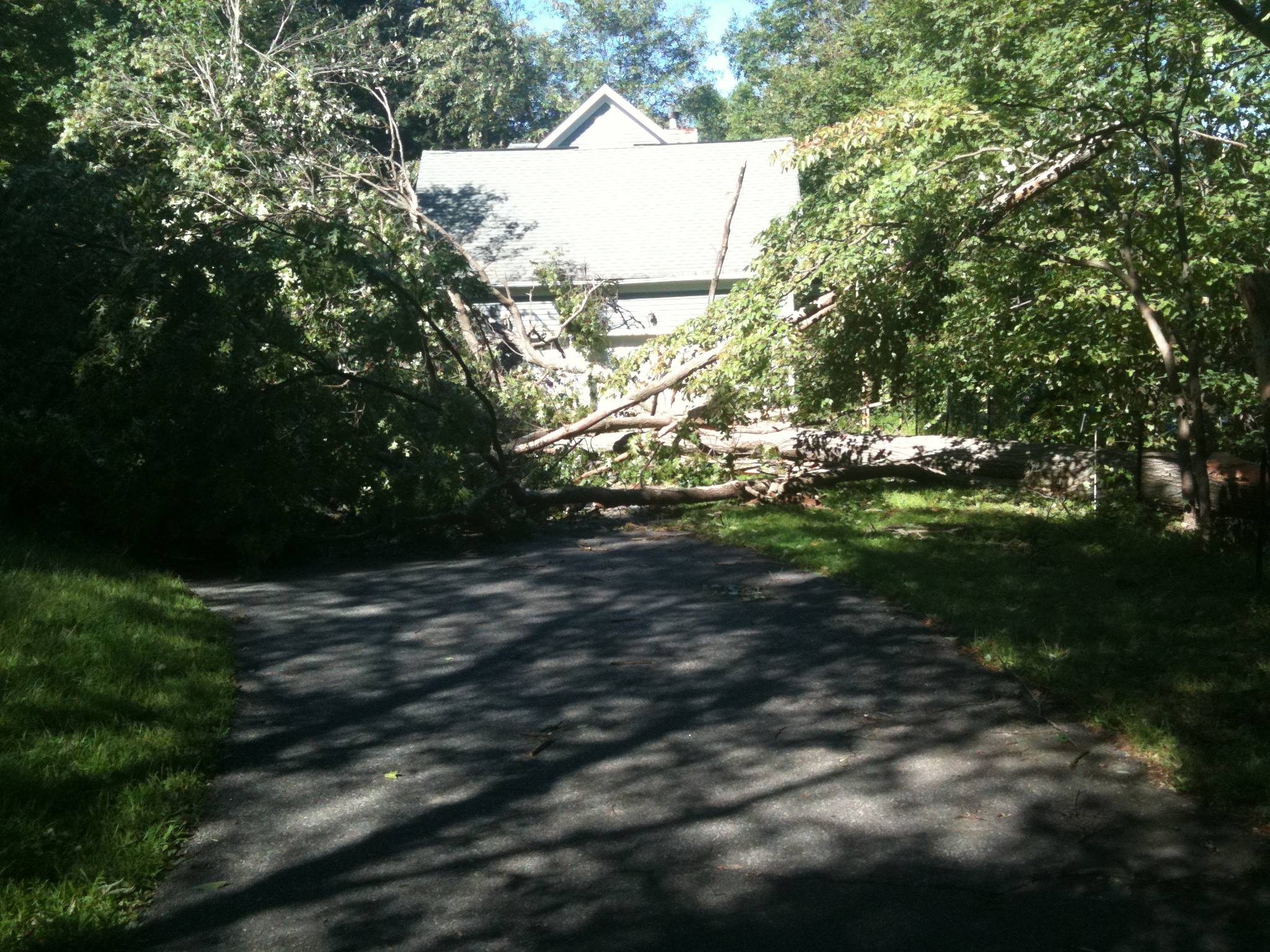
Oh yeah, and a tree almost fell on my house. The key word there is almost. Nobody was hurt, nothing important was damaged, the garage is still standing. But things have been a little hectic for the past couple of days.

Having borrowed a car, I am once again mobile. Of course, most of the streets around my house are flooded (I distinctly recall telling my wife several years ago that “Living on a river will be great!”). Rumor has it that two towns away there is a Starbucks with coffee, wifi, and power. As I haven’t been able to make coffee, I might have enough caffeine-withdrawal rage to fight my way to that mythical plug. If I manage to triumph over the hordes and re-charge, I’ll try and get a real post up later today. Should my quest fail…but it won’t!

In the meantime, there are lots of people all along the Eastern seaboard who got hammered harder than we did. If you want to help, please check out the American Red Cross Hurricane Irene Relief

And for now, here’s a picture of the tree that knocked on our door late Saturday night:

That's My Garage Hiding Behind the Tree

REVIEW: Summer, Fireworks, and My Corpse by Otsuichi


Title: Summer, Fireworks, and My Corpse
Author: Otsuichi
(translated by Nathan Collins)
Pub Date: September 21, 2010
Chris’ Rating (5 possible): 1 point 1 point 1 point 1 point
An Attempt at Categorization If You Like… / You Might Like…
A carefully constructed collection of unsettling horror stories with purposeful use of language.

Maybe it’s because I spent a decade living abroad, or because both my parents are immigrants. But for whatever reason, foreign techniques in storytelling and art have always fascinated me. Now and again, I find myself going on a binge of reading from a particular part of the world, and several months ago I started a Japanese binge – made all the harder knowing nothing about the language, and having only local sushi joints and the little otaku pop-culture I’ve been able to observe as culture references. But in my blind stumbles around Japanese literature, I picked up Summer, Fireworks, and My Corpse written by Otsuichi and translated by Nathan Collins.

This is subtle, literary horror from Haikasoru (an imprint of Viz Media that specializes in bringing Japanese genre titles to the United States). Reading it brought to mind old-school Gothic works by folks like Sheridan le Fanu or Daphne du Maurier, with some of the creepiness of Edgar Allen Poe. What made this three story collection stand out were the prose techniques employed by Otsuichi (or possibly his translator). Using word choice and sentence construction as the subtle thematic bedrock is a rare treat in the horror genre.

The first (titular) story was written when Otsuichi was still in high school, and it shows some of the still-rough techniques that he would hone in his later works. Summer, Fireworks, and My Corpse is told from the perspective of a nine year-old girl’s corpse, and I consider it to be the weakest of the three stories in this book. I cracked open the spine unfamiliar with Otsuichi’s writing or Nathan Collins’ translations, having been stung by particularly poor translations of other Japanese books in the past. As a result, the opening pages made me very concerned. The sentences were simple. Almost each one was a declarative statement. They were stilted. Choppy. The narrator’s observations were superficial and factual: this happened and then that happened and then something else happened. Reading these initial pages, I thought: “Great. Another lousy translation.” But I was wrong.

The unsubtle language that opens the story is purposeful. Otsuichi (and his translator) use simple sentence construction to put us in the head of his nine year-old narrator. As the story progresses, we watch through her eyes as her friend (and murderer) and her friend’s older brother try to hide her corpse. The narrator, in a child’s spare and simple language, tells us the facts of what happened, but the narrator’s understanding is limited by her age. Once she dies, the language grows more complex as her after-death experiences change her perceptions of the world. The transition happens subtly over the course of the story, and Otsuichi and Collins manage to make this transition smooth. If I were not looking for it, I might not have noticed it.

Once I realized that the author was doing this on purpose, I could get past the unsubtle prose and into the story. Despite being satisfied, I remain troubled by how superficially the narrator’s perceptions are presented. There was precious little introspection or abstract thought, and most nine year-olds I’ve met have some capacity for both. While this technique may be a cultural trait of Japanese fiction (Yasunari Kawabata excels at such purposefully superficial presentation), the degree to which it is employed in this story made it difficult for me to engage emotionally with any of the characters. However, the story’s disquieting ending relies on the narrator lacking an adult reader’s understanding of its implications.

The second story in the collection, Yuko is much shorter, much more powerful, and from my perspective, the best story in the book. Taking place in an indeterminate time period (could be present day rural Japan, could be any time in the last couple of hundred years), it follows a young, uneducated housemaid who takes care of a writer and his bedridden wife, Yuko. The housemaid, however, never sees, speaks with, hears, or interacts with Yuko, only with her husband. Scenes are presented from both the housemaid’s perspective (where Yuko never appears) and from the husband’s perspective (where he interacts with Yuko).

Reading this story, the beautiful language matters tremendously: the author and translator use lyrical, literate language and style to pull a fast one on the reader. That is not a bad thing. Throughout the story – almost to its end – the language evokes a conviction in the reader’s mind of one reality. And then with just one word – one word placed in just the right spot – it flips the reader’s genre expectations from horror to mystery. I had to go back to the beginning, and read it all again, before finishing the story with a new set of reading protocols.

That one word is the hinge on which Yuko pivots: before the hinge, the story is horror, generating that delightful sensation of creepy, disquieting terror. After the hinge, the terror is gone, replaced with an intellectual curiosity seeking an explanation: a mystery. When that explanation comes, the terror returns – but it is subtler, deeper, and darker than the Gothic terror inspired before that hinge.

Since reading this story, I’ve been wrestling with this technique. It is excellently executed, and manipulates the reader brilliantly. I had thought I was reading a Gothic horror story, and suddenly I found myself reading a Gothic mystery. Cleverly done. Yet at the same time, the technique stood out as a technique. It was like a slap in the face: there was no way I could have missed it. And I do not know if that is good or bad. Should the impact of word choice and sentence construction be noticeable to the reader as they are reading? Does seeing the mirrors ruin the trick? I loved this story, and the emotional ride it took me on. So I suppose it works. “Good” might be like pornography (and science fiction): I know it when I see it. But as a writing technique, I think it might be extremely risky.

The last and longest story in the book, The Black Fairy Tale, takes far fewer risks. It is a short novel told in three parts: the first is a grizzly, frightening tale about a raven who steals peoples’ eyes as a gifts for a blind girl. This was my favorite part of the story, with beautiful lyrical prose that tells a heart-breaking story of love, devotion, and the light and darkness of memory. The second part is told from the perspective of a teenage girl who loses her left eye, receives a transplant, and now sees her new eye’s memories. The final part is told from the perspective of the raven fairy tale’s author. On a superficial level, the teenage girl and the author’s story are linked: they come into gruesome conflict. Below that superficial level, the stories are unified by the fairy tale itself, with its focus on memory, vision, and detachment.

The emotional terror evoked by the story is its most powerful aspect. The story’s violence is depicted and described, and some of it gets fairly rough, but throughout it is handled tastefully; its horrific nature is in the emotional implication of what it does (or has done) to its victims. The story’s language, and in particular the gradual evolution and progression of imagery throughout the three parallel parts, makes this story a delight to read.

The book’s biggest problem is its organization. The Black Fairy Tale makes up over sixty percent of the book, yet it is the third story. The opening story – Summer, Fireworks, and My Corpse – is the book’s weakest: I almost put it down before realizing that its unsubtle sentence construction was purposeful. I can imagine that many readers unfamiliar with Otsuichi or Collins might have given up without getting to the good part. A better way of organizing the book would have been to start with either Yuko or The Black Fairy Tale.

Regardless, the book is well worth reading. Fans of western horror will enjoy a title that hearkens back to the strong, subtle, emotionally resonant horror of du Maurier, le Fanu, and Poe. I think this is a good intro to Japanese horror and I’m definitely going to be checking out more from Haikasoru.

O Canada! Travels in Canadian Science Fiction, Fantasy, and Horror


As I mentioned last week, I’m off on my honeymoon at the moment. What I don’t think I mentioned is the fact that I’m honeymooning in the United States’ neighbor to the north. When the Professor and I mentioned honeymooning in Canada to most people, their reaction was usually one of considerate bewilderment: why not go someplace with warm, sandy beaches and fizzy drinks with little umbrellas? Well, both of us like rocky coastlines, lighthouses, cabins in the middle of nowhere, and tons of wonderful used bookstores. All this makes Nova Scotia pretty ideal.

And with a couple of days spent wandering through the stacks of some great used bookstores in Halifax, I thought I might give a shout-out to some of the Canadian genre creators who I’ve enjoyed:

Author Comments Good Titles to Start On
Margaret Atwood Putting aside Atwood’s semantic quibbles as to the definition of science fiction versus speculative fiction, her novels tend to be solid sociological treatises reminiscent of the 1970’s New Wave in science fiction. Her writing often reminds me Ursula K. Le Guin’s, although with a more starkly dystopic sensibility.

William Gibson Gibson’s name is synonymous with the cyberpunk sub-genre, and he is often hailed as one of the luminaries of early steampunk. His cyberpunk novels combine noir storytelling techniques with an often-prophetic depiction of near-future technologies, with his more recent works relying more heavily on prescient sociology sensitivity.

Guy Gavriel Kay Kay is an excellent fantasist who models his secondary worlds on real-world historical settings. Whether it is medieval Spain, Italy, Byzantium, or 8th century China, Kay’s depictions of settings and character paint a vibrant picture of times and cultures that most of us only know from history books.

Claude Lalumière Lalumière tends to produce dark fantasy short fiction notable for eliciting a quiet sense of unease. Language and characters are put to deft – though dark – use. His most recent novella (The Door to Lost Pages) stands out as particularly compelling.

Robert J. Sawyer Sawyer is a prolific science fiction author whose novels utilize hard science to probe more humanist concerns. His work tends to deal with the relationship between science and religion, as well as focusing on issues of self-identity. His books are fun, fast-paced reads whose seriousness sneaks up on you (at least they did on me when I first discovered his work some fifteen odd years ago).

Karl Schroeder A hard science fiction author who – for whatever reason – is grouped in my mind with Robert J. Sawyer and Robert Charles Wilson, Schroeder writes action-packed, fast-paced novels which rely on hard scientific conjecture for their settings and underlying premises.

Peter Watts Watts is a hard-SF author whose particular passion seems to be the biological sciences. If “genepunk” were a subgenre (and I think it damn well should be), then I would argue Watts for its doyen. His novels tend to be fairly dark and hard-hitting, and while they are not light on the science, they still manage to play effectively with the tropes of related genres (horror in particular).

Robert Charles Wilson Most of Wilson’s work is hard SF, though his earlier works veer towards the softer side of hard. My particular favorites are some of his earlier novels which play delightfully with concepts of time travel and most importantly reader expectations.

So without having the benefit of browsing through my bookshelves, that’s a list of fun Canadian genre authors I thought I’d share with all of you. Anyone have any others they’d like to recommend? Since I’m in Canada at the moment, I’d love to hear of any Canadian authors whose work has yet to appear in the United States. Does anyone have any suggestions?

Some Brief Thoughts on Love, Relationships, and Characters in Fiction


Over the course of the past couple of days, I’ve been thinking a lot about relationships. Fiction focuses so much on characters, that I suppose it should come as no surprise that their relationships are so often central to the story. What would Don Quixote be without his Sancho Panza? Holmes without his Watson? C-3PO without his R2? Could we even have a Romeo without a Juliet? Or Cyrano without Roxanne?

A Typology of Fictional Relationships

There are as many types of fictional relationships as there are real relationships. We’ve got friends (Frodo and Gimli), partners (Holmes and Watson), lovers (Othello and Desdemona), rivals (Taran the Assistant Pig-Keeper and Ellidyr), and enemies (Val Jean and Javert), and a million and one shades of interstitial grey. But each type of relationship has some defining characteristics.

NOTE: Since I’m in a good mood, I’m going to skip the darker end of the relationship spectrum. I might share some thoughts on villainy and antagonism later (probably around election season) but for the time being I’m going to focus on the healthier relationships.

Friendship in Fiction: Always There, but Separate

Who are the great friends in fiction? They’re not Holmes and Watson: their relationship goes deeper than mere friendship, and has too many characteristics of a fictional partnership to be so easily classified. Instead, I think the defining characteristics of friendship in fiction is when the characters retain independence. Partners cannot exist without each other: they need each other to form a single complete unit. But friends can have lives and stories of their own: they are not defined by their relationship.

Taran Releasing Fflewddur Fflam in The Black Cauldron

Taran Releasing Fflewddur Fflam in The Black Cauldron, via AnimatorMag.com

Friendships like this that come to mind include Gimli and Frodo (or any of the fellowship other than Sam). There is clear affection between the characters: they care about each other, they can laugh together, are willing to fight and die together…but they are not their respective focuses (focii?). Fantasies have a lot of these kinds of friendships: in the Chronicles of Prydain, Taran has a pair of great friends in Fflewddur Fflam (I bet Lloyd Alexander’s proof-reader or copyeditor had a hell of a time spell-checking that name!) and Doli. Both Fflewddur and Doli could just as easily be the heroes of their own story: we just happen to be observing their actions in Taran’s Chronicles. Friends will always be there for each other, even when – like Gimli or Fflewddur – they go off on their own adventures.

Fictional Partnerships: Making a Complete Character

Partnerships are a much tighter bond between two characters. In these types of situations, the duo becomes effectively one character. Sherlock Holmes – the superhuman analytical machine – needs Dr. John Watson to humanize him. Without Watson there to temper the icy scalpel of his intellect, Holmes would be a caricature, not a character. He would be a sad, frustrated, lonely man. And as a fictional construct, we are made to care about Holmes through Watson’s cuddlier perspective.

Illustration by Sidney Paget from the Sherlock Holmes story The Greek Interpreter (via Wikipedia)

Frodo and Sam operate on a similar basis. Frodo’s quest defines him. The ring – and his duty – consume him as both an individual and a character. But Sam keeps Frodo firmly grounded in what matters to both Tolkien and – presumably – the reader: friendship, loyalty, and home. Without Sam there to shoulder the heroic burden, Frodo would be a drag (some would argue he still is, though I still like his story…because of Samwise Gamgee). The thing about these kinds of partnerships is that it really takes two to tango: either of these partners alone is only half of a character.

Love: Why do we remember the tragic ones?

I suppose fiction is full of happy love stories. But I spent a good couple of hours trying to wrack my brain to come up with some of them. Invariably, when I think of love stories, my brain goes to tragic romances: Romeo and Juliet, Cyrano and Roxanne, Don Quixote and Dulcinea, Arthur and Guinevere (and Lancelot), Othello and Desdemona. None gets a happily-ever-after.

But not all love stories end tragically, either in fiction or in real life. Marius and Cosette in Hugo’s Les Miserables. Elizabeth Bennet and Fitzwilliam Darcy in Pride and Prejudice. Benedick and Beatrice from Much Ado About Nothing. Or in film, Han Solo and Leia Organa.

Most of the “happy” romances I just mentioned have lovers who are also partners. Unlike regular partnerships, however, each lover is a fully formed character. Holmes, Don Quixote, or C-3PO are rough caricatures without their partners. They could not operate effectively on their own: Cervantes depicts this explicitly in Don Quixote’s adventures before he hooks up with Sancho Panza. But in “happy” love stories, the lovers remain fully formed characters without their partner: they are just not likeable characters.

Benedick and Beatrice both need to have their wits balanced: if Benedick lacked Beatrice’s foil, then he would likely come off as a slightly snarkier version of Iago (ironically, both characters who have been excellently portrayed by Kenneth Branaugh on film). Without Lizzie there to puncture his pride, Darcy would come off as an unbearable ass. And without Darcy to lend Lizzie moral certitude, she would be a fairly bratty busybody. It is through their partners that lovers become loveable.

It all boils down to negotiating intimacy, and happy love stories do so through a combination of partnership and antagonism. It is no coincidence that Darcy/Lizzie, Benedick/Beatrice, Kate/Petruchio, Taran/Elionwy, Han Solo/Leia Organa, or Nick/Norah are defined by their verbal sparring. Without Solo’s irrepressible devil-may-care humor, Leia Organa would be a dull-as-doorknobs earnest senator. Unlike Holmes or Quixote, she is a fully-formed character without Solo to complete her. But who wants to deal with that level of humorless earnestness all the time? Han Solo makes Princess Leia sufferable, and even likeable.

Why am I harping on relationships, love, and partnerships?

Well, here’s why:

Photo from Chris & the Professor's Wedding, August 6th, 2011

Photo from Chris & the Professor's Wedding, August 6th, 2011 courtesy of SMBFZ


(sorry for the graininess of the image – it’s a screen grab from a friend’s awesome video from our wedding)

This past weekend, I married the smartest, most beautiful, funniest woman I have ever met. She is my best friend: she’s her own person, independent, strong-minded (extremely so, sometimes), and always there for me. She’s my partner: without her I’m just a caricature of a person. And she makes for a great complementary antagonist, able to poke holes in my (all too common) pretension whenever I need it (which is often). If she weren’t there, I’m sure I would be an insufferable jerk. But because she was silly enough to say yes, I’m hopefully a slightly less insufferable jerk.

She makes me the happiest guy in the world, and so I’m going to sign off from this blog now and go back to enjoying my honeymoon.

REVIEW: Let’s Play White by Chesya Burke


Title: Let’s Play White
Author: Chesya Burke
Pub Date: April 26, 2011
Chris’ Rating (5 possible): 1 point 1 point 1 point 1 point
An Attempt at Categorization If You Like… / You Might Like…
An quiet, emotional ride.

Meeting a book is a lot like meeting a person for the first time. The setting, the company we find ourselves in (the book included), and the general ambiance all have an impact. The honest truth of the matter is that if I – a middle-class white guy in my late twenties – had not had the pleasure of meeting Chesya Burke at Readercon this past year, I probably would have skipped over her collection Let’s Play White. I would have judged it solely on the title, and Jordan Casteel’s excellent cover, as being intended for a different audience. And if I had skipped it, I would have missed a quiet collection of emotionally powerful short stories that remind me of Shirley Jackson at her best.

It’s tough to try and identify a common theme across the eleven stories in this collection. Yes, they all deal with race, class, and gender to some extent. But the stories avoid both strident polemics and simplistic allegory. Instead, Burke focuses on the more emotionally intense inner experiences of her characters, thus going beyond the superficial trappings of race, gender, or class. It’s tough to bring the totality of a character – incorporating both their personality and societal context – to life in a work of short fiction. There just isn’t that much room to build that reader/character relationship. But in each of the book’s stories, Burke pulls it off by giving us vibrant, powerful, and vivid characters that we can follow and feel for. Which is why the horror of their experiences is so powerful.

The stories in this collection are tough to classify. They skirt the liminal edge between horror, dark urban fantasy, noir, and straightforward mainstream literary fiction. Stories like “Walter and the Three-Legged King” or “He Who Takes the Pain Away” have a magical realist flavor to them, but the magic does not produce horror in the reader. Instead, the choices the characters make, and the consequences of those choices evoke that sense of horror.

Several of the stories stand out as being particularly effective. “I Make People Do Bad Things” is an excellent noir story set in early 1930’s Harlem. Anyone familiar with the history of post-Prohibition gangs in New York will enjoy Burke’s spin. Most of the stories and movies (like The Cotton Club) I’ve come across that focus on that time period tend to zoom in on the larger-than-life personalities of Bumpy Johnson, Dutch Schultz, and Lucky Luciano. But “I Make People Do Bad Things” instead focuses on Madame St. Clair, who was the Dutchman’s primary competition in the Harlem numbers racket. Burke opens up an interesting (fictional) window into her life and times, and in particular into a relationship she develops with a young girl with mysterious powers. The story pulls no punches, and portrays the kind of hard-as-nails toughness that is particular to all great noir stories. Yet at the same time, Burke manages to make St. Clair a more human character than most noir heroes, with fully realized flaws, regrets, and acceptance of choices made.

Both “Purse” and “What She Saw When They Flew Away” are quiet, heartfelt stories of loss that have few – if any – fantastical elements to them. The former evokes horror both on an emotional and visual level, while the latter is difficult to even call horror, unless that is the horror of deep sorrow. Were it not for the powerful visuals in “Purse” I suspect both stories would fit well within mainstream literary magazines, opening a window into the sad reality of women coming to terms with the loss of daughters and sisters. In many respects, I thought that they blended the quiet humanity of Shirley Jackson’s best work with Richard Matheson’s tactical use of violence.

Of the stories in this collection, “The Room Where Ben Disappeared” brought Shirley Jackson most to mind. In particular, it reminded me of my favorite Jackson short story (“Flower Garden”, which I’ve written about before). From a plotting and a stylistic standpoint, the two stories are very different. For one, “The Room Where Ben Disappeared” is more insistent. For another, it is much more direct than the Jackson story and represents bigotry head-on in its action. Yet despite this directness, it evokes similar sensations of horror and judgment, while retaining a quiet depth that will stay with me for quite some time.

Not all of the stories in this collection worked for me. In particular, I found the plot of “Walter and the Three-Legged King” unsatisfying at its conclusion. Much as I love ambiguous endings left open to interpretation, I felt that this story’s ending was too rushed, missing out on a symmetry to balance its excellent beginning and middle. Similarly, “CUE: Change” stood out as being a touch more simplistic than most of the other stories in the collection. In and of itself, it was not a bad story: the narrator’s voice was excellent (arguably one of the best executed voices in the collection) but I found that the story’s resolution lacked the subtlety and quiet resonance of its neighbors. Of the eleven stories in the collection, only three didn’t really work for me.

If you’re looking for a gore-spattered mess of horror, then Let’s Play White is probably not the book for you. Sure, Burke has scenes of visceral blood and guts, but they are rare in these stories, and then only used to evoke horror tangentially. Like Jackson, Burke taps into that eternal font of the most horrific aspects of humanity: our twisted desires, reasoning, and emotions. She shows what happens when we are pushed too far, but she does it with a deft hand and subtlety that is refreshing. I’m looking forward to reading more of her work in the future!

Oblique Wisdom: The Secret of Evergreen Middle-Grade?


Probably right around the age of nine, I discovered Lloyd Alexander’s Chronicles of Prydain. These books opened up a world of adventure, mystery, and wisdom for me – and are probably the reason why I love fantasy so much. Fast forward twenty years, and this past weekend I cracked open The Book of Three, the first book in the series. Reading it over the course of an afternoon (it’s a much faster read today than I remember it being), I think I stumbled on an aspect of middle-grade fiction that I think might be universal in evergreen titles (the classics that never go out of print, never stop being popular): oblique wisdom transparent for the reader but opaque for the hero.

Some Thoughts on the Heart of Middle-Grade Fiction

There is a world of difference between middle-grade (MG) and even young adult (YA) fiction. While both are lumped together as “children’s fiction,” everyone knows that an eight year old looks at the world very differently from a sixteen year old. Differences in awareness, concerns, and our ability to articulate our thoughts and emotions drive many of the fundamental differences between MG and YA books. An eight year old can love Norton Juster’s The Phantom Tollbooth, but the themes and concerns of Suzanne Collins’ The Hunger Games would likely go over that same child’s head.

Classic MG titles like The Phantom Tollbooth and Dealing with Dragons show us fundamental truths about the world. Most of these truths are foundational, and so basic that MG readers will already understand them before they ever pick up a book. Research has shown that by the age of five, kids understand and apply complex rules of “fairness” in their behavior. They might not be able to articulate those rules, or explain why something is right or wrong, but they have already formed a sense of it.

The best YA fiction helps us to negotiate the muddier waters of an adult reality. Books like Collins’ The Hunger Games, or Pullman’s The Golden Compass transition a child’s black-and-white value system to the shades of grey that (unfortuntely) operate in the adult world. But middle-grade, at its heart, is there to provide the initial vocabulary. It teaches us how to articulate values every child knows, but might not be able to otherwise express.

Fairy Tales, Learning Better, and the Role of the Teacher

The 18th and 19th centuries saw the rise of popular children’s literature. In particular, Charles Perrault, the brothers Grimm, Alexander Afanasyev, Hans Christen Andersen, and Gregory MacDonald all contributed to popularizing stories with magical characters that grew to be beloved by children in their respective countries. These early fairy tales were often based on oral storytelling traditions, and employed a remarkably consistent morphology (I recommend Propp’s Morphology of the Folktale and Luthi’s The European Folktale: Form and Nature for a detailed discussion).

In the 20th century, Robert A. Heinlein argued that all stories (irrespective of audience) could be reduced to three categories: Boy Meets Girl, the Brave Little Tailor, or the Person Who Learns Better. The vast majority of early fairy tales – and the majority of middle-grade fiction – fall into either the Brave Little Tailor or Learns Better structures. Within the confines of these archetypes, the mentor (or dispatcher, in Propp’s terminology) is a standard element. Consider Merlyn in T.H. White’s The Sword in the Stone, Dallben (and Coll, and Gwydion) in The Book of Three, Morwen and Kazul in Dealing with Dragons, Mrs. Whatsit, Mrs. Who, and Mrs. What in A Wrinkle in Time, or Mrs. Frankweiler in From the Mixed-up Files of Mrs. Basil E. Frankweiler:

Each of these mentors is an adult, placed by the story’s plot in a parental/guardian position relative to the story’s hero. That the hero may be a hidden monarch or a prophesied savior is immaterial for the mentor’s role. From a plotting standpoint, the mentor is there to initiate and end the adventure.

Pushing the Hero Towards Adventure

Parents typically protect the hero. They want to keep the hero guarded against all of the vicissitudes of the outside world. The mentor, however, does not. The mentor recognizes – in their infinite wisdom – that the hero needs to face danger to grow. Merlyn puts Wart in potentially life-threatening situations because he hopes the lessons will make Wart a better king. Mrs. Whatsit, Mrs. Who, and Mrs. Which fetch Meg, Charles Wallace, and Calvin and put them directly in harm’s way. Kazul and Morwen – ostensibly – have few qualms about placing Cimorene in what the novel’s society considers danger. In this sense, the mentor often adopts the role of dispatcher in Propp’s morphology. In some cases, as in Morwen and Kazul, the mentor can play the role of helper just as easily.

Starting Points: Explaining the Lesson at the Start of the Book

Mentors are by definition wise. And invariably they share that wisdom with the middle-grade hero before the adventure starts. Consider Dallben’s exchange with Taran the Assistant Pig-keeper:

“Tut,” said Dallben, “there are worse things. Do you set yourself to be a glorious hero? Do you believe it is all flashing swords and galloping about on horses? As for being glorious…”

“What of Prince Gwydion?” cried Taran. “Yes! I wish I might be like him!”

“I fear,” Dallben said, “that is entirely out of the question.”

“Buy why?” Taran sprang to his feet. “I know if I had the chance…”

“Why?” Dallben interrupted. “In some cases,” he said, “we learn more by looking for the answer to a question and not finding it than we do from learning the answer itself. This is one of those cases. I could tell you why, but at the moment it would only be more confusing. If you grow up with any kind of sense – which you sometimes make me doubt – you will very likely reach your own conclusions.

“They will probably be wrong,” he added. “However, since they will be yours, you will feel a little more satisfied with them.”

This exchange – which we find in chapter one – outlines the arc at the heart of The Book of Three. Taran obviously fails to grasp the wisdom of Dallben’s warnings – otherwise, he would never run off after Hen Wen and begin his exciting adventures. But reading this exchange, an adult reader instantly sees the timeless wisdom of Dallben’s teaching. And I would argue that a nine year old reader gets it just as well.

The Triangle of Understanding in Middle-grade Fiction

The Triangle of Understanding in Middle-grade Fiction

The reason for that is because of Dallben’s obvious wisdom. A nine year old might not be able to articulate this wisdom, to communicate it anew, yet nonetheless it strikes a chord. We know Dallben’s interdiction will be broken, that Taran will go out on an adventure. And we know that the adventure will change him, make him recognize at least a part of Dallben’s teachings. The same model can be found in Madeleine L’Engle, Susan Cooper, Diana Wynne-Jones, L. Frank Baum: all of the classic middle-grade fantasists understood the power of foreshadowing the lesson at the start of their books.

Contrary to what many grown-ups believe, children well understand the difference between reality and fiction. They know that Taran’s adventures are dangerous. If they did not grasp the inherent wisdom of Dallben’s warnings, why would they be scared or excited when Taran faces Achren or the Horned King? While Dallben’s warnings might go right over Taran’s head, even a young reader will still understand and recognize their wisdom. They may not be able to explain what they have understood, but that does not mean they have failed to grasp its underlying significance. The reader knows what lesson is coming before they’re even finished with chapter one: which is why the book’s conclusion – when Taran has had his adventures, and has learned at least a little more wisdom – is so satisfying.

The Obliquity of Wisdom: Mediating the Mentor and the Hero

This structure is satisfying because the reader not only understands the mentor’s wisdom, but the hero’s desires. What nine year old doesn’t want an exciting adventure slaying monsters? We want Taran to have his adventure, we want him to face down monsters and evil, and to come out stronger, smarter, and happier at the end. We know that Taran will get into trouble by breaking Dallben’s interdiction, but there remains that niggling little voice inside that says adventure is worth it.

The relationship brings to a mind the best line of the trailer for Martin Scorsese’s film adaptation of Brian Selznick’s The Invention of Hugo Cabret, where Isabelle warns Hugo that they can get into trouble and Hugo responds “That’s how you know it’s an adventure.” That exchange encapsulates the reader’s mediation between grasping the hero’s immature desires, and internalizing the mentor’s wisdom. If the hero were not in danger, if the hero did not break the mentor’s rules, then there would be no adventure.

Developing One’s Own Vocabulary: The Learning Hero in Middle Grade

As MG novels progress, the hero has to gradually develop their own vocabulary for the mentor’s teachings. The hero cannot just parrot the mentor’s lessons: that would not show any development on the part of the character, and would thus be fundamentally unsatisfying. Instead, the hero rationalizes an initial rejection of the mentor’s lesson and then builds an acceptance of the lesson by getting (proverbially – or literally) kicked in the teeth by life.

Note that there are examples where authors have tried to deviate from this pattern. Joseph Delaney – in his 2004 novel The Last Apprentice – tries to invert the classic structure. Delaney’s hero understands the wisdom of the Spook’s interdictions. However, he finds that certain rules are overly stringent. He does not break them due to a failure of understanding: instead, he breaks them because he actively disagrees with their universality. These books are a little too recent to be deemed evergreen, but I am curious as to how they will age over time. They have not resonated with me the way the more classic structure has, but that may have more to do with my own tastes (my fiancée accuses me of being an old-fashioned curmudgeon) than with any actual weakness in an inverted structure. Eventually, time will tell whether the mirror image of the classic structure can function as well as the original.

Regardless of whether the author plays it straight or flips the structure, at the end of the story the hero has learned a lesson and articulates it in words different from those of the mentor. What matters is that the lesson cannot be presented didactically: kids can smell that kind of condescension a mile away, and overt morals ruin good stories. Nobody likes to be patronized, least of all a nine year old. If the action and emotion of a story cannot imply a lesson through subtext, then it is a weak lesson that simply won’t resonate.

By finding a different subtext-driven way of articulating (or potentially refuting) the mentor’s earlier wisdom, a classic MG novel can show the reader how that wisdom can be applied in a fictional context. Just as the hero’s understanding of reality is broadened, so too is the reader’s conceptual vocabulary. Like Dallben says:

“…If you grow up with any kind of sense – which you sometimes make me doubt – you will very likely reach your own conclusions.

“They will probably be wrong,” he added. “However, since they will be yours, you will feel a little more satisfied with them.”

And that, ultimately is what childhood and fiction are both about.

REVIEW: The Clockwork Rocket by Greg Egan


Title: The Clockwork Rocket
Author: Greg Egan
Pub Date: June 21, 2011
Chris’ Rating (5 possible): 1 point 1 point
An Attempt at Categorization If You Like… / You Might Like…
An extremely detailed exercise in scientific world-building, though skimpy on character engagement.

Before I get into reviewing Greg Egan’s new book The Clockwork Rocket, I feel I must offer a disclaimer: I am neither a physicist nor a mathematician. The fact that I need to preface a discussion of the book with such a disclaimer should already tell you a lot about it. The Clockwork Rocket is hard science fiction, an impressive exercise in rationalist world-building that posits a universe whose physics differs significantly from our own. And while the book wins my applause for its science and world-building, I’m afraid the characters left a little to be desired.

The Clockwork Rocket follows the character of Yalda, a non-human female who lives on a planet quite unlike the Earth we know. She comes from a rural farming backwater, where few people are literate (despite the fact that her species can naturally manipulate their bodies’ shape and structure with enough precision to form symbols on their skin).

From the start of the book, Yalda is set apart from her neighbors. Unlike most of her siblings and cousins, she is introduced as a child who is discriminated against due to her lack of a predetermined mate and her large size. Using a child perspective character to gradually introduce the reader to some pretty complicated world-building is an old trick, but Egan pulls it off reasonably well. As Yalda learns about the physics of her world, we learn alongside her. When she becomes a teacher, we learn along with her students. The book is structured such that each chapter represents a particular event in her life, with jumps of indeterminate time between them – sometimes spanning days, other times entire years. We get to follow Yalda as she leaves the family farm, and begins to get a proper university education…still subject to her society’s discrimination and social expectation that females should be content to die giving birth to their children.

By the end of the first several pages, we are absolutely certain that we are not in Kansas anymore. If the structure introduces a problem, it is that there is a colossal amount of world-building to communicate. How much world-building would that be? Well, over on his web site Egan has posted over 80,000 words (that is not a typo) of notes on the physics and math alone. They are a thing of beauty. He’s even got cool tutorial videos! However, the strategy employed and the density of the world-building both lead the first half of the book to consist of little other than one scientist explaining something to another scientist (with copious diagrams and some explanation of formula). While the explanations are intellectually interesting, the lack of emotional tension and density of the scientific material may be off-putting to some readers.

From a plotting standpoint, two basic tensions are introduced. First, Yalda’s species has an interesting reproductive cycle. Females die giving birth, and if they delay reproduction for too long they risk involuntary parthenogenesis. This creates an interesting dynamic between the genders of her species, and leads to some thematic tension. Because she lacks a mate, Yalda is under particular pressure by the establishment of her society. As an independent thinker who aggressively seeks education and rejects the standard female role in her society, she challenges that establishment, and of course that establishment pushes back. It was refreshing to see that throughout the book, Yalda at no point needs to be rescued by a man. I can respect a hard SF story that puts a female scientist in jeopardy and doesn’t have her rely on an alpha male to save her.

The second tension is an impending apocalypse caused by two universes (with different rules of physics) colliding. As they collide, Yalda’s world is in danger of being destroyed. As a theoretical physicist and the discoverer of her universe’s flavor of relativity, Yalda is at the heart of her species’ efforts to save themselves. Their solution – to build a rocket ship that can be taken out of time, filled with top scientists, and then re-inserted into their timeline when the scientists’ descendents have figured out a solution – is ingenious. It is really cool that Egan’s alternative rules of physics make this plausible.

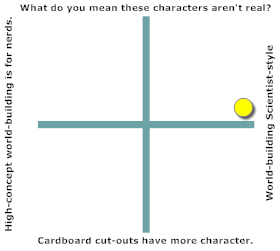
World-building vs Emotional Engagement in The Clockwork Rocket by Greg Egan

The Clockwork Rocket: Intensity of Reading Experience

One would think that both the societal pressure and the risk of apocalypse would lend Yalda’s story a degree of emotional tension, but unfortunately whatever tension is produced gets subsumed by the sheer volume of diagrams and scientific explanations. The physics are fascinating – but I found that I didn’t quite care about the character as much as I would have liked to. This is especially a problem for the first half of the book, where the reader’s learning curve is very high. Once we’re grounded in the physics, the character and her problems become more engaging. But two hundred pages of world-building is a lot to plow through before we can really start investing in our perspective character. The Clockwork Rocket is not unique in this issue: much hard SF shares this problem (Kim Stanley Robinson’s classic Red Mars comes to mind). While readers used to hard SF who enjoy the intellectual challenge may enjoy this, it is not for everyone.

Egan’s The Clockwork Rocket is particularly interesting when compared to Charles Yu’s How to Live Safely in a Science Fictional Universe. Like Egan, Yu posits a universe with rules of physics entirely different from our own. But Yu’s book focuses on the internal and emotional experience of his everyman character. It is through his character that we understand Yu’s world-building. Egan’s strategy is to focus on the world-building first, and then have the character follow. These two different approaches yield very different reading experiences.

Ultimately, I found The Clockwork Rocket reasonably satisfying. But that satisfaction was very cerebral: the book resonated intellectually with me in the same way that a particularly neat thought experiment might. Fans of hard SF will love the complexity, rigor, and comprehensiveness of Egan’s world building. However, now that Egan’s universe is introduced and his characters are left in a fairly interesting situation, I hope the next book focuses more on the characters and less on the physics. The physics are great – but alone they can’t really carry the story.