Skip to content

REVIEW: Southern Gods by John Hornor Jacobs


Title: Southern Gods
Author: John Hornor Jacobs
Pub Date: July 26th, 2011
Chris’ Rating (5 possible): 1 point 1 point 1 point
An Attempt at Categorization If You Like… / You Might Like…
A reasonably-well structured debut novel with near-perfect Southern Gothic world-building.

Fiction has been mining myth since the first storyteller hushed a campfire crowd. Myths are – at some level – the foundation of every story, and in speculative fiction we often rely on them to shortcut the audience’s emotional response: to get the reader “in the mood”. In doing so, we rely on the oldest, most primal images: eyes glowing red in the night, footsteps behind us in the fog, etc. These images are rooted in our reptile brains, and there’s no way we won’t respond to them. But what about myths of newer vintage? The kind that haven’t been percolating in our collective unconscious for centuries? In his debut novel, Southern Gods, horror author John Hornor Jacobs does a solid job mining two recent American myths: the Blues, and the Cthulhu Mythos.

Southern Gods tells the story of Bull Ingram, a WWII-vet hired to find a missing radio promoter, and Sarah Rheinhart, a single mother from a wealthy Arkansas family who comes back to her childhood home. The book opens with an incredibly well-written prologue set seventy three years before the events of the main story. Too frequently, I find that such prologues merely delay the story’s real beginning and serve no narrative purpose. And looked at unemotionally, one might accuse Jacobs’ prologue of being superfluous: the information it imparts might have been easily revealed through the principal narrative. But in this case, I am more than willing to forgive Jacobs’ his prologue because it is hands down the best writing in the entire book. The prose is mellifluous, rich, and evocative. It draws you in, and makes you feel every moment of emotional heartache and fright. By the conclusion of the prologue, I found myself thoroughly engaged with the story and the unfortunate character the prologue introduces us to. From a plot standpoint, it might not have been necessary, but from an emotional standpoint it earned my complete engagement with Jacobs’ world.

After the prologue, the story jumps seventy three years to 1951 and introduces us to our real hero: Bull Ingram. The main story opens with a classic noir setup: a world-weary and battle-scarred vet is just scraping by as muscle for a Memphis gangster when he gets hired to do a seemingly simple job that turns strange and very dangerous. Noir fiction is just as much about feeling as it is about its tropes, and Jacobs executes very well by taking his time. While the prose in the main storyline is not quite as evocative as the prologue, Jacobs focuses just enough attention to give us a real feel for Ingram’s values and personality. We understand that he is a hard man, able and willing to do hard things when he has to. But he’s also not a bad guy: he’s just trying to get by, like everyone else. By not rushing into frenetic action, Jacobs more fully earns our investment in his hero and our engagement with his southern world.

I found Sarah Rheinhart, the female protagonist, to be far less engaging than Bull. While thematically much of her story arc revolves around re-establishing her own agency (we first meet her leaving her abusive husband), I nevertheless found found her overshadowed by supporting characters for much of her storyline. In particular, her childhood friend Alice upstages Sarah throughout the book’s first half, only to recede to unimportance in the book’s second half. I understand that Sarah’s storyline is necessary for the book to function as a whole, but the role she is given is by nature more receded than I would have liked. If the supporting character of Alice were less engaging, or evidenced somewhat less agency than she does, perhaps I would not have noticed this relative weakness. But as it stands, I found Sarah to be less engaging than Bull.

Bull gets hired by a Memphis music promoter to find a radio promoter who went missing somewhere in rural Arkansas, and to track down Ramblin’ John Hastur, a mysterious Blues musician whose powerful songs are played on a pirate radio station that nobody knows anything about, and which drive people to commit primal acts of lust and rage. And here, within that one sentence description of the book’s plot, we already have the merging of those two quintessential American myths: Hastur’s name is itself taken from Ambrose Bierce’s short story “Haita the Shephard“, from which it was lifted by Robert W. Chambers and then H.P. Lovecraft, and August Derleth in turn. This progression – from benign god of shepherds in Bierce’s story, to the spawn of Yog-Shoggoth in Derleth’s work – is plainly an example of the “folk process” at work on fiction. It also gives the reader an immediate insight into the Cthulhu-flavored horror that awaits them as the book progresses.

Jacobs’ depiction of Ramblin’ John Hastur also reconfigures the legend of Robert Johnson’s Faustian deal, in which the Delta blues legend supposedly sold his soul at a crossroads at midnight in exchange for mastery of the guitar. This legend is probably one of my favorite aspects of the Blues as American myth, and I love encountering it time and again whether it’s in books like Southern Gods or in the Coen Brothers’ O Brother, Where Art Thou?. Both this legend and the harsh peripatetic lifestyle of early Blues musicians infuse Jacobs’ lush descriptions of the music, his immersive imagery of the early 1950’s rural south, and especially his characters’ dialog.

Jacobs has an excellent ear for southern dialect, and his characters’ speech patterns do a fantastic job of grounding the story in its setting. He does a particularly good job conveying characterization through his characters’ sentence structures, which is done so subtly that I didn’t even catch the mechanism until my second read through of the book. The dialog is easily my favorite part of this book’s writing, because unlike the prose, it is consistently excellent throughout the entire book.

Much as I enjoyed Southern Gods, I did find a number of weaknesses. I have already mentioned the relative weakness of the female protagonist. But in addition, I felt that themes, characters, and plot points introduced in the first half either fade into insignificance in the second, or get ignored fairly completely. Alice, a strong, compelling supporting character is marginalized once Bull and Sarah get together. The intimation of Alice’s ability to perform little acts of magic is dropped with only a cursory handwave. And I found a frustrating asymmetry between the themes of family explored in Sarah’s storyline and the corresponding themes in Bull’s arc. And finally and perhaps most significantly, I found the treatment of religion to be the one glaring weakness in Jacobs’ otherwise excellent world-building.

The Cthulhu Mythos have a long and complex relationship with Judeo-Christian religion. In one sense, the Great Old Ones are an American myth purposefully divorced from traditional religious concepts. But regardless of the cosmogony employed by Jacobs and gradually revealed in the text, the human characters in his Deep South setting would be steeped in their own more traditional religious heritage. Yet religion is almost completely absent from Southern Gods, unless one counts a Roman Catholic priest’s proclamations of atheism. The story repeatedly references Ramblin’ John’s Faustian deal as a deal with the devil, yet nowhere is there any other religious dimension applied to the whole affair, or even referenced in passing. I would have expected some nod towards Southern Baptist or Pentecostal traditions, but I didn’t find any.

By its very nature, Lovecraftian horror operates in opposition to traditional Judeo-Christian religious concepts. That is one of the reasons why Cthulhu and his ilk are so unknowable and terrifying: they are gods inimical to our more comfortable conception of divinity. And yet Jacobs leaves this opposition implied, without even a cursory exploration in the text. In a less well-written book, this weakness would not have stood out so strongly for me. It is precisely because the rest of Jacobs’ world-building is so excellent that this omission becomes so prominent.

Nonetheless, Southern Gods is a very well realized debut novel. It is atmospheric horror that skews into blood-and-guts when necessary. From a violence standpoint, it is not for the faint of heart, and yet both the execution and the narrative purpose of its violence is well considered. When Jacobs depicts violence, he does so well and for a good reason. Nevertheless, squeamish readers may find it a little off-putting. Fans of Southern Gothic will particularly enjoy the book’s first half. Fans of the Cthulhu Mythos will probably get a kick out of the book in its entirety. Southern Gods is a really solid book, and I am definitely looking forward to Jacobs’ next book (This Dark Earth, due out from Simon & Schuster in July 2012).

And to close out this review, here’s a clip of Robert Johnson playing some awesome Delta blues:

Moving Across Mediums: Assessing the Adaptations of Hugo and Tinker Tailor Soldier Spy


In the past month, I got to see two very different film adaptations of books that I loved: Martin Scorsese’s Hugo (which adapts Brian Selznick’s The Invention of Hugo Cabret) and Tomas Alfredson’s Tinker, Tailor, Soldier, Spy (an adaptation of John le Carré’s novel of the same title). Although both feature science fictional elements (if you don’t believe me about Tinker Tailor Soldier Spy, then check out my earlier blog post on the subject), they could not be more different. Hugo is a children’s story, and Tinker, Tailor, Soldier, Spy is as far from middle-grade as one can get. And yet, their screen adaptations got me thinking about the nature of prose and film, and on the differences in storytelling between the two mediums.

Why The Invention of Hugo Cabret and Tinker Tailor Soldier Spy are Compelling

Both Selznick’s middle-grade novel and le Carré’s spy novel are excellent works of fiction, captivating and moving on multiple levels. What makes these books so good is the way in which they unfold with unity of plot, theme, and character. At its most basic level, The Invention of Hugo Cabret is the story of how a young orphan named Hugo finds a family, and how an old man named George finds himself with Hugo’s help. Le Carré’s Tinker Tailor Soldier Spy is the story of how an old retired spy is dragged back into the murky world of betrayal he had (ostensibly) left behind.

Selznick and le Carré are very different storytellers. More than half of Selznick’s book is told visually through gorgeous drawings. A picture is worth a thousand words, and as a world-building device Selznick’s drawings perform beautifully: his opening sequence introduces us to 1930s Paris, to the Gare Montparnasse, to our hero Hugo, and to the old man at the train station. In a handful of drawings, Selznick quickly draws us into Hugo’s world and engages us with his two primary characters. When Selznick switches into prose, we already suspect what comes next, even if we can’t articulate it. Selznick uses his drawings to lend emotional immediacy to his story, thus accelerating the rate at which we invest in his characters.

Le Carré doesn’t use illustrations. Tinker Tailor Soldier Spy is all told in prose, and deals with the very difficult themes of betrayal, loyalty, and motivation. Although the book follows George Smiley, it actually features a broad cast of characters. Le Carré’s omniscient narrator takes us in and out of their heads smoothly, giving us insight into everyone’s motivations, concerns, and emotional states. And while Tinker Tailor Soldier Spy is a spy novel, a great deal of its prose focuses on the (seemingly) banal personal relationships of Smiley, his wife, and his friends. By showing us both the intellectual game of espionage and its more private underside, le Carré earns our investment in the character: we understand the degree to which Smiley is conflicted with his charge, we understand the degree to which the chase both excites him and disappoints him, and we understand why his companions and quarries act the way they do. His personal concerns, and those of his friends and enemies, serve to establish moral equivalence, to humanize them for the reader.

Both books feature multiple, related plotlines, and all of these plotlines oscillate around the same themes. The different converging plots involving Hugo, his father’s automaton, the old toyshop owner, and the Station Inspector who hunts the orphan child all swirl to greater or lesser extent around the question of family and acceptance. The same holds true for George Smiley: the A plot of Smiley’s hunt for the traitor puts into concrete action the themes of le Carré’s B and C plots (Smiley’s relationship with his deceased mentor, and Smiley’s relationship with his wife). This unity of action, theme, and emotion closes the emotional distance that would otherwise have been built between the characters and the reader. And ultimately, it is this unity that makes the stories compelling.

The Differences Between Film and Prose

Obviously, there are many differences between text and film. However, I like to believe that good storytelling transcends the medium and that the underlying goals of storytelling are universal: we want the audience to be engaged, we want them to be interested, we want them to turn the page. However, different techniques are employed in different media to achieve our intended narrative effects. In a real sense, authors and film-makers are master manipulators: it is our job to evoke some kind of response on the part of our audience. If we evoke the response we intended, then we’re doing a good job. If we evoke a different (or the opposite) response, then we’ve made a mistake.

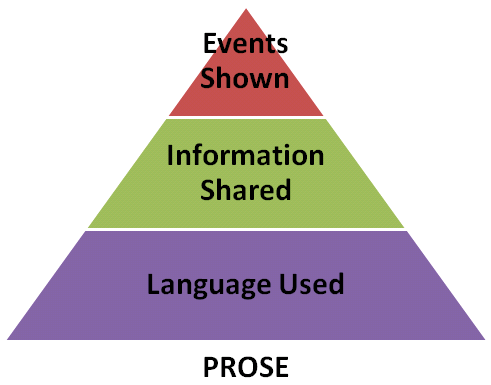
Narrative Tools in Prose: Events Shown, Information Shared, Language Used

The Narrative Tools in Prose

In prose, our primary tools are the events that we depict, the information we impart to the reader, and the language we use to do both. Of course, this is a gross over-simplification: I could probably talk about choosing a single metaphor for a day or two if given the chance. Yet nonetheless, it is our job as creators to choose what we want to present and how to present it. In prose, all of these tools are in the author’s control (although to be fair, good editors have their say, too). When we write, we make conscious choices as to what information our reader needs, when they need to get that information, and how that information is delivered to them.

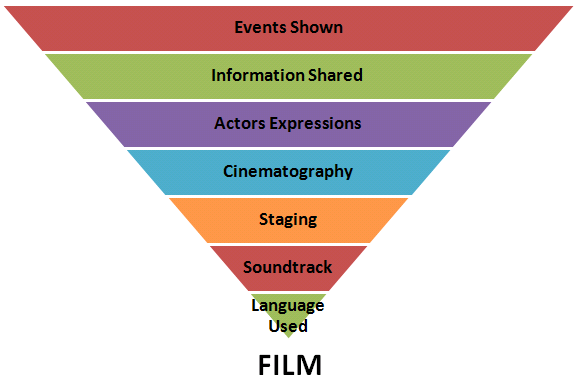
Narrative Tools in Film

Narrative Tools in Film

In film, it’s a little more complicated. At the most basic level, movie-makers have the same two basic tools as authors: they select the events they wish to show, and decide the information they wish to impart to their viewer. However, language is only one of the many devices they have available to accomplish both goals. Actors convey a wealth of information on multiple levels: their facial expressions, movement, and tone of voice all are part of the storytelling and are only partially (at best) under the screenwriter or director’s control. Then, directors choose what visuals are presented in the film, how shots are set up, how a scene gets lit, and how it gets staged. This is conveyed visually, but can be used to elicit an emotional or intellectual response in the audience. And the soundtrack adds an emotional undertone to the visual events, guiding the audience into a certain desired state. And finally, we get the language that is used in the dialog itself.

This is not to say that there are more moving parts in film-making. There aren’t, despite what movie makers might say. It’s just that the moving parts are very different from those faced in prose, and I think that when writing and directing an adaption it is incumbent upon us to bear in mind the differences in technique that both mediums work with.

Why Hugo Works as an Adaptation

Martin Scorsese’s Hugo is probably one of the best film adaptations I have ever seen for the simple reason that it tells the same story that the book told, hitting the same narrative notes and evoking the same emotions in me as an audience member. While Scorsese may have chosen different events to show, different information to share with the audience, and of course made his own choices on cinematography, soundtrack, etc., his adaptation stayed true to the overarching flow of Selznick’s story. Hugo achieved the same type of unity in plot, theme, and character as The Invention of Hugo Cabret, and as the original book’s story was excellent, so too was its film adaptation.

To be fair, Scorsese’s task was made easier by Selznick’s beautiful illustrations. The book was itself already heavily cinematic, with illustrations that conformed to most of the classic structures of visual storytelling: establishing shots, action shots, close-ups to communicate facts and emotions, etc. Since half of Selznick’s book consisted of detailed illustrations, much of the visual storytelling had already been done. I expect this made Scorsese’s task at least somewhat easier, since Selznick had already made a slew of decisions regarding the story’s visual narrative.

Of course, this is not to suggest that Scorsese, the actors, and the screenwriter John Logan didn’t have a lot to do with the finished product. But it is very clear that they were heavily influenced (as is only right for an adaptation) by Selznick’s original book. By letting Selznick’s illustrations and storytelling influence their choices, they were able to capture his thematic and tonal focus, leading to a finished work as beautiful, compelling, and moving as the original.

Why Tinker, Tailor, Soldier, Spy Does Not Work as an Adaptation

Unfortunately, Tomas Alfredson’s Tinker, Tailor, Soldier, Spy does not work nearly as well as Scorsese’s Hugo. It remains a good movie: the cinematography is solid, the music is excellent, the acting great, and the writing good. It clearly tried to stay true to the original source material, but by de-emphasizing the characters’ personal lives it weakened the overall product.

The film version of Tinker, Tailor, Soldier, Spy engages us on an intellectual level: George Smiley (played well by Gary Oldman) and company keep the audience at an emotional distance, presumably just as they keep themselves emotionally removed from the sordid work that they do. That leaves us with the intellectual mystery of the whodunit: we are engaged with the story because we want to identify the traitor…not because we care about what happens to any of the characters.

Superficially, this is consistent with the book: le Carré portrays most of his characters, and Smiley in particular, as emotionally distant. Yet le Carré shows us that their reticence to engage emotionally is a sham: by showing us their emotional reactions to their personal lives, we know the characters to be living, breathing, feeling human beings. Alfredson chose to de-emphasize this emotional dimension of the story, and his movie suffers for it.

It is telling that the two characters who I found most engaging in Tinker, Tailor, Soldier, Spy were the two shown to be emotionally invested in their own stories: the naive Ricki Tarr (Tom Hardy), who tragically falls in love with a Russian agent, and Peter Guilliam (Benedict Cumberbatch), who kicks his lover out of his flat to keep him safe. It is precisely because these two characters are shown to be more than cold-blooded apparatchiks that they evoke an emotional response. We can identify with their concerns, and can feel empathy for their troubles.

The emotional concerns of the other – more principal – characters are merely alluded to, and not really explored. It could be argued that those concerns are purposefully left between the lines, there for the discerning viewer to pick up and project onto the screen. That may well have been the reasoning, but I for one found the effect flawed: if that was the intent, it didn’t work for me. The movie was engaging on an intellectual level, but fell short of the unified intellectual/emotional impact evoked by the original book.

Advice for Book-to-Movie Adapters

It seems to me that putting together a good film adaptation of a great book relies on a careful examination of why a book worked, and then translating the techniques that worked in prose form to film. If the method by which a book worked were correctly identified, then a good filmmaker should be able to achieve similar effects using the tools available to them. Of course, this is easier said than done, especially in a Hollywood driven by consensus decision-making.

What are some other examples of good adaptations? Why did they work? Or how about some terrible adaptations, and why did they fall apart? Love to have some more perspectives!

REVIEW: The Fantastic: A Structural Approach to a Literary Genre by Tzvetan Todorov


Title: The Fantastic: A Structural Approach to a Literary Genre
Author: Tzvetan Todorov
Pub Date: 1970 (French)
1975 (English)
Chris’ Rating (5 possible): 1 point 1 point 1 point 1 point 1 point
An Attempt at Categorization If You Like… / You Might Like…
A relevant exploration of a narrow sub-genre within fantasy, applicable beyond its borders.

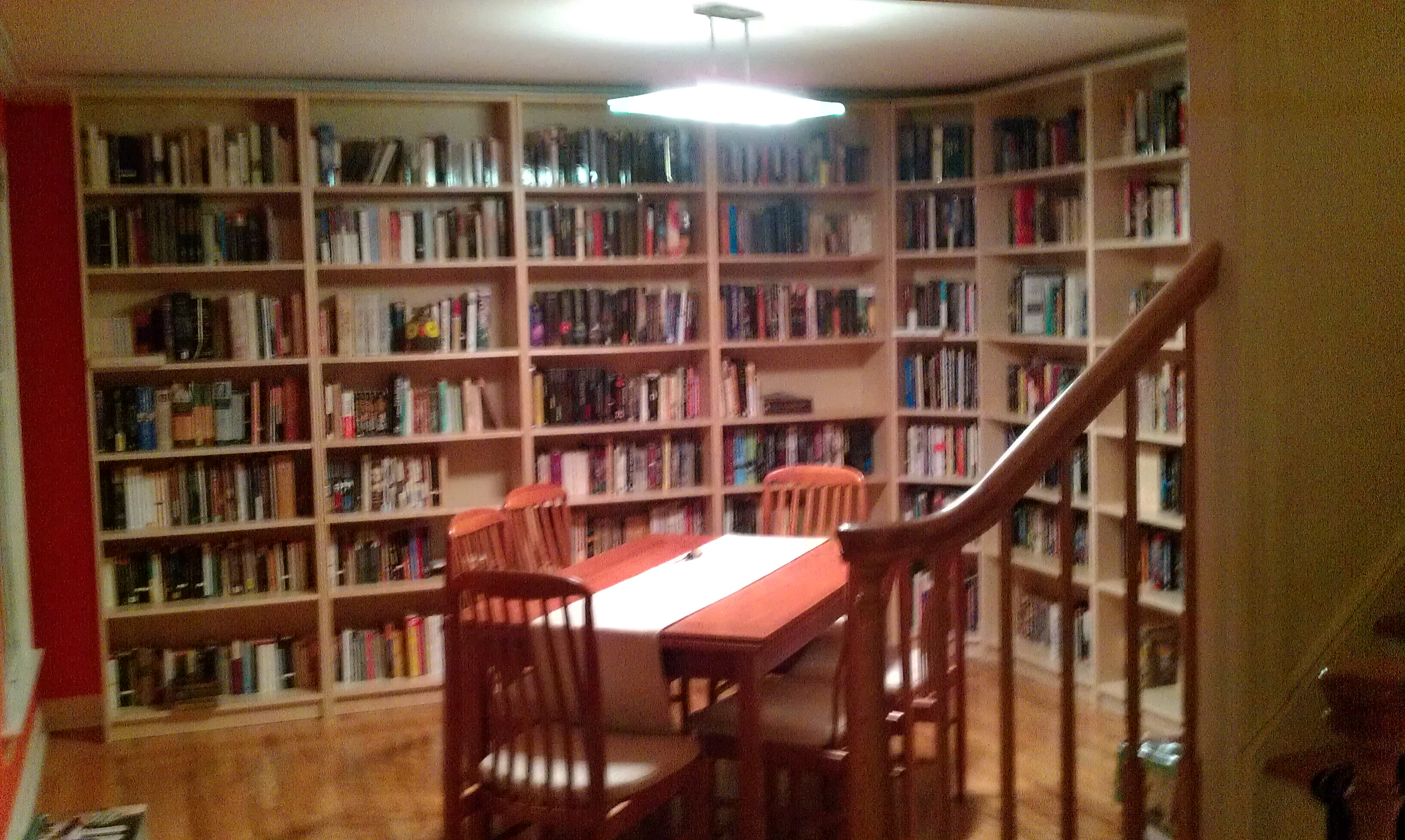
Happy New Year! Now that the formalities are out of the way, I thought I’d take a few moments to share with you what I did between Christmas and New Year’s: In addition to remodeling our library, and turning our dining room into a library annex, I also spent the week slowly and carefully reading Tzvetan Todorov’s classic book of genre criticism, appropriately titled The Fantastic: A Structural Approach to a Literary Genre.

Our Library Annex (aka the Dining Room)

Our Library Annex (aka the Dining Room)

Of course, I’d read about Todorov many times before. I’d even read a couple essays he’d written (I particularly recommend his typology of detective fiction). But I figured that it was best to see for myself what he had to say. And though in the end I was very satisfied, this book really defied my expectations.

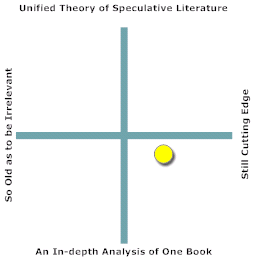
The book’s title is misleading. From the adjective-cum-noun “Fantastic” it is a short leap to the modern genre of “fantasy” – and so when I first bought the book, I expected to find a master critic expressing his own Unified Theory of Fantasy, like a Northrup Frye or a Wayne Booth for the speculative genre (for two excellent analyses more in this vein, I recommend Farah Mendelsohn’s Rhetorics of Fantasy and Brian Attebery’s Strategies of Fantasy). Instead, Todorov uses a much narrower interpretation of fantasy, placing it on a spectrum between stories where ostensibly supernatural events are explained through rational means (which he calls the “uncanny”) and stories where supernatural events are shown to actually be supernatural (which he calls the “marvelous”).

Todorov's Spectrum of the Supernatural

Todorov's Spectrum of the Supernatural

To put it another way, Todorov’s uncanny stories are Scooby Doo episodes: during the action, the characters and reader experience events which are ostensibly beyond mortal ken (ghosts, monsters, strange worlds, etc.). But by the end of the story, all of the ostensibly supernatural experiences are explained away in a naturalistic and rational fashion, thus erasing the supernatural from the story. It’s like Old Man Withers being unmasked by the gang. On the opposite end of the spectrum, Todorov’s “marvelous” stories are Buffy episodes: during the action, the characters and reader experience events which are beyond mortal ken, but by the end of the story, all of the ostensibly supernatural experiences can only be explained by an acceptance of their supernatural reality. Todorov’s “fantastic” genre, however, is the Twilight Zone: neither the characters nor the reader is ever really certain whether the supernatural events are to be accepted.

This is a much narrower definition of “the fantastic” than “fantasy” would imply. It excludes almost all secondary world fantasy, and almost all science fiction. Even most wainscot fantasies would fall into Todorov’s “marvelous” camp. Which is a shame, because anything beyond his narrowly defined borders gets brushed off as beyond the scope of his analysis.

The first half of The Fantastic is an interesting, if dry, exercise in critical philosophy and semantic hair-splitting. He defines what he means by the fantastic, and provides a definite set of criteria for use in its identification. Given my (incorrect) expectations, the book initially frustrated me. I wanted to gleam sweeping insights with applicability across a broad swathe of fantasy titles and sub-genres. Todorov’s painstakingly detailed definition of “hesitation” or what I would call ambiguity: the uncertainty felt by the character and the reader as to their implied frame of reference for experiencing the story. According to Todorov, if a story has no ambiguity, then by definition it falls outside the bounds of his fantastic. Now, I love ambiguous stories. But most fantasy, and most science fiction, eschews the degree of ambiguity described by Todorov. Let’s face it: there are few Chronicles of Thomas Covenant, the Unbeliever or There Are Doors out there.

Yet once Todorov establishes his definitions, he begins to dissect his ambiguous stories in much more painstaking detail, parsing their themes and structures. And here, The Fantastic becomes a treasure trove of insight. The conclusions Todorov draws regarding the fantastic are not, in fact, particularly interesting. They may be thought provoking, but they have limited applicability beyond his caged genre, and furthermore I suspect his reliance on the psychoanalytic school of criticism ignores too many other factors. Yet the techniques that Todorov applies, independent of the genre against which they are applied, are quite impressive.

In a very real sense, Todorov draws the treasure map to a very narrow sub-genre. But by doing so, he shows us how to draw such maps for any other genre in existence. I wish that Todorov had taken the trouble to do the same for both his uncanny and marvelous genres. But the process of structural analysis that he applied to his ambiguous stories can just as readily be applied to secondary world fantasy, portal/quest fantasies, wainscot fantasies, liminal fantasies, intrusion fantasies, and all the rest. And that is why this book remains significant: on the one hand, it adds to our critical toolkit, and by using much-analyzed “classic” texts of the Gothic age, it helps to bring the tools of genre criticism into the “respectable” light of academia.

In that sense, later critics like Farah Mendlesohn or Brian Attebery both benefited from Todorov’s work. On the one hand, they apply to a broader body of work the universal techniques that Todorov pioneered. And on the other hand, they benefit from the fact that Todorov dragged ghosts and demons into the light of critical respectability.

All in all, this is a book on criticism well worth reading. But not for its conclusions: more for its methods.

Ruminations on Blogivating after a Year and Change and Resolutions for 2012


So judging by the calendar, this is going to be my last blog post in 2011. This time of year always makes me a little introspective, and leads me to think about what the past year has brought and what I want the new year to bring. And since at this point I’ve been posting weekly reviews and essays fairly religiously for the past 15 months, I thought it would also be a good moment to assess how this blog has developed.

Thank You All

First, let me say how utterly and completely thankful I am to everyone who reads this blog. When I started back in 2010, I thought it would attract some ten or fifteen people every week. I figured that was a safe expectation, considering that the non-fiction I write tends to be fairly dense by the standards of the blogosphere. Add to this the fact that I’m writing this blog anonymously and that I’m not a big name author, and well…let’s just say that the visitor stats back in late 2010 bore out my suspicion.

But over the last year, I’ve gone from averaging about fifteen weekly readers to now averaging about fifteen hundred (excluding spam commenters, who I assume don’t actually know how to read). This fact is amazing, and incredibly gratifying. It is humbling to know that there are so many like-minded people out there who love speculative fiction as much as I do, and who find my thoughts interesting enough to subscribe, read, comment, and share with their friends. Seriously, you are all amazing. Thank you!

What Folks Liked in 2011

Since September 2010, I’ve made eighty-four posts here. Of those eighty-four posts, one third were reviews and the rest were almost all theoretical discussions of writing and genre. Based on my WordPress stats, the ten most popular posts in 2011 were as follows:

RANK TITLE DATE POSTED
1 Science Fiction Techniques in Spy Novels: James Bond and George Smiley November 22nd, 2011
2 The Evolution of Middle-Grade Fantasy and Television August 30th, 2011
3 Techniques in Writing Alternate History February 22nd, 2011
4 Flirting and Writing Good Dialogue June 26th, 2011
5 REVIEW: The Crippled God (Malazan Book of the Fallen, Book 10) by Steven Erikson March 2nd, 2011
6 Leaping the Chasm of Imagination: Verisimilitude, Historical Fiction, and Speculative Fiction November 1st, 2011
7 REVIEW: The Clockwork Rocket by Greg Egan July 19th, 2011
8 The Future is Now: Is Hatsune Miku William Gibson’s Idoru made real? December 21st, 2010
9 Some Brief Thoughts on Love, Relationships, and Characters in Fiction August 9th, 2011
10 A Theory of the Hero: Story Archetypes for Heroic Characters (part 2 of 3) September 17th, 2011

What this data suggests to me is that you folks like my theoretical investigations of genre more than my reviews. Is that the case? As I look to continue this great blogging adventure in 2012, I’d love to know more about what kind of material you’d like to see. I did a couple of one-off experiments in 2012 (the interview with Jonathan Case and Steven Padnick, a couple of three-post blog series, etc.) and they were qualified successes. Do you want to see more interviews? Guest posts? Podcasts? Video blogs? More pictures of our guinea pigs? Or should I stick to the approach I’m currently adopting under the theory of “if it ain’t broke, don’t fix it?”

Current Resolutions for 2012

In 2012, I would like to continue this blog. I’ve been having a lot of fun writing it and getting to exchange views with all of you both here and on Twitter. As I’ve been thinking about what to do with the blog in 2012, I’ve put together a brief list of blog resolutions for the new year. A year from now, it’ll be fun to check back and see which of these resolutions I actually managed to stick with:

  • Read James Wood’s How Fiction Works Without Throwing it Across a Room. I read a lot of literary criticism and books on writing. I find them fun. But I have never been able to get through James Wood’s How Fiction Works. I find that his quasi-academic presentation obscures his rather banal observations, and the book has just infuriated me every time I’ve picked it up. Yet it comes highly recommended, and so I resolve that in 2012 I will actually finish it. Cover to cover. Honest.
  • Broaden My Critical Theory. There are lots of critics out there who have interesting and insightful things to say about how fiction, and how genre fiction, works. I want to broaden my knowledge, to read wider in the field, and to share some of my perspectives with you as I do.
  • Read More Review Books. About one third of my blog posts are reviews, but I would love to read more widely in and out of genre and post more of my thoughts on what I have found. Since my theoretical musings seem to be somewhat more popular than my reviews, I’d ideally like to do this by increasing my post frequency and thus keeping my theoretical output stable. I’m a little skeptical as to whether this resolution will actually be achievable, but some resolutions are made to be broken, right?
  • Experiment with Give-aways. So far, I have never done any giveaways or anything like that. But as the shelves of ARCs and review copies keep growing, I think it’ll be worth experimenting with a giveaway or two this year. I’m curious to see how it works.
  • Build Guest Post Relationships. I resolve to try to build guest post relationships, both where interesting and thoughtful people come and share their thoughts over here, and where I foray out into the wild Interwebs to share my thoughts on other blogs. It’s a brave new world out there.
  • Be More Active in the Fan Community. This year, I resolve to go to more conventions (I’m already registered for Arisia, Readercon, and Chicon) and to meet other creators, bloggers, and folks who I’ve (so far) only met on the Interwebs.
  • Experiment with Different Formats. This year, I resolve to continue various experiments with different post formats. They may be short micro-reviews, or different style posts entirely (video blogs? Podcasts?)

Do you have any other suggestions for me? I’d love to know what kind of stuff you’ve particularly enjoyed, and what type of material you’d like to see more of in the future. Please let me know! I’ve loved writing this blog for the past year and change, and am looking forward to doing more fun stuff like it in the near future.

Meanwhile, Happy New Year to everyone!

Thinning and Accusations of Nostalgia in Fantasy


The other day I came across a comment somewhere (alas, I don’t remember on what blog/forum) that enjoyment of fantasy stems from a nostalgia for the medieval era when lives were “poor, nasty, brutish, and short.” This view is typically delivered with the rather heavy-handed (though often unstated) implication that only children and fools would enjoy stories set in a time period lacking women’s rights, flush toilets, and antibiotics. I suspect if you’re reading this blog you would agree when I label such a view simplistic and rather asinine. And yet…this opinion has been around for decades, and its staying power suggests that – just maybe – there might be something more at work here than haters hating.

Romanticizing the Past versus Being Nostalgic About It

So why then do people today still say fantasy just romanticizes the ugly past? I’ve never seen a child of the late ’90s and early ’00s make this statement. That’s understandable when we consider that for that generation, Harry Potter was the defining work of fantasy, and that its appeal and reach extended far beyond fandom’s traditional minority. In my experience, the accusation of nostalgia is most often made by folks who matured in the ’70s and ’80s. Unlike the Harry Potter generation, many of those my age or older could have grown up utterly insulated from the boom in genre. They would likely have only been exposed to the unavoidable hits of the generation that preceded them: Howard’s Conan, Tolkien’s Elves, Lewis’ Narnia, etc. Those formative books established their expectations, expectations which a cursory glance at fantasy covers in the ’70s and ’80s would have instantly confirmed. After all, contemporary urban fantasy at that time was the bleeding edge.

So fantasy’s predilection for medieval settings (whether secondary world or not) is an understandable stereotype. By volume, I would suspect (though I have no hard data) it remains warranted today. If someone were to tell me “Most fantasy is set in a quasi-medieval setting” I would say that this is likely a fact. But if somebody says that “Fantasy is nostalgic for the medieval era” I would take exception.

Contemporary fantasy owes many of its roots to romantic literature of the 19th century. In the literal sense, quasi-medieval fantasy does romanticize the past: images of the past are used as a cultural short-hand to set the tone of the work, establish a framework by which its themes can be explored, and set reader expectations. This focus on the reader’s frame of mind and emotional state is in many ways the defining rhetorical device of the Romantics. Realistic fiction does the same, but through the use of different imagery: contemporary imagery, objective or ironic presentation, etc. Both romanticize their subjects (however strenuously the realists might deny it). Fantasy just happens to use quasi-medieval window dressing.

However there is a line between romanticizing the past (a sin of which fantasy, historical fiction, and well-written biographies are all guilty), and being nostalgic for it. In fantasy, that line gets blurred by the genre’s reliance on thinning.

The Thinned End of the Wedge: Thinning vs Nostalgia

In The Encyclopedia of Fantasy, John Clute defines “thinning” as the weakening of some aspect of the world or character which then enables the story to be structured as a recovery fable. I won’t reprint the entire definition, but I strongly recommend you check it out: it’s a deep and meaningful concept, however fuzzy the borders of Clute’s definition. The classic way in which fantasy stories use thinning is to present a world in some form of decline. The reversal or slowing of that decline becomes the object of the plot or one of the story’s major themes.

Tolkien’s Middle Earth is replete with thinned elements yearning for restoration: the elves are leaving the world and going west, the line of Numenor is spent, Hobbits are no longer easy to find, dwarves are locked in their mountains, and the Ents have lost the Entwives (just to name a few examples that spring to mind: there are more). In The Lion, the Witch, and the Wardrobe we first find a Narnia where humans have died out, the land is blanketed in perpetual snow, and the White Witch oppresses the land and its people. Thinning is even used in non-medieval fantasy, such as in Marie Brennan’s Onyx Court series (see my earlier review).

Thematically, thinning is deployed with a nostalgic tone. The pre-thinning state is never shown, so the reader never sees what this idealized past was like. But the narrator and characters leave us with no doubt that it featured characteristics that they felt were good. It is their nostalgia which permeates the text, not the reader’s or (necessarily) the writer’s. It is merely a rhetorical device, analogous in kind to the use of framing stories or unreliable narrators. It can highlight themes that the writer seeks to dramatize, and can plant deeper emotional hooks in the reader. This isn’t a tool unique to fantasy, and in fact has a long pedigree.

Remember the Dark Ages? Even though it’s an awfully imprecise term, Petrarch’s origination of it really lends a fantastical narrative to the Middle Ages: the Dark Ages were western culture’s own period of thinning after the fall of the Roman Empire, and the influence of the Renaissance (which itself idealized the classical era) remains a powerful force in fantasy today. Contemporary portal/quest fantasies are the descendents of Dante’s Divine Comedy, and characteristic fantasy characters (rogues, merchants, warriors, etc.) can often trace their lineage back to Bocaccio, Chaucer, or Malory.

What Comes after Thinning?

Thinning, and the nostalgic tone it engenders, is clearly nothing new for fantasy. This makes the accusation that fantasy pines for the medieval past an understandable conflation of the terms. Yes, it is wooly-headed. Yes, it is imprecise. And yes, the people who level this accusation are dying out. But if there is some poorly articulated truth to their criticism, then what if they really have a different and far more valid point: is thinning played out as a rhetorical device? Does it remain relevant for the thematic concerns contemporary writers wish to address?

The backwards-looking Renaissance gave way to the striving of the Enlightenment. Thinning and its nostalgic tone became rarer, and tended to be confined to the (already more fantastic) Gothic novels. Though there was much writing we might today call speculative, the thinning popular during the Renaissance was replaced by satire, philosophy, and utopian texts which raised questions about society in the moment and postulated future directions for its development. If thinning as a device has become cliché, what comes next? Can we expect a new Enlightenment in fantasy which replaces thinning and the nostalgic tone with satire? I don’t think we’ve reached that point yet, but I suspect we may be on our way there. And who knows? Terry Pratchett’s Discworld might just be the satirical canary in the coalmine that drags us kicking and screaming into the century of the fruitbat.

REVIEW: Planesrunner by Ian McDonald


Title: Planesrunner
Author: Ian McDonald
Pub Date: December 6th, 2011
Chris’ Rating (5 possible): 1 point 1 point 1 point 1 point
An Attempt at Categorization If You Like… / You Might Like…
A fast-paced adventure story that reads more like adult science fiction than YA science fiction.

As I’ve mentioned before, I am a huge fan of Ian McDonald’s adult science fiction. His complex, multi-layered plots and penchant for near-future science fiction set in non-western cultures (Africa, India, Brazil, Turkey, etc.) have always struck me as interesting, engaging, ambitious, and structurally complex. So when I heard that Pyr was going to be releasing a new YA novel by Ian McDonald entitled Planesrunner, I jumped at the chance to read it.

McDonald has earned a large, loyal, and very much deserved following for his adult fiction, I don’t know if the decision to market this particular story as YA lay with the author, his agent, or with his publishers, but it does make reviewing the book an interesting challenge. UPDATE: but his foray into MG/YA fiction represents an interesting critical challenge. The YA and SF genres have different (though overlapping) conventions which stem from both their respective histories and their divergent audiences, and it is unclear through which lens we should look at Planesrunner. What comes first: the science fiction, or the YA?

Planesrunner is told from the perspective of Everett Singh, the fourteen year old son of a quantum physicist involved in the development of doorways onto parallel worlds. Everett watches his father get kidnapped, and then finds that he alone has the clues and capabilities to rescue him.

Judged solely by the protagonist’s age, Planesrunner falls firmly into YA territory. Though the book opens in London, McDonald’s hero comes from a Punjabi background, and McDonald’s excellent ear for local cultures comes through in Everett’s voice. Particularly in the novel’s first third, McDonald paints Everett in solidly contemporary British colors, albeit filtered through his Punjabi background. Everett’s cultural background can likely best be compared to that of Jessminder “Jess” Bhamra in the excellent Bend It Like Beckham: to say that Everett is a soccer-loving British boy tells only half the story, while to say he is Punjabi does the same. This is a blend culture more accessible to western readers than the India McDonald took us to in his (adult) Cyderabad Days, but it is definitely not the whitebread England of Harry Potter. As always, I applaud McDonald’s presentation of cultural complexity.

The first third of the novel focuses on Everett’s reactions to his father’s kidnapping. From the high-powered opening, the story’s pace slows down significantly as we learn more about Everett’s family background (his parents have split up, he has a younger sister, etc.) and we get gradually introduced to our protagonist. We learn about Everett through his interactions with his mother, his soccer team buddy, the police, and his father’s co-workers. Throughout this process, we gradually learn more about the work his father does, and about the parallel worlds that he helped discover. This part of the book is written with McDonald’s typical skill, providing a good feel for Everett, his values, his cultural background, and his life. We grow to care about him, and get engaged in his desire to save his father. All of this is good, however by the standards of contemporary YA it happens rather slowly. Most contemporary YA that dives into the action the way this story does maintains and rapidly escalates the tension from page one. Here, the tension is maintained but its escalation unfolds more slowly. It is effective, but it has more of the feel of an adult novel than a typical YA story.

Once Everett deduces that his father has been taken to the parallel world of E3 and follows him through the gates, the book’s pace accelerates substantially. First, the alternate reality Everett crosses into is a vastly different London, where oil was never discovered. As a result, its 21st-century society runs on coal-powered electricity and has no access to technology we take for granted (e.g. plastics). It is a delightful and compelling steampunk world, complete with vast airship fleets. The concept of a 21st-century London where oil had never been discovered is an interesting one, and McDonald does an excellent job of rendering its technological development believably. But while he does a fine job of nailing the technological/scientific world-building, I am less sold on the cultural flavor of his alternate London, which blends contemporary and pseudo-Victorian sensibilities.

On the one hand, we see that the alternate world has values and a cultural background commensurate or at least compatible with those of our modern world. The villains in E3 are quite at home in skyscrapers, modern dress, and with modern weaponry. But they are set in opposition to a romantic rabble of airship sailors who dress, talk, and generally act like they stepped out of the Victorian era. Perhaps this disconnect is part of McDonald’s point, but upon reflection, I found myself doubtful. Nevertheless, it is a testament to McDonald’s skill at world-building that these quibbles only arose upon reflection: while reading the story, I found the world compelling, engaging, and believable.

Once in this new world, Everett quickly joins up with that staple of the steampunk sub-genre, a crew of airship pirates sailors. They are second-class citizens presented as a rough-around-the-edges but still lovable rabble, quasi-Romany in nature. The characters Everett runs into, in particular his fiesty love-interest Sen, her adoptive mother (the captain), and her Bible/Shakespeare-quoting crewman are all extremely distinct, very interesting, and very engaging. In portraying both this world and the harsh underbelly of its society, McDonald made an interesting authorial choice: most of these characters speak in polari, which IRL is a cant slang developed in the British theater community in the 17th and 18th centuries. McDonald portrays this dialect directly in dialog, making it hard to parse for the uninitiated. I found myself torn as to its effectiveness.

The strategic use of polari deepens the credibility of McDonald’s alternate world. Yet at the same time, it decreases the accessibility of that world. As an American whose only previous encounters with polari had been limited to a handful of phrases in a few episodes of Porridge while living in Europe, I found that it took real work to decode what characters in Planesrunner were saying. Interestingly, Everett had very little trouble doing so: it is possible that growing up in London, he would have had more exposure to polari than I have had growing up in the States. Readers as unfamiliar with it as I was might find that it takes a bit of effort to get through. Overall, this strategy marks an interesting choice, and one that in general McDonald pulls off effectively. However, it is a choice that I have rarely seen in YA. Experienced genre readers will probably just accept it and make use of the glossary at the end of the book, but I am less certain that YA readers will be willing to invest the same amount of effort.

The biggest weakness I found in Planesrunner was that once Everett stepped into the parallel world, it seemed as if he had entirely forgotten about the mother and younger sister he left behind. To some extent, this is a natural consequence of the plot’s focus on rescuing his father. Nevertheless, I had the impression that themes of Everett’s family introduced at the book’s opening remained unaddressed (let alone resolved) at the book’s end. Above all, it is this fact that makes the book feel more like an adult SF novel than a YA SF novel.

Themes of family, of choosing/balancing sides, and of cultural identity are all frequently explored in YA. One can argue (and I’ve done so on this blog before) that at some level all YA novels address the challenge of finding one’s place in a complex, multi-layered, and ambiguous world. McDonald sets these themes up fairly well in the opening of Planesrunner, but fails to follow through on them by its end. Themes of family get re-introduced, with the focus on Everett’s place within the airship’s “adopted family”, but it never ties back to the family he left at home. Perhaps as the series continues we will return to these themes and gain some closure. But stretching a single unresolved thematic arc across a series and without clear inflection points in each installment is something adult series may pull off, but flies in the face of typical YA conventions. It is one thing to end the plot of the first book on a cliffhanger as McDonald (more-or-less) does, but to leave thematic threads dangling (as opposed to tied, whether loosely or strongly) weakens the book’s emotional resonance.

Overall, Planesrunner is a solid adventure. Read as such, it is perfectly enjoyable. Fans of adult science fiction will find it especially satisfying, and will likely find it fast by the standards of the adult genre. Fans of YA science fiction will likely enjoy it as well, though I suspect that long-term it won’t be as memorable as more tightly themed YA novels. Readers of McDonald’s earlier work will enjoy Planesrunner for how it builds on McDonald’s strengths and how it diverges and expands on his previous patterns. However, readers looking for the thematic, structural, and sociological complexity of McDonald’s adult novels won’t find it here. That complexity may exist below the story’s surface, incorporated into the story’s world-building, but Planesrunner is a simpler, more adventure-focused story than McDonald’s earlier work. In general, I found Planesrunner a fun if only partially-satisfying read, but I am definitely invested enough to pick up the next book in the series when it comes out.

Earning/Maintaining a Reader’s Trust: Character/Narrator Consistency and Reliability (part 3 of 3)


NOTE: This is the third and final installment in a three-part series on earning and maintaining a reader’s trust. The first part focuses on earning initial trust just at the start of a story, while the second part focuses on how world-building, consequential plotting, and story structure/pacing affect the reader’s trust. This part deals with character consistency/reliability, and I know it’s long. I do apologize for that, but there’s really a lot to talk about here.

Consistent Characterization and Reader Trust

When we write, we create a wide variety of characters, each of whom has different degrees of complexity. Like real people, our characters’ choices, attitudes, personalities, and decisions are shaped by their experiences. The most memorable characters are those that are shown to be complex, to have foibles and flaws as everyone else. Readers appreciate flawed characters, but what matters is that their flaws and behavior are consistent with the events of the story. Some people claim that they like to be surprised by characters, but there is a big difference between letting the plot surprise us, and letting a character do so. Character actions should be an inevitable consequence of their natures, and their experiences before and during the story.

Every decision a character makes must logically follow from the experiences our reader has observed through the story. In Les Misérables, Hugo shows us the moral quandary that Marius Pontmercy finds himself in on the eve of revolution: should he join his friends on the barricades or escape with the love of his life, Cosette? Hugo establishes this as a real choice for Marius, one that forces him to choose between two equally “right” values (according to his own value system). As the reader, we understand that he can believably go either way on the choice. Which makes his final decision and the reveal both a surprise (either of the two options would have been) and satisfying.

The seeds of every major (and most minor) choice should be planted well in advance. The hard part, is to plant seeds that allow for branches of equal probability. If the character only has one plausible recourse, then where does tension derive from? This is one of my most frequent complaints about portal/quest fantasies, in particular those of the “prophesied monarch” sub-type. As I’ve grown older (and more curmudgeonly) I have found it very difficult to get any emotional tension out of this kind of story. They become predictable and dull, because I know a priori that every complication the hero runs into will at some point be resolved, and that every mistake he makes will be fixed by the end. The prophecy (which is all too rarely actually ambiguous) will take care of matters in the end.

By setting up characters who have real choices to make internally, and who have real conflicts amongst themselves, we maintain the reader’s interest in the underlying story – which is a prerequisite for maintaining their trust. If the character does something that was not adequately prepared for, something so surprising that it comes out of left field, then the reader may be shocked into losing all trust in the story.

Consider for a moment Star Wars. Would the story have worked if in Return of the Jedi Princess Leia betrayed the rebels to the Empire? No. It might have worked (though yielded a very different story) if Han Solo had done so (for money), or if Luke turned to the Dark Side. But Leia? There was nothing in her character to make such a choice remotely plausible. It would have been a bridge too far, a leap of faith that the audience would have been unwilling to follow.

However, this does not mean that characters need to always be reliable. In fact, one of my favorite methods of playing with reader trust is the use of an unreliable narrator/character.

Structures that Enable Trusting in Unreliable Storytelling

Whether it’s in film (Rashomon, The Usual Suspects, or Citizen Kane) or in prose (Akutagawa’s In a Grove, Nabokov’s Lolita, or Larbalestier’s Liar), I love unreliable narration/characterization. It’s a lever on which my entire understanding of a story can hinge. Executed skillfully, it offers an exponentially broader story experience. But how does the reader trust in a story when the storyteller is shown to be a liar? That’s a question that has been on my mind quite a lot recently, as one of my current WIPs deals extensively with the concept of deception.

In thinking it through, I think I’ve managed to identify five different modes of unreliable storytelling, each of which plays with reader trust in different ways. This list is by no means exhaustive, and I’d love to know other examples:

1 Implicit Unreliability
The narrative voice is strongly imbued with the characteristics of the story’s narrator, thus adopting the inherent biases, idiosyncrasies, or fallacies held by the narrator. These may include a childlike naivete, a desire to rationalize/justify morally reprehensible actions, or strongly held opinions that color the narrator’s perspective. What matters in such stories is that the narrative voice must go beyond the merely functional, and present a particularly close “lived-in” feel.

The book’s character/narrator will likely be the most memorable aspect of the book, and this stems entirely from a reliance on the narrator’s voice. The source of the narrator’s underlying unreliability affects our emotional position vis á vis the character: we love Huck Finn or Evie Spooner for their childlike innocence, even as that innocence is shattered by their experiences. We love to recoil from Humbert Humbert, and his beguiling rationalization of his monstrous deeds. We judge Chaucer’s Merchant, and the Wife of Bath for the positions and opinions they hold. At no point in the story itself do we as the author insert ourselves and tell the reader about the veracity of our narrator’s statements. Our job is to present the story as if it were the narrator’s, with whatever inaccuracies or ugliness that entails.

The success or failure of these stories rests on their ability to draw us into the character/narrator’s viewpoint. To aid in this process, such stories are often told in first-person to accelerate us into the reader’s head, though that is by no means a requirement. Typically, the reader’s enjoyment derives from a multi-layered interpretation of the text. On the one hand, we can enjoy the events unfold as we share in the narrator’s experiences. On the other hand, we have an intellectual and emotional response to our own interpretation of those experiences based upon our own value systems. We take the facts of the story as given, and generally we do not dispute them. However the moral and emotional implications will be drawn from the reader’s own values and opinions.

So long as the narrator is consistent in terms of voice and characterization, the reader will trust that the narrator is supplying the basic facts of the events accurately. However, if the voice is distinct enough, the reader gains that degree of separation that enables that multi-layered interpretation. This makes apparent the fact that the reader is expected to have value judgments that are independent of the narrators’. As a result, the reader will supply their own emotional/moral “truth” , based upon the facts filtered by the narrator. In essence, the reader is expected to trust the facts of the story, but to question the narrator’s interpretation of those facts. The reader’s “trust” in this type of unreliable narrator rests entirely on that narrator’s voice, and its distinctiveness and attractiveness (even if the character is reprehensible).

2 Conflicting POVs
When we combine multiple implicitly unreliable POVs, the result is often an interesting structure which throws into doubt the facts of the story. Here, it is not only the moral/emotional implications which need to be supplied by the user, but the facts of the story as well. Most frequently this story relies on presenting a series of narrators, each of whom recounts the same or closely-related events from their own highly subjective perspective. This structure creates a more complex intellectual puzzle than most implicitly unreliable stories, as it requires the reader to parse and analyze what characters want, what they say, and what they do not say. By analyzing the gaps between what different narrators tell us, the reader can infer the “true” facts of the story.

The facts of the story are themselves in flux in such stories, and will never be explicitly stated by any of the narrators. And because the underlying facts are ambiguous, so too are the emotional and moral implications of the story as well. This mode relies more heavily on a careful analysis of the details included in particular narrators’ versions of the story. Who includes what details, who mentions what, who justifies what actions, who lies, and when they do so are all vital factors that we need to have carefully mapped out as we write the story. The reader’s trust relies on the non-obvious nature of the “truth”. Because this type of story is a puzzle-box, readers who figure out or intuit the puzzle within the first couple of chapters may lose interest: their intellectual investment will have been wasted. To maintain the reader’s trust, balance must be maintained between all of the perspective characters, in terms of level of detail offered and the reader’s expected emotional investment.

3 Explicit Unreliability
In many stories, we are explicitly told that we should not trust the narrator: that their words cannot necessarily be taken at face value. This may be because the character is a self-avowed liar, or is insane, or because a framing device tells us a priori that the story is untrue. In each case, this model puts the reader on alert that they are dealing with an unreliable narrator and forces the reader into a “problem solving” mode of story consumption.

This model seems to be especially popular in speculative fiction, where a number of authors (Gene Wolfe in particular) execute admirably. When we read stories like There Are Doors or Soldier of the Mist, we question every statement (however banal) that the narrator makes. In essence, we’re playing a perennial game of gotcha with a chimerical narrator: it is only through the narrator that we can glean insight into the author’s intent, and by catching the narrator out we hope to deepen our understanding of the story’s thematic implications.

This is my personal favorite type of unreliable narrator, as when done well, it leaves almost infinite room for conjecture. Books like Soldier of the Mist or Justine Larbalestier’s Liar leave us room for hours and hours of discussion and examination. These stories rely on a combination of factors to maintain reader trust:

First, we must balance the narrator’s stated unreliability against the need to ground our reader in the story. This balancing act rests on the idea of uncertainty. In Soldier of the Mist, Latro’s interactions with gods and monsters may be a result of the head wound that gave him his anterograde amnesia. The character acts as though they are real, because he is unaware of this uncertainty. We as the reader need to choose which interpretation we believe: the explicitly stated, skeptical viewpoint? Or the character’s credulous one? We face the same choice, though further complicated, in Justine Larbalestier’s Liar where on the first page our narrator tells us that she is a pathological liar:

I was born with a light covering of fur.

After three days it had all fallen off, but the damage was done. My mother stopped trusting my father because it was a family condition he had not told her about. One of many omissions and lies.

My father is a liar and so am I.

But I’m going to stop. I have to stop.

I will tell you my story and I will tell it straight. No lies, no omissions.

That’s my promise.

This time I truly mean it.

We are at first told that the narrator is a liar, explicitly letting us know that she is not to be trusted. But a moment later we are told that from here on in, everything she says is the truth (“No lies, no omissions.”). At first blush, we might be tempted to believe this. But then two paragraphs further we find two short words which again make us doubt: “This time I truly mean it” (emphasis mine). This push-me/pull-you dynamic is characteristic of these kinds of stories, even when the narrator’s unreliability is more of a background condition (as in Kesey’s One Flew Over the Cuckoo’s Nest).

In the stories where this explicit unreliability is effective and maintains the reader’s trust, there exists a thematic consistency that encourages dueling interpretations of the text. We can almost look at it has having two separate ways of reading the stories: one where we accept the narrator’s word, and one where we disbelieve most of it. If each interpretation wrestles with similar themes, and if each remains plausible based on the text, the reader’s trust will be maintained. By making the narrator explicitly unreliable, we are entering into a contract with the reader, promising that we will consciously play with “truth” in the story.

This is one reason why I was disappointed by James Clemens’ The Banned and the Banished series: in the first novel, Wit’ch Fire, Clemens uses an interesting framing device to establish that the story we are about to read is (ostensibly) false, with hints that this stems from political revisionism. However, as we get into the meat of the story this frame becomes practically forgotten: the story devolves into a fairly standard portal/quest fantasy, with marginal attempts at exploring the ambiguity introduced by the book’s forward. For those of us who like unreliable narrators, ambiguity is like an awesome toy. If the author puts it on the table, we want to play with it. If it’s there, but we aren’t allowed to play, then we feel cheated.

However, it is possible to have too much of a good thing. Much as I admire Larbalestier’s Liar, I found the constant retractions and restatements tiring. When we craft an explicitly unreliable narrator, we’re asking our reader to pay constant attention to the various plausible interpretations we offer them. The more variants the reader must store in their head, the more tiring the experience will become. In most successful cases, the author introduces the narrator’s unreliability and then leaves us with just two ways of interpreting the story: either based on the narrator’s prima facie interpretation, or taking the narrator’s statements with a grain of salt.

In Larbalestier’s case, her story rested upon a narrator who explicitly contradicted her story some twelve times (by my count). This created a swirling cloud of possible interpretations, with many fractal branches to consider. Of course, this was Larbalestier’s thematic goal. However, neither the voice nor the story’s underlying conflict were strong enough to justify the significant investment of effort demanded of me. This may simply be a question of taste, and my own ability to identify with Larbalestier’s character. Regardless of how much I might admire the book’s structural ambitions (which – unquestionably – Larbalestier delivers on excellently), the narrator’s voice was not quite strong enough to maintain my trust.

Bottom line: for explicitly unreliable narrators, make sure that their unreliability relates directly to the story’s thematic concerns, be careful of asking the reader to keep too many plausible interpretations in their heads, and try to offset the inherent complexity through an engaging voice and conflicts.

4 Revealed Unreliability
Revealed unreliability relies on a moment of anagnorisis or discovery regarding the narrator. While more commonly an element in film than in novels, this probably owes its origins to Agatha Christie’s classic mystery The Murder of Roger Ackroyd. Stories with revealed unreliability rely on a twist ending where some fact is revealed about the narrator (e.g. their identity, mental state, etc.) which forces the audience to re-evaluate the entirety of the preceding story.

Twist endings of this kind are very controversial, and difficult to pull off. Badly rendered twists (text: “It was all a dream!” author: Bahahaha!) are considered a trite cliché. Debate still abounds in the mystery community around whether Christie’s classic is good or bad. That book relies on a narrator who purposefully leaves out vital clues and inserts many red herrings to obscure the killer’s identify – up until the very end of the book, when the killer is revealed. As an early form of this kind of mystery, The Murder of Roger Ackroyd is ostentatious by most measures. Even astute and experienced readers of the genre have difficulty figuring out the mystery before the killer is revealed, which is no doubt one source of readers’ frustration.

Revealed unreliability has become much more accepted – particularly in the literary community. Nevertheless, it is a difficult feat to pull off effectively. To function properly, the author must take great care to lay the seeds of inevitability such that the “answer” becomes apparent on subsequent readings of the same story. Palahniuk’s Fight Club does this particularly well by establishing the tonal uncertainty of the narrator’s own mind: at no point before the reveal is the narrator explicitly shown to be unreliable, but the narrator’s own doubts as to his reliability create the possibility of the reveal near the end.

From what I can see, a revealed unreliability is easier to pull off in film, where the use of visual images can rapidly communicate the revelation to to the audience. Because the train moves very fast, the audience doesn’t have time to feel cheated. Prime examples of this include The Usual Suspects, A Beautiful Mind, and Christopher Nolan’s The Prestige.

In revealed unreliability, it is very easy for the audience to lose trust at the moment of revelation. The reader’s trust relies on a sense of not being cheated. This relies on the author salting the preceding events with enough hints that before the revelation are innocuous enough, but after the revelation make it seem inevitable. Furthermore, the revelation must fit smoothly and plausibly into the preceding events. If it does not (“It was all a dream!”) then the reader will feel like the author pulled a fast one, and cheated them of a satisfying experience.

Everything Relies on Everything Else

In conclusion, everything about reader trust relies on consistently and smoothly introducing the story’s building blocks such that the reader does not notice. I think the train metaphor is a good one for that trust: If the reader can count the rivets on the train, then the train isn’t moving fast enough. The speed at which it moves is only partially a question of pacing. The train’s engine is stoked by the cultural touchstones it relies upon, the narrative voice it is told in, and the author’s precise use of language. It runs on rails of world-building, and story structure, and consistent plotting. And it’s driven by characters who are internally consistent, whether they are reliable or not. If they’re not reliable, then at the very least they need to be functionally unreliable, to have that reliability carefully mapped out by the author so that the reader’s trust is maintained.

Speeding Train is Reader Trust

This is Reader Trust

Many good stories fall short on one or more of these components. And that’s okay. Honestly, I can’t think of any “perfect” stories that nail every aspect of this. It might be impossible (at least by us mere mortals). But even if they’re not all equally solid, the components do need to balance and work together to earn the reader’s initial investment, to earn their trust, and to keep them turning pages. Which is ultimately the goal: readers show us their trust by turning to the next page.

Earning/Maintaining a Reader’s Trust: World-building, Story Structure, & Consequential Plotting (part 2 of 3)


NOTE: This is the second installment in a three-part series on earning and maintaining a reader’s trust. The previous installment focuses on earning initial trust just at the start of a story, while this part focuses on how world-building, consequential plotting, and story structure/pacing affect the reader’s trust. The third and final installment dealing with character consistency/reliability will be was published on Tuesday, December 6th, 2011.

Early Days: The Importance of Accessibility

Getting the reader to turn past page one is only the start of the battle. Once we’ve got the reader reading along with us, the next step is to make sure that they stay engaged and gradually become more immersed in our fictional world. I think this rests on the concept of accessibility, and in speculative fiction that accessibility relates very closely to world-building.

When we read, we store all of the salient facts about the fictional world in our brains. We need them to put the story in context: they color how we imagine events unfolding, and they ensure that we understand what it means for the Dothraki to invade Westeros. Cramming all of that information into the reader’s head decreases the book’s accessibility, risks wearing the reader out, and gradually degrades the reader’s trust in the author’s skill. Which is why I believe that accessibility is a key virtue of maintaining reader trust: if the world-building, characterization, and plotting is presented in an accessible fashion at a rate that the reader can internalize without drowning in detail or florid prose (*cough* Umberto Eco), then the reader is far more likely to trust the author enough to keep reading.

Nevertheless, world-building and detail remain an intrinsic component of all fiction. Our job as writers is to strike an appropriate balance between our world-building and our story’s accessibility. If we throw in too much world-building, the detail might occlude the story (the literary equivalent of hiding a forest behind too many trees). On the other hand, if we withhold too many details then our story loses clarity. Both mistakes can lose the reader’s trust, which is why a balance must be struck between them.

Finding the Balance Between World-building, Detail, and Accessibility

We don’t read books for the setting, or for the characters, or for conflict. We read books for the underlying story, which we access through the characters, conflict, and setting. Just about any story can be told in a different environment or with completely different characters, and to maintain reader trust, we need to make sure that the details we offer don’t obscure the story that underlies them. The more details we load into the text, and the rate at which we pack those details into our paragraphs, the harder it will be spot the underlying story. But some detail is always needed, whether we’re writing a secondary world fantasy or a contemporary mainstream realistic novel.

As Charlie Stross points out in this excellent essay on world-building, every piece of fiction relies on a balance between what the author shows/tells the reader, and the reader’s shared experience of the world. If we’re writing a realistic piece of contemporary fiction set in New York City, our readers will open the book with preconceived ideas and experiences of what NYC is like. Even if they’ve never set foot in Manhattan and unless they’ve been living in a cave, they will have certain images and concepts taken (accurately or not) from movies, other books, and their own cultural background.

If we’re writing a piece of contemporary realist fiction, we can rely on their shared experiences and thus skimp (to some extent) on the details. We don’t need to define, explain, or depict a car or a traffic light for the reader to understand what’s going on. Since we can eschew detailed explanations, we can instead focus on how those objects act or are acted upon within our story. This shared experience establishes a certain baseline for reader trust.

Eric Flint, 1632, 2001

It is when our story diverges from the reader’s expectations (when we put the island of Manhattan on the Yangtze River, for example) that we risk that trust. Diverging from shared experiences makes it incumbent upon us to offer some sort of explanation for the new or unusual elements. It takes groundwork on our part to prepare the reader for that type of cognitive estrangement. This groundwork happens at many levels within the story, and it actually starts with the book’s marketing category and design. For example, the cover of Eric Flint’s 1632 immediately tells the reader that they’ll be dealing with some type of anachronistic story where armored knights on horseback encounter modern pick-up trucks. If the reader is expecting a completely realistic story, they know just from the cover to look elsewhere.

Unfortunately, we can’t rely on design and marketing category to do the heavy lifting for us (for one thing, traditionally published authors rarely have any control over either). The details we include in our text, the way we talk about our characters’ assumptions, the descriptions we offer of our setting, the words our characters use are the hammers, screws, and nails of our world-building. Consider what an innocent verb like “steamroll” implies about a world. Sure, it’s tempting in our contemporary context to describe an overbearing character as a “steamroller” or to say that character X “steamrolled” character Y. But if our story is set in a pre-industrial world, then “steamrollers” or even steam-rolling mechanisms for clothing likely wouldn’t (yet) exist. It is this kind of minor, precise detail of world-building which risks undermining a reader’s trust in the author and our world-building.

I suspect there are as many techniques for effective world-building as there are books. Regardless of what technique we apply, it is the consistency of that world-building which maintains the reader’s trust. In the previous installment, I quoted from the opening of Patricia C. Wrede’s Dealing with Dragons. Her first paragraph establishes that we are dealing with a secondary world (the fictional land of Linderwall, east of the fictional Mountains of Morning), that is quasi-medieval in nature (a feudal system with kings, queens, princes/ses, and knights), and magical (dragons and fairy godmothers included). This single paragraph establishes the entire context necessary for the rest of Wrede’s world to be imagined and understood. Were Wrede to introduce a new element into her story (witches, for example), it has to fit within that context. If her new element does not fit (e.g. airplanes), then without expanding the context to make it believable, it would create a dissonance that damaged the reader’s trust.

Because Wrede does an excellent job of concisely contextualizing the story’s environment in her first paragraph, she levels up and earns the ability to quickly introduce new elements into her world’s context. So long as she maintains consistency with that brief initial context, we won’t even blink at the introduction of characters transformed by witchcraft, or of magical forests. We are able to internalize them as rapidly as the author serves them up because of that consistency.

However, consistency does not give us carte blanche to infodump detail on our poor unsuspecting reader. Ultimately, it is the story that should determine the rate at which new details are introduced. In Dealing with Dragons, Wrede could have theoretically taken ten pages and written a description of her world’s geography, its politics, and the systems of magic that operate within it. But doing so would have halted the forward momentum of the underlying story, and given the reader too many details (however consistent they might be) to maintain the story’s accessibility. Story is key, and no amount of world-building detail should ever obscure it. When I think about this in my own writing, I think of it in terms of Hemingway’s iceberg theory: sometimes by consciously leaving details out of our text, we actually make both the world-building and the story more accessible.

The Use of Icebergs in World-building

As the creators of our worlds, we should know everything there is to know about them. Their historical background, their cultural environment, technology, idiosyncrasies, etc. In our heads, we should have a veritable encyclopedia of knowledge about our made up world. But that doesn’t mean the reader needs it.

An Iceberg in Profile

An Iceberg in Profile, via Wikimedia. Created by Uwe Kils (iceberg) and User:Wiska Bodo (sky).

If we’ve done our homework, and if we’ve fully imagined our world, then even if we don’t explicitly include details in our text we will still write consistently within our context. That’s because all of that detail – from the shoes our character might be wearing, all the way to their fraught childhood relationships with neighbors – sits in the back of our brain and trickles through onto the page. The reader doesn’t need to see that, because it becomes the underlying detail that exists between the lines on the page. It’s what Hemingway called the iceberg effect, where only the top 10% of the story is actually shown to the reader. The rest remains in the author’s head. Even if we never show the reader those details, readers will still have the palpable sense that the details exist somewhere: that the author knows what they are doing, and that they will include only the necessary details in the text.

This ties into the concept of including details as demanded to by the story. If, lacking a particular detail, the story won’t move forward, then by all means include what’s necessary. If your character needs to leave on a space ship, you’ll need to introduce the minor detail of the space ship itself. But if you only include the information the story needs, and you make sure that information is consistent with a more generally established context, then I think you’ll go a long way to maintaining reader trust. Our job is to give the reader the details they need to understand what happens, and enough context to imagine the rest. So long as our world has some logical underpinnings, and so long as we consistently depict the extrapolations of our world, the reader will have confidence that we know what we’re doing. At least, that’s my hope.

The Accessibility of Story Structure

Just as a balance must be struck between world-building and the story’s accessibility, there exists a similar balance between story structure and its accessibility. Fiction is wonderful in that we can play many fun games with non-linear stories, jumps in time, jumps in perspective, etc. Our range of motion and range of structures are arguably limitless. But the more complicated we make our story structure, the more mental gymnastics our readers will have to perform to follow along.

Sometimes, we want a complex structure. Italo Calvino’s If On a Winter’s Night a Traveler is multiply-recursive, extremely meta, and is half told in second person. It is a complicated puzzle-box of a novel. However, it remains a delightful (if challenging) book to read. Justine Larbalestier’s Liar jumps backwards and forwards in time, and wrestles with an unreliable narrator who at several points recants most of the preceding story. It too has a complicated structure, and challenges the reader to understand what is actually happening.

Both Calvino and Larbalestier employed complex structures because those structures helped accentuate the themes they wished to explore. They faced a trade-off between the degree of complexity (decreasing the story’s accessibility and risking reader trust) and the efficacy of their thematic goals. When it comes to story structure, I suspect the trade-offs are more numerous than that. Generally, I fall into the school of thought that says story structures should be simple unless their complication is thematically driven. But I know many others successfully complicate their structures for more tactical reasons: managing suspense, pacing, or side-plot resolution.

When working on story structure, I think every decision to complicate that structure needs to be carefully considered. If it detracts from the story’s accessibility, it should at the very least maintain the story’s forward momentum. Decreasing the story’s accessibility will gradually erode the reader’s trust, but losing that forward momentum is a much faster way of losing that trust. After all, they’re reading the story for the story. If your structure stops the story’s progress, then the reader is no longer getting what they’re looking for. And what readers want is a sequence of events where each event follows in some logical fashion from the events and choices that preceded it.

Consequential Plotting and Reader Trust

The very concept of story is predicated on events and choices having consequences. A description of unrelated events does not constitute a story: it is just a recitation of unrelated facts. When readers begin reading our story, they are investing effort to internalize our world and follow our structure because they want to see what happens. They make this effort because, if we’ve done our job right, they trust that we are giving them the salient facts and details which they need to maximize their enjoyment. If what they read on the first page has no bearing to what they read on the last page, then as writers we have betrayed that trust, and the reader is right to feel cheated.

This is why deus ex machina is so often deplored. It implies that everything the reader worked to get through is meaningless for the story’s conclusion. It makes the story a trick, misdirection, sleight of hand. If such misdirection is part of the book’s thematic purpose (as with Larbalestier’s Liar, for example) then groundwork needs to be laid throughout the story that makes it plausible within the story’s context. It’s the equivalent of setting up the prestige in a magic trick: all of the work that makes the trick functional happens before the trick itself.

In the movie Serenity, Joss Whedon killed off one of the series’ beloved characters to make an existential philosophical point. Many fans – myself included – felt betrayed by this event, because there was no groundwork within either the movie or the preceding television series to prepare the audience for it. Of course, Whedon’s point was that death can strike at any time and especially in situations of high danger. But at no point prior to this did he lay any groundwork for this thematic and tonal point. As a result, the atonal dissonance of the event struck many fans as an effect without a prior cause. This weakened (and in some cases broke) many viewers’ trust.

Compare this to the way that George R.R. Martin deals with the death of beloved characters in his Song of Ice and Fire series. At the end of Game of Thrones (the first book in the series), one of the principle characters gets killed. But unlike Whedon, Martin carefully laid the groundwork throughout the preceding pages for this event to be plausible within the context of his story. He put in the work to make the death consistent on a tonal, thematic, characterization, and plot level. Early in the book, one of Martin’s other characters – a young child – gets chucked out of a window by two other principle characters. If nothing else, chucking that kid out of the window established that this was a story where horrible acts occur to undeserving people. As the plot unfolded, Martin carefully made sure that his characters were put in varying degrees of real, consequential danger and discomfort. He balanced the motivations on all sides of the conflict. This stands in stark contrast to Whedon’s out-of-left-field “hand of Author as a Capricious God” moment in Serenity.

It is this consistency and consequence of story, plot, and character which maintains the implied contract between the reader and the author. And that consistency is equally important when dealing with the characters and narrators who tell the story, regardless of how reliable they may be.

NEXT: Come back on Tuesday for Check out the third and final installment on how character consistency and reliability contribute to managing reader trust.

Earning/Maintaining a Reader’s Trust: Starting a Story with Cultural Touchstones, Narrative Voice, and Precision (part 1 of 3)


I mentioned last week about how I’ve been on a spy fiction kick recently, and all of the deceptions and double-crosses have left me thinking quite a bit about trust in fiction. Because really, every piece of fiction is a lie. And yet when we sit down to enjoy it, we’re willing to give the author the benefit of the doubt and offer some modicum of trust (on credit, of course). And this begs the question: why? How do writers earn that trust, and how can we manipulate it?

NOTE: This is the first in a three-part series of posts. This post is focused on initially gaining a reader’s trust with a story’s opening. On Saturday, I’ll post I posted the second installment focusing on how world-building, consequential plotting and story structure affect reader trust. And on Tuesday I’ll post I posted the final installment, focusing on character consistency and narrator/character reliability.

Reader Trust as the Foundation of Fiction

The act of reading is an act of profound trust: without ever articulating it, the reader tells us that they will approach our words as truth in order to derive some benefit (catharsis, enlightenment, etc.) at the end of the story. Coleridge called this a willing suspension of disbelief, and while I know many people have a problem with that phrase, I’ve always really liked it. When we read a story, we are giving the author the benefit of the doubt: we’re not scoring points and indicating every falsehood the author tells us. Instead, we’re accepting the author’s lies fiction at face value because we believe that at the story’s conclusion, the experience will have been worth it.

This trust is not automatic. Nor is it easy. Reading a story takes effort, and some (Italo Calvino, say) take more effort than others (Dan Brown). In speculative fiction, this trust is even more important because we ask more of our readers. When reading secondary world fantasy or far-future science fiction, the reader needs to internalize our world-building. To be immersed in our imagined environment takes more investment on the part of the reader (more new words to remember, more fictional context to internalize). When reading a locked-room mystery, the reader inherently trusts that everything will be explained at the story’s end. If the reader is to be emotionally invested in a character, they must trust that the character’s actions have meaning and consequence.

Trust is what gets the reader to read the next sentence, the next paragraph, to turn the page, and to read the next chapter. The reader needs to have confidence that the author will make their journey worthwhile: the moment they lose that confidence, the book gets put down and (at best) forgotten.

Reader Psychology, Reader Trust and Writer Control

Reader trust is only partially in the writer’s control. A reader’s willingness to trust an author is based partially in their own psychology, and partially in the writing itself. Obviously, a reader is likely to cut a much-loved author more slack than someone brand new to them. That’s because the author has built up a pre-existing level of trust, even if the text itself does not engender that trust. For example, I slogged through most of China Miéville’s Kraken despite the fact that I didn’t enjoy it because on past experience I trusted Miéville to make it worth the effort in the end. When the book didn’t satisfy, my level of trust in the author for subsequent books decreased (although so far Embassytown has been undoing the damage). Short of only writing books that don’t suck, there is nothing a writer can do about this: there will always be readers new to our books, so I figure it’s best not to stress over it.

The reader’s preconceived tastes are equally important. Many people know what they like and only read within that one particular genre or sub-genre. When reading outside of their comfort zone, their level of trust may be nonexistent. Someone who only ever reads police procedurals is likely to be a harder convert to Amish romance. As writers, we might deplore this kind of blinkered reading, but it remains a fact. And one that we can do very little about: there will always be readers who we can’t convert.

Equally important is the reader’s state of receptivity. While Frank Herbert’s Gurney Halleck might gripe that mood is a thing for cattle and love-play, the fact is that the reader’s state of mind affects how they read. Some days, I’m in the mood to be immersed. I want something fun, vivid, and escapist. Other days, I want the mental challenge of unreliable narrators and non-linear structure. And sometimes, I just want to read some dry non-fiction. If I try to force myself to read something I’m not in the mood for, my willingness to trust the author is decreased. However, the author does have some influence over the reader’s mood. Before the reader has even finished the first page, we have control over the book’s technical execution, its cultural touchstones, and the narrative voice. And all three affect the reader’s frame of mind.

Technical Execution: Sine qua non for Reader Trust

We’re always told not to judge a book by its cover, but the fact is that we do. When we see a book that is poorly designed, shoddily structured, or badly proof-read, the level of trust we’re willing to offer the author decreases. This, actually, is one of the issues I run into with self-published eBooks. When I see a traditionally published book, I know that a team of experienced people worked to make it the best book possible. That team worked for (typically) about a year after the book was finished to line-edit, copy-edit, proof-read, and design the final work. The fact that the editors actually acquired the book means that someone (actually a committee, more typically) thought the author worthy of their trust. Even if that book still has mistakes, even if it still has a lousy cover, the editorial team’s efforts contribute to increase my trust.

Many (and thankfully an increasing number of) self-published eBooks are well-edited, copy-edited, proof-read, and designed. But when compared to traditionally published novels, a greater share of self-pubbed eBooks are not. I have been burned so often by unprofessional self-pubbed eBooks that my level of trust for the entire category is (unfortunately) decreased by association. That may be unfair to those eBook publishers who work their butts off to execute well, but hey: that’s the capricious judgment of the consumer.

The quality of a book’s technical execution is the cost of entry to reader trust. A book can break all the rules of syntax (Anthony Burgess’ A Clockwork Orange comes to mind) and still be excellent. But there is an inherent difference between breaking rules by design and breaking them through inattention. That difference is precision, and the sense of the author’s ineluctable control over their words. If the reader cracks open the first page, and they see haphazardly misspelled words, broken clauses, and meaningless tense shifts, their level of trust will drop through the floor because we are asking them to work too hard to get to the story.

Language is the rail on which the story runs. Would you trust a train where the passengers needed to fix it while riding?

Cultural Touchstones, Clichés, and Psychological Baggage

Assuming the writing is technically well-executed, we still need to wrestle with the reader’s frame of mind. One of the tools for doing so is what I call cultural touchstones. Writers are told to avoid clichés like pestilential vermin, but I believe that clichés have a use in fiction. They are able to cast a concise and powerful spell on the reader, and used appropriately, they become a shortcut into the reader’s mental/emotional state. While they should not be relied upon to the exclusion of all else, they can be incredibly valuable for getting the reader into the desired frame of mind.

Imagine for a moment a preschool, where twenty toddlers (our readers) are running wild and screaming bloody murder. The teacher, a much put upon soul, claps and shouts “Story time!” All of the readers kids take their seats, and look up expectantly. In this idealized scenario, our brave teacher is able to shift her audience’s mental state just by giving them a practiced touchstone, a pair of words that establishes their expectations based on their past experiences. Clichés work the same way.

Consider the sonorous phrase “Once upon a time…” If we come from a western cultural background, this hackneyed cliché is steeped in history and associations. It brings to mind princesses, wicked queens, fairy godmothers, and wolves in the woods. It carries with it a host of psychological baggage associations, which we can use when we tell stories. If we start a story with that phrase, we set certain expectations in the reader’s mind. They can safely assume that we will be dealing with the tropes of fairy tale, that the story will follow certain conventions relevant to the subgenre. Unless the author subsequently shows us that they intend to subvert those conventions, we should not expect a cyberpunk dystopia to follow.

Famous clichés (“Once upon a time…”, “It was a dark and stormy night…”, “In a hole in the ground there lived a hobbit…”) only work effectively when put to use tactically and consciously. They are the literary equivalent of a cannon. If they sneak into our writing haphazardly, then our writing will quite simply suck. We will be pushing the reader’s emotional buttons not wisely, but too well. Used sparingly, they have the narrative effect of slamming the reader into the desired mental state. Their impact is fast and powerful, but lacks in subtlety and nuance. For more finely grained control of your reader’s mental state, consider using imagery as cultural touchstones and narrative voice as a modulator.

Cultural Touchstones and Narrative Voice without the Cliché

Patricia C. Wrede’s Enchanted Forest Chronicles are inherently concerned with the conventions of fairy tales, yet she has enormous discipline in avoiding the clichés of the sub-genre. Consider how she opens Dealing with Dragons, the first book in the series:

Linderwall was a large kingdom, just east of the Mountains of Morning, where philosophers were highly respected and the number five was fashionable. The climate was unremarkable. The knights kept their armor brightly polished mainly for show — it had been centuries since a dragon had come east. There were the usual periodic problems with royal children and uninvited fairy godmothers, but they were always the sort of thing that could be cleared up by finding the proper prince or princess to marry the unfortunate child a few years later. All in all, Linderwall was a very prosperous and pleasant place.

Cimorene hated it.

Patricia C. Wrede, Dealing with Dragons, 1990

Wrede does not use a single cliché, even though her subject matter is ostensibly fairy-tale related. Instead, she relies on imagery that is already associated with fairy tales (knights and dragons, royal children and uninvited fairy godmothers, etc.) to put the reader in a fairy tale frame of mind. But by avoiding a reliance on a hoary old cliché, Wrede also gains the space to employ the second tool for managing reader receptivity: narrative voice.

In her first paragraph, she describes a stereotypical fairy tale kingdom. But through the application of careful phrases she establishes a sense of whimsy (“…the number five was fashionable”, “knights kept their armor brightly polished mainly for show”). These images and concepts are not cultural touchstones the way dragons or fairy godmothers are. Instead, they are included to show the reader that the narrator has a sense of humor and acknowledges the inherent silliness of all fairy tales. This contributes to reader trust in two key fashions: juxtaposed against the fairy tale imagery, it establishes that the author is familiar with the conventions of the subgenre, which in turn establishes Wrede’s authority and instills confidence. Second, it undermines (though does not yet subvert) fairy tale conventions, telegraphing to the reader that the author intends to play with expectations. This second contribution sets the stage for Wrede’s masterful one-sentence second paragraph (“Cimorene hated it.”), where she packs characterization, theme, and pacing acceleration into three short words.

This use of voice draws the reader in through unity of character, purpose, and precise execution. Examining the text closely, every word serves a purpose. Even the design contributes to its effectiveness: we have three editions of this book in our house (and an eBook edition on my phone) and every single edition has the first and second paragraphs on the book’s first page. It is the totality of those two paragraphs that Wrede uses as a hook. If she dropped the first paragraph altogether, the second paragraph (the classically “interesting” paragraph with character and emotional engagement) would be meaningless and emotionally dull. It is that slow first paragraph that gives her second paragraph context, like a steep hill on a roller-coaster.

Timing and Reader Trust: When Should the Reader Be Hooked?

Just about every piece of writing advice tells us to hook the reader ASAP, preferably in the first sentence. Like all generalities, it is generally good advice. But there are alternatives available, which may potentially make more sense for our story. Wrede’s first sentence, while interesting, is not a classically interesting hook. It fails to introduce a character, conflict, dramatic action, or thematic factors. Yet the precision of its prose and the sense of whimsy communicated through the voice is likely to get us to the second sentence, which in turn brings us to the third, and so on. Until we get to the second paragraph, have finished the first page, and find ourselves thinking “Okay, Wrede, you’ve earned our trust (for now). Let’s see where this goes.”

When I write, I like to think of it as getting the reader to the next sentence, then the next paragraph, then the next page, then the next chapter. Every sentence and every paragraph is a chance for me to degrade, lose, or (worst of all) betray the reader’s trust. The more of their trust I’ve built up, and the sooner I do so, the better. If I can earn a page’s worth of trust in my first sentence, great. Sometimes, that is possible. But if not? Well, that’s not the end of the world. So long as I can identify the point by which I need their trust, and so long as the writing to earn and maintain that trust is precise, I’m ahead of the game.

I’ve read many stories that never really earned my trust and just meandered into the action. If you’ve read a lot of fantasy, you know what I’m talking about: front-loaded prologues offering backstory that only interests the author, epigraphs that I suspect most folks don’t even read, etc. Sometimes, slow beginnings are the best way to start a story. But the greatest tool an author has to get the reader through that slow start is the precision of their words. Nabokov pulls this off superlatively in Lolita, where even with a distancing framing device and an unreliable (and unsympathetic) narrator, every word follows inevitably and beautifully from its antecedent.

I generally don’t notice that precision consciously on my first reading of a text. When executed well, it should be invisible (if we can count the rivets on the engine, the train isn’t moving fast enough). But even if it’s not consciously noticed, it still affects how I perceive the story and the author. Precise control of language establishes confidence that the author’s expert hand is on the tiller, and thus builds reader trust. That trust isn’t limitless, and eventually the story must hook me. But precision will typically get me past the first paragraph, which in turn might earn the author the second paragraph, then the first page, and so on until I find myself immersed in the story. It’s a chain of chances, and precision connects the links.

Beyond the story’s opening, trust must be cultivated and maintained. In speculative fiction especially, that often hinges on how world-building is managed, or on the book’s plot structure, and the reliability/consistency of characterization and narration.

NEXT: Come back on Saturday Check out the second installment on world-building, story structure, and consequential plotting.

Science Fiction Techniques in Spy Novels: James Bond and George Smiley


One of the upsides of spending two weeks traveling on business in Eastern Europe is that it really adds some perspective to spy fiction. For years I’ve meant to read more of Ian Fleming’s James Bond novels and to pick up John Le Carré’s George Smiley trilogy. So I worked my way through them and came to an interesting conclusion: both Fleming and Le Carré are science fiction authors. I don’t just mean that in the sense that they use fantastical conceits or gadgets. Instead, I mean that they establish cognitive estrangement for the same reasons and using the exact same narrative devices and prose techniques as speculative fiction authors.

Cognitive Estrangement and the Novum as a Defining Characteristic of Spy Fiction

Reading Fleming and Le Carré brought to mind Darko Suvin’s concepts of cognitive estrangement and novum. Suvin uses cognitive estrangement to describe the method by which science fiction establishes itself as operating in a made-up world where the rules of our humdrum reality need not apply. That estrangement contributes to both our sense-of-wonder and to the genre’s escapist label: it gives us a world that we can inhabit where the impossible becomes possible, and thus opens our horizons to as-yet unimagined concepts.

All fiction relies on cognitive estrangement to some extent: even when we read a contemporary mainstream novel, we accept its fictional premises. How many people do you know who live or speak like fictional characters? None. Effective dialog and effective characterization both rely on carefully considered pruning of reality. Writers are like Mister Miyagi, carefully sculpting his bonsai tree. The natural tree may still be interesting and beautiful, but Miyagi shapes it to underline that beauty. Fiction works the same way. But the difference between speculative fiction and realistic fiction is the degree of cognitive estrangement demanded of the reader. And here is where Suvin’s second concept of novum comes into play.

Suvin claimed that science fiction relied on incorporating something new, something different, something outside of the experience of the real world as a device to achieve a cognitive estrangement. It might be time travel, or aliens, some fancy whiz-bang technology – doesn’t matter. What does matter is that it is a marker that tells the reader “Here there be dragons” and thus puts the reader into the frame of mind for receiving a fantastical story. Reading the Bond novels and the George Smiley novels, I’ve come to the conclusion that spy fiction works in the exact same way.

In order for us to enjoy a spy novel, we need to inhabit a world that most of us don’t ever see: the world of espionage, and assassination, and skullduggery. Does this world exist in actuality? It’s naive to suggest otherwise. But as I’ve never been a spy, it is as foreign to me as Middle Earth or the planet Arrakis. Are there some authors who portray this world more realistically than others? I’m sure there are (I’ve heard rumors that actual spies tend to prefer Le Carré’s novels to Fleming’s, for example). But who cares? In each case, as long as it is fiction, all that matters is the ride that the story takes us on, and whether it is compelling. Just like with science fiction, this ride’s effectiveness is dependent on the story’s ability to establish cognitive estrangement: on its ability to take me into that fictional world alongside our own.

World-building and Character as Tools of Cognitive Estrangement

I’d argue that the techniques Fleming employs are very similar to those used by urban fantasy writers (particularly those who write episodic urban fantasy, like Jim Butcher or Charlaine Harris).

Much urban fantasy posits a “hidden world” alongside ours. We might go our whole lives without ever touching on the affairs of the supernatural that Butcher’s Harry Dresden deals with every day. The same holds true for the cloak-and-dagger world that James Bond inhabits. In both cases, the authors need to establish a degree of trust that we will buy into their reality. And they generally do so in similar fashions.

Like Harry Dresden, James Bond is an initiate. When we first meet him in Casino Royale (or in any of the Bond novels), he already knows the score. He may have more or less experience, he may be more or less jaded, but it is through his already-experienced eyes that we perceive his world. This is a classic device in episodic fiction (see my earlier post on episodic heroes), and it is one that works just as well in spy fiction as in urban fantasy or science fiction.

Secondly, Ian Fleming gives us a setting that while ostensibly realistic, is entirely outside most readers’ experience. Bond doesn’t go to work in a small town in northern New Jersey. If he did, I’d have difficulty buying into the story. Bond travels to exotic locales, places where I’ve never been or places where I’ve only been as a tourist. The result is that Bond’s environment is a priori new to me. I’ve never been to Jamaica, and so the setting Bond moves through is as new to me as Tolkien’s Shire.

Fleming uses classic fantastical devices to make this world real for the reader: he employs the tried-and-true science fictional method of salting his story with very small details that ground his setting and earn my inherent trust in his skills as a storyteller. He goes into painstaking detail about the planes, trains, and automobiles that Bond interacts with. He uses precise language to describe the settings where the action takes place. He doesn’t infodump that information: he just uses it like a dash of spice in his prose, and even though I know that at times it’s absolutely inaccurate, I accept it because it contributes to the story’s flow and the establishment of his environment. I see no difference between this approach and the way George Alec Effinger establishes the Budayeen in When Gravity Fails or how William Gibson assembles his cyberpunk reality in the Bridge trilogy.

It’s easy to see Fleming’s gadgets or his larger-than-life villains as being the primary novum that establish cognitive estrangement, but I actually think it is his world-building that really does it. If we had not already bought into Fleming’s fantastic slice of our world, then we would never believe in Bond’s gadgets or in his monologuing villains.

Neologism as Novum: John Le Carré and the Language of Tradecraft

In many ways John Le Carré’s George Smiley trilogy (Tinker Tailor Soldier Spy, The Honourable Schoolboy, and Smiley’s People) are like the anti-James Bond spy novels. Bond is crystal clear in that he is on the “right” (British) side. Even in those books where Bond wrestles with doubts, it is a superficial wrestling and not one that really drives to the heart of the story. The heart of Bond is adventure. The heart of George Smiley is ambiguity (or as Kingsley Amis put it in The James Bond Dossier, anguished cynicism).

The Smiley trilogy is set in a world that more clearly borders on our own. Smiley’s adventures take place in London, Berlin, Hong Kong, Prague. These aren’t tourist wonderlands like Caribbean or the French Riviera. I can’t speak for every reader, but these are often places where I’ve spent a fair amount of time. Unlike Fleming, Le Carré doesn’t spend a lot of time with detailed descriptions of his settings or of the ingredients that make up those settings. His focus is on his characters. The setting, and the world that his characters occupy comes across, but it is always filtered through the film of his characters’ perceptions.

But even if he doesn’t salt his prose with telling details to make the setting seem real for us, Le Carré does use a different science fictional technique to establish cognitive estrangement: neologism. Like James Bond, George Smiley is an initiate: he understands the world of spies and secret service. And that comes through in the language that he uses, in particular in his reliance on the jargon of the trade. His fluency with terms like “tradecraft” and “lamplighters” and “mole” (a term which Le Carré actually popularized, based on a translation of the KGB term for a long-term deep cover agent).

These neologisms are employed to the same end as other science fictional neologisms (grok, hyperspace, warp, cyberspace, ansible, etc.). They establish a sense of cognitive estrangement without distracting from the story. Those of us who aren’t spies don’t use words like “tradecraft” or “lamplighters” in our everyday speech. But whatever our profession, I’m sure we’ve all encountered jargon before. It’s a very real and unavoidable part of life. Because Le Carré uses these terms so fluently, so sparingly, their use buys our belief in Smiley’s world and his perceptions of it.

Of the two techniques, I think Le Carré’s is the harder sell. It is a very fine line to walk between successfully establishing cognitive estrangement, and confusing the reader. But I think he pulls it off, and the fact that words he introduced (mole, tradecraft, etc.) can now be found on most any television show is a testament to his success at pulling it off.

Science Fiction Tropes in Spy Fiction?

If spy fiction relies on science fiction techniques, do the tropes of science fiction get play in spy fiction? Here, I think the answer is less clear. The two genres definitely share some common ancestors. Most spy fiction (in particular the James Bond novels) probably trace their lineage to the noir mysteries of the pulp era. The George Smiley books can probably be traced back to G.K. Chesterton’s The Man Who Was Thursday: A Nightmare or Conrad’s The Secret Agent: A Simple Tale. The same books often show up in science fictional lineages, but I’m not sure if the two genres share more than a reliance on the same techniques. It’s something I’m going to be thinking some more about, but I’d love to know what everyone else thinks. How are spy fiction and speculative fiction similar? How are they different? What methods and devices work in one but fail in the other?