Skip to content

Posts from the ‘Random Thoughts’ Category

Some Brief Thoughts on Love, Relationships, and Characters in Fiction


Over the course of the past couple of days, I’ve been thinking a lot about relationships. Fiction focuses so much on characters, that I suppose it should come as no surprise that their relationships are so often central to the story. What would Don Quixote be without his Sancho Panza? Holmes without his Watson? C-3PO without his R2? Could we even have a Romeo without a Juliet? Or Cyrano without Roxanne?

A Typology of Fictional Relationships

There are as many types of fictional relationships as there are real relationships. We’ve got friends (Frodo and Gimli), partners (Holmes and Watson), lovers (Othello and Desdemona), rivals (Taran the Assistant Pig-Keeper and Ellidyr), and enemies (Val Jean and Javert), and a million and one shades of interstitial grey. But each type of relationship has some defining characteristics.

NOTE: Since I’m in a good mood, I’m going to skip the darker end of the relationship spectrum. I might share some thoughts on villainy and antagonism later (probably around election season) but for the time being I’m going to focus on the healthier relationships.

Friendship in Fiction: Always There, but Separate

Who are the great friends in fiction? They’re not Holmes and Watson: their relationship goes deeper than mere friendship, and has too many characteristics of a fictional partnership to be so easily classified. Instead, I think the defining characteristics of friendship in fiction is when the characters retain independence. Partners cannot exist without each other: they need each other to form a single complete unit. But friends can have lives and stories of their own: they are not defined by their relationship.

Taran Releasing Fflewddur Fflam in The Black Cauldron

Taran Releasing Fflewddur Fflam in The Black Cauldron, via AnimatorMag.com

Friendships like this that come to mind include Gimli and Frodo (or any of the fellowship other than Sam). There is clear affection between the characters: they care about each other, they can laugh together, are willing to fight and die together…but they are not their respective focuses (focii?). Fantasies have a lot of these kinds of friendships: in the Chronicles of Prydain, Taran has a pair of great friends in Fflewddur Fflam (I bet Lloyd Alexander’s proof-reader or copyeditor had a hell of a time spell-checking that name!) and Doli. Both Fflewddur and Doli could just as easily be the heroes of their own story: we just happen to be observing their actions in Taran’s Chronicles. Friends will always be there for each other, even when – like Gimli or Fflewddur – they go off on their own adventures.

Fictional Partnerships: Making a Complete Character

Partnerships are a much tighter bond between two characters. In these types of situations, the duo becomes effectively one character. Sherlock Holmes – the superhuman analytical machine – needs Dr. John Watson to humanize him. Without Watson there to temper the icy scalpel of his intellect, Holmes would be a caricature, not a character. He would be a sad, frustrated, lonely man. And as a fictional construct, we are made to care about Holmes through Watson’s cuddlier perspective.

Illustration by Sidney Paget from the Sherlock Holmes story The Greek Interpreter (via Wikipedia)

Frodo and Sam operate on a similar basis. Frodo’s quest defines him. The ring – and his duty – consume him as both an individual and a character. But Sam keeps Frodo firmly grounded in what matters to both Tolkien and – presumably – the reader: friendship, loyalty, and home. Without Sam there to shoulder the heroic burden, Frodo would be a drag (some would argue he still is, though I still like his story…because of Samwise Gamgee). The thing about these kinds of partnerships is that it really takes two to tango: either of these partners alone is only half of a character.

Love: Why do we remember the tragic ones?

I suppose fiction is full of happy love stories. But I spent a good couple of hours trying to wrack my brain to come up with some of them. Invariably, when I think of love stories, my brain goes to tragic romances: Romeo and Juliet, Cyrano and Roxanne, Don Quixote and Dulcinea, Arthur and Guinevere (and Lancelot), Othello and Desdemona. None gets a happily-ever-after.

But not all love stories end tragically, either in fiction or in real life. Marius and Cosette in Hugo’s Les Miserables. Elizabeth Bennet and Fitzwilliam Darcy in Pride and Prejudice. Benedick and Beatrice from Much Ado About Nothing. Or in film, Han Solo and Leia Organa.

Most of the “happy” romances I just mentioned have lovers who are also partners. Unlike regular partnerships, however, each lover is a fully formed character. Holmes, Don Quixote, or C-3PO are rough caricatures without their partners. They could not operate effectively on their own: Cervantes depicts this explicitly in Don Quixote’s adventures before he hooks up with Sancho Panza. But in “happy” love stories, the lovers remain fully formed characters without their partner: they are just not likeable characters.

Benedick and Beatrice both need to have their wits balanced: if Benedick lacked Beatrice’s foil, then he would likely come off as a slightly snarkier version of Iago (ironically, both characters who have been excellently portrayed by Kenneth Branaugh on film). Without Lizzie there to puncture his pride, Darcy would come off as an unbearable ass. And without Darcy to lend Lizzie moral certitude, she would be a fairly bratty busybody. It is through their partners that lovers become loveable.

It all boils down to negotiating intimacy, and happy love stories do so through a combination of partnership and antagonism. It is no coincidence that Darcy/Lizzie, Benedick/Beatrice, Kate/Petruchio, Taran/Elionwy, Han Solo/Leia Organa, or Nick/Norah are defined by their verbal sparring. Without Solo’s irrepressible devil-may-care humor, Leia Organa would be a dull-as-doorknobs earnest senator. Unlike Holmes or Quixote, she is a fully-formed character without Solo to complete her. But who wants to deal with that level of humorless earnestness all the time? Han Solo makes Princess Leia sufferable, and even likeable.

Why am I harping on relationships, love, and partnerships?

Well, here’s why:

Photo from Chris & the Professor's Wedding, August 6th, 2011

Photo from Chris & the Professor's Wedding, August 6th, 2011 courtesy of SMBFZ


(sorry for the graininess of the image – it’s a screen grab from a friend’s awesome video from our wedding)

This past weekend, I married the smartest, most beautiful, funniest woman I have ever met. She is my best friend: she’s her own person, independent, strong-minded (extremely so, sometimes), and always there for me. She’s my partner: without her I’m just a caricature of a person. And she makes for a great complementary antagonist, able to poke holes in my (all too common) pretension whenever I need it (which is often). If she weren’t there, I’m sure I would be an insufferable jerk. But because she was silly enough to say yes, I’m hopefully a slightly less insufferable jerk.

She makes me the happiest guy in the world, and so I’m going to sign off from this blog now and go back to enjoying my honeymoon.

Some Assembly Required: Building Pacing and Emotional Flow with Legos


The other week, I pulled a sentence at random out of John Crowley’s classic Little, Big. I used it to illustrate a point about narrative voice, but a couple of days later I had an epiphany: the same sentence can also illuminate pacing and a story’s emotional flow.

Legos Tell Stories

When I was a kid, I spent just about every waking moment building adventures out of Legos. Back then (despite my fiancée’s assertions, dinosaurs did not roam the earth), Legos lacked variety. There were blocks…and blocks. A handful of different sizes, and that was about it. But despite their limited palette, I could tell just about any story my five year old self could imagine using those blocks. I built castles, and spaceships, and horses, and windmills. Fantasy, science fiction, monsters: I was only limited by my imagination.

Handful of Standard Lego Bricks

Lego Color Bricks, via Wikipedia

Fast forward a few years, and you’ll still find me playing with building blocks. Only now, I use words, sentences, and paragraphs to tell stories instead of little plastic bricks. At its most basic, a story is composed of letters. Those letters build up words, which in turn comprise sentences, then paragraphs, then chapters, then acts, then books, then series, and so on. But those letters are not necessarily our story’s real building blocks: instead, think of them as the long-chain polymers that make up our true Lego pieces. And the specific mix of Legos will differ across stories and media.

Literal Building Blocks: Panels, Scenes, and Shots in Visual Mediums

Jumbo Comics #1 (September 1938) “Hawks of the Sea” by Will Eisner, via kirbymuseum.org

It’s easiest to see these building blocks at work in visual media like sequential art (comics, graphic novels) and film. Some people might argue that dialog is key to these media, but I disagree. Dialog doesn’t frame the story: dialog is what gets framed.

For sequential art, Scott McCloud1 and Will Eisner2 both explained brilliantly how the page is the medium’s real building block. Each page is composed of one or more panels that depict some action occurring in time. The composition of each panel and its relationship to others on the page establishes tension and moves us from one state to another. The page frames a finite emotional progression, while the panels that make up that page control our sensation of time (the story’s pacing) throughout the journey.

The same paradigm works for film. A screenwriter’s scenes function the same way as a comic book page, where each scene represents a finite emotional arc through which the audience and characters travel. Each scene takes us from an initial point A to a subsequent point B, and the director uses one or more shots to get us there. Shots structure and control the flow of time and tension throughout the encapsulating scene, just as sequential panels structure the flow on a comic book page.

Visual media impose structural constraints by their very nature, which helps make their building blocks easier to spot. But when writing prose, those constraints go right out the window.

The Building Blocks of Prose Pacing: Sentences

The structure of our prose affects how we perceive the flow of time. Hemingway’s short declarative sentences communicate speed. Proust’s meandering sentences, with their convoluted clauses and tangential commentary, establish a more laconic feeling. Short paragraphs and short chapters read faster than longer ones. But it is their relationship to emotion that determines the real pace of the story.

In Little, Big, Crowley uses the sentence as his primary building block. Practically every sentence in that book takes the reader on its own miniature emotional arc:

Sentence #1: “Then an expectant silence, followed by a firmer start, and the station wagon backed warily out into the drive, making two soft and delible marks in the wet leaves.”
Sentence #2: “That there was such a house in the world, lit and open and empty, became a story in those days; there were other stories, people were in motion, stories were all they cared to hear, stories were all they believed in, life had got that hard.”
Sentence #3: “But life is wakings-up, all unexpected, all surprising.”
John Crowley, Little, Big, 1982

Even the utilitarian sentences that describe an almost-incidental action contain an emotional arc. If Little, Big is composed of Legos, then they are sentence-shaped.

The sentence length, structure, punctuation, and emotion-laden words control the story’s pace. Each sentence demands that we pause and savor what it has done to us. Without those miniature emotional arcs, the text would be meandering, dull, and lifeless. But by employing brilliant tricks of emotional association, Crowley’s manipulation of our emotional state becomes transparent and, like Smoky Barnable, we find ourselves enraptured in the liminal fairyland of Edgewood.

Paragraphs as Building Blocks

Compare this to G.K. Chesteron’s The Man Who Was Thursday. While his individual sentences lack the emotional depth of Crowley’s, we remain moved by his paragraphs (again, selected at random):

Paragraph #1: As the wood grew first thinner and then smaller with distance, he could see the sunlit slopes beyond it and above it; and across these was still moving the square black mob like one monstrous beetle. In the very strong sunlight and with his own very strong eyes, which were almost telescopic, Syme could see this mass of men quite plainly. He could see them as separate human figures; but he was increasingly surprised by the way in which they moved as one man. They seemed to be dressed in dark clothes and plain hats, like any common crowd out of the streets; but they did not spread and sprawl and trail by various lines to the attack, as would be natural in an ordinary mob. They moved with a sort of dreadful and wicked woodenness, like a staring army of automatons.
Paragraph #2: Syme’s laughter at all this had about it a wild weakness of relief. He laughed at the idea of the paralytic Professor being really a young actor dressed up as if for the foot-lights. But he felt that he would have laughed as loudly if a pepperpot had fallen over.
Paragraph #3: At first the large stone stair seemed to Syme as deserted as a pyramid; but before he reached the top he had realised that there was a man leaning over the parapet of the Embankment and looking out across the river. As a figure he was quite conventional, clad in a silk hat and frock-coat of the more formal type of fashion; he had a red flower in his buttonhole. As Syme drew nearer to him step by step, he did not even move a hair; and Syme could come close enough to notice even in the dim, pale morning light that his face was long, pale and intellectual, and ended in a small triangular tuft of dark beard at the very point of the chin, all else being clean-shaven. This scrap of hair almost seemed a mere oversight; the rest of the face was of the type that is best shaven—clear-cut, ascetic, and in its way noble. Syme drew closer and closer, noting all this, and still the figure did not stir.
G.K. Chesterton, The Man Who Was Thursday: A Nightmare, 1908

Taken individually, the sentences are utilitarian. Most are solely descriptive, with no emotional imagery employed to direct our mental state. Yet in each paragraph, certain imaginative descriptions are employed with laser precision to manipulate our emotions (a “staring army of automatons”, “wild weakness of relief”, or “deserted as a pyramid”). Each sentence is just a sentence, but with his paragraphs Chesterton increases and decreases tension like a sound engineer mixing in a recording studio.

Still other authors use scenes or whole chapters as their basic building block. While I won’t quote entire chapters here, I recommend taking a look at how Steven Erikson or Yasunari Kawabata manage it (particularly in Gardens of the Moon and The Master of Go, respectively).

Picking Legos out of the Box

So enough theory: what practical conclusions can we draw from this? If each story has a set of natural building blocks, then we have to identify it. The set will depend on the story’s medium, its audience, and the emotions we want to evoke. I suspect a spy thriller is unlikely to use sentences as its building blocks: to get an emotional response from individual sentences would slow the action too much to work within spy thriller conventions. By contrast an introspective memoir might luxuriate in the kind of sentence-level emotional manipulation that Crowley executes.

While this may just be my own idiosyncrasy, I find that once I know what the basic building block of a story is, it becomes much easier to write. If I know that I start a [sentence / paragraph / scene / chapter] at emotional point A, and need to get to point B by its end, the amorphous task of writing becomes easier. It’s not just a question of knowing where to go: that’s just plotting. Instead, it’s grokking the space I have to operate in. While I’m not a painter, I imagine it’s like understanding the bounds imposed by a piece of canvas. Within those bounds, I am limited solely by my imagination. But by figuring out which Legos I’m really using, it lets me have fun building stories.

In Conclusion: Some Fun Lego Constructions

And to conclude with the Lego metaphor, here are some fun Lego projects that some amazingly talented people have constructed:

10,000-piece Sandcrawler

Functional Antikythera Mechanism

Bill Willingham and Down the Mysterly River


I’ve been a fan of Bill Willingham’s writing since the first issue of Fables, so I’ve been looking forward to his prose novel Down the Mysterly River for quite awhile.

Here are some of the things he said today:

  • biggest difference between comics and prose, [time] commitment needed to write a novel much greater than for a comic script
  • “Villains should be villainous.”
  • Motivation for writing prose is to have complete control over the story.
  • “The need to shut up [in expository writing] is much greater in prose [than comic scripts].”

Google eBooks Session


Forgive me for the editing of this post, but I’m typing it on my phone at Google’s eBook session.

Listening to: Scott Dougall, director, product management, from Google

  • Google positioning Google eBooks as “all about choice”.
  • 15 million Google Books
  • 3 million free Google eBooks
  • cross-platform accessibility
  • eBook sales tripled @ Google over last year
  • 7k publishers
  • 4 mln books found – 100 mln pgs read = 25 pgs read per book on avg?
  • most eBooks found via web, read within apps
  • Google Bookstore becoming destination and mobile store gaining traction at cost of search
  • 250 resellers in the US
  • indie booksellers getting creative: bar codes and purchasing within store to mobile apps
  • “higher priced” nonfiction (eg medical texts) outselling fiction among Google eBooks
  • in-store events to promote eBooks
  • affiliate program for bloggers slated for this year
  • bundling (digital/print) not in the works
  • hinting at book rental play (Netflix model)

Tuesday at BEA11


Sorry for the brevity of this post, but I’m drafting it on my phone at the moment.

So I’m now after my first day here at BEA and I’ve got some thoughts and observations:

  • If there’s a single word on everybody’s lips here it is digital. With new eReaders and new digital distribution platforms, everyone’s discussing the shifting economics of the book industry. Much of the focus was on self-publishing platforms, marketing, and practices – which doubtless worries booksellers and traditional publishers.
  • Genre only counts if it’s YA (at least today – tomorrow might be better). With token panels for thrillers, I thought there was precious little core sf/f/horror programming.
  • Genre in every booth. While today’s programming was light on genre, I found it at just about every exhibitor’s booth. There are fewer genre specialists exhibiting this year, but they are offset by the number of non-genre imprints/publishers who are dabbling on the edges of genres. I’ll write more about this in a separate post later.
  • Small press publishers have – it seems – vanished from the floor. Independent or self-publishing outfits are springing up like mushrooms after the rain, but small-press exhibitors aren’t here. The economics are understandable, but it is curious considering the buyers wandering around in this crowd.

Okay, since they’re closing the press room and I’ve got another event to get to, I’ll wrap up for today. More to come tomorrow.

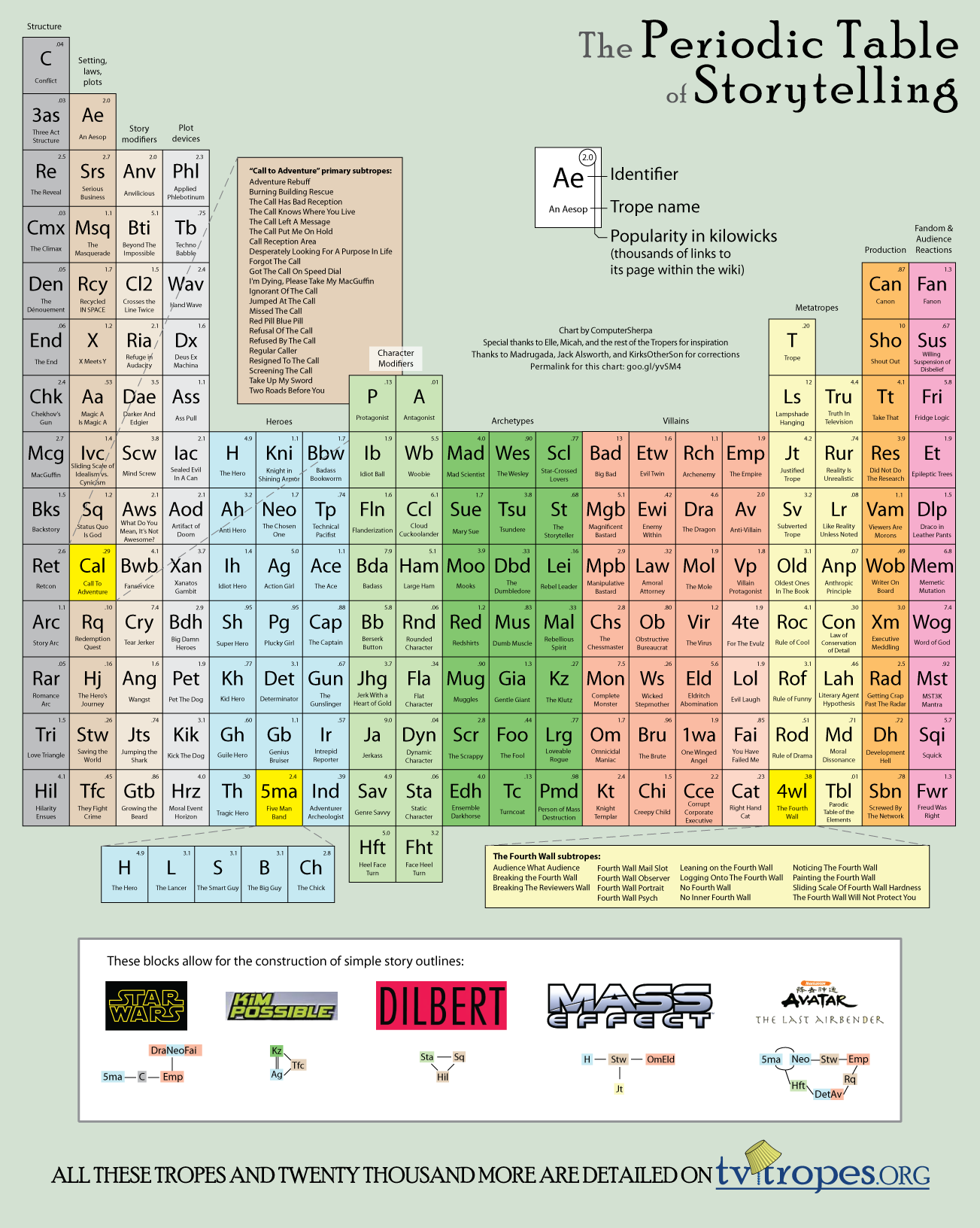
Awesome Conceptual Tool: The Periodic Table of Storytelling


So thanks to The Professor (my fiancée), here’s an absolutely amazing infographic that may just become my favorite outlining / conceptual tool. It’s the Periodic Table of Storytelling, which was posted on DeviantArt by ComputerSherpa, a second-semester art student. Check out the table below:

Periodic Table of Storytelling by ComputerSherpa

Periodic Table of Storytelling by ComputerSherpa, via DeviantArt

What makes this infographic so amazing is its ability to map out just about any story structure using its “atoms.” ComputerSherpa included some great example molecules that lay out some really well-known stories, and I might just start using molecules like that when I outline my own stuff. What I really need is a smartphone app that will let me search and model those kind of storytelling molecules on my phone. That would be really helpful.

In the meantime, lacking such a smartphone app, you can order a poster print of this here. The example molecules have been removed from the bottom on the poster (which I think is a shame), but I think it’s really cool anyway.

Sufficiently Accurate for Poetry: Charles Babbage and the Analytical Mind


So doing research for an alternate history I’m working on, I read through the Wikipedia entry on Charles Babbage and was particularly struck by the following passage:

Babbage once contacted the poet Alfred Tennyson in response to his poem “The Vision of Sin”. Babbage wrote, “In your otherwise beautiful poem, one verse reads,[43]

Every moment dies a man,
Every moment one is born.

… If this were true, the population of the world would be at a standstill. In truth, the rate of birth is slightly in excess of that of death. I would suggest [that the next version of your poem should read]:

Every moment dies a man,
Every moment 1 1/16 is born.

Strictly speaking, the actual figure is so long I cannot get it into a line, but I believe the figure 1 1/16 will be sufficiently accurate for poetry.”

This made me LOL, and I thought I’d share.

Awesome list of Genre Review Blogs


Courtesy of Grasping for the Wind, I’ve just posted an awesome (and huge) list of science fiction and fantasy review blogs. You can find the full list here.

Artist Interview: Elizabeth Goldring


A little while ago, I had the pleasure of commissioning a work of art. Why it was necessary…well we won’t get into that. But I needed a practically life-size baby sky bison (as in, the six-legged flying bovines from the Avatar the Last Airbender cartoon). In doing so, I had the pleasure to work with Elizabeth Goldring, a young artist just starting in the business. Working with her, I thought it might be interesting to do an interview with her and get a visual artist’s perspective on some interesting questions:

1. As a new artist breaking into the field, how would you describe your work?
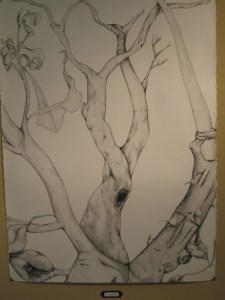
I like to make work that is subtle yet striking. I enjoy the idea of creating a beautiful object, be it a drawing or a sculpture, that has a quiet strength. The imagery that I use tends to be unusual or unsettling but not shocking or loud. I draw on nature, mostly plants and animals, though sometimes the figure as well. I like to do a lot of different things. I think one of my biggest issues is that I have so much I want to do but only 2 hands and 24 hours in a day.

Cryptobotany by Elizabeth Goldring

Cryptobotany by Elizabeth Goldring

2. What do you think has had the greatest impact on your work? How do those influences affect the work you do on commission versus the work you do for yourself?
I would say that my own experiences have had the greatest impact on my work. My personal pieces tend to be heavily autobiographical though not necessarily in the conventional sense. It’s really in regard to the emotional content, not so much the subjects themselves. The pieces tend to require a lot of repetitive almost meditative actions and in that kind of mindset I end up imbuing the pieces with emotion as opposed to concept.

Commissions are always going to differ from the personal simply because I am producing something to please someone else as opposed to myself. Then there is the difference between commissions that are someone else’s concept that require approval from the buyer versus commissions where I am essentially given free reign. Even in those situations though, I still enjoy the process and I like to think that the work still has my mark.

3. Aspiring writers are usually told to read, read, read. Is there some similar advice for aspiring visual artists? What kind of value does it provide?
The usual advice is know your predecessors as well as your contemporaries, so its a combination of look look look and read read read. It’s important to know where you come from artistically, to know your influences. The past can inspire you in a lot of ways, whether it’s finding something in it that you admire or coming across something that shows what you don’t want to do. Art comes from Art, it does not exist in a vacuum.

4. When working on a piece, what’s your process like? How do you set the priorities for your work in general or for a particular piece?
My process varies depending on what I am working on. Drawings tend to be a little bit more organic while sculptures require more planning because of materials tests and mockups. Drawings still require some planning, but that’s usually just some loose sketches to get a feel for proportions and to try different compositions. Once the initial tests and sketches are done I try to just sit down and work for as long as I can. Sometimes I can work for 8 hours or so only stopping to eat or stretch, other times I can only focus for an hour. Even if I feel like I can keep working after a long sitting I try to walk away from it for a little while so I can come back to it with a fresh eye and see what needs changing. It can also be difficult to know when something is “Done;” walking away is key here so that the piece doesn’t get over worked. There is always more that can be done but there is not always more that should be done and some time away from the work helps in that decision. The finished piece is important to me, but honestly I tend to get lost in what I am doing. I really enjoy the process, it makes me feel calm in a way that few other activities do.

5. How do those priorities translate into your broader opinions on art and its role/function in society?
I was once told by a professor that making art is the most self indulgent thing a person can do with their life. I think that sums up how I feel about making art fairly well. I will admit, as an artist I am fairly selfish. I love what I do but I do it for me, I have no grandiose ideas about my work changing the world or the face of art or anything like that. I am not attempting to raise political or social awareness or make a “statement”. These are the functions generally associated with art and its purpose, and these are completely valid for some artists, but not really for me. I take a much more hermetic approach to what I do, it is about making things that I think are beautiful and convey the emotions that I need them to. If other people can connect with it on a similar level, then that is a really successful piece, but at the end of the day I am the one who has to be square with what I have created. Again, a lot of this is about the act of doing for me so it is difficult for me to think about their function outside of that. In an ideal world the person who looks at the piece finds something in it akin to what I felt while making it. For some art is a vehicle for some greater message or statement. For others its not.

6. Is there a divide between the “fine arts” and “illustration”? If so, where does that divide come from? Should it exist? And which side of it do you fall on?
There is a definite division between fine arts and illustration, though not as much in recent years. The division usually comes from the idea that fine artists decide what they will make and how they will make it, with only themselves and their intentions in mind. Illustrators have traditionally been seen in a commercial light; usually they are a way of realizing someone else’s vision. There are many illustrators being featured in fine art galleries now, and there is more acceptance of them than there was though I still hear the term “illustration” used as a derogatory term towards drawings. I think the difference really comes from the intention of the work. It’s all a gray area that is open to a lot of debate.

7. For writing, I’ve always believed that technique/craft is one half of what makes great art. Is it the same for the visual arts? And do all visual artists feel that way, or just you?
Personally I think technique is definitely a large part of a successful piece, this holds true for some artists and not others. For some people the concept is the entire point and execution is merely a formality. In the conceptual art movement of the 60s it got taken so far that some artists thought it was enough to come up with the idea or instructions and that it wasn’t even necessary to bring it into physical being. That approach: not for me.

8. Many writers say that the art of writing is the art of re-writing. Does your work go through any kind of editing or revision? How does (or doesn’t) that work?
I think the revision process is a huge part of art making. I do a lot of revisions and editing during the preliminary sketches; that is part of the entire reason to do them. They are like a rough draft. Just as in writing, it’s about trimming things down or adding things in. Revisions can vary in difficulty from piece to piece depending on the materials. A graphite drawing is easier to revise than ink, a clay sculpture is easier to revise than stone etc.

Regeneration by Elizabeth Goldring

Regeneration by Elizabeth Goldring

9. Can you tell us anything about the stuff you’re working on now? Or where can we see any of your work?
At the moment I am working on a series of drawings as well as some sculptures. The basic premise is documenting strange and anomalous occurrences in nature. Specifically plants and animals. It plays off the human tendency towards anthropomorphizing the world around us and our capacity to love what also repels us.

I am currently part of a show at the Visual Arts Gallery in New York City (601 West 26 Street, 15th Floor, New York, New York) that will run through February 15, 2011. I also have a blog where people can see my past and current work until I compose a more formal website: http://egfineart.blogspot.com/

So with great thanks to Elizabeth and her insightful answers, I think the best way to sign off is to show the results of my own commissioned piece. Here’s Baby Appa, relaxing in front of the fireplace (I apologize for being a lousy photographer – the picture doesn’t really do justice):

Baby Appa by Elizabeth Goldring

Baby Appa by Elizabeth Goldring (mediocre photo by King of Elfland's 2nd Cousin)

An Approach to Re-writing a First Novel


Several months ago, I wrote about my perspective on the differences between writing a novel and writing a short story. Now, several months later I’m knee-deep in re-writing that first draft of the novel, and so I thought it might be neat to follow up on my earlier comments:

Distance Buys Perspective

Writing a novel is an intensely personal investment, made over an extended period of time. It can take months or years of our cogitation, sweat, and emotional turmoil. It’s never far from our minds. We lie awake in bed thinking about how to do certain things with it (at least I do). By the time we write “The End” we’re relieved and rightly proud of our creation. And – I at least – wanted to dive right into re-writing it.

But that’s not wise. Because after we’ve just finished writing the book, it’s still up at the forefront of our minds. The characters names roll off our tongues, and we could recite the events of the plot backwards and blindfolded. Even if we can’t recite the text from memory, we still know what the sentences should say. At this point, we’re too close to it for effective revision. Where the story has narrative pot-holes – missing plot points, pacing issues, clumsy writing – our minds fill them in, gloss over them, because we know how it should work. It’s like having beer-goggles on: our minds won’t let us see the reality.

Which is why all of the smart advice out there tells us to wait. To put the book away. File it in a drawer, forget about it for a couple of weeks, or a couple of months, work on something else and then come back to it. Coincidentally, Kay Kenyon – one of my favorite science fiction authors – just posted about this exact issue. Unsurprisingly, I agree with her with all of my heart. But, like avoiding sweets and getting regular exercise, it’s not easy.

Letting it settle is one of the hardest aspects of writing a novel that I’ve discovered. While waiting to go back to my first novel, I took the time to write a second novel (okay, technically a graphic novel – but I figure it counts). Even though I intellectually know that I need to leave that graphic novel aside and let it settle, I still want to dive right into it and do the re-write. Which, much as I am loathe to admit it, is probably proof that I’m still too emotionally and intellectually close to it for proper revision. But it really makes sense to resist the temptation, because it lets us spot weaknesses that otherwise we would miss.

The Re-writing Attitude

Getting ready to re-write my first novel has been a mix of trepidation and hubris. On the one hand, I’m worried that as I take another look at it I’ll discover that it sucks. Then my ego kicks in and says “What are you talking about, the book is great, it can’t possibly suck.” Of course, that ego is a thin veneer over my own insecurities (which, of course, I quash). Which is why I found it helpful to keep the following statement in mind as I sit down to re-write:

Most first novels don’t get published. It’s okay if it sucks: we re-write to make it better.

Ask a bunch of authors how many books they wrote before they ever got an agent, or before they ever sold one to a major house. The number will surprise you. I’ve regularly heard debut authors talk about having five, six, seven finished novels (sometimes entire series!) in their drawers at home. That’s because writing a novel is a skill, and it is a skill that takes time to hone. Writing short stories can help with some of the craft, but it takes a different set of skills to write a great novel. In many ways, I think of it like playing a sport: how many games did Babe Ruth have to play before he could hit a homerun in the major leagues? How many pick-up basketball games did Michael Jordan play before setting foot on an NBA court?

It’s alright if the first draft of a novel sucks. That’s why it is the first draft. Because, if we’re serious about writing, we’ll produce a second draft that will be stronger than the first. And if need be, we’ll write a third draft that’s even better than the second. And at some point, perhaps, the finished product might be polished enough for publication. And if it isn’t, well then the skills we’ve picked up and practiced will help us write our next book, which will be better than our first. At least that’s the theory.

The Process of Re-writing

The Professor – my fiancée who edits YA books for a living – gave me some really good advice on the re-writing process. Of course, being male and knowing better, I promptly ignored her excellent advice and it bit me in the ass. Her advice on the process of re-writing:

Don’t sweat the small stuff.

When I initially picked up my first draft and started to read it, I did it with pen in hand. I dove in and attacked clumsy sentences, poor word choices, weak verbs. In the trade, this is called a line-edit and apparently it’s a classic first-time novelist mistake. The point of the re-write isn’t to fix the little flaws that have crept into the work. The point of the re-write is to spot the BIG structural weaknesses. If we’re bogged down in the minutiae of the sentences, we’ll never see the yawning pacing chasm or the gaping plot hole. We won’t see the forest for the trees.

I realized this about mid-way through my book. I had a niggling concern about a structural issue (the pacing), and it just wouldn’t leave me alone. But I couldn’t diagnose the problem effectively, because by jumping right into the sentences, I had gotten in too deep, too quickly. So I had to put it down again, walk away from it again, and then approach it a different way.

My second time around, I followed The Professor’s advice, and read it just as a first time reader would. I read through it – cover to cover – without a pen in hand. I was reading it like I hoped a typical reader (or an agent, or an editor) would. I was paying attention to my response to the text, to see where my interest flagged, where the story got my heart racing. I wanted to find where the book worked well, and where it lost me. Sure, I still saw the occasional weak sentence. But I resisted the (often difficult) temptation to pounce and fix it. Instead, I tried to figure out if the bones of the story worked.

Here’s what I found (in ascending order of importance):

  1. The events of the plot – at a general level – work reasonably well.
  2. The world-building seems reasonably solid, with compelling settings and believable (and interesting) factions/characters.
  3. The themes of the book can be emotionally and philosophically interesting.
  4. I lost interest around the 25% mark, and didn’t have interest until the last 5% of the book.

That last one is really important: reading through the book, it fundamentally failed the “So what?” test. That failure was evident in the way that the book slowed down and lost the reader’s interest. That, however, is just an observation: a fact. It told me nothing about why it lost the reader’s interest. In thinking it through, and discussing it with The Professor (who was awesome enough to take a look and give me a professional’s opinion on where I dropped the ball), the major failing’s cause was the protagonist’s motivation. It didn’t ring true, it didn’t work, and as a result, the reader just didn’t care.

Responding to a Major Flaw

That’s a major, major super-mega-important flaw. Characters are their motivations, and so if the hero’s motivation isn’t compelling…well, the story’s missing its fuel. That’s also not a quick fix. That’s not something that can be addressed by “sticking it in” as an editorial after-thought. To get that kind of motivation right, it needs to be ever-present throughout the story, from the first sentence all the way through to the last. And it should have really started with a question I’d failed to ask myself at the onset: why is my hero the hero?

The answer – if I’m being honest with myself – is that in the case of this novel, his was a convenient perspective and I wrote the opening chapters with a nifty voice that I happened to like. Alas, that’s not enough of a reason. So back to the drawing board. I took a look at the story, rotating it in my mind and considering all of the characters’ motivations and trying to determine how I could find/develop a more compelling hero. As I did this, I found the answer staring me in the face: the book had a major character, who did have motivation, and who was compelling…he just wasn’t the original focus. The solution (perhaps) would be to make that character, or someone like that character the hero.

Of course, this would mean re-writing the whole book. I wouldn’t be able to keep the eighty-three odd thousand words I’d written over the course of five months. I’d have to junk it, and basically start from scratch. That is not an easy call to make. It took a lot of work to write those words, and some of those words were (I think) pretty good. But I faced two basic choices: I could either trash the whole novel, or I could take another stab at it by writing it all over again from a different perspective. Rather than throwing in the towel, I decided to (literally) re-write it.

My reasoning was pretty straightforward: the bones of the plot, the world-building, the themes, they were all solid. I had gotten them right once, I could get them right again. It was my hero/narrator characterization which had failed. I’d written a book once, right? Surely I could do it again. So I decided to re-write it. This also gave me the opportunity to re-imagine what kind of motivation I wanted to give my (now-different) hero, and to play with the components of the plot to add more tension and raise the stakes. It’s an opportunity to take another stab at the whole project, and make the whole thing that much stronger.

Looking to the Future

And so now that’s what I’m doing. It’s early days yet. I’ve got a revised outline in place, and I’ve re-written the first couple of chapters. I’m thinking that maybe, as I get further along in the re-write, I might be able to re-use some select passages from my earlier draft. But I’m not certain of that. If I can, great. If not, no big loss. The actual process of writing the book is going smoother (and it seems faster) than on the first go-around. That’s probably because I’ve been living with these characters and this world in my head for almost a year now. It also suggests to me that I’m on a better track: the experience is reminiscent of writing the graphic novel I finished a couple of weeks ago, which has much simpler motivation (it might have other issues, but the motivation at least should be pretty solid).

I don’t know if this re-write will make the book good enough to vie for representation and publication. I’m hopeful, but if it ends up not being good enough…well, that’s alright, too. Because the process has taught me a lot about myself as a writer and about some of the skills that are essential for writing long-form work. And so even if this first novel ends up collecting dust in a drawer, I’ll still say it was damn well worth it.