Skip to content

Posts from the ‘Random Thoughts’ Category

BEA 2012 (Day 0): The Book Blogger Conference


NOTE: Since I’m spending this week at BEA, my plan is to post a daily recap of my perceptions of this year’s event. Today – Tuesday – is the first day of the expo itself, so here is my review of yesterday’s Book Blogger Conference.

Several weeks ago, I wrote (here and here) about Reed Exhibitions’ stumbles and strategic missteps in the run-up to the 2012 Book Blogger Conference. Now that the event is over, a brief follow-up might be helpful.

The Weaknesses of BEA Book Blogger Con

On the whole, I was quite disappointed. I can look past communications screw ups (provided they get fixed). I can shrug off logistical blunders the day of an event. I can even tune out the occaisional poor speaker. But, as feared, Reed’s earlier missteps have proven where the organization’s priorities lie…and book bloggers do not make the cut.

The day started with an author/blogger networking breakfast. Tables were set up, and authors went on a “speed dating” trip…rotating between each table every fifteen or so minutes. The same setup was repeated for lunch. Speculative fiction – and generally fiction beyond YA – was woefully underrepresented. The morning literally had none, while the afternoon offered only two speculative fiction authors. While I was personally disappointed by SF’s absence, this part of the program did not bother me. It worked reasonably well, and likely provided value for the conference’s other attendees. I don’t mind being pitched when I expect it, and when the rest of my conference is goign to be full of insight into blogging practice.

But then we got to the keynote, which was presented by Jennifer Weiner, author of The Next Best Thing: A Novel. Weiner was an interesting (and for many book bloggers surprising) choice of keynote speaker: she is a popular author first, and a blogger second. What could she have to say that is both relevant to book bloggers and significant? In fairness, Weiner gave a good speech, and she made a herculean effort to focus on blogging. Yet it was clear to everyone in the room that she was there for one reason: to promote her upcoming book. The closing speaker, Jenny Lawson (a.k.a. the Bloggess), at least had a closer connection to the community…but she, too, was there to promote her recent book Let’s Pretend This Never Happened: (A Mostly True Memoir).

This was a common theme in much of the Book Bloggers Conference’s programming: it was skewed to align with the interests of authors/publishers in promoting their books to the book blogging community. I understand the motivation, and I understand the temptation: after all, publishers spend a lot of money on booths at BEA. The breakfast, the keynote, (to a lesser extent) the panel which followed, lunch, and the closing presentations all were oriented around pitching to the book blogging community. I for one regret having – apparently – spent $135 to be not-so-subtly pitched.

The Good amidst the Bad

Yet that being said, the day was not without value. Out of seven elements of the program, there were two which actually focused on the audience’s interest. The afternoon featured two breakout sessions, where we could each choose panels to sit in on that addressed either monetizing blogs, engaging community, critical review craft, or the publisher/blogger relationship. I sat in on the panels on monetizing and engaging community, and both were actually on-topic, interesting, and insightful. I walked away with at least one significant insight from each of these two panels. Had this ratio been maintained for the other program features, I would have been quite satisfied.

The Verdict: Reed Exhibitions Either Doesn’t Care About or Understand Book Bloggers

Unfortunately, $135 is a lot to spend for two insightful hours out of nine total. What I hoped for from the event was an in-depth discussion of blogging practice, offering relevant expertise from people who know whereof they speak. There was plenty of such expertise in the room. But – with the exception of the two panels I mentioned – there was terribly little on the program itself.

If this were an isolated incident – a programming snafu – it would be unfortunate, but reasonably acceptale. But this was not an isolated mistake: it is yet another indication of the conference organizer’s condescending attitude towards book bloggers. It leaves me to wonder: would critics for national news organizations get such treatment? Somehow, I think it unlikely. Other book bloggers, notably Read React Review and The Reading Ape, saw this coming. And I am sad to say that their fears were proven prescient.

If you are a book blogger, and if you were at the 2012 BEA Blogger Conference, you might have a different opinion. I know some people thought the conference was a valuable and enjoyable experience. But for me, it failed to provide the concrete insights I was looking for, and unless I see a dramatic improvement in Reed’s communications and programming, then I will skip it next year. Better to save my time and treasure for BEA itself.

PSA: Viable Paradise Applications Almost Due!


This isn’t my main post for the week (that’ll be going live in a couple of hours), but I just wanted to issue a quick PSA:

The deadline for this year’s applications to Viable Paradise are fast approaching. Applications are due on June 15th, 2012 which is just over three weeks away.

If you’re polishing up your application, or if you’re still on the fence about applying, here are some fun links to check out from some of my classmates (if you’ve written about the VP experience and I missed it, let me know and I’ll add your link!):

If after perusing some of these links, you’re still uncertain and want to chat with someone who’s gone, just shoot me an e-mail, tweet @KgElfland2ndCuz, or comment here!

BEA’s Follow-up to the “Press Pass” Controversy


As I wrote yesterday, Reed Exhibitions (the organizers of Book Expo America) stirred up bit of controversy by unexpectedly and summarily rejecting press passes for a large swathe of book bloggers. Perhaps unsurprisingly, many folks took to their keyboards with blog posts and tweets questioning both Reed’s decision and its handling (thanks everyone!). Today, BEA show director Steve Rosato posted an official response to this controversy over on The BEAN, and I urge everyone to take a look here.

Looking at this response, I have somewhat mixed opinions. As I said yesterday, my concerns were with the transparency of Reed’s criteria, the timing of their communication, and the broader implications suggested by both. So how does the official response score on these points?

First, I have to give them credit for recognizing that the timing/process of these press pass rejections was unfortunate. Since many bloggers (most of whom do it as a labor of love) have already shelled out cash for hotels and flights, it is encouraging that Rosato says:

For that we are very sorry and we apologize to those individuals (and are working with those individuals to resolve amicably in a way that will make sure they are able to still attend BEA).

What this means concretely, I don’t know. But it is an encouraging sign, and I’m pleased that BEA was able to both recognize that a mistake had been made, and to proactively try to address it. How they will do so, it is likely too early to know, but nonetheless this is encouraging.

On the transparency front, the post goes a little ways to help explain the criteria according to which press passes are issued. On the one hand, it is helpful that BEA lays out some of their criteria. It is a valid, and worthwhile step in the direction of transparency. And yet, I don’t think they’ve managed to actually achieve meaningful and helpful clarity.

Reading these criteria I don’t know if I qualify or not, and I imagine many book bloggers are in the same boat. Here’s a detailed breakdown of what does and doesn’t work about these “standards”:

BEA Criteria My Comments
No one under 18 years of age. This is great! It is clear, unequivocal, and absolutely unambiguous.
Professional editorial coverage of BEA in trade magazines, electronic media (TV, Radio, etc.), blogs, periodicals, etc. What does this mean? By “professional” does that mean that the journalist needs to be paid for it? Or does “professional” in this case imply a certain level of quality/professionalism? Would bloggers – most of whom are unpaid – be disqualified by this criteria?
Subject Matter & Focus A good, common sense criterion. If the journalist doesn’t write about books or publishing, why should they go to BEA?
Content Update Frequency A good criterion to judge on, but what’s the cut-off? Does someone who writes a monthly column not make the cut? What about (like me) a weekly columnist? What matters more: frequency or regularity?
Community & Traffic Also a reasonable criterion. Someone who is only read by their pet cat might not be right for a press pass. But what level of readership sets the cut-off and according to whose numbers? The bloggers’ own? comScore? Nielsen Online? Alexa? Compete? For print, you’ve got the ABC, MRI, and a host of other sources. I know book bloggers with the kind of traffic that I’d love who got rejected while others (much smaller) got through.

Overall, I’m encouraged by BEA’s response to this issue. They’ve at least recognized that a problem exists, and are trying to address the community’s concerns. But if BEA wants to maintain good relations with the book blogging world, I’d suggest that they make their criteria less ambiguous.

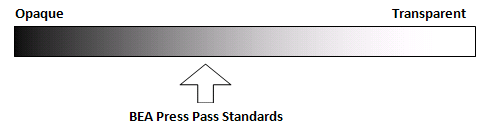
BEA Press Pass Standards Still a bit Translucent

Transparency and translucency aren’t the same at all, and as it stands I find their criteria a little translucent…which is still an improvement over opaque.

BookExpo America and the Definition of “Press”


Those of you who follow this blog regularly know that I’m pretty passionate about books. I read many, and every week I write either an in-depth analysis of some book/writing-related issue, or I post a detailed, analytical review of a science fiction, fantasy, or horror title. In the almost two years that I’ve been at this, I’ve had the opportunity to meet and work with some of the greatest, most professional publicists and authors in the world. It’s been an awesome experience, and one that (judging by the traffic of my blog and by my Technorati ranking) it seems folks appreciate (at least a little!). And yet, this blog no longer meets Book Expo America’s “standards that are required to qualify for a Press Pass”. Which is odd, considering that it qualified last year when my readership was about 10% of what it is now.

Here’s the form e-mail that I, and many other popular book bloggers, received from Reed Exhibitions today:

Thank you for submitting your Press application to attend BEA as a working member of the media. Unfortunately you did not meet the standards that are required to qualify for a Press Pass. The standards have been determined for BEA by our exhibitors as to what are considered benchmarks of a professional “press credential”. We review all applications very carefully due to limits on the number of press passes that are issued. Unfortunately, your application does not meet the guidelines we have been given in order to maintain the expected standard of trade and general media. We greatly appreciate your time and consideration, hoping you can still participate in BEA or follow the coverage through our video and podcast initiatives.

Best regards, -R
Roger Bilheimer
BEA Public Relations Director

Despite the fact that I’ve made lots of productive relationships through BEA in the past and covered the event on this blog, I understand if they’ve established criteria that I now fail to meet. It’s their event, and the guest list is in their purview. And yet, this whole process raises a number of questions. To whit:

1 What are the “standards [that] have been determined for BEA by our exhibitors as to what are considered benchmarks of a professional “press credential”” ?
2 Why are people only getting this notice today, two months before the event and several months after registering, when hotels and flights have already been booked?
3 Are Reed Exhibitions, and their publisher exhibitors intentionally sending a message to book bloggers that we don’t count as press, that our POV on industry events is less worthy?

To be clear, I’m not grousing about the fact that I’m not getting a press pass. At this point in my blogging career, I have enough relationships in the industry that I’ll still have plenty of stuff to cover even if I never set foot on the show floor. Yes, I might miss a lot of interesting developments…but I’ll still have plenty to write about, regardless. But, Reed Exhibitions’ lack of transparency, the lateness of their communication, and its implications are all troubling.

Is this the kind of relationship Book Expo America and its exhibitors want to foster with the book blogger community? Don’t book bloggers count as press? Shouldn’t we be given the professional courtesy of clearly communicated criteria before we’ve booked our flights and hotels, scheduled meetings and interviews? In short, if book bloggers act as professional media, don’t we deserve to be treated as such?

If, like me, if you’ve got a problem with Reed’s approach to this whole process and would appreciate some more transparency, please make Book Expo America aware of it. You can tweet stuff @BookExpoAmerica, as well as e-mail inquiry@bookexpoamerica.com. I’ve e-mailed and tweeted at them asking for clarification, and I know a lot of other book bloggers are doing the same.

If you care about books and their coverage on blogs, boost the signal!

Reflections on the Workshop Experience: Viable Paradise


So as I’ve mentioned before, this past October I attended the Viable Paradise writing workshop. The basic facts are pretty simple: it’s a week-long writing workshop for science fiction and fantasy taught by eight professional writers and editors. And the experience itself was amazing. While I’d been meaning to write a blog post about the experience, it wasn’t until some recent online discussions with other writers got my butt in gear, and thus here are my thoughts on my experiences at VP (note that Viable Paradise is so far the only workshop experience I have had, and so these thoughts may or may not apply to other workshops like Clarion or Odyssey).

Choosing to Attend a Workshop

Everybody’s got their own reasons for attending a workshop, most of which are set up like a combination of critique group and summer camp (only the “fun activities” involve critiques, lectures, and writing). I can’t speak to my classmates’ goals, but in my case I applied to VP hoping for a number of things:

Craft-oriented Critique Writing – especially in the novel-form – is a lonely activity, and living in suburban NJ I haven’t had any luck finding a professional-grade critique group. I was seeking new insights into the way I wrote, to identify and address weaknesses, and to get it through rigorous and detailed criticism of my work.
Revision Techniques When I applied to VP, I knew that I could write something novel length. But to then revise it so that it would be ready to ship out, that’s a whole ‘nother story. I wanted to develop the revision techniques I’d need to polish my prose enough to get published.
Community While there are lots of people out there who want to write, in the offline world I’ve had little luck finding those as serious about the craft, and as committed to writing as I am. I was hoping to get plugged into a shared sense of community that goes beyond the virtual.
Validation And yeah, it’s a guilty secret, but I wanted someone who didn’t have an emotional stake – either through love, family, or friendship – to give me their honest assessment of my writing. I hoped for some indication that my writing is good (while simultaneously learning where it could improve).

So with these hopes in mind, I had to figure out which workshop to apply to, get in, and then go.

Picking Between Viable Paradise, Clarion, and Odyssey

In the science fiction and fantasy genre, there are three workshops that regularly come up in discussions. In order of their (seeming) size/stature in the field, they are Clarion, Odyssey, and Viable Paradise. There are major differences between these workshops, however, and by considering how they differed I was able to pick which one I wanted to attend.

Note, that this comparison is based on what I (a prospective workshop student) was able to find out about these workshops online. I haven’t attended either Clarion or Odyssey, so please forgive me if I got anything wrong!

Clarion Odyssey Viable Paradise
Time of Year Summer Summer Fall
Duration Six weeks Six weeks One week
Focus Short stories Short stories (mostly) Novels or Short Stories
Instructors (total) Six One (with guest lecturers) Eight (though we got lucky and had a 9th “guest star”)
Instructors at One Time 1 – 2 1 – 2 Eight (though we got lucky and had a 9th “guest star”)
Format

  • Milford-style Critique
  • Lectures
  • One-on-one Critique
  • Writing Exercises

  • Milford-style Critique
  • Lectures
  • One-on-one Critique
  • Writing Exercises

  • Milford-style Critique
  • Lectures
  • One-on-one Critique
  • Writing Exercises

Application Fee $50 $35 $25
Tuition $4,957 $1,920 $1,100
Housing Cost (included in tuition) $790 – 1,580 $465 – 1,050 (plus tax)

With my more-than full-time job, taking six weeks off in the middle of the year was just not going to happen. And so that simple fact automatically disqualified both Clarion and Odyssey. Putting this underlying fact aside, Viable Paradise still appealed to me more out of the gate: with a reputation of focusing more on novels than short stories, VP aligned more with the issues I was wrestling with in my own writing. And I imagined that having eight instructors on-location for the entirety of the workshop would make it more intense and stimulating.

The Viable Paradise Community

After applying to VP (and getting accepted) I was shocked by the degree to which a VP community exists in the science fiction and fantasy genre. Sure, there’s an e-mail list on which instructors and alums from various years are pretty active. But when in July I went to Readercon, I met a whole bunch of awesome VP alums who were able to offer lots of insight into what the experience would be like. This community, and the sense of shared-experience and support were awesome.

When I got to Martha’s Vineyard, getting to know my classmates was equally awesome. While I can’t speak for everyone else, I was really nervous about meeting everyone. Some of them had pro sales to their names, others had agents already, and there I was with neither. I was nervous that I’d be the amateur among a group of budding professionals. I was a little nervous of the exact opposite, too: anyone serious about writing has met people who have lots of desire to write, but less will to do so. In hindsight, both fears were absolutely ridiculous.

My class at VP was a diverse group of folks, at all ages, all levels of experience, and all backgrounds. We had homemakers, and scientists, and business folk, and lawyers, and this diversity of background really enriched our discussions. Regardless of whether we’d sold anything or not, we all shared a passion for writing, our love of the genre, and our desire to improve. And more than anything else, finding my tribe was one of the greatest aspects of my Viable Paradise experience, and with any luck it will be the most lasting. It is probably telling that six months on, my VP class remains in touch and even has a sort of loosely-structured, self-organized online critique group type thing going on. Which is unbelievably cool.

Structuring the Learning

Like, I think, all of the leading workshops VP combines elements of Milford-style critique with lectures. Each day features group critiques, scheduled one-on-one critiques with instructors, lectures, general discussions, and unscheduled one-on-one critiques with instructors. The day literally starts around dawn, and doesn’t end until quite late in the evening. VP’s focus seems to be very much on face-time and interaction with classmates and instructors, which was exactly what I wanted.

Groups for group critique are structured around writers who wrestle with similar issues, or who the instructors think can bring particular insight to their other group members. I found the composition of these groups (put together based on our application materials) to be a masterful piece of psychology and craft deconstruction. The groups I was in (can’t speak to those I wasn’t) worked really well, and everybody had something different to say about the writing. Diverse viewpoints, all coalescing into a stronger whole.

The lectures and group discussions were another interesting dimension. Each day, a different instructor offered a lecture or moderated the group discussion (sometimes themed, sometimes not). But what is perhaps unique about Viable Paradise is that during these lectures and group discussions all (or almost all) of the instructors were present. This effectively turned the lectures/group discussions into a highly-interactive conversation, moderated by a group of super-experienced professionals. As a result, we got to see where different instructors might have different approaches, where something that worked for one instructor might not work for another. The heterogeneous nature of these discussions really elevated the experience beyond a typical “lecture”.

Each of us had two one-on-one sessions scheduled with different instructors. But what is even cooler is that the students are actively encouraged to seek out the other instructors to have off-schedule one-on-ones with them. The net result was that rather than having two one-on-one critique sessions, I got to pick eight different (amazing) brains about my specific work. I got infinitely more out of the sheer variety of viewpoints, the differing issues that they identified, and their different approaches than I could possibly have gotten from any one critiquer (however brilliant).

There was less of a focus on writing new content than I expected (I expected to have to write something new every day – don’t worry, you don’t) but I don’t think the program suffered any for that. And I couldn’t possibly forget about the social dimension: hanging out, talking about books, about writing, drinking, philosophizing, making music, and generally having a good time.

The Net Assessment of Viable Paradise

All in all, I cannot recommend Viable Paradise enough. It is the only workshop I’ve done to date, but the experience was fantastic. I have the sense that one gets out of it what one chooses to get from it. I went in wanting to gain a sense of community, to learn new skills, to identify weaknesses in my own writing, and to get validation that I’m not crazy to think I can write fun, interesting stories. I got all of that (and more) out of VP – and in only one week’s time.

If you’re looking for the kind of stuff I was, and you can take a week off of work to find it, then I recommend you apply to Viable Paradise. Applications for this year (2012) close on June 15, 2012, and you can find out what you need to do to apply by clicking here.

Unity, Economy, and Writing as a Revelatory Act


So I’ve finally read Samuel R. Delany’s The Jewel-Hinged Jaw: Notes on the Language of Science Fiction, which had been strongly recommended to me by many people over many years. It was definitely worth the read, and I was particularly drawn into the essay “About 5,750 Words” which should be required reading for any storyteller in any medium. In it, Delany presents a compelling metaphor for the act of writing, presenting it as a gradual revelation of the story’s essence where each word simultaneously moves the story forward and changes our perception of everything that came before. It puts me in mind of a writer-as-sculptor, chiseling away at a block of marble to reveal the shape beneath. Each strike of the hammer is the next word on the page.

NOTE: Delany is one of those amazing writers who instantly put me in a philosophical frame of mind. So bear that in mind: I don’t know how practical my thoughts are going to be, but they do represent the way my mind is drifting beneath his wind.

Honestly, I was surprised to find the revelatory metaphor so compelling. When it comes to craft, I’ve always fallen into the ultra-rationalist camp. I like to believe that I am (or that I should be) in absolute control of every aspect of my storytelling. Before writing word one, I have always liked to know where my characters and story were going, and how they were going to get there. That doesn’t mean I need to have an entire book in my head before writing, but it does mean I need to know where a particular scene (at the least) is going. Writing as a revelatory act just didn’t – conceptually – work for me. But I find that the more I write, the more my outlook on this is changing. Partially, this is a question of experience and a broadening of my toolkit o’craft. But it also stems from what I consider the driving force of narrative: the quest for unity in storytelling.

When I think of the greatest stories I’ve ever read I find that every level of their storytelling is pulling in the same direction. Stories affect us on a physiological and psychological level, exerting both a rational and emotional influence on us. Basically, when we read, our bodies and minds are like great echo chambers where everything feeds back on everything else, amplifying the essential notes to a thunderous roar. Stories like Hugo’s Les Misérables, Walter Miller’s A Canticle for Leibowitz, and John Crowley’s Little, Big use their action, emotions, and themes in concert to resonate like a struck gong. I’ve come to believe that the secret to that kind of amplified resonance is a perfect (or near perfect) unity between the story’s action, emotions, and themes and the structure, pacing, and words through which they are expressed.

The Essence of Story

On a prosaic level, a story is just a bunch of words or images set down and consumed in sequence. But at the heart of each story, there lies some ephemeral truth that we as artists wish to communicate. Every story ever created might have a very different kind of truth: Zamyatin’s We warns us against the logical extremes of Marxism. Crowley’s Little, Big shows us something about family and the cycles of life. Jackson’s “Flower Garden” points us to the horror of unstated small-town bigotry. These truths could not be more different. Yet they are the unifying elements which tie together the events of their respective story, the structures of those events, their pace, and the words used to express them.

In that sense, I agree with Delany that our job as writers is to identify the underlying essence of the story. That essence is a chimerical questing beast: I don’t think any of us can ever truly internalize every aspect of a story’s essence. Any mere mortal’s brain would probably explode. But we can and should get our reaching fingers around the last, loose strand of that beast’s tail. And having plucked that strand free, to take a page from Baron Cuvier’s playbook and extrapolate the rest of the creature as best we can.

Different writers approach this in different fashions. My own preference is to consciously consider the essence of the story before or during its initial writing. But I know plenty of great authors who don’t give it any conscious thought until after it has been written. Their initial focus is on telling a fun story: they let their subconscious build the story’s essence, tie it into their words, and then try to amplify it during revision. Neither approach is better or worse than the other, and both ultimately lead us to the moment when a story gains meaning and achieves artistry. In my own writing, I’d really like to master both techniques, though I have a long way to go with both.

Words, Words, Words: The Only Things the Reader Sees

Fortunately or unfortunately, we can’t just download the essence of our stories into the audience’s brain (though I imagine there’s a good SF story in that concept, come to think of it). So we have to use symbols and metaphors to approximate that essence, employing language (the most basic symbol) to do so. Which is what brings us to Delany and Chekhov. Consider the following two quotes:

A sixty-thousand word novel is one picture corrected fifty-nine thousand, nine hundred and ninety-nine times.

Don’t tell me the moon is shining; show me the glint of light on broken glass.

Samuel Delany Anton Chekhov

The Chekhov quote is often used by folks blathering on about “show, don’t tell” and I’ll put it bluntly: they don’t get it. All writers – yes, even Chekhov – rely on “telling” to a greater or lesser degree, so that truism is only helpful for the most basic writing. Delany and Chekhov are implying the same concept: they are each indicating that the words we use become the very essence of the story we are trying to communicate. Chekhov’s two nouns (his “glint of light” and “broken glass”) communicate more as images than his earlier verb (“shining”). We don’t need to know the story’s plot for those words to evoke emotions. The words themselves and the rhythm of their sequence do all of the heavy lifting. And to Delany’s point, Chekhov’s simple exhortation is effective because he first paints a picture (of the moon shining), and then refines it with more powerful and evocative language.

Word choice and sequence matters, because unless we’re working in a graphical medium, it’s the only tool we have. But when those words align with the emotions, themes, and (manipulative) intentions of the storyteller, then we achieve unity, and by the same token, the inevitability of prose that most folks like to call “style” or “economy”.

Plot and the Essence of Story

When I think about plot, I usually think of it as independent from the essence of my story. The truth of my stories is only tangentially related to the plot. While I find Ayn Rand’s screeds and self-aggrandizement to be incredibly annoying, I love the concept of plot and plot-theme which she introduces in her The Art of Fiction. What she calls the plot-theme is for me the essence of the story. It is what the story is about, its philosophical and emotional core. It is the truth that I wish to communicate. But plot is just Stuff That Happens, which, if I’ve done my job correctly, expresses the plot-theme succinctly and powerfully. And it does so by making the story’s essence accessible for the reader.

Consider the essence of Miller’s brilliant A Canticle for Leibowitz. One can likely reduce it to the warning that if we aren’t careful, we risk repeating the tragic mistakes of the past. Stated so baldly, the power of that essence is blunted. It becomes bland, polemic, and boring. But it is through Miller’s plot (what happens) that the story’s essence is demonstrated in action. Through the characters, and the events they experience, we gain a means of emotionally investing in the story’s essential truth…before that truth is fully revealed at the book’s conclusion. Our engagement with the book becomes emotional as well as intellectual, thus increasing the story’s effect on us.

When done properly, every plot point in a story contributes to the story’s final essence. This contribution, or the story’s essence itself, might not be apparent until the very end of the book. But if when we turn the last page the characters have consistently acted in support of the story’s unstated essence, we will find ourselves satisfied and the story ringing in our hearts and minds.

Writing as a Revelatory Act: A Writing Exercise

In his essay “About 5,750 Words”, Delany performs a neat trick: he writes a single descriptive sentence, and painstakingly, word-by-word shows how each word revises and clarifies the initial image that the author has in his head. It’s a neat trick, because it literally puts into practice the concept quoted above. And it shows how one can consciously construct a unified, economical story.

Of course, Delany does this trick for didactic purposes: I suspect that when he sits down to write fiction, he does not weigh each word five or six times before deciding on it. Doing so would likely mean decades spent on a single book. Yet I find myself fascinated by this concept of each word simultaneously revising and building on the words that came before it. Given the underlying essence of story, it makes that story’s expression a revelatory act: likely as surprising to the author as to the reader. And that kind of revelation would be awesome.

Because of the way my brain is wired, I strive to do everything on purpose. But of course, that’s an aspiration and I doubt I ever really come close to meeting it. But sometimes, a reader’s comments really surprise me. For example, one of my beta readers recently sent me her feedback on a draft of a finished novel. In her feedback, she mentioned how much she liked the fact that two opposing characters at different points in the story mirror each other in their personal desires for vengeance. She thought it really added and amplified the philosophical and emotional themes at play between those characters.

And this floored me, because while I wrote the words and mapped out the plot, this was just a happy accident. I wish I was cool enough to do that on purpose. But in fact, it was a revelation to me, because at no point in the process did I tell myself “These enemies will be mirror images of each other along the dimension of vengeance by which their themes will be amplified.” It just worked out that way. And even after I’d written it, I didn’t notice that that’s how the characters and their actions related to each other. Which on one level, just goes to show that even a self-conscious writer’s subconscious has a heavy hand, and that readers will always find something the writer didn’t expect in every story. Of course, on another level it might mean I wasn’t paying enough conscious attention to my story – which if that’s the case is a little more worrying.

Which brings me back to the trick that Delany employs in “About 5,750 Words”. I get the impression that letting the imagination run free and consciously considering each word individually and in sequence may produce the same kind of revelatory experience. If nothing else, I suppose it will exponentially increase my awareness of word choice. It’s probably not a viable technique for writing long pieces, but I think I’m going to do a writing exercise at some point where I write an entire short story one word at a painstaking time…without prior consideration of the story’s essence. On one level, this sounds almost like free-writing (an exercise I always found frustrating and useless). But I think it is actually more its opposite: because each word is carefully weighed and selected, it will hopefully yield some of the most unified and essential writing I could hope for.

At least, that’s the theory. And I figure it’s a worthy experiment to try. Would you like to see the results of the experiment up here on the blog? Since it’s just a crazy experiment (I don’t expect the creature to live), it might be fun to dissect it. What do you think? And how do you approach getting that kind of unity into your stories?

Enter Macduff


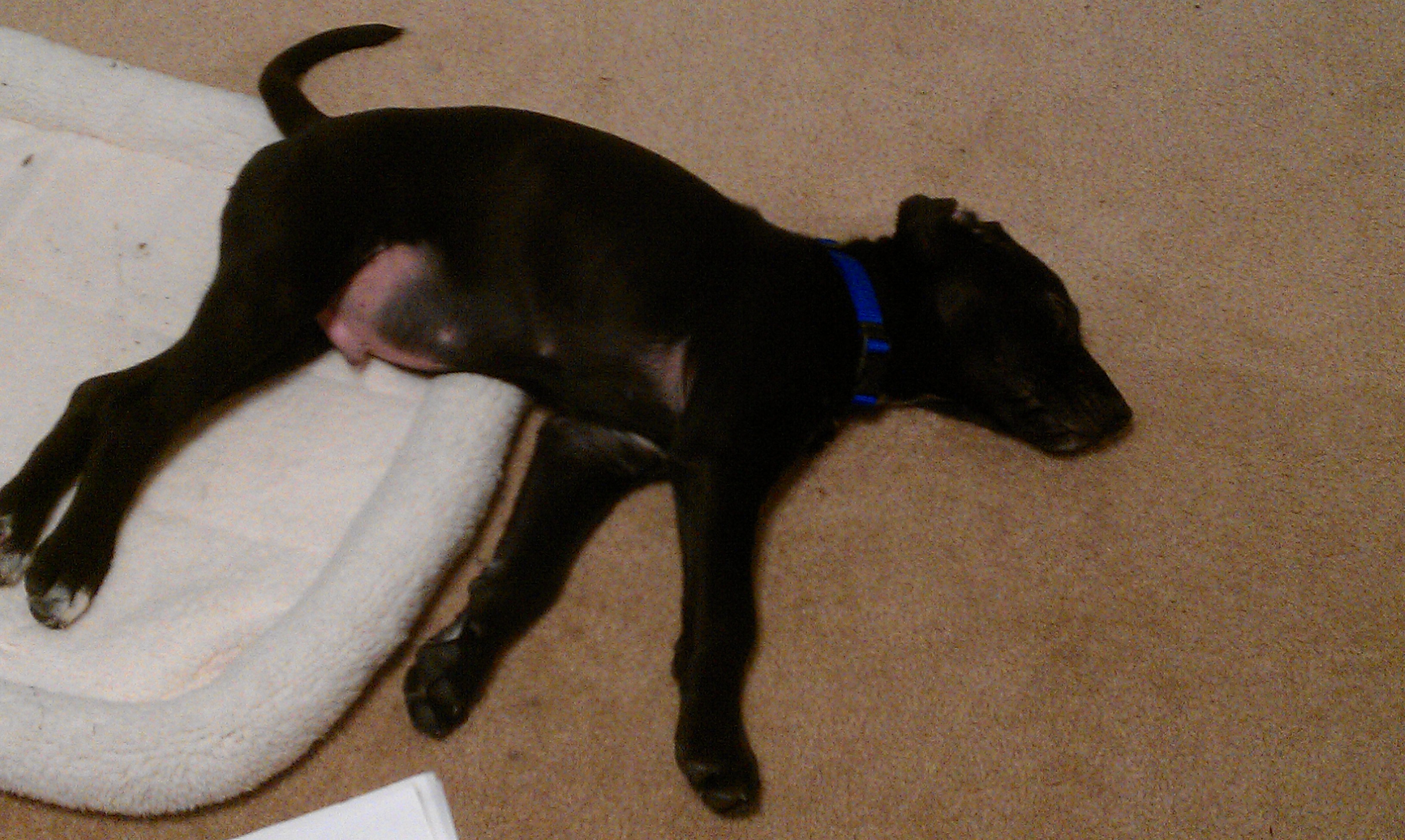
So things have been a little hectic today at Casa Chris. And it’s all because of this little guy:

Macduff, Thane of Fife

Macduff, Thane of Fife

Yeah, ain’t he a cutie? His name’s Macduff, and he’s about ten or eleven weeks old. He’s a rescue, apparently some kind of retriever/hound mix. We picked him up today from a local shelter, and he is an absolute sweetheart. And now, after a very trying day of exploring his new home (with minimal mess-making, thankfully!) he’s fast asleep. So fast asleep, in fact, that he missed his doggy bed.

Ruminations on Blogivating after a Year and Change and Resolutions for 2012


So judging by the calendar, this is going to be my last blog post in 2011. This time of year always makes me a little introspective, and leads me to think about what the past year has brought and what I want the new year to bring. And since at this point I’ve been posting weekly reviews and essays fairly religiously for the past 15 months, I thought it would also be a good moment to assess how this blog has developed.

Thank You All

First, let me say how utterly and completely thankful I am to everyone who reads this blog. When I started back in 2010, I thought it would attract some ten or fifteen people every week. I figured that was a safe expectation, considering that the non-fiction I write tends to be fairly dense by the standards of the blogosphere. Add to this the fact that I’m writing this blog anonymously and that I’m not a big name author, and well…let’s just say that the visitor stats back in late 2010 bore out my suspicion.

But over the last year, I’ve gone from averaging about fifteen weekly readers to now averaging about fifteen hundred (excluding spam commenters, who I assume don’t actually know how to read). This fact is amazing, and incredibly gratifying. It is humbling to know that there are so many like-minded people out there who love speculative fiction as much as I do, and who find my thoughts interesting enough to subscribe, read, comment, and share with their friends. Seriously, you are all amazing. Thank you!

What Folks Liked in 2011

Since September 2010, I’ve made eighty-four posts here. Of those eighty-four posts, one third were reviews and the rest were almost all theoretical discussions of writing and genre. Based on my WordPress stats, the ten most popular posts in 2011 were as follows:

RANK TITLE DATE POSTED
1 Science Fiction Techniques in Spy Novels: James Bond and George Smiley November 22nd, 2011
2 The Evolution of Middle-Grade Fantasy and Television August 30th, 2011
3 Techniques in Writing Alternate History February 22nd, 2011
4 Flirting and Writing Good Dialogue June 26th, 2011
5 REVIEW: The Crippled God (Malazan Book of the Fallen, Book 10) by Steven Erikson March 2nd, 2011
6 Leaping the Chasm of Imagination: Verisimilitude, Historical Fiction, and Speculative Fiction November 1st, 2011
7 REVIEW: The Clockwork Rocket by Greg Egan July 19th, 2011
8 The Future is Now: Is Hatsune Miku William Gibson’s Idoru made real? December 21st, 2010
9 Some Brief Thoughts on Love, Relationships, and Characters in Fiction August 9th, 2011
10 A Theory of the Hero: Story Archetypes for Heroic Characters (part 2 of 3) September 17th, 2011

What this data suggests to me is that you folks like my theoretical investigations of genre more than my reviews. Is that the case? As I look to continue this great blogging adventure in 2012, I’d love to know more about what kind of material you’d like to see. I did a couple of one-off experiments in 2012 (the interview with Jonathan Case and Steven Padnick, a couple of three-post blog series, etc.) and they were qualified successes. Do you want to see more interviews? Guest posts? Podcasts? Video blogs? More pictures of our guinea pigs? Or should I stick to the approach I’m currently adopting under the theory of “if it ain’t broke, don’t fix it?”

Current Resolutions for 2012

In 2012, I would like to continue this blog. I’ve been having a lot of fun writing it and getting to exchange views with all of you both here and on Twitter. As I’ve been thinking about what to do with the blog in 2012, I’ve put together a brief list of blog resolutions for the new year. A year from now, it’ll be fun to check back and see which of these resolutions I actually managed to stick with:

  • Read James Wood’s How Fiction Works Without Throwing it Across a Room. I read a lot of literary criticism and books on writing. I find them fun. But I have never been able to get through James Wood’s How Fiction Works. I find that his quasi-academic presentation obscures his rather banal observations, and the book has just infuriated me every time I’ve picked it up. Yet it comes highly recommended, and so I resolve that in 2012 I will actually finish it. Cover to cover. Honest.
  • Broaden My Critical Theory. There are lots of critics out there who have interesting and insightful things to say about how fiction, and how genre fiction, works. I want to broaden my knowledge, to read wider in the field, and to share some of my perspectives with you as I do.
  • Read More Review Books. About one third of my blog posts are reviews, but I would love to read more widely in and out of genre and post more of my thoughts on what I have found. Since my theoretical musings seem to be somewhat more popular than my reviews, I’d ideally like to do this by increasing my post frequency and thus keeping my theoretical output stable. I’m a little skeptical as to whether this resolution will actually be achievable, but some resolutions are made to be broken, right?
  • Experiment with Give-aways. So far, I have never done any giveaways or anything like that. But as the shelves of ARCs and review copies keep growing, I think it’ll be worth experimenting with a giveaway or two this year. I’m curious to see how it works.
  • Build Guest Post Relationships. I resolve to try to build guest post relationships, both where interesting and thoughtful people come and share their thoughts over here, and where I foray out into the wild Interwebs to share my thoughts on other blogs. It’s a brave new world out there.
  • Be More Active in the Fan Community. This year, I resolve to go to more conventions (I’m already registered for Arisia, Readercon, and Chicon) and to meet other creators, bloggers, and folks who I’ve (so far) only met on the Interwebs.
  • Experiment with Different Formats. This year, I resolve to continue various experiments with different post formats. They may be short micro-reviews, or different style posts entirely (video blogs? Podcasts?)

Do you have any other suggestions for me? I’d love to know what kind of stuff you’ve particularly enjoyed, and what type of material you’d like to see more of in the future. Please let me know! I’ve loved writing this blog for the past year and change, and am looking forward to doing more fun stuff like it in the near future.

Meanwhile, Happy New Year to everyone!

Why Process, Criticism, and Theory Can Be Good for All Writers


What’s the fastest way to start an argument with…
The Professor? Advocate an analytically-driven, engineered writing process.
Chris? Advocate process-less, instinctive writing (“Just write!”)

Obviously, this is one subject on which my wife and I disagree. Sometimes quite vehemently. And this is also an argument that I’ve seen writers manifest in the perennial debate over outlining, writing synopses, or just seat-of-the-pantsing it.

Why Seat-of-the-Pants vs Outline is a False Dichotomy

That question, beloved of the interwebs, is bogus. For a story to be effective, it must be coherent on one or more levels. And coherence in narrative results from having a plan. If a story didn’t have an underlying plan, it would be stream of consciousness and word association. And while some few (*cough* James Joyce *cough*) may have pulled it off, most of us won’t. The real question is one of timing, worldview, and brain wiring.

Let’s posit two (obviously extreme) writers: Jane Outline and John Pants. Obviously, Jane likes to map out the events of her story before sitting down to pen some prose. John, by contrast, sits down and lets his characters tell the story. Both John and Jane still execute on a plan. The real difference is when each prepares that plan.

Jane, with her spreadsheets, notes, and color charts front-loads a great deal of the work. Before she writes her opening sentence, Jane knows what her characters will do at each stage of her story. She knows what motivates them, and how they will react to the situations she puts them in. For her, the act of writing is more a question of finding the words to best express actions that she has already mapped out. The events of her story will rarely surprise her, but her execution might.

John, by contrast, sits down with a character, a voice, or a sentence. He has a hook that brings him into the world of his story, but beyond that he doesn’t know much of where the story is going. After he writes that first sentence, or the first paragraph, he lets the character/voice guide him. The story that unfolds might surprise him, though he counts on his facility for language to express that story as it makes itself apparent. If John has a plan, he makes it up as he goes: he knows what will happen in the next sentence, the next paragraph, or the next scene. But he might not necessarily have an end-goal in sight. His plan is gradually uncovered in parallel to the story.

Both plans come from the heart of storytelling in our souls. Those of us wired like Jane might consciously try to tap into that wellspring, while those like John might have to negotiate access on a moment-by-moment basis. But if we want to write at a professional level, we need to develop the capacity to touch that heart of storytelling whenever we need to. Waiting for the elusive muse, or relying on some ritual, is counterproductive and inhibiting. And that is something that the Professor and I agree on. So how can writers – regardless of whether they plan ahead of time or not – develop the capability to build stories? While at its most basic level the answer is practice (or as the Professor tells me constantly: Just write, dammit!), I think the more complete answer depends on how our brains are wired.

Creative Tools for the Analytical Writer

I’m a fairly analytical fellow by both nature and training. I see patterns and systems just about everywhere (whether they’re really there or not). When I sit down to write, I try to think of it in terms of systems and processes. This isn’t to say that I write by the numbers, but I find that I will always try to build a conceptual framework around whatever writing project I’m working on at any precise moment. Sometimes, that conceptual framework manifests itself in an outline, other times in a synopsis, and sometimes (usually when I write short fiction) it stays in my head. But the quality of those conceptual frameworks, and the tools that I can apply to them are actually the result of critical theory and extensive analytical reading.

I try to read as much critical theory as possible. And since I write primarily in the speculative genres, I also read heavily in genre theory. If your only exposure to critical theory has been Derrida (ick) or most of the other post-modernists, then I strongly suggest you take a look at some of the more formalist schools of thought: there’s a lot of value to be found there. I’ve found that useful critical theory expands my conceptual vocabulary, and gives me a way of thinking about story structure, character archetypes, and narrative techniques. Unlike how-to-write books or blogs (which can also be helpful), most good theory isn’t didactic. It’s diagnostic: it describes what the investigator sees in the field, rather than what a practitioner should do.

Why is this helpful? It explains what other authors, schools of writing, or genres have done. If I’m writing a fairy tale, I find that I keep Vladimir Propp’s Morphology of the Folktale close to hand. Not because I slavishly stick to the plot constructions he describes, but because he has laid out a time-tested architecture for fairy tale storytelling. I might choose to diverge from his framework, but if I do so, I do so consciously: I know where I’m diverging and why. When I write fantasy, I keep in mind Farah Mendlesohn’s categories of fantasy (from her excellent Rhetorics of Fantasy). Doing so does not limit my writing, but it expands my awareness of where my story might go.

Analytical reading is a way of consciously constructing my own conceptual vocabulary. When I read a story, in particular when I’m reading something for review consideration, I’m always asking myself what techniques the author used to manipulate the reader’s perception. I examine their effectiveness, and the reasons driving it. In essence, I’m creating my own internal critical theory that then informs my writing and affects how stories get constructed in the deeper recesses of my brain. A big part of this blog is actually my attempt to further systematize this nebulous personal critical theory and deepen my conscious awareness of it through its articulation.

“Theory is Boring, Didactic, and Risky,” says the Instinctive Writer

Our theoretical John Pants (and The Professor, and a who’s who list of amazing writers) would probably disagree with everything I just said above. They would say that theory can be inhibiting, leading us to write by the numbers. And yes, this is a real risk. Just consider all of the dross produced on the back of the Campbellian monomyth. Instead, they would probably suggest that people should just read extensively and analytically, and write, write, write.

And that is absolutely true. But extensive reading (whether consciously analytical or not) has the same ultimate effect as reading theory. Have you ever found yourself reading extensively in a particular time period, or genre, and discovered that you’ve picked up habits (sentence construction, pacing, plot) from your reading? Even if we don’t consciously dissect our reading material, the act of reading still builds our internal critical theory. Consciously, analytically, or through osmosis, the act of reading assembles our conceptual vocabulary whether we want it to or not. Whether we can ever consciously articulate that theory or not doesn’t matter: it’s still somewhere in our brains. And it percolates there, and then leaks out to flavor our writing. And the more extensive our internal critical theory, the wider assortment of narrative tools we have in our writing workshop.

I admit, I’m not one of these instinctive writers. But I suspect the biggest challenge for such writers is to work through the moments in their writing when their limited conscious plan peters out. “Where do I take the story from here?” is a question I suspect many struggle with at some point. Which is why they say Broadway is paved with excellent first acts. The exhortation that writers force themselves to write, come hell or high water, is designed to train us to smoothly access our conceptual vocabulary – whether we’re conscious of the process or not. And the wider our reading, the broader and deeper that conceptual vocabulary becomes. This then lets us avoid such dead-ends, or to more easily identify them so we can backtrack to fix them.

Process vs Ritual: The First is Good, the Second is Bad

We writerly types are fairly idiosyncratic. Like athletes, we all have our little habits that put us in the zone. Whether it’s a particular chair we love to write in, or a particular time of day to write at, or a particular process that we go through before setting fingers to keyboard, we’ve all got our little rituals. And rituals are bad. They’re crutches that over the space of a career are just not sustainable. Because life generally is not conducive to ritualized work processes. Sooner or later, our favorite chairs break, mugs get lost, schedules get all mixed up. Life just gets in the way. And if we’re beholden to our rituals, then our writing will suffer.

Imagine if John Pants lands a three book deal, with a national book tour (okay, I realize this isn’t likely in the modern world – but for illustrative purposes only, bear with me). He’ll be on the road for eight weeks plugging the first book in his trilogy, meanwhile his deadline for book number two is rapidly approaching (if it hasn’t already passed). If he’s addicted to his favorite writing chair, or to his cat lounging on his feet, he’s going to have a lot of trouble finishing book two while on tour.

I find that I struggle with a variety of rituals in my writing. For example: when I sit down to write a short story, I like to write a complete draft in one sitting. Silly, but it’s just a little ritual or idiosyncrasy that I’ve got. Or if I’m working on a long form work, I like to write a complete scene, or a complete chapter. As far as rituals go, this isn’t that bad (the upside is I usually finish the stuff I start). But it still means there will be times when I decide not to write because I know I won’t have time to get far beyond a single sentence or paragraph. If I don’t have an hour or two to focus, I might just wait for later. And that’s an inhibiting habit that I’m working on breaking. It’d be nice to be able to write effectively at any time of day, whether I’ve got five minutes or an hour to do so. With the Professor’s exhortations (and mockery) I’m working through this, but it’s something that takes – and will continue to take – work.

But there is a difference between ritual and process. Process is an outgrowth of how our brains are wired, and so if we need to write an outline to tell a story, then I say go for it! But we cannot let ourselves become slaves to that process. An outline is one process that is particularly suited to those of us with an analytical mindset. There are others (synopses, notes, mind-maps, and yes – even just winging it, etc.). If we say we absolutely need an outline to write, and then we get stuck in the outlining phase, that might mean our process has broken down for a particular project.

If our process has become a ritual, we might get stuck. But if we have the flexibility to switch to a different process, the odds of bogging down fall dramatically. The last three long works I’ve drafted (one fantasy novel, one graphic novel script, and one alternate history novel) all used a different process. The first had a detailed outline before I ever started writing it. The second had a loose synopsis. And I winged the third until I got about halfway through it, then built a detailed scene-by-scene outline from there. Much as I like process, it can be a crutch. And here my wife’s aversion to analytical writing is dead on: At some point, crutches always break. Which is why having the widest possible assortment of processes in our writing toolkit makes good analytical sense. It is always good to push our own boundaries as writers, to play and experiment with different tools, techniques, and methods.

So what processes work for you in your writing? What techniques would you recommend? What techniques have you tried that didn’t work for you?

Hurricane Irene


So as some of you may know, I happen to live in New Jersey. Thankfully, not on the shore, but still close enough to Hurricane Irene to get a bit beat up. Two days after the hurricane, we are still without power, phone, and (of course) Internet. I am writing this on a cell phone which has a perilously low battery.

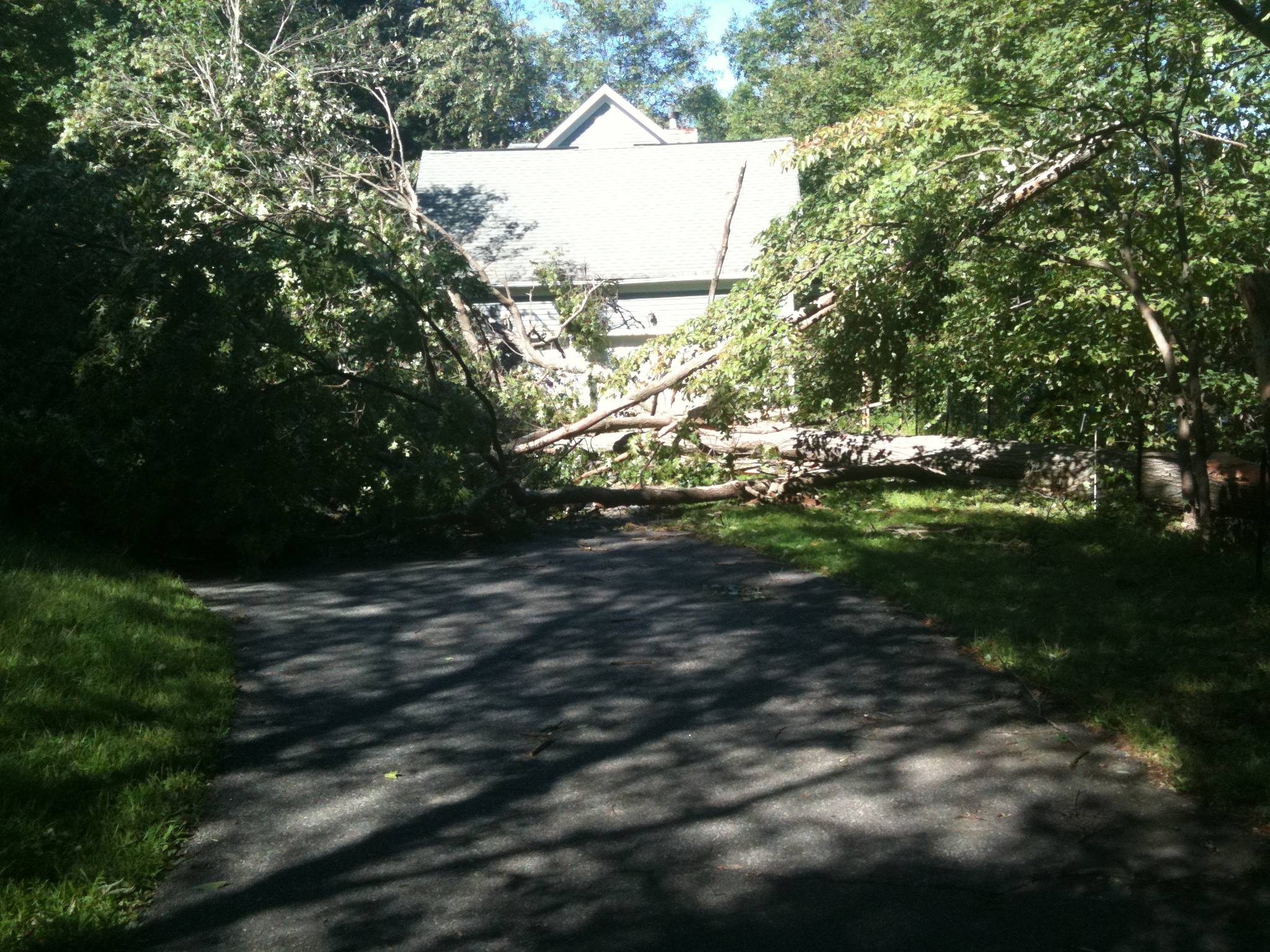
Oh yeah, and a tree almost fell on my house. The key word there is almost. Nobody was hurt, nothing important was damaged, the garage is still standing. But things have been a little hectic for the past couple of days.

Having borrowed a car, I am once again mobile. Of course, most of the streets around my house are flooded (I distinctly recall telling my wife several years ago that “Living on a river will be great!”). Rumor has it that two towns away there is a Starbucks with coffee, wifi, and power. As I haven’t been able to make coffee, I might have enough caffeine-withdrawal rage to fight my way to that mythical plug. If I manage to triumph over the hordes and re-charge, I’ll try and get a real post up later today. Should my quest fail…but it won’t!

In the meantime, there are lots of people all along the Eastern seaboard who got hammered harder than we did. If you want to help, please check out the American Red Cross Hurricane Irene Relief

And for now, here’s a picture of the tree that knocked on our door late Saturday night:

That's My Garage Hiding Behind the Tree