Skip to content

Posts from the ‘Genre Observations’ Category

A Theory of the Hero: Agency, Voice, and Sincerity (part 1 of 3)


For a while now I’ve been chewing on the concept of heroes/heroines, which at first glance looks simple. Say the word “hero” and everyone knows what we mean: we’re (stereotypically) talking about square-jawed men and kick-ass women who stab bad guys in the eyes with icicles, rescue intergalactic princesses, and Do The Right Thing. Heroes are “The Good Guys” that we root for in a story. But fiction – as life – tends to be more complex than that. For every Frodo Baggins we have an Elric of Melniboné. For every Peter Pevensie we have Steerpike. What then constitutes a hero? What makes one character or one story heroic and another not?

NOTE: This is the first in a three-part series of posts. This post is focused on what makes a given character heroic. On Saturday, I’ll post the next chapter, focusing on story archetypes for heroic characters, and the final post on Tuesday will focus on the difference between tragic and anti-tragic heroes.

Why do we need a Theory of the Hero?

If we want some sort of all-encompassing theory of the hero, we need to go beyond Campbell’s monomyth and Propp’s functional formalism. Regardless of how much I love both, a complete theory should be able to encompass both the classically-modeled Frodo Baggins and the monstrous Humbert Humbert.

In reading Ivan Morris’ excellent The Nobility of Failure: Tragic Heroes in the History of Japan over the weekend, something in my brain clicked. I think I might have figured out a secret ingredient that goes into the make-up of any hero, regardless of where they fall on a moral spectrum. Per Morris, heroes are defined at their core by the Japanese concept of makoto, which Morris translates as “sincerity” with connotations of self-contained philosophical sufficiency. In other words, a hero is a hero – regardless of their moral or immoral actions – if they act relative to a consistent moral code.

Hero vs Protagonist: Six of One, Half-Dozen of the Other

If you will forgive a brief moment of semantic pedantry, I think it is important to explain that I have never particularly liked the term “protagonist”. Since originating in Greek drama, I think the term has become incredibly muddled and imprecise. Etymologically, it means “chief actor” but a literal definition is too limiting to be functional. There are too many sweeping, epic novels like Hugo’s Les Miserables where identifying a particular chief actor becomes difficult (if not impossible).

Terms like protagonist and antagonist really describe the relationships between characters. The protagonist is opposed by the antagonist. This tells us nothing whatsoever about the characters in question, their value systems, moral codes, or courage. However, describing characters as either heroic or non-heroic does offer insights into their natures. Generally, for good drama in storytelling a hero needs to have an opposition: but a good hero can just as easily be opposed (antagonized) by another hero (the relationship between Hugo’s Jean Val Jean and Javert is a prime example of this type of opposition).

The Hero’s Function: Building Engagement through Agency and Voice

So what does a hero actually do in fiction? Besides saving the day, that is? As I see it, the hero/heroine is there to engage us on an emotional level. The hero draws us in and makes us care, and does so using the agency of their choices and the author’s narrative voice (which may be different from the character‘s voice).

The Hero’s Choices Make Us Respond

Can you imagine a hero with no agency? Would a character who just let stuff happen to them and passively reacted be at all engaging? Probably not. The hero/heroine’s choices determine how they change over the course of the story, giving us insight into their natures. Some heroes (Ayn Rand, I’m looking at you) are little more than two-dimensional symbols, a personification of some philosophical outlook with which we can either agree or disagree. Others are more complex, rounded (in Forster’s sense) characters for whom the nature of their choices actually matters. In each case, the hero’s choices cause some sort of a reaction in us. We may to some extent agree, sympathize, or understand the character’s dilemma and the outcome. Or we may view that choice as antithetical: we may disagree with it so violently that the strength of our dispute resonates just as strongly. Whether the hero strums our heartstrings up or down, the note still sounds. What matters is that the hero’s choices have an impact within the story, on the hero, and on us as readers.

It is this kind of approach that produces some of the most memorable heroes in fiction. Tolkien’s The Lord of the Rings is replete with heroes who have to make choices: first, who will take the burden of the Ring? Then, who will escort the Ring to Mount Doom? Will Frodo actually destroy the ring? Will Aragorn take the throne of Gondor?

These are difficult choices that Tolkien’s heroes must make. Every member of Tolkien’s Fellowship is a hero, and every one of these choices resonates with us to a greater or a lesser extent. For some (Samwise Gamgee in particular) their choices are shown in a generally positive light: they are the classic “good guys” who make the difficult choices that the author (and presumably most readers) view as morally right. Other heroes – in particular Boromir, Gollum, and even Frodo himself – all make at least one morally reprehensible choice, transgressing against their value systems. But it is the uncertainty of their choices and their struggle to make them – for better or worse – that make us engage with the book. Whose breath didn’t catch when Frodo’s simple nobility fails him at the last second? Who doesn’t feel a pang of Bilbo’s pity as the villainous Gollum’s ugly history is slowly exposed? And who isn’t relieved when Aragon finally accepts his responsibility for Gondor?

But just like Gollum, not all heroes need to be good guys. Remember that old saw about every villain being the hero of their own story? Consider Milton’s Paradise Lost, Nabokov’s Lolita or Jesse Bullington’s more-recent The Sad Tale of the Brothers Grossbart. These books’ heroes are morally reprehensible villains.

Milton’s Satan is…well, Satan. He’s The Devil. The embodiment of all evil, at least according to the sensibilities of Milton and his contemporaries. Nabokov’s Humbert Humbert is a pedophile, a monster as vile as could possibly be imagined. Yet he still has agency, and his choices – reprehensible as they may be – never fail to provoke a reaction on our parts. Bullington’s grave-robbing Grossbarts, though less compelling than the other two mentioned, generally pull off the same trick. And all three of these monstrous heroes do so using the second tool of hero-construction: the author’s narrative voice.

Narrative Voice as the Sneaky Tool of Understanding

What could make us care about such monsters? We may disagree, sometimes vehemently, with their choices. So why do we continue to follow the story? We care because the author’s narrative voice is beguilingly engaging. Milton’s primary (initial) character – Satan – needs no introduction. We know that he is a monster: The Devil. But Milton’s narrative style makes Satan’s charisma a palpable force, not unlike the serpent’s beguiling silver tongue in the Garden of Eden.

Both Nabokov and Bullington utilize framing devices that unequivocally establish that the heroes in question are evil. But we get drawn into their heads, drawn into their twisted worldviews, by the authors’ compelling rhetorical structure. By the time the monsters perpetrate their evil deeds, it is too late for us. However much their choices may disgust us, at some level the narrator’s slippery words have given us a window into their souls. Through that window, we can catch a glimmer of the monster/hero’s intrinsic nature.

The Hero’s Nature, Moving Targets, and Sincerity

And here we come back to the concept of makoto: if the hero (whether morally laudable or not) fails to evidence sincerity, if they are not true to their underlying nature, then no amount of agency or rhetorical trickery will resonate. At the heart of a hero’s underlying nature lies his moral value system. Whether we agree with this system or not, or to what degree their value system aligns with our culturally-acceptable moral codes, is unimportant. What matters is that the hero’s value system remains immutable throughout the story.

If the hero’s value system changes within a story, then suddenly the hero’s choices lose their meaning. Whether they articulate their system explicitly or not, their values represent an aspirational target for their behavior. Han Solo, Humbert Humbert, or John McClain always know what the “right” action is, according to their own moral codes. And while they may not always live up to their moral codes, those codes do not change. If they did, if the hero’s moral target moves, if their definition of “right” and “wrong” shifts, then suddenly all of their prior choices become meaningless within the confines of the story. It would be like retconning Uncle Ben out of Spider-Man’s origin story.

Neither Humbert Humbert’s or Frodo Baggins’ values change throughout their respective stories. At no point do their concepts of “right” and “wrong” shift. Instead, their actions either eventually align with those (stated or implied) values or transgress against them. The hero’s choices must be mobile – not the yardstick by which they are measured. Whether we agree with them or not, heroic characters maintain a firm and unchanging set of values: they must be “sincere” in their worldview. It is the choices they make relative to that philosophy that affects the drama and resonance of a story, and which makes them heroic.

NEXT: Come back on Saturday for the second installment on plot structures and story archetypes for heroic characters!

The Evolution of Middle-Grade Fantasy and Television


NOTE: I drafted this on my computer while I had power at a local café, but I’m posting it from home on my cell phone. As a result, some of my formatting may have gotten messed up. If so, I apologize: I’ll fix it as soon as I have power and Internet at home.

When I was a kid, I watched a lot of cartoons. Thundercats, G.I. Joe, Transformers, Inspector Gadget…the list goes on. Thanks to Netflix, I’ve started re-watching many of these shows, but I find that it is hard to re-capture my childhood appreciation. Most did not age well (or maybe I haven’t), but it is somewhat saddening to see stories I loved as a kid come off as puerile now. Interestingly, the books I read as a child do not suffer from the same problem. Why are the shows I watched at eight or nine unwatchable now, but the books I read at the same age still enjoyable? Have I just become some sort of egg-headed curmudgeon (obviously I have, but is that the cause?), or is there something different about these stories that affects their longevity?

Since Hurricane Irene knocked out our power for the last couple of days, I’ve had nothing to do but think about this while twiddling my thumbs by candlelight. And here’s the conclusion I’ve come to: what sets timeless middle-grade fiction apart from the cartoons from the ’80s and early ’90s is the evolution of character and moral ambiguity.

The Quest Structure and Character Evolution in Middle Grade Fiction

Much of the middle-grade fantasy I read as a child (Lloyd Alexander’s The Chronicles of Prydain, Madeleine L’Engle’s Wrinkle in Time Quintet, or Susan Cooper’s The Dark Is Rising) relied on the standard portal/quest structure. The youthful hero/ine has to leave home, find something, and return.

A screenshot from Avatar: The Last Airbender showing Zuko.

Prince Zuko from Avatar the Last Airbender, via Wikipedia

Their physical quest mirrors an evolution of their characters. As they progress through the various stages of their adventure, the characters are naturally changed by their experiences. Edmund Pevensie, in C.S. Lewis’ The Lion, the Witch and the Wardrobe, starts as a resentful, selfish child. His exposure to the White Witch’s evil changes him, as do his attempts to earn his siblings’ (and Aslan’s) forgiveness. At the end of the book, bratty little Edmund Pevensie ultimately becomes “Edmund the Just.”

In Lloyd Alexander’s The Book of Three, Taran learns that adventure is not the rollicking good time he supposes, and that heroes must make difficult choices.

In Madeleine L’Engle’s A Wrinkle in Time, Meg develops self-confidence and self-value through realizing that although she lacks her siblings’ more obvious gifts, her capacity for love ensures a central place within her family.

While adult readers might deride the portal/quest fantasy structure as trite, its ability to harmonize the characters’ emotional journey with their physical adventure continues to make it resonate. The key to that resonance, particularly for young readers, is how compelling the characters are. If the characters are uninteresting, no kid will ever enjoy the book. If those characters do not change, then young readers will rapidly outgrow the story (if they ever get into it at all).

Character Evolution in Cartoons

This kind of character evolution is distinctly absent from cartoons of the ’80s. At the time, cartoons were often made to sell toys, and by their very nature were more open-ended: the writers had to keep the story going until the show got cancelled. This presents its own storytelling challenges, and as a consequence, each episode tended to be a self-contained story arc, while the series as a whole had only the loosest overall structure. Typically a shows’ latter seasons – when the creators saw their series nearing the end of its viability – would often feature multi-episode or season-spanning plots which the creators hoped would finish a story. Yet despite this “innovation” in storytelling, each episode still needed to be self-contained, and characters never evolved greatly from one episode to the next. The Donatello we meet in the first episode of Teenage Mutant Ninja Turtles is the same Donatello ten seasons later: his experiences over the ten years of show continuity have not introduced any changes into the character’s personality or values.

When we look at more modern cartoons, like Avatar The Last Airbender, we see an entirely different structure at work. First and foremost, the story is no longer open-ended. The show’s creators set out to tell a story in three parts. There was never an intention to keep the show going through ten years of storytelling. Avatar The Last Airbender is similar to much middle-grade fiction in that it retains a quest structure at its macro-level and focuses on an over-arching conflict between our heroes and a “Dark Lord” villain. However, as in all cartoons, each episode remains a self-contained adventure within the confines of the broader story.

I believe that this innovation is enormously significant in terms of televised animated storytelling. Thanks to its structure, Avatar The Last Airbender is able to introduce character arcs that parallel the story’s plot arc. Over the story’s three seasons, we can watch Aang mature and take on his responsibilities as the Avatar, Sokka grow into the capable warrior he dreams of being, and Katara master water-bending and come to terms with her feelings for Aang. Each of the principal characters gradually grows and changes over the course of the show’s three seasons, which ultimately makes the series’ conclusion all the more satisfying.

Villainy in Middle-Grade Fiction and Cartoons

Another key difference lies in how “classic” cartoons portray their villains. The portal/quest fantasy has often been mocked for its stereotypically irredeemable “Dark Lord” (for a hilarious send-up, I strongly recommend Diana Wynne Jones’ The Tough Guide to Fantasyland: The Essential Guide to Fantasy Travel). And both middle-grade novels and cartoons feature this trope.

The Dark Lord’s goals tend to be suitably grandiose: take over the world/universe/whatever. But while the Dark Lord is portrayed as irredeemable and morally abhorrent, our heroes rarely face him until the final battle. Instead, their direct opposition usually comes from the Dark Lord’s lackeys, who are more complex characters serving the Dark Lord for their own (less inscrutable) reasons. Their goals are more localized: gain temporal power, get the respect they think they deserve, etc.

Whether it is Alexander’s Queen Archen, Cooper’s Walker, or Lewis’ Edmund Pevensie, the Dark Lord’s helpers are shown to actively make choices that align themselves with evil. Unlike the Dark Lord, their evil is never a given: they choose it for themselves. But in “classic” cartoons, the Dark Lords’ lackeys are just as irredeemably evil as their master. Whether we are talking about the Thundercats’ Slythe, the Decepticon Starscream, or Cobra’s The Baroness, the front-line villains have no depth; their motivations are rarely explored.

Moral Ambiguity in Today’s Cartoons

Fast forward twenty years, and you find an entirely new generation of cartoons, like Avatar The Last Airbender and the Cartoon Network’s reboot of Thundercats. Today, the irredeemable evil of the villain and the unquenchable goodness of the “good guys” is far more flexible.

Consider the rebooted Thundercats: in the first episode, we learn that the Thundercats have been repressing the dogs and lizardmen for generations. While our hero, Lion-O might oppose this level of repression, “the good guys” are generally depicted as racists. Or consider Avatar The Last Airbender. In the first episode, we learn that the Fire Nation has waged a century-long war of subjugation against the other nations, slaughtering an entire race (the Airbenders) in an unprecedented genocide. Within the first season, though, we learn that both this genocide and the war-torn century are a result of the Avatar (theoretically our hero) running from his responsibilities.

None of the “classic” cartoons from the ’80s would ever have explored a theme as morally ambiguous as Aang’s rejection of responsibility. Instead, each of these shows had to end with a moralistic “lesson” portrayed through the dénoument: remember those “knowing is half the battle” sequences at the end of GI Joe episodes? Such an externally-imposed mandate makes morally ambiguous storytelling difficult, if not impossible.

But middle-grade fiction has always had this type of moral ambiguity. In The Lion, the Witch and the Wardrobe, Edmund Pevensie betrays his siblings to the White Witch in exchange for promises of power and Turkish Delight. More recently, Eoin Colfer’s Artemis Fowl is a thief and kidnapper who performs morally abhorrent acts with (it turns out) noble intentions. Michael Buckley’s Sisters Grimm wrestle with the right-and-wrong of trapping all magical Everafters in a small rural town, and their friend is the Big Bad Wolf – a villain struggling with his past crimes. Susan Cooper’s Walker shows us that the “good guys” might not always do good, and that they too can betray – or seemingly betray – their friends. None of this even touches upon Rowling’s Harry Potter books, with the moral ambiguity of Snape, Dumbledore, and Tom Riddle.

Avatar The Last Airbender probably offers us the most powerful example of how contemporary cartoons can treat villainy: when the series opens, Prince Zuko is the heroes’ primary opposition, and we watch him hunt the Avatar with intense zeal. However, by the end of the first season we understand that Zuko struggles through his relationship with his father (Fire Lord Ozai, the “Dark Lord” of the series) and with his own moral compass, personified by his Uncle Iroh. While Zuko represents the primary threat against the heroes, he is forced him into chasing the Avatar, and though we may not agree with his motives we at least understand them. His portrayal as an almost-sympathetic character makes his evolution that much more satisfying, as over the course of the three seasons we watch him gradually change from being the Dark Lord’s lackey to being one of the story’s principal heroes.

What are the Implications for Children’s Storytelling?

I think Avatar The Last Airbender, with its moral ambiguity and even-handed character arcs makes for innovative children’s storytelling, irrespective of medium. Avatar The Last Airbender’s treatment of Prince Zuko would be the equivalent of Queen Archen or the Horned King switching sides, and I have not seen much middle-grade fantasy take moral ambiguity to such lengths (though Lloyd Alexander’s Westmark trilogy – which may or may not be considered middle-grade – comes very close, and Joseph Delaney tries for it in The Last Apprentice: Revenge of the Witch). The creators of the Thundercats reboot openly discuss wanting to make a darker, more cinematic story than the original cartoon (although Cartoon Network’s Friday at 8:30pm timeslot for the show might suggest they are aiming for an older audience). Personally, I think all of this represents an opportunity for writers of middle-grade and cartoons.

The success of Avatar The Last Airbender proves that the middle-grade audience enjoys complex storytelling, with extended character arcs and moral ambiguity. While some might say that shows like that are “too much for kids,” I could not disagree more: by blending childish adventure with more serious storytelling, they are doing what children’s literature has always done: helping kids develop a vocabulary with which to internalize and articulate a morally complex world.

In a real sense, I think this represents the gradual accrual of wisdom. If – thanks to more morally ambiguous middle-grade fiction or morally-challenging cartoons – kids are able to recognize, understand, and internalize a more complex world, then I think this can only be good. Doesn’t it suggest that kids are growing wiser sooner? And from a more crassly commercial standpoint, it also opens up “children’s” stories for an audience entirely outside of its intended demographic.

Who says grown-ups can’t enjoy good kids’ stories, anyway?

Recommended Blog Posts Works Mentioned
If you enjoyed this blog post, here’s a list of others that are on related subjects which you might find interesting:

Since I talk about a lot of different authors and titles in this post, here’s a list for your enjoyment. I’ve included some titles that don’t get mentioned directly, but which you might find fun/interesting:

Books:

REVIEW: Summer, Fireworks, and My Corpse by Otsuichi


Title: Summer, Fireworks, and My Corpse
Author: Otsuichi
(translated by Nathan Collins)
Pub Date: September 21, 2010
Chris’ Rating (5 possible): 1 point 1 point 1 point 1 point
An Attempt at Categorization If You Like… / You Might Like…
A carefully constructed collection of unsettling horror stories with purposeful use of language.

Maybe it’s because I spent a decade living abroad, or because both my parents are immigrants. But for whatever reason, foreign techniques in storytelling and art have always fascinated me. Now and again, I find myself going on a binge of reading from a particular part of the world, and several months ago I started a Japanese binge – made all the harder knowing nothing about the language, and having only local sushi joints and the little otaku pop-culture I’ve been able to observe as culture references. But in my blind stumbles around Japanese literature, I picked up Summer, Fireworks, and My Corpse written by Otsuichi and translated by Nathan Collins.

This is subtle, literary horror from Haikasoru (an imprint of Viz Media that specializes in bringing Japanese genre titles to the United States). Reading it brought to mind old-school Gothic works by folks like Sheridan le Fanu or Daphne du Maurier, with some of the creepiness of Edgar Allen Poe. What made this three story collection stand out were the prose techniques employed by Otsuichi (or possibly his translator). Using word choice and sentence construction as the subtle thematic bedrock is a rare treat in the horror genre.

The first (titular) story was written when Otsuichi was still in high school, and it shows some of the still-rough techniques that he would hone in his later works. Summer, Fireworks, and My Corpse is told from the perspective of a nine year-old girl’s corpse, and I consider it to be the weakest of the three stories in this book. I cracked open the spine unfamiliar with Otsuichi’s writing or Nathan Collins’ translations, having been stung by particularly poor translations of other Japanese books in the past. As a result, the opening pages made me very concerned. The sentences were simple. Almost each one was a declarative statement. They were stilted. Choppy. The narrator’s observations were superficial and factual: this happened and then that happened and then something else happened. Reading these initial pages, I thought: “Great. Another lousy translation.” But I was wrong.

The unsubtle language that opens the story is purposeful. Otsuichi (and his translator) use simple sentence construction to put us in the head of his nine year-old narrator. As the story progresses, we watch through her eyes as her friend (and murderer) and her friend’s older brother try to hide her corpse. The narrator, in a child’s spare and simple language, tells us the facts of what happened, but the narrator’s understanding is limited by her age. Once she dies, the language grows more complex as her after-death experiences change her perceptions of the world. The transition happens subtly over the course of the story, and Otsuichi and Collins manage to make this transition smooth. If I were not looking for it, I might not have noticed it.

Once I realized that the author was doing this on purpose, I could get past the unsubtle prose and into the story. Despite being satisfied, I remain troubled by how superficially the narrator’s perceptions are presented. There was precious little introspection or abstract thought, and most nine year-olds I’ve met have some capacity for both. While this technique may be a cultural trait of Japanese fiction (Yasunari Kawabata excels at such purposefully superficial presentation), the degree to which it is employed in this story made it difficult for me to engage emotionally with any of the characters. However, the story’s disquieting ending relies on the narrator lacking an adult reader’s understanding of its implications.

The second story in the collection, Yuko is much shorter, much more powerful, and from my perspective, the best story in the book. Taking place in an indeterminate time period (could be present day rural Japan, could be any time in the last couple of hundred years), it follows a young, uneducated housemaid who takes care of a writer and his bedridden wife, Yuko. The housemaid, however, never sees, speaks with, hears, or interacts with Yuko, only with her husband. Scenes are presented from both the housemaid’s perspective (where Yuko never appears) and from the husband’s perspective (where he interacts with Yuko).

Reading this story, the beautiful language matters tremendously: the author and translator use lyrical, literate language and style to pull a fast one on the reader. That is not a bad thing. Throughout the story – almost to its end – the language evokes a conviction in the reader’s mind of one reality. And then with just one word – one word placed in just the right spot – it flips the reader’s genre expectations from horror to mystery. I had to go back to the beginning, and read it all again, before finishing the story with a new set of reading protocols.

That one word is the hinge on which Yuko pivots: before the hinge, the story is horror, generating that delightful sensation of creepy, disquieting terror. After the hinge, the terror is gone, replaced with an intellectual curiosity seeking an explanation: a mystery. When that explanation comes, the terror returns – but it is subtler, deeper, and darker than the Gothic terror inspired before that hinge.

Since reading this story, I’ve been wrestling with this technique. It is excellently executed, and manipulates the reader brilliantly. I had thought I was reading a Gothic horror story, and suddenly I found myself reading a Gothic mystery. Cleverly done. Yet at the same time, the technique stood out as a technique. It was like a slap in the face: there was no way I could have missed it. And I do not know if that is good or bad. Should the impact of word choice and sentence construction be noticeable to the reader as they are reading? Does seeing the mirrors ruin the trick? I loved this story, and the emotional ride it took me on. So I suppose it works. “Good” might be like pornography (and science fiction): I know it when I see it. But as a writing technique, I think it might be extremely risky.

The last and longest story in the book, The Black Fairy Tale, takes far fewer risks. It is a short novel told in three parts: the first is a grizzly, frightening tale about a raven who steals peoples’ eyes as a gifts for a blind girl. This was my favorite part of the story, with beautiful lyrical prose that tells a heart-breaking story of love, devotion, and the light and darkness of memory. The second part is told from the perspective of a teenage girl who loses her left eye, receives a transplant, and now sees her new eye’s memories. The final part is told from the perspective of the raven fairy tale’s author. On a superficial level, the teenage girl and the author’s story are linked: they come into gruesome conflict. Below that superficial level, the stories are unified by the fairy tale itself, with its focus on memory, vision, and detachment.

The emotional terror evoked by the story is its most powerful aspect. The story’s violence is depicted and described, and some of it gets fairly rough, but throughout it is handled tastefully; its horrific nature is in the emotional implication of what it does (or has done) to its victims. The story’s language, and in particular the gradual evolution and progression of imagery throughout the three parallel parts, makes this story a delight to read.

The book’s biggest problem is its organization. The Black Fairy Tale makes up over sixty percent of the book, yet it is the third story. The opening story – Summer, Fireworks, and My Corpse – is the book’s weakest: I almost put it down before realizing that its unsubtle sentence construction was purposeful. I can imagine that many readers unfamiliar with Otsuichi or Collins might have given up without getting to the good part. A better way of organizing the book would have been to start with either Yuko or The Black Fairy Tale.

Regardless, the book is well worth reading. Fans of western horror will enjoy a title that hearkens back to the strong, subtle, emotionally resonant horror of du Maurier, le Fanu, and Poe. I think this is a good intro to Japanese horror and I’m definitely going to be checking out more from Haikasoru.

O Canada! Travels in Canadian Science Fiction, Fantasy, and Horror


As I mentioned last week, I’m off on my honeymoon at the moment. What I don’t think I mentioned is the fact that I’m honeymooning in the United States’ neighbor to the north. When the Professor and I mentioned honeymooning in Canada to most people, their reaction was usually one of considerate bewilderment: why not go someplace with warm, sandy beaches and fizzy drinks with little umbrellas? Well, both of us like rocky coastlines, lighthouses, cabins in the middle of nowhere, and tons of wonderful used bookstores. All this makes Nova Scotia pretty ideal.

And with a couple of days spent wandering through the stacks of some great used bookstores in Halifax, I thought I might give a shout-out to some of the Canadian genre creators who I’ve enjoyed:

Author Comments Good Titles to Start On
Margaret Atwood Putting aside Atwood’s semantic quibbles as to the definition of science fiction versus speculative fiction, her novels tend to be solid sociological treatises reminiscent of the 1970’s New Wave in science fiction. Her writing often reminds me Ursula K. Le Guin’s, although with a more starkly dystopic sensibility.

William Gibson Gibson’s name is synonymous with the cyberpunk sub-genre, and he is often hailed as one of the luminaries of early steampunk. His cyberpunk novels combine noir storytelling techniques with an often-prophetic depiction of near-future technologies, with his more recent works relying more heavily on prescient sociology sensitivity.

Guy Gavriel Kay Kay is an excellent fantasist who models his secondary worlds on real-world historical settings. Whether it is medieval Spain, Italy, Byzantium, or 8th century China, Kay’s depictions of settings and character paint a vibrant picture of times and cultures that most of us only know from history books.

Claude Lalumière Lalumière tends to produce dark fantasy short fiction notable for eliciting a quiet sense of unease. Language and characters are put to deft – though dark – use. His most recent novella (The Door to Lost Pages) stands out as particularly compelling.

Robert J. Sawyer Sawyer is a prolific science fiction author whose novels utilize hard science to probe more humanist concerns. His work tends to deal with the relationship between science and religion, as well as focusing on issues of self-identity. His books are fun, fast-paced reads whose seriousness sneaks up on you (at least they did on me when I first discovered his work some fifteen odd years ago).

Karl Schroeder A hard science fiction author who – for whatever reason – is grouped in my mind with Robert J. Sawyer and Robert Charles Wilson, Schroeder writes action-packed, fast-paced novels which rely on hard scientific conjecture for their settings and underlying premises.

Peter Watts Watts is a hard-SF author whose particular passion seems to be the biological sciences. If “genepunk” were a subgenre (and I think it damn well should be), then I would argue Watts for its doyen. His novels tend to be fairly dark and hard-hitting, and while they are not light on the science, they still manage to play effectively with the tropes of related genres (horror in particular).

Robert Charles Wilson Most of Wilson’s work is hard SF, though his earlier works veer towards the softer side of hard. My particular favorites are some of his earlier novels which play delightfully with concepts of time travel and most importantly reader expectations.

So without having the benefit of browsing through my bookshelves, that’s a list of fun Canadian genre authors I thought I’d share with all of you. Anyone have any others they’d like to recommend? Since I’m in Canada at the moment, I’d love to hear of any Canadian authors whose work has yet to appear in the United States. Does anyone have any suggestions?

Some Brief Thoughts on Love, Relationships, and Characters in Fiction


Over the course of the past couple of days, I’ve been thinking a lot about relationships. Fiction focuses so much on characters, that I suppose it should come as no surprise that their relationships are so often central to the story. What would Don Quixote be without his Sancho Panza? Holmes without his Watson? C-3PO without his R2? Could we even have a Romeo without a Juliet? Or Cyrano without Roxanne?

A Typology of Fictional Relationships

There are as many types of fictional relationships as there are real relationships. We’ve got friends (Frodo and Gimli), partners (Holmes and Watson), lovers (Othello and Desdemona), rivals (Taran the Assistant Pig-Keeper and Ellidyr), and enemies (Val Jean and Javert), and a million and one shades of interstitial grey. But each type of relationship has some defining characteristics.

NOTE: Since I’m in a good mood, I’m going to skip the darker end of the relationship spectrum. I might share some thoughts on villainy and antagonism later (probably around election season) but for the time being I’m going to focus on the healthier relationships.

Friendship in Fiction: Always There, but Separate

Who are the great friends in fiction? They’re not Holmes and Watson: their relationship goes deeper than mere friendship, and has too many characteristics of a fictional partnership to be so easily classified. Instead, I think the defining characteristics of friendship in fiction is when the characters retain independence. Partners cannot exist without each other: they need each other to form a single complete unit. But friends can have lives and stories of their own: they are not defined by their relationship.

Taran Releasing Fflewddur Fflam in The Black Cauldron

Taran Releasing Fflewddur Fflam in The Black Cauldron, via AnimatorMag.com

Friendships like this that come to mind include Gimli and Frodo (or any of the fellowship other than Sam). There is clear affection between the characters: they care about each other, they can laugh together, are willing to fight and die together…but they are not their respective focuses (focii?). Fantasies have a lot of these kinds of friendships: in the Chronicles of Prydain, Taran has a pair of great friends in Fflewddur Fflam (I bet Lloyd Alexander’s proof-reader or copyeditor had a hell of a time spell-checking that name!) and Doli. Both Fflewddur and Doli could just as easily be the heroes of their own story: we just happen to be observing their actions in Taran’s Chronicles. Friends will always be there for each other, even when – like Gimli or Fflewddur – they go off on their own adventures.

Fictional Partnerships: Making a Complete Character

Partnerships are a much tighter bond between two characters. In these types of situations, the duo becomes effectively one character. Sherlock Holmes – the superhuman analytical machine – needs Dr. John Watson to humanize him. Without Watson there to temper the icy scalpel of his intellect, Holmes would be a caricature, not a character. He would be a sad, frustrated, lonely man. And as a fictional construct, we are made to care about Holmes through Watson’s cuddlier perspective.

Illustration by Sidney Paget from the Sherlock Holmes story The Greek Interpreter (via Wikipedia)

Frodo and Sam operate on a similar basis. Frodo’s quest defines him. The ring – and his duty – consume him as both an individual and a character. But Sam keeps Frodo firmly grounded in what matters to both Tolkien and – presumably – the reader: friendship, loyalty, and home. Without Sam there to shoulder the heroic burden, Frodo would be a drag (some would argue he still is, though I still like his story…because of Samwise Gamgee). The thing about these kinds of partnerships is that it really takes two to tango: either of these partners alone is only half of a character.

Love: Why do we remember the tragic ones?

I suppose fiction is full of happy love stories. But I spent a good couple of hours trying to wrack my brain to come up with some of them. Invariably, when I think of love stories, my brain goes to tragic romances: Romeo and Juliet, Cyrano and Roxanne, Don Quixote and Dulcinea, Arthur and Guinevere (and Lancelot), Othello and Desdemona. None gets a happily-ever-after.

But not all love stories end tragically, either in fiction or in real life. Marius and Cosette in Hugo’s Les Miserables. Elizabeth Bennet and Fitzwilliam Darcy in Pride and Prejudice. Benedick and Beatrice from Much Ado About Nothing. Or in film, Han Solo and Leia Organa.

Most of the “happy” romances I just mentioned have lovers who are also partners. Unlike regular partnerships, however, each lover is a fully formed character. Holmes, Don Quixote, or C-3PO are rough caricatures without their partners. They could not operate effectively on their own: Cervantes depicts this explicitly in Don Quixote’s adventures before he hooks up with Sancho Panza. But in “happy” love stories, the lovers remain fully formed characters without their partner: they are just not likeable characters.

Benedick and Beatrice both need to have their wits balanced: if Benedick lacked Beatrice’s foil, then he would likely come off as a slightly snarkier version of Iago (ironically, both characters who have been excellently portrayed by Kenneth Branaugh on film). Without Lizzie there to puncture his pride, Darcy would come off as an unbearable ass. And without Darcy to lend Lizzie moral certitude, she would be a fairly bratty busybody. It is through their partners that lovers become loveable.

It all boils down to negotiating intimacy, and happy love stories do so through a combination of partnership and antagonism. It is no coincidence that Darcy/Lizzie, Benedick/Beatrice, Kate/Petruchio, Taran/Elionwy, Han Solo/Leia Organa, or Nick/Norah are defined by their verbal sparring. Without Solo’s irrepressible devil-may-care humor, Leia Organa would be a dull-as-doorknobs earnest senator. Unlike Holmes or Quixote, she is a fully-formed character without Solo to complete her. But who wants to deal with that level of humorless earnestness all the time? Han Solo makes Princess Leia sufferable, and even likeable.

Why am I harping on relationships, love, and partnerships?

Well, here’s why:

Photo from Chris & the Professor's Wedding, August 6th, 2011

Photo from Chris & the Professor's Wedding, August 6th, 2011 courtesy of SMBFZ


(sorry for the graininess of the image – it’s a screen grab from a friend’s awesome video from our wedding)

This past weekend, I married the smartest, most beautiful, funniest woman I have ever met. She is my best friend: she’s her own person, independent, strong-minded (extremely so, sometimes), and always there for me. She’s my partner: without her I’m just a caricature of a person. And she makes for a great complementary antagonist, able to poke holes in my (all too common) pretension whenever I need it (which is often). If she weren’t there, I’m sure I would be an insufferable jerk. But because she was silly enough to say yes, I’m hopefully a slightly less insufferable jerk.

She makes me the happiest guy in the world, and so I’m going to sign off from this blog now and go back to enjoying my honeymoon.

Oblique Wisdom: The Secret of Evergreen Middle-Grade?


Probably right around the age of nine, I discovered Lloyd Alexander’s Chronicles of Prydain. These books opened up a world of adventure, mystery, and wisdom for me – and are probably the reason why I love fantasy so much. Fast forward twenty years, and this past weekend I cracked open The Book of Three, the first book in the series. Reading it over the course of an afternoon (it’s a much faster read today than I remember it being), I think I stumbled on an aspect of middle-grade fiction that I think might be universal in evergreen titles (the classics that never go out of print, never stop being popular): oblique wisdom transparent for the reader but opaque for the hero.

Some Thoughts on the Heart of Middle-Grade Fiction

There is a world of difference between middle-grade (MG) and even young adult (YA) fiction. While both are lumped together as “children’s fiction,” everyone knows that an eight year old looks at the world very differently from a sixteen year old. Differences in awareness, concerns, and our ability to articulate our thoughts and emotions drive many of the fundamental differences between MG and YA books. An eight year old can love Norton Juster’s The Phantom Tollbooth, but the themes and concerns of Suzanne Collins’ The Hunger Games would likely go over that same child’s head.

Classic MG titles like The Phantom Tollbooth and Dealing with Dragons show us fundamental truths about the world. Most of these truths are foundational, and so basic that MG readers will already understand them before they ever pick up a book. Research has shown that by the age of five, kids understand and apply complex rules of “fairness” in their behavior. They might not be able to articulate those rules, or explain why something is right or wrong, but they have already formed a sense of it.

The best YA fiction helps us to negotiate the muddier waters of an adult reality. Books like Collins’ The Hunger Games, or Pullman’s The Golden Compass transition a child’s black-and-white value system to the shades of grey that (unfortuntely) operate in the adult world. But middle-grade, at its heart, is there to provide the initial vocabulary. It teaches us how to articulate values every child knows, but might not be able to otherwise express.

Fairy Tales, Learning Better, and the Role of the Teacher

The 18th and 19th centuries saw the rise of popular children’s literature. In particular, Charles Perrault, the brothers Grimm, Alexander Afanasyev, Hans Christen Andersen, and Gregory MacDonald all contributed to popularizing stories with magical characters that grew to be beloved by children in their respective countries. These early fairy tales were often based on oral storytelling traditions, and employed a remarkably consistent morphology (I recommend Propp’s Morphology of the Folktale and Luthi’s The European Folktale: Form and Nature for a detailed discussion).

In the 20th century, Robert A. Heinlein argued that all stories (irrespective of audience) could be reduced to three categories: Boy Meets Girl, the Brave Little Tailor, or the Person Who Learns Better. The vast majority of early fairy tales – and the majority of middle-grade fiction – fall into either the Brave Little Tailor or Learns Better structures. Within the confines of these archetypes, the mentor (or dispatcher, in Propp’s terminology) is a standard element. Consider Merlyn in T.H. White’s The Sword in the Stone, Dallben (and Coll, and Gwydion) in The Book of Three, Morwen and Kazul in Dealing with Dragons, Mrs. Whatsit, Mrs. Who, and Mrs. What in A Wrinkle in Time, or Mrs. Frankweiler in From the Mixed-up Files of Mrs. Basil E. Frankweiler:

Each of these mentors is an adult, placed by the story’s plot in a parental/guardian position relative to the story’s hero. That the hero may be a hidden monarch or a prophesied savior is immaterial for the mentor’s role. From a plotting standpoint, the mentor is there to initiate and end the adventure.

Pushing the Hero Towards Adventure

Parents typically protect the hero. They want to keep the hero guarded against all of the vicissitudes of the outside world. The mentor, however, does not. The mentor recognizes – in their infinite wisdom – that the hero needs to face danger to grow. Merlyn puts Wart in potentially life-threatening situations because he hopes the lessons will make Wart a better king. Mrs. Whatsit, Mrs. Who, and Mrs. Which fetch Meg, Charles Wallace, and Calvin and put them directly in harm’s way. Kazul and Morwen – ostensibly – have few qualms about placing Cimorene in what the novel’s society considers danger. In this sense, the mentor often adopts the role of dispatcher in Propp’s morphology. In some cases, as in Morwen and Kazul, the mentor can play the role of helper just as easily.

Starting Points: Explaining the Lesson at the Start of the Book

Mentors are by definition wise. And invariably they share that wisdom with the middle-grade hero before the adventure starts. Consider Dallben’s exchange with Taran the Assistant Pig-keeper:

“Tut,” said Dallben, “there are worse things. Do you set yourself to be a glorious hero? Do you believe it is all flashing swords and galloping about on horses? As for being glorious…”

“What of Prince Gwydion?” cried Taran. “Yes! I wish I might be like him!”

“I fear,” Dallben said, “that is entirely out of the question.”

“Buy why?” Taran sprang to his feet. “I know if I had the chance…”

“Why?” Dallben interrupted. “In some cases,” he said, “we learn more by looking for the answer to a question and not finding it than we do from learning the answer itself. This is one of those cases. I could tell you why, but at the moment it would only be more confusing. If you grow up with any kind of sense – which you sometimes make me doubt – you will very likely reach your own conclusions.

“They will probably be wrong,” he added. “However, since they will be yours, you will feel a little more satisfied with them.”

This exchange – which we find in chapter one – outlines the arc at the heart of The Book of Three. Taran obviously fails to grasp the wisdom of Dallben’s warnings – otherwise, he would never run off after Hen Wen and begin his exciting adventures. But reading this exchange, an adult reader instantly sees the timeless wisdom of Dallben’s teaching. And I would argue that a nine year old reader gets it just as well.

The Triangle of Understanding in Middle-grade Fiction

The Triangle of Understanding in Middle-grade Fiction

The reason for that is because of Dallben’s obvious wisdom. A nine year old might not be able to articulate this wisdom, to communicate it anew, yet nonetheless it strikes a chord. We know Dallben’s interdiction will be broken, that Taran will go out on an adventure. And we know that the adventure will change him, make him recognize at least a part of Dallben’s teachings. The same model can be found in Madeleine L’Engle, Susan Cooper, Diana Wynne-Jones, L. Frank Baum: all of the classic middle-grade fantasists understood the power of foreshadowing the lesson at the start of their books.

Contrary to what many grown-ups believe, children well understand the difference between reality and fiction. They know that Taran’s adventures are dangerous. If they did not grasp the inherent wisdom of Dallben’s warnings, why would they be scared or excited when Taran faces Achren or the Horned King? While Dallben’s warnings might go right over Taran’s head, even a young reader will still understand and recognize their wisdom. They may not be able to explain what they have understood, but that does not mean they have failed to grasp its underlying significance. The reader knows what lesson is coming before they’re even finished with chapter one: which is why the book’s conclusion – when Taran has had his adventures, and has learned at least a little more wisdom – is so satisfying.

The Obliquity of Wisdom: Mediating the Mentor and the Hero

This structure is satisfying because the reader not only understands the mentor’s wisdom, but the hero’s desires. What nine year old doesn’t want an exciting adventure slaying monsters? We want Taran to have his adventure, we want him to face down monsters and evil, and to come out stronger, smarter, and happier at the end. We know that Taran will get into trouble by breaking Dallben’s interdiction, but there remains that niggling little voice inside that says adventure is worth it.

The relationship brings to a mind the best line of the trailer for Martin Scorsese’s film adaptation of Brian Selznick’s The Invention of Hugo Cabret, where Isabelle warns Hugo that they can get into trouble and Hugo responds “That’s how you know it’s an adventure.” That exchange encapsulates the reader’s mediation between grasping the hero’s immature desires, and internalizing the mentor’s wisdom. If the hero were not in danger, if the hero did not break the mentor’s rules, then there would be no adventure.

Developing One’s Own Vocabulary: The Learning Hero in Middle Grade

As MG novels progress, the hero has to gradually develop their own vocabulary for the mentor’s teachings. The hero cannot just parrot the mentor’s lessons: that would not show any development on the part of the character, and would thus be fundamentally unsatisfying. Instead, the hero rationalizes an initial rejection of the mentor’s lesson and then builds an acceptance of the lesson by getting (proverbially – or literally) kicked in the teeth by life.

Note that there are examples where authors have tried to deviate from this pattern. Joseph Delaney – in his 2004 novel The Last Apprentice – tries to invert the classic structure. Delaney’s hero understands the wisdom of the Spook’s interdictions. However, he finds that certain rules are overly stringent. He does not break them due to a failure of understanding: instead, he breaks them because he actively disagrees with their universality. These books are a little too recent to be deemed evergreen, but I am curious as to how they will age over time. They have not resonated with me the way the more classic structure has, but that may have more to do with my own tastes (my fiancée accuses me of being an old-fashioned curmudgeon) than with any actual weakness in an inverted structure. Eventually, time will tell whether the mirror image of the classic structure can function as well as the original.

Regardless of whether the author plays it straight or flips the structure, at the end of the story the hero has learned a lesson and articulates it in words different from those of the mentor. What matters is that the lesson cannot be presented didactically: kids can smell that kind of condescension a mile away, and overt morals ruin good stories. Nobody likes to be patronized, least of all a nine year old. If the action and emotion of a story cannot imply a lesson through subtext, then it is a weak lesson that simply won’t resonate.

By finding a different subtext-driven way of articulating (or potentially refuting) the mentor’s earlier wisdom, a classic MG novel can show the reader how that wisdom can be applied in a fictional context. Just as the hero’s understanding of reality is broadened, so too is the reader’s conceptual vocabulary. Like Dallben says:

“…If you grow up with any kind of sense – which you sometimes make me doubt – you will very likely reach your own conclusions.

“They will probably be wrong,” he added. “However, since they will be yours, you will feel a little more satisfied with them.”

And that, ultimately is what childhood and fiction are both about.

Negotiating the Borders of Intimacy and Imagination: Romance and Fantasy


Last week, I came across Jacqueline Lichtenberg’s Big Love Sci-Fi series of blog posts (part 1, part 2, and part 3). I had been thinking about how romance, sexual tension, and emotional intimacy is built and maintained in books, and so her suggestion that romance in fiction is actually a negotiation of the borders of intimacy particularly struck me. As I thought about it some more, I realized that in some ways the romance genre and fantasy are analogous. If romance derives its power from the borders of intimacy, then fantasy builds its sense of wonder from negotiating the borders of imagination.

Borders of Intimacy: A Framework for Thinking about Romance

Romance may well be the oldest genre in existence. Since before the written word, stories and myths were full of love, sex, and betrayal. And why not? It’s fun! It grabs our attention, focuses our minds, and gets our hearts racing. What’s not to like? Artists have known for millenia that sex sells, but the methods by which it’s portrayed are culturally dependent.

Jane Austen’s Pride and Prejudice manages romantic/sexual tension very differently from Laurell K. Hamilton’s Guilty Pleasures. 19th century readers had different standards of intimacy: the kind of hot-and-heavy sex scenes we take for granted today would have been off limits back then. Even more graphic 17th century romances like Eliza Haywood’s Love in Excess; or, the Fatal Enquiry (which was called pornographic when first published) lack the overtly-described throbbing body parts of today’s sex scenes. Despite the changing standards of intimacy, romances from Ovid to Danielle Steele engage us by bringing characters to an emotional precipice, and then having them finally plunge over it.
The Facets of Intimacy in Romance

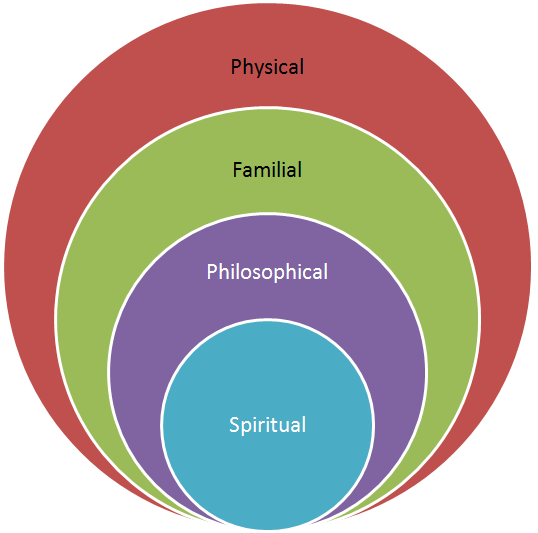
An overly-simplistic view of romance says that it’s just sex. But Jacqueline is exactly right when she says that a sex scene lacking emotional depth is just boring. In western culture, the physical act of sex has always been used as a proxy for other intimacies:

Aspects of Intimacy

Aspects of Intimacy

Marriage (which traditionally precedes sex) represents a type of familial intimacy: one person’s family opens up and accepts a new member, or two families join. Probably the best example of this is Shakespeare’s Romeo and Juliet. Of course, the two families alike in dignity reject that intimacy. But nonetheless, the underlying tension of that love story rests on Romeo and Juliet trying – and failing – to negotiate that familial intimacy. Here, death plays the role that sex often does: it represents the culmination and climax of their negotiation.

A different type of intimacy is the philosophical or worldview model that Austen nailed so perfectly: both Pride and Prejudice and Sense and Sensibility deal with the protagonists adjusting how they perceive other characters. This is a philosophical intimacy, where the climax is the moment of acceptance rather than the moment of marriage (let alone sex). For Austen, sex – of course preceded by marriage – is in fact the denouement, never shown but instead implied by her heroes’ betrothal.

Spiritual intimacy between characters can likewise be negotiated. Unfortunately, I had some difficulty thinking of romances that deal with this facet of intimacy, but ultimately I think Ayn Rand’s Atlas Shrugged is probably the most succinct example. Dagny Taggart’s relationships with Hank Rearden, Francisco D’Anconia, and John Galt all oscillate around her most fundamental spiritual values. While Rand might well have spit nails to see those values described as spiritual, there is no change in Dagny’s philosophy over the course of her relationships. Instead, the climax of these relationships is her finding her idealized counterpart, the impossible superman who personifies her ideals. If we were to swap Rand’s Objectivism for any religion, the relationships would still function the same way (though the plot’s MacGuffins would not).
The Borders of Imagination and the Fantasy Spectrum

If the core of romance is characters negotiating the borders of their intimacy, then I suspect the core of fantasy might be negotiating the borders of the reader’s imagination. Love titillates us because it speaks to something deep within our hearts, touching on our innermost desires, exciting us with the promise of fulfillment. But intimacy doesn’t lurk alone in the deep, dark corners of our soul. It shares those caverns with our imagination.

A romance hinges on the borders of intimacy between the story’s characters. Typically, that intimacy is indelibly linked to the story’s plot. For example, the plot of Romeo and Juliet would fall to pieces without the Capulets and the Montagues. But fantasy’s relationship with imagination tends to be slightly more removed from the story’s plot, and it does not need to rely so heavily on proxies the way intimacy often does.

The Borders of Imagination

The Borders of Imagination

Fantasies make us look at reality sideways, utilizing evocative imagery, secondary worlds, strange creatures, and magical powers to broaden our understanding of our own reality. Superficially, elves, monsters, and wizards are cool plotting devices that let us tell entertaining stories. Who doesn’t like magic and monsters? But beneath that surface level, they give us a new lens through which we can see an oblique picture of the world.

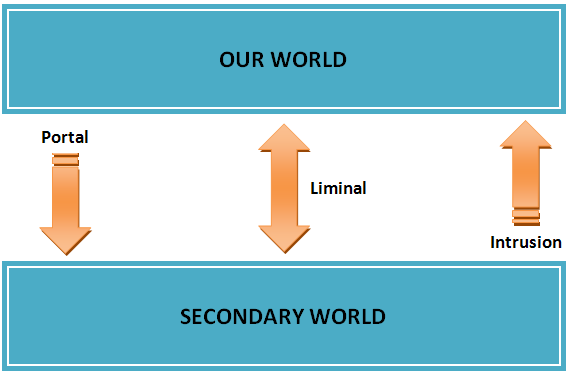
Imagination operates on a spectrum that describes a relationship between the story’s characters, the reader, and their environment. At one extreme we have our world, in all its mundane glory. It is at this end that we find mainstream literary fiction, where the world operates according to the real-life rules that govern our everyday existence. The range of plot options or the focus of characterization at this end of the spectrum is nearly limitless: we can deal with a plot-driven mystery, or a character-driven rumination. The focus can be narrow, internal, psychological or just as easily societal, philosophical, or spiritual.

At the other extreme we have a secondary world, where anything goes. A secondary world does not even need to have human characters – consider Edwin A. Abbott’s Flatland. Immersive fantasies – which force the reader to suspend disbelief and to accept the prima facie rules that govern the secondary world – operate at this level. Just as with mainstream literary texts, their range of plotting options and focuses is nearly limitless. However, unlike mainstream literary fiction, immersive fantasies have the ability to use different rules of existence and their accompanying imagery to cast a different light on aspects of our reality.

Portals and the Broad World Perspective

If we start in our real world, then we can gain access to the rich imaginative vocabulary of the secondary world. But to do that, we have to take our characters from our world and bring them to the secondary world, typically through the use of a portal of some kind. In her excellent Rhetorics of Fantasy, Farah Mendlesohn conflates the portal fantasy with the quest fantasy, and while this works at the level of plot, it does little to explain how portal fantasies interact with the reader’s imagination. That’s because we can have an immersive quest fantasy that takes place in a completely secondary world (think Tolkien, Brooks, etc.), but the thematic, plot, and character focus tends to be different if we start in our world.

The moment our characters go through the portal, everything in their new reality is contrasted to our world. Whether it is in Stephen R. Donaldson’s Lord Foul’s Bane, C.S. Lewis’ The Lion, the Witch and the Wardrobe, or Rowling’s Harry Potter and the Philosopher’s Stone, by starting the story in mundane reality we establish the reader’s (and characters’) initial state. Whatever imagery follows can then be related back to our real life, and can be interpreted as a thematic symbol. From a plotting standpoint, the secondary world is often thinned and ultimately by the climax of the book, comes back to some sort of eucatastrophe that leads to its restoration.

Intrusions and Narrow Focus

Intrusion fantasies – where the secondary world inserts itself into our reality – are the mirror image of portal fantasies. Consider Shirley Jackson’s The Haunting of Hill House, Emma Bull’s War for the Oaks, or China Miéville’s King Rat. Here, the secondary world is dark, dangerous, and forbidding as a general rule. Its intrusion into our own world tends to be frightening, disorienting, and leaves our heroes struggling to find their own place in the world.

Just as in the portal fantasies, the fantastical elements can be interpreted as thematic symbols. But the mood tends to be darker, and the focus of the story narrower. While portal fantasies tend to focus on the world at large and build towards eucatastrophe, intrusion fantasies focus on the narrower, private world of the principle protagonists. Rather than building towards a climactic eucatastrophe, they instead build towards a moment of personal climax/realization/rejection.

Liminal Fantasies: Philosophical by Design

Liminal fantasies either dance on the border between two worlds (like John Crowley’s Little, Big) or ambiguously hint at the existence of a secondary world (Graham Joyce’s How to Make Friends with Demons). In these cases, fantastical imagery is often used allegorically and the reader’s position relative to the events of the text is always ambiguous. Reading these books, we wonder if we are – in fact – operating within a fantastical reality? Or are we instead merely using allegory to highlight and comment upon philosophical, emotional, and spiritual considerations?
Understandably, the focus for such liminal fantasies is always narrow, focusing on the values of the protagonist. Their emotional climax typically lies not in picking a side: choosing our “real” world or the secondary world. Instead, it rests in becoming comfortable with that middle ground between the two. Acceptance on an emotional, philosophical or spiritual level, as opposed to the more conflict-oriented eucatastrophe or resolution.

Symbols, Imagination, Plot, and Emotion

While fantasy makes it possible to use a rich palette of imagery, fantasy is not merely symbolic: sometimes, a talking tree is just a talking tree. Plot is just as important as the underlying themes of a story, and images are used not just to represent values and thoughts in the real world. They can just as easily be used to evoke certain emotions, to raise tension and the like. What specific imagery we utilize should tie into our goals for a particular scene, whether those goals are emotional, thematic, or both.

And of course, part of the fun is when we combine aspects of romance (negotiating the borders of intimacy) with aspects of the fantastic (negotiating the borders of imagination). Fantasy and romance are genres that can contain multitudes, after all.

Flirting and Writing Good Dialogue


I love exposition: flowing sentences, tight action, enveloping description. Prose is great. But for the past couple of weeks, I’ve been wondering what makes dialogue tick.

Well-written dialogue is not conversation. Have you ever listened to the way people speak? Our conversations (regardless of our erudition) are almost always inane. Want proof? Spend an hour or two in a cafe listening to the conversations around you. Are they interesting? Do they raise tension? Do they give us deeper, subtle insight into the speakers? Only marginally. We waste words, meander around topics, count on body language to fill in gaps, and stutter over halting words like “Umm” and “Uhh” and “Well”. It’s a signal-to-noise problem: in our everyday discussions, there is far too much noise to isolate a clean narrative signal. Well-written dialogue may not be conversation, but I think of it as a particular type of conversation: flirting.

Writing Dialogue with Game

It’s a great feeling when our game is on, and every exchange is tantalizing, enticing, teasing, and provocative. Our goal in flirting is always to draw someone in deeper: into our heart, our head, or – fine – our pants. Sure, there’s a functional level to it: on the surface, we might be talking about where to get dinner that night. But we all know what’s really going on, and odds are it doesn’t have much to do with oysters on the half-shell.

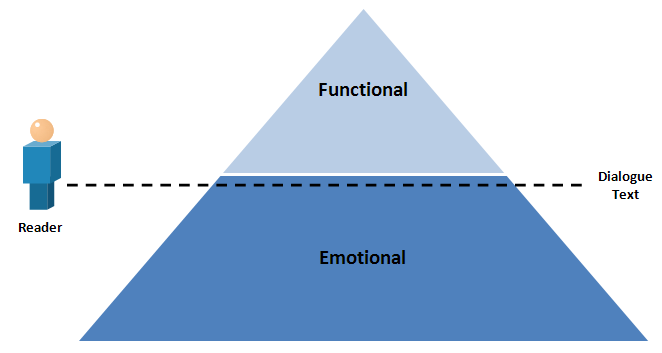
Conceptual Diagram for Good Dialogue

Functional versus Emotional Dialogue

Good dialogue works the same way. Superficially, information needs to be exchanged and decisions need to be made to either move the plot forward or lay the groundwork for doing so later. That’s the functional level of dialogue. But as the writer, we use that exchange to flirt with the reader. Below that functional level, we want to draw them in, heighten the underlying tension, and make them care deeply about the characters involved. So how can we do that?

Less is More: Make Every Word Count

When I have been particularly flirtatious (not that it happens often, but it has happened…once…I think), I feel like every sentence, every word I uttered made the other person dig me more. That’s not because my every utterance was gold. It’s because everything I said was just enough and not too much to accomplish my functional and emotional goals.

Imagine you’re trying to ask someone out to dinner. Your functional goal is for them to share a meal with you. Your emotional goal is for them to want to. If you come at them with a multiple-paragraph emotion-laden monologue, at best you’ll be shot down. At worst, out comes the pepper spray. In that conversation, you want to give them just enough to want more – more conversation, more shared experiences, more of you. Brevity – in this instance – is your friend. Of course, you don’t want to just bark “Yo! Dinner?” That’s probably going a little too far in the opposite direction. It has no emotional resonance, no hidden layers of private meaning.

Probably the best tool I’ve found to find the happy medium is the comic book panel. As I’ve talked about before, panels are the basic building block of sequential art. Each panel uses both art and dialogue to manage the reader’s experience. But here’s the thing: a panel is a limited space. If we want the art to do its job, then the panel naturally constrains the amount of dialogue it can contain.

A good rule of thumb is for panels to not exceed twenty-five words of dialogue. That previous sentence has fifteen. Now we’re up to twenty.

There. That paragraph directly above is the amount of dialogue that will typically fit comfortably in a panel. That doesn’t leave a lot of room for wasted clauses, wasted words, wasted feelings. It needs to be absolutely tight: one sentence, two sentences, maybe three. It may be an exchange, or in that one panel one person may be the only one speaking. But thinking about dialogue in terms of twenty-five word panels within a scene really helps me to pare my characters’ dialogue to the bare essentials.

What did you say? Making Every Word Clear

Clarity’s another important factor. When flirting, if every other sentence is “What? What did you say?” odds are it’ll be quite a turn off. The same holds true for dialogue. We want our readers to instantly understand the surface level of dialogue so that they can internalize the underlying emotional level.

This is why I’m always nervous about dialect in dialogue, especially in genre fiction. One of the defining characteristics of speculative literature is the use of neologism to signify new concepts. The creation of new terms and new concepts is so important that Istvan Csicsery-Ronay dubbed it science fiction’s “first beauty” in his excellent The Seven Beauties of Science Fiction. We use new words and alien languages as a world-building tool, to defamiliarize the user and transport them to a reality where our fantastical story can take place. But before we can grok Valentine Michael Smith’s dialogue, we need to grok the word itself.

Like so many aspects of writing, this is a balancing act. And one that even experienced and skilled authors can get wrong. For example, I have loved China Miéville’s writing since his first novel, King Rat. Yet I found myself unable to enjoy his more recent Kraken because I found that it took so much effort to understand what the characters were saying on a superficial level, that I lacked the energy to get emotionally invested. Were the dialogue there slightly clearer, no doubt I would have loved the characters and the story as much as his other books.

Coming at Dialogue From the Side

Flirting is as much about what is left unsaid as what is stated. Good dialogue is the same. Sol Stein describes it as obliquity in Stein On Writing, and I think that’s a pretty good description of both flirting and writing good dialogue. Consider the following two exchanges:

DIRECT “What would you like to do tonight?” John asked.

“I want to eat a garden salad, have two glasses of red wine, and engage in coitus with you,” Jane said.

OBLIQUE “What would you like to do tonight?” John asked.

“A little of this, a little of that,” Jane said.

The first is painfully direct and clinical. It leaves nothing to either John’s or the reader’s imagination. The second does not – in fact – answer John’s question. It leaves the entire answer to the imagination. The entire experience – and its emotional significance – is left for our reader to find between the lines.

In some cases, the direct approach is smart. Used in counterpoint to oblique dialog, it can be used to drive the point home. Consider a slightly modified direct approach:

DIRECT “What would you like to do tonight?” John asked.

“Have sex,” Jane said.

Here, the frank approach to the underlying subject matter stands out against more oblique dialogue. If every exchange read like this one, the book would turn monotone. And if every exchange were perfectly oblique, the book would be abstruse. When focusing on principal characters and particularly meaningful scenes, I try to go beyond the merely functional and lean towards obliquity. But with judicious application, a little directness adds extra spice.

Blending Prose and Dialogue

In one sense, comic books have it easy. Sequential artists have an extremely expressive medium (art) to place the dialog in context. They can communicate tone, setting, attitude in fractions of a second. Those of us laboring in prose have exposition to do the same, but text is by its nature less expressive than illustration. So how do we intersperse prose into dialogue for best effect?

Just about any good writing book or teacher will tell you to avoid active reporting clauses (he said/she said). It’s still like flirting. If someone were trying to flirt with us and they screamed every statement, growled every question, and sighed every punctuation mark, odds are we’d remember a pressing engagement elsewhere pretty quickly (unless both people involved are angsty teenagers, in which case they might not even notice). But that does not mean we’re limited to the factual he said/she said.

We can also play with placement. Consider our earlier oblique passage. What would happen if we moved the reporting clause elsewhere in the second sentence?

ORIGINAL OBLIQUE “What would you like to do tonight?” John asked.

“A little of this, a little of that,” Jane said.

MODIFIED OBLIQUE “What would you like to do tonight?” John asked.

“A little of this,” Jane said, “a little of that.”

Moving the reporting clause to the middle of the sentence introduces a beat that the reader won’t even consciously notice. Instead, they’ll pause for a half-second as they read it and fill that pause with meaning. Maybe they’ll picture Jane winking, or giving a mischievous little smile.

We can also substitute actions for the reporting clauses, though this may be a slippery slope. Consider:

ORIGINAL OBLIQUE “What would you like to do tonight?” John asked.

“A little of this, a little of that,” Jane said.

MODIFIED OBLIQUE “What would you like to do tonight?” John asked.

“A little of this,” Jane said, “a little of that.”

ACTIVE OBLIQUE “What would you like to do tonight?” John asked.

Jane took his hand. “A little of this, a little of that.”

ACTIVE DIRECT “What would you like to do tonight?” John asked.

Jane took his hand. “Have sex.”

By prefacing Jane’s statement with a simple action, we can help put it in context. It’s like a marker guiding the reader to the conclusion we want them to reach. This should be used sparingly however, because it can otherwise lead to problems. For example, if a character says something while “spinning” many readers will imagine them twirling like a top while speaking…which is probably not the effect you were going for.

The Transparency of Great Dialogue

I’ve never heard a book described as “having great dialogue but really lousy prose.” (though the opposite is unfortunately common). The reason for that is that truly great dialogue is utterly transparent: its effects on us are palpable, but indistinguishable from the those of the book as a whole. We can’t truly say whether we’re invested because of the dialogue or the prose. What we know is that the dialogue supplements the prose and gives us pulls us deeper into the story. If the prose is an attractive person spotted across a dance floor, then the dialogue is the test of whether they’re nice. And can hold a conversation.

Apologies for the Delay


I’m sorry today’s post is going to be delayed ’til tomorrow. I’m currently travelling by train from Warsaw to Prague and my laptop is being singularly uncooperative. This apology may or may not get posted depending on my phone’s ability to connect to the interwebs from somewhere in the Silesian hinterlands.

In honor of the fact that I’m in Poland on business at the moment and lacking the GPRS connection to post what I originally intended, here’s a link to some fun news about Poland’s most famous SF author, Stanislaw Lem: there is a new (direct from Polish) translation of Solaris available as an audiobook.

This matters because previously the only English translation was actually an English language translation of a French translation of the Polish original, which apparently (according to Lem) really doesn’t do the material justice. Unfortuneately, the new version is (so far) only available as an audiobook. In the next couple of weeks I’ll give it a listen and share how I think it compares to the original (ha! Bet you didn’t know I’m fluent in Polish!)

Hopefully I’ll get to do a more complete post tomorrow from Prague. Let’s hope my cell phone manages to post this…

Representing Genres at BookExpoAmerica 2011


So last week was pretty fun, what with BEA 2011 and the Book Bloggers Convention (BBC) both taking place in New York. This was my second year attending BEA, although my first as a blogger. While I did manage to post some brief thoughts last week, I wanted to take a little time to discuss a disconnect I noticed during both events.

Genre, Genre Everywhere…

Everywhere I turned at BEA and at the BBC, genre was plainly visible. Whether it was mystery, thrillers, horror, science fiction, fantasy, paranormal romance, steampunk – every major publisher was promoting the heck out of genre titles. Even those who traditionally keep their toes out of genre waters seemed to dabbling, with “magical realism” or “magical romance” offerings.

Particularly noticeable was the degree to which young adult and middle-grade publishers were aligning their publicity machines with speculative sensibilities. While there are few YA/MG publishers who specialize within science fiction, fantasy, or horror, almost all of the galleys handed out at BEA had some fantastical element – however sleight. Many of these galleys were riding the post-apocalyptic/dystopian wave currently cresting, but nonetheless it was clear that publishers feel that kids read books about monsters, fairies, and ghosts.

…and Not a Home for It

Despite the ubiquity of science fiction, fantasy, and horror titles, there was a noticeable absence of niche booths. The major publishers had consolidated their imprints’ such that niche-market imprints were exhibited under their corporate umbrella. This trend was universal across the major publishers, and I would argue that it failed to serve the niche imprints well. As a general rule, it made it harder (though not impossible) to find people at the booths who could cogently discuss either the galleys being handed out, or the niche imprint’s other speculative titles. Don’t get me wrong – the Javitz floor was full of niche imprint editors, publicists, salespeople, and authors. But they had other things to do there than man their imprints’ booths, and so the folks stuck “back at base” ended up getting mobbed.

There are – of course – notable exceptions. Prometheus Books in particular stands out for how they handled their PYR imprint. Not only was the PYR side of the booth well-supported, but even PYR’s non-fiction cousins were well-prepared to talk about PYR’s list. That ability to cross-promote books across imprint lines was unique on the Javitz floor, at least from what I could see.

A Lack of Genre Programming…

Equally startling – from my perspective – was the lack of science fiction, fantasy, and horror programming. While there were some “author buzz” sessions, outside of the YA and middle-grade segment, there was a startling lack of BEA sessions devoted to discussing trends in SF/F/H. Instead, just about every session focused on one aspect or another of digital publishing.

Are booksellers and librarians no longer interested in learning about trends in particular genres? Or has BEA gone astray by focusing too heavily on promoting individual books and particular authors? I for one suspect the latter: while it’s great to hear about author X and their new genre book Y, there is clearly a place for a discussion of the aisles that by some counts, are the most frequented in any bookstore/library. Is BEA that place? Judged by the conversations on the floor with booksellers and librarians: certainly. Judged by the programming set up by BEA’s organizers? Not so much.

…Especially at the Book Blogger Convention

Even more startling was the paucity of niche programming at the second-annual Book Blogger Convention. Don’t get me wrong, this was an excellent event – and one which I cannot recommend strongly enough to anyone who wishes to attend next year. As a relative newcomer to the world of book blogging, I walked away from the one-day BBC with insights and relationships just as valuable as those I developed during the four-day BEA. But the genres represented at the BBC both within the audience and on the BBC’s programming were surprising.

First, the BBC’s audience struck me as primarily focused on romance and YA. That probably shouldn’t come as a big surprise, considering the size of the romance and kidlit blogospheres respectively. And while my own speculative predilections might bias me, I think the SF/F/H genres generally don’t slouch when it comes to online representation. Heck, just a couple of weeks ago I mentioned the awesome list of SF/F review blogs curated by Grasping for the Wind. Were so few speculative bloggers able to attend BBC? For whatever reason, we were thin on the ground in the audience on Friday. Perhaps as a consequence of this skewing of the BBC’s audience, speculative fiction didn’t get much representation in the programming. For example, the “niche blogging” panel had one speculative fiction representative, compared to four YA bloggers. And during the (incredibly valuable) publicist panels, only mainstream or YA publishers were represented.

Representing Speculative Fiction at BEA and the BBC

Despite all of this, both BEA and the BBC were useful for different reasons. BEA remains a great place to get new galleys and chat with industry professionals about books and the industry. Plus, it’s always fun to meet authors and get books signed. The BBC was useful because it allowed me to learn more about book blogging, to share techniques and best practices with other book bloggers who’ve been at it for longer than I have. Would both events have been better for more speculative programming? Overall, yes. Consolidating for cost purposes makes sense, but ultimately it’s a balancing act between being penny wise and pound foolish. Hopefully, they’ll nail the balancing act next year.