Skip to content

Archive for

REVIEW: Supernatural Noir ed. Ellen Datlow


Title: Supernatural Noir
Editor: Ellen Datlow
Pub Date: June 22nd, 2011
Chris’ Rating (5 possible): 1 point 1 point 1 point 1 point
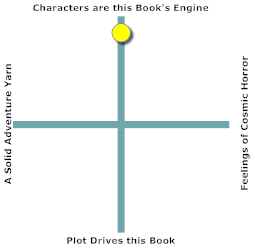
An Attempt at Categorization If You Like… / You Might Like…
Excellent storytelling, though slightly more supernatural than dark.  


First, let me start by saying that I love noir fiction and film. Give me a good hard-boiled detective story, and I’ll lap it up – typically not looking for much beyond entertainment. I also love dark fantasy and horror, and so the thought of blending them in a new anthology fittingly titled Supernatural Noir sounded great to me. Throw in one of the best editors working in the business today – Ellen Datlow – and I am definitely there. Having read a digital review copy, I can say that Dark Horse’s Supernatural Noir delivers as advertised, even if it may lean closer to dark fantasy than I would have liked.

With Datlow’s editorial pedigree, this should come as no surprise. On my shelves at home, I have over fifteen anthologies edited by Datlow (often with excellent collaborators like Terri Windling). I admit, I’m a bit of a fan. Historically, her anthologies have demonstrated a particularly consistent ability to showcase top-flight authors and stories, and to assemble them into collections unified along whatever dimension is relevant to a particular book. The table of contents for Supernatural Noir is no different in this regards.

The authors read like a “who’s who” of dark fantasy (more so than noir): Gregory Frost, Melanie Tem, Paul G. Tremblay, Laird Barron, Jeffrey Ford, Joe R. Lansdale. Sixteen authors contributed original short stories for the anthology, and all of them come from a dark fantasy / supernatural / horror background in their writing. This is not a complaint, but it should be an indicative fact: the authors selected for this book skew by experience towards the “supernatural” part of the anthology’s title, so it should not be surprising that their stories lean in that direction. If you are looking for horror stories written by hard-boiled mystery writers, you won’t find them here. Instead, this collection offers dark fantasists’ spins on the hard-boiled crime story. Which – I would argue – is just as fun, although it means the noir elements might get a little de-emphasized in some places.

A large number of stories (either explicitly or plausibly/implicitly) are set in the time period from the late ’40s to the late ’70s. Considering noir‘s roots in the late ’40’s and ’50’s, this makes sense to me: the square-jawed hero (or stalwart heroine – more on this in a sec) in a worn trenchcoat is emblematic of the post-War period. But the difference in tone between the stories set in this post-War period and the stories set in a contemporary (or vaguely futuristic) setting is striking. The stories set closer to WWII – like Richard Bowes‘ “Mortal Bait”, or Joe R. Lansdale’s “Dead Sister” – tend to employ a greater number of noir tropes. The later a story is set, the less prevalent noir‘s emblematic elements become. What does this say about modern society and the evergreen qualities of noir as a sub-genre? Is noir possible in a world with mobile information and instant access? Judging by the excellent contributions from Melanie Tem (“Little Shit”) and Nick Mamatas (“Dreamer of the Day”), the tropes of traditional noir fiction need to be adjusted and updated to operate in our modern reality: the tropes that worked in the days of vacuum tube televisions may not work any longer.

The second stand-out was the number of female and queer heroes featured. In many ways, this is representative of noir‘s original values: it should be only natural for a genre typified by a frank treatment of violence and sex to grow beyond the “haunted square-jawed hetero male detective” trope. The variety of heroes employed in these stories was encouraging, although at times it stretched some bounds of credulity. For example, while I thought Caitlin R. Kiernan‘s story “The Maltese Unicorn” was great fun, I was haunted by an inability to completely buy its heroine in 1935 New York.

Coming to it looking for fantastical noir, the anthology will be reasonably satisfying. If you come to it looking for noirish dark fantasy, I suspect you will be more satisfied. All of the stories here are competently executed. Some including Jeffrey Ford’s “The Last Triangle” and Elizabeth Bear‘s “The Romance” (which snuck up on me delightfully) will stay with me for a long time. Others, like Laird Barron’s “The Carrion Gods in Their Heaven” just didn’t suit my own tastes, although I recognize their quality. Only two stories (Joe R. Lansdale’s “Dead Sister” and “Mortal Bait”) didn’t work for me for critical reasons: in both cases, they featured characters/voices that did not stand out, and plot structures that I found predictable. Interestingly, both were among the stories that adhered most closely to traditional noir structures. I believe their weaknesses highlight the single greatest challenge in modern noir: crafting a hero and voice that is distinctive and interesting. Most of the stories in this anthology – even those that did not particularly appeal to me – manage to get it right.

If I have one complaint to register, it’s a relatively minor (and inordinately geeky) one. I really enjoyed reading this anthology for its entertainment value. But I would have loved to see one or two critical essays discussing noir and its long relationship with the fantastic (and the Gothic). While I would have loved to see that, I freely admit to being a the kind of dork who likes reading literary analysis.

I recommend Supernatural Noir for fans of hard-boiled detective fiction who want to dabble in the fantastic, or for fans of dark fantasy/horror who want a touch of hard-boiled crime. And that recommendation really says it all: Supernatural Noir delivers as advertised.

Apologies for the Delay


I’m sorry today’s post is going to be delayed ’til tomorrow. I’m currently travelling by train from Warsaw to Prague and my laptop is being singularly uncooperative. This apology may or may not get posted depending on my phone’s ability to connect to the interwebs from somewhere in the Silesian hinterlands.

In honor of the fact that I’m in Poland on business at the moment and lacking the GPRS connection to post what I originally intended, here’s a link to some fun news about Poland’s most famous SF author, Stanislaw Lem: there is a new (direct from Polish) translation of Solaris available as an audiobook.

This matters because previously the only English translation was actually an English language translation of a French translation of the Polish original, which apparently (according to Lem) really doesn’t do the material justice. Unfortuneately, the new version is (so far) only available as an audiobook. In the next couple of weeks I’ll give it a listen and share how I think it compares to the original (ha! Bet you didn’t know I’m fluent in Polish!)

Hopefully I’ll get to do a more complete post tomorrow from Prague. Let’s hope my cell phone manages to post this…

Some Assembly Required: Building Pacing and Emotional Flow with Legos


The other week, I pulled a sentence at random out of John Crowley’s classic Little, Big. I used it to illustrate a point about narrative voice, but a couple of days later I had an epiphany: the same sentence can also illuminate pacing and a story’s emotional flow.

Legos Tell Stories

When I was a kid, I spent just about every waking moment building adventures out of Legos. Back then (despite my fiancée’s assertions, dinosaurs did not roam the earth), Legos lacked variety. There were blocks…and blocks. A handful of different sizes, and that was about it. But despite their limited palette, I could tell just about any story my five year old self could imagine using those blocks. I built castles, and spaceships, and horses, and windmills. Fantasy, science fiction, monsters: I was only limited by my imagination.

Handful of Standard Lego Bricks

Lego Color Bricks, via Wikipedia

Fast forward a few years, and you’ll still find me playing with building blocks. Only now, I use words, sentences, and paragraphs to tell stories instead of little plastic bricks. At its most basic, a story is composed of letters. Those letters build up words, which in turn comprise sentences, then paragraphs, then chapters, then acts, then books, then series, and so on. But those letters are not necessarily our story’s real building blocks: instead, think of them as the long-chain polymers that make up our true Lego pieces. And the specific mix of Legos will differ across stories and media.

Literal Building Blocks: Panels, Scenes, and Shots in Visual Mediums

Jumbo Comics #1 (September 1938) “Hawks of the Sea” by Will Eisner, via kirbymuseum.org

It’s easiest to see these building blocks at work in visual media like sequential art (comics, graphic novels) and film. Some people might argue that dialog is key to these media, but I disagree. Dialog doesn’t frame the story: dialog is what gets framed.

For sequential art, Scott McCloud1 and Will Eisner2 both explained brilliantly how the page is the medium’s real building block. Each page is composed of one or more panels that depict some action occurring in time. The composition of each panel and its relationship to others on the page establishes tension and moves us from one state to another. The page frames a finite emotional progression, while the panels that make up that page control our sensation of time (the story’s pacing) throughout the journey.

The same paradigm works for film. A screenwriter’s scenes function the same way as a comic book page, where each scene represents a finite emotional arc through which the audience and characters travel. Each scene takes us from an initial point A to a subsequent point B, and the director uses one or more shots to get us there. Shots structure and control the flow of time and tension throughout the encapsulating scene, just as sequential panels structure the flow on a comic book page.

Visual media impose structural constraints by their very nature, which helps make their building blocks easier to spot. But when writing prose, those constraints go right out the window.

The Building Blocks of Prose Pacing: Sentences

The structure of our prose affects how we perceive the flow of time. Hemingway’s short declarative sentences communicate speed. Proust’s meandering sentences, with their convoluted clauses and tangential commentary, establish a more laconic feeling. Short paragraphs and short chapters read faster than longer ones. But it is their relationship to emotion that determines the real pace of the story.

In Little, Big, Crowley uses the sentence as his primary building block. Practically every sentence in that book takes the reader on its own miniature emotional arc:

Sentence #1: “Then an expectant silence, followed by a firmer start, and the station wagon backed warily out into the drive, making two soft and delible marks in the wet leaves.”
Sentence #2: “That there was such a house in the world, lit and open and empty, became a story in those days; there were other stories, people were in motion, stories were all they cared to hear, stories were all they believed in, life had got that hard.”
Sentence #3: “But life is wakings-up, all unexpected, all surprising.”
John Crowley, Little, Big, 1982

Even the utilitarian sentences that describe an almost-incidental action contain an emotional arc. If Little, Big is composed of Legos, then they are sentence-shaped.

The sentence length, structure, punctuation, and emotion-laden words control the story’s pace. Each sentence demands that we pause and savor what it has done to us. Without those miniature emotional arcs, the text would be meandering, dull, and lifeless. But by employing brilliant tricks of emotional association, Crowley’s manipulation of our emotional state becomes transparent and, like Smoky Barnable, we find ourselves enraptured in the liminal fairyland of Edgewood.

Paragraphs as Building Blocks

Compare this to G.K. Chesteron’s The Man Who Was Thursday. While his individual sentences lack the emotional depth of Crowley’s, we remain moved by his paragraphs (again, selected at random):

Paragraph #1: As the wood grew first thinner and then smaller with distance, he could see the sunlit slopes beyond it and above it; and across these was still moving the square black mob like one monstrous beetle. In the very strong sunlight and with his own very strong eyes, which were almost telescopic, Syme could see this mass of men quite plainly. He could see them as separate human figures; but he was increasingly surprised by the way in which they moved as one man. They seemed to be dressed in dark clothes and plain hats, like any common crowd out of the streets; but they did not spread and sprawl and trail by various lines to the attack, as would be natural in an ordinary mob. They moved with a sort of dreadful and wicked woodenness, like a staring army of automatons.
Paragraph #2: Syme’s laughter at all this had about it a wild weakness of relief. He laughed at the idea of the paralytic Professor being really a young actor dressed up as if for the foot-lights. But he felt that he would have laughed as loudly if a pepperpot had fallen over.
Paragraph #3: At first the large stone stair seemed to Syme as deserted as a pyramid; but before he reached the top he had realised that there was a man leaning over the parapet of the Embankment and looking out across the river. As a figure he was quite conventional, clad in a silk hat and frock-coat of the more formal type of fashion; he had a red flower in his buttonhole. As Syme drew nearer to him step by step, he did not even move a hair; and Syme could come close enough to notice even in the dim, pale morning light that his face was long, pale and intellectual, and ended in a small triangular tuft of dark beard at the very point of the chin, all else being clean-shaven. This scrap of hair almost seemed a mere oversight; the rest of the face was of the type that is best shaven—clear-cut, ascetic, and in its way noble. Syme drew closer and closer, noting all this, and still the figure did not stir.
G.K. Chesterton, The Man Who Was Thursday: A Nightmare, 1908

Taken individually, the sentences are utilitarian. Most are solely descriptive, with no emotional imagery employed to direct our mental state. Yet in each paragraph, certain imaginative descriptions are employed with laser precision to manipulate our emotions (a “staring army of automatons”, “wild weakness of relief”, or “deserted as a pyramid”). Each sentence is just a sentence, but with his paragraphs Chesterton increases and decreases tension like a sound engineer mixing in a recording studio.

Still other authors use scenes or whole chapters as their basic building block. While I won’t quote entire chapters here, I recommend taking a look at how Steven Erikson or Yasunari Kawabata manage it (particularly in Gardens of the Moon and The Master of Go, respectively).

Picking Legos out of the Box

So enough theory: what practical conclusions can we draw from this? If each story has a set of natural building blocks, then we have to identify it. The set will depend on the story’s medium, its audience, and the emotions we want to evoke. I suspect a spy thriller is unlikely to use sentences as its building blocks: to get an emotional response from individual sentences would slow the action too much to work within spy thriller conventions. By contrast an introspective memoir might luxuriate in the kind of sentence-level emotional manipulation that Crowley executes.

While this may just be my own idiosyncrasy, I find that once I know what the basic building block of a story is, it becomes much easier to write. If I know that I start a [sentence / paragraph / scene / chapter] at emotional point A, and need to get to point B by its end, the amorphous task of writing becomes easier. It’s not just a question of knowing where to go: that’s just plotting. Instead, it’s grokking the space I have to operate in. While I’m not a painter, I imagine it’s like understanding the bounds imposed by a piece of canvas. Within those bounds, I am limited solely by my imagination. But by figuring out which Legos I’m really using, it lets me have fun building stories.

In Conclusion: Some Fun Lego Constructions

And to conclude with the Lego metaphor, here are some fun Lego projects that some amazingly talented people have constructed:

10,000-piece Sandcrawler

Functional Antikythera Mechanism

REVIEW: Cowboy Angels by Paul McAuley


Title: Cowboy Angels
Author: Paul McAuley
Pub Date: January 11th, 2011
Chris’ Rating (5 possible): 1 point 1 point 1 point
An Attempt at Categorization If You Like… / You Might Like…
High-concept, hard SF alternate history with a spy-thriller edge.

I first came across Paul McAuley’s work sometime in the mid-to-late ’90s with his genetic cyberpunk (genepunk? I’ve always thought this should be a term) masterpiece Fairyland. Since then, I’ve always kept my eyes open for new McAuley novels and have found far more hits than misses among them. While his books span a variety of sub-genres (space opera, alternate history, genepunk, etc.), they share that high-concept imagination that underpins the best in science fiction. It was that same high-concept approach to alternate history which attracted me to his new novel, Cowboy Angels.

Books employing the many worlds interpretation of quantum physics are a dime-a-dozen, and so that on its own isn’t really enough to grab me. However, in Cowboy Angels, McAuley asks a question: what if the United States had found a way to travel between alternate versions of Earth at the height of the Cold War? In our real history, the Cold War was characterized by the domino theory, containment, détente, and proxy wars fought all over the world (Central America, Afghanistan, Southeast Asia, South Asia, etc.). A downright fascinating time period in history, with the all-too-real primacy of the CIA, KGB, Mossad and other espionage agencies. McAuley’s brilliant concept is to introduce parallel worlds as a new front in this Cold War, which to my history-loving mind made me sit up and say: “Right on, this is going to be awesome!”

Cowboy Angels follows one Adam Stone, a retired special operations agent for the CIG (Central Intelligence Group). He has made his career as a spy working to spread US-style democracy across alternate versions of America. We first meet Adam Stone at the end of an era: American policy is changing with the election of the “peacenik” President Carter, and the nature of the Company’s missions is evolving. Adam Stone is comfortable with this change, having grown disillusioned by the manifest destiny ideology that had put him in moral quandaries in alternate Americas. But not all of his fellow agents are as comfortable with their country’s shifting values, and the book’s plot explores the lengths some people will go to in service of their ideology.

The novel’s plot is structured like a spy thriller, with Stone being called out of retirement to track down his friend and former partner, Tom Waverly. Waverly has gone on a killing spree across multiple alternate realities – killing the exact same woman over and over again. Neither the local authorities in those realities nor the Company know why. And so Stone gets reactivated to try and bring his friend in. What follows is a spy-thriller, but rather than have us jet off to exotic locales, McAuley takes us to exotic versions of the United States. Stone’s hunt for Waverly takes us to a kleptocratic New York decimated by nuclear war, to a United States that had been leveled in an apocalyptic World War III, and to a version of history very much like our own.

This is not a James Bond-style spy caper, where our hero gets to enjoy the good life in sunny Macao, Monaco, or other fancy places that begin with the letter “M”. While some of the alternate realities our hero visits seem bucolic, even pastoral “untouched” realities have their gritty undersides. And McAuley artfully exposes us to that, using blood and sinew to temper the novel’s escapism.

In terms of general concept, Cowboy Angels gets ten out of ten points for me. The idea of Kennedy-era expansionist/messianical foreign policy applying across alternate worlds practically begs to be written. Once again, McAuley’s ability to identify and execute on a particular concept is compelling.

However, for me, the book relied too heavily on this (admittedly awesome) concept to carry it. There were three weaknesses that detracted from my enjoyment of the book. Successful execution of both the novel’s concept as well as its spy-thriller plot structure requires distinctive settings, and the concept enables for some fascinating alternate versions of our world. While we get tantalizing glances into some fascinating settings (Nuclear Winter America, an American government-in-exile in Cuba, etc.), the majority of the book takes place in settings only slightly different from what we know. The settings we explore are different enough to remain distinct, but I think there was a wasted opportunity to explore some really interesting alternate versions of America. With so much of the book’s backstory dealing with the Cold War and the fight against Communism, it struck me as particularly odd that at no time did our hero venture into a Communist version of the USA.

The second, less significant, issue I found lay in some aspects of McAuley’s characterization. In particular, Stone’s romantic interest (which serves as a significant motivator through much of the book) struck me as particularly under-developed. Overall, I bought the character: I felt Stone was believable, and engaging. But I was unable to shake that arms-length disconnect and engage enough with the character enough to lose myself in his world(s). It was close – almost nailed just right – but I found that I just didn’t feel enough of Stone’s motivation. The solid plotting and awesome concept were enough to carry me over this weakness, but I wasn’t close enough to the character for McAuley’s gears and cogs at work to disappear.

The third, and least significant, problem I came across lay in the book’s pacing. Please don’t get me wrong, this is a fast-paced book, and it reads very quickly. However, the pacing is relatively unvaried throughout the text. This is an issue I often find in spy-thrillers: too often, I suspect their authors and editors believe readers equate escalating, no-respite events with being a page-turner. This leads to a go-go-go pacing which can be tiring if not offset and balanced against the emotional arc of the story. Just yesterday, Ursula K. Le Guin posted a great essay on this very subject. By giving his character – and the reader – room to catch one’s breath, McAuley could have deepened my emotional connection to the character and the story. By slowing down the story in a couple of places, the overall result would have been more emotionally powerful.

Cowboy Angels Cover by Sparth

Cowboy Angels Cover by Sparth

Visually, the novel is attractive and stands out nicely. The cover was designed by Jacqueline Nasso Cooke and features an illustration by Sparth (aka nicolas bouvier). The cover really communicates the novel’s feel, contrasting futuristic Turing Gates against the decidedly-less-futuristic trains emerging from them.

Much as I enjoyed Stone’s adventure, my own personal tastes would likely have preferred to see the book’s backstory moved to the front. The transition from “manifest destiny” to “peace and reconciliation” and how that transition unfolds amongst the Company’s agents would be a really fascinating story, and one particularly relevant in today’s geopolitical environment. McAuley has set up a fascinating universe with infinite potential for clever, high-concept, and emotionally powerful stories. I would love to see a prequel set in this same universe exploring the Church Committee’s investigations into the Company’s clandestine operations.

Cowboy Angels is a very enjoyable book. The underlying concept is strong enough to overcome the minor weaknesses in setting, characterization, and pacing. That concept was enough to get my imagination firing, and often that’s exactly what I look for in SF. If you enjoy a good spy thriller, or get a kick out of playing with alternate histories, this book is definitely worth your time.

Representing Genres at BookExpoAmerica 2011


So last week was pretty fun, what with BEA 2011 and the Book Bloggers Convention (BBC) both taking place in New York. This was my second year attending BEA, although my first as a blogger. While I did manage to post some brief thoughts last week, I wanted to take a little time to discuss a disconnect I noticed during both events.

Genre, Genre Everywhere…

Everywhere I turned at BEA and at the BBC, genre was plainly visible. Whether it was mystery, thrillers, horror, science fiction, fantasy, paranormal romance, steampunk – every major publisher was promoting the heck out of genre titles. Even those who traditionally keep their toes out of genre waters seemed to dabbling, with “magical realism” or “magical romance” offerings.

Particularly noticeable was the degree to which young adult and middle-grade publishers were aligning their publicity machines with speculative sensibilities. While there are few YA/MG publishers who specialize within science fiction, fantasy, or horror, almost all of the galleys handed out at BEA had some fantastical element – however sleight. Many of these galleys were riding the post-apocalyptic/dystopian wave currently cresting, but nonetheless it was clear that publishers feel that kids read books about monsters, fairies, and ghosts.

…and Not a Home for It

Despite the ubiquity of science fiction, fantasy, and horror titles, there was a noticeable absence of niche booths. The major publishers had consolidated their imprints’ such that niche-market imprints were exhibited under their corporate umbrella. This trend was universal across the major publishers, and I would argue that it failed to serve the niche imprints well. As a general rule, it made it harder (though not impossible) to find people at the booths who could cogently discuss either the galleys being handed out, or the niche imprint’s other speculative titles. Don’t get me wrong – the Javitz floor was full of niche imprint editors, publicists, salespeople, and authors. But they had other things to do there than man their imprints’ booths, and so the folks stuck “back at base” ended up getting mobbed.

There are – of course – notable exceptions. Prometheus Books in particular stands out for how they handled their PYR imprint. Not only was the PYR side of the booth well-supported, but even PYR’s non-fiction cousins were well-prepared to talk about PYR’s list. That ability to cross-promote books across imprint lines was unique on the Javitz floor, at least from what I could see.

A Lack of Genre Programming…

Equally startling – from my perspective – was the lack of science fiction, fantasy, and horror programming. While there were some “author buzz” sessions, outside of the YA and middle-grade segment, there was a startling lack of BEA sessions devoted to discussing trends in SF/F/H. Instead, just about every session focused on one aspect or another of digital publishing.

Are booksellers and librarians no longer interested in learning about trends in particular genres? Or has BEA gone astray by focusing too heavily on promoting individual books and particular authors? I for one suspect the latter: while it’s great to hear about author X and their new genre book Y, there is clearly a place for a discussion of the aisles that by some counts, are the most frequented in any bookstore/library. Is BEA that place? Judged by the conversations on the floor with booksellers and librarians: certainly. Judged by the programming set up by BEA’s organizers? Not so much.

…Especially at the Book Blogger Convention

Even more startling was the paucity of niche programming at the second-annual Book Blogger Convention. Don’t get me wrong, this was an excellent event – and one which I cannot recommend strongly enough to anyone who wishes to attend next year. As a relative newcomer to the world of book blogging, I walked away from the one-day BBC with insights and relationships just as valuable as those I developed during the four-day BEA. But the genres represented at the BBC both within the audience and on the BBC’s programming were surprising.

First, the BBC’s audience struck me as primarily focused on romance and YA. That probably shouldn’t come as a big surprise, considering the size of the romance and kidlit blogospheres respectively. And while my own speculative predilections might bias me, I think the SF/F/H genres generally don’t slouch when it comes to online representation. Heck, just a couple of weeks ago I mentioned the awesome list of SF/F review blogs curated by Grasping for the Wind. Were so few speculative bloggers able to attend BBC? For whatever reason, we were thin on the ground in the audience on Friday. Perhaps as a consequence of this skewing of the BBC’s audience, speculative fiction didn’t get much representation in the programming. For example, the “niche blogging” panel had one speculative fiction representative, compared to four YA bloggers. And during the (incredibly valuable) publicist panels, only mainstream or YA publishers were represented.

Representing Speculative Fiction at BEA and the BBC

Despite all of this, both BEA and the BBC were useful for different reasons. BEA remains a great place to get new galleys and chat with industry professionals about books and the industry. Plus, it’s always fun to meet authors and get books signed. The BBC was useful because it allowed me to learn more about book blogging, to share techniques and best practices with other book bloggers who’ve been at it for longer than I have. Would both events have been better for more speculative programming? Overall, yes. Consolidating for cost purposes makes sense, but ultimately it’s a balancing act between being penny wise and pound foolish. Hopefully, they’ll nail the balancing act next year.

Bill Willingham and Down the Mysterly River


I’ve been a fan of Bill Willingham’s writing since the first issue of Fables, so I’ve been looking forward to his prose novel Down the Mysterly River for quite awhile.

Here are some of the things he said today:

  • biggest difference between comics and prose, [time] commitment needed to write a novel much greater than for a comic script
  • “Villains should be villainous.”
  • Motivation for writing prose is to have complete control over the story.
  • “The need to shut up [in expository writing] is much greater in prose [than comic scripts].”

Google eBooks Session


Forgive me for the editing of this post, but I’m typing it on my phone at Google’s eBook session.

Listening to: Scott Dougall, director, product management, from Google

  • Google positioning Google eBooks as “all about choice”.
  • 15 million Google Books
  • 3 million free Google eBooks
  • cross-platform accessibility
  • eBook sales tripled @ Google over last year
  • 7k publishers
  • 4 mln books found – 100 mln pgs read = 25 pgs read per book on avg?
  • most eBooks found via web, read within apps
  • Google Bookstore becoming destination and mobile store gaining traction at cost of search
  • 250 resellers in the US
  • indie booksellers getting creative: bar codes and purchasing within store to mobile apps
  • “higher priced” nonfiction (eg medical texts) outselling fiction among Google eBooks
  • in-store events to promote eBooks
  • affiliate program for bloggers slated for this year
  • bundling (digital/print) not in the works
  • hinting at book rental play (Netflix model)

Tuesday at BEA11


Sorry for the brevity of this post, but I’m drafting it on my phone at the moment.

So I’m now after my first day here at BEA and I’ve got some thoughts and observations:

  • If there’s a single word on everybody’s lips here it is digital. With new eReaders and new digital distribution platforms, everyone’s discussing the shifting economics of the book industry. Much of the focus was on self-publishing platforms, marketing, and practices – which doubtless worries booksellers and traditional publishers.
  • Genre only counts if it’s YA (at least today – tomorrow might be better). With token panels for thrillers, I thought there was precious little core sf/f/horror programming.
  • Genre in every booth. While today’s programming was light on genre, I found it at just about every exhibitor’s booth. There are fewer genre specialists exhibiting this year, but they are offset by the number of non-genre imprints/publishers who are dabbling on the edges of genres. I’ll write more about this in a separate post later.
  • Small press publishers have – it seems – vanished from the floor. Independent or self-publishing outfits are springing up like mushrooms after the rain, but small-press exhibitors aren’t here. The economics are understandable, but it is curious considering the buyers wandering around in this crowd.

Okay, since they’re closing the press room and I’ve got another event to get to, I’ll wrap up for today. More to come tomorrow.

REVIEW: Chasing the Moon by A. Lee Martinez


Title: Chasing the Moon
Author: A. Lee Martinez
Pub Date: May 25, 2011
Chris’ Rating (5 possible): 1 point 1 point 1 point 1 point
An Attempt at Categorization If You Like… / You Might Like…
An engaging, amusing read with decent characters.

A. Lee Martinez’ books are characterized by their serious plots, sympathetic characters, and an infectious humor that bubbles out of the cracks in his characters’ fictional lives. His latest novel, Chasing the Moon is a solid, enjoyable book that continues to showcase Martinez’ facility with genre tropes.

Chasing the Moon follows Diana, a vaguely-down-on-her-luck coat salesperson, who manages to land a great apartment. However, that apartment opens up Diana’s mind to all of the dark, Lovecraftian monsters that have stumbled into our reality. Diana must deal with the creatures in her apartment, the twisted realities of her entire apartment building, and ancient gods who want to devour the moon. All in a day’s work, right?

Martinez’ singular strength lies in portraying normal people in absolutely extraordinary situations. His ability to depict humanity, with all its shortcomings and strengths, is what imbues his books with humor. For Martinez, every monster – however alien, however monstrous, however evil – is just trying to get by, like you or me. Sure, that may mean destroying our universe, or devouring anything and everything in its path, but hey – nobody’s perfect. Martinez’ humor bubbles out of the clash of expectations created by these characters. Genre fans will expect the eternal embodiment of hunger to devour everything. That he might view his hunger as an eating disorder is unexpected, refreshing, and makes the character instantly sympathetic. Martinez places his heroes – human and inhuman alike – squarely before the abyss, and time after time he perfectly nails that moment when a nice person would reach out to shake the abyss’ hand.

While Martinez often gets compared to Douglas Adams or Terry Pratchett, I think a better comparison might be Tom Holt. Like Holt, Martinez tightly controls the lunacy of his worlds. Chasing the Moon – like Martinez’ earlier books – lacks the gonzo anything can-and-probably-will happen world-building of Adams’ Hitchhiker’s Guide to the Galaxy. And while it shares Pratchett’s serious-story-grounded-in-a-comedic-setting framework, Martinez’ world is more firmly grounded in our reality than Discworld, where everything becomes grist for Pratchett’s parody mill. I would argue that Chasing the Moon is not a parody at all, but that Martinez uses humor to show what makes us human.
While I greatly enjoyed Chasing the Moon, there were two aspects that left me vaguely unsatisfied. It’ll be a little difficult to explain without giving any spoilers, but here goes nothing:

The speed with which one of the principal secondary characters gets shuffled out of the story left me a little surprised. I suspect that was partially Martinez’ point: that someone we have invested in for much of the book, someone who bears under the strain for a while, may suddenly crack, or that the cracks might have been there all along and then suddenly give way. I also understand the need to contrast that character’s attitude and approach to the heroine’s. But that being said, the resolution to their interaction struck me as rushed. I would have preferred to have lingered on it a little longer, to explore that secondary character’s evolution a little more deeply. It was a choice, and I don’t necessarily think Martinez made a bad one. Just one that left me a little dissatisfied (which might equally well have been his point).

A less significant concern for me was the aspect of horror in this novel. Martinez clearly knows his science fiction, fantasy, and horror tropes, having played them like a violin in his earlier novels. The influence of Lovecraft and Clark Ashton Smith on Chasing the Moon is clear. But while Martinez manages tension very adroitly, that tension never veers into the gut-wrenching, abyssal horror that was emblematic of the classic Weird Tales pulps. Perhaps I’m a little jaded, or perhaps Martinez’ heroine is a little too plucky, a little too ready to deal with the horrors she faces. The tension escalates nicely, but I found myself reading it more like an adventure story than a cosmic horror tale. That being said, it reads as a very strong adventure story.

Overall, I strongly recommend Chasing the Moon. It is a fast-paced, really engaging read. Much like life, it has its moments of laugh-out-loud humor, coupled with moments of deep emotion. If you enjoy Tom Holt, John Scalzi’s Agent to the Stars, or Neil Gaiman and Terry Pratchett’s Good Omens, I expect you will get a particular kick out of it. It’s a great summer book, perfect for reading on the beach…although beware of tentacles reaching up from the depths.

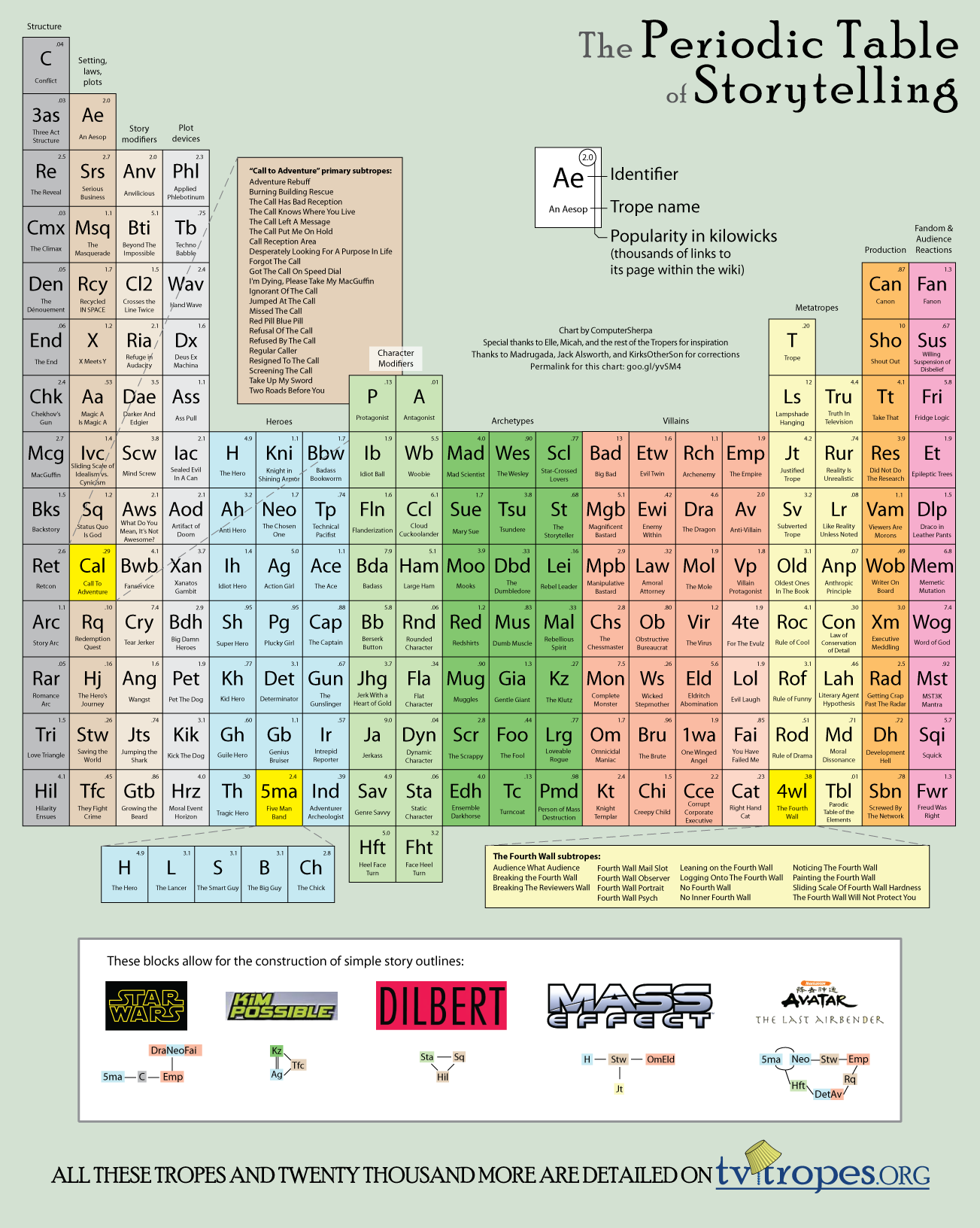
Awesome Conceptual Tool: The Periodic Table of Storytelling


So thanks to The Professor (my fiancée), here’s an absolutely amazing infographic that may just become my favorite outlining / conceptual tool. It’s the Periodic Table of Storytelling, which was posted on DeviantArt by ComputerSherpa, a second-semester art student. Check out the table below:

Periodic Table of Storytelling by ComputerSherpa

Periodic Table of Storytelling by ComputerSherpa, via DeviantArt

What makes this infographic so amazing is its ability to map out just about any story structure using its “atoms.” ComputerSherpa included some great example molecules that lay out some really well-known stories, and I might just start using molecules like that when I outline my own stuff. What I really need is a smartphone app that will let me search and model those kind of storytelling molecules on my phone. That would be really helpful.

In the meantime, lacking such a smartphone app, you can order a poster print of this here. The example molecules have been removed from the bottom on the poster (which I think is a shame), but I think it’s really cool anyway.