Skip to content

Posts tagged ‘fantasy’

REVIEW: With Fate Conspire by Marie Brennan


Title: With Fate Conspire
Author: Marie Brennan
Pub Date: August 30th, 2011
Chris’ Rating (5 possible): 1 point 1 point 1 point
An Attempt at Categorization If You Like… / You Might Like…
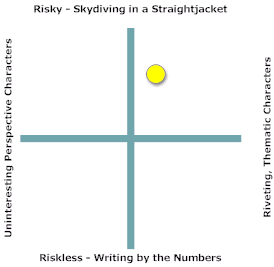
A risky undertaking that is more than half-successful.

A while back, I received a review copy of Marie Brennan’s With Fate Conspire, the fourth in her Onyx Court series. Now, let me start with a confession: before receiving my copy, I hadn’t read any of the earlier books. I know, I know – alternate/secret history set in various periods in London’s history? Liking historical fantasy as much as I do, one would think I had devoured this series from the first book up to now. But for whatever reason, I missed it until finding its fourth volume in the mailbox. Holding the book in my hand, I faced a choice: I could either catch up on the previous three books, or I could just dive into the fourth. Doing so would be a risk: would I miss vital backstory or world-building? I didn’t know. But I justified my decision with the fig leaf of “someone else might pick up the fourth book first, right?”

With Fate Conspire is set in an exceedingly well-researched late nineteenth century London. It features two primary viewpoint characters: the mortal Eliza O’Malley, a poor woman of Irish descent living in the London slums and Dead Rick, a faerie skriker (a Lancashire name for a lycanthropic faery who is an omen of death – more commonly known as a Black Dog) living in the Onyx Court’s Goblin Market. When we first meet Eliza, we quickly learn that she is desperately seeking a way to track down the faerie who kidnapped her lover seven years prior. When we first meet Dead Rick, we find him brutally forced to work as a slave, enforcer, and errand-boy for Nadrett, a criminal kingpin in the Goblin Market. Connecting both perspectives is the accelerating industrialization of London: the rise of iron-based industry and the development of the London Underground Railway are destroying the faerie city.

When we first meet both characters, they already have interesting pasts. Eliza’s lover was kidnapped by faeries and she foiled a faerie terrorist attack on the London underground. Dead Rick’s past is more mysterious, but it somehow put him at the mercy of Nadrett. At first, I assumed that these histories were the backstory that I had missed by not reading the earlier books. But then I realized that A Star Shall Fall is set more than a century before With Fate Conspire – which means that their backstories could not possibly have been in the pages I’d skipped.

When I picked up the fourth book in the series, I risked missing out on vital backstory. But writing the fourth book in the series, Brennan took a similar risk: she placed the moment of displacement – the point where Eliza and Dead Rick’s adventures start – off-screen. This is a particularly risky approach: by not allowing us to participate in her protagonists’ displacement, Brennan risks our investment in the characters and their world. I really enjoyed the structure and courage that this showed, but I found that the risk was only partially successful.

Dead Rick is modeled as a hero (see my post on A Theory of the Hero). We are shown his desperation to survive the Onyx Court’s imminent collapse, and his willingness to commit violence, but there remain lines he refuses to cross. He is a moral character, despite the self-loathing we see. He is an aspirational hero who wants to survive while still doing what he feels to be right. He may not always succeed, but he continues to aspire. He is used to show us the lawless underbelly of the Onyx Court, and the amoral brutality of some faeries. The challenges he face are existential: will Nadrett kill him? Will he survive the imminent destruction of the Onyx Court? Will he become like Nadrett to do so?

The portrayal of Dead Rick and faerie society were the high points of the book for me. First, I always enjoy well-drawn heroic characters. The challenges which Dead Rick faces are packed with drama. On an individual level, the unflinching depiction of Nadrett’s brutality and Dead Rick’s desperation make him particularly sympathetic: I cringed to see his experiences and wanted everything to work out for him. At the same time, his story becomes a microcosm of the Onyx Court’s story. Dead Rick’s experiences concretize the drama of the Onyx Court’s collapse by showing us the little guy’s perspective. Dead Rick is no chosen hero, capable of saving the Onyx Court from London’s industrialization. He can barely keep himself alive, let alone save the faerie city. But it is his courageous struggle against insurmountable challenges that makes his story a page turner. In Dead Rick’s case, Brennan was able to successfully skip his backstory: the sympathy he engenders, his emotional stakes, and his relationship to the Onyx Court’s broader struggle were enough to earn my investment.

By contrast, I found Eliza to be the far weaker character. If Dead Rick is defined by his rough moral code, then Eliza is defined by her obsession with tracking down Owen Darragh. This is not an existential challenge. The worst-case scenario for Eliza is that she never finds him. But because we did not get her backstory, we are not as invested in her quest as she is. Brennan tries to make Eliza sympathetic using tools parallel to those used for Dead Rick: Eliza is a poor costerwoman of Irish descent. Her experience of London is that of the down-trodden and the discriminated. While this works to make Eliza somewhat sympathetic, her story lacks the emotional tension of Dead Rick’s. The dilemmas she faces are not moral in nature: she rarely needs to choose between right and wrong, or the lesser of two evils. Short of killing innocents, she’s happy to cross almost any line in her quest. Her challenges are almost always tactical, and they fail to mirror or concretize those of broader mortal London.

In Eliza’s case, skipping of the backstory did the character a disservice. It made it impossible for me to really invest in Eliza’s travails. This problem is especially apparent when compared against Dead Rick’s storyline. Eliza’s difficulties and choices are inconsequential when set against Dead Rick’s primary problem (the catastrophic collapse of the Onyx Court).

That the faerie perspective is more compelling than the mortal one probably should not be a surprise. The Onyx Court is the primary constant throughout the (surprise surprise) Onyx Court series – which in and of itself is an interesting structural feature. Most contemporary fantasies that deal with the world of faerie tend to be either portal or intrusion stories where the focal lens is a human who finds themselves caught up in the magical world. In those stories where a human isn’t our lens, we often see through the eyes of a faery who – for all intents and purposes – tends to be indistinguishable from a super-powered mortal.

When writing a series, most authors take the safe approach of following one set of characters as they progress through events that can be encapsulated within a mortal lifetime. But Brennan takes a different path. Rather than give us characters to follow over the course of a single escalating adventure, she instead opens a window onto a particular time in the history of the eternal Onyx Court. The effect is like tuning into a long-running TV series mid-episode, mid-season. By nailing the faerie perspective – and lending it continuity throughout the series – Brennan is able to diminish the impact. Yet the relative weakness of her mortal character (Eliza) underlines the fact that the faeries – and how the Onyx Court deals with the challenges it faces – are the author’s primary concern. I am curious whether the mortal characters in the earlier books are as weak as Eliza.

Despite Eliza’s weakness, With Fate Conspire remains a very good book. Dead Rick’s story is – in my opinion – enough to carry it, and ultimately make it a satisfying experience. The world-building and research stand out for the level of detail and the skill with which they are woven into the story. The book’s pacing was fairly solid, providing moments of rising tension and breaths where I could assimilate the plentiful skulduggery and intrigue. Fans of “London Above / London Below” fiction along the lines of Kate Griffen’s Matthew Swift novels (see my earlier review), Neil Gaiman’s Neverwhere: A Novel, or China Miéville’s King Rat will likely enjoy With Fate Conspire, as will fans of painstakingly researched and imagined alternate/secret histories like Bruce Sterling and William Gibson’s The Difference Engine, Susanna Clarke’s Jonathan Strange & Mr Norrell: A Novel, or Jonathan Stroud’s Bartimaeus trilogy.

Perhaps the strongest recommendation I can offer is that after finishing With Fate Conspire, I went out and bought the preceding three volumes. Brennan took a significant risk structuring this book as she did, and while she may not have succeeded as well as I might have liked, neither did she fail. I applaud her courage, and her skill for getting it more than half right. I’m looking forward to the preceding three books.

A Theory of the Hero: Story Archetypes for Heroic Characters (part 2 of 3)


NOTE: This is the second in a three-part series on heroic characters. The previous installment discussed how agency, voice, and sincerity are used to determine heroic characters, while the third installment focuses on narrative timing and the tragic and anti-tragic hero.

This past Tuesday, I wrote about how narrative voice, and a character’s agency and sincerity determine whether they can be considered heroic. But in order for those three components to mean something, they must be embedded within a larger story and then expressed through the plot. Any heroic story – whether Tolkien, Howard, or Nabokov – is principally concerned with the hero’s value system. I see three primary archetypes for a heroic story, and makoto (a character’s sincerity to their own values) is central to each:

Heroic Story Archetype Description
1 Aspirational Will the hero live up to their own values? Or will they fail and transgress against them?
2 Observational How will the hero apply their values within a particular set of circumstances?
3 Consequential How will the hero face the consequences of their choices?

Different Strokes for Different Folks, and Different Stories for Different Heroes

The archetype that applies to a particular hero need not be the archetype that applies to the overall book/film. We talk about books having “a story” but really each hero gets their own story. Some books might have no heroes (Franz Kafka’s The Metamorphosis), others might have one (Nabokov’s Lolita), or many (I count nine in Les Miserables).

As a quick example to start off, let’s consider Star Wars (the original trilogy, naturally). Han Solo’s journey is entirely different from Luke Skywalker’s: though they share many experiences (though they go through the same plot), the choices, subtext, and meaning is different for each character. Darth Vader likewise has his own story. Luke’s is aspirational: will he stay on the Light Side or go to the Dark? Solo’s story – particularly in The Empire Strikes Back and Return of the Jedi – is observational: how will he apply his values under trying circumstances? And Vader’s story is consequential, focusing on themes of redemption and the consequences of choices he made before the events of the original trilogy. Each of these characters could be the “star” of the trilogy: that Luke’s arc gets the focus merely reflects the creator’s choice.

The hero’s story archetype determines the emotional arc of the story, the subtext that drives us to invest in the characters and keeps us tense. The hero’s value system and their behavior relative to that system determine the story archetype and set us up for the Aristotelian catharsis at the story’s climax.

Aspirational Stories: Portal/Quest Fantasies and Children’s Fiction

The Encyclopedia of Fantasy has a great entry on heroes and heroines which outlines a pretty extensive (though not exhaustive) typology of heroes. Looking at this list, however, it is clear that not every type of hero can support an aspirational archetype.

The classic model of an aspirational heroic story is the coming-of-age tale. Since so much of middle-grade and YA fiction is about helping characters negotiate and articulate their value systems, it should come as no surprise that children’s literature is rife with aspirational heroes. Taran the Assistant Pig-keeper in Alexander’s The Book of Three, Garion in Eddings’ Pawn of Prophecy, or Wart in White’s The Once and Future King are all great examples of aspirational heroes.

Hidden monarchs, ugly ducklings, changelings, and people who learn better are classic character models for aspirational stories. What is essential to this archetype is an evolution in the character’s choices. Unlike the observational archetype (see below), these characters’ are still struggling with their value systems. The “right” and “wrong” of their story is implied in the text: the reader understands what Taran must do, the reader knows what choices Garion must make, but the character does not. As the plot unfolds, the character gradually catches up to the reader and becomes able to articulate and act on their implicit value system.

Portal/quest fantasies are the most frequent structure for aspirational stories. The plot’s quest becomes the device by which the hero explores and articulates their choice. Frodo’s quest to destroy the Ring is inherently tied up in his value system. The crux of his story hinges on the question of whether he will allow himself to be corrupted by the Ring, or whether he will stay true to his values and destroy it. The climax of this archetype is the moment when the hero makes that final choice: when they decide whether they will do right or not. That climax is the moment of maximum tension within the story, and it defines the hero’s success or failure.

One of the most satisfying aspects of aspirational heroes is that they often make the “right” choice. Aragorn, Luke Skywalker, and most heroes in MG/YA fiction all ultimately make a choice that more-or-less aligns with most readers’ moral codes. But that success is not necessary. So long as the hero’s moral code remains unchanging, whether he succeeds or fails to live up to that code has no impact on the story’s resonance. Failure can be just as strong a resonator as success.

For example, Frodo Baggins is a failure. Yes, he remains a hero, but standing over the Crack of Doom, he allows the Ring to corrupt him, and he cannot bring himself to destroy it. Tolkien’s use of eucatastrophe (Gollum’s convenient attack on the invisible Frodo) is the device by which the author wrenches a positive ending out of his principal hero’s failure. This does not weaken the story – in fact, I think it enhances it by adding a tragic dimension to the character of Frodo Baggins. Everything does not work out, certainly not for Frodo. For the rest of his life, Frodo will have to bear the knowledge that at that last desperate moment, he blinked. If Frodo’s story is aspirational, then at the end of the day he fails in his aspiration. Yet his story still resonates.

Observational Archetypes: The Classic Heroic Story

When we use the words “heroic fantasy” most of us automatically think of muscle-bound heroes along the lines of Beowulf, Conan of Cimmeria, or Fafhrd and the Gray Mouser. We think of the stories written by Robert E. Howard, Michael Moorcock, Glen Cook, etc. Typically, these are immersive fantasies where the world of the story is assumed as a given. The heroes in question already fully live in their worlds, and their value systems are fully-formed and clearly articulated. However, what sets these stories apart from their aspirational counterparts is that they focus less intensely upon the hero’s moral code.

The climax of an aspirational heroic story hinges upon whether the hero will or will not live up to their values. But in an observational story, the hero will always live up to their values. These values are typically idiosyncratic when compared to those of other characters. Whether we’re dealing with loveable rogues like Han Solo, utter villains like the Brothers Grossbart, or introspective brooders like Elric of Melniboné, the hero’s value system always features some difference to those of the book’s other characters. Reading these characters’ stories, we are less concerned with will they or won’t they stick to their guns, and more concerned with how they will do so.

Observational heroes tend to be what The Encyclopedia of Fantasy calls Brave Little Tailors, Duos, or Temporal Adventuresses. Many fairy tale heroes, in particular the “Ivans” of Russian fairy tales or the “Jacks” of the British variety, fall into this camp. So would most of Robert E. Howard’s Conan stories, where his sword-swinging Cimmerian broods and simmers…but always acts according to his (admittedly sometimes rough) moral values.

The typical observational hero never ages: he or she is almost always portrayed in the prime of their youth, as the story’s momentum hinges upon their ability to act with physical or magical strength. Aspirational heroes and their stories tend to deal earnestly with stark moral black-and-whites. Observational heroes, however, tend to see more shades of grey. For Frodo Baggins or Taran the Assistant Pig-keeper, there is no middle ground: either they do right or they fail. For Conan, or Leiber’s Fafhrd and the Gray Mouser, their moral codes and the choices they face are more ambiguous, allowing for compromise.

This ambiguity creates a great degree of space for humor in observational stories. Whether it is Fafhrd and the Gray Mouser, Conan, or Han Solo, the ambiguity of the hero’s moral code and their situational application offers the opportunity to inject irony and sarcasm into the narrative. This kind of humor tends to be quite infectious, because it perhaps deals with moral choices more accessible to the average reader than those common in high fantasy. The choices our heroes face, while expressed in outlandish fashions, tend to have fewer world-changing or soul-destroying consequences than those found in aspirational stories.

Duos in particular are a common type of observational hero. While I have already mentioned Fafhrd and the Gray Mouser, I think a far better set of examples can be found in the mystery genre. Sherlock Holmes and Dr. Watson represent the classic ur-duo, and their stories clearly show the application of Holmes’ rational worldview. In Dashiell Hammett’s The Thin Man, Nick and Nora Charles have a clearly ideosyncratic, “us-against-the-world” value system which they apply consistently. As in so many mysteries, the morality of their philosophy is not the focus of the story: instead, the focus is on how that philosophy is actively applied within the plot.

Generally, heroic stories whose narrative focus is on the action of their plot tend to skew observationally. These are the stories that are more exciting than earnest. Bullington’s The Sad Tale of the Brothers Grossbart is a fun exploration of how a set of villainous moral codes can be applied across a variety of trying situations. Super-hero comic books in particular are another great example of this kind of storytelling: the hero’s moral code (remember Truth, Justice and the American Way?) is always a given, but decades of continuity explore how the hero applies that code to all manner of situations.

Consequential Archetypes: Living with Choices

The third and final story archetype for heroic characters returns to deal with the moral choices more earnestly than in most observational stories. Consequential stories focus on the hero’s actions after a moral choice has been made. By its very definition, this archetype tends towards the Aristotelian and the tragic. Typical heroes that fit this mold are the Knight of Doleful Countenance, or the sinner seeking redemption.

Often, the hero’s nobility is established off-screen before the events of the story. We know Macbeth is a noble hero because Duncan, his men at arms, and the sergeant tell us so before we ever meet the thane of Glamis. But Macbeth transgresses against his own moral code by killing his king, and the rest of the play focuses on him living with and facing up to the consequences of his evil act. Robert E. Howard’s Solomon Kane stories do something similar, where we first meet Solomon Kane as a puritanical zealot obsessed with meting out stern justice and stamping out whatever he considers evil, regardless of danger. Through the stories’ subtext, we gradually get the sense that Kane’s obsession is redemptive: that by stamping out evil, he may purge his own soul of whatever past sins may stain it. In Michael Moorcock’s Elric of Melniboné stories, the hero must live with the guilt of feeding souls to his demon-sword Stormbringer.

Consequential heroes and their stories may be redemptive or tragic. Darth Vader’s is a redemptive story, where he is able to return to the Light by betraying the Emperor. Macbeth or Othello, by contrast, are tragic: no amount of contrition on their part can ever expunge their guilt. Typical of consequential stories is a constant revisiting and escalation of the hero’s original choice: Macbeth is forced to one-up his betrayal of Duncan with the murder of his friend Banquo, followed by the slaughter of MacDuff’s family. Elric has to feed ever more souls to Stormbringer so that he can do what he feels is right.

By their very nature, consequential heroes and their stories are tragic: if aspirational stories end on “and they lived happily/sadly ever after” then consequential stories are what happens in the ever after.

Story versus Story and Mixing Archetypes

Like so many aspects of storytelling, the borders between these archetypes can be blurred. For example, Moorcock’s Elric of Melniboné combines aspects of the consequential archetype (the exploration of Elric’s guilt) with the observational (constantly re-visiting his moral choices in new circumstances). It is also possible, though very difficult, for a single hero to progress from an aspirational story, to an observational story, and then to a consequential story. I know of few examples of this kind of progression, but those that do come to mind are almost always some of my favorite stories. Lloyd Alexander’s Westmark trilogy shows us Theo’s aspirational story in its first book, and then follows the pattern of a consequential story in the second and third.

In Hugo’s Les Miserables, Valjean’s story opens as aspirational, proceeds to observational, and ends as consequential. In Hugo’s case, this masterful progression is strengthened by pitting Valjean’s moral code against opponents who are elsewhere along the archetypal progression. When Valjean’s story is in its aspirational phase, his antagonist Javert is in an observational mode. By the time Valjean has entered the observational phase of his evolution, Javert has “regressed” to the aspirational phase. When Valjean is in the consequential phase of his life, Marius Pontmercy is in the aspirational phase of his.

Hugo is arguably the master of this kind of complex hero construction: reading his works (in particular Les Miserables and The Hunchback of Notre-Dame) I suspect that every single hero archetype and every combination of their oppositions, tragic and anti-tragic, can be found. The next installment of this series (on Tuesday) will focus on this aspect of heroic storytelling. In particular, I will focus on how narrative timing affects tragedy in heroic fiction, and on the differences between tragic and anti-tragic heroes.

NEXT: Come back on Tuesday for the third and final installment which focuses on how narrative timing affects tragedy in heroic fiction, and for a discussion of tragic heroes and anti-tragic heroes.

The Evolution of Middle-Grade Fantasy and Television


NOTE: I drafted this on my computer while I had power at a local café, but I’m posting it from home on my cell phone. As a result, some of my formatting may have gotten messed up. If so, I apologize: I’ll fix it as soon as I have power and Internet at home.

When I was a kid, I watched a lot of cartoons. Thundercats, G.I. Joe, Transformers, Inspector Gadget…the list goes on. Thanks to Netflix, I’ve started re-watching many of these shows, but I find that it is hard to re-capture my childhood appreciation. Most did not age well (or maybe I haven’t), but it is somewhat saddening to see stories I loved as a kid come off as puerile now. Interestingly, the books I read as a child do not suffer from the same problem. Why are the shows I watched at eight or nine unwatchable now, but the books I read at the same age still enjoyable? Have I just become some sort of egg-headed curmudgeon (obviously I have, but is that the cause?), or is there something different about these stories that affects their longevity?

Since Hurricane Irene knocked out our power for the last couple of days, I’ve had nothing to do but think about this while twiddling my thumbs by candlelight. And here’s the conclusion I’ve come to: what sets timeless middle-grade fiction apart from the cartoons from the ’80s and early ’90s is the evolution of character and moral ambiguity.

The Quest Structure and Character Evolution in Middle Grade Fiction

Much of the middle-grade fantasy I read as a child (Lloyd Alexander’s The Chronicles of Prydain, Madeleine L’Engle’s Wrinkle in Time Quintet, or Susan Cooper’s The Dark Is Rising) relied on the standard portal/quest structure. The youthful hero/ine has to leave home, find something, and return.

A screenshot from Avatar: The Last Airbender showing Zuko.

Prince Zuko from Avatar the Last Airbender, via Wikipedia

Their physical quest mirrors an evolution of their characters. As they progress through the various stages of their adventure, the characters are naturally changed by their experiences. Edmund Pevensie, in C.S. Lewis’ The Lion, the Witch and the Wardrobe, starts as a resentful, selfish child. His exposure to the White Witch’s evil changes him, as do his attempts to earn his siblings’ (and Aslan’s) forgiveness. At the end of the book, bratty little Edmund Pevensie ultimately becomes “Edmund the Just.”

In Lloyd Alexander’s The Book of Three, Taran learns that adventure is not the rollicking good time he supposes, and that heroes must make difficult choices.

In Madeleine L’Engle’s A Wrinkle in Time, Meg develops self-confidence and self-value through realizing that although she lacks her siblings’ more obvious gifts, her capacity for love ensures a central place within her family.

While adult readers might deride the portal/quest fantasy structure as trite, its ability to harmonize the characters’ emotional journey with their physical adventure continues to make it resonate. The key to that resonance, particularly for young readers, is how compelling the characters are. If the characters are uninteresting, no kid will ever enjoy the book. If those characters do not change, then young readers will rapidly outgrow the story (if they ever get into it at all).

Character Evolution in Cartoons

This kind of character evolution is distinctly absent from cartoons of the ’80s. At the time, cartoons were often made to sell toys, and by their very nature were more open-ended: the writers had to keep the story going until the show got cancelled. This presents its own storytelling challenges, and as a consequence, each episode tended to be a self-contained story arc, while the series as a whole had only the loosest overall structure. Typically a shows’ latter seasons – when the creators saw their series nearing the end of its viability – would often feature multi-episode or season-spanning plots which the creators hoped would finish a story. Yet despite this “innovation” in storytelling, each episode still needed to be self-contained, and characters never evolved greatly from one episode to the next. The Donatello we meet in the first episode of Teenage Mutant Ninja Turtles is the same Donatello ten seasons later: his experiences over the ten years of show continuity have not introduced any changes into the character’s personality or values.

When we look at more modern cartoons, like Avatar The Last Airbender, we see an entirely different structure at work. First and foremost, the story is no longer open-ended. The show’s creators set out to tell a story in three parts. There was never an intention to keep the show going through ten years of storytelling. Avatar The Last Airbender is similar to much middle-grade fiction in that it retains a quest structure at its macro-level and focuses on an over-arching conflict between our heroes and a “Dark Lord” villain. However, as in all cartoons, each episode remains a self-contained adventure within the confines of the broader story.

I believe that this innovation is enormously significant in terms of televised animated storytelling. Thanks to its structure, Avatar The Last Airbender is able to introduce character arcs that parallel the story’s plot arc. Over the story’s three seasons, we can watch Aang mature and take on his responsibilities as the Avatar, Sokka grow into the capable warrior he dreams of being, and Katara master water-bending and come to terms with her feelings for Aang. Each of the principal characters gradually grows and changes over the course of the show’s three seasons, which ultimately makes the series’ conclusion all the more satisfying.

Villainy in Middle-Grade Fiction and Cartoons

Another key difference lies in how “classic” cartoons portray their villains. The portal/quest fantasy has often been mocked for its stereotypically irredeemable “Dark Lord” (for a hilarious send-up, I strongly recommend Diana Wynne Jones’ The Tough Guide to Fantasyland: The Essential Guide to Fantasy Travel). And both middle-grade novels and cartoons feature this trope.

The Dark Lord’s goals tend to be suitably grandiose: take over the world/universe/whatever. But while the Dark Lord is portrayed as irredeemable and morally abhorrent, our heroes rarely face him until the final battle. Instead, their direct opposition usually comes from the Dark Lord’s lackeys, who are more complex characters serving the Dark Lord for their own (less inscrutable) reasons. Their goals are more localized: gain temporal power, get the respect they think they deserve, etc.

Whether it is Alexander’s Queen Archen, Cooper’s Walker, or Lewis’ Edmund Pevensie, the Dark Lord’s helpers are shown to actively make choices that align themselves with evil. Unlike the Dark Lord, their evil is never a given: they choose it for themselves. But in “classic” cartoons, the Dark Lords’ lackeys are just as irredeemably evil as their master. Whether we are talking about the Thundercats’ Slythe, the Decepticon Starscream, or Cobra’s The Baroness, the front-line villains have no depth; their motivations are rarely explored.

Moral Ambiguity in Today’s Cartoons

Fast forward twenty years, and you find an entirely new generation of cartoons, like Avatar The Last Airbender and the Cartoon Network’s reboot of Thundercats. Today, the irredeemable evil of the villain and the unquenchable goodness of the “good guys” is far more flexible.

Consider the rebooted Thundercats: in the first episode, we learn that the Thundercats have been repressing the dogs and lizardmen for generations. While our hero, Lion-O might oppose this level of repression, “the good guys” are generally depicted as racists. Or consider Avatar The Last Airbender. In the first episode, we learn that the Fire Nation has waged a century-long war of subjugation against the other nations, slaughtering an entire race (the Airbenders) in an unprecedented genocide. Within the first season, though, we learn that both this genocide and the war-torn century are a result of the Avatar (theoretically our hero) running from his responsibilities.

None of the “classic” cartoons from the ’80s would ever have explored a theme as morally ambiguous as Aang’s rejection of responsibility. Instead, each of these shows had to end with a moralistic “lesson” portrayed through the dénoument: remember those “knowing is half the battle” sequences at the end of GI Joe episodes? Such an externally-imposed mandate makes morally ambiguous storytelling difficult, if not impossible.

But middle-grade fiction has always had this type of moral ambiguity. In The Lion, the Witch and the Wardrobe, Edmund Pevensie betrays his siblings to the White Witch in exchange for promises of power and Turkish Delight. More recently, Eoin Colfer’s Artemis Fowl is a thief and kidnapper who performs morally abhorrent acts with (it turns out) noble intentions. Michael Buckley’s Sisters Grimm wrestle with the right-and-wrong of trapping all magical Everafters in a small rural town, and their friend is the Big Bad Wolf – a villain struggling with his past crimes. Susan Cooper’s Walker shows us that the “good guys” might not always do good, and that they too can betray – or seemingly betray – their friends. None of this even touches upon Rowling’s Harry Potter books, with the moral ambiguity of Snape, Dumbledore, and Tom Riddle.

Avatar The Last Airbender probably offers us the most powerful example of how contemporary cartoons can treat villainy: when the series opens, Prince Zuko is the heroes’ primary opposition, and we watch him hunt the Avatar with intense zeal. However, by the end of the first season we understand that Zuko struggles through his relationship with his father (Fire Lord Ozai, the “Dark Lord” of the series) and with his own moral compass, personified by his Uncle Iroh. While Zuko represents the primary threat against the heroes, he is forced him into chasing the Avatar, and though we may not agree with his motives we at least understand them. His portrayal as an almost-sympathetic character makes his evolution that much more satisfying, as over the course of the three seasons we watch him gradually change from being the Dark Lord’s lackey to being one of the story’s principal heroes.

What are the Implications for Children’s Storytelling?

I think Avatar The Last Airbender, with its moral ambiguity and even-handed character arcs makes for innovative children’s storytelling, irrespective of medium. Avatar The Last Airbender’s treatment of Prince Zuko would be the equivalent of Queen Archen or the Horned King switching sides, and I have not seen much middle-grade fantasy take moral ambiguity to such lengths (though Lloyd Alexander’s Westmark trilogy – which may or may not be considered middle-grade – comes very close, and Joseph Delaney tries for it in The Last Apprentice: Revenge of the Witch). The creators of the Thundercats reboot openly discuss wanting to make a darker, more cinematic story than the original cartoon (although Cartoon Network’s Friday at 8:30pm timeslot for the show might suggest they are aiming for an older audience). Personally, I think all of this represents an opportunity for writers of middle-grade and cartoons.

The success of Avatar The Last Airbender proves that the middle-grade audience enjoys complex storytelling, with extended character arcs and moral ambiguity. While some might say that shows like that are “too much for kids,” I could not disagree more: by blending childish adventure with more serious storytelling, they are doing what children’s literature has always done: helping kids develop a vocabulary with which to internalize and articulate a morally complex world.

In a real sense, I think this represents the gradual accrual of wisdom. If – thanks to more morally ambiguous middle-grade fiction or morally-challenging cartoons – kids are able to recognize, understand, and internalize a more complex world, then I think this can only be good. Doesn’t it suggest that kids are growing wiser sooner? And from a more crassly commercial standpoint, it also opens up “children’s” stories for an audience entirely outside of its intended demographic.

Who says grown-ups can’t enjoy good kids’ stories, anyway?

Recommended Blog Posts Works Mentioned
If you enjoyed this blog post, here’s a list of others that are on related subjects which you might find interesting:

Since I talk about a lot of different authors and titles in this post, here’s a list for your enjoyment. I’ve included some titles that don’t get mentioned directly, but which you might find fun/interesting:

Books:

O Canada! Travels in Canadian Science Fiction, Fantasy, and Horror


As I mentioned last week, I’m off on my honeymoon at the moment. What I don’t think I mentioned is the fact that I’m honeymooning in the United States’ neighbor to the north. When the Professor and I mentioned honeymooning in Canada to most people, their reaction was usually one of considerate bewilderment: why not go someplace with warm, sandy beaches and fizzy drinks with little umbrellas? Well, both of us like rocky coastlines, lighthouses, cabins in the middle of nowhere, and tons of wonderful used bookstores. All this makes Nova Scotia pretty ideal.

And with a couple of days spent wandering through the stacks of some great used bookstores in Halifax, I thought I might give a shout-out to some of the Canadian genre creators who I’ve enjoyed:

Author Comments Good Titles to Start On
Margaret Atwood Putting aside Atwood’s semantic quibbles as to the definition of science fiction versus speculative fiction, her novels tend to be solid sociological treatises reminiscent of the 1970’s New Wave in science fiction. Her writing often reminds me Ursula K. Le Guin’s, although with a more starkly dystopic sensibility.

William Gibson Gibson’s name is synonymous with the cyberpunk sub-genre, and he is often hailed as one of the luminaries of early steampunk. His cyberpunk novels combine noir storytelling techniques with an often-prophetic depiction of near-future technologies, with his more recent works relying more heavily on prescient sociology sensitivity.

Guy Gavriel Kay Kay is an excellent fantasist who models his secondary worlds on real-world historical settings. Whether it is medieval Spain, Italy, Byzantium, or 8th century China, Kay’s depictions of settings and character paint a vibrant picture of times and cultures that most of us only know from history books.

Claude Lalumière Lalumière tends to produce dark fantasy short fiction notable for eliciting a quiet sense of unease. Language and characters are put to deft – though dark – use. His most recent novella (The Door to Lost Pages) stands out as particularly compelling.

Robert J. Sawyer Sawyer is a prolific science fiction author whose novels utilize hard science to probe more humanist concerns. His work tends to deal with the relationship between science and religion, as well as focusing on issues of self-identity. His books are fun, fast-paced reads whose seriousness sneaks up on you (at least they did on me when I first discovered his work some fifteen odd years ago).

Karl Schroeder A hard science fiction author who – for whatever reason – is grouped in my mind with Robert J. Sawyer and Robert Charles Wilson, Schroeder writes action-packed, fast-paced novels which rely on hard scientific conjecture for their settings and underlying premises.

Peter Watts Watts is a hard-SF author whose particular passion seems to be the biological sciences. If “genepunk” were a subgenre (and I think it damn well should be), then I would argue Watts for its doyen. His novels tend to be fairly dark and hard-hitting, and while they are not light on the science, they still manage to play effectively with the tropes of related genres (horror in particular).

Robert Charles Wilson Most of Wilson’s work is hard SF, though his earlier works veer towards the softer side of hard. My particular favorites are some of his earlier novels which play delightfully with concepts of time travel and most importantly reader expectations.

So without having the benefit of browsing through my bookshelves, that’s a list of fun Canadian genre authors I thought I’d share with all of you. Anyone have any others they’d like to recommend? Since I’m in Canada at the moment, I’d love to hear of any Canadian authors whose work has yet to appear in the United States. Does anyone have any suggestions?

Oblique Wisdom: The Secret of Evergreen Middle-Grade?


Probably right around the age of nine, I discovered Lloyd Alexander’s Chronicles of Prydain. These books opened up a world of adventure, mystery, and wisdom for me – and are probably the reason why I love fantasy so much. Fast forward twenty years, and this past weekend I cracked open The Book of Three, the first book in the series. Reading it over the course of an afternoon (it’s a much faster read today than I remember it being), I think I stumbled on an aspect of middle-grade fiction that I think might be universal in evergreen titles (the classics that never go out of print, never stop being popular): oblique wisdom transparent for the reader but opaque for the hero.

Some Thoughts on the Heart of Middle-Grade Fiction

There is a world of difference between middle-grade (MG) and even young adult (YA) fiction. While both are lumped together as “children’s fiction,” everyone knows that an eight year old looks at the world very differently from a sixteen year old. Differences in awareness, concerns, and our ability to articulate our thoughts and emotions drive many of the fundamental differences between MG and YA books. An eight year old can love Norton Juster’s The Phantom Tollbooth, but the themes and concerns of Suzanne Collins’ The Hunger Games would likely go over that same child’s head.

Classic MG titles like The Phantom Tollbooth and Dealing with Dragons show us fundamental truths about the world. Most of these truths are foundational, and so basic that MG readers will already understand them before they ever pick up a book. Research has shown that by the age of five, kids understand and apply complex rules of “fairness” in their behavior. They might not be able to articulate those rules, or explain why something is right or wrong, but they have already formed a sense of it.

The best YA fiction helps us to negotiate the muddier waters of an adult reality. Books like Collins’ The Hunger Games, or Pullman’s The Golden Compass transition a child’s black-and-white value system to the shades of grey that (unfortuntely) operate in the adult world. But middle-grade, at its heart, is there to provide the initial vocabulary. It teaches us how to articulate values every child knows, but might not be able to otherwise express.

Fairy Tales, Learning Better, and the Role of the Teacher

The 18th and 19th centuries saw the rise of popular children’s literature. In particular, Charles Perrault, the brothers Grimm, Alexander Afanasyev, Hans Christen Andersen, and Gregory MacDonald all contributed to popularizing stories with magical characters that grew to be beloved by children in their respective countries. These early fairy tales were often based on oral storytelling traditions, and employed a remarkably consistent morphology (I recommend Propp’s Morphology of the Folktale and Luthi’s The European Folktale: Form and Nature for a detailed discussion).

In the 20th century, Robert A. Heinlein argued that all stories (irrespective of audience) could be reduced to three categories: Boy Meets Girl, the Brave Little Tailor, or the Person Who Learns Better. The vast majority of early fairy tales – and the majority of middle-grade fiction – fall into either the Brave Little Tailor or Learns Better structures. Within the confines of these archetypes, the mentor (or dispatcher, in Propp’s terminology) is a standard element. Consider Merlyn in T.H. White’s The Sword in the Stone, Dallben (and Coll, and Gwydion) in The Book of Three, Morwen and Kazul in Dealing with Dragons, Mrs. Whatsit, Mrs. Who, and Mrs. What in A Wrinkle in Time, or Mrs. Frankweiler in From the Mixed-up Files of Mrs. Basil E. Frankweiler:

Each of these mentors is an adult, placed by the story’s plot in a parental/guardian position relative to the story’s hero. That the hero may be a hidden monarch or a prophesied savior is immaterial for the mentor’s role. From a plotting standpoint, the mentor is there to initiate and end the adventure.

Pushing the Hero Towards Adventure

Parents typically protect the hero. They want to keep the hero guarded against all of the vicissitudes of the outside world. The mentor, however, does not. The mentor recognizes – in their infinite wisdom – that the hero needs to face danger to grow. Merlyn puts Wart in potentially life-threatening situations because he hopes the lessons will make Wart a better king. Mrs. Whatsit, Mrs. Who, and Mrs. Which fetch Meg, Charles Wallace, and Calvin and put them directly in harm’s way. Kazul and Morwen – ostensibly – have few qualms about placing Cimorene in what the novel’s society considers danger. In this sense, the mentor often adopts the role of dispatcher in Propp’s morphology. In some cases, as in Morwen and Kazul, the mentor can play the role of helper just as easily.

Starting Points: Explaining the Lesson at the Start of the Book

Mentors are by definition wise. And invariably they share that wisdom with the middle-grade hero before the adventure starts. Consider Dallben’s exchange with Taran the Assistant Pig-keeper:

“Tut,” said Dallben, “there are worse things. Do you set yourself to be a glorious hero? Do you believe it is all flashing swords and galloping about on horses? As for being glorious…”

“What of Prince Gwydion?” cried Taran. “Yes! I wish I might be like him!”

“I fear,” Dallben said, “that is entirely out of the question.”

“Buy why?” Taran sprang to his feet. “I know if I had the chance…”

“Why?” Dallben interrupted. “In some cases,” he said, “we learn more by looking for the answer to a question and not finding it than we do from learning the answer itself. This is one of those cases. I could tell you why, but at the moment it would only be more confusing. If you grow up with any kind of sense – which you sometimes make me doubt – you will very likely reach your own conclusions.

“They will probably be wrong,” he added. “However, since they will be yours, you will feel a little more satisfied with them.”

This exchange – which we find in chapter one – outlines the arc at the heart of The Book of Three. Taran obviously fails to grasp the wisdom of Dallben’s warnings – otherwise, he would never run off after Hen Wen and begin his exciting adventures. But reading this exchange, an adult reader instantly sees the timeless wisdom of Dallben’s teaching. And I would argue that a nine year old reader gets it just as well.

The Triangle of Understanding in Middle-grade Fiction

The Triangle of Understanding in Middle-grade Fiction

The reason for that is because of Dallben’s obvious wisdom. A nine year old might not be able to articulate this wisdom, to communicate it anew, yet nonetheless it strikes a chord. We know Dallben’s interdiction will be broken, that Taran will go out on an adventure. And we know that the adventure will change him, make him recognize at least a part of Dallben’s teachings. The same model can be found in Madeleine L’Engle, Susan Cooper, Diana Wynne-Jones, L. Frank Baum: all of the classic middle-grade fantasists understood the power of foreshadowing the lesson at the start of their books.

Contrary to what many grown-ups believe, children well understand the difference between reality and fiction. They know that Taran’s adventures are dangerous. If they did not grasp the inherent wisdom of Dallben’s warnings, why would they be scared or excited when Taran faces Achren or the Horned King? While Dallben’s warnings might go right over Taran’s head, even a young reader will still understand and recognize their wisdom. They may not be able to explain what they have understood, but that does not mean they have failed to grasp its underlying significance. The reader knows what lesson is coming before they’re even finished with chapter one: which is why the book’s conclusion – when Taran has had his adventures, and has learned at least a little more wisdom – is so satisfying.

The Obliquity of Wisdom: Mediating the Mentor and the Hero

This structure is satisfying because the reader not only understands the mentor’s wisdom, but the hero’s desires. What nine year old doesn’t want an exciting adventure slaying monsters? We want Taran to have his adventure, we want him to face down monsters and evil, and to come out stronger, smarter, and happier at the end. We know that Taran will get into trouble by breaking Dallben’s interdiction, but there remains that niggling little voice inside that says adventure is worth it.

The relationship brings to a mind the best line of the trailer for Martin Scorsese’s film adaptation of Brian Selznick’s The Invention of Hugo Cabret, where Isabelle warns Hugo that they can get into trouble and Hugo responds “That’s how you know it’s an adventure.” That exchange encapsulates the reader’s mediation between grasping the hero’s immature desires, and internalizing the mentor’s wisdom. If the hero were not in danger, if the hero did not break the mentor’s rules, then there would be no adventure.

Developing One’s Own Vocabulary: The Learning Hero in Middle Grade

As MG novels progress, the hero has to gradually develop their own vocabulary for the mentor’s teachings. The hero cannot just parrot the mentor’s lessons: that would not show any development on the part of the character, and would thus be fundamentally unsatisfying. Instead, the hero rationalizes an initial rejection of the mentor’s lesson and then builds an acceptance of the lesson by getting (proverbially – or literally) kicked in the teeth by life.

Note that there are examples where authors have tried to deviate from this pattern. Joseph Delaney – in his 2004 novel The Last Apprentice – tries to invert the classic structure. Delaney’s hero understands the wisdom of the Spook’s interdictions. However, he finds that certain rules are overly stringent. He does not break them due to a failure of understanding: instead, he breaks them because he actively disagrees with their universality. These books are a little too recent to be deemed evergreen, but I am curious as to how they will age over time. They have not resonated with me the way the more classic structure has, but that may have more to do with my own tastes (my fiancée accuses me of being an old-fashioned curmudgeon) than with any actual weakness in an inverted structure. Eventually, time will tell whether the mirror image of the classic structure can function as well as the original.

Regardless of whether the author plays it straight or flips the structure, at the end of the story the hero has learned a lesson and articulates it in words different from those of the mentor. What matters is that the lesson cannot be presented didactically: kids can smell that kind of condescension a mile away, and overt morals ruin good stories. Nobody likes to be patronized, least of all a nine year old. If the action and emotion of a story cannot imply a lesson through subtext, then it is a weak lesson that simply won’t resonate.

By finding a different subtext-driven way of articulating (or potentially refuting) the mentor’s earlier wisdom, a classic MG novel can show the reader how that wisdom can be applied in a fictional context. Just as the hero’s understanding of reality is broadened, so too is the reader’s conceptual vocabulary. Like Dallben says:

“…If you grow up with any kind of sense – which you sometimes make me doubt – you will very likely reach your own conclusions.

“They will probably be wrong,” he added. “However, since they will be yours, you will feel a little more satisfied with them.”

And that, ultimately is what childhood and fiction are both about.

Negotiating the Borders of Intimacy and Imagination: Romance and Fantasy


Last week, I came across Jacqueline Lichtenberg’s Big Love Sci-Fi series of blog posts (part 1, part 2, and part 3). I had been thinking about how romance, sexual tension, and emotional intimacy is built and maintained in books, and so her suggestion that romance in fiction is actually a negotiation of the borders of intimacy particularly struck me. As I thought about it some more, I realized that in some ways the romance genre and fantasy are analogous. If romance derives its power from the borders of intimacy, then fantasy builds its sense of wonder from negotiating the borders of imagination.

Borders of Intimacy: A Framework for Thinking about Romance

Romance may well be the oldest genre in existence. Since before the written word, stories and myths were full of love, sex, and betrayal. And why not? It’s fun! It grabs our attention, focuses our minds, and gets our hearts racing. What’s not to like? Artists have known for millenia that sex sells, but the methods by which it’s portrayed are culturally dependent.

Jane Austen’s Pride and Prejudice manages romantic/sexual tension very differently from Laurell K. Hamilton’s Guilty Pleasures. 19th century readers had different standards of intimacy: the kind of hot-and-heavy sex scenes we take for granted today would have been off limits back then. Even more graphic 17th century romances like Eliza Haywood’s Love in Excess; or, the Fatal Enquiry (which was called pornographic when first published) lack the overtly-described throbbing body parts of today’s sex scenes. Despite the changing standards of intimacy, romances from Ovid to Danielle Steele engage us by bringing characters to an emotional precipice, and then having them finally plunge over it.
The Facets of Intimacy in Romance

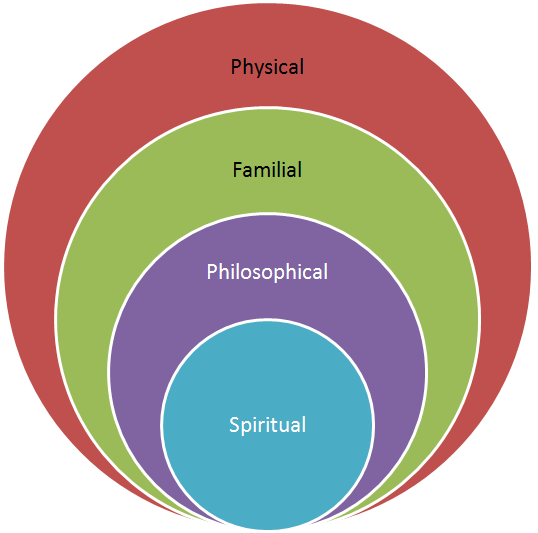
An overly-simplistic view of romance says that it’s just sex. But Jacqueline is exactly right when she says that a sex scene lacking emotional depth is just boring. In western culture, the physical act of sex has always been used as a proxy for other intimacies:

Aspects of Intimacy

Aspects of Intimacy

Marriage (which traditionally precedes sex) represents a type of familial intimacy: one person’s family opens up and accepts a new member, or two families join. Probably the best example of this is Shakespeare’s Romeo and Juliet. Of course, the two families alike in dignity reject that intimacy. But nonetheless, the underlying tension of that love story rests on Romeo and Juliet trying – and failing – to negotiate that familial intimacy. Here, death plays the role that sex often does: it represents the culmination and climax of their negotiation.

A different type of intimacy is the philosophical or worldview model that Austen nailed so perfectly: both Pride and Prejudice and Sense and Sensibility deal with the protagonists adjusting how they perceive other characters. This is a philosophical intimacy, where the climax is the moment of acceptance rather than the moment of marriage (let alone sex). For Austen, sex – of course preceded by marriage – is in fact the denouement, never shown but instead implied by her heroes’ betrothal.

Spiritual intimacy between characters can likewise be negotiated. Unfortunately, I had some difficulty thinking of romances that deal with this facet of intimacy, but ultimately I think Ayn Rand’s Atlas Shrugged is probably the most succinct example. Dagny Taggart’s relationships with Hank Rearden, Francisco D’Anconia, and John Galt all oscillate around her most fundamental spiritual values. While Rand might well have spit nails to see those values described as spiritual, there is no change in Dagny’s philosophy over the course of her relationships. Instead, the climax of these relationships is her finding her idealized counterpart, the impossible superman who personifies her ideals. If we were to swap Rand’s Objectivism for any religion, the relationships would still function the same way (though the plot’s MacGuffins would not).
The Borders of Imagination and the Fantasy Spectrum

If the core of romance is characters negotiating the borders of their intimacy, then I suspect the core of fantasy might be negotiating the borders of the reader’s imagination. Love titillates us because it speaks to something deep within our hearts, touching on our innermost desires, exciting us with the promise of fulfillment. But intimacy doesn’t lurk alone in the deep, dark corners of our soul. It shares those caverns with our imagination.

A romance hinges on the borders of intimacy between the story’s characters. Typically, that intimacy is indelibly linked to the story’s plot. For example, the plot of Romeo and Juliet would fall to pieces without the Capulets and the Montagues. But fantasy’s relationship with imagination tends to be slightly more removed from the story’s plot, and it does not need to rely so heavily on proxies the way intimacy often does.

The Borders of Imagination

The Borders of Imagination

Fantasies make us look at reality sideways, utilizing evocative imagery, secondary worlds, strange creatures, and magical powers to broaden our understanding of our own reality. Superficially, elves, monsters, and wizards are cool plotting devices that let us tell entertaining stories. Who doesn’t like magic and monsters? But beneath that surface level, they give us a new lens through which we can see an oblique picture of the world.

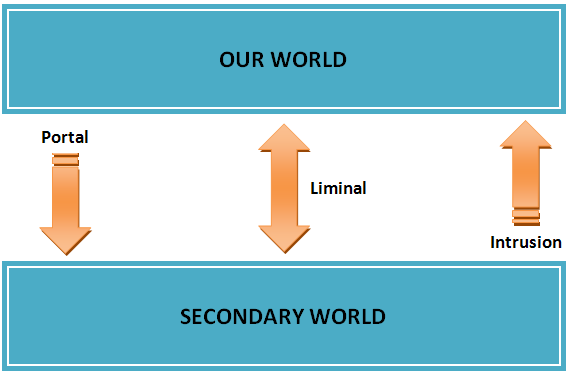
Imagination operates on a spectrum that describes a relationship between the story’s characters, the reader, and their environment. At one extreme we have our world, in all its mundane glory. It is at this end that we find mainstream literary fiction, where the world operates according to the real-life rules that govern our everyday existence. The range of plot options or the focus of characterization at this end of the spectrum is nearly limitless: we can deal with a plot-driven mystery, or a character-driven rumination. The focus can be narrow, internal, psychological or just as easily societal, philosophical, or spiritual.

At the other extreme we have a secondary world, where anything goes. A secondary world does not even need to have human characters – consider Edwin A. Abbott’s Flatland. Immersive fantasies – which force the reader to suspend disbelief and to accept the prima facie rules that govern the secondary world – operate at this level. Just as with mainstream literary texts, their range of plotting options and focuses is nearly limitless. However, unlike mainstream literary fiction, immersive fantasies have the ability to use different rules of existence and their accompanying imagery to cast a different light on aspects of our reality.

Portals and the Broad World Perspective

If we start in our real world, then we can gain access to the rich imaginative vocabulary of the secondary world. But to do that, we have to take our characters from our world and bring them to the secondary world, typically through the use of a portal of some kind. In her excellent Rhetorics of Fantasy, Farah Mendlesohn conflates the portal fantasy with the quest fantasy, and while this works at the level of plot, it does little to explain how portal fantasies interact with the reader’s imagination. That’s because we can have an immersive quest fantasy that takes place in a completely secondary world (think Tolkien, Brooks, etc.), but the thematic, plot, and character focus tends to be different if we start in our world.

The moment our characters go through the portal, everything in their new reality is contrasted to our world. Whether it is in Stephen R. Donaldson’s Lord Foul’s Bane, C.S. Lewis’ The Lion, the Witch and the Wardrobe, or Rowling’s Harry Potter and the Philosopher’s Stone, by starting the story in mundane reality we establish the reader’s (and characters’) initial state. Whatever imagery follows can then be related back to our real life, and can be interpreted as a thematic symbol. From a plotting standpoint, the secondary world is often thinned and ultimately by the climax of the book, comes back to some sort of eucatastrophe that leads to its restoration.

Intrusions and Narrow Focus

Intrusion fantasies – where the secondary world inserts itself into our reality – are the mirror image of portal fantasies. Consider Shirley Jackson’s The Haunting of Hill House, Emma Bull’s War for the Oaks, or China Miéville’s King Rat. Here, the secondary world is dark, dangerous, and forbidding as a general rule. Its intrusion into our own world tends to be frightening, disorienting, and leaves our heroes struggling to find their own place in the world.

Just as in the portal fantasies, the fantastical elements can be interpreted as thematic symbols. But the mood tends to be darker, and the focus of the story narrower. While portal fantasies tend to focus on the world at large and build towards eucatastrophe, intrusion fantasies focus on the narrower, private world of the principle protagonists. Rather than building towards a climactic eucatastrophe, they instead build towards a moment of personal climax/realization/rejection.

Liminal Fantasies: Philosophical by Design

Liminal fantasies either dance on the border between two worlds (like John Crowley’s Little, Big) or ambiguously hint at the existence of a secondary world (Graham Joyce’s How to Make Friends with Demons). In these cases, fantastical imagery is often used allegorically and the reader’s position relative to the events of the text is always ambiguous. Reading these books, we wonder if we are – in fact – operating within a fantastical reality? Or are we instead merely using allegory to highlight and comment upon philosophical, emotional, and spiritual considerations?
Understandably, the focus for such liminal fantasies is always narrow, focusing on the values of the protagonist. Their emotional climax typically lies not in picking a side: choosing our “real” world or the secondary world. Instead, it rests in becoming comfortable with that middle ground between the two. Acceptance on an emotional, philosophical or spiritual level, as opposed to the more conflict-oriented eucatastrophe or resolution.

Symbols, Imagination, Plot, and Emotion

While fantasy makes it possible to use a rich palette of imagery, fantasy is not merely symbolic: sometimes, a talking tree is just a talking tree. Plot is just as important as the underlying themes of a story, and images are used not just to represent values and thoughts in the real world. They can just as easily be used to evoke certain emotions, to raise tension and the like. What specific imagery we utilize should tie into our goals for a particular scene, whether those goals are emotional, thematic, or both.

And of course, part of the fun is when we combine aspects of romance (negotiating the borders of intimacy) with aspects of the fantastic (negotiating the borders of imagination). Fantasy and romance are genres that can contain multitudes, after all.

Why bother with science fiction, fantasy, or horror?


Article first published as Why Bother with Science Fiction, Fantasy, and Horror? on Blogcritics.

“That stuff’s for kids.”

“Elves and trolls and aliens are silly.”

“None of it’s real, anyway.”

“It’s all escapism.”

“Those are boy books.”

Many people wouldn’t be caught dead holding onto The Hobbit, or Stranger in a Strange Land, or The Haunting of Hill House. Of course, everyone’s entitled to their own opinions. Not everyone is going to enjoy SF, some people won’t get a kick out of fantasy, and others may shudder at the very thought of horror. That’s a question of taste, and really who am I to argue with individual’s tastes? But saying that a particular genre isn’t to your taste is very different from blithely discounting the entire oeuvre. The latter is like a toddler insisting that they don’t like a dish they’ve never tasted before.

Many grown-ups wave genre fiction away by saying that it’s for kids. I get it: it’s an easy argument, really. Society’s perception already pigeon-holes it, so playing to that misconception is an easy out. And history – genre’s roots in the pulps, the Victorian fairy tales for children, etc. – all lend it credence. But on closer examination, this argument falls apart on several levels:

On the one hand, it is factually inaccurate. No one can seriously argue that Ursula K. Le Guin’s The Dispossessed: An Ambiguous Utopia, Frank Herbert’s Dune, or John Scalzi’s Old Man’s War are books for children. Thoughtful kids might get some enjoyment out of the adventure, but the themes these books wrestle with are definitely of concern to adults. This applies across the genres, where at least since the 1950’s the majority has been written with an adult audience in mind.

On the other hand, this argument forgets that kids are much more discerning readers than adults. Consider how easily kids see through weak plots, how quickly they stop caring about milquetoast characters, how they lose interest when the pace sags. When was the last time you saw a ten-year old enjoy a Saul Bellow book? If the purpose of literature is to entertain, and to broaden our understanding of the human condition, then I think we’d be hard-pressed to find books that execute better than middle-grade and YA fiction. Consider Madeleine L’Engle’s A Wrinkle in Time, or A.A. Milne’s Pooh books, or J.M. Barrie’s Peter Pan. They’ve sure got some fantastical elements to them (teleportation to alien planets, talking animals, and Never Never Land respectively), don’t they? But they employ fantasy as entertainment and to highlight themes that speak to our hearts. Kids books – and all genre books, whether targeted to kids or not – use fantastical elements as tools to highlight their themes. Bear in mind that kids see right through pretension, and have no patience for it.

One can argue that elves and ray-guns and monsters are silly, unrealistic, and as a result offer no value. They might be entertaining, but who cares about entertainment? All of us, I’d wager. We read books, watch TV, listen to music to be entertained. Sure, we also want to have our horizons broadened but first and foremost we want to be distracted from the concerns of daily life. One can sneer at such escapism, but escapism relaxes us and makes us more productive. How is that a bad thing?

I’ve seen folks denounce genre fiction to a room full of fans as “mindless entertainment” – strangely enough, I’ve never seen anyone say the same about watching football at a sports bar. Entertainment in and of itself has value, and genre fiction simply employs a bigger toolkit than “mainstream” fiction. Using monsters to provide a concrete visualization of humanity’s dark side is a time-honored storytelling tradition that dates back to the first fireside ghost stories. If we reject genre for employing such tools, then so too must we reject classic myths, legends, and folk tales.

Sure, it’s not real. And there are plenty of people out there who don’t like fiction. Fine: if you only like reading non-fiction, more power to you. But if we accept that fiction of any kind has inherent value, then so too must all flavors of fiction. Why would realistic fiction have value and fantastic fiction not? Do George Orwell, Aldous Huxley, H.G. Wells have nothing to add to our understanding of humanity? All three wrote plenty of realistic fiction as well as speculative fiction. What are they remembered for?

The last argument I find most pernicious, since it continues to consistently crop up in circles where it shouldn’t. Just several days ago, Ginia Bellafante published a review of HBO’s ‘Game of Thrones’ in the New York Times. Putting aside her comments on the actual show, she patronizingly fobbed off George R.R. Martin’s bestselling Song of Ice and Fire series (and all of fantasy) as “boy fiction”. I guess twelve year old boys have much greater buying power than I thought. After all, the latest installment (A Feast for Crows) debuted at #1 on the New York Times Bestseller list. Such misogynistic disdain for genre fiction is equivalent to saying that only women enjoy romantic comedies. I’m a red-blooded, steak-eating, bacon-enjoying American male, and like many others I enjoy a good rom com with the best of ’em!

Science fiction, fantasy, and horror is enjoyed by people of all ages, all genders, all religions, all backgrounds. Yes, it is entertaining. But like Whitman, it contains multitudes. There’s something for everyone’s tastes on the genre shelves: Looking for Jane Austen-esque comedy of manners? Check out Jo Walton’s Tooth and Claw, or Mary Robinette Kowal’s Shades of Milk and Honey. Looking for beautiful magical realism? Check out Jorge Luis Borges’ Labyrinths or Italo Calvino. In the mood for fast-paced quasi-corporate thrillers? Take a look at William Gibson’s cyberpunk (Neuromancer, Idoru). Want some light-hearted parody? Pick up some Terry Pratchett (any of the Discworld novels) or Douglas Adams (The Hitchhiker’s Guide to the Galaxy). Want blistering social satire? Pick up James Morrow’s City of Truth or Walter Tevis’ Mockingbird. Want political intrigue? Pick up George R.R. Martin’s Game of Thrones. In the mood for some thoughtful, soul-searching philosophical musings? Read some Samuel Delany, or Ursula K. Le Guin.

The science fiction, fantasy, and horror genres do as much as the mainstream literary genre. Yes, mainstream literary is a genre. In many ways, its reliance realism as a storytelling tool is one of its defining characteristics. Mainstream literary fiction and speculative fiction have the same job: to entertain and to elucidate. Rejecting the fantastical genres just because they have a greater variety of screwdrivers and hammers in their narrative toolbox is silly.

Would you do the same when hiring a plumber?

Techniques in Writing Alternate History


For the past several months, I’ve been having a lot of fun reading recent alternate histories and historical fantasies (I’ve reviewed a couple in earlier posts). As a result, I’ve been thinking about how alternate history works, and what techniques apply to the sub-genre.

Divergence as the Elephant in the Room

At some point, all of us wonder about the road not taken. In our private lives, we wonder how life would have turned out if we’d gone to college B rather than college A, if we’d gotten (or kept) a particular job, etc. The same “what if” question gives rise to alternate history, where we try to imagine our world as made different. Whether the portrayal is fairly realistic (as in Harry Turtledove’s Timeline 191) or completely fantastical (e.g. Jonathon Stroud’s Bartimaeus trilogy), alternate history gives us the chance to consider what our world would be like in entirely different circumstances. And that’s fun, because it can give us insight into our own world, culture, and history today.

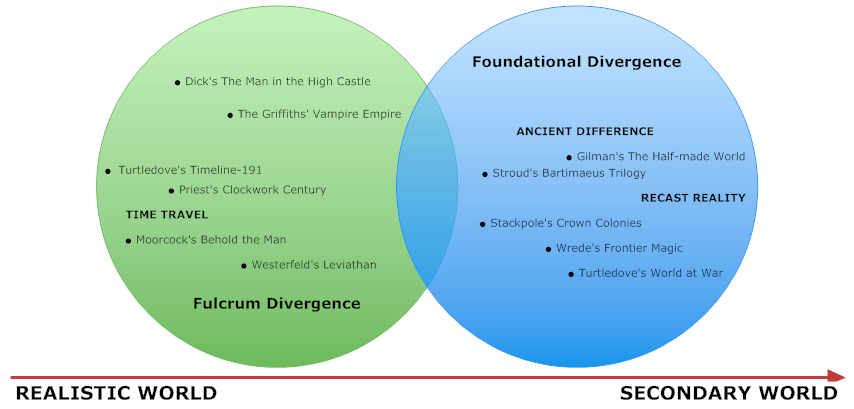
Because alternate history is so centrally concerned with what sets the imagined reality apart from our current reality, how the timeline diverges must be established very early on. Thinking about it, I’ve spotted a kind of spectrum of divergence in alternate history:

Spectrum of Divergence Techniques in Alternate History

Spectrum of Divergence Techniques in Alternate History

On the one hand, we have what I call fulcrum divergences. This method is most commonly found in “realistic” alternate histories, which lack magic, monsters, or really anything that could not exist in the real world. Some event is identified as a fulcrum on which history swings, and when creating the story we have things work out differently.

The best example I can think of for this type of alternate history has to be Harry Turtledove’s How Few Remain. In our real history, a Confederate messenger lost General Lee’s plans for the invasion of the North. The Union found the plans, and General McLellan was able to turn the Confederates back at the Battle of Antietam. Turtledove asks “what if the message never fell into Union hands?” and proceeds to create an excellent series of realistic novels that paint a Confederate victory and map out the consequences through World War II. Such “little differences” need not be so minor, however: Philip K. Dick posited a world where the Axis Powers won WWII in his classic The Man in the High Castle, nor need the resulting world be particularly realistic (consider Scott Westerfeld’s Leviathan series, where Darwin discovers DNA). Even fairly fantastical stories like Clay and Susan Griffith’s Vampire Empire series still rely on that one point where history changed. Universal within these stories is that the world’s history follows the familiar path we should all know up to that one key fulcrum moment when it skews Doc Brown-like into an alternate timeline.

The other end of the spectrum are foundational divergences. Typically used in more fantastical alternate histories, foundational divergence occurs so far back in the story’s timeline that its effects percolate through all aspects of the world. The place names, some of the personalities involved may be familiar to us, but they are already skewed relative to our timeline based on events that happened significantly prior to the events of the story.

In Stroud’s Bartimaeus trilogy, Patricia C. Wrede’s Frontier Magic series, or Michael A. Stackpole’s At the Queen’s Command magic has been known and applied within the world for centuries. There is no “point of divergence” with our known history, because instead the impacts of magic diffuse throughout all aspects of society, history, and cultural development. The key difference between such alternate histories and those relying on fulcrum divergence is that all recorded history has to be different from what is known. In these books, the foundational difference (e.g. the presence of magic) occurred or was discovered so far in antiquity that its consequences have percolated throughout the world. As a result, such books can often be enjoyed as secondary-world fantasies.

Between these two poles lie a variety of techniques that authors can use to establish that divergence. Often, authors use a time traveler from our timeline to introduce the divergence. Once in the past, the time traveler proceeds to change (or – sometimes not) the past as we know it.

Excellent examples of this kind of alternate history include books like Eric Flint’s 1632, Michael Moorcock’s Behold the Man and Mary Gentle’s First History sequence. In many respects, these books are similar to those that use a fulcrum divergence: in this case, the time traveler becomes the fulcrum. However, they differ significantly in that typically the protagonist (the time traveler) is aware of the divergence or its possibility. This changes the dynamic of the story and significantly alters the reader’s relationship with the hero.

On the opposite end of the spectrum, one can have an “alternate history” that completely recasts our known reality, which does not take place in any kind of recognizable version of our history. Here, the events of the book are modeled on actual events in our history, but they are depicted in a completely secondary world.

Turtledove’s World at War series employs this technique, depicting the events of WWII in a completely secondary world. Felix Gilman’s The Half-Made World (see my earlier review) similarly (though less historically) models aspects of his world on the American frontier.

Maintaining Suspension of Disbelief in Alternate Histories

The key to constructing an effective alternate history is to keep the reader locked in what Gardner calls the “dream” of the novel. This task is particularly challenging in alternate histories, where the reader knows they are reading something inimical to their pre-existing knowledge of the world. As a result, readers are likely to quickly pounce on perceived flaws, places where the author’s research or techniques fell short. There are several tools that can be used to maintain the reader’s acceptance of the alternate history.

The perspective that the book is written from, and the narrative voice that is employed, are both essential tools to maintain the reader’s disbelief. This is doubly-so if the book is written in first-person, but even when written in third the speech patterns, word choices, and value systems that our narrator employs contribute to the milieu of the era we are depicting. Recently, I read two alternate histories that execute on this aspect perfectly: Cherie Priest’s Dreadnought and Michael A. Stackpole’s At the Queen’s Command (see my earlier reviews here and here, respectively).

In both books, the narrative voice and the dialog employed by the characters rings (at least to my ear) true to the period when the books are set. The words key characters employ, the value systems inherent in their views, the differences in how different characters speak, in both books the quality of voice and dialog help to lock the reader into the alternate history. In At the Queen’s Command, the dialog is strongly reminiscent of other accounts of the late 18th century. As a result, I am able to believe that while there may be magic, I am still reading a story set in the 18th century I am familiar with. The same applies to Dreadnought, which follows a southern Confederate nurse across the frontier.

Nailing the voice like this is partly a question of the writer’s natural ear, but it is also heavily influenced by research. Reading books written in and written about the time period can help provide the “feel” of that time period. And solid research on word use and etymology can help make sure that the dialog is period-appropriate (as Mary Robinette Kowal pointed out recently, people swore differently even one hundred years ago). Research and extensive reading are the keys to nailing this aspect of an alternate history.

But there is a flip side to this coin: When we write alternate histories (or even historical fantasies) there is an understandable temptation to shoe-horn massive amounts of research into the text. After all, not everyone is as familiar with the time period as the author. But this natural tendency has to be handled very delicately because people who enjoy alternate histories are likely those who enjoy history. As a result, they are likely to already have substantial knowledge about history, and thus overloading them with historical information may weaken their engagement with the story.

In historical fantasy, this is a danger that I recently observed in Jasper Kent’s otherwise excellent Twelve. Kent clearly knows the history of 19th century Russia, however in many places he assumes that his readers do not. For some readers, this is likely not a problem. But for those of us who are familiar with that time period, the extensive expository background that Kent provides detracts from the rising action of the story. Striking a balance between that need for background and the forward motion of the story is key to writing any story based in history. When I think about the authors who do this well, they apply the rule of “less is more” and leave the reader to infer whatever background they do not already know. If we have to pick between momentum and background, I say always go for momentum.

Imagining a Different Today

If futuristic science fiction is about imagining a possible tomorrow, then alternate histories are about imagining a possible present. This at once constrains our world-building (to a greater or lesser degree, we have to conform to known history) while providing the opportunity for very focused imagination. When I read excellent alternate histories, I often think that it is much harder to paint a maserpiece by coloring within the lines. But the best authors of alternate history manage to do exactly that.

If you’re looking for fun alternate histories, below is a list of the authors and books that I’ve mentioned in this post. I strongly recommend you pick up a copy, from your local bookstore or your library and enjoy:

Where are America’s science fiction, fantasy, and horror specialist retailers?


I spent last week in London on business. I love London, even in chilly, misty, drizzly January. One of the reasons why is because it is home to Forbidden Planet, the world’s largest and (to the best of my knowledge) only chain (though technically a pair of chains – see update below) retailer specializing in science fiction, fantasy, and horror products. The London megastore sits on two floors, stocked to the gills with action figures, comic books, graphic novels, trade and mass-market books, and DVDs: if it is genre, odds are you can find it there. Split between two somewhat-related separate companies (Forbidden Planet and Forbidden Planet International), the Forbidden Planet brand name offers twenty-five different locations in the United Kingdom. If the United Kingdom – home to sixty two million souls – can support twenty five chain outlets, why can’t the US – with five times the population – do the same?

UPDATE: Just a word of clarification since the above might not be clear: Forbidden Planet and Forbidden Planet International are in fact two separate companies. The former has nine stores in the UK, while the latter has thirteen branded outlets in the UK, one in Ireland, one in New York, and two other associated (though not branded) stores in the UK. While the two were related in the past (per Wikipedia), they are now operated as two completely independent companies. However, this fact does nothing to detract from the main point of this post: where are our genre chains in the United States?

Both countries have their share of general media retailers: the United States is home to Borders, Barnes & Noble, and Best Buy. The United Kingdom is home to W.H. Smith and Waterstone’s. Despite the ever-present moans of indie media outlets (whether booksellers or comic book shops), both have reasonably vibrant indie communities. I find it unlikely that the UK has a larger number of genre fans as a percentage of the population than the United States. If that were the case, then the UK would host a far greater number of genre publications (pro, small-press, and amateur) than it does.

Forbidden Planet (at least the London megastore, which admittedly may not be a representative sample) knows the genre business far better than its more general counterparts. The store is clearly divided by product type. Action figures, novelty items, and gaming are in one area. Anime, graphic novels, comic books, and regular books are in another. The book section is impressively stocked and organized along broad genre lines. Each section is consistently sub-divided, with its own “New Releases”, a “Chart” section where top-sellers are shown face-out with shelf talkers, and a general stock alphabetically arranged by author. This structure makes navigating the shelves a downright pleasure. Identifying what is new, and spotting what is performing well within a given category is very easy – whether you’re familiar with the genre or not.

This type of organizational scheme would be unimaginable at a general retailer. However, it is not a product of the stocking teams’ deep knowledge of the genre. Instead, it is the product of solid operational management. While visiting the store on a Tuesday mid-afternoon, I got to watch shelves being re-stocked. The stocking teams used netbook computers with bar code scanners to control inventory and shelf placement. This makes it possible for even new employees without genre familiarity to stock shelves properly. Forbidden Planet earns a gold star in shelf management in my book, especially when compared to recent experiences at (the admittedly beleaguered) Borders.

Several weeks ago, I was looking for a copy of Scott McCloud’s Understanding Comics: The Invisible Art. I went online, and the Borders web site told me that it was “likely in store” at my local retailer. I drove on over, and proceeded to check the in-store computer. It told me to check in the graphic novel section, where I was patently unable to identify any organizational method. Seeking help from an employee, I was told that it was in fact in stock, and that it would be in the criticism section. Of course, it was not. I checked with a different employee, and was told it would be in with the art books. And of course, it was not. Contrast this ordeal with the simple process of stopping by Forbidden Planet, wandering through the graphic novel section, and finding it precisely in the “M” section of independent graphic novels. I would expect to find this title in both stores, but the operational management of Forbidden Planet left me a satisfied customer while Borders failed me.

The United States has its share of specialist booksellers. Whether it is Borderlands Books in San Francisco, or Pandemonium Books and Games in Cambridge, Massachusetts, many offer a fine selection and deep understanding of genre style and history. However, as a general rule these bookstores are independent one-location operations. This is not a criticism, merely an observation. With so many genre fans in the US, perhaps we, too, could support a chain of specialist media stores like Forbidden Planet? Economies of scale would help with profitability (the interminable lament of the indie bookseller), while technology would make operations and quality-control easier across a network of locations. On an early Tuesday afternoon, the London store was reasonably full of shoppers and needed two cashiers to service the line of customers waiting to buy. Why doesn’t America have something comparable?

REVIEW: At the Queen’s Command by Michael A. Stackpole


At the Queen's Command by Michael A. Stackpole Title: At the Queen’s Command
Author: Michael A. Stackpole
Pub Date: November 16th, 2010
Chris’ Rating (5 possible): 1 point 1 point 1 point 1 point
An Attempt at Categorization If You Like… / You Might Like…
A fantastical alternate history with major differences from accepted history.

In At the Queen’s Command (the first installment in a new alternate history series designed to span a re-imagined American Revolution) Michael A. Stackpole strikes a careful balance between historical source material and fervent imagination. Stackpole’s book combines engaging characters, a palpable sense of place, and a strong sense of Georgian voice and mores to create a compelling alternate history that draws you in and leaves you eager for more.

One of the great challenges in writing an alternate history is to strike a balance between recognizable history, and the central conceit that sets the story apart from accepted truth. Sometimes, as in Harry Turtledove’s How Few Remain, the conceit is a tiny difference which leads to significant divergence: a message that in reality was intercepted, gets to its intended destination and as a consequence the Confederacy wins the American Civil War. In other alternate histories, like Patricia C. Wrede’s Frontier Magic series, the known world is entirely re-imagined by introducing a pervasive fictional element (like magic). The more foundational the alternate history’s conceit, the harder it becomes to maintain consistency with both the facts and values of acknowledged history. Which is why At the Queen’s Command, which adds dragons, magic, and necromancy to a re-imagined Colonial America is so impressive.

At the Queen’s Command follows Captain Owen Strake, a soldier in the Queen’s Own Wurm Guard. He has fought against the Tharyngians (read: the French) on the Auropan (read: European) continent, and now has been sent on a reconnaissance mission to the colonies in Mystria. He must win over the colonists, survey the frontier, and return to Norisle (read: England). Of course, the mission does not go as planned and the colonies are drawn into war with the Tharyngians on their frontier.

The publisher makes it very plain on the book’s cover that the series is meant to re-imagine the American revolution, but Stackpole made a brilliant choice to set the first book during his world’s analog to the French and Indian War. First, most readers are not going to be as familiar with that war as they would be with the American Revolution. If Stackpole had jumped right into historical events that most American readers are already acquainted with, he would have had a much harder time getting readers to accept his central conceit. By setting the book several years prior to the American Revolution, Stackpole has the opportunity to take more liberties with acknowledged history, draw the reader into his re-imagined world, and get reader investment in his characters.

The characters are one of the strongest aspects of this book. This time period in real history is fraught with the consequences of history, a burgeoning streak of independence among the colonists, a sense of financial peril amongst the colonizers “back home”. Stackpole manages to capture the complex social, economical, political, military, and philosophical interactions of this time period through his well-realized characters. Whether it is through Owen Strake wrestling with his loyalty to Norisle, Prince Vladimir insisting upon the scientific method, Caleb Frost pushing for self-determination, the frontier trappers bridling at rumored taxes, Stackpole places a filter on Colonial America but still captures its colors. It is through these characters and their values that Stackpole addresses his themes, which are – in effect – the themes of John Locke, Thomas Paine and the other Enlightenment philosophers.

The central conceit of this alternative world is the existence of magic. In Stackpole’s world, this is not a recent discovery but instead dates back to before the Romans. It has affected – to some extent – all technological and societal evolution that precedes the events of this book. For Owen Strake and the the other characters, magic is as much of a fact of life as breathing. While on the one hand this helps to ground the reader in the world, it also leads to one of the few moments that rings off true. Specifically, the magic of the colonies is wilder, less controlled, more free than the magic Owen Strake is familiar with. The narration supporting Strake’s initial explorations, especially the first introduction of the wendigo concept, are clumsy by comparison to the rest of the book’s smooth execution. In the hands of a lesser author, I would still consider them quite well done. However, once past the initial introduction, Stackpole’s seamless narration kicks in again and the book strengthens as it gathers pace.

The book itself is a handsome product released as a trade paperback from Night Shade Books. The book’s cover, with design by Claudia Noble and art by Ryan Pancoast, is beautiful. I was particularly struck by how Pancoast seamlessly introduced a dragon and Native Americans into John Trumbull’s The Death of General Mercer at the Battle of Princeton. Looking at Pancoast’s cover image, it is difficult to imagine that they don’t belong there in reality, which adds to the book’s sense of an alternate history:

The Death of General Mercer at the Battle of Princeton, by John Trumbull (circa 1795) via Wikipedia

The Death of General Mercer at the Battle of Princeton, by John Trumbull (circa 1795) via Wikipedia

At the Queen's Command, by Ryan Pancoast (2010)

At the Queen's Command, by Ryan Pancoast (2010) via ryanpancoast.com

At the Queen’s Command is an excellent new entry in the field of alternate history. Like any good book, it offers no easy solutions at its conclusion. Partially, this is to set up tension for subsequent books in the series, but in a very real sense it is because we still wrestle with the same questions as Stackpole’s fictional Mystria: where does the state’s responsibility end, and where does the citizen’s begin? I am eagerly looking forward to seeing how Mystria and how Stackpole’s characters wrestle with these questions in the books to come.