Skip to content

Posts tagged ‘fantasy’

The Circus as a Fantastic Device


I grew up devouring the works of Ray Bradbury, and I have no doubt that Dandelion Wine, Something Wicked This Way Comes, and The Illustrated Man all had an enormous influence on my love of fantasy. Add to that the fact that I grew up in New Jersey, where the dilapidated boardwalks of the Jersey Shore eerily embody the same carnival creepiness, and I suppose it is no wonder that I love stories that feature circuses, carnivals, freak shows or anything at all related to them. And now that I am a little older (and can look two out of three circus clowns in the eye without crying), and having just finished Robert Jackson Bennett’s The Troupe, I find myself considering what makes the device so compelling.

The Many Faces of the Circus

I group a pretty broad assortment of devices into my “circus” or “carnival” category: on one end of the spectrum, we have the traditional traveling circus as brilliantly depicted in Genevieve Valentine’s recent Mechanique: A Tale of the Circus Tresaulti or Charles G. Finney’s The Circus of Dr. Lao. The focus in these stories is performative: the players in the circus play certain roles which stand either in contrast to or in embodiment of their true natures. Where play ends and player begins is purposefully blurred, and the stories often explore this fuzzy gray area explicitly. On the opposite end of the spectrum, we have the traveling carnival, such as those that Bradbury so adores or the one used in Jonathan L. Howard’s Johannes Cabal the Necromancer. In these stories, the roles that the performers play do matter but they are counter-balanced and contrasted against their lives outside of their performances, and further balanced by the devices employed in their show. The performances matter, but these stories feature an assumption that there is more to the players than their performances. Between these two extremes, lies the Vaudeville circuit that Robert Jackson Bennett explores in The Troupe.

The borders between these variants are fluid, and it is entirely possible that The Encyclopedia of Fantasy is right to call them interchangeable: they share many of the same structural and aesthetic features. What such enterprises represent for the reader is a portal into the world of fantasy. When we read a story that features this device, the circus marks the jumping off point between a representation of reality and the wild adventure of fiction.

As a device, the circus taps into a primal cultural touchstone (you can find my earlier thoughts on such touchstones and their relationship to reader trust here). By the time we are ten, most of us will have had the disorienting experience of going to an amusement park, visiting a fair, or seeing a circus. As a result, we will have already internalized the mental shift that the circus’ superficial fantasy demands of us. The process by which we accept the (clearly fictional) conceit of the real-life circus is close cousin to Coleridge’s suspension of disbelief when reading fiction. By tapping into this physiological and emotional memory, writers who employ the circus as a narrative device boost the signal of their fiction, and significantly accelerate the reader’s acceptance of the story. Everyone, after all, loves the circus.

The Real-world Circus as an Imperfect Portal

Despite its power as a cultural touchstone, the circus is not a perfect portal from reality to fantasy. And part of its strength as a narrative device stems from its very imperfection. When we go to the movies, we experience a complete immersion into the film’s fantasy. If we see the wires, if we see the camera, we scoff and complain about the film’s poor production quality. But at a real-life circus or carnival it is impossible to make such a complete break from reality. Even children will see the carnival worker smoking behind the tent, will catch the cracks in the face paint, or spot the smudges in the hall of mirrors.

This creates a certain level of cognitive dissonance: on the one hand, we want to immerse ourselves in the fiction of the circus, but on the other hand we are unable to divorce ourselves from its seedy reality. As a portal, the real-life circus is flawed. And the fictional portrayals of such circuses rely on that flawed nature by asking us to hold two conflicting thoughts in our head at the same time: that the circus is fake, a glamour, a sham. And that it is real, that the fantasy it asks us to concede is true. If that is not a perfect description of how fantasy – or fiction itself – works, I don’t know what is.

The Circus as a Means of Transition

Many stories that involve the circus device feature young characters signing onto the troupe or at least peaking behind its curtain. Whether it is Bradbury’s Will Halloway, Jim Nightshade, or Douglas Spaulding, Valentine’s Little George, or Bennett’s George Carole, it is children who are the natural window through which we can experience the circus. This extends the portal concept: we run away to join the circus, we transition from a “normal” existence into a fantastical one, and in many ways we grow from the innocence of childhood where we hew closely to the fantasy into the more cynical reality of adulthood where we sneer at the greasepaint.

Circus stories often use a child’s innocent perspective to deepen their basic cognitive dissonance. They use the circus, and their young protagonist’s gradual understanding of its nature as a concrete expression of the dissonance of adolescence. Whether it is Douglas Spaulding, Holden Caulfield, or Katniss Everdeen, every young adult must wrestle with the transition from childhood to adulthood: it is the literal foundation of every bildungsroman ever written.

The Circus as the Anti-Quest

There is an (over-simplistic) interpretation of Joseph Campbell’s theory of the hero that has given us the “hero’s journey” as an almost write-by-the-numbers recipe for fantasy. With its nature as a portal device, its coterie of unusual characters, and its predilection for young protagonists, one might think that circus stories naturally lend themselves to the heroic quest model. It is a tempting theory, but from a thematic perspective, I find that circus stories are almost the anti-thesis of the traditional quest narrative.

Consider the object of the quest: it is an object, an achievement, a moment that is distinct in both time and space. The destruction of the ring in Mount Doom. The recovery of Henwen the Oracular Pig. Such specificity is anathema to the circus: they are traveling shows, by their very nature transient. From the perspective of the performers, there is no quest: there is simply a never-ending progression of indistinct towns. From the perspective of the towns they visit: there is merely a brief sojourn in a fantastical realm. When the circus itself is given a specific goal, as it is in Howard’s Johannes Cabal the Necromancer, its thematic efficacy is sorely weakened. And when, as in most narrative fiction, our characters create for themselves a tangible goal – as in Valentine’s Mechanique, Bennett’s The Troupe, Howard’s Johannes Cabal, Philip Reeve’s A Web of Air, or Peter S. Beagle’s The Last Unicorn – they will leave the confines of the circus to ultimately achieve it. To do otherwise would elide the cognitive dissonance the device relies on.

The Troupe as the Anti-Band of Heroes

The attractions of the circus – in real life as in fiction – are invariably the characters that it invites us to meet. They are always distinct, extremely varied, and most importantly led by a charismatic, engaging, and mysterious leader. In much heroic fantasy, especially in the hero’s journey school of quest fantasies, one might think that a circus offers the perfect source for our hero’s plucky band of entertaining companions. But just as the hero’s quest structure eviscerates the circus’ effectiveness as a narrative device, its performers are the antithesis to the stereotypical band of companions.

The Encyclopedia of Fantasy talks about how companions in heroic fantasy tend to either appear in “dirty dozen” configurations (where external circumstances force them together) or as “seven samurai” (where their association to achieve a shared goal is voluntary). Despite their superficial resemblance to a pariah elite, the circus performers by definition do not conform to either configuration. The defining characteristic of circus performers is their independence: both from each other, and from the broader society. This independence further heightens their fantastical disassociation from reality, and gives greater scope for the exploration of character themes. They are not brought together by some external circumstance, even if it might seem that way. Even if – as in Something Wicked This Way Comes – they serve the circus under duress, it is almost always their choices that put them there. Yet despite this, their association is rarely voluntary: they do not share goals with their fellow travelers, and their friendships are tenuous at best. Three threads bind them: the circus master, the circus itself, and the fact that they are all – in some way – broken.

And this represents the greatest departure from either the Dirty Dozen or Seven Samurai trope: in most heroic fantasy, and especially in the bildungsroman, the youthful hero’s companions represent facets of the fully mature ur-hero. From the disreputable thief companion our hero might learn tactical flexibility and cunning wit, the noble knight companion might teach honor in the face of certain death, the magus might teach wisdom, etc. Each companion plays a certain role and embodies a certain facet of the mature hero’s ultimate personality. Not so in a circus story. If anything, the youthful protagonist must build their mature self in opposition to their companions.

And this is something which Bennett nails perfectly in The Troupe. Each of the members of Silenus’ vaudeville troupe is, as all fictional circus performers are, broken. Their fracture lines are intensely private, and tie directly into the themes of the book. The unity with which Bennett structures his story is very impressive, and a significant improvement over his debut Mr. Shivers. But his young hero, George Carole, must navigate the minefields of his companion’s tragic histories. In some cases, he pours salt on their wounds. In others, he is oblivious until almost too late. But he grows to define himself not as an amalgamation of his companion’s value systems, but with a worldview distinctly his own.

And it is this, the defining of oneself, and negotiating the border between fantasy and reality, that lies at the heart of every circus story. It is the primary theme of Valentine’s Mechanique, of Finney’s The Circus of Dr. Lao, and of just about every circus story I have ever read. And I suspect that is a greater truth that lies at the heart of every fantasy. And, for that matter, at the heart of every work of fiction.

REVIEW: The Steel Seraglio by Mike Carey, Linda Carey, Louise Carey


Title: The Steel Seraglio
Author: Mike Carey, Linda Carey, Louise Carey
Pub Date: March 13th, 2012
Chris’ Rating (5 possible): 1 point 1 point 1 point 1 point
An Attempt at Categorization If You Like… / You Might Like…
A mythic novel-in-stories that maintains a fast, unified pace

Several years ago, I discovered N.M. Penzer’s The Harem: Inside the Grand Seraglio of the Turkish Sultans, which opened my eyes to the fascinating history of the Ottoman sultan’s harem. What could be more fertile soil for an awesome story than a group of educated women from diverse backgrounds, locked away by a patriarchal society yet with intimate access to the heart of political, military, and religious power, and simultaneously grooming the next generation of the same? The real intrigue and blood-soaked history of the Ottoman Empire’s seraglio might well be called “implausible” if it were to show up in a fantasy novel, but with my pre-existing fascination, the moment I saw a book entitled The Steel Seraglio, I had to read it.

The Steel Seraglio is an impressively structured and well-executed fantasy that follows the experiences of three hundred sixty five concubines who – when their sultan is overthrown by an ascetic zealot – find themselves exiled into the desert, fighting for their lives, and their futures.

The Steel Seraglio is loosely structured as a novel-in-stories recounted by Rem, a librarian from the harem’s home city. With its mythic feel and folktale overtones, I was strongly reminded of Catherynne M. Valente’s The Orphan’s Tale and Gregory Frost’s Shadowbridge. However, The Steel Seraglio is more accessible and features more consistent momentum than either of these titles. Like most novels-in-stories, it features both nested and discrete, self-contained tales, but in this case each addresses and expands upon the conflict at the heart of this book: the concubines’ battle for self-determination.

The book opens with not one but two prologues, which is an interesting and rather unusual choice. The prologues firmly establish the book’s mythic tone, give a good sense of its flowing, evocative descriptions, and introduce us to the Careys’ daring technical choices. The first of the two prologues transports us to a dry, desert environment and establishes a decidedly non-Western, patriarchal culture heavily influenced by Middle Eastern traditions. At this point, it is entirely unclear whether we are dealing with a secondary world fantasy or find ourselves in some strange quasi-historical environment.

The first prologue does a good job of communicating the flavor of the novel, introducing us to both a setting and style that heavily reminded me of The Arabian Nights and The Shahnameh. Considering how much I like both, and how rare it is to find fantasy which eschews quasi-medieval northern European settings, The Steel Seraglio was quite refreshing.

The second of the two prologues further introduces us to our narrator, the librarian Rem, and lays out some of the background essential to the novel which follows. At the same time, this second prologues shifts to a slightly different, more self-aware narrative voice that strategically abandons some of the mythic tone – and it is this shift in voice that most caught my eye, as a bold and risky stylistic gamble that I felt ultimately paid off.

Despite the fact that I enjoyed both prologues on their own terms, I found the first to be one of the weaker parts of an otherwise strong novel. As mentioned above, the Careys successfully avoid the trap of most novels-in-stories by ensuring that each embedded tale shares and focuses on the novel’s driving conflict. Of all of the disparate sections of the book, the first prologue alone ignores this central conflict. While it does a good job of grounding the reader in tone, style, and setting through some wonderfully evocative writing, when considered as the first movement in the larger score, I felt it to be somewhat out of place. The second prologue, however, does a good job of easing us into the book’s central conflict.

The rest of the book maintains the prologues’ lush descriptions and combines them with a momentum-charged focus on character and conflict. The over-arching story is of how the sultan’s concubines are exiled after a coup d’état, and how they carve out self-determination for themselves. The story skillfully focuses on the experiences of the harem’s leaders (and those of the narrator Rem herself).

The principal characters are a delight: the pragmatic wisdom of the elderly Gursoon, the icy passion of the assassin-cum-concubine Zuleika, the terrifying zealotry of the usurper Hakkim Mehdad, the hilarious cunning of the camel thief Anwar Das, or the self-absorbed immaturity of the surviving prince Jamal are a delight on the page. I found the narrator’s own story a little self-absorbed for my taste, but this is not actually a weakness: the character remained well-drawn and interesting. I just found the others more compelling. Despite the myriad characters, and their many embedded stories, the Careys do an excellent job of capturing the conflicting, complicated, messy, and beautiful relationships of a disparate group thrust into one another’s orbits by powers beyond their control. The fact that the characters are so rich and varied is a testament to the Careys’ skill, and is the primary pillar on which the book’s success rests.

The narrative voice is interesting, and takes a notable (and ultimately successful) risk: the narrator, Rem, is gifted by the djinni with the ability to see possible futures. She is a seer, and a librarian, and a storyteller, embedded in of her own mythic time while cognizant of our somewhat more egalitarian future. The seer character is a trope much over-used in fantasy, but the Careys freshen it with a realistic conceit: with her ability to see into the future, Rem’s voice becomes peppered with anachronisms. Idioms and words that have no business in a mythic tale salt her prose: in the second paragraph of the second prologue, we are told that for a seer who can see the future “Tenses get a bit confused…and unravelling them again can be a bitch.” This departure from the somewhat florid style so commonly associated with myth is shocking, and I found it refreshing.

This is a daring choice of technique, because it risks our immersion in the story: at first blush, we read The Steel Seraglio as a mythic, folktale style narrative. The prose is evocative, lush, flowing: it reads like legend. But by inserting contemporary, anachronistic constructions into otherwise mythic prose, we are forced to reconsider and reevaluate the words and themes introduced by the story. The effect may be jarring. Although some readers might find that it lessens the sense of mythic immersion the prose otherwise produces, I found that the technique was used sparingly enough, and with just enough strategic precision, to heighten my own sense of immersion. After all, wouldn’t someone perceptually unmoored from their own time end up with some rather odd verbal tics? Because the Careys play this narrative device straight, making Rem’s anachronistic tics and stories strange or incomprehensible to her own contemporaries, the effect heightens the world’s remove from our contemporary mores, enhancing the gap between the novel’s patriarchal world and our own.

Just as the novel’s non-traditional setting is refreshing, so too is its thematic focus on women and their self-determination in a patriarchal society. This is the kind of theme that fantasy, a genre stereotypically known for its lantern-jawed (male) heroes, too rarely addresses. While the book wears its feminist themes on its sleeve, the Careys avoid the polemical trap by focusing on the complicated and at times messy emotional journeys that their (predominantly female) characters must take. As a result, the (perhaps obvious) themes are treated with a skill, compassion, and empathy which diffuses and dramatizes any moralizing agenda.

The core thrust of the novel is divided into two “books” within the larger novel, a “Book the First” and a “Book the Second”. While both are well-told, well-structured, and maintain a well-paced momentum, I found that the second of these two books felt somewhat rushed. It focuses on the consequences of the events of the first, but it does so in a much more sweeping, view-from-thirty-thousand-feet fashion than the first eighty percent of the novel. In some respects, as a work of history within the fictional narrative, it works well. And my discomfort with this approach may simply stem from the fact that I wanted to spend more time in the Careys’ world, and in the city of Bessa, and with the characters they introduced me to. But nevertheless, I found it felt to some degree like an attempt at a duology crammed into one volume.

Overall, The Steel Seraglio is a delight. Fans of mythic fantasy like Valente’s The Orphan’s Tale or Frost’s Shadowbridge will likely enjoy both its characterization and evocative description, while readers looking for a fun, action-packed story can find the same in its fast-moving pace. The weaknesses I saw, whether in its initial prologue or in the rushed second book, are on the whole quibbles: the book is great fun, and a rich, lovely work of art. The excellent interior illustrations by Nimit Malavia further add to its artistry, though from a design standpoint the artistry might have been heightened by illustrations more evocative of or otherwise tied to the Arabian, Persian, or Ottoman traditions which feature so strongly in the text itself, and in the excellent cover by Erik Mohr.

The Steel Seraglio is a wonderful, resonant book and I would love to see more such novels from its authors, illustrator, and publisher.

Explorations of Religion in Science Fiction…but what about Fantasy?


In the real world, organized religion is messy. It has inspired wars and peace treaties, marriages and shunnings, art and book burnings. It is incredibly varied, both between areas where different organized religions predominate and within each area as well. There is no aspect of human history – anywhere on the planet – where organized religion has not influenced and been influenced. It is only natural that our species’ fascination with the divine and its concomitant expression in the organized structures of society would figure prominently in our fiction. And when we look at speculative fiction, some of the greatest works explicitly deal with it (A Case of Conscience, The Sparrow, A Canticle for Leibowitz, etc.) and yet I find that they are almost always science fictional, as opposed to fantasy. Which leads me to wonder why?

In the Encyclopedia of Science Fiction, Brian Stableford and David Langford point out that science fiction’s roots lie in sixteenth and seventeenth century organized religion. And while fewer SF titles today deal explicitly with religion, it remains a theme that we return to time and time again. Here’s a brief overview of the ways in which science fiction explores religion:

Faith versus Reason One of religion’s functions is to provide an explanation for the reality we live in, and when scientific discovery expands the boundaries of that reality, organized religions have to either incorporate it into their faith or reject it. Naturally, science fiction – which pushes the boundaries of science – can mine this vein for rich conflict.

Syncretic Science Fiction By couching the descriptions and events of a story in scientific terms, some authors are able to construct a metaphor which achieves a syncretic unity between religion/faith and science.

Time Traveler vs Facts of Faith By taking certain articles of faith at face value, science fiction authors can explore the events and implications of the underlying tenets of (a usually Christian) faith.

Religion as Sociological Construct The role that religion – and in particular, organized religion – plays within society is another dimension that science fiction often explores.

The Identity of God An exploration of the borders between humanity and God, as well as an exploration of the more metaphysical/spiritual aspects of faith.

But is a similar table even possible for fantasy? I wracked my brain to come up with one, and simply couldn’t do it. Instead, when I trolled through my library looking for interesting secondary-world fantasies that explore religion, I almost always found:

  • A thinly-disguised version of the late medieval or early Renaissance Catholic Church.
  • A Corrupt Church riven by internal power struggles more tied to politics than faith.
  • A Church which usually bans the practice of magic, and hunts and kills magic practitioners.
  • A Church which dominates militarily and sociologically its sphere of influence…with relatively little diversity in its practitioners or its practice.
  • A Church which is opposed by some (usually implicitly pagan or animistic) external (read: savage) religion.

In the cases of some books, Christian religious scripture is literally appropriated to serve the purposes of the story. And while I don’t have a problem with this per se, the sheer frequency with which I see it makes me scratch my head. Shouldn’t secondary world fantasy be able to support and explore the more complex dimensions of religion? Must it always boil down to the (I think false) dichotomy of dogma versus magic?

To some extent, science fiction has an easier time of it because it can assume some reader familiarity with most major religions. As a result, there is less risk of bogging the story down with the world-building that a realistically complicated imagined religion demands. Is this weight of world-building the only reason why religion is so superficially addressed through fantasy? Or have I just missed the really interesting fantasy books that explore religion the way science fiction does?

The only examples that I can think of that do a good job with it are Elizabeth Moon’s The Deed of Paksenarrion, David Eddings’ Belgariad series (though this is somewhat debatable), Robert Jordan’s Wheel of Time series, and Ursula K. Le Guin’s Earthsea series. Surely there are others? Am I just missing them?

REVIEW: Ride the Moon ed. M.L.D. Curelas


Title: Ride the Moon
Editor: M.L.D. Curelas
Pub Date: February 29th, 2012
Chris’ Rating (5 possible): 1 point 1 point 1 point
An Attempt at Categorization If You Like… / You Might Like…
An enjoyable, entertaining anthology with a wide variety of new authors.

When I think about the anthologies I have read, I tend to break them out into three different types: exploring a particular style (e.g. Supernatural Noir ed. Ellen Datlow, reviewed here), showcasing a particular sub-genre (e.g. Steampunk ed. Ann and Jeff VanderMeer), or plumbing the depths of a specific theme (e.g. Paper Cities ed. Ekaterina Sedia). Through painstaking editorial curation, anthologists consolidate different voices and stories into a meaningful, unified whole. They can become more than the sum of their parts, and at the same time are packed full of fun, entertaining stories. And while I found that Tyche Books moon-themed debut anthology Ride the Moon didn’t culminate in a deeper insight into human nature, the collection of fantasy and science fiction stories was well-selected, well-organized, and definitely a fun read.

Thematic anthologies like Ride the Moon are, in my opinion, the hardest type of anthology to pull off. A stylistic exploration requires attention to style and tone, a sub-genre survey requires breadth and depth within that sub-genre, but a good thematic anthology necessitates building a TOC of excellent stories that are linked on a superficial level (the ostensible theme) and whose underlying truths are simultaneously unified in some fashion. The best example of this kind of anthology in recent times that I can think of is Ekaterina Sedia’s Paper Cities, which (despite the weaknesses of some individual stories) still managed to offer insight into how cities are employed in modern fantasy.

Ride the Moon is the debut book published by a new Canadian small press, Tyche Books. As their launch title, it is impressive. If I hold it to a high standard, it’s because on most measures I believe it comes pretty damn close to meeting it. Most of the stories are original to the anthology, though the occasional reprint (Edward Willet’s “Je Me Souviens” I recognized) is well worth inclusion. Most of the authors are Canadian, and I strongly recommend readers who might not be familiar with SF/F north of the border to check them out. While I recognized some of the authors (notably Claude Lalumière, Edward Willet, and Marie Bilodeau), most were brand new to me.

As the title suggests, every story in this anthology somehow touches on or deals with the moon as metaphor, god(dess), monster, or setting. With its lunar theme, the anthology skews somewhat fantastical: of the eighteen stories, only six are clearly science fiction. However, the remaining twelve fantasy stories tend to blend nicely between the explicit dark fantasy of Lori Strongin’s “A Moonrise in Seven Hours” to the more science fictional fantasy of Ada Hoffman’s “Moon Laws, Moon Dreams”.

About half of the stories – most notably C.A. Lang’s “Tidal Tantrums”, Shereen Vedam’s “Aloha Moon”, Keven Cockle’s “The Dowser” and Amy Laurens’ “Cherry Blossoms” – wrestle with the relationships of myth and magic in a modern, technological society. And while it might be tempting to say that therein lies the anthology’s unifying truth, I’m afraid that theory doesn’t hold up when faced with the anthology’s other stories.

The stories that I enjoyed most invariably did something fresh with both the lunar theme and their storytelling. Isabella Drzemczewska Hodson’s “Husks” is a beautifully written dark fantasy. The prose is lyrical and flowing, and Hodson’s imagery just draws you in. Her use of omniscience in the storytelling works to great effect: despite the omniscient narrator, I found myself embedded in the characters and their experiences. A. Merc Rustad’s “With the Sun and Moon in His Eyes” employs excellent characterization with tight prose. Both the subject matter and story structure reminded me of N.K. Jemisin’s Inheritance Trilogy, and appealed to me in many of the same ways. Shereen Vedam’s “Aloha Moon” and Ada Hoffman’s “Moon Laws, Moon Dreams” both do a great job of drawing the reader into their characters, though I found the plot resolution of “Aloha Moon” a little too convenient. The biggest stand-out for me, however, had to be Edward Willet’s “Je Me Souviens”: a quiet, emotional, and intensely powerful story about mourning, loyalty, remembrance, and faith.

Some of the other stories, notably Krista D. Ball’s “On the Labrador Shore, She Waits”, Tony Noland’s “Sunset at the Sea of Fertility”, and Lori Strongin’s “A Moonrise in Seven Hours” didn’t work for me. In most cases this was because I found their characters and plot structures fairly predictable. They were well executed for what they were…I just found that they didn’t appeal to me, and were otherwise unmemorable and unremarkable.

In sum, I would say that Ride the Moon is an entertaining, well-written, and well-structured anthology. Despite their significant differences, the stories flow into each other nicely. I enjoyed reading it and – perhaps most importantly – it has turned me onto a number of authors who I might not otherwise have encountered. This is an anthology well worth picking up if only for those two traits. And as a debut from Tyche Books, it makes Tyche a small press that I’m going to be paying attention to going forward.

Romance as the Emotional B-Plot in Speculative Fiction


If you live in the United States, then no doubt all of the chocolate manufacturers have made damned sure that you know today is Valentine’s Day. I know plenty of people who grumble that it’s a made-up holiday, developed and popularized with the sole purpose of schilling chocolate and greeting cards. That may be true, but I like it anyway. And since romance is in the air, I thought I’d briefly ruminate on how romance can provide the emotional core of a story.

The Ubiquity of Love

There’s a reason why most stories are – at least in part – love stories. The cynic in me says it’s because sex sells, but I think the reality is a little more complicated. While we might read for very different reasons at different times, the capacity for love and affection automatically promotes emotional engagement. Don’t believe me? Check out this photo:

Kitten & Bunny, via The Sound of the Nosing Machine thru Google Images

When we see pictures like that, our response doesn’t end on “Awww, cute!” We engage with their subjects emotionally because we automatically feel affection for any living being that does the same. And the same holds true for characters in our fiction. Cheryl Klein, executive editor at Arthur A. Levine Books and author of Second Sight (which I reviewed here) lists Fourteen Qualities of Attractive Characters (they’re mid-way through the linked post), and it is telling that six out of those fourteen can be shown through romantic attachment.

The reason why love works so well is because it immediately exposes the emotional core of our character. By its very nature, love puts their motivations, fears, and value systems on display. But in speculative fiction, the love story rarely drives the action. How does the emotional journey relate to the adventure?

Love as the B-Plot

In realistic literary fiction, love is often the central pillar of the story. Conflict is internally generated by the characters, and with its emotional highs and lows, love is an effective source of both conflict and pathos. In speculative fiction, however, we have much wider options for generating conflict: the fate of the universe can and often does hang in the balance. And with tremendous adventure, danger, and excitement it’s tempting to quote Short-round and say “No time for Love, Doctor Jones!” but as Indy shows us: there is always time for love, even if it’s just a side plot.

That’s because when it is shunted into a story’s side plot, the romance can then buttress the story’s entire emotional journey. I found a great example of this at work in Saladin Ahmed’s Throne of the Crescent Moon. Ostensibly, it’s a fun epic fantasy adventure, stuffed to the gills with monsters, magic and mayhem. The action of the story centers on Doctor Adoulla Makhslood, an aging ghul hunter who rather than retire must instead battle a threat greater than any he’s ever faced before. The danger is physically and spiritually existential, but Ahmed uses his characters’ romantic relationships both to structure his story and provide emotional depth.

Throne of the Crescent Moon is principally told from five perspectives, and it is notable that four of these five are matched pairs: Raseed with Zamia, and Dawoud with his wife Litaz. Our central character, Adoulla, is pointedly alone. His love interest, Miri, has basically given him the old heave-ho. Structurally, his companions’ relationships present varying stages of Adoulla’s (now failed) relationship with Miri: Raseed/Zamia are young love, nervous and fiery. Dawoud and Litaz are the settled, comfortable love of long-standing companionship. Adoulla has neither of these, precisely because Miri has kicked him to the curb. And why has she done so? Because despite the fact that he’s getting old, Adoulla still insists on haring off after monsters out of his sense of duty.

Now that paragraph provides a neat summary of the romantic relationships in the book. But you’ll note that it doesn’t really touch (at all) on the action of the story. That’s primarily an adventure / mystery, where our heroes must figure out who is creating these monsters, why they’re doing it, and then stop them before they destroy the city (and eventually the world). But the romantic relationships add depth to all of the characters, and get us to invest in them. Without that romantic dimension, the characters would be cardboard.

Adoulla’s relationship with Miri employs a classic device when romance is a side-plot: duty versus desire. Adoulla wants to stop adventuring, to retire to a life of domestic pleasure and comfort with Miri. But his innate sense of duty will not let him. And through this opposition the first chapter of Throne of the Crescent Moon already provides us with a profound insight into Adoulla’s character.

By complicating his hero’s love life and then structuring his characters’ relationships in contrast to that emotional conflict, Ahmed creates an emotional resonance chamber: each supporting character individually gains depth through a deeper understanding of their motivations, desires, and values. And together, they escalate the hero’s emotional conflict by dangling an emotional brass ring before the hero and the reader. It is an elegant structure.

The Structure of Love and Thoughts on the Love Triangle

Structures like Ahmed’s are only effective when the emotional arcs they produce are either reflected or opposed by the action of the main story. In this case, Adoulla’s duty (the action) opposes his desires (the emotion). Another example is Suzanne Collins’ Hunger Games trilogy, where Katniss’ emotional desire for familial security is intrinsically bound up with her conflicting feelings towards Gale (a hunter/provider type) and Peeta (a feeder/reliable type). Unlike Adoulla, Katniss’ emotional arc and the story’s action are not in opposition: the relevant themes reflect and amplify each other, where decisions in Katniss’ emotional life mirror those in her political life.

Collins’ love triangle is also an excellent example of a classic romance structure executed well. I love the love triangle as an emotional structure because when done right, it has a multiplier effect on the story’s emotional and thematic resonance. However, it is not without significant risk: the failure mode for love triangles is utterly atrocious. And since one can’t swing a cat in a bookstore’s YA section without knocking over a bookcase full of such triangles, Sturgeon’s law takes hold and most of the those I come across these days fail.

Love triangles only work when they mirror or oppose the themes of the story expressed through its action. When I look for classic triangles, there’s no one better than Victor Hugo: The Hunchback of Notre-Dame and Les Miserables both feature amazing love triangles that are packed with emotion…and which reflect the story’s broader action.

Hugo is interesting because his love triangles (in particular that of Marius/Cosette/Eponine) simultaneously reflect and oppose the action-oriented themes of the student revolution. Hugo is often called melodramatic for that reason, but c’mon…is there any way to have a love triangle avoid melodrama? Either in life or fiction, I don’t think it’s possible. And melodrama can and does add to many stories.

But if a love triangle fails to oppose or reflect the action-themes of the story, I find that my engagement with the characters is destroyed. Characters who would otherwise be engaging and interesting, suddenly become incredibly self-centered. If a love triangle, or even a love story, has no thematic or emotional relationship to the story’s action, it just becomes an exercise in narcissism. I love well-constructed narcissistic characters: they often make amazing villains or foils, and their emotional journeys can often be incredibly fun. But there’s a world of difference between aiming for and hitting a narcissistic character, and trying for engagement and getting a dreadful jerk.

When it comes to romance — triangular or not — unity is absolutely essential (see my earlier thoughts on unity here).

Techniques for Expressing Love

Honestly, there are so many ways to express a love story that trying to outline some of them is rather daunting. While I continue to try and put together a concise set of notes, I’m constantly reminded of Kipling:

There are nine and sixty ways of constructing tribal lays,
And every single one of them is right!

As I try and put my notes together, I’d really love (terrible pun absolutely intended) your help:

What are some stories that you’ve found do a good job with romance? And why do they do a good job?

The Aesthetics, Structure, and Themes of Noir Speculative Fiction


Last week on Twitter, I got into an interesting discussion on whether noir fiction is inimical to science fiction. The original conversation got fairly involved, and while we reached few conclusions (substantive discussions in 140 chars are tough!) the conversation made me wonder: is there something about the aesthetics, tropes, and themes of noir that make it oil to speculative fiction’s water?

The Components of Noir Fiction

In thinking it through, I’ve come to the conclusion that what we think of as “noir” is like any other genre: a broad spectrum of storytelling methods that at their basic root share some combination of the following traits (there may be more, but this is the list I came up with over lunch):

Stylistic / Tonal

  • Sparse prose lacking in emotional qualifiers (e.g. Dashiell Hammett).
  • Heavy use of juxtaposed similes rather than metaphor (e.g. Raymond Chandler).
  • Focus on realistic characters, plot, and and mimetic description (all).
  • Characters mired in a particular setting, situation, or themselves (all).
  • Sensory and simile-laden descriptions of atmospheric settings (all).
  • Hyper-localized (usually to a particular city) scope and setting (all).
  • Frank / mimetic treatment of violence and sex (all).

Structural Tropes

  • Innocent protagonist is wrongly accused of a crime.
  • The protagonist’s action is incited by competing interests who want the same thing.
  • The protagonist is betrayed by someone (typically a lover) he had trusted.
  • The love interest in need of saving turns out to be just as bad as the bad guys.
  • The femme fatale who excites self-loathing, pity, anger, and distrust.
  • The detective with a violent past.
  • Taciturn, bitter, damaged heroes.

Thematic

  • Moral protagonist at the whims of an amoral world.
  • Moral trajectory (clawing upwards or sliding downwards) of the flawed hero.
  • Unimportance of individual lives/crimes to the broader world.
  • The supposed futility of moral action.
  • The fraying of an outdated moral code in the face of changing values.

Can all of these traits – or any of these traits – work in speculative fiction? Are there some that cause the narrative to break if combined with aspects of speculative storytelling?

Noir Stylings in Science Fiction and Fantasy

Noir is often called a style, rather than a genre, precisely because of its stable set of stylistic tendencies. It’s easy to spot a noir sentence: “The muzzle of the Luger looked like the mouth of the Second Street tunnel” (Raymond Chandler from The Big Sleep). Noir owes much of its stylistic roots to the 1930’s obsession with mimetic fiction. Yes, the stories are lurid and over-the-top. But that doesn’t change the fact that classic noir writers eschewed metaphor in favor of journalistic storytelling or colloquial simile. At the level of world choice and sentence construction, this aesthetic stands in sharp contrast to the way much speculative fiction is written.

Whether we’re writing science fiction, fantasy, or horror, we are working with realized metaphors. Sure, sometimes a sword is just a sword. But Bilbo’s Sting is much more than a sword. Colonies mining selenium three in the asteroid belt? That’s an aspirational metaphor, a conceit, that the author asks us to accept for the sake of the story. While all fiction is – at some level – a metaphor, speculative fiction brings that metaphor forward: the very world in which it operates is meant to function according to different rules. For all we know, the physics and morality of that fictional universe are very different from our own. And it is the author’s job to engage us in that strange world.

The most common technique for establishing this world-building is to use an extended metaphor: to treat the unreal as if it were real. If the characters accept it, then so too will the reader. However, there is an inverse relationship between the familiarity of the story’s world and the work that the prose must do to communicate that world. Speculative fiction uses simile and metaphor to make the unfamiliar world understandable. Sparse descriptive prose works for the traditional noir story because it is – by definition – set in a world familiar to its readers. But in speculative fiction, layering simile upon simile and metaphor risks turning the story into a stylistic house of cards. Executed poorly, the story collapses under its own stylistic pretensions.

Applying a noir style to speculative fiction is an exercise in careful and precise balancing. On the one hand, we need to employ metaphor and simile to communicate our world-building. Yet on the other hand, we need to use sparse and carefully selected simile to give the story its emblematic noir feel. I suspect that achieving noir style is more difficult in fantasy than it is in science fiction.

Beneath its core speculative conceit, much science fiction aspires to a mimetic presentation of plausible action. As such, science fictional prose generally tends to rely less heavily on metaphor (besides its central world-building) than fantastical prose. Which is probably why I can think of many more science fiction novels which employ noir style than fantasies (George Alec Effinger’s Marid Audran novels, William Gibson’s Bridge trilogy, Richard Paul Russo’s Lt. Frank Carlucci novels, and A. Lee Martinez’ The Automatic Detective all come instantly to mind). Because fantastic prose relies more heavily on metaphor, it approaches noir more through its reliance on the classic tropes than through the style of its prose.

Tropes and Structure as a Window into Noir

We all know the noir hero when we see him: he’s wearing a trench coat beneath a streetlamp in the pouring rain, the smoke from a cigarette curling around the brim of his drenched fedora. You can see the weight of his history in his eyes. And while this kind of description is cliché, it is no less accurate for all that.

Noir and speculative fiction both share their roots in the pulps, and thus derive many of their stock characters from the same sources. It is hard not to see the connections between the tough-but-sensitive private eye, the cowboy with a past, or the scruffy space pirate. Noir structural tropes play well into the traditional independent ethos of much speculative fiction, which is probably one of the reasons why they so often get co-opted. And when the noir writing style won’t really work (as in much fantasy) then this puts that much weight onto the tropes and themes.

Consider for a moment Jim Butcher’s Dresden Files. The basic premise behind them (the only wizard in the phone book) is straight out of hard-boiled crime fiction. In fact, much urban fantasy relies on the structure of the classic noir story to shape its plot. Of course, such urban fantasy tends to straddle a spectrum of storytelling: for every horror-tinged Southern Gothic (like Southern Gods by John Horner Jacobs – see my review here) you have a PI tale (Butcher’s The Dresden Files, Laurell K. Hamilton’s Anita Blake: Vampire Hunter, Glen Cook’s Garrett PI, etc. ) or a criminal-as-good-guy (Harry Connolly’s Twenty Palaces).

However, it takes more than just using plot structures or character tropes intrinsic to the genre to make a speculative fiction story noir. Those that do it well (like the ones I just mentioned) start with other noir devices. For example, Butcher and Connolly both tend to employ fairly sparse, descriptive prose. Connolly and Jacobs both have frank, bare-knuckled approaches to violence. Hamilton is just as frank when it comes to sex, itself an “innovation” often laid at the feet of noir. Their books also tend to oscillate around themes familiar to readers of noir.

However, there are plenty of times when fantasy stories tack on the structures and tropes of noir as mere window dressing. For example, in Ellen Datlow’s enjoyable anthology Supernatural Noir (see my review here) there were a couple of stories which failed to go beyond the most superficial employment of noir tropes. And as a result, for me at least, they neither worked as noir, nor as good fiction.

The Thematic Dimensions of Noir and Speculative Fiction

In our Twitter discussion, Kip Manley raised the argument that science fiction, fantasy, horror, and noir can all be characterized by their relationship to modernity. And while I agree with that statement on its basic tenet, I think that the thematic exploration of all four genres can go much deeper. In particular, noir has always been much more concerned with the individual than with a broader generality. This was not always true of science fiction.

People often call science fiction the “literature of ideas”, and it is often criticized for prioritizing concept and technology over characterization. And for a long time, this criticism was pretty accurate. In our time, this type of idea-focused science fiction tends to reside in the “hard science fiction” sub-genre written by Greg Egan, Peter Watts, Ben Bova, and Gregory Benford. Fiction which places its thematic focus on the ideas (technological or sociological) is to a great degree inimical to noir. And that’s because noir‘s central thematic concern has always been the individual, who typically gets lost in hard SF.

And yet. Noir themes show up frequently in “less hard” science fiction, be it in space opera (Alastair Reynolds comes to mind), cyberpunk (William Gibson, George Alec Effinger) or near-future science fiction (Ian McDonald, Lauren Beukes). Alone, themes focusing on the individual and their struggle in an amoral universe are not enough to make a work of speculative fiction “noir“. Too much fiction – let alone speculative fiction – focuses on the individual. But where those themes appear with other nods in the direction of noir, whether in structure or style, then I think it is safe to call a work of speculative fiction noir or at least noir-inspired.

But what about fantasy? Just as hard science fiction is made inimical to noir through its central concerns, so too are certain branches of fantasy. For example, epic fantasy – by its epic scope – breaks noir‘s reliance on hyper-localized concerns. Even if, as in Brandon Sanderson’s Mistborn novels or N.K. Jemisin’s Inheritance Trilogy (see my review of the second book here), an epic fantasy’s themes focus on the individual, by elevating that individual above the concerns of the everyman, an inherent trait of noir gets broken. Yet in plenty of other fantasy (and especially in urban fantasy), the hero’s everyman status is maintained and the story can safely be called noir.

How to Write Noir Speculative Fiction

In other words, I believe that there is no inherent reason why noir cannot be melded with speculative fiction, either in science fiction or in fantasy. The genres are not, as some would believe, mutually incompatible. However, it takes more effort on the writer’s part to take a piece of speculative fiction and give it a noir sensibility. If noir is composed of a combination of certain stylistic, structural, and thematic devices then the use of any one of those devices isn’t enough to give speculative fiction a sheen of noir. To really meld the genres, the writing needs to combine multiple dimensions of noir: style and tropes, or style and themes, or themes and tropes. Which is why doing that kind of noir mash-up well is so bloody difficult.

And because I love me some lists, here are a bunch of excellent speculative fiction books that I consider to be rather noirish:

Science Fiction Fantasy

REVIEW: The Fantastic: A Structural Approach to a Literary Genre by Tzvetan Todorov


Title: The Fantastic: A Structural Approach to a Literary Genre
Author: Tzvetan Todorov
Pub Date: 1970 (French)
1975 (English)
Chris’ Rating (5 possible): 1 point 1 point 1 point 1 point 1 point
An Attempt at Categorization If You Like… / You Might Like…
A relevant exploration of a narrow sub-genre within fantasy, applicable beyond its borders.

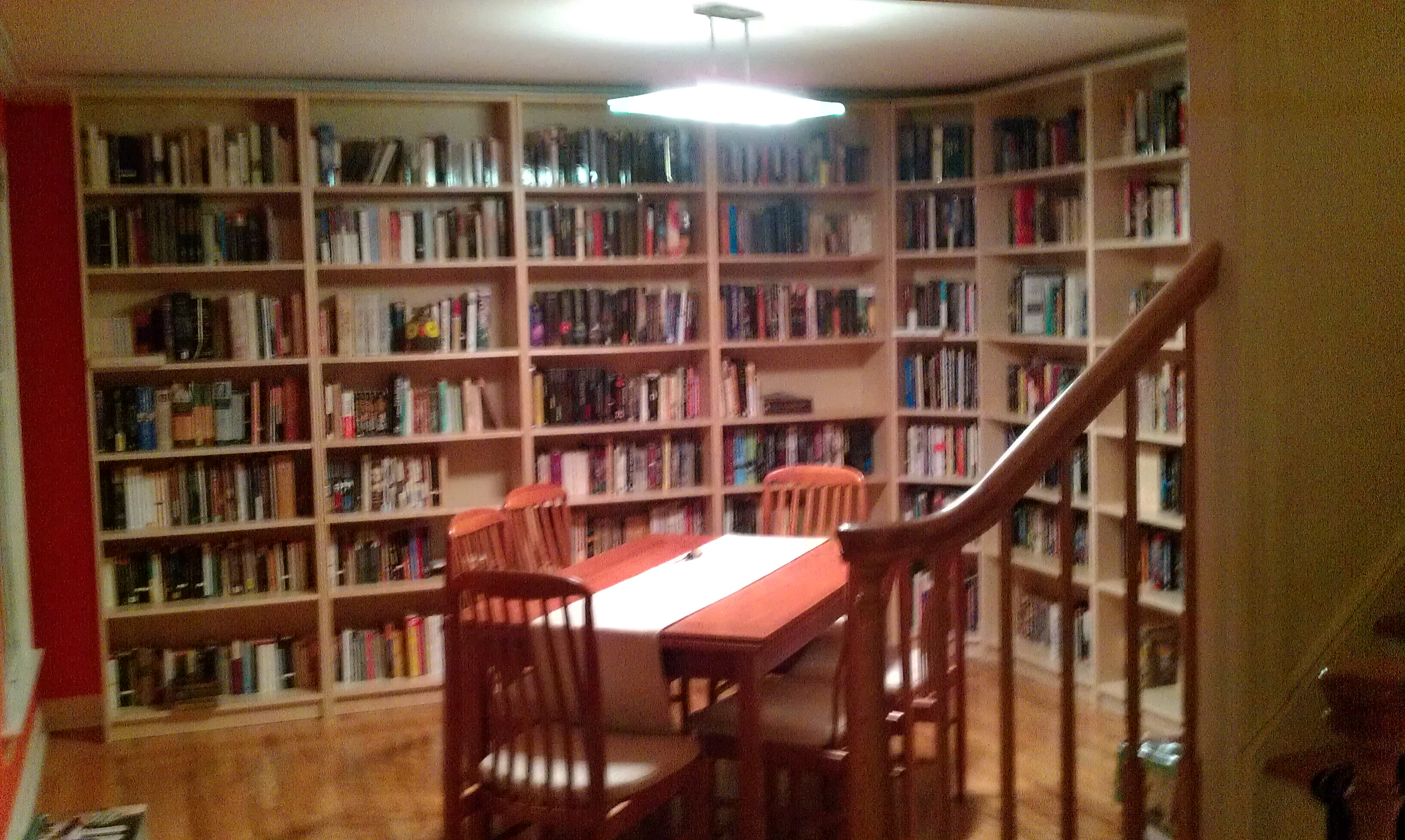
Happy New Year! Now that the formalities are out of the way, I thought I’d take a few moments to share with you what I did between Christmas and New Year’s: In addition to remodeling our library, and turning our dining room into a library annex, I also spent the week slowly and carefully reading Tzvetan Todorov’s classic book of genre criticism, appropriately titled The Fantastic: A Structural Approach to a Literary Genre.

Our Library Annex (aka the Dining Room)

Our Library Annex (aka the Dining Room)

Of course, I’d read about Todorov many times before. I’d even read a couple essays he’d written (I particularly recommend his typology of detective fiction). But I figured that it was best to see for myself what he had to say. And though in the end I was very satisfied, this book really defied my expectations.

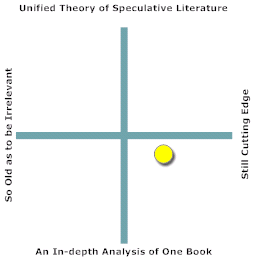
The book’s title is misleading. From the adjective-cum-noun “Fantastic” it is a short leap to the modern genre of “fantasy” – and so when I first bought the book, I expected to find a master critic expressing his own Unified Theory of Fantasy, like a Northrup Frye or a Wayne Booth for the speculative genre (for two excellent analyses more in this vein, I recommend Farah Mendelsohn’s Rhetorics of Fantasy and Brian Attebery’s Strategies of Fantasy). Instead, Todorov uses a much narrower interpretation of fantasy, placing it on a spectrum between stories where ostensibly supernatural events are explained through rational means (which he calls the “uncanny”) and stories where supernatural events are shown to actually be supernatural (which he calls the “marvelous”).

Todorov's Spectrum of the Supernatural

Todorov's Spectrum of the Supernatural

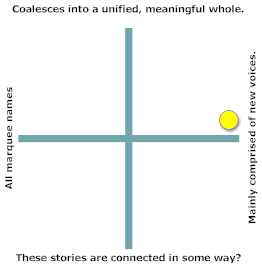
To put it another way, Todorov’s uncanny stories are Scooby Doo episodes: during the action, the characters and reader experience events which are ostensibly beyond mortal ken (ghosts, monsters, strange worlds, etc.). But by the end of the story, all of the ostensibly supernatural experiences are explained away in a naturalistic and rational fashion, thus erasing the supernatural from the story. It’s like Old Man Withers being unmasked by the gang. On the opposite end of the spectrum, Todorov’s “marvelous” stories are Buffy episodes: during the action, the characters and reader experience events which are beyond mortal ken, but by the end of the story, all of the ostensibly supernatural experiences can only be explained by an acceptance of their supernatural reality. Todorov’s “fantastic” genre, however, is the Twilight Zone: neither the characters nor the reader is ever really certain whether the supernatural events are to be accepted.

This is a much narrower definition of “the fantastic” than “fantasy” would imply. It excludes almost all secondary world fantasy, and almost all science fiction. Even most wainscot fantasies would fall into Todorov’s “marvelous” camp. Which is a shame, because anything beyond his narrowly defined borders gets brushed off as beyond the scope of his analysis.

The first half of The Fantastic is an interesting, if dry, exercise in critical philosophy and semantic hair-splitting. He defines what he means by the fantastic, and provides a definite set of criteria for use in its identification. Given my (incorrect) expectations, the book initially frustrated me. I wanted to gleam sweeping insights with applicability across a broad swathe of fantasy titles and sub-genres. Todorov’s painstakingly detailed definition of “hesitation” or what I would call ambiguity: the uncertainty felt by the character and the reader as to their implied frame of reference for experiencing the story. According to Todorov, if a story has no ambiguity, then by definition it falls outside the bounds of his fantastic. Now, I love ambiguous stories. But most fantasy, and most science fiction, eschews the degree of ambiguity described by Todorov. Let’s face it: there are few Chronicles of Thomas Covenant, the Unbeliever or There Are Doors out there.

Yet once Todorov establishes his definitions, he begins to dissect his ambiguous stories in much more painstaking detail, parsing their themes and structures. And here, The Fantastic becomes a treasure trove of insight. The conclusions Todorov draws regarding the fantastic are not, in fact, particularly interesting. They may be thought provoking, but they have limited applicability beyond his caged genre, and furthermore I suspect his reliance on the psychoanalytic school of criticism ignores too many other factors. Yet the techniques that Todorov applies, independent of the genre against which they are applied, are quite impressive.

In a very real sense, Todorov draws the treasure map to a very narrow sub-genre. But by doing so, he shows us how to draw such maps for any other genre in existence. I wish that Todorov had taken the trouble to do the same for both his uncanny and marvelous genres. But the process of structural analysis that he applied to his ambiguous stories can just as readily be applied to secondary world fantasy, portal/quest fantasies, wainscot fantasies, liminal fantasies, intrusion fantasies, and all the rest. And that is why this book remains significant: on the one hand, it adds to our critical toolkit, and by using much-analyzed “classic” texts of the Gothic age, it helps to bring the tools of genre criticism into the “respectable” light of academia.

In that sense, later critics like Farah Mendlesohn or Brian Attebery both benefited from Todorov’s work. On the one hand, they apply to a broader body of work the universal techniques that Todorov pioneered. And on the other hand, they benefit from the fact that Todorov dragged ghosts and demons into the light of critical respectability.

All in all, this is a book on criticism well worth reading. But not for its conclusions: more for its methods.

Thinning and Accusations of Nostalgia in Fantasy


The other day I came across a comment somewhere (alas, I don’t remember on what blog/forum) that enjoyment of fantasy stems from a nostalgia for the medieval era when lives were “poor, nasty, brutish, and short.” This view is typically delivered with the rather heavy-handed (though often unstated) implication that only children and fools would enjoy stories set in a time period lacking women’s rights, flush toilets, and antibiotics. I suspect if you’re reading this blog you would agree when I label such a view simplistic and rather asinine. And yet…this opinion has been around for decades, and its staying power suggests that – just maybe – there might be something more at work here than haters hating.

Romanticizing the Past versus Being Nostalgic About It

So why then do people today still say fantasy just romanticizes the ugly past? I’ve never seen a child of the late ’90s and early ’00s make this statement. That’s understandable when we consider that for that generation, Harry Potter was the defining work of fantasy, and that its appeal and reach extended far beyond fandom’s traditional minority. In my experience, the accusation of nostalgia is most often made by folks who matured in the ’70s and ’80s. Unlike the Harry Potter generation, many of those my age or older could have grown up utterly insulated from the boom in genre. They would likely have only been exposed to the unavoidable hits of the generation that preceded them: Howard’s Conan, Tolkien’s Elves, Lewis’ Narnia, etc. Those formative books established their expectations, expectations which a cursory glance at fantasy covers in the ’70s and ’80s would have instantly confirmed. After all, contemporary urban fantasy at that time was the bleeding edge.

So fantasy’s predilection for medieval settings (whether secondary world or not) is an understandable stereotype. By volume, I would suspect (though I have no hard data) it remains warranted today. If someone were to tell me “Most fantasy is set in a quasi-medieval setting” I would say that this is likely a fact. But if somebody says that “Fantasy is nostalgic for the medieval era” I would take exception.

Contemporary fantasy owes many of its roots to romantic literature of the 19th century. In the literal sense, quasi-medieval fantasy does romanticize the past: images of the past are used as a cultural short-hand to set the tone of the work, establish a framework by which its themes can be explored, and set reader expectations. This focus on the reader’s frame of mind and emotional state is in many ways the defining rhetorical device of the Romantics. Realistic fiction does the same, but through the use of different imagery: contemporary imagery, objective or ironic presentation, etc. Both romanticize their subjects (however strenuously the realists might deny it). Fantasy just happens to use quasi-medieval window dressing.

However there is a line between romanticizing the past (a sin of which fantasy, historical fiction, and well-written biographies are all guilty), and being nostalgic for it. In fantasy, that line gets blurred by the genre’s reliance on thinning.

The Thinned End of the Wedge: Thinning vs Nostalgia

In The Encyclopedia of Fantasy, John Clute defines “thinning” as the weakening of some aspect of the world or character which then enables the story to be structured as a recovery fable. I won’t reprint the entire definition, but I strongly recommend you check it out: it’s a deep and meaningful concept, however fuzzy the borders of Clute’s definition. The classic way in which fantasy stories use thinning is to present a world in some form of decline. The reversal or slowing of that decline becomes the object of the plot or one of the story’s major themes.

Tolkien’s Middle Earth is replete with thinned elements yearning for restoration: the elves are leaving the world and going west, the line of Numenor is spent, Hobbits are no longer easy to find, dwarves are locked in their mountains, and the Ents have lost the Entwives (just to name a few examples that spring to mind: there are more). In The Lion, the Witch, and the Wardrobe we first find a Narnia where humans have died out, the land is blanketed in perpetual snow, and the White Witch oppresses the land and its people. Thinning is even used in non-medieval fantasy, such as in Marie Brennan’s Onyx Court series (see my earlier review).

Thematically, thinning is deployed with a nostalgic tone. The pre-thinning state is never shown, so the reader never sees what this idealized past was like. But the narrator and characters leave us with no doubt that it featured characteristics that they felt were good. It is their nostalgia which permeates the text, not the reader’s or (necessarily) the writer’s. It is merely a rhetorical device, analogous in kind to the use of framing stories or unreliable narrators. It can highlight themes that the writer seeks to dramatize, and can plant deeper emotional hooks in the reader. This isn’t a tool unique to fantasy, and in fact has a long pedigree.

Remember the Dark Ages? Even though it’s an awfully imprecise term, Petrarch’s origination of it really lends a fantastical narrative to the Middle Ages: the Dark Ages were western culture’s own period of thinning after the fall of the Roman Empire, and the influence of the Renaissance (which itself idealized the classical era) remains a powerful force in fantasy today. Contemporary portal/quest fantasies are the descendents of Dante’s Divine Comedy, and characteristic fantasy characters (rogues, merchants, warriors, etc.) can often trace their lineage back to Bocaccio, Chaucer, or Malory.

What Comes after Thinning?

Thinning, and the nostalgic tone it engenders, is clearly nothing new for fantasy. This makes the accusation that fantasy pines for the medieval past an understandable conflation of the terms. Yes, it is wooly-headed. Yes, it is imprecise. And yes, the people who level this accusation are dying out. But if there is some poorly articulated truth to their criticism, then what if they really have a different and far more valid point: is thinning played out as a rhetorical device? Does it remain relevant for the thematic concerns contemporary writers wish to address?

The backwards-looking Renaissance gave way to the striving of the Enlightenment. Thinning and its nostalgic tone became rarer, and tended to be confined to the (already more fantastic) Gothic novels. Though there was much writing we might today call speculative, the thinning popular during the Renaissance was replaced by satire, philosophy, and utopian texts which raised questions about society in the moment and postulated future directions for its development. If thinning as a device has become cliché, what comes next? Can we expect a new Enlightenment in fantasy which replaces thinning and the nostalgic tone with satire? I don’t think we’ve reached that point yet, but I suspect we may be on our way there. And who knows? Terry Pratchett’s Discworld might just be the satirical canary in the coalmine that drags us kicking and screaming into the century of the fruitbat.

Leaping the Chasm of Imagination: Verisimilitude, Historical Fiction, and Speculative Fiction


The borders of genre are famously porous. Devices that start in one genre will get adopted, subsumed, and then modified in another. Then the cycle starts again, with the “new” device trickling back to its original progenitor. This tendency is why asking whether realistic or speculative fiction developed first is meaningless: anthropologists and fans can probably debate this ’til the heat death of the universe, and even then the answer won’t matter. But I’m curious as to how and why certain narrative techniques make this leap and others don’t.

Verisimilitude is the Heart of Storytelling

Every single genre – regardless of how speculative it is – relies on some degree of verisimilitude to enable comprehension. Sure, it’s theoretically possible to write a science fiction novel entirely in a made-up alien language with concepts for which there is no human analog…but who on this planet would actually read it? At the most basic level of language, we rely on mutually comprehensible words to communicate. This is the point where I call shenanigans on the pseudo-linguistic (read: intellectually irresponsible) school of critical theory that argues that text/words/language are inherently meaningless. If that were true, then we would not only never have fiction, we would also lose all written correspondence and spoken conversation. Community relies on communication: note their similar roots.

The sentence “John opened the door.” could appear in a hard science fiction story, an immersive secondary world fantasy, or in mimetic chick lit. Sure, we might need to replace the character’s name, and call John “Blaghosan” or something to maintain the illusion, but the act of opening a door can apply in any of these fictional modes. The richness of our lexicon and its corresponding flexibility enables us to assemble more complex, interesting, and layered sentences. But fiction (and any communication) relies on a shared ontological foundation.

At Viable Paradise (which I attended a couple of weeks ago), the amazing Teresa Nielsen Hayden said something utterly profound: “The subject verbed the object, and it was good.” The particulars might vary, but at the sentence level that basic principle underlies all communication, regardless of its realism. The fancy stuff (metaphors, similes, neologisms) that speculative fiction authors love is really a set of clothes hung on this incredibly flexible frame.

The Basic Devices of Fiction: Simile, Metaphor, and Neologism as Genre Markers

All writers use a certain basic arsenal in an infinite variety of combinations to communicate and manipulate their audiences. The most basic tools are such an indelible part of language, communication, and thought as to be near inseparable. But how we use them can actually be one of the markers of speculative fiction.

When we employ a simile (“John scuttled like an ant”) we are establishing a sense of apparency. The use of “like” indicates that John is not in actuality an ant. He merely acts with characteristics more commonly associated with one. Such a use of apparency can take place in any genre and is likely as old as language. Metaphor (“John was an ant scuttling across the floor.”) and neologism (“John the antyman scuttled”), however, are a little more complicated.

If we’re reading a work that is by definition realistic, then we recognize metaphor as a stronger way of evoking apparency. If we’re reading an F. Scott Fitzgerald novel, we know that John hasn’t actually become an arthropod. But if we’re reading something speculative than lacking other markers in the text, our hero John may have suddenly literally transmogrified into an insect (hey, it worked for Kafka, right?).

When we come across a neologism (“antyman”) we now have to decode the new word and incorporate it into our lexicon. Its semantic meaning may be unclear, and needs to be gleaned from context. In speculative fiction, that context may support fantastic concepts (antyman – the hybrid of a human and an ant) or merely extend our realistic lexicon (like Shakespeare coining terms like “assassination”).

This decoding process is part of what we love about science fiction, fantasy, and horror. Decoding where a given work’s fantastic borders are is an intellectual puzzle that gives us no small degree of satisfaction (whether escapist or otherwise). Traditionally, literal metaphor has been the plaything of speculative fiction writers. Realistic writers might have dallied in it a bit, but it is only with the relatively recent rise of magical realism and literary fiction’s “discovery” of science fictional devices that this technique has been fully appropriated. A similar process has happened over the centuries with narrative structures.

The Many Structures of the Novel

While many hardcore genre fans might disagree, I would argue that most innovative novel structures first appeared in “realistic” fiction. Whether it is the epistolary novel, the framed narrative, stream of consciousness, or non-linearity it probably appeared first in the realm of realistic mimetic fiction. There’s a good reason for that: like speculative fiction, innovative structures require effort on the part of the reader to decode and process them. To expect the reader to decode an innovative structure and process the speculative elements is likely expecting too much.

Consider the history of the epistolary novel. When it first grew to prominence in the seventeenth century (check out Aphra Behn’s Love-Letters Between a Nobleman and His Sister), we had to learn how to consume realistic epistolary novels before fantastical interpretations could flourish. As far as I know, it was not until 1818 that Mary Shelley’s Frankenstein or The Modern Prometheus successfully introduced early science fictional elements into the epistolary structure, and not until 1897 that Bram Stoker’s Dracula did the same for the nascent genre of horror. I suspect these novels owe much of their continued longevity and relevance to being early examples of speculative stories that made the imaginative leap and successfully appropriated a mimetic/realistic structure.

The pattern is quite similar for other innovative narrative structures. Could Delaney’s Dhalgren have appeared without the innovations of Kerouac? Or would Effinger’s When Gravity Fails have the same resonance without Raymond Chandler or Dashiell Hammett? As readers, we don’t need to have read the realistic taproot texts to experience and enjoy their speculative descendents. Because their structures are successful, they spawn a multiplicity of children: they become part of the cultural zeitgeist that soaks into our awareness.

This pattern actually holds even for the most basic taproot texts of literature. At the start of this post, I asked whether realistic or speculative fiction came first. And the answer is that they both appeared at the same time in the form of historical fiction. Wikipedia dates the first piece of historical fiction back to the 20th century BC. In those ancient days, there was little distinction between what today we characterize as “myth” and what they called “history”.

Even the earliest historical fiction had the same world-building challenges as speculative fiction. History is a foreign country we can never visit, and ancient Greece or Regency Britain are as foreign to our twenty-first century sensibilities as Middle-Earth or the Sagittarius Arm. The world-building techniques for the two genres are identical. Look at how Patrick O’Brian pulls us into his Napoleonic-era nautical understanding in his Aubrey and Maturin books. Then compare his methods to how Arthur C. Clarke introduces us to space-age technology in Rendezvous With Rama. The challenge is the same, and the craft to address it is the same as well.

Does the Pendulum Swing Both Ways?

With the rise of the modernists in the early twentieth century, we saw the fantastic get relegated to a pulp ghetto that we still struggle to escape. Yet even then, there were some “mainstream” authors who looked to fantastic fiction as a source of inspiration (Kingsley Amis and Shirley Jackson both come to mind). The last several decades have seen fantastical techniques gain acceptability within the realistic fiction community (provided they’re labeled “magical realism”). With post-apocalyptic texts like Cormac McCarthy’s The Road or blatantly science fictional novels like Charles Yu’s How to Live Safely in a Science Fictional Universe: A Novel being published as “mainstream literary fiction” we may be living through the pendulum’s reversal as we speak.

Which are the fantastical devices that will now hop back over that imaginative chasm? What are – and what will – contemporary “realistic” writers learn from their speculative peers? That the cycle will keep going I have no doubt, but I’m curious what lessons realistic authors are learning from those of us who like to mess about with elves and space ships and zombies. Regardless of the genre, my own predilections suggest that writers who want to innovate structurally should read widely and extensively across genres to internalize others’ innovations wherever we come across them. T.S. Eliot nailed it when he said “Mediocre writers borrow. Great writers steal.”

What should we be stealing nowadays?

Why do we love science fiction, fantasy, or horror?


Over on the Absolute Write Forums, GreenEpic posted a fairly thought provoking question:

Does anyone have a theory as to why science fiction and fantasy are so popular?

While the thread there has a bunch of really good answers, most of them tend towards the anecdotal. And as this is the Internet, and I have a generalized opinion, I figured I’d share it for public consumption. Here’s what I think:

Science fiction, fantasy, and horror are all marketing categories. They loosely describe a set of fictional conventions that can be expected within a given work. Does a story have robots? Odds are it is science fiction. Does it have magic? Most likely fantasy. Does it have undead monsters out to eat your flesh? I’d guess horror. Of course, this is a gross over-simplification. As a lot of my earlier posts on genre observations suggest, the reality is a heck of a lot more complicated. But your typical reader or movie-goer isn’t terribly concerned with the minutiae of genre theory (which I think is unfortunate, but I’m both nerdy and pedantic). Why do so many respond – in one fashion or another – to speculative storytelling?

Psychological, Physiological, and Neurological Levels of Storytelling

Rational, Emotional, Physiological, and Neurological Responses to Storytelling

Levels of Response to Story

Experiencing a story affects us on both psychological and physiological levels. Have you read stories that put you on the edge of your seat? They tugged on your subconscious emotions to increase tension. That sensation of your palms sweating or your heart beating faster? The story, and the tension it engendered, elicited a physiological response. Or have you ever fallen into a story so lovely that the world around you and the passage of time faded into mere background noise? The story produced a neurological trance-state, not unlike meditation or hypnosis. Have you ever read a book and realized you might be wrong about something? The story’s rhetoric affected your rational thoughts and values.

There’s a connection between our brains and our bodies that good storytelling can powerfully manipulate. It is simultaneously a positive and negative feedback system, where if a story affects one aspect of our beings it has ripple effects that impinge on every other aspect. When a creator manipulates this system skillfully, the effect is transparent and immensely powerful. And here’s why this is important: a story’s marketing category has no bearing on the audience’s response.

That’s right. Whether we’re reading mainstream literary fiction, watching Blade Runner, or flipping through a comic book, our brains and bodies will still respond to the underlying story. When we participate in ludic reading (reading for pleasure), we are looking for a certain configuration of those four responses. Of course, we can’t possibly articulate what that configuration might be (I can’t imagine anyone looking for a story that produces a 40% emotional, 30% physiological, 20% neurological, and 10% rational responses). And the components of those configurations are likely to have fairly fuzzy borders, because they are greatly affected by our state of mind/body at the time of the experience. But when we experience a satisfying story, when a story has elicited a satisfactory configuration of responses, we know it. We say “That was a good story” or “That was fun” without trying to really take it apart and understand why. And a story’s marketing category does not affect how it manipulates our responses. Instead, it describes the conventions appropriate to correctly interpreting its plot.

Basic Modes of Storytelling

Put away your Northrup Frye. I’m talking about something much more essential than mimesis or myth. If we just focus on a story’s plot and how that plot is constructed, we find several different modes of storytelling. Each of these modes relies on a certain configuration of those responses I mentioned above.

For example, an adventure story is going to produce a certain kind of physiological response. Our heart rate might increase, our breath might grow short, we might be eagerly looking to see how the hero will get out of a particular jam. But a mimetic (for the sake of simplicity, let’s call it a representative or slice-of-life) story is unlikely to produce that kind of response. Instead, it is more likely to be quieter, slower.

Basic Modes of Storytelling, with Realistic & Fantastical Examples

Basic Modes of Storytelling, with Realistic & Fantastical Examples

These responses have nothing whatsoever to do with whether a story has fantastical elements or not. Consider two adventures: Alexandre Dumas’ The Three Musketeers and Steven Brust’s The Phoenix Guards. They make for an interesting comparison, in that the latter is explicitly modeled on the former. But while Dumas’ most famous work has no fantastical elements to speak of, Brust’s novel is replete with them. Yet both stories produce similar responses in the reader, particularly if we are familiar with both works.

So if a story’s fantastical elements (or the lack thereof) has no bearing on the mode a story is told in, then why do some folks prefer speculative fiction over realistic fiction?

Gateway Drugs, Sense-of-Wonder, and the Multitudinous Genre

I believe that fantastical storytelling has an inherent advantage over realistic storytelling. There are no boundaries on what we can do with it. If a concretized metaphor (*cough* the one ring *cough*) adds value to our story, then why not run with it? Just because it isn’t realistic does not mean such images or metaphors are valueless.

Realistic storytelling is actually a subset of fantastical storytelling: by design, it chooses to limit its images and narrative devices to those which can be found in real life. If we love good storytelling, then it’s perfectly natural that we would love the speculative genres. Like Whitman, they contain multitudes. Every single realistic story, from Shakespeare to Joyce, can be presented using fantastical imagery. That a particular execution of a story remains realistic is merely the consequence of an authorial decision as to its ideal presentation.

Yet despite the fact that good stories do not need fantastical devices to remain good stories, plenty of folks out there read exclusively in the fantastic genres. Why? If they can find equally enjoyable stories among the “realistic” shelves, why stick with SF/F/H? I suspect it is because of a positive feedback loop imprinted on our brains early on. When we first consciously encounter storytelling, we look for patterns. It’s a consequence of our highly-developed simian brains. So if in those formative years, we learn that science fiction, or fantasy, or horror is statistically more likely to produce a particular configuration of responses that satisfies us, we treat it like a drug. We learn to love it, and to equate that particular marketing category with the pleasure it produces. And then sometimes, we never stray beyond that gateway.

This gate swings both ways, of course. The same holds true for many readers of realistic fiction, or for many movie-goers who never pick up a book. It’s all about the positive feedback loop that gets imprinted on our neurons at a formative age. I suspect (on the basis of absolutely zero neurological knowledge) that this imprinting can be changed as our experiences change us, but it remains a powerful driver of our experiences.

I suspect the tough-to-pin-down “sense of wonder” is actually a consequence of this gateway drug. If we are adequately self-aware, we learn to recognize (through a meta-cognitive experience), the response we are seeking. That recognition produces that scintillating sense-of-wonder fans of SF/F/H use to justify our genre habit. Speaking for myself, I can elicit that same sense-of-wonder reading outside of genre (Patrick O’Brian’s books come to mind, as do Yasunari Kawabata’s). I don’t believe wonder is genre-specific, although the experience is statistically more common among the fantastic shelves.

And this brings us to the core reason why the speculative genres are so popular: they are a marketing category that encompasses all of the basic modes of storytelling found in realistic fiction. You’ll notice there is no such marketing category as “realistic fiction”. If we want to balance “SF/F/H” we would need an equally broad “realistic fiction” category. But instead, the “realistic fiction” section is fragmented into literary fiction, thrillers, romance, mystery, historical fiction, etc. If you want to find a realistic story told in the romantic mode, well your odds are pretty small looking under literary fiction. If you want a piece of mimetic fiction that deepens your understanding of the human condition, you should probably avoid the thriller shelves.

Yet all of these storytelling modes can be found side-by-side in the science fiction, fantasy, and horror section. Fans of genre fiction need never wander outside of those shelves to find stories that satisfy their every need. And that’s why, as a marketing category, it is so popular. It contains multitudes. And those increase the odds that a story from that marketing category will produce a satisfying response. Of course, much as I love fantastical fiction, I still think folks should read outside of their beloved genres every now and again. But if they don’t, well that’s fine, too: speculative fiction’s got a lot to love.

What do you think? Why does speculative fiction push a lot of our buttons and keep our attention the way it does? Why does it produce such fervent loyalty on the part of readers and viewers?