Skip to content

Characters’ Age: Musings on How it Affects Writing


In the western world, we live in a culture that idolizes youth, and I suppose that’s understandable. We naturally gravitate towards characters who are young, healthy, vibrant, powerful, and exciting. And yet, some of my favorite characters in fiction (e.g. M. John Harrison’s teugis-Cromis, Ian McDonald’s Georgios Ferentinou, or John Scalzi’s John Perry) are the exact opposite: they’re old, often sickly, damaged, and (superficially) weak. And yet despite their age and infirmity, they become memorable and compelling characters. (since a book I’m currently shopping to agents has an eighty-five year old protagonist, it’s a subject that’s been on my mind a lot recently)

The protagonist’s age is central to every dimension of their story. There is nothing — literally, nothing — that their age does not affect. Whether we’re writing realistic fiction, space opera, or secondary world fantasy, our protagonist’s age will affect the story’s broad plot, the techniques through which we build our world, the style of dialog, and even the specific word choices we make in our narrative.

Age and Plausibility

Let’s first look at age’s interaction with our protagonist’s background. Would you trust your brain to a fourteen year old neurosurgeon? Or would you get into a starship captained by a ten year old? Probably not. At least, not without some hefty assurances that you’re not about to commit suicide. When we consider the role our character plays in their society, we need to run a basic plausibility check. If the character’s age and role stretches that plausibility, then we need to ensure that we provide adequate justification for that divergence.

One of the better examples of this I’ve seen takes place in Philip Reeve’s madcap middle-grade space adventure, Larklight. There, we meet a fifteen year old space pirate captain named Jack Havock. Of course, Larklight is aimed at children…which is good, ’cause there are few readers who call out plausibility BS faster than a ten year old. And the idea that a fifteen year old might find himself a space pirate — and a space pirate captain, no less — obviously stretches credulity. But Reeve makes it plausible both through how he depicts Jack Havock’s actions (while still a child, in a crunch he behaves very responsibly) and through the back story he shows the reader.

A counter-example, where I felt a character’s age worked less well, was Ian McDonald’s recent YA debut Planesrunner where McDonald’s teenage protagonist is shown to be preternaturally skilled at just about everything he puts his mind to. McDonald is too experienced a writer to ask us to make the leap in plausibility unaided: he does provide explanations that justify Everett Singh’s abilities. I might have easily believed Everett to be a savant quantum physicist. Or a naturally gifted soccer player. Or a superb chef. But all three? That suggests plot-oriented convenience, and strains plausibility. Because each of those skills takes time to master…time that a teenager simply hasn’t had yet.

The same plausibility gap works in the opposite direction. In my aforementioned WIP, my protagonist is an eighty-five year old named Johann von Kempelen (yeah, the guy who invented the Mechanical Turk…’cause who else would you want as a clockwork emperor’s physician?). In this case, making him a young man would have stretched credulity on two fronts: first, his job is to be the personal engineer to the emperor. He is responsible for keeping the emperor ticking. That’s not a job you get at a young age, regardless of how fantastical the world is or how talented the engineer. Second, the real-life von Kempelen actually lived in the 18th century. But my alternate history is set in the 19th century. So to make that alternate history less-credibility-stretching, I decided to keep him an old man (even though, in reality, by 1885 he was long dead). Keeping von Kempelen old prevented a plausibility gap, and simultaneously better allowed me to explore the philosophical themes of the book.

In Saladin Ahmed’s Throne of the Crescent Moon (which I discussed here), his protagonist is also an old man, in this case an aging ghul-hunter. On a superficial, sword-and-sorcery action-oriented level, Ahmed did not need Doctor Adoulla Makhslood to be an old man. He could have made him an inexperienced young ghul-hunter, eager to prove himself. Or he could have had him a ghul-hunter in his prime. Any of these choices would have been equally plausible given the overall shape of his story. But they would have completely changed the themes explored, the story’s emotional trajectory, and the technical way in which the story was told.

Age, Actions, and Reactions

Have you ever seen old people fight? I mean, physically? They move differently from the ways teenagers do. There are many reasons for that, some physiological, some psychological, but the bottom line is that a badass move we might pull off at twenty is not something we’re likely to succeed at when we’re sixty. As a result, the character’s age completely changes the way action sequences are depicted. Movement slows and becomes more deliberate, reaction times increase. The characters’ movements in an action sequence, the choices they make, the way they react to danger, all of those will be different based upon their age and whatever infirmities might come with it.

The same holds true for a character’s emotional reactions to events. I react to events completely differently today than I did at the age of sixteen (thank god). That’s one of the realities of aging. And it is one that we need to bear in mind when constructing our characters.

Nnedi Okorafor handles this brilliantly in Who Fears Death? (which I wrote about here). Her heroine, Onyesonwu, is relatively young. And she acts her age, with all of the high-strung emotion that entails. Reading the book, her choices made me gnash my teeth in frustration…but that didn’t mean they were “wrong” for the character: they were exactly the choices Onyesonwu would make. If she were fifteen years older, she would likely have taken a completely different path. But the character worked because her choices – however frustrating they might have been – were realistic given her emotional makeup and maturity.

Equally well-done in this regards is Knuffle Bunny: A Cautionary Tale, by Mo Willems. If you haven’t seen it, check it out: whether you have kids or not (I don’t), you will find it absolutely charming. The picture book centers around a child who loses her favorite stuffed animal (the titular Knuffle Bunny). What makes this book stand out is that it focuses just as much on the father’s reaction as on the child’s, and Willems manages to grasp both the child’s frustration and fear, and her father’s panic and guilt (so well that we feel the story must be autobiographical). Both reactions are determined by the characters’ ages…and both are rendered in text and illustration perfectly.

Teaching an Old Dog New Tricks: Age and Its Relationship to Prose and Themes

There’s a school of thought that says a well-rendered character needs to grow and change over the course of a book. And this is true. But the trajectory of that growth differs based on the character’s age. All characters, regardless of their age, have some sort of back story that informs everything about the character, their perceptions, their values, their opinions, and their voice. However, when writing older characters there needs to be more of that back story, with all of the ups and downs that a full life demands.

The reader doesn’t need to see it, unless it somehow directly affects the events of the story. But we as writers need to know it, because the choices our characters made yesterday affect the choices they’ll make today. For example, if we’re writing first person or close third person, characters are going to notice and react to different smells, colors, textures, tastes based upon their previous experiences. Does the character notice a particular scent? Smell is the sense most closely linked to memory, followed closely by taste. How a character reacts to it (and what else a character notices) should be informed by their earlier experiences.

So should the choices they make. A more mature character is going to grow and change differently from how a teenager would. That’s not because you can’t teach an old dog new tricks, it’s just that a more mature character will already have grown and learned many of life’s lessons. This dimension of character growth is, I think, more difficult for more mature characters. For the character’s emotional arc, I think the trick is to identify what lessons they failed to learn before the events of the story.

Saladin Ahmed does an excellent job of this in Throne of the Crescent Moon. Adoulla’s emotional journey centers around his failed relationship with a mature, strong-willed woman. He “failed” to learn a lesson about priorities in his younger days (or made choices that he has since come to regret), and the emotional arc of the story focuses on his realization of this fact and his rectification of that mistake. This puts into conflict two “goods” against each other: his duty as a ghul-hunter, and his love for Miri. This makes for a poignant emotional conflict. And a believable one for a character of his age.

Age Handled Well

I’ve mentioned a couple of books where I think characters’ ages are handled particularly well. But there are others which I also wanted to give shout outs to. I’ve mentioned Dickens’ A Christmas Carol: if Scrooge wasn’t an old man, the book would have no meaning. Hugo’s Les Miserables also works precisely because of its interplay between the emotional arcs of youth (Marius, Cosette, Eponine, Enjolras) and age (Valjean, Javert, the Thenardiers). And last but not least, John Crowley’s masterful Little, Big also only works because of the characters’ ages: the growth and evolution of Smoky Barnable and the Drinkwater clan only works because of their (sometimes purposefully indeterminate) ages.

What are some other examples that you think handle characters of different (or unusual) ages well?

An Unscheduled Rant: The Death of Science Fiction and Unrepentant Ignorance of YA SF


While I do tend to blather on about my thoughts about speculative fiction, I don’t normally post off my weekly schedule or post rants. In what is perhaps a bit of a departure from my norm, today I’m going to do both. What set off this rant is a couple of thought-provoking posts, the first from Jason Sanford over at SF Signal and the second a thoughtful response over at Nerd Redefined.

Sanford’s post started the simmer of my rant. He poses a good, thoughtful question: why are there so few readers of science fiction while so many consumers of science fiction in other media? That is an interesting question, relevant to storytelling across all media, and to our society’s aspirations and future. And – perhaps unsurprisingly – the answers suggested by both Sanford’s post and the comments in response lay the blame squarely at the feet of YA science fiction:

However, in today’s marketplace there are relatively few current SF novels aimed at young readers (with the exception of dystopian novels, like The Ember series by Jeanne Duprau and The Hunger Games series by Suzanne Collins, and movie tie-in novels related to Star Wars and Star Trek).

This is one of those “facts” that I see SF fandom trot out time and time again. And this fact is wrong. Let me be clear: it is factually incorrect. It evidences a basic ignorance of what is being produced within the YA community, which – BTW – is actually a vibrant community often completely separate and unaware of the SF fandom/writer community. For those who want evidence, at the end of this post I’ve got a brief list of some YA SF novels published in the last couple of years.

I also took the time to go through the last seven e-mails I’ve received from Publisher’s Marketplace listing deals that were announced in the past week. Bear in mind that not all deals are announced in Publishers Marketplace, and that a one week sample isn’t statistically sound (if I wanted to be methodologically reliable I’d need to go through at least one or – better yet – two years worth of deal announcements). But even this cursory glance at titles/deals announced in the US and the UK is telling. Here’s how the numbers break out:

DATE YA SF YA Fantasy Middle-grade SF Middle-grade Fantasy
March 8, 2012 3 1
March 7, 2012 1
March 6, 2012 1
March 4, 2012 2 5
March 1, 2012 1 1 1 1
February 29, 2012
February 28, 2012 2 1
TOTAL: 9 6 1 4
as % of Non-adult SF/F 45% 30% 5% 20%
as % of Age Group 60% 40% 20% 80%

Now, there are a lot of methodological caveats to be made here, not least:

  • I am doing a categorization based on the little snippet of information included with the deal announcements.
  • My categorization of titles is neither anonymized nor corroborated to exclude personal bias.
  • I selected the last seven e-mails from PM that I had in my inbox. Thus the time period is not random, nor is it broad enough to draw far reaching conclusions.

But these methodological caveats, coupled with the list of titles below, should at the least be suggestive that perhaps there is more YA/MG science fiction being published than the traditional SF community is cognizant of.

Now, I’m not a YA or MG (middle-grade) author. Not writing for those age groups, I don’t have a horse in that race. But because The Professor edits YA/MG for a living, I do tend to read a lot of it. And hear about a lot more than I read. And so when I’m confronted with authoritative statements being made that evidence little awareness of the facts, it tends to get me riled.

To be clear, this is not an indictment of Jason Sanford’s post. His post was thoughtful, respectful, and intelligently constructed. Instead, what I wish to indict is the fact that in almost every discussion of YA SF I have come across – whether at cons or online – those invited to the table are almost always SF authors with little exposure to the contemporary world of YA literature. Their arguments all too often are based upon ignorant assumptions.

Let me bust out some – potentially heretical – knowledge here:

Heinlein juveniles are utterly and completely irrelevant in today’s YA marketplace.

I know, I know. We all grew up reading them. And we all love them. But readers below the age of twenty thirty who’ve ever heard of them are few and far between. Tomorrow’s science fiction readers are not interested in whiz bang technology, or in “accessible” science fiction. They want good storytelling, tight prose, and most importantly, engaging characterization. In casual conversations with some of The Professor’s colleagues (who all edit YA and MG for a living, I should add) I once asked if they’d ever heard of Heinlein’s juveniles. The only one who had (and who groaned at my question) was The Professor. Now, some of us might say “Aha!” and point to that as the problem. But it isn’t. Because these same editors publish tons of science fiction. They just don’t call it that: they call it YA or middle-grade.

And this is the problem, which Nerd Redefined touched on. The traditional SF community and the YA community are completely and utterly ignorant of each others’ existence. It’s like a middle school dance. In one corner, we’ve got the SF folks who are all lamenting the fact that there’s no science fiction being written for kids. And across the gym we’ve got the YA writers who are happily writing science fiction while blissfully wondering who’s whinging in the other corner.

Here’s how I see it: today’s young audience is devouring speculative fiction. Whether it’s science fiction, or fantasy, or horror, they’re eating it up in video games, in movies, in sequential art, and — yes — in books, too. But for today’s audience, the borders between genre have become porous. A teenager doesn’t give a damn whether something is science fiction or fantasy. They want a good story, and they go to their store’s YA section to find it, which itself you’ll note is rarely subdivided into “YA SF” and “YA Fantasy”. We have a vibrant, active community of YA authors who are writing SF for young readers…only they think of themselves as YA writers first and SF writers second (if at all).

SF fandom likes to make sweeping (lamenting or condemning) statements about YA science fiction: there’s very little of it, it doesn’t sell, it’s all dystopian. These kinds of generalizations remind me of the same ignorant statements often made about SF: scantily-clad greens skinned women, nothing more than “escapist” fantasy, etc. I suggest that our compatriots writing for YA audiences deserve just as much respect as those of us toiling in the SF mines.

If we’re going to make broad generalizations, I’d like to see the hard data backing those claims up. There’s precious little data that I’ve seen on YA SF publishing, or on YA SF sales. And as for the “all dystopian” brush-off, even a cursory familiarity with the YA marketplace would suggest that the “dystopian trend” is just that: a momentary trend in a genre where trend cycles are three to four times faster than in adult genres. I think these are fascinating issues to discuss, and I’m delighted whenever anyone wants to discuss them, but they require us to converse based upon a familiarity with both the YA world and the SF world.

I suggest that anybody who in 2012 suggests that SF readership is declining because there’s no equivalent for Heinlein juveniles is stuck in the 1950’s. Consider that Heinlein’s juveniles were published from 1947 – 1958. During that same time period, young adults were consuming Leave It to Beaver, Captain Video and his Video Rangers, Dragnet, The Adventures of Superman, Gunsmoke and a host of other television programs which by the standards of today’s YA media are “quaint” at best. Do we really expect kids to like the same kind of books? Try getting a fourteen year old to sit through an episode of Gunsmoke. While I still enjoy Heinlein’s juveniles, and while I think a YA reader can, they are simply no longer relevant.

Which is why I think the SF community’s concern with “accessibility” is missing the mark. First, because there is a lot of SF being published for kids today (it’s just not on the radar of most adult SF fans). And second, because it prescribes a solution (the Heinlein juvenile equivalent!) to a non-problem (no SF for kids!).

If we want kids and teenagers to read science fiction, we need to put the story and characters first and the science second. Because what kids care about today is the story, and not the science. Science is transparent to kids: they live in a world where digital information surrounds them. They can play an immersive three-dimensional multi-actor game before they ever go to school. The hard science that it takes to make these playthings work is uninteresting: it is taken for granted, just as is the air we breathe. But the characters and stories that unfold in that reality, that’s a different matter.

So here’s my appeal to science fiction fandom: accept the fact that Heinlein juveniles are a product of the 1950’s, and consign them to the nostalgia for yesterday. Before you start making authoritative statements on “the state of YA science fiction”, at least take the time to familiarize yourself with what’s happening in that arena. Take a stroll through your local bookstore’s YA section. Hold your nose at some of the cover art: remember, unless you’re a hormone-crazed teen, odds are you’re not its target audience. Crack some of the spines and read some of what you find. Not all of it will be good; in fact, some will be pretty lousy. But I guarantee you that you will be surprised at what you find.

To help, here’s a quick list of YA and MG science fiction books. These are the ones I was able to spot just taking a quick spin around our home library: I’m sure there are tons more out there. Pick ’em up, there’s good reading there…even if it isn’t much like a Heinlein juvenile. And if anyone wants to chime in with their thoughts or with other suggestions, please do so!

NOTES:

  • For books in a series, I’m only listing the first book.
  • I’m going by the publishers’ recommended ages to categorize books as MG/YA.
  • I haven’t read all of these books, and so can’t really “recommend” every one of them. But I have read many of them.

Middle Grade: aged 8 – 12 Young Adult: aged 12 – 18

Reflections on the Workshop Experience: Viable Paradise


So as I’ve mentioned before, this past October I attended the Viable Paradise writing workshop. The basic facts are pretty simple: it’s a week-long writing workshop for science fiction and fantasy taught by eight professional writers and editors. And the experience itself was amazing. While I’d been meaning to write a blog post about the experience, it wasn’t until some recent online discussions with other writers got my butt in gear, and thus here are my thoughts on my experiences at VP (note that Viable Paradise is so far the only workshop experience I have had, and so these thoughts may or may not apply to other workshops like Clarion or Odyssey).

Choosing to Attend a Workshop

Everybody’s got their own reasons for attending a workshop, most of which are set up like a combination of critique group and summer camp (only the “fun activities” involve critiques, lectures, and writing). I can’t speak to my classmates’ goals, but in my case I applied to VP hoping for a number of things:

Craft-oriented Critique Writing – especially in the novel-form – is a lonely activity, and living in suburban NJ I haven’t had any luck finding a professional-grade critique group. I was seeking new insights into the way I wrote, to identify and address weaknesses, and to get it through rigorous and detailed criticism of my work.
Revision Techniques When I applied to VP, I knew that I could write something novel length. But to then revise it so that it would be ready to ship out, that’s a whole ‘nother story. I wanted to develop the revision techniques I’d need to polish my prose enough to get published.
Community While there are lots of people out there who want to write, in the offline world I’ve had little luck finding those as serious about the craft, and as committed to writing as I am. I was hoping to get plugged into a shared sense of community that goes beyond the virtual.
Validation And yeah, it’s a guilty secret, but I wanted someone who didn’t have an emotional stake – either through love, family, or friendship – to give me their honest assessment of my writing. I hoped for some indication that my writing is good (while simultaneously learning where it could improve).

So with these hopes in mind, I had to figure out which workshop to apply to, get in, and then go.

Picking Between Viable Paradise, Clarion, and Odyssey

In the science fiction and fantasy genre, there are three workshops that regularly come up in discussions. In order of their (seeming) size/stature in the field, they are Clarion, Odyssey, and Viable Paradise. There are major differences between these workshops, however, and by considering how they differed I was able to pick which one I wanted to attend.

Note, that this comparison is based on what I (a prospective workshop student) was able to find out about these workshops online. I haven’t attended either Clarion or Odyssey, so please forgive me if I got anything wrong!

Clarion Odyssey Viable Paradise
Time of Year Summer Summer Fall
Duration Six weeks Six weeks One week
Focus Short stories Short stories (mostly) Novels or Short Stories
Instructors (total) Six One (with guest lecturers) Eight (though we got lucky and had a 9th “guest star”)
Instructors at One Time 1 – 2 1 – 2 Eight (though we got lucky and had a 9th “guest star”)
Format

  • Milford-style Critique
  • Lectures
  • One-on-one Critique
  • Writing Exercises

  • Milford-style Critique
  • Lectures
  • One-on-one Critique
  • Writing Exercises

  • Milford-style Critique
  • Lectures
  • One-on-one Critique
  • Writing Exercises

Application Fee $50 $35 $25
Tuition $4,957 $1,920 $1,100
Housing Cost (included in tuition) $790 – 1,580 $465 – 1,050 (plus tax)

With my more-than full-time job, taking six weeks off in the middle of the year was just not going to happen. And so that simple fact automatically disqualified both Clarion and Odyssey. Putting this underlying fact aside, Viable Paradise still appealed to me more out of the gate: with a reputation of focusing more on novels than short stories, VP aligned more with the issues I was wrestling with in my own writing. And I imagined that having eight instructors on-location for the entirety of the workshop would make it more intense and stimulating.

The Viable Paradise Community

After applying to VP (and getting accepted) I was shocked by the degree to which a VP community exists in the science fiction and fantasy genre. Sure, there’s an e-mail list on which instructors and alums from various years are pretty active. But when in July I went to Readercon, I met a whole bunch of awesome VP alums who were able to offer lots of insight into what the experience would be like. This community, and the sense of shared-experience and support were awesome.

When I got to Martha’s Vineyard, getting to know my classmates was equally awesome. While I can’t speak for everyone else, I was really nervous about meeting everyone. Some of them had pro sales to their names, others had agents already, and there I was with neither. I was nervous that I’d be the amateur among a group of budding professionals. I was a little nervous of the exact opposite, too: anyone serious about writing has met people who have lots of desire to write, but less will to do so. In hindsight, both fears were absolutely ridiculous.

My class at VP was a diverse group of folks, at all ages, all levels of experience, and all backgrounds. We had homemakers, and scientists, and business folk, and lawyers, and this diversity of background really enriched our discussions. Regardless of whether we’d sold anything or not, we all shared a passion for writing, our love of the genre, and our desire to improve. And more than anything else, finding my tribe was one of the greatest aspects of my Viable Paradise experience, and with any luck it will be the most lasting. It is probably telling that six months on, my VP class remains in touch and even has a sort of loosely-structured, self-organized online critique group type thing going on. Which is unbelievably cool.

Structuring the Learning

Like, I think, all of the leading workshops VP combines elements of Milford-style critique with lectures. Each day features group critiques, scheduled one-on-one critiques with instructors, lectures, general discussions, and unscheduled one-on-one critiques with instructors. The day literally starts around dawn, and doesn’t end until quite late in the evening. VP’s focus seems to be very much on face-time and interaction with classmates and instructors, which was exactly what I wanted.

Groups for group critique are structured around writers who wrestle with similar issues, or who the instructors think can bring particular insight to their other group members. I found the composition of these groups (put together based on our application materials) to be a masterful piece of psychology and craft deconstruction. The groups I was in (can’t speak to those I wasn’t) worked really well, and everybody had something different to say about the writing. Diverse viewpoints, all coalescing into a stronger whole.

The lectures and group discussions were another interesting dimension. Each day, a different instructor offered a lecture or moderated the group discussion (sometimes themed, sometimes not). But what is perhaps unique about Viable Paradise is that during these lectures and group discussions all (or almost all) of the instructors were present. This effectively turned the lectures/group discussions into a highly-interactive conversation, moderated by a group of super-experienced professionals. As a result, we got to see where different instructors might have different approaches, where something that worked for one instructor might not work for another. The heterogeneous nature of these discussions really elevated the experience beyond a typical “lecture”.

Each of us had two one-on-one sessions scheduled with different instructors. But what is even cooler is that the students are actively encouraged to seek out the other instructors to have off-schedule one-on-ones with them. The net result was that rather than having two one-on-one critique sessions, I got to pick eight different (amazing) brains about my specific work. I got infinitely more out of the sheer variety of viewpoints, the differing issues that they identified, and their different approaches than I could possibly have gotten from any one critiquer (however brilliant).

There was less of a focus on writing new content than I expected (I expected to have to write something new every day – don’t worry, you don’t) but I don’t think the program suffered any for that. And I couldn’t possibly forget about the social dimension: hanging out, talking about books, about writing, drinking, philosophizing, making music, and generally having a good time.

The Net Assessment of Viable Paradise

All in all, I cannot recommend Viable Paradise enough. It is the only workshop I’ve done to date, but the experience was fantastic. I have the sense that one gets out of it what one chooses to get from it. I went in wanting to gain a sense of community, to learn new skills, to identify weaknesses in my own writing, and to get validation that I’m not crazy to think I can write fun, interesting stories. I got all of that (and more) out of VP – and in only one week’s time.

If you’re looking for the kind of stuff I was, and you can take a week off of work to find it, then I recommend you apply to Viable Paradise. Applications for this year (2012) close on June 15, 2012, and you can find out what you need to do to apply by clicking here.

REVIEW: Ride the Moon ed. M.L.D. Curelas


Title: Ride the Moon
Editor: M.L.D. Curelas
Pub Date: February 29th, 2012
Chris’ Rating (5 possible): 1 point 1 point 1 point
An Attempt at Categorization If You Like… / You Might Like…
An enjoyable, entertaining anthology with a wide variety of new authors.

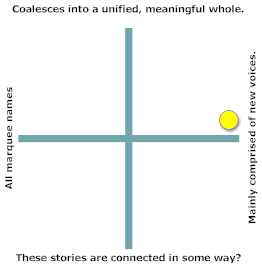
When I think about the anthologies I have read, I tend to break them out into three different types: exploring a particular style (e.g. Supernatural Noir ed. Ellen Datlow, reviewed here), showcasing a particular sub-genre (e.g. Steampunk ed. Ann and Jeff VanderMeer), or plumbing the depths of a specific theme (e.g. Paper Cities ed. Ekaterina Sedia). Through painstaking editorial curation, anthologists consolidate different voices and stories into a meaningful, unified whole. They can become more than the sum of their parts, and at the same time are packed full of fun, entertaining stories. And while I found that Tyche Books moon-themed debut anthology Ride the Moon didn’t culminate in a deeper insight into human nature, the collection of fantasy and science fiction stories was well-selected, well-organized, and definitely a fun read.

Thematic anthologies like Ride the Moon are, in my opinion, the hardest type of anthology to pull off. A stylistic exploration requires attention to style and tone, a sub-genre survey requires breadth and depth within that sub-genre, but a good thematic anthology necessitates building a TOC of excellent stories that are linked on a superficial level (the ostensible theme) and whose underlying truths are simultaneously unified in some fashion. The best example of this kind of anthology in recent times that I can think of is Ekaterina Sedia’s Paper Cities, which (despite the weaknesses of some individual stories) still managed to offer insight into how cities are employed in modern fantasy.

Ride the Moon is the debut book published by a new Canadian small press, Tyche Books. As their launch title, it is impressive. If I hold it to a high standard, it’s because on most measures I believe it comes pretty damn close to meeting it. Most of the stories are original to the anthology, though the occasional reprint (Edward Willet’s “Je Me Souviens” I recognized) is well worth inclusion. Most of the authors are Canadian, and I strongly recommend readers who might not be familiar with SF/F north of the border to check them out. While I recognized some of the authors (notably Claude Lalumière, Edward Willet, and Marie Bilodeau), most were brand new to me.

As the title suggests, every story in this anthology somehow touches on or deals with the moon as metaphor, god(dess), monster, or setting. With its lunar theme, the anthology skews somewhat fantastical: of the eighteen stories, only six are clearly science fiction. However, the remaining twelve fantasy stories tend to blend nicely between the explicit dark fantasy of Lori Strongin’s “A Moonrise in Seven Hours” to the more science fictional fantasy of Ada Hoffman’s “Moon Laws, Moon Dreams”.

About half of the stories – most notably C.A. Lang’s “Tidal Tantrums”, Shereen Vedam’s “Aloha Moon”, Keven Cockle’s “The Dowser” and Amy Laurens’ “Cherry Blossoms” – wrestle with the relationships of myth and magic in a modern, technological society. And while it might be tempting to say that therein lies the anthology’s unifying truth, I’m afraid that theory doesn’t hold up when faced with the anthology’s other stories.

The stories that I enjoyed most invariably did something fresh with both the lunar theme and their storytelling. Isabella Drzemczewska Hodson’s “Husks” is a beautifully written dark fantasy. The prose is lyrical and flowing, and Hodson’s imagery just draws you in. Her use of omniscience in the storytelling works to great effect: despite the omniscient narrator, I found myself embedded in the characters and their experiences. A. Merc Rustad’s “With the Sun and Moon in His Eyes” employs excellent characterization with tight prose. Both the subject matter and story structure reminded me of N.K. Jemisin’s Inheritance Trilogy, and appealed to me in many of the same ways. Shereen Vedam’s “Aloha Moon” and Ada Hoffman’s “Moon Laws, Moon Dreams” both do a great job of drawing the reader into their characters, though I found the plot resolution of “Aloha Moon” a little too convenient. The biggest stand-out for me, however, had to be Edward Willet’s “Je Me Souviens”: a quiet, emotional, and intensely powerful story about mourning, loyalty, remembrance, and faith.

Some of the other stories, notably Krista D. Ball’s “On the Labrador Shore, She Waits”, Tony Noland’s “Sunset at the Sea of Fertility”, and Lori Strongin’s “A Moonrise in Seven Hours” didn’t work for me. In most cases this was because I found their characters and plot structures fairly predictable. They were well executed for what they were…I just found that they didn’t appeal to me, and were otherwise unmemorable and unremarkable.

In sum, I would say that Ride the Moon is an entertaining, well-written, and well-structured anthology. Despite their significant differences, the stories flow into each other nicely. I enjoyed reading it and – perhaps most importantly – it has turned me onto a number of authors who I might not otherwise have encountered. This is an anthology well worth picking up if only for those two traits. And as a debut from Tyche Books, it makes Tyche a small press that I’m going to be paying attention to going forward.

Post-scarcity and Realistic Utopia: Where’s the fight?


One of the WIPs I’m working on right now is a far future SF novel inspired largely by Le Guin’s classic The Dispossessed: An Ambiguous Utopia. As I’ve observed before, utopian novels are hard to pull off because an ostensibly perfect society removes – in most major ways – meaningful (read: existential) conflict. But I think I might have been wrong about that.

Fictional utopia and dystopia are tools through which we negotiate our society’s ethics. They are, in a very real sense, a debate about the values our society holds. Le Guin’s short story The Ones Who Walk Away from Omelas, Shirley Jackson’s The Lottery, or James Morrow’s City of Truth all ask us what price we are willing to pay for a perfect/harmonious society. In all utopian/dystopian stories, conflict occurs at the levels of logos and pathos, and traditionally, there are two structures through which that conflict gets expressed: the Outsider, and the Dissident.

The Outsider: Conflict in Utopia

A utopia is ostensibly a perfect environment, and that perfection tends to make society somewhat static. Lacking conflict, debate, the society becomes relatively unchanging. In some utopian environments, like Iain M. Banks’ Culture or John C. Wright’s Golden Oecumene, “constant change” may be the most static characteristic. But lacking internal debate, most authors positing a utopia turn to the borders of that perfect state to find conflict.

Older utopias, like Perkins Gilman’s Herland, Wells’ A Modern Utopia, or Skinner’s Walden Two, tend to adopt the structure of a travelogue/fish-out-of-water story, and they typically prioritize logos over pathos in their conflicts. What little conflict they generate is produced by putting the utopian society’s values into conflict with an Outsider: typically a guest who comes to visit the perfect society, and thus disturbs – to some extent – that society’s equilibrium. More modern utopias, like Banks’ Culture novels, also rely on the Outsider to produce conflict. However, these stories focus on where the utopia’s remit ends, and where it comes into contact with different value systems. As such, it presents the utopia as being in constant conflict, to a greater or lesser extent, with the world outside its borders.

The Dissident: Conflict in Dystopias

Dystopias are generally characterized by their lack of defined borders. Look at any of the great dystopian novels, like Orwell’s Nineteen Eighty-Four, Zamyatin’s We, Huxley’s Brave New World, Bradbury’s Fahrenheit 451, Morrow’s City of Truth or even Collins’ The Hunger Games. The ostensibly perfect society is all-encompassing. Borders in Orwell are political and expedient, as opposed to ideological. Elsewhere, the totalitarian state controls the entire planet save for some few wild places that lack any structure through which the One State can be opposed. The classic dystopian narrative arc takes a character inside the dystopia, and translates them into an Outsider. These stories derive their tension from the fact that there is no Outside. Which is why their conflict stems from the creation of a Dissident.

The Dissident plays a more violent version of the Outsider’s role. His or her purpose is to oppose the dystopia’s value system, to express the nature of that opposition and to either withstand or fall beneath the system’s crushing totalitarian jackboot. And it is precisely that totalitarian, militaristic dimension which sets a dystopia apart from a utopia.

Characteristics of Dystopian and Utopian Environments

A utopia is generally a society which operates harmoniously, effectively, and perhaps most important, equitably. Historically, utopian fiction has been heavily influenced by the 18th and 19th century anarchist and socialist movements. But the basic premise underpinning all utopias is that within their borders, they function effectively and smoothly. Because utopian fiction tends to put value on its utopian precepts, it is typically a given that the society is internally cohesive. There is no dissidence, and nobody falls through the society’s cracks. Utopias are defined by the fact that, in their fictional universes, they work.

Dystopias, however, do not. They present the superficial appearance of effective operation. But that veneer hides the stick that the regime uses to enforce its values. Without the totalitarian police/military force, it would be impossible to concretely express the Dissident’s conflict with their society. When faced with internal opposition to its values, a dystopian regime cracks down, and does so violently, and it is from this conflict that we get a fun, action-packed narrative.

And yet, in thinking about it in light of the United States’ current economic troubles, I think we’re at a point in our societal development where a new type of utopian fiction can be proposed, and one which opens a third source of potential conflict: the Post-scarcity/Realistic Utopia, which can derive its conflict from the Marginalized.

The Realistic Utopia

Post-scarcity science fiction has been around for awhile, and lots of people have talked and written about it before. Much of the philosophical debates around post-scarcity society stem from anarcho-capitalist philosophy, which I’m going to leave to one side. Instead, I’d like to make the case that in essence, the developed world is today already a post-scarcity society. We produce more food than our population could ever consume. Consumer goods are available at a lower economic cost than ever before in the history of our species. We have access to healthcare that would boggle the finest minds of our great-grandparents’ generation. If there is a problem with our post-scarcity society, it is that the benefits of that post-scarcity are not evenly distributed.

Unlike the anarcho-communist utopias dreamed of yesterday, our society today still retains a division between the haves and have nots. And as a species, we have never been able to scale an equal distribution of societal benefit (whether we’re talking economic wealth, military power, healthcare, standard of living, etc.). As a result, the debates of today – as exemplified by the Occupy Movement – are less about ensuring economic equality, and more about negotiating how our society interacts with individuals or groups who otherwise fall through the current system’s cracks. The folks protesting in the Occupy movement are, to a great extent, either the Marginalized or the voice of the Marginalized in what by most measures can be considered a near-Utopian society.

If the past hundred years have taught us anything, it is that it is naive to believe that society will ever eliminate crime, or completely eliminate poverty, etc. These are ills that will always plague human society, and any utopia that tries to dream them away fails my plausibility test. Yet the mere existence of these societal ills is less important than how we as a society respond to them. And this, I believe, is fertile ground for utopian SF to explore. By focusing less on the economics of the utopian society, and by turning a lens on the values of that society through its marginalized constituents, we can gain greater insight into the human condition, and at the same time develop conflicts through which to tell compelling stories.

While it isn’t a perfect example, I believe that Samuel Delany’s Triton: An Ambiguous Heterotopia, his response to Le Guin’s The Dispossessed: An Ambiguous Utopia, presages this future. His Bron Helstrom is ostensibly an Outsider, coming to the heterotopia of Triton from much more conservative Martian culture. In his new home, he is marginalized through his own value system, which is inimical to that of his new home. Yes, Delany also uses an Outsider structure in this novel, pitting his Triton against Earth in a devastating interplanetary war. And yet, it is Bron Helstrom’s narrative and personal experience of trying to adjust to his new – ostensibly Utopian – home that takes focus. Triton is not a perfect example of the kind of realistic utopia that I’m talking about here, but the focus on a marginalized individual who falls through the cracks of a supposedly perfect society is exactly what I believe utopian science fiction needs.

And I think it is exactly the kind of philosophical discussion that our society needs as well.

Romance as the Emotional B-Plot in Speculative Fiction


If you live in the United States, then no doubt all of the chocolate manufacturers have made damned sure that you know today is Valentine’s Day. I know plenty of people who grumble that it’s a made-up holiday, developed and popularized with the sole purpose of schilling chocolate and greeting cards. That may be true, but I like it anyway. And since romance is in the air, I thought I’d briefly ruminate on how romance can provide the emotional core of a story.

The Ubiquity of Love

There’s a reason why most stories are – at least in part – love stories. The cynic in me says it’s because sex sells, but I think the reality is a little more complicated. While we might read for very different reasons at different times, the capacity for love and affection automatically promotes emotional engagement. Don’t believe me? Check out this photo:

Kitten & Bunny, via The Sound of the Nosing Machine thru Google Images

When we see pictures like that, our response doesn’t end on “Awww, cute!” We engage with their subjects emotionally because we automatically feel affection for any living being that does the same. And the same holds true for characters in our fiction. Cheryl Klein, executive editor at Arthur A. Levine Books and author of Second Sight (which I reviewed here) lists Fourteen Qualities of Attractive Characters (they’re mid-way through the linked post), and it is telling that six out of those fourteen can be shown through romantic attachment.

The reason why love works so well is because it immediately exposes the emotional core of our character. By its very nature, love puts their motivations, fears, and value systems on display. But in speculative fiction, the love story rarely drives the action. How does the emotional journey relate to the adventure?

Love as the B-Plot

In realistic literary fiction, love is often the central pillar of the story. Conflict is internally generated by the characters, and with its emotional highs and lows, love is an effective source of both conflict and pathos. In speculative fiction, however, we have much wider options for generating conflict: the fate of the universe can and often does hang in the balance. And with tremendous adventure, danger, and excitement it’s tempting to quote Short-round and say “No time for Love, Doctor Jones!” but as Indy shows us: there is always time for love, even if it’s just a side plot.

That’s because when it is shunted into a story’s side plot, the romance can then buttress the story’s entire emotional journey. I found a great example of this at work in Saladin Ahmed’s Throne of the Crescent Moon. Ostensibly, it’s a fun epic fantasy adventure, stuffed to the gills with monsters, magic and mayhem. The action of the story centers on Doctor Adoulla Makhslood, an aging ghul hunter who rather than retire must instead battle a threat greater than any he’s ever faced before. The danger is physically and spiritually existential, but Ahmed uses his characters’ romantic relationships both to structure his story and provide emotional depth.

Throne of the Crescent Moon is principally told from five perspectives, and it is notable that four of these five are matched pairs: Raseed with Zamia, and Dawoud with his wife Litaz. Our central character, Adoulla, is pointedly alone. His love interest, Miri, has basically given him the old heave-ho. Structurally, his companions’ relationships present varying stages of Adoulla’s (now failed) relationship with Miri: Raseed/Zamia are young love, nervous and fiery. Dawoud and Litaz are the settled, comfortable love of long-standing companionship. Adoulla has neither of these, precisely because Miri has kicked him to the curb. And why has she done so? Because despite the fact that he’s getting old, Adoulla still insists on haring off after monsters out of his sense of duty.

Now that paragraph provides a neat summary of the romantic relationships in the book. But you’ll note that it doesn’t really touch (at all) on the action of the story. That’s primarily an adventure / mystery, where our heroes must figure out who is creating these monsters, why they’re doing it, and then stop them before they destroy the city (and eventually the world). But the romantic relationships add depth to all of the characters, and get us to invest in them. Without that romantic dimension, the characters would be cardboard.

Adoulla’s relationship with Miri employs a classic device when romance is a side-plot: duty versus desire. Adoulla wants to stop adventuring, to retire to a life of domestic pleasure and comfort with Miri. But his innate sense of duty will not let him. And through this opposition the first chapter of Throne of the Crescent Moon already provides us with a profound insight into Adoulla’s character.

By complicating his hero’s love life and then structuring his characters’ relationships in contrast to that emotional conflict, Ahmed creates an emotional resonance chamber: each supporting character individually gains depth through a deeper understanding of their motivations, desires, and values. And together, they escalate the hero’s emotional conflict by dangling an emotional brass ring before the hero and the reader. It is an elegant structure.

The Structure of Love and Thoughts on the Love Triangle

Structures like Ahmed’s are only effective when the emotional arcs they produce are either reflected or opposed by the action of the main story. In this case, Adoulla’s duty (the action) opposes his desires (the emotion). Another example is Suzanne Collins’ Hunger Games trilogy, where Katniss’ emotional desire for familial security is intrinsically bound up with her conflicting feelings towards Gale (a hunter/provider type) and Peeta (a feeder/reliable type). Unlike Adoulla, Katniss’ emotional arc and the story’s action are not in opposition: the relevant themes reflect and amplify each other, where decisions in Katniss’ emotional life mirror those in her political life.

Collins’ love triangle is also an excellent example of a classic romance structure executed well. I love the love triangle as an emotional structure because when done right, it has a multiplier effect on the story’s emotional and thematic resonance. However, it is not without significant risk: the failure mode for love triangles is utterly atrocious. And since one can’t swing a cat in a bookstore’s YA section without knocking over a bookcase full of such triangles, Sturgeon’s law takes hold and most of the those I come across these days fail.

Love triangles only work when they mirror or oppose the themes of the story expressed through its action. When I look for classic triangles, there’s no one better than Victor Hugo: The Hunchback of Notre-Dame and Les Miserables both feature amazing love triangles that are packed with emotion…and which reflect the story’s broader action.

Hugo is interesting because his love triangles (in particular that of Marius/Cosette/Eponine) simultaneously reflect and oppose the action-oriented themes of the student revolution. Hugo is often called melodramatic for that reason, but c’mon…is there any way to have a love triangle avoid melodrama? Either in life or fiction, I don’t think it’s possible. And melodrama can and does add to many stories.

But if a love triangle fails to oppose or reflect the action-themes of the story, I find that my engagement with the characters is destroyed. Characters who would otherwise be engaging and interesting, suddenly become incredibly self-centered. If a love triangle, or even a love story, has no thematic or emotional relationship to the story’s action, it just becomes an exercise in narcissism. I love well-constructed narcissistic characters: they often make amazing villains or foils, and their emotional journeys can often be incredibly fun. But there’s a world of difference between aiming for and hitting a narcissistic character, and trying for engagement and getting a dreadful jerk.

When it comes to romance — triangular or not — unity is absolutely essential (see my earlier thoughts on unity here).

Techniques for Expressing Love

Honestly, there are so many ways to express a love story that trying to outline some of them is rather daunting. While I continue to try and put together a concise set of notes, I’m constantly reminded of Kipling:

There are nine and sixty ways of constructing tribal lays,
And every single one of them is right!

As I try and put my notes together, I’d really love (terrible pun absolutely intended) your help:

What are some stories that you’ve found do a good job with romance? And why do they do a good job?

The Aesthetics, Structure, and Themes of Noir Speculative Fiction


Last week on Twitter, I got into an interesting discussion on whether noir fiction is inimical to science fiction. The original conversation got fairly involved, and while we reached few conclusions (substantive discussions in 140 chars are tough!) the conversation made me wonder: is there something about the aesthetics, tropes, and themes of noir that make it oil to speculative fiction’s water?

The Components of Noir Fiction

In thinking it through, I’ve come to the conclusion that what we think of as “noir” is like any other genre: a broad spectrum of storytelling methods that at their basic root share some combination of the following traits (there may be more, but this is the list I came up with over lunch):

Stylistic / Tonal

  • Sparse prose lacking in emotional qualifiers (e.g. Dashiell Hammett).
  • Heavy use of juxtaposed similes rather than metaphor (e.g. Raymond Chandler).
  • Focus on realistic characters, plot, and and mimetic description (all).
  • Characters mired in a particular setting, situation, or themselves (all).
  • Sensory and simile-laden descriptions of atmospheric settings (all).
  • Hyper-localized (usually to a particular city) scope and setting (all).
  • Frank / mimetic treatment of violence and sex (all).

Structural Tropes

  • Innocent protagonist is wrongly accused of a crime.
  • The protagonist’s action is incited by competing interests who want the same thing.
  • The protagonist is betrayed by someone (typically a lover) he had trusted.
  • The love interest in need of saving turns out to be just as bad as the bad guys.
  • The femme fatale who excites self-loathing, pity, anger, and distrust.
  • The detective with a violent past.
  • Taciturn, bitter, damaged heroes.

Thematic

  • Moral protagonist at the whims of an amoral world.
  • Moral trajectory (clawing upwards or sliding downwards) of the flawed hero.
  • Unimportance of individual lives/crimes to the broader world.
  • The supposed futility of moral action.
  • The fraying of an outdated moral code in the face of changing values.

Can all of these traits – or any of these traits – work in speculative fiction? Are there some that cause the narrative to break if combined with aspects of speculative storytelling?

Noir Stylings in Science Fiction and Fantasy

Noir is often called a style, rather than a genre, precisely because of its stable set of stylistic tendencies. It’s easy to spot a noir sentence: “The muzzle of the Luger looked like the mouth of the Second Street tunnel” (Raymond Chandler from The Big Sleep). Noir owes much of its stylistic roots to the 1930’s obsession with mimetic fiction. Yes, the stories are lurid and over-the-top. But that doesn’t change the fact that classic noir writers eschewed metaphor in favor of journalistic storytelling or colloquial simile. At the level of world choice and sentence construction, this aesthetic stands in sharp contrast to the way much speculative fiction is written.

Whether we’re writing science fiction, fantasy, or horror, we are working with realized metaphors. Sure, sometimes a sword is just a sword. But Bilbo’s Sting is much more than a sword. Colonies mining selenium three in the asteroid belt? That’s an aspirational metaphor, a conceit, that the author asks us to accept for the sake of the story. While all fiction is – at some level – a metaphor, speculative fiction brings that metaphor forward: the very world in which it operates is meant to function according to different rules. For all we know, the physics and morality of that fictional universe are very different from our own. And it is the author’s job to engage us in that strange world.

The most common technique for establishing this world-building is to use an extended metaphor: to treat the unreal as if it were real. If the characters accept it, then so too will the reader. However, there is an inverse relationship between the familiarity of the story’s world and the work that the prose must do to communicate that world. Speculative fiction uses simile and metaphor to make the unfamiliar world understandable. Sparse descriptive prose works for the traditional noir story because it is – by definition – set in a world familiar to its readers. But in speculative fiction, layering simile upon simile and metaphor risks turning the story into a stylistic house of cards. Executed poorly, the story collapses under its own stylistic pretensions.

Applying a noir style to speculative fiction is an exercise in careful and precise balancing. On the one hand, we need to employ metaphor and simile to communicate our world-building. Yet on the other hand, we need to use sparse and carefully selected simile to give the story its emblematic noir feel. I suspect that achieving noir style is more difficult in fantasy than it is in science fiction.

Beneath its core speculative conceit, much science fiction aspires to a mimetic presentation of plausible action. As such, science fictional prose generally tends to rely less heavily on metaphor (besides its central world-building) than fantastical prose. Which is probably why I can think of many more science fiction novels which employ noir style than fantasies (George Alec Effinger’s Marid Audran novels, William Gibson’s Bridge trilogy, Richard Paul Russo’s Lt. Frank Carlucci novels, and A. Lee Martinez’ The Automatic Detective all come instantly to mind). Because fantastic prose relies more heavily on metaphor, it approaches noir more through its reliance on the classic tropes than through the style of its prose.

Tropes and Structure as a Window into Noir

We all know the noir hero when we see him: he’s wearing a trench coat beneath a streetlamp in the pouring rain, the smoke from a cigarette curling around the brim of his drenched fedora. You can see the weight of his history in his eyes. And while this kind of description is cliché, it is no less accurate for all that.

Noir and speculative fiction both share their roots in the pulps, and thus derive many of their stock characters from the same sources. It is hard not to see the connections between the tough-but-sensitive private eye, the cowboy with a past, or the scruffy space pirate. Noir structural tropes play well into the traditional independent ethos of much speculative fiction, which is probably one of the reasons why they so often get co-opted. And when the noir writing style won’t really work (as in much fantasy) then this puts that much weight onto the tropes and themes.

Consider for a moment Jim Butcher’s Dresden Files. The basic premise behind them (the only wizard in the phone book) is straight out of hard-boiled crime fiction. In fact, much urban fantasy relies on the structure of the classic noir story to shape its plot. Of course, such urban fantasy tends to straddle a spectrum of storytelling: for every horror-tinged Southern Gothic (like Southern Gods by John Horner Jacobs – see my review here) you have a PI tale (Butcher’s The Dresden Files, Laurell K. Hamilton’s Anita Blake: Vampire Hunter, Glen Cook’s Garrett PI, etc. ) or a criminal-as-good-guy (Harry Connolly’s Twenty Palaces).

However, it takes more than just using plot structures or character tropes intrinsic to the genre to make a speculative fiction story noir. Those that do it well (like the ones I just mentioned) start with other noir devices. For example, Butcher and Connolly both tend to employ fairly sparse, descriptive prose. Connolly and Jacobs both have frank, bare-knuckled approaches to violence. Hamilton is just as frank when it comes to sex, itself an “innovation” often laid at the feet of noir. Their books also tend to oscillate around themes familiar to readers of noir.

However, there are plenty of times when fantasy stories tack on the structures and tropes of noir as mere window dressing. For example, in Ellen Datlow’s enjoyable anthology Supernatural Noir (see my review here) there were a couple of stories which failed to go beyond the most superficial employment of noir tropes. And as a result, for me at least, they neither worked as noir, nor as good fiction.

The Thematic Dimensions of Noir and Speculative Fiction

In our Twitter discussion, Kip Manley raised the argument that science fiction, fantasy, horror, and noir can all be characterized by their relationship to modernity. And while I agree with that statement on its basic tenet, I think that the thematic exploration of all four genres can go much deeper. In particular, noir has always been much more concerned with the individual than with a broader generality. This was not always true of science fiction.

People often call science fiction the “literature of ideas”, and it is often criticized for prioritizing concept and technology over characterization. And for a long time, this criticism was pretty accurate. In our time, this type of idea-focused science fiction tends to reside in the “hard science fiction” sub-genre written by Greg Egan, Peter Watts, Ben Bova, and Gregory Benford. Fiction which places its thematic focus on the ideas (technological or sociological) is to a great degree inimical to noir. And that’s because noir‘s central thematic concern has always been the individual, who typically gets lost in hard SF.

And yet. Noir themes show up frequently in “less hard” science fiction, be it in space opera (Alastair Reynolds comes to mind), cyberpunk (William Gibson, George Alec Effinger) or near-future science fiction (Ian McDonald, Lauren Beukes). Alone, themes focusing on the individual and their struggle in an amoral universe are not enough to make a work of speculative fiction “noir“. Too much fiction – let alone speculative fiction – focuses on the individual. But where those themes appear with other nods in the direction of noir, whether in structure or style, then I think it is safe to call a work of speculative fiction noir or at least noir-inspired.

But what about fantasy? Just as hard science fiction is made inimical to noir through its central concerns, so too are certain branches of fantasy. For example, epic fantasy – by its epic scope – breaks noir‘s reliance on hyper-localized concerns. Even if, as in Brandon Sanderson’s Mistborn novels or N.K. Jemisin’s Inheritance Trilogy (see my review of the second book here), an epic fantasy’s themes focus on the individual, by elevating that individual above the concerns of the everyman, an inherent trait of noir gets broken. Yet in plenty of other fantasy (and especially in urban fantasy), the hero’s everyman status is maintained and the story can safely be called noir.

How to Write Noir Speculative Fiction

In other words, I believe that there is no inherent reason why noir cannot be melded with speculative fiction, either in science fiction or in fantasy. The genres are not, as some would believe, mutually incompatible. However, it takes more effort on the writer’s part to take a piece of speculative fiction and give it a noir sensibility. If noir is composed of a combination of certain stylistic, structural, and thematic devices then the use of any one of those devices isn’t enough to give speculative fiction a sheen of noir. To really meld the genres, the writing needs to combine multiple dimensions of noir: style and tropes, or style and themes, or themes and tropes. Which is why doing that kind of noir mash-up well is so bloody difficult.

And because I love me some lists, here are a bunch of excellent speculative fiction books that I consider to be rather noirish:

Science Fiction Fantasy

Character Plausibility in Prose and on Screen


Over the last two years, The Professor and I have gotten really into police procedural TV. We’d been casual fans of NCIS and Criminal Minds for awhile, but when we got Netflix we started to systematically churn through shows like Numb3rs, Lie to Me, Sherlock, White Collar, Bones and most recently, Castle. We tend to like all sorts of flavors in the sub-genre: whether it’s comedic fare like Psych (the Professor asks me to note that she is less of a fan of this one), beyond-the-law like Burn Notice or Leverage, or forensics like Bones, we dig it all. But having recently completed the first season of Castle and simultaneously thinking about characterization for my current WIP, I had a bit of an epiphany:

The plausibility of plot is a conceit I will grant any story, provided the characters are plausible.

At first, this epiphany might seem obvious. But the more I’ve been thinking about it, the more I’ve come to realize it as a bone-deep pillar of solid writing. And that pillar supports all narrative media: prose, comics, film — anything.

Characterization at The Center of Every Story

Mystery — whether in film or prose — is always centered around a small number of crime fighters. Sherlock Holmes/John Watson, Nero Wolfe/Archie Goodwin, Don and Charlie Eppes, Michael Weston/Sam Axe/Fiona Glennan, etc. They are the heroes of the story, but more than that they are the window through which the plot is revealed. We find the mystery interesting for more than thirty seconds only insofar as we find interesting the heroes through which our experience is filtered.

Engagement with a character rests on that character’s plausibility. If we find ourselves calling bullshit on a character, then we won’t be engaged with them for long. This doesn’t mean that they need to be realistic: some of the best characters are completely unrealistic. Batman? Sherlock Holmes? People like that don’t really exist in real life. But we love them as characters because they are portrayed in such a way that we can conceive of a world in which they do. When an essential character fails this plausibility test, then the narrative’s ability to keep us engaged will be crippled.

A Study in Implausibility: Bones

I have an enormous problem with Bones. Granted, I’ve seen every episode that’s available on Netflix so far (I blame the Professor), but I have a real problem with much of the show’s writing. I find the show’s principal character (Dr. Temperance “Bones” Brennan) to be utterly unbelievable. I have no problem with her copious knowledge of anatomy, with the all-too-convenient pseudo-anthropological theory she espouses. Instead, my problem stems from the idea that someone so socially maladjusted can function at a high level in human society, and that a person unable to relate to a single living human could somehow write best-selling novels.

When the show opened, Bones was presented as being more Vulcan than Spock (a pop culture reference that she – purportedly a trained anthropologist – would not get). She was shown to have no ability to relate to other people, and only the most abrasive methods of communicating with them. The show took great pains to show us how outside-the-norm she was, and then offered us the hand-wavey justification that she gets away with it because she’s the best at what she does.

Sorry, I don’t buy it. There is no way that a person as socially maladjusted as the first season’s Bones could ever rise to a senior position in any field. Because doing so takes at least some modicum of people skills. Which we are clearly shown Bones lacks. Similarly, we are asked to believe that a character who is unable to frame her thoughts so that they are understood by other well educated characters can somehow write New York Times bestseller mysteries/thrillers. It is so completely implausible that — for me — it throws the rest of the show’s weaknesses into sharp relief.

Of course, the writers want to force character growth onto us by making the awakening of Bones’ empathy the show’s central theme (concretized through her relationship with her partner, Special Agent Seeley Booth). Quite frankly, Star Trek: The Original Series did it better, as did both Sir Arthur Conan Doyle and Rex Stout. To make a character like Bones plausible is a delicate balancing act, requiring the writers to make sure that she skirts the very edge of acceptable behavior. Rather than toe that line carefully, the writers just cranked the idiosyncrasy dial to thirteen.

From the first episode, I failed to engage with the show’s primary character, and the show was consequently skating on thin ice. As a result, all of the other (much better written) characters had to do double-duty. By the fourth or fifth season, I was engaged with the show’s secondary characters enough to keep me marginally interested. But because I found the show’s principal hero so implausible, its plot conceits jumped out at me for their silliness, sloppiness, or utter implausibility.

A Study in Plausibility: Castle

We’ve recently started to watch Castle, which in some ways combines aspects of Bones with Lie to Me. We’re only through the first season at this point, but already I am sold on the characters’ plausibility. Richard Castle is supposed to be a best-selling mystery/thriller author (like Bones). He’s also a single dad (like Dr. Cal Lightman in Lie to Me) who also has to take care of/put up with his mother.

What makes Castle plausible as a character are two facts: first, he talks like a lot of writers I know. He focuses on story, on fun plot twists, and tries to frame every crime as a story. I think every writer does that. Second, he is multi-dimensional. His daughter, mother, and ex-wives are all totally independent from the crime he is engaged in solving. And because those relationships are written (and acted) well, we find ourselves engaging with a character ostensibly as implausible as Bones.

We accept Castle as a writer because of the way he speaks, because we see him typing away, because of his attitude towards book launches and reviews, and because he plays poker with James Patterson and Stephen J. Cannell. The show does exactly what film must: it shows us that Richard Castle is a writer by completely incorporating the fact into his behavior.

We accept Castle as a human being because of the way he interacts with both strangers and those closest to him. We like Castle, even though he can be a bit of a jerk, because his relationship with his daughter and mother show us what his priorities really are. And that characterization is made all the stronger through the differences between Castle and his daughter.

The plots of Castle are no less hackneyed or implausible than those of Bones. But because we believe in the character, we’re completely willing to suspend our disbelief and give the show a passing grade on plot.

Plausible Characterization in Prose and Film

Prose and film achieve characterization in very different ways. Although, to be fair, they need not be that different. In prose, especially in today’s writing, we are given characterization through a combination of demonstrable action and internal monologue. Because the narrator can get into the protagonist’s head or otherwise show us a close view of events as-if through their eyes, we are given a ringside seat for both the external (shown action) and internal (experienced action) expression of our protagonist’s character. It’s tempting to say we don’t need to “see” the character’s emotional state expressed in their actions, because we can take a shortcut right into their thoughts.

Visual media (film, comics, etc.) fight the same battle with one hand tied behind their backs. On film, we can’t possible get into our hero’s head or heart. Even with voice-over, we are never able to experience the inner life of the character directly. Books can transport us into the character’s head, but film cannot. Visual media rely entirely on what is shown to communicate character. This is a many-person job: the screenwriter needs to give the words, the director needs to frame the shot, and the actor needs to communicate the emotion. All we know of a character is through what we see/hear them explicitly do/say.

In prose, there are a myriad of devices that we can use to facilitate that characterization. On one end of the spectrum, we can take a page out of Dashiell Hammett’s playbook. Hammett’s descriptions are a masterclass in conveying characterization solely through demonstrated action. We don’t go into his characters heads, we don’t know what they’re thinking. Like the other characters in his stories, all we know is what we see them do. And yet, Sam Spade and the Charles’ are perfectly plausible. We know real people like them, even if we don’t like them very much. It is not a coincidence that Hammett was a mystery writer, by the by.

On the opposite end of the spectrum, we have Vladimir Nabokov, who keeps us locked tight in his characters’ mind and emotions. We experience the story of Lolita through the mind and emotions of the vile Humbert Humbert. But Nabokov manages this deft trick of characterization almost exclusively through his mastery of voice. Yes, we see Humbert’s actions. But we also see his values and thoughts and emotions as he undertakes them. He is plausible not because we know people like him (I would hope not!) but because Nabokov frames the narrative in perfectly unified way, making the character and his actions inevitable. It is interesting to note that Lolita is almost the opposite of a mystery or police procedural: the crime is past, the guilty man caught, and we are shown the story through his eyes.

I suspect that in prose, every story is a balancing act between these two methods of characterization. Likely no two stories will ever or should ever strike the same balance. But as I go forward in my current WIP (and revise the characterization that I’ve been phoning in for the last couple of chapters) I’m definitely going to be thinking about how plausible the characters are. And while I’m at it, I think I’ll start watching the second season of Castle.

Unity, Economy, and Writing as a Revelatory Act


So I’ve finally read Samuel R. Delany’s The Jewel-Hinged Jaw: Notes on the Language of Science Fiction, which had been strongly recommended to me by many people over many years. It was definitely worth the read, and I was particularly drawn into the essay “About 5,750 Words” which should be required reading for any storyteller in any medium. In it, Delany presents a compelling metaphor for the act of writing, presenting it as a gradual revelation of the story’s essence where each word simultaneously moves the story forward and changes our perception of everything that came before. It puts me in mind of a writer-as-sculptor, chiseling away at a block of marble to reveal the shape beneath. Each strike of the hammer is the next word on the page.

NOTE: Delany is one of those amazing writers who instantly put me in a philosophical frame of mind. So bear that in mind: I don’t know how practical my thoughts are going to be, but they do represent the way my mind is drifting beneath his wind.

Honestly, I was surprised to find the revelatory metaphor so compelling. When it comes to craft, I’ve always fallen into the ultra-rationalist camp. I like to believe that I am (or that I should be) in absolute control of every aspect of my storytelling. Before writing word one, I have always liked to know where my characters and story were going, and how they were going to get there. That doesn’t mean I need to have an entire book in my head before writing, but it does mean I need to know where a particular scene (at the least) is going. Writing as a revelatory act just didn’t – conceptually – work for me. But I find that the more I write, the more my outlook on this is changing. Partially, this is a question of experience and a broadening of my toolkit o’craft. But it also stems from what I consider the driving force of narrative: the quest for unity in storytelling.

When I think of the greatest stories I’ve ever read I find that every level of their storytelling is pulling in the same direction. Stories affect us on a physiological and psychological level, exerting both a rational and emotional influence on us. Basically, when we read, our bodies and minds are like great echo chambers where everything feeds back on everything else, amplifying the essential notes to a thunderous roar. Stories like Hugo’s Les Misérables, Walter Miller’s A Canticle for Leibowitz, and John Crowley’s Little, Big use their action, emotions, and themes in concert to resonate like a struck gong. I’ve come to believe that the secret to that kind of amplified resonance is a perfect (or near perfect) unity between the story’s action, emotions, and themes and the structure, pacing, and words through which they are expressed.

The Essence of Story

On a prosaic level, a story is just a bunch of words or images set down and consumed in sequence. But at the heart of each story, there lies some ephemeral truth that we as artists wish to communicate. Every story ever created might have a very different kind of truth: Zamyatin’s We warns us against the logical extremes of Marxism. Crowley’s Little, Big shows us something about family and the cycles of life. Jackson’s “Flower Garden” points us to the horror of unstated small-town bigotry. These truths could not be more different. Yet they are the unifying elements which tie together the events of their respective story, the structures of those events, their pace, and the words used to express them.

In that sense, I agree with Delany that our job as writers is to identify the underlying essence of the story. That essence is a chimerical questing beast: I don’t think any of us can ever truly internalize every aspect of a story’s essence. Any mere mortal’s brain would probably explode. But we can and should get our reaching fingers around the last, loose strand of that beast’s tail. And having plucked that strand free, to take a page from Baron Cuvier’s playbook and extrapolate the rest of the creature as best we can.

Different writers approach this in different fashions. My own preference is to consciously consider the essence of the story before or during its initial writing. But I know plenty of great authors who don’t give it any conscious thought until after it has been written. Their initial focus is on telling a fun story: they let their subconscious build the story’s essence, tie it into their words, and then try to amplify it during revision. Neither approach is better or worse than the other, and both ultimately lead us to the moment when a story gains meaning and achieves artistry. In my own writing, I’d really like to master both techniques, though I have a long way to go with both.

Words, Words, Words: The Only Things the Reader Sees

Fortunately or unfortunately, we can’t just download the essence of our stories into the audience’s brain (though I imagine there’s a good SF story in that concept, come to think of it). So we have to use symbols and metaphors to approximate that essence, employing language (the most basic symbol) to do so. Which is what brings us to Delany and Chekhov. Consider the following two quotes:

A sixty-thousand word novel is one picture corrected fifty-nine thousand, nine hundred and ninety-nine times.

Don’t tell me the moon is shining; show me the glint of light on broken glass.

Samuel Delany Anton Chekhov

The Chekhov quote is often used by folks blathering on about “show, don’t tell” and I’ll put it bluntly: they don’t get it. All writers – yes, even Chekhov – rely on “telling” to a greater or lesser degree, so that truism is only helpful for the most basic writing. Delany and Chekhov are implying the same concept: they are each indicating that the words we use become the very essence of the story we are trying to communicate. Chekhov’s two nouns (his “glint of light” and “broken glass”) communicate more as images than his earlier verb (“shining”). We don’t need to know the story’s plot for those words to evoke emotions. The words themselves and the rhythm of their sequence do all of the heavy lifting. And to Delany’s point, Chekhov’s simple exhortation is effective because he first paints a picture (of the moon shining), and then refines it with more powerful and evocative language.

Word choice and sequence matters, because unless we’re working in a graphical medium, it’s the only tool we have. But when those words align with the emotions, themes, and (manipulative) intentions of the storyteller, then we achieve unity, and by the same token, the inevitability of prose that most folks like to call “style” or “economy”.

Plot and the Essence of Story

When I think about plot, I usually think of it as independent from the essence of my story. The truth of my stories is only tangentially related to the plot. While I find Ayn Rand’s screeds and self-aggrandizement to be incredibly annoying, I love the concept of plot and plot-theme which she introduces in her The Art of Fiction. What she calls the plot-theme is for me the essence of the story. It is what the story is about, its philosophical and emotional core. It is the truth that I wish to communicate. But plot is just Stuff That Happens, which, if I’ve done my job correctly, expresses the plot-theme succinctly and powerfully. And it does so by making the story’s essence accessible for the reader.
Consider the essence of Miller’s brilliant A Canticle for Leibowitz. One can likely reduce it to the warning that if we aren’t careful, we risk repeating the tragic mistakes of the past. Stated so baldly, the power of that essence is blunted. It becomes bland, polemic, and boring. But it is through Miller’s plot (what happens) that the story’s essence is demonstrated in action. Through the characters, and the events they experience, we gain a means of emotionally investing in the story’s essential truth…before that truth is fully revealed at the book’s conclusion. Our engagement with the book becomes emotional as well as intellectual, thus increasing the story’s effect on us.

When done properly, every plot point in a story contributes to the story’s final essence. This contribution, or the story’s essence itself, might not be apparent until the very end of the book. But if when we turn the last page the characters have consistently acted in support of the story’s unstated essence, we will find ourselves satisfied and the story ringing in our hearts and minds.

Writing as a Revelatory Act: A Writing Exercise

In his essay “About 5,750 Words”, Delany performs a neat trick: he writes a single descriptive sentence, and painstakingly, word-by-word shows how each word revises and clarifies the initial image that the author has in his head. It’s a neat trick, because it literally puts into practice the concept quoted above. And it shows how one can consciously construct a unified, economical story.

Of course, Delany does this trick for didactic purposes: I suspect that when he sits down to write fiction, he does not weigh each word five or six times before deciding on it. Doing so would likely mean decades spent on a single book. Yet I find myself fascinated by this concept of each word simultaneously revising and building on the words that came before it. Given the underlying essence of story, it makes that story’s expression a revelatory act: likely as surprising to the author as to the reader. And that kind of revelation would be awesome.

Because of the way my brain is wired, I strive to do everything on purpose. But of course, that’s an aspiration and I doubt I ever really come close to meeting it. But sometimes, a reader’s comments really surprise me. For example, one of my beta readers recently sent me her feedback on a draft of a finished novel. In her feedback, she mentioned how much she liked the fact that two opposing characters at different points in the story mirror each other in their personal desires for vengeance. She thought it really added and amplified the philosophical and emotional themes at play between those characters.

And this floored me, because while I wrote the words and mapped out the plot, this was just a happy accident. I wish I was cool enough to do that on purpose. But in fact, it was a revelation to me, because at no point in the process did I tell myself “These enemies will be mirror images of each other along the dimension of vengeance by which their themes will be amplified.” It just worked out that way. And even after I’d written it, I didn’t notice that that’s how the characters and their actions related to each other. Which on one level, just goes to show that even a self-conscious writer’s subconscious has a heavy hand, and that readers will always find something the writer didn’t expect in every story. Of course, on another level it might mean I wasn’t paying enough conscious attention to my story – which if that’s the case is a little more worrying.

Which brings me back to the trick that Delany employs in “About 5,750 Words”. I get the impression that letting the imagination run free and consciously considering each word individually and in sequence may produce the same kind of revelatory experience. If nothing else, I suppose it will exponentially increase my awareness of word choice. It’s probably not a viable technique for writing long pieces, but I think I’m going to do a writing exercise at some point where I write an entire short story one word at a painstaking time…without prior consideration of the story’s essence. On one level, this sounds almost like free-writing (an exercise I always found frustrating and useless). But I think it is actually more its opposite: because each word is carefully weighed and selected, it will hopefully yield some of the most unified and essential writing I could hope for.

At least, that’s the theory. And I figure it’s a worthy experiment to try. Would you like to see the results of the experiment up here on the blog? Since it’s just a crazy experiment (I don’t expect the creature to live), it might be fun to dissect it. What do you think? And how do you approach getting that kind of unity into your stories?

Enter Macduff


So things have been a little hectic today at Casa Chris. And it’s all because of this little guy:

Macduff, Thane of Fife

Macduff, Thane of Fife

Yeah, ain’t he a cutie? His name’s Macduff, and he’s about ten or eleven weeks old. He’s a rescue, apparently some kind of retriever/hound mix. We picked him up today from a local shelter, and he is an absolute sweetheart. And now, after a very trying day of exploring his new home (with minimal mess-making, thankfully!) he’s fast asleep. So fast asleep, in fact, that he missed his doggy bed.