Skip to content

Posts from the ‘Genre Observations’ Category

Google eBooks Session


Forgive me for the editing of this post, but I’m typing it on my phone at Google’s eBook session.

Listening to: Scott Dougall, director, product management, from Google

  • Google positioning Google eBooks as “all about choice”.
  • 15 million Google Books
  • 3 million free Google eBooks
  • cross-platform accessibility
  • eBook sales tripled @ Google over last year
  • 7k publishers
  • 4 mln books found – 100 mln pgs read = 25 pgs read per book on avg?
  • most eBooks found via web, read within apps
  • Google Bookstore becoming destination and mobile store gaining traction at cost of search
  • 250 resellers in the US
  • indie booksellers getting creative: bar codes and purchasing within store to mobile apps
  • “higher priced” nonfiction (eg medical texts) outselling fiction among Google eBooks
  • in-store events to promote eBooks
  • affiliate program for bloggers slated for this year
  • bundling (digital/print) not in the works
  • hinting at book rental play (Netflix model)

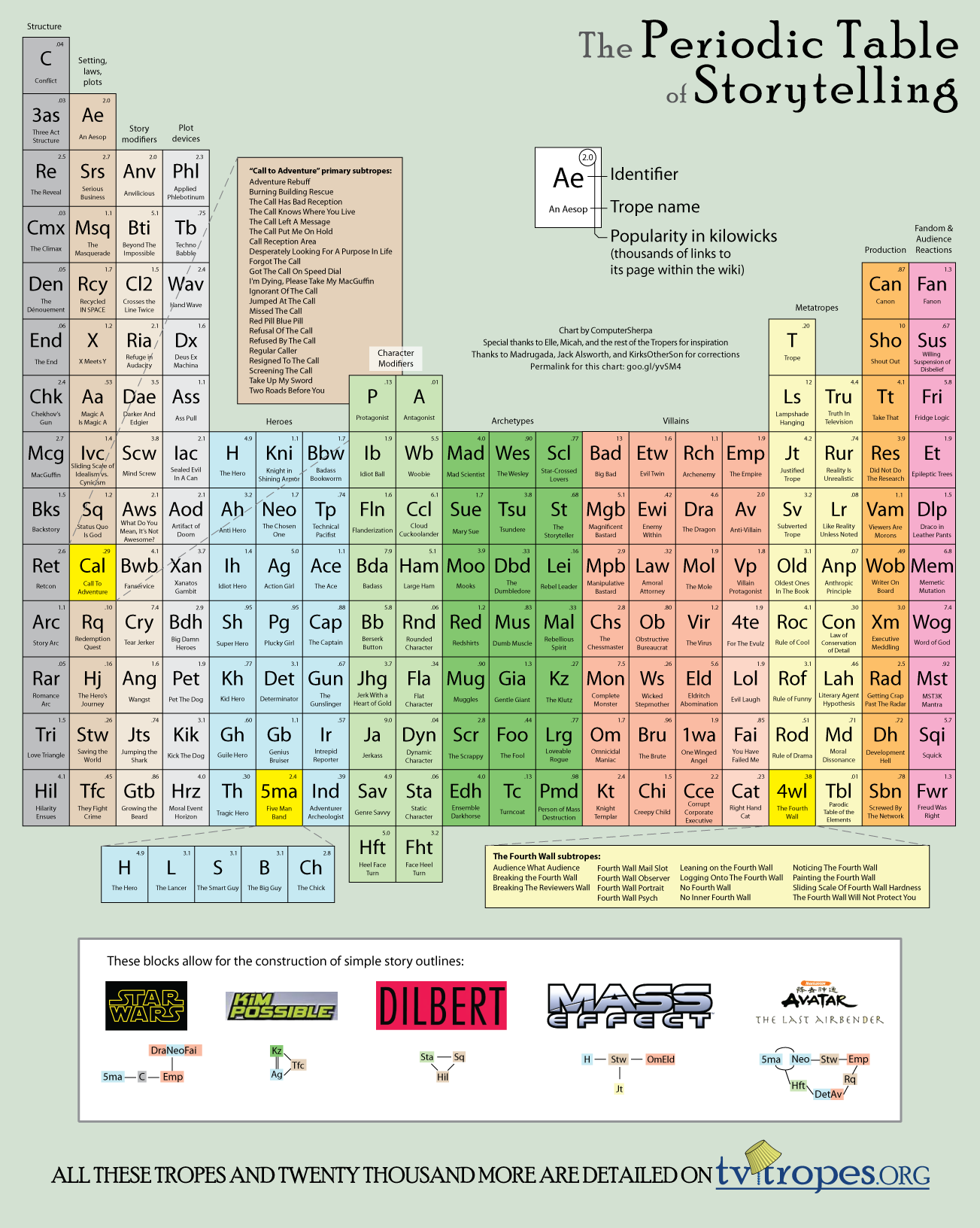
Awesome Conceptual Tool: The Periodic Table of Storytelling


So thanks to The Professor (my fiancée), here’s an absolutely amazing infographic that may just become my favorite outlining / conceptual tool. It’s the Periodic Table of Storytelling, which was posted on DeviantArt by ComputerSherpa, a second-semester art student. Check out the table below:

Periodic Table of Storytelling by ComputerSherpa

Periodic Table of Storytelling by ComputerSherpa, via DeviantArt

What makes this infographic so amazing is its ability to map out just about any story structure using its “atoms.” ComputerSherpa included some great example molecules that lay out some really well-known stories, and I might just start using molecules like that when I outline my own stuff. What I really need is a smartphone app that will let me search and model those kind of storytelling molecules on my phone. That would be really helpful.

In the meantime, lacking such a smartphone app, you can order a poster print of this here. The example molecules have been removed from the bottom on the poster (which I think is a shame), but I think it’s really cool anyway.

Narrative Voice as Mind-control: Thoughts on Manipulating Reader Perception


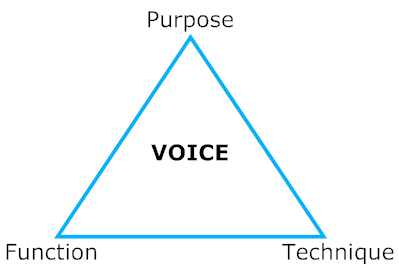
Voice: Purpose, Function, Technique

A Conceptual Framework for Narrative Voice

I’ve always considered voice one of the most important tools when writing alternate history, and over the past couple of weeks I’ve been thinking about how that tool really works (both within and outside the sub-genre).

There are probably as many valid descriptions of voice as there are writers, editors, and critics out there. For my part, I believe that voice has three components: its purpose, its function, and its technique.

The Purpose of Voice: Establishing a Relationship with the Text

The purpose of voice is to establish the reader’s relationship to the text. Different stories, different narrators, call for different relationships. Would Nabokov’s Lolita be as powerful if we weren’t sympathetically engaged with the monstrous Humbert Humbert? Would Doyle’s Sherlock Holmes stories be as effective if the narration were as coldly dispassionate as the detective himself? Voice – both in narration, and in dialog – establishes how we relate to a story. At its most basic level, it controls the emotional distance with which we perceive it, and is most powerful when wedded to the story’s themes.

Nabokov wants us to view Humbert Humbert up close and personal. The power of his book relies on juxtaposing our the intellectual horror at Humbert Humbert and the visceral engagement his voice engenders. Had Nabokov employed a distancing technique, for example making Humbert’s story epistolary, or telling it from the dispassionate perspective of a court stenographer, it would not have the resonance it does.

John Crowley in Little, Big uses voice to distance us at once from our reality, and the reality of the text. The lyrical, metaphoric voice he employs puts us in a liminal state, somewhere on the borders of what is, what was, and what might be. In this, the voice employed is fundamentally aligned with the book’s themes.

Olaf Stapledon in Last and First Men keeps the reader at arms length, so that we can view the events of his future history dispassionately, as if we were observing them from billions of years removed.

When Michael A. Stackpole employs a voice reminiscent of 17th century colonial texts in At the Queen’s Command it instantly links his book to that time in the reader’s mind.

The relationship created between us and the text is foundational in the act of reading. It sets the context for everything else, determining how we perceive a story’s pacing, how we engage with its characters, and how we identify its themes. In this sense, the purpose of voice transcends any individual sentence, or any paragraph. It is a combination of the voice’s expression in narration, in dialog, even in its epigraphs (shout out to @DDSyrdal for reminding me of this term!). But apart from its broad and abstract purpose, voice has a function within the story which is variable over the length of the text.

The Function of Voice: Manipulating the Reader’s Perception

I often think that it is the writer’s job to manipulate the reader, to take us on an emotional roller-coaster the author has designed. By influencing how we perceive events, settings, and characters, the narrative voice becomes the rail which guides us along the ride. It imparts the twists, falls, and rises. If well-constructed, it shouldn’t be noticeable (unless we’re looking for it). But if it’s shoddily put together, well…I’d rather not consider what happens when a roller-coaster comes off its rail.

Voice’s function can be modulated for specific effect. This is easiest to see in dialog, where each actor has their own voice, more or less distinct from the voices of other characters. Those differences exert a subtle influence on our perception of those characters. Consider the following exchange from George R.R. Martin’s A Game of Thrones:

“Boy,” a voice called out to him. Jon turned.

Tyrion Lannister was sitting on the ledge above the door to the Great Hall, looking for all the world like a gargoyle. The dwarf grinned down at him. “Is that animal a wolf?”

“A direwolf,” Jon said. “His name is Ghost.” He stared up at the little man, his disappointment suddenly forgotten. “What are you doing up there? Why aren’t you at the feast?”

“Too hot, too noisy, and I’d drunk too much wine,” the dwarf told him. “I learned long ago that it is considered rude to vomit on your brother. Might I have a closer look at your wolf?”

From his short, staccato sentences we get the sense that Jon is direct, straightforward. He answers the question asked of him, but by offering little additions he avoids being brusque. He asks direct questions, wanting to know the answers. By contrast, Tyrion Lannister’s dialog is more complicated. His first sentence is broken apart by prose narration, imbuing a meaningful pause that – were the text read aloud – might suggest either humor, or shock. His second sentence, with its precise list and brutally honest self-assessment shows us Tyrion’s precision and self-deprecation. His third sentence gives us further insight into both his sense of humor, and his relationship with his brother.

The entire exchange is used to manipulate us into liking both Tyrion Lannister and Jon Snow, though for different reasons. Even if we cannot articulate it, even if we don’t notice it at the first reading, we respond to Jon’s simple directness. And we appreciate Tyrion’s self-deprecating humor. And Martin achieves this subtle effect just using voice in his characters’ dialog.

Prose narration – descriptions of setting, of action – can similarly affect our perception of and emotional response to the story. Consider two brief passages, each describing the same actions (sorry for the quality of my example sentences – I’m coming up with these on the fly):

Version #1 Version #2
The rain-slick leaves left the tree like snowflakes, gently spinning to melt into the mud. Rain battered the leaves. Glop! Glop! Glop! And down into the mud.

Hopefully (if I’ve done my job right) the two example sentences establish an entirely different mood. The first is more laconic, gentler, quieter. While the second is harsher, more abrupt, and louder through the use of onomatopoeia. The events are identical, but the difference in voice puts the reader into a different frame of mind. Voice becomes the tool I use to control the reader’s response to a particular scene, passage, or sentence (even a particular word!). And like any tool, there are a variety of ways in which it can be applied.

Purpose and Function Applied: Techniques for Controlling Voice

The range of control that we choose to exert over voice lies on a spectrum. At one end is banally utilitarian prose – the bland monotone of “Dick and Jane run after the ball.” On the other end we find the inimitable mastery of Nabokov, whose fine-grain manipulation of voice makes its inner workings invisible to the reader. Most of us operate somewhere between these two extremes employing a variety of techniques that are universal:

Perspective as a Window to Voice
Every one of us uses perspective to imbue our story with voice, whether consciously or not. In terms of purpose, the choice between first, close third, omniscient third, or the rare second-person narration has an immediate and major impact on the reader’s relationship to the story.

First person narration – when executed well – earns the reader’s instant engagement precisely through its link to voice. The narrator is a character in the story, with their own perceptions, predilections, and foibles. They have their own way of seeing the world, a tendency to pay attention to certain aspects that others might not notice in the same way. One narrator might comment on people’s appearances. Another might pay closer attention to facial expressions. And just like a character’s personality should affect their speech patterns in dialog, the same affects a first person narrator. For example, in Lisa Yee’s excellent YA novel Millicent Min, Girl Genius the narrator (the titular genius) uses complex sentences, a refined vocabulary and sprinkles in a little Latin every now and again. Her defining characteristic – her intellect – is intrinsic to how the narrator’s voice is portrayed.

In first-person narration, we are generally locked into the narrator’s voice throughout the story. That’s the trade-off we make for building that super-close reader/narrator relationship. Close third-person narration trades a little more distance between the reader and the POV character, in exchange for greater latitude in vocal manipulation. With close-third narration, we can shift POV characters (typically at chapter or section breaks for decent narrative flow) employing different voices for different points of view, as well as make more gradual, subtle shifts in tone and mood within the confines of a scene. This facility to shift vocal strategy is a double-edged sword and must be used judiciously. Do it too often or too fast, and we risk either confusing the reader or putting too much distance between her and the characters. For a great example of this technique employed well, I recommend Tad Williams’ Otherland series.

The relationship between voice and distance is less clear-cut for omniscient third-person perspective. As the most emotionally distant of the perspectives, omniscient third may well suit our thematic or stylistic purposes. However, by requiring a consistent narrative voice throughout, omniscient third loses the vocal flexibility that close third enjoys. There are situations where this trade-off makes sense. For example, J.R.R. Tolkien’s Lord of the Rings requires an omniscient narrator and consistent voice to evoke its linkages to epic storytelling and myth.

Style and Structure as Voice
If we were to ask five writers to write one sentence describing something, we would inevitably get five different sentences. How those sentences are composed – how the writer employs clauses and adverbs and conjunctions and even punctuation – determine what is typically called the author’s “style” and represents one of the most influential aspects of voice.

Pick up any book from the 19th century. You’ll immediately see that the way 19th century authors put their sentences together differs dramatically from contemporary styles. When we say an old classic hasn’t aged well, what we are really saying is that the modern reader’s emotional response as controlled by the story’s voice differs from an original reader’s presumed response. The variegated, many-claused sentences that characterize 18th and 19th century texts have a distancing effect for the modern reader. Bulwer-Lytton is a great example of this at work. In his day, he was one of the most influential, most celebrated writers in the English language. Today, there are awards named after him that celebrate purple prose.

This is not to say that contemporary voices are simpler than their predecessors, or that such simplicity would be a good thing. Many excellent authors – John Crowley, Gene Wolfe, Gabriel Garcia Marquez, Jorge Luis Borges, to name a few – write lush, complex sentences. However their structure differs substantially from what came before. For one thing, contemporary authors adhere more strongly to the principle of “show, don’t tell.” Consider the following two sentences selected at random:

Sentence #1: “But they were entirely ignorant of what had passed; and their raptures continued with little intermission to the very day of Lydia’s leaving home.” Jane Austen, Pride And Prejudice, 1813
Sentence #2: “Then an expectant silence, followed by a firmer start, and the station wagon backed warily out into the drive, making two soft and delible marks in the wet leaves.” John Crowley, Little, Big, 1982

Both come from excellent books. I would in fact argue that the Crowley sentence is more structurally complex than the Austen. However, the voices are quite dissimilar: the Austen voice tells us that their raptures continued. It does not show us those raptures, nor does it provide any metaphor or analogy by which we can emotionally connect to them. The voice is – by design – at a remove from the emotional significance of the events. Austen’s voice leaves it to the reader to establish that connection, through the implications of certain facts dropped and hinted at: the “little intermission” and “to the very day”.

Crowley’s voice, by contrast, employs evocative imagery to show the reader a prosaic event. His adjectives, and the order in which they are placed all communicate an emotional significance (which may or may not be important). By calling the silence “expectant,” the start “firmer”, and the marks on the leaves “soft and delible”, Crowley anthropomorphizes insensate objects, imbuing them with emotions. The sentence describes no characters, yet we still have an arc that rises from expectation (expectant), to action (firmer), and descends through denouement (soft and delible).

The complexity of sentence structures is of course infinitely varied. However, stealing vocal tricks from other authors is a good idea and can lead to some truly impressive work. In her 1973 essay “From Elfland to Poughkeepsie” Ursula K. Le Guin calls Lord Dunsany “the First Terrible Fate that Awaiteth Unwary Beginners in Fantasy” – specifically because his mastery of voice and style is so inimitable and so frequently imitated. Lots of us fall victim to this trap (I know I’ve been guilty of it!), but this ability to imitate past masters, to emulate their voices and styles, is actually a skill for any writer. It broadens our vocabulary, adding new tools to our toolkit. Archaic voices have a place in fiction, as do Gothic voices, or Lovecraftian voices. Imitation is the finest form of flattery, after all, and a writer’s skill lies in deciding where to use which voice.

For example, The Phoenix Guards is Steven Brust’s homage to Alexandre Dumas’ The Three Musketeers. Of course, Brust’s story is an out-and-out fantasy, with dragons and semi-immortal elf-like people. But his plot structure has clear ties to the d’Artagnan romances and his sentence constructions echo Dumas’ voice flawlessly. Reading The Phoenix Guards today is an experience much like reading The Three Musketeers, and it is precisely because Brust not only built off of Dumas’ plot, but because he adopted Dumas’ vocal methods as well. Had he chosen to emulate only one facet (either the plot, or the sentence structures), the book would have rung off-true: somehow not quite complete.

As I’ve mentioned before, the best writers of alternate history and historical fiction employ such emulation to cement the reader in the time period depicted. Examples can be found in Michael A. Stackpole’s At the Queen’s Command, or Cherie Priest’s Dreadnought (see my reviews here and here).

But we can also have too much of a good thing. For example, in Freedom and Necessity Steven Brust and Emma Bull (otherwise, two masters of vocal technique) pull off their emulation too well. The combined effect of the novel’s epistolary frame and its flawless emulation of 19th century sentence construction create a sense that one is actually reading a genuine 19th century novel…despite the fact that it was written in 1997. Technically, it is a masterpiece of voice. However, I find that it establishes too much distance for the contemporary reader. The reader’s engagement with the events of the story is held at arm’s length, slowing the pace of what would otherwise be an amazing, exciting book.

The Invisible Voice
Voice is the ultimate mind-control, affecting how the story resonates with us, how we feel about the characters, and what we remember when the last page is turned. At its most impressive, it should be invisible. When we notice the voice, its influence on our responses and perceptions is lessened. I can’t think of anybody who has mastered voice more superlatively than Nabokov. His Lolita is the perfect union of purpose, function, and technique. No matter how many times I read the story, I still cannot figure out how Nabokov hooks me. I dream of finding the time to dissect his work word by word, sentence by sentence, paragraph by paragraph: to take it apart like clockwork and examine its movements and physics. Maybe someday I will. But until then, a more productive use of my time – and one which will probably get me farther – is to just imitate him. I’m sure anything I write won’t even approach the quality of his invisible voice (and I’m even more sure my practices won’t be fit for any editors eyes!), but by tracing over his lines maybe I’ll pick up a thing or two. And then when it’s time to apply those techniques, I’ll have some new and useful tricks up my sleeve.

What about you? How do you approach constructing and managing narrative voice in your own writing? What are some of the best-voiced books you’ve come across? If – like me – you’re looking for good books that use voice in interesting ways, below is the list of authors and books that I’ve mentioned in this post. I strongly recommend you pick up a copy from your local bookstore or library, and enjoy:
An Argument for Writing Characters You Don’t Like


I’ve written before about some of the differences between novels and short stories, but for the past several days one of those differences has been sitting in the forefront of my mind: character. With only several thousand words to work with in a short story, there just isn’t space to really develop more than one character. But a novel needs at least a handful of well-defined characters, and the more complex the story’s plot, the more complex and varied the characters need to be.

My current WIP is more complex than any of the other (even novel-length) stories I’ve written before. With a Byzantine plot swirling with clockwork diplomacy, revolutionary intrigue, assassination, and Great Powers espionage, I’m juggling a more varied cast of characters than I’ve managed before. It’s hard work keeping their motivations straight, their voices distinct, and their reactions true. And while I would love to have coffee or play a game of chess with some of these people, others I’d want to throttle. And that brings me to the crux of the issue that I’ve been thinking about for the past week or two: how to tell a story from the perspective of a character that I don’t like?

Unsympathetic perspective characters are nothing new. They span a spectrum from the truly vile who we come to like despite our best instincts, like Vladimir Nabokov’s amazing Humbert Humbert (Lolita). Then there’s Charles Dickens’ amoral but ultimately redeemable Sidney Carton (A Tale of Two Cities). More true to life, the real Emma Goldman’s autobiography Living My Life comes across as unsettling today. And Gregory Maguire spends pretty much all of Wicked: The Life and Times of the Wicked Witch of the West humanizing an erstwhile villain. And finally, Nnedi Okorafor’s powerful Onyesonwu (Who Fears Death), whose heart is in the right place, but whose personality often made me gnash my teeth in frustration.

Each of these authors uses a different technique. Nabokov fills the book with Humbert Humbert: the monster in a very real sense transcends the role of narrator or memoirist. Every single word, every punctuation point, and every pause between sentences is filtered through the all-too-human mind of Humbert Humbert. By drawing us in through such a unique and compelling voice, Nabokov slides in Humbert’s vile nature almost surreptitiously. It is subtle, and oily, and all too awe-inspiringly impressive. Thankfully my current WIP lacks an unrepentant, irredeemable Humbert-esque villain, and so I won’t have to try pulling this off (Yet! I’ve got another book I want to write someday where I’ll hopefully give it a shot…just because it’ll be a lot of fun to try!).

But the unsympathetic Sidney Carton, the zealous Emma Goldman, the tragic Elphaba, and the quick-to-anger Onyesonwu all have at least one central trait fundamentally tied up in their very nature that shines pure and noble. The traits might vary across the characters, and the authors may choose to present them using different techniques, but for all of their pettiness, their villainy, their zealotry, and their fury there remains something inherently noble about them.

Dickens paints Carton as a professionally-stunted, self-indulgent alcoholic. We can see his nobility in his reaction to Lucie Manette, and in his self-deprecating gallows humor. He is drawn in stark opposition to his double: Charles Darnay, whose inner nobility is readily apparent and who fails to evidence the slightest doubt in himself. By showing us Carton’s struggle, by showing us his doubts, Dickens makes us identify with Carton and look past the superficially unsympathetic traits: his biting humor, his self-pity, his self-indulgence. He is the underdog, and we want to give him a firm kick because we know that Carton is worth more, even if he does not realize it himself until the very end.

Emma Goldman – an actual historical personage – was as complicated as any real individual could be, and I believe her positive and negative traits stem from the very same root. Her autobiography paints a picture of an unsettling and strangely compelling zealot. Throughout her amazing life, she was an unrepentant revolutionary: mere facts and science would not get in the way of her convictions! She practiced what she preached, both politically and in her personal life. She forced herself to live true to her mission, even when it caused her much heartache. This unwavering belief in her revolution – however misguided, misattributed, or wasted – offers her a nobility that her (more hypocritical) contemporaries lacked. Goldman remains an unsettling person, and while I cannot agree with her views, I can respect the lifelong commitment that speaks so clearly through her words.

Maguire shows us the Wicked Witch’s perspective in Wicked. He takes pains to show the development of a conflicted character, with noble intentions that just work out unfortunately. Elphaba’s primary flaw is that she has human failings, of which her quickness to anger and her father-issues are just two examples. In many ways, I always found the book to be almost a revisionist apologia for the Wicked Witch, but Maguire makes Elphaba’s tragic rise and fall compelling precisely by showing us her internal rationalizations and the noble intentions that went so wrong.

And Okorafor introduces us to Onyesonwu, whose intentions are noble, whose heart is pure, but whose failing is simply that of being too quick to anger. Alone of the characters I’ve mentioned in this post, I do not believe we are ever for a moment meant to believe her unsympathetic. Okorafor makes us feel deeply for Onyesonwu. We meet her as a young girl, and we are shown painfully the development of her defensiveness character. We understand how she came to have that defensiveness. We understand that her anger is a part of her, and that in fact it helps her with her magic. I consider her “unsympathetic” simply because of how infuriating I found her. I wanted to tell her to get a grip: that her anger would hurt more than it helped. But the root of my frustration with the character was my understanding of what had made her: through an understanding how she developed into the strong, angry young woman she became, Okorafor grounded Onyesonwu’s “unsympathetic” traits in sympathy: she made the character so sympathetic that I recognize her flaws and want to help her learn to deal with her flaws.

This is a technique frequently used in YA (I suspect it may come naturally to Okorafor, considering her earlier experiences in YA). Maybe it means I’m getting old, that the little foibles of human emotion that are so frustrating to me come so naturally to teenagers. Harumph. Those kids should get off my lawn. Nonetheless, I can appreciate it when an author pulls it off the way Okorafor has, and I can also see how introducing that flaw was natural to the character, given her history. The net result makes me more invested in the character, thus raising my engagement with the whole story.

And that – I think – is what unsympathetic perspective characters ultimately do. They make us invest more in the story, either because we root for the underdog (Carton), respect misguided nobility (Goldman), lament tragic failure (Elphaba), or sympathize with the source of the characters’ flaws (Onyesonwu).

What are some of your favorite unsympathetic characters? And how did their authors make them appeal to you?

Why bother with science fiction, fantasy, or horror?


Article first published as Why Bother with Science Fiction, Fantasy, and Horror? on Blogcritics.

“That stuff’s for kids.”

“Elves and trolls and aliens are silly.”

“None of it’s real, anyway.”

“It’s all escapism.”

“Those are boy books.”

Many people wouldn’t be caught dead holding onto The Hobbit, or Stranger in a Strange Land, or The Haunting of Hill House. Of course, everyone’s entitled to their own opinions. Not everyone is going to enjoy SF, some people won’t get a kick out of fantasy, and others may shudder at the very thought of horror. That’s a question of taste, and really who am I to argue with individual’s tastes? But saying that a particular genre isn’t to your taste is very different from blithely discounting the entire oeuvre. The latter is like a toddler insisting that they don’t like a dish they’ve never tasted before.

Many grown-ups wave genre fiction away by saying that it’s for kids. I get it: it’s an easy argument, really. Society’s perception already pigeon-holes it, so playing to that misconception is an easy out. And history – genre’s roots in the pulps, the Victorian fairy tales for children, etc. – all lend it credence. But on closer examination, this argument falls apart on several levels:

On the one hand, it is factually inaccurate. No one can seriously argue that Ursula K. Le Guin’s The Dispossessed: An Ambiguous Utopia, Frank Herbert’s Dune, or John Scalzi’s Old Man’s War are books for children. Thoughtful kids might get some enjoyment out of the adventure, but the themes these books wrestle with are definitely of concern to adults. This applies across the genres, where at least since the 1950’s the majority has been written with an adult audience in mind.

On the other hand, this argument forgets that kids are much more discerning readers than adults. Consider how easily kids see through weak plots, how quickly they stop caring about milquetoast characters, how they lose interest when the pace sags. When was the last time you saw a ten-year old enjoy a Saul Bellow book? If the purpose of literature is to entertain, and to broaden our understanding of the human condition, then I think we’d be hard-pressed to find books that execute better than middle-grade and YA fiction. Consider Madeleine L’Engle’s A Wrinkle in Time, or A.A. Milne’s Pooh books, or J.M. Barrie’s Peter Pan. They’ve sure got some fantastical elements to them (teleportation to alien planets, talking animals, and Never Never Land respectively), don’t they? But they employ fantasy as entertainment and to highlight themes that speak to our hearts. Kids books – and all genre books, whether targeted to kids or not – use fantastical elements as tools to highlight their themes. Bear in mind that kids see right through pretension, and have no patience for it.

One can argue that elves and ray-guns and monsters are silly, unrealistic, and as a result offer no value. They might be entertaining, but who cares about entertainment? All of us, I’d wager. We read books, watch TV, listen to music to be entertained. Sure, we also want to have our horizons broadened but first and foremost we want to be distracted from the concerns of daily life. One can sneer at such escapism, but escapism relaxes us and makes us more productive. How is that a bad thing?

I’ve seen folks denounce genre fiction to a room full of fans as “mindless entertainment” – strangely enough, I’ve never seen anyone say the same about watching football at a sports bar. Entertainment in and of itself has value, and genre fiction simply employs a bigger toolkit than “mainstream” fiction. Using monsters to provide a concrete visualization of humanity’s dark side is a time-honored storytelling tradition that dates back to the first fireside ghost stories. If we reject genre for employing such tools, then so too must we reject classic myths, legends, and folk tales.

Sure, it’s not real. And there are plenty of people out there who don’t like fiction. Fine: if you only like reading non-fiction, more power to you. But if we accept that fiction of any kind has inherent value, then so too must all flavors of fiction. Why would realistic fiction have value and fantastic fiction not? Do George Orwell, Aldous Huxley, H.G. Wells have nothing to add to our understanding of humanity? All three wrote plenty of realistic fiction as well as speculative fiction. What are they remembered for?

The last argument I find most pernicious, since it continues to consistently crop up in circles where it shouldn’t. Just several days ago, Ginia Bellafante published a review of HBO’s ‘Game of Thrones’ in the New York Times. Putting aside her comments on the actual show, she patronizingly fobbed off George R.R. Martin’s bestselling Song of Ice and Fire series (and all of fantasy) as “boy fiction”. I guess twelve year old boys have much greater buying power than I thought. After all, the latest installment (A Feast for Crows) debuted at #1 on the New York Times Bestseller list. Such misogynistic disdain for genre fiction is equivalent to saying that only women enjoy romantic comedies. I’m a red-blooded, steak-eating, bacon-enjoying American male, and like many others I enjoy a good rom com with the best of ’em!

Science fiction, fantasy, and horror is enjoyed by people of all ages, all genders, all religions, all backgrounds. Yes, it is entertaining. But like Whitman, it contains multitudes. There’s something for everyone’s tastes on the genre shelves: Looking for Jane Austen-esque comedy of manners? Check out Jo Walton’s Tooth and Claw, or Mary Robinette Kowal’s Shades of Milk and Honey. Looking for beautiful magical realism? Check out Jorge Luis Borges’ Labyrinths or Italo Calvino. In the mood for fast-paced quasi-corporate thrillers? Take a look at William Gibson’s cyberpunk (Neuromancer, Idoru). Want some light-hearted parody? Pick up some Terry Pratchett (any of the Discworld novels) or Douglas Adams (The Hitchhiker’s Guide to the Galaxy). Want blistering social satire? Pick up James Morrow’s City of Truth or Walter Tevis’ Mockingbird. Want political intrigue? Pick up George R.R. Martin’s Game of Thrones. In the mood for some thoughtful, soul-searching philosophical musings? Read some Samuel Delany, or Ursula K. Le Guin.

The science fiction, fantasy, and horror genres do as much as the mainstream literary genre. Yes, mainstream literary is a genre. In many ways, its reliance realism as a storytelling tool is one of its defining characteristics. Mainstream literary fiction and speculative fiction have the same job: to entertain and to elucidate. Rejecting the fantastical genres just because they have a greater variety of screwdrivers and hammers in their narrative toolbox is silly.

Would you do the same when hiring a plumber?

A Brief Post on Dystopia


I’m really sorry for the brevity of this post, but I’m traveling in Europe on business this week and my insane and constantly-changing travel schedule has forced me to do a much shorter post today than I normally do. I’ll try and make it up to everyone with another more in-depth post later this week. In the meantime, here’s some brief thoughts on dystopias:

The folks at Tor.com are celebrating a week of dystopia (I detect some irony in this, considering it’s the week when taxes are due in the US). As a result, they’ve got a lot of great bloggers and authors writing about dystopia as sub-genre of SF, or about particular examples of dystopian media. It’s early days yet, but already there have been two really interesting posts that I’d like to call attention to:

The first is an essay by Jo Walton where she asks Where does dystopia fit as a genre? She contends that the “classic” dystopian novels like Brave New World, We, 1984, etc. are not really science fiction. She readily admits that they have science fictional elements, but in both the essay and comment thread she makes the case that Huxley, Orwell, and Zamyatin were not writing science fiction because they weren’t readers of science fiction, the majority of their other (non-dystopian) writing was outside the realm of science fiction, they weren’t writing in their contemporary science fiction tradition, and they were relying on techniques more commonly found in mainstream literary writing than in genre.

She has a valid point that these progenitors of dystopian tradition are clearly different from their contemporary SF peers. In the 1920’s and 1930’s, science fiction (or “scientifiction” as some contemporaries preferred) was primarily confined to the pulp magazines, which were filled with stories by authors like E.E. “Doc” Smith, Theodore Sturgeon, John Wyndham, Clark Ashton Smith, Edgar Rice Burroughs, and H.P. Lovecraft. Primarily under the influence of legendary editors Hugo Gernsback and later John W. Campbell the pulps had a significant focus on technology and predictive extrapolation, and with a predominantly young, male audience they tended towards more commercial adventure than satire.

The dystopias, however, are all first and foremost books of thought. Whatever “adventure” they contain takes a back seat to their themes. In that sense, it is perfectly fair to say that the early dystopians diverged from contemporary SF tradition. But does the fact that they diverge mean that they’re not SF? Or that they should be lumped with their “mainstream” contemporaries like Sinclair Lewis? I don’t think so. I think the early dystopias enriched science fiction by showing that technological extrapolation and world-building can be applied to philosophical and sociological themes. Fun as the pulps might be, most 1920’s and 1930’s SF wasn’t particularly meaningful.

I don’t believe one needs to read science fiction in order to write it. Huxley, Orwell, and Zamyatin all wrote amazing works of science fiction, set on certain technological precepts and then extrapolated them to their logical conclusions. That act is what makes their work science fiction. So what if there isn’t a single raygun or spaceship in any of the books? That fact shouldn’t matter. So what if they never wrote another piece of science fiction? That in no way diminishes the science fictional work that they did.

Okay, that’s enough of a rant out of me for now. I promised this would be a short post, and so I’m not going to go on at length on this. I’d love to hear everyone else’s thoughts though: are those dystopias science fiction? What about contemporary dystopias like Suzanne Collins’ Hunger Games, or Paulo Bacigalupi’s The Wind-up Girl? Walton seems to suggest that dystopia is more of a mainstream tradition than a genre one, but is that the case?

The second essay that I’d like to draw your attention to is one that’s a lot more fun: are you aware that the Jetsons is a dystopian cartoon? I certainly wasn’t, until I read this fun essay from Clay and Susan Griffith. What I found really interesting is how they argue that the 1980’s saw a significant shift in the United States’ perception of the future: from the up-beat mechanistic futurism of the 1960’s, to the down-trodden perils of technology in the ’80s.

This struck a particular chord with me because the day I read this essay, I had just finished reading Walter Tevis’ Mockingbird, a Nebula-nominated dystopian novel first published in 1980. The book is amazing, simply amazing: I might put up a more complete review of it later this week if I can find some free time. But it perfectly captures that transitional moment from Jetsonian push-buttan robotics to the bleak, soulless dehumanization that came to dominate in the ’80s (especially in movies like Blade Runner, The Terminator, 2001, etc.).

Since I’ve got to dash to another meeting, let me leave you with a question: what do you think about the 1980’s changing perception of the future? Was the perception changing? Has it changed since?

Some Ruminations on “Geek Culture” in Response to Chris Braak’s Post


Over on io9, Chris Braak put up a thought-provoking rant where he seems to compare the culture of genre fandom (including fan fiction, cosplay, conventions, etc.) with mainstream literary culture, and the culture of broader mainstream (read: non-genre) America.

There’s a lot of hyperbole in the post, but he seems to make two key points – each of which I have to disagree with.

When Chris can’t find examples of Shakespeare cosplay or fanfic, he concludes that Shakespeare, Melville, Proust, Faulkner, Tom Wolfe, etc. are all dead and contribute nothing to our cultural growth. As a consequence, he claims that Geek Culture is the “ONLY legitimate form of American culture” (the caps are his). I suspect that part of this is hyperbole for rhetorical effect, but I see a basic problem in the logic: it conflates community behavior with culture itself, and that’s simply incorrect.

Kayan Woman with Neck Rings

Kayan Woman with Neck Rings, via Wikipedia

Consider the Kayan Lahwi, a people indigenous to Burma. The Kayan women are famous for wearing brass neck rings which over time reshape there clavicles and compress their rib cages, giving them the appearance of elongated necks. Most people in the United States don’t wear neck rings. Does that mean that US-residents don’t have culture? Or that the Kayans don’t?

Of course not. All it means is that each of these two communities expresses its culture in different ways. Fashion, visual arts, writing, dance, and behavior in group encounters are all expressions of culture. In “Geek Culture” we may dress as super-heroes or anime characters, but is that in any way “more cultured” than a Maasai tribal dance?

Cosplay, fan fiction, conventions, etc. are all ways for us to identify ourselves as part of a community with whom we share common interests, perhaps values, etc. We participate in that community to have fun. Other communities have different ways of doing the exact same thing. That does not mean that genre fandom’s methods of expression are “more legitimate” than those of Melville fans. The fact that Melville fans don’t grow massive beards, or Shakespeare readers don’t wear ruffs, or Van Gogh lovers don’t slice off their ears tells us absolutely nothing about the cultural value or currency of these artists. The only conclusion we can draw is that the Melville/Shakespeare/Van Gogh communities express themselves differently than genre fandom. And the closest thing to a credo I’ve found in genre fandom is that different does not necessarily mean bad.

As individuals, and as a society, we are vast and contain multitudes. I don’t need to wear a ruff to be influenced by Shakespeare in my own writing. I don’t need to slice off my ear to paint a beautiful painting (although, considering my utter lack of painting skills it probably couldn’t hurt). Shakespeare and Melville aren’t “dead” because their influence continues to percolate through every contemporary creative endeavor. Why do we still read Shakespeare? Because they tell us to in school? That’s a major over-simplification. Shakespeare still provides us with new and interesting insight into ourselves and our society. We don’t need to write Shakespearean fanfic to benefit from that. Genre creators who haven’t been influenced by past masters are thin on the ground. We all stand on the shoulders of giants, after all.

Chris goes on to say that contemporary genre works will stand the test of time better than contemporary mainstream literary works (which are also a genre, BTW). None of us has a (functional) crystal ball, and so that prediction may even be correct. In all honesty, I actually agree with that prediction. But that’s because I believe that a greater proportion of SF/F/H works have relevant things to say about the human condition. That’s a result of the quality of the creative products: it has absolutely nothing whatsoever to do with the community behavior of its creators.

Where are the massive epic science fiction series?


I’ve really been enjoying the invective-laden “debate” between Sam Sykes and Ari Marmell over at Babel Clash this past week. Their discussion, essentially on “standalone fantasy novels” versus “single-story epic fantasy series” raised an interesting question in my mind. With door-stopper tomes so common in fantasy, why does fantasy’s cousin science fiction not have similar Chihuahua-killers?

It’s hard to think of contemporary fantasy without the likes of Robert Jordan, Terry Goodkind, David & Leigh Eddings, George R.R. Martin, Brandon Sanderson, Patrick Rothfuss, Steven Erikson, Brent Weeks, etc. There’s quite a bit of commonality across these authors: first, they have written (or are writing) series telling a single story across more than four books, which take up entire shelves at the bookstore, and where each individual book is heavy enough to weigh down a tent.

The last thirty years in fantasy can generally be described as giving us longer series, and longer individual titles within those series. Back in the 1960’s and 1970’s, the Tolkien-inspired, 300-page apiece trilogy was the general rule. In the 1980’s, David and Leigh Eddings gave us the quintet (where again, each title was about 300 pages). In the ’90s, Robert Jordan, Terry Goodkind, and George R.R. Martin gave us the N-teen volume epic series, with each title clocking in at 600 – 1000 pages. In the 2000’s, we have a fresh bevy of fantasists like Brandon Sanderson, Patrick Rothfuss, Brent Weeks, and Steven Erikson continuing the process. Where are science fiction’s gargantuan multi-volume epics?

If we can generally say that over the last thirty years, a significant portion of fantasy has used (a) more books, and (b) longer books, to tell a single story, why has this trend not appeared in science fiction? Sure, science fiction has its share of series. But these series tend to be trilogies or duologies (with a very rare quartet). Each of the novels in best-selling “series” by authors like Alastair Reynolds or Iain M. Banks is a standalone title, sharing a universe with its siblings, but little else. So…why is this?

I’ll be the first to say it: I don’t know. I don’t have an answer, although I do have some thoughts on narrowing down the cause. The way I see it, the reason that science fiction hasn’t expanded the way fantasy has can be laid at the feet of one of four actors in the process: the readers, the writers, the publishers, or the stories.
Saying that “science fiction readers are different from fantasy readers” doesn’t fly for me. Sure, the two audiences differ. But there is very significant overlap between the two, and, fundamentally, people are people. The drive to lose oneself in a fantasy universe applies just as strongly to a science fictional universe. That’s one of the many reasons why Iain M. Banks’ Culture novels are so popular, as are Reynolds’ Revelation Space novels or Larry Niven’s Ringworld. So I don’t buy any argument that says “readers of science fiction wouldn’t like it.” To me, that’s the equivalent of someone in 1965 saying that readers of fantasy would never accept a quintet. Time and time again, readers have proven such accepted wisdom wrong.

So if the readers aren’t at fault, what about the writers? Are science fiction writers too good to produce what some would call bloated epics? Or – to apply the flip side of that coin – are they too limited in their outlook to conceive of a story/universe on so grand a scale? I think the answer to both questions would have to be “no.” Science fiction writers are just as talented – and just as fallible – as their fantasist counterparts. Saying that there are no multi-volume, large science fiction epics because of the writers is too simplistic. Nature and publishing abhor a vacuum, and sooner or later a new author would come along and write one. After all, the fantasy genre didn’t typically expand beyond trilogies until the 80’s. And the door-stoppers didn’t show up until the 1990s. It all starts somewhere.

So maybe the fault lies with the publishers. Here, my natural cynicism makes me want to say “Aha!” and blame editors and acquisitions departments. But again, I fear that’s too much of an oversimplification. If at some point an author tried to write a multi-volume science fiction epic, then sooner or later some editor would take a chance on it. And if it did well, then others would quickly follow suit. That’s the nature of the industry (Vampires, anyone? Zombies?). So I don’t think this is a case of publishers not wanting to publish books like that because they don’t want to take a chance. Eventually, someone would try it out and a new trend would start.
If the reader, the writer, and the publisher aren’t at fault, is there something intrinsic to the science fictional story that precludes a 10+ volume series? Is fantasy somehow exceptional as a genre in that it either enables or requires such series where other genres do not? If the story is to blame, then the fault must lie in its setting, characters, or plot.

We fantasy fans talk about these giant series in terms of losing ourselves in a fictional universe. We love to take our time exploring the richly imagined lands of Westeros, or Genabckis, or Randland. But science fictional settings can be just as richly imagined, just as Other, as fantastical ones. What’s the difference between Arrakis and Westeros? Or the universe of the Culture and Randland? From a technical standpoint, the real differences are window-dressing: spacecraft and ray-guns rather than galleons and swords. Sure, that’s flippant and over-simplified, but any science fictional world is just as fantastical as a fantasy world. This applies just as much to space opera, sociological SF, the future (whether post-apocalyptic or not), time travel stories, etc. The quality of the world-building rests in the author’s hands, and science fiction presents just as much opportunity for involved and interesting world-building. I don’t believe that fantasy settings do something that science fictional settings don’t (or vice versa). They’re settings, imagined universes with rules and actors and factions as complex or as simplistic as the author wishes to make them. Alien is alien, whether they carry swords or blasters.

So what about the characters? Huge fantasy series are replete with a dizzying cast of characters – so much so, that the appendices to keep dramatis personae and their factions straight are a cliché feature. Typically, these large casts effectively comprise different protagonists who we follow at different points in the story. Farah Mendelsohn makes a great point in her Rhetorics of Fantasy, which – if I may paraphrase somewhat – suggests that this is really a shell-game: It takes what are essentially separate epic plots, and disperses the reader’s attention across them. We think that there’s one complex story going on, but really we’re watching ten or twelve simple stories happening in parallel. This isn’t a bad device, and it is one which I enjoy very much when done well. But why does this device appear in fantasy, but not in science fiction? A complicated cast of deeply personified characters is not unique to fantasy. Ever read Victor Hugo? Or Tolstoy? Or Iain M. Banks? There is no reason why this technique, or why this character structure, cannot apply in any genre.

So that leaves the science fiction plot as the remaining culprit. Perhaps there is something in science fiction’s plots that precludes such epic myth-making. I’ve read quite a bit of theory on fantasy, and rather a lot of excellent research on the morphologies of fantasy plots (I cannot recommend Mendelsohn’s Rhetorics of Fantasy enough). But I haven’t come across much morphological research on science fiction. When I think about all of the criticism of SF that I’ve read over the years, I can’t think of a single piece of criticism that tries to postulate a morphology of plot structures in SF. There are many great books on the history of the genre’s evolution, on the different themes that crop up in SF, and even on the techniques by which these themes are communicated. But I can’t find anything that deals with the sequence or structure of science fiction narrative.

So rather than try and come up with some back-of-the-envelope set of structures based on the books I can remember right now, I’ll instead leave you with three questions:

1 First, does science fiction have broad categories of plots the way fantasy does?
2 If it does, then do those categories somehow preclude the development of multi-volume door-stopper epics in science fiction?
3 And if not, then why aren’t we seeing series like that get published?

The Desperate Horror of Suburbia: Thoughts on Shirley Jackson


A couple of months ago, I wrote about different modes of horror, and while enjoying the Library of America collection Shirley Jackson: Novels and Stories, it got me thinking about how Jackson employed (and mastered) the art of identification in her stories.

The Library of America collection, selected by Joyce Carol Oates, contains forty-nine of Jackson’s stories. Except for the previously-unpublished works, the collection effectively spans the entire twenty-year period in which Jackson wrote before her untimely death in 1965. The stories range in length from what today would be considered flash fiction (like the two-page Colloquoy) to Jackson’s short novels (including the classic The Haunting of Hill House). The book starts with Jackson’s earliest stories that were originally collected in The Lottery and Other Stories, and when I think of Shirley Jackson, these are without a doubt my favorites.

As a genre, horror has a great many tropes: moonlit streets, foggy nights, sexy gentlemen with a dark side, the unrelenting psychopath, et cetera, et cetera, et cetera. However, most of the stories that rely on these tropes tend to either utilize revulsion or dread to induce the delightful frisson of horror. For folks who look for their horror to be splatterpunk blood-fests, or for sexy vampires lurking languidly in the night, most of Shirley Jackson’s work would disappoint. The reason for that is that she utilizes every tool of the horror trade like a scalpel, and in her earliest works the tool she most relied on was identification (or realization).

Most of the stories collected in the original The Lottery and Other Stories (and which are now reprinted) have zero supernatural elements, depict no violence, and arguably lack the thriller-tension that most readers think of as horror. If it were not for the subtle manipulation of the reader’s morality, these stories would be utterly forgettable slice-of-life or Americana stories, accurate, in their representation of small-town life but insignificant as to the broader human condition. However, what makes Jackson unique in my view is the way that she can ellicit abject horror and revulsion from these utterly plebian events.

Consider Flower Garden, which on its face tracks the musings of a young Mrs. Winning, a 1940′s housewife, as she goes about her life in a small country town. She interacts with people like her neighbors, the grocer, her family. Shortly into the story, we learn that a new woman (a Mrs. MacLane) has moved into town from the city, and that she has a son of an age with Mrs. Winning’s boy. However, as the story proceeds, Jackson shows us the underside of small-town life, with its small-town prejudices. As the newcomer forms a friendship with one of the town’s few African American families, the “respectable” portion of small-town society begins to draw away. What Jackson does amazingly in this story is in the way that she portrays Mrs. Winning’s rationalization of their ostracization. Mrs. Winning isn’t guilty of any such prejudice: no, that’s only for more small-minded people. But ultimately, she adopts a similar stance to the other townsfolk and effectively isolates poor Mrs. MacLane in this new community. The story works because Jackson makes us care – deeply – about the characters, both Mrs. Winning (who we know isn’t all bad) and Mrs. MacLane (who is the victim). Jackson accomplishes this using three tools:

  • Keeping Her Point of View Character Oblivious to the Theme. This is a technique which Jackson uses frequently in the best of her stories. In Flower Garden, Mrs. Winning is completely oblivious to the prejudice that is going on around her. She notices that her relationships in town are weakened by her friendship with Mrs. MacLane, and so she begins to avoid her friend without even drawing attention to it. But when eventually she does notice it, she rationalizes it such that she never recognizes the moral choice that she has already made. Because we – the reader – are aware of this choice, our emotions are engaged and our minds focused on the theme: it’s like watching a movie where you want to shout at the heroine “Don’t go in there!” because you know something she doesn’t. Jackson elicits the same emotional response, only without the knife-wielding psychopath.
  • Employing Minutia to Ground the Reader. Jackson takes much time to show us the petty, inconsequential elements of Mrs. Winning’s daily life. Her conversation with the green grocer, the fact that she went to high school with him, her relationship with her mother-in-law: these facts have zero bearing on the primary plot. However, they lay the foundation for Jackson’s character, and for the broader community. As such, they establish the “feel” of the world Jackson paints for us. And it is a world that anyone who has lived in small-town America (even seventy years later) would instantly recognize. The reader places themselves into the nameless small-town, precisely because the prosaic details are so true-to-life and believable.
  • The Tragic Triumph of Moral Failure.When we read Flower Garden, we know what the “right” outcome should be. We know – morally, intellectually – that the community’s prejudice against Mrs. MacLane is abhorrent. However, in the end, it is their prejudices – and Mrs. MacLane’s own inverted prejudices against the small-town set – which triumph. The story ends tragically, not in the dramatic sense of everyone on stage dying, but rather in the Aristotelian sense of characters changing state from good to bad.

There is nothing to suggest that Flower Garden is a horror story: there is no violence, no fear, no physical tension of any kind. There are no ghosts or other supernatural elements. Yet it leaves the reader horrified at the underlying truth dramatized through the story’s actors. It ensures that we not only understand the author’s message but that we recognize it as an inevitable (and morally repugnant) consequence of human nature. And nowhere does Jackson come out and spell this message out for us: it is in the pauses between her characters’ thoughts, in the punctuation of her sentences, in the selection of her words. The story leaves us uneasy because it is all too easy to see ourselves in it.

Jackson applies this pattern in many of her works, and I find that it is put to best effect in her short stories. There, she evokes similar sensations of horror, disgust, revulsion, and tragic catharsis but with admirable economy. In her later novels, Jackson employed more supernatural (or ambiguously supernatural) elements, which often serve as sleight-of-hand to provide us a cozy rationalization for the real cause of our horror. Of course, even this interpretation is likely an over-simplification because even in her “supernatural” stories, Jackson leaves everything delightfully ambiguous: perhaps we need to blame our terror on ghosts and demons because the alternative – that humanity itself produces such horror – is too unsettling.

For anyone looking for an excellent author – whether a literary/mainstream author, or for one of the greatest horror writers ever to put pen to paper – I strongly recommend Shirley Jackson. Having come to her stories some sixty years after they were first published, I often wonder how my modern values affect my interpretation. I suspect, however, that the themes that Jackson addresses are universal and timeless. The foibles of humanity, the petty iniquities of small-town life, the dark secrets that lurk unspoken in our hearts: these never go away. It is easy to paint a black and white moralizing picture and say a character’s actions are morally repugnant: that does not mean those actions are unrealistic, or that they are not presented in cathartic and artistic fashion. Jackson offers no easy solutions. In fact, she doesn’t offer any solutions at all. But she raises questions that go to the heart of what we value as individuals, as a community, and as a broader society. That alone makes her worth reading. The fact that her works are fun, and unsettling, and in some cases absolutely horrifying, makes it that much better.

REVIEW: Second Sight by Cheryl Klein


Second Sight by Cheryl Klein Title: Second Sight
Author: Cheryl Klein
Pub Date: March 11th, 2011
Chris’ Rating (5 possible): 1 point 1 point 1 point 1 point
An Attempt at Categorization If You Like… / You Might Like…
A strong reference compilation on writing from an experienced children's book editor.

Several years ago, The Professor (my fiancée) introduced me to children’s book editor Cheryl Klein’s blog, where I discovered several years’ worth of thoughtful, analytical, and insightful talks she has given on the craft of writing and its intersection with the craft of editing. Having found her thoughts interesting, I was excited to learn that Klein is now releasing a self-published, crowd-funded (via Kickstarter) book on writing entitled Second Sight. I was lucky enough to get my hands on a review copy not too long ago, and found it be challenging, insightful, and professional in all the right ways. This is a book for people seriously interested in writing as both a craft and a career: people looking for touchy-feely encouragement or platitudes on the “writing life” need not apply.

From my perspective, this is high praise. What I look for in books on writing is a serious discussion of the techniques used to construct effective, powerful, and publishable fiction. Whenever I read a new book on writing, I am always comparing it to the books on my “Writing on Writing Shelf,” which is primarily stocked with classics like E.M. Forster’s Aspects of the Novel, John Gardner’s The Art of Fiction, Ayn Rand’s (very different) The Art of Fiction, or Ursula K. Le Guin’s The Language of the Night: Essays on Fantasy and Science Fiction. Klein’s Second Sight is like these excellent books in many ways.

Second Sight demands a modicum of pre-existing knowledge. Someone still struggling to grasp the basics of writing (figuring out what a plot is, understanding the difference between point of view and voice, etc.) will likely find this book intimidating. An intermediate writer (as I like to consider myself) – who has been working at the craft for several years, who has a finished (though not yet published) novel or two under their belt, and who is looking for helpful ways to think about technique – will derive a lot of value from this book.

Like Forster, Gardner, and Rand, Klein flits effortlessly between the high-concept philosophy of writing (the nature of fiction, the nature of art) and the gritty reality of constructing a working novel (building point, character, plot, and voice). It is clear in reading this book that Klein has thought long and hard about what constitutes good writing, and what criteria to apply when judging the written word. However, unlike E.M. Forster, or John Gardner, (and certainly unlike Ayn Rand) Second Sight is far less didactic.

Reading Le Guin’s, Forster’s, or Gardner’s works on writing, I am often reminded of looking at a skyscraper. In Forster’s Aspects of the Novel, he takes 192 pages to walk us through the six pillars on which all novels rest. Each chapter builds on those that precede it to concisely outline the author’s vision of The Novel, like one floor resting atop another. This kind of writing on writing provides immense value, but it is by its very nature broad: it speaks in generalities from a hundred stories above the ground, glossing over many challenging aspects of writing. But if reading Forster is like looking at a finished skyscraper, reading Klein is like looking over an architect’s shoulder.

When I finish classic books on writing, I am often left with a feeling of “Whoa,” as my perception of The Novel has changed. Reading Klein cover to cover doesn’t produce that response. Instead, each chapter of Klein’s book leaves me with a smaller sense of “Neat!” that shifts my thinking on a particular facet of the craft. I wouldn’t be able to swallow a book like this in one or two sittings. In the two or three months that I’ve had my review copy, I’ve found that I would read a chapter or two, put it aside, and then return to it repeatedly when running into tough spots in my own writing. And that is its primary value: as a helpful tool for the dedicated writer struggling with the minutia of craft.

The primary meat of this book is framed by practicalities. It opens with a series of brief philosophical musings on the nature of good writing, and then dives right into the process of finding a publisher. That fact alone should tell you that this isn’t a book for someone who has never written anything. However, those early chapters are beautiful for their simple, straightforward discussion of the publishing process. The annotated query letters (one “from hell” and one which “gets it right”) are excellent, providing real-world lessons that can be applied by anyone intending to pitch editors or agents.

The middle of the book consists of independent chapters on various aspects of writing. The subjects range from a working definition of young adult literature, to techniques for constructing picture books, to the relationship between plot and emotion. There are commonalities across all of these sections, but they are not structured – and should not be read – as laying out a dialectical argument. Instead, they are insightful musings on varied aspects of writing, which may be relevant to some readers some of the time…but not to everyone, and not always.

It is only as she approaches the end of the “meaty” section that Klein veers into a Forster-esque mode of outlining a “theory of the novel.” Captured in a sixty-four page quartet of chapters (with their own introduction), Klein discusses what she considers the pillars on which a novel rests: point, character, plot, and voice. While these chapters are insightful and valuable, they represent the book’s one structural weakness: up to this point, the chapters all provided valuable insight without relying on the other chapters. Diving into the quartet on page 186, with its concomitant shift in structure and tone, struck me as inconsistent with the rest of the book’s structure. Without a doubt, the quartet deserves a place in this book, and I understand the difficulty Klein likely had in figuring out how to get it to fit. However, I suspect it could have benefited from either an alternative placement (perhaps earlier in the book, amidst the more “philosophical” chapters), or a better lead-in. But despite the inconsistency in structure and approach, the quartet – and the other independent chapters – still provide great value.

The last third of the book returns us to the brutal reality of revising a finished work. Her chapter on twenty-five revision techniques is immensely practical, the type of bare bones heavy lifting that every author should do, but that nobody likes to think or talk about. This section is immediately applicable to anyone who has finished a written work (of any length), and is now embarking on the revision process. The concrete advice given here clearly stems from years of editing books as a career. No shortcuts are given, no platitudes are offered: writing is hard work, and Klein lays out a series of techniques to produce higher quality work.

Second Sight is unlike most of my writing library. In general, that library consists of books that either try to lay out an all-encompassing theoretical framework (Forster, Gardner, Rand), analyze critical genre theory (Mendelsohn, Clute, Suvin), or exhaustively detail a particular facet of writing (Card, Kress, Propp). Some of the books in my library are well worn: the books I return to frequently as I think about my own writing. Since getting my review copy of Second Sight, it has never left my desk. It doesn’t answer the question of “What is The Novel?” but it does answer the question “What goes into an effective novel?” And for someone working on writing new works while revising what they have already written, I suspect this is the most important question.

NOTE: As I mention above, Second Sight is a self-published book, and can be ordered from Cheryl Klein’s web site at: http://cherylklein.com/buying-second-sight. Also, be sure to check out her great blog.