Skip to content

Posts tagged ‘writing’

Characters’ Age: Musings on How it Affects Writing


In the western world, we live in a culture that idolizes youth, and I suppose that’s understandable. We naturally gravitate towards characters who are young, healthy, vibrant, powerful, and exciting. And yet, some of my favorite characters in fiction (e.g. M. John Harrison’s teugis-Cromis, Ian McDonald’s Georgios Ferentinou, or John Scalzi’s John Perry) are the exact opposite: they’re old, often sickly, damaged, and (superficially) weak. And yet despite their age and infirmity, they become memorable and compelling characters. (since a book I’m currently shopping to agents has an eighty-five year old protagonist, it’s a subject that’s been on my mind a lot recently)

The protagonist’s age is central to every dimension of their story. There is nothing — literally, nothing — that their age does not affect. Whether we’re writing realistic fiction, space opera, or secondary world fantasy, our protagonist’s age will affect the story’s broad plot, the techniques through which we build our world, the style of dialog, and even the specific word choices we make in our narrative.

Age and Plausibility

Let’s first look at age’s interaction with our protagonist’s background. Would you trust your brain to a fourteen year old neurosurgeon? Or would you get into a starship captained by a ten year old? Probably not. At least, not without some hefty assurances that you’re not about to commit suicide. When we consider the role our character plays in their society, we need to run a basic plausibility check. If the character’s age and role stretches that plausibility, then we need to ensure that we provide adequate justification for that divergence.

One of the better examples of this I’ve seen takes place in Philip Reeve’s madcap middle-grade space adventure, Larklight. There, we meet a fifteen year old space pirate captain named Jack Havock. Of course, Larklight is aimed at children…which is good, ’cause there are few readers who call out plausibility BS faster than a ten year old. And the idea that a fifteen year old might find himself a space pirate — and a space pirate captain, no less — obviously stretches credulity. But Reeve makes it plausible both through how he depicts Jack Havock’s actions (while still a child, in a crunch he behaves very responsibly) and through the back story he shows the reader.

A counter-example, where I felt a character’s age worked less well, was Ian McDonald’s recent YA debut Planesrunner where McDonald’s teenage protagonist is shown to be preternaturally skilled at just about everything he puts his mind to. McDonald is too experienced a writer to ask us to make the leap in plausibility unaided: he does provide explanations that justify Everett Singh’s abilities. I might have easily believed Everett to be a savant quantum physicist. Or a naturally gifted soccer player. Or a superb chef. But all three? That suggests plot-oriented convenience, and strains plausibility. Because each of those skills takes time to master…time that a teenager simply hasn’t had yet.

The same plausibility gap works in the opposite direction. In my aforementioned WIP, my protagonist is an eighty-five year old named Johann von Kempelen (yeah, the guy who invented the Mechanical Turk…’cause who else would you want as a clockwork emperor’s physician?). In this case, making him a young man would have stretched credulity on two fronts: first, his job is to be the personal engineer to the emperor. He is responsible for keeping the emperor ticking. That’s not a job you get at a young age, regardless of how fantastical the world is or how talented the engineer. Second, the real-life von Kempelen actually lived in the 18th century. But my alternate history is set in the 19th century. So to make that alternate history less-credibility-stretching, I decided to keep him an old man (even though, in reality, by 1885 he was long dead). Keeping von Kempelen old prevented a plausibility gap, and simultaneously better allowed me to explore the philosophical themes of the book.

In Saladin Ahmed’s Throne of the Crescent Moon (which I discussed here), his protagonist is also an old man, in this case an aging ghul-hunter. On a superficial, sword-and-sorcery action-oriented level, Ahmed did not need Doctor Adoulla Makhslood to be an old man. He could have made him an inexperienced young ghul-hunter, eager to prove himself. Or he could have had him a ghul-hunter in his prime. Any of these choices would have been equally plausible given the overall shape of his story. But they would have completely changed the themes explored, the story’s emotional trajectory, and the technical way in which the story was told.

Age, Actions, and Reactions

Have you ever seen old people fight? I mean, physically? They move differently from the ways teenagers do. There are many reasons for that, some physiological, some psychological, but the bottom line is that a badass move we might pull off at twenty is not something we’re likely to succeed at when we’re sixty. As a result, the character’s age completely changes the way action sequences are depicted. Movement slows and becomes more deliberate, reaction times increase. The characters’ movements in an action sequence, the choices they make, the way they react to danger, all of those will be different based upon their age and whatever infirmities might come with it.

The same holds true for a character’s emotional reactions to events. I react to events completely differently today than I did at the age of sixteen (thank god). That’s one of the realities of aging. And it is one that we need to bear in mind when constructing our characters.

Nnedi Okorafor handles this brilliantly in Who Fears Death? (which I wrote about here). Her heroine, Onyesonwu, is relatively young. And she acts her age, with all of the high-strung emotion that entails. Reading the book, her choices made me gnash my teeth in frustration…but that didn’t mean they were “wrong” for the character: they were exactly the choices Onyesonwu would make. If she were fifteen years older, she would likely have taken a completely different path. But the character worked because her choices – however frustrating they might have been – were realistic given her emotional makeup and maturity.

Equally well-done in this regards is Knuffle Bunny: A Cautionary Tale, by Mo Willems. If you haven’t seen it, check it out: whether you have kids or not (I don’t), you will find it absolutely charming. The picture book centers around a child who loses her favorite stuffed animal (the titular Knuffle Bunny). What makes this book stand out is that it focuses just as much on the father’s reaction as on the child’s, and Willems manages to grasp both the child’s frustration and fear, and her father’s panic and guilt (so well that we feel the story must be autobiographical). Both reactions are determined by the characters’ ages…and both are rendered in text and illustration perfectly.

Teaching an Old Dog New Tricks: Age and Its Relationship to Prose and Themes

There’s a school of thought that says a well-rendered character needs to grow and change over the course of a book. And this is true. But the trajectory of that growth differs based on the character’s age. All characters, regardless of their age, have some sort of back story that informs everything about the character, their perceptions, their values, their opinions, and their voice. However, when writing older characters there needs to be more of that back story, with all of the ups and downs that a full life demands.

The reader doesn’t need to see it, unless it somehow directly affects the events of the story. But we as writers need to know it, because the choices our characters made yesterday affect the choices they’ll make today. For example, if we’re writing first person or close third person, characters are going to notice and react to different smells, colors, textures, tastes based upon their previous experiences. Does the character notice a particular scent? Smell is the sense most closely linked to memory, followed closely by taste. How a character reacts to it (and what else a character notices) should be informed by their earlier experiences.

So should the choices they make. A more mature character is going to grow and change differently from how a teenager would. That’s not because you can’t teach an old dog new tricks, it’s just that a more mature character will already have grown and learned many of life’s lessons. This dimension of character growth is, I think, more difficult for more mature characters. For the character’s emotional arc, I think the trick is to identify what lessons they failed to learn before the events of the story.

Saladin Ahmed does an excellent job of this in Throne of the Crescent Moon. Adoulla’s emotional journey centers around his failed relationship with a mature, strong-willed woman. He “failed” to learn a lesson about priorities in his younger days (or made choices that he has since come to regret), and the emotional arc of the story focuses on his realization of this fact and his rectification of that mistake. This puts into conflict two “goods” against each other: his duty as a ghul-hunter, and his love for Miri. This makes for a poignant emotional conflict. And a believable one for a character of his age.

Age Handled Well

I’ve mentioned a couple of books where I think characters’ ages are handled particularly well. But there are others which I also wanted to give shout outs to. I’ve mentioned Dickens’ A Christmas Carol: if Scrooge wasn’t an old man, the book would have no meaning. Hugo’s Les Miserables also works precisely because of its interplay between the emotional arcs of youth (Marius, Cosette, Eponine, Enjolras) and age (Valjean, Javert, the Thenardiers). And last but not least, John Crowley’s masterful Little, Big also only works because of the characters’ ages: the growth and evolution of Smoky Barnable and the Drinkwater clan only works because of their (sometimes purposefully indeterminate) ages.

What are some other examples that you think handle characters of different (or unusual) ages well?

Post-scarcity and Realistic Utopia: Where’s the fight?


One of the WIPs I’m working on right now is a far future SF novel inspired largely by Le Guin’s classic The Dispossessed: An Ambiguous Utopia. As I’ve observed before, utopian novels are hard to pull off because an ostensibly perfect society removes – in most major ways – meaningful (read: existential) conflict. But I think I might have been wrong about that.

Fictional utopia and dystopia are tools through which we negotiate our society’s ethics. They are, in a very real sense, a debate about the values our society holds. Le Guin’s short story The Ones Who Walk Away from Omelas, Shirley Jackson’s The Lottery, or James Morrow’s City of Truth all ask us what price we are willing to pay for a perfect/harmonious society. In all utopian/dystopian stories, conflict occurs at the levels of logos and pathos, and traditionally, there are two structures through which that conflict gets expressed: the Outsider, and the Dissident.

The Outsider: Conflict in Utopia

A utopia is ostensibly a perfect environment, and that perfection tends to make society somewhat static. Lacking conflict, debate, the society becomes relatively unchanging. In some utopian environments, like Iain M. Banks’ Culture or John C. Wright’s Golden Oecumene, “constant change” may be the most static characteristic. But lacking internal debate, most authors positing a utopia turn to the borders of that perfect state to find conflict.

Older utopias, like Perkins Gilman’s Herland, Wells’ A Modern Utopia, or Skinner’s Walden Two, tend to adopt the structure of a travelogue/fish-out-of-water story, and they typically prioritize logos over pathos in their conflicts. What little conflict they generate is produced by putting the utopian society’s values into conflict with an Outsider: typically a guest who comes to visit the perfect society, and thus disturbs – to some extent – that society’s equilibrium. More modern utopias, like Banks’ Culture novels, also rely on the Outsider to produce conflict. However, these stories focus on where the utopia’s remit ends, and where it comes into contact with different value systems. As such, it presents the utopia as being in constant conflict, to a greater or lesser extent, with the world outside its borders.

The Dissident: Conflict in Dystopias

Dystopias are generally characterized by their lack of defined borders. Look at any of the great dystopian novels, like Orwell’s Nineteen Eighty-Four, Zamyatin’s We, Huxley’s Brave New World, Bradbury’s Fahrenheit 451, Morrow’s City of Truth or even Collins’ The Hunger Games. The ostensibly perfect society is all-encompassing. Borders in Orwell are political and expedient, as opposed to ideological. Elsewhere, the totalitarian state controls the entire planet save for some few wild places that lack any structure through which the One State can be opposed. The classic dystopian narrative arc takes a character inside the dystopia, and translates them into an Outsider. These stories derive their tension from the fact that there is no Outside. Which is why their conflict stems from the creation of a Dissident.

The Dissident plays a more violent version of the Outsider’s role. His or her purpose is to oppose the dystopia’s value system, to express the nature of that opposition and to either withstand or fall beneath the system’s crushing totalitarian jackboot. And it is precisely that totalitarian, militaristic dimension which sets a dystopia apart from a utopia.

Characteristics of Dystopian and Utopian Environments

A utopia is generally a society which operates harmoniously, effectively, and perhaps most important, equitably. Historically, utopian fiction has been heavily influenced by the 18th and 19th century anarchist and socialist movements. But the basic premise underpinning all utopias is that within their borders, they function effectively and smoothly. Because utopian fiction tends to put value on its utopian precepts, it is typically a given that the society is internally cohesive. There is no dissidence, and nobody falls through the society’s cracks. Utopias are defined by the fact that, in their fictional universes, they work.

Dystopias, however, do not. They present the superficial appearance of effective operation. But that veneer hides the stick that the regime uses to enforce its values. Without the totalitarian police/military force, it would be impossible to concretely express the Dissident’s conflict with their society. When faced with internal opposition to its values, a dystopian regime cracks down, and does so violently, and it is from this conflict that we get a fun, action-packed narrative.

And yet, in thinking about it in light of the United States’ current economic troubles, I think we’re at a point in our societal development where a new type of utopian fiction can be proposed, and one which opens a third source of potential conflict: the Post-scarcity/Realistic Utopia, which can derive its conflict from the Marginalized.

The Realistic Utopia

Post-scarcity science fiction has been around for awhile, and lots of people have talked and written about it before. Much of the philosophical debates around post-scarcity society stem from anarcho-capitalist philosophy, which I’m going to leave to one side. Instead, I’d like to make the case that in essence, the developed world is today already a post-scarcity society. We produce more food than our population could ever consume. Consumer goods are available at a lower economic cost than ever before in the history of our species. We have access to healthcare that would boggle the finest minds of our great-grandparents’ generation. If there is a problem with our post-scarcity society, it is that the benefits of that post-scarcity are not evenly distributed.

Unlike the anarcho-communist utopias dreamed of yesterday, our society today still retains a division between the haves and have nots. And as a species, we have never been able to scale an equal distribution of societal benefit (whether we’re talking economic wealth, military power, healthcare, standard of living, etc.). As a result, the debates of today – as exemplified by the Occupy Movement – are less about ensuring economic equality, and more about negotiating how our society interacts with individuals or groups who otherwise fall through the current system’s cracks. The folks protesting in the Occupy movement are, to a great extent, either the Marginalized or the voice of the Marginalized in what by most measures can be considered a near-Utopian society.

If the past hundred years have taught us anything, it is that it is naive to believe that society will ever eliminate crime, or completely eliminate poverty, etc. These are ills that will always plague human society, and any utopia that tries to dream them away fails my plausibility test. Yet the mere existence of these societal ills is less important than how we as a society respond to them. And this, I believe, is fertile ground for utopian SF to explore. By focusing less on the economics of the utopian society, and by turning a lens on the values of that society through its marginalized constituents, we can gain greater insight into the human condition, and at the same time develop conflicts through which to tell compelling stories.

While it isn’t a perfect example, I believe that Samuel Delany’s Triton: An Ambiguous Heterotopia, his response to Le Guin’s The Dispossessed: An Ambiguous Utopia, presages this future. His Bron Helstrom is ostensibly an Outsider, coming to the heterotopia of Triton from much more conservative Martian culture. In his new home, he is marginalized through his own value system, which is inimical to that of his new home. Yes, Delany also uses an Outsider structure in this novel, pitting his Triton against Earth in a devastating interplanetary war. And yet, it is Bron Helstrom’s narrative and personal experience of trying to adjust to his new – ostensibly Utopian – home that takes focus. Triton is not a perfect example of the kind of realistic utopia that I’m talking about here, but the focus on a marginalized individual who falls through the cracks of a supposedly perfect society is exactly what I believe utopian science fiction needs.

And I think it is exactly the kind of philosophical discussion that our society needs as well.

The Aesthetics, Structure, and Themes of Noir Speculative Fiction


Last week on Twitter, I got into an interesting discussion on whether noir fiction is inimical to science fiction. The original conversation got fairly involved, and while we reached few conclusions (substantive discussions in 140 chars are tough!) the conversation made me wonder: is there something about the aesthetics, tropes, and themes of noir that make it oil to speculative fiction’s water?

The Components of Noir Fiction

In thinking it through, I’ve come to the conclusion that what we think of as “noir” is like any other genre: a broad spectrum of storytelling methods that at their basic root share some combination of the following traits (there may be more, but this is the list I came up with over lunch):

Stylistic / Tonal

  • Sparse prose lacking in emotional qualifiers (e.g. Dashiell Hammett).
  • Heavy use of juxtaposed similes rather than metaphor (e.g. Raymond Chandler).
  • Focus on realistic characters, plot, and and mimetic description (all).
  • Characters mired in a particular setting, situation, or themselves (all).
  • Sensory and simile-laden descriptions of atmospheric settings (all).
  • Hyper-localized (usually to a particular city) scope and setting (all).
  • Frank / mimetic treatment of violence and sex (all).

Structural Tropes

  • Innocent protagonist is wrongly accused of a crime.
  • The protagonist’s action is incited by competing interests who want the same thing.
  • The protagonist is betrayed by someone (typically a lover) he had trusted.
  • The love interest in need of saving turns out to be just as bad as the bad guys.
  • The femme fatale who excites self-loathing, pity, anger, and distrust.
  • The detective with a violent past.
  • Taciturn, bitter, damaged heroes.

Thematic

  • Moral protagonist at the whims of an amoral world.
  • Moral trajectory (clawing upwards or sliding downwards) of the flawed hero.
  • Unimportance of individual lives/crimes to the broader world.
  • The supposed futility of moral action.
  • The fraying of an outdated moral code in the face of changing values.

Can all of these traits – or any of these traits – work in speculative fiction? Are there some that cause the narrative to break if combined with aspects of speculative storytelling?

Noir Stylings in Science Fiction and Fantasy

Noir is often called a style, rather than a genre, precisely because of its stable set of stylistic tendencies. It’s easy to spot a noir sentence: “The muzzle of the Luger looked like the mouth of the Second Street tunnel” (Raymond Chandler from The Big Sleep). Noir owes much of its stylistic roots to the 1930’s obsession with mimetic fiction. Yes, the stories are lurid and over-the-top. But that doesn’t change the fact that classic noir writers eschewed metaphor in favor of journalistic storytelling or colloquial simile. At the level of world choice and sentence construction, this aesthetic stands in sharp contrast to the way much speculative fiction is written.

Whether we’re writing science fiction, fantasy, or horror, we are working with realized metaphors. Sure, sometimes a sword is just a sword. But Bilbo’s Sting is much more than a sword. Colonies mining selenium three in the asteroid belt? That’s an aspirational metaphor, a conceit, that the author asks us to accept for the sake of the story. While all fiction is – at some level – a metaphor, speculative fiction brings that metaphor forward: the very world in which it operates is meant to function according to different rules. For all we know, the physics and morality of that fictional universe are very different from our own. And it is the author’s job to engage us in that strange world.

The most common technique for establishing this world-building is to use an extended metaphor: to treat the unreal as if it were real. If the characters accept it, then so too will the reader. However, there is an inverse relationship between the familiarity of the story’s world and the work that the prose must do to communicate that world. Speculative fiction uses simile and metaphor to make the unfamiliar world understandable. Sparse descriptive prose works for the traditional noir story because it is – by definition – set in a world familiar to its readers. But in speculative fiction, layering simile upon simile and metaphor risks turning the story into a stylistic house of cards. Executed poorly, the story collapses under its own stylistic pretensions.

Applying a noir style to speculative fiction is an exercise in careful and precise balancing. On the one hand, we need to employ metaphor and simile to communicate our world-building. Yet on the other hand, we need to use sparse and carefully selected simile to give the story its emblematic noir feel. I suspect that achieving noir style is more difficult in fantasy than it is in science fiction.

Beneath its core speculative conceit, much science fiction aspires to a mimetic presentation of plausible action. As such, science fictional prose generally tends to rely less heavily on metaphor (besides its central world-building) than fantastical prose. Which is probably why I can think of many more science fiction novels which employ noir style than fantasies (George Alec Effinger’s Marid Audran novels, William Gibson’s Bridge trilogy, Richard Paul Russo’s Lt. Frank Carlucci novels, and A. Lee Martinez’ The Automatic Detective all come instantly to mind). Because fantastic prose relies more heavily on metaphor, it approaches noir more through its reliance on the classic tropes than through the style of its prose.

Tropes and Structure as a Window into Noir

We all know the noir hero when we see him: he’s wearing a trench coat beneath a streetlamp in the pouring rain, the smoke from a cigarette curling around the brim of his drenched fedora. You can see the weight of his history in his eyes. And while this kind of description is cliché, it is no less accurate for all that.

Noir and speculative fiction both share their roots in the pulps, and thus derive many of their stock characters from the same sources. It is hard not to see the connections between the tough-but-sensitive private eye, the cowboy with a past, or the scruffy space pirate. Noir structural tropes play well into the traditional independent ethos of much speculative fiction, which is probably one of the reasons why they so often get co-opted. And when the noir writing style won’t really work (as in much fantasy) then this puts that much weight onto the tropes and themes.

Consider for a moment Jim Butcher’s Dresden Files. The basic premise behind them (the only wizard in the phone book) is straight out of hard-boiled crime fiction. In fact, much urban fantasy relies on the structure of the classic noir story to shape its plot. Of course, such urban fantasy tends to straddle a spectrum of storytelling: for every horror-tinged Southern Gothic (like Southern Gods by John Horner Jacobs – see my review here) you have a PI tale (Butcher’s The Dresden Files, Laurell K. Hamilton’s Anita Blake: Vampire Hunter, Glen Cook’s Garrett PI, etc. ) or a criminal-as-good-guy (Harry Connolly’s Twenty Palaces).

However, it takes more than just using plot structures or character tropes intrinsic to the genre to make a speculative fiction story noir. Those that do it well (like the ones I just mentioned) start with other noir devices. For example, Butcher and Connolly both tend to employ fairly sparse, descriptive prose. Connolly and Jacobs both have frank, bare-knuckled approaches to violence. Hamilton is just as frank when it comes to sex, itself an “innovation” often laid at the feet of noir. Their books also tend to oscillate around themes familiar to readers of noir.

However, there are plenty of times when fantasy stories tack on the structures and tropes of noir as mere window dressing. For example, in Ellen Datlow’s enjoyable anthology Supernatural Noir (see my review here) there were a couple of stories which failed to go beyond the most superficial employment of noir tropes. And as a result, for me at least, they neither worked as noir, nor as good fiction.

The Thematic Dimensions of Noir and Speculative Fiction

In our Twitter discussion, Kip Manley raised the argument that science fiction, fantasy, horror, and noir can all be characterized by their relationship to modernity. And while I agree with that statement on its basic tenet, I think that the thematic exploration of all four genres can go much deeper. In particular, noir has always been much more concerned with the individual than with a broader generality. This was not always true of science fiction.

People often call science fiction the “literature of ideas”, and it is often criticized for prioritizing concept and technology over characterization. And for a long time, this criticism was pretty accurate. In our time, this type of idea-focused science fiction tends to reside in the “hard science fiction” sub-genre written by Greg Egan, Peter Watts, Ben Bova, and Gregory Benford. Fiction which places its thematic focus on the ideas (technological or sociological) is to a great degree inimical to noir. And that’s because noir‘s central thematic concern has always been the individual, who typically gets lost in hard SF.

And yet. Noir themes show up frequently in “less hard” science fiction, be it in space opera (Alastair Reynolds comes to mind), cyberpunk (William Gibson, George Alec Effinger) or near-future science fiction (Ian McDonald, Lauren Beukes). Alone, themes focusing on the individual and their struggle in an amoral universe are not enough to make a work of speculative fiction “noir“. Too much fiction – let alone speculative fiction – focuses on the individual. But where those themes appear with other nods in the direction of noir, whether in structure or style, then I think it is safe to call a work of speculative fiction noir or at least noir-inspired.

But what about fantasy? Just as hard science fiction is made inimical to noir through its central concerns, so too are certain branches of fantasy. For example, epic fantasy – by its epic scope – breaks noir‘s reliance on hyper-localized concerns. Even if, as in Brandon Sanderson’s Mistborn novels or N.K. Jemisin’s Inheritance Trilogy (see my review of the second book here), an epic fantasy’s themes focus on the individual, by elevating that individual above the concerns of the everyman, an inherent trait of noir gets broken. Yet in plenty of other fantasy (and especially in urban fantasy), the hero’s everyman status is maintained and the story can safely be called noir.

How to Write Noir Speculative Fiction

In other words, I believe that there is no inherent reason why noir cannot be melded with speculative fiction, either in science fiction or in fantasy. The genres are not, as some would believe, mutually incompatible. However, it takes more effort on the writer’s part to take a piece of speculative fiction and give it a noir sensibility. If noir is composed of a combination of certain stylistic, structural, and thematic devices then the use of any one of those devices isn’t enough to give speculative fiction a sheen of noir. To really meld the genres, the writing needs to combine multiple dimensions of noir: style and tropes, or style and themes, or themes and tropes. Which is why doing that kind of noir mash-up well is so bloody difficult.

And because I love me some lists, here are a bunch of excellent speculative fiction books that I consider to be rather noirish:

Science Fiction Fantasy

Character Plausibility in Prose and on Screen


Over the last two years, The Professor and I have gotten really into police procedural TV. We’d been casual fans of NCIS and Criminal Minds for awhile, but when we got Netflix we started to systematically churn through shows like Numb3rs, Lie to Me, Sherlock, White Collar, Bones and most recently, Castle. We tend to like all sorts of flavors in the sub-genre: whether it’s comedic fare like Psych (the Professor asks me to note that she is less of a fan of this one), beyond-the-law like Burn Notice or Leverage, or forensics like Bones, we dig it all. But having recently completed the first season of Castle and simultaneously thinking about characterization for my current WIP, I had a bit of an epiphany:

The plausibility of plot is a conceit I will grant any story, provided the characters are plausible.

At first, this epiphany might seem obvious. But the more I’ve been thinking about it, the more I’ve come to realize it as a bone-deep pillar of solid writing. And that pillar supports all narrative media: prose, comics, film — anything.

Characterization at The Center of Every Story

Mystery — whether in film or prose — is always centered around a small number of crime fighters. Sherlock Holmes/John Watson, Nero Wolfe/Archie Goodwin, Don and Charlie Eppes, Michael Weston/Sam Axe/Fiona Glennan, etc. They are the heroes of the story, but more than that they are the window through which the plot is revealed. We find the mystery interesting for more than thirty seconds only insofar as we find interesting the heroes through which our experience is filtered.

Engagement with a character rests on that character’s plausibility. If we find ourselves calling bullshit on a character, then we won’t be engaged with them for long. This doesn’t mean that they need to be realistic: some of the best characters are completely unrealistic. Batman? Sherlock Holmes? People like that don’t really exist in real life. But we love them as characters because they are portrayed in such a way that we can conceive of a world in which they do. When an essential character fails this plausibility test, then the narrative’s ability to keep us engaged will be crippled.

A Study in Implausibility: Bones

I have an enormous problem with Bones. Granted, I’ve seen every episode that’s available on Netflix so far (I blame the Professor), but I have a real problem with much of the show’s writing. I find the show’s principal character (Dr. Temperance “Bones” Brennan) to be utterly unbelievable. I have no problem with her copious knowledge of anatomy, with the all-too-convenient pseudo-anthropological theory she espouses. Instead, my problem stems from the idea that someone so socially maladjusted can function at a high level in human society, and that a person unable to relate to a single living human could somehow write best-selling novels.

When the show opened, Bones was presented as being more Vulcan than Spock (a pop culture reference that she – purportedly a trained anthropologist – would not get). She was shown to have no ability to relate to other people, and only the most abrasive methods of communicating with them. The show took great pains to show us how outside-the-norm she was, and then offered us the hand-wavey justification that she gets away with it because she’s the best at what she does.

Sorry, I don’t buy it. There is no way that a person as socially maladjusted as the first season’s Bones could ever rise to a senior position in any field. Because doing so takes at least some modicum of people skills. Which we are clearly shown Bones lacks. Similarly, we are asked to believe that a character who is unable to frame her thoughts so that they are understood by other well educated characters can somehow write New York Times bestseller mysteries/thrillers. It is so completely implausible that — for me — it throws the rest of the show’s weaknesses into sharp relief.

Of course, the writers want to force character growth onto us by making the awakening of Bones’ empathy the show’s central theme (concretized through her relationship with her partner, Special Agent Seeley Booth). Quite frankly, Star Trek: The Original Series did it better, as did both Sir Arthur Conan Doyle and Rex Stout. To make a character like Bones plausible is a delicate balancing act, requiring the writers to make sure that she skirts the very edge of acceptable behavior. Rather than toe that line carefully, the writers just cranked the idiosyncrasy dial to thirteen.

From the first episode, I failed to engage with the show’s primary character, and the show was consequently skating on thin ice. As a result, all of the other (much better written) characters had to do double-duty. By the fourth or fifth season, I was engaged with the show’s secondary characters enough to keep me marginally interested. But because I found the show’s principal hero so implausible, its plot conceits jumped out at me for their silliness, sloppiness, or utter implausibility.

A Study in Plausibility: Castle

We’ve recently started to watch Castle, which in some ways combines aspects of Bones with Lie to Me. We’re only through the first season at this point, but already I am sold on the characters’ plausibility. Richard Castle is supposed to be a best-selling mystery/thriller author (like Bones). He’s also a single dad (like Dr. Cal Lightman in Lie to Me) who also has to take care of/put up with his mother.

What makes Castle plausible as a character are two facts: first, he talks like a lot of writers I know. He focuses on story, on fun plot twists, and tries to frame every crime as a story. I think every writer does that. Second, he is multi-dimensional. His daughter, mother, and ex-wives are all totally independent from the crime he is engaged in solving. And because those relationships are written (and acted) well, we find ourselves engaging with a character ostensibly as implausible as Bones.

We accept Castle as a writer because of the way he speaks, because we see him typing away, because of his attitude towards book launches and reviews, and because he plays poker with James Patterson and Stephen J. Cannell. The show does exactly what film must: it shows us that Richard Castle is a writer by completely incorporating the fact into his behavior.

We accept Castle as a human being because of the way he interacts with both strangers and those closest to him. We like Castle, even though he can be a bit of a jerk, because his relationship with his daughter and mother show us what his priorities really are. And that characterization is made all the stronger through the differences between Castle and his daughter.

The plots of Castle are no less hackneyed or implausible than those of Bones. But because we believe in the character, we’re completely willing to suspend our disbelief and give the show a passing grade on plot.

Plausible Characterization in Prose and Film

Prose and film achieve characterization in very different ways. Although, to be fair, they need not be that different. In prose, especially in today’s writing, we are given characterization through a combination of demonstrable action and internal monologue. Because the narrator can get into the protagonist’s head or otherwise show us a close view of events as-if through their eyes, we are given a ringside seat for both the external (shown action) and internal (experienced action) expression of our protagonist’s character. It’s tempting to say we don’t need to “see” the character’s emotional state expressed in their actions, because we can take a shortcut right into their thoughts.

Visual media (film, comics, etc.) fight the same battle with one hand tied behind their backs. On film, we can’t possible get into our hero’s head or heart. Even with voice-over, we are never able to experience the inner life of the character directly. Books can transport us into the character’s head, but film cannot. Visual media rely entirely on what is shown to communicate character. This is a many-person job: the screenwriter needs to give the words, the director needs to frame the shot, and the actor needs to communicate the emotion. All we know of a character is through what we see/hear them explicitly do/say.

In prose, there are a myriad of devices that we can use to facilitate that characterization. On one end of the spectrum, we can take a page out of Dashiell Hammett’s playbook. Hammett’s descriptions are a masterclass in conveying characterization solely through demonstrated action. We don’t go into his characters heads, we don’t know what they’re thinking. Like the other characters in his stories, all we know is what we see them do. And yet, Sam Spade and the Charles’ are perfectly plausible. We know real people like them, even if we don’t like them very much. It is not a coincidence that Hammett was a mystery writer, by the by.

On the opposite end of the spectrum, we have Vladimir Nabokov, who keeps us locked tight in his characters’ mind and emotions. We experience the story of Lolita through the mind and emotions of the vile Humbert Humbert. But Nabokov manages this deft trick of characterization almost exclusively through his mastery of voice. Yes, we see Humbert’s actions. But we also see his values and thoughts and emotions as he undertakes them. He is plausible not because we know people like him (I would hope not!) but because Nabokov frames the narrative in perfectly unified way, making the character and his actions inevitable. It is interesting to note that Lolita is almost the opposite of a mystery or police procedural: the crime is past, the guilty man caught, and we are shown the story through his eyes.

I suspect that in prose, every story is a balancing act between these two methods of characterization. Likely no two stories will ever or should ever strike the same balance. But as I go forward in my current WIP (and revise the characterization that I’ve been phoning in for the last couple of chapters) I’m definitely going to be thinking about how plausible the characters are. And while I’m at it, I think I’ll start watching the second season of Castle.

Unity, Economy, and Writing as a Revelatory Act


So I’ve finally read Samuel R. Delany’s The Jewel-Hinged Jaw: Notes on the Language of Science Fiction, which had been strongly recommended to me by many people over many years. It was definitely worth the read, and I was particularly drawn into the essay “About 5,750 Words” which should be required reading for any storyteller in any medium. In it, Delany presents a compelling metaphor for the act of writing, presenting it as a gradual revelation of the story’s essence where each word simultaneously moves the story forward and changes our perception of everything that came before. It puts me in mind of a writer-as-sculptor, chiseling away at a block of marble to reveal the shape beneath. Each strike of the hammer is the next word on the page.

NOTE: Delany is one of those amazing writers who instantly put me in a philosophical frame of mind. So bear that in mind: I don’t know how practical my thoughts are going to be, but they do represent the way my mind is drifting beneath his wind.

Honestly, I was surprised to find the revelatory metaphor so compelling. When it comes to craft, I’ve always fallen into the ultra-rationalist camp. I like to believe that I am (or that I should be) in absolute control of every aspect of my storytelling. Before writing word one, I have always liked to know where my characters and story were going, and how they were going to get there. That doesn’t mean I need to have an entire book in my head before writing, but it does mean I need to know where a particular scene (at the least) is going. Writing as a revelatory act just didn’t – conceptually – work for me. But I find that the more I write, the more my outlook on this is changing. Partially, this is a question of experience and a broadening of my toolkit o’craft. But it also stems from what I consider the driving force of narrative: the quest for unity in storytelling.

When I think of the greatest stories I’ve ever read I find that every level of their storytelling is pulling in the same direction. Stories affect us on a physiological and psychological level, exerting both a rational and emotional influence on us. Basically, when we read, our bodies and minds are like great echo chambers where everything feeds back on everything else, amplifying the essential notes to a thunderous roar. Stories like Hugo’s Les Misérables, Walter Miller’s A Canticle for Leibowitz, and John Crowley’s Little, Big use their action, emotions, and themes in concert to resonate like a struck gong. I’ve come to believe that the secret to that kind of amplified resonance is a perfect (or near perfect) unity between the story’s action, emotions, and themes and the structure, pacing, and words through which they are expressed.

The Essence of Story

On a prosaic level, a story is just a bunch of words or images set down and consumed in sequence. But at the heart of each story, there lies some ephemeral truth that we as artists wish to communicate. Every story ever created might have a very different kind of truth: Zamyatin’s We warns us against the logical extremes of Marxism. Crowley’s Little, Big shows us something about family and the cycles of life. Jackson’s “Flower Garden” points us to the horror of unstated small-town bigotry. These truths could not be more different. Yet they are the unifying elements which tie together the events of their respective story, the structures of those events, their pace, and the words used to express them.

In that sense, I agree with Delany that our job as writers is to identify the underlying essence of the story. That essence is a chimerical questing beast: I don’t think any of us can ever truly internalize every aspect of a story’s essence. Any mere mortal’s brain would probably explode. But we can and should get our reaching fingers around the last, loose strand of that beast’s tail. And having plucked that strand free, to take a page from Baron Cuvier’s playbook and extrapolate the rest of the creature as best we can.

Different writers approach this in different fashions. My own preference is to consciously consider the essence of the story before or during its initial writing. But I know plenty of great authors who don’t give it any conscious thought until after it has been written. Their initial focus is on telling a fun story: they let their subconscious build the story’s essence, tie it into their words, and then try to amplify it during revision. Neither approach is better or worse than the other, and both ultimately lead us to the moment when a story gains meaning and achieves artistry. In my own writing, I’d really like to master both techniques, though I have a long way to go with both.

Words, Words, Words: The Only Things the Reader Sees

Fortunately or unfortunately, we can’t just download the essence of our stories into the audience’s brain (though I imagine there’s a good SF story in that concept, come to think of it). So we have to use symbols and metaphors to approximate that essence, employing language (the most basic symbol) to do so. Which is what brings us to Delany and Chekhov. Consider the following two quotes:

A sixty-thousand word novel is one picture corrected fifty-nine thousand, nine hundred and ninety-nine times.

Don’t tell me the moon is shining; show me the glint of light on broken glass.

Samuel Delany Anton Chekhov

The Chekhov quote is often used by folks blathering on about “show, don’t tell” and I’ll put it bluntly: they don’t get it. All writers – yes, even Chekhov – rely on “telling” to a greater or lesser degree, so that truism is only helpful for the most basic writing. Delany and Chekhov are implying the same concept: they are each indicating that the words we use become the very essence of the story we are trying to communicate. Chekhov’s two nouns (his “glint of light” and “broken glass”) communicate more as images than his earlier verb (“shining”). We don’t need to know the story’s plot for those words to evoke emotions. The words themselves and the rhythm of their sequence do all of the heavy lifting. And to Delany’s point, Chekhov’s simple exhortation is effective because he first paints a picture (of the moon shining), and then refines it with more powerful and evocative language.

Word choice and sequence matters, because unless we’re working in a graphical medium, it’s the only tool we have. But when those words align with the emotions, themes, and (manipulative) intentions of the storyteller, then we achieve unity, and by the same token, the inevitability of prose that most folks like to call “style” or “economy”.

Plot and the Essence of Story

When I think about plot, I usually think of it as independent from the essence of my story. The truth of my stories is only tangentially related to the plot. While I find Ayn Rand’s screeds and self-aggrandizement to be incredibly annoying, I love the concept of plot and plot-theme which she introduces in her The Art of Fiction. What she calls the plot-theme is for me the essence of the story. It is what the story is about, its philosophical and emotional core. It is the truth that I wish to communicate. But plot is just Stuff That Happens, which, if I’ve done my job correctly, expresses the plot-theme succinctly and powerfully. And it does so by making the story’s essence accessible for the reader.

Consider the essence of Miller’s brilliant A Canticle for Leibowitz. One can likely reduce it to the warning that if we aren’t careful, we risk repeating the tragic mistakes of the past. Stated so baldly, the power of that essence is blunted. It becomes bland, polemic, and boring. But it is through Miller’s plot (what happens) that the story’s essence is demonstrated in action. Through the characters, and the events they experience, we gain a means of emotionally investing in the story’s essential truth…before that truth is fully revealed at the book’s conclusion. Our engagement with the book becomes emotional as well as intellectual, thus increasing the story’s effect on us.

When done properly, every plot point in a story contributes to the story’s final essence. This contribution, or the story’s essence itself, might not be apparent until the very end of the book. But if when we turn the last page the characters have consistently acted in support of the story’s unstated essence, we will find ourselves satisfied and the story ringing in our hearts and minds.

Writing as a Revelatory Act: A Writing Exercise

In his essay “About 5,750 Words”, Delany performs a neat trick: he writes a single descriptive sentence, and painstakingly, word-by-word shows how each word revises and clarifies the initial image that the author has in his head. It’s a neat trick, because it literally puts into practice the concept quoted above. And it shows how one can consciously construct a unified, economical story.

Of course, Delany does this trick for didactic purposes: I suspect that when he sits down to write fiction, he does not weigh each word five or six times before deciding on it. Doing so would likely mean decades spent on a single book. Yet I find myself fascinated by this concept of each word simultaneously revising and building on the words that came before it. Given the underlying essence of story, it makes that story’s expression a revelatory act: likely as surprising to the author as to the reader. And that kind of revelation would be awesome.

Because of the way my brain is wired, I strive to do everything on purpose. But of course, that’s an aspiration and I doubt I ever really come close to meeting it. But sometimes, a reader’s comments really surprise me. For example, one of my beta readers recently sent me her feedback on a draft of a finished novel. In her feedback, she mentioned how much she liked the fact that two opposing characters at different points in the story mirror each other in their personal desires for vengeance. She thought it really added and amplified the philosophical and emotional themes at play between those characters.

And this floored me, because while I wrote the words and mapped out the plot, this was just a happy accident. I wish I was cool enough to do that on purpose. But in fact, it was a revelation to me, because at no point in the process did I tell myself “These enemies will be mirror images of each other along the dimension of vengeance by which their themes will be amplified.” It just worked out that way. And even after I’d written it, I didn’t notice that that’s how the characters and their actions related to each other. Which on one level, just goes to show that even a self-conscious writer’s subconscious has a heavy hand, and that readers will always find something the writer didn’t expect in every story. Of course, on another level it might mean I wasn’t paying enough conscious attention to my story – which if that’s the case is a little more worrying.

Which brings me back to the trick that Delany employs in “About 5,750 Words”. I get the impression that letting the imagination run free and consciously considering each word individually and in sequence may produce the same kind of revelatory experience. If nothing else, I suppose it will exponentially increase my awareness of word choice. It’s probably not a viable technique for writing long pieces, but I think I’m going to do a writing exercise at some point where I write an entire short story one word at a painstaking time…without prior consideration of the story’s essence. On one level, this sounds almost like free-writing (an exercise I always found frustrating and useless). But I think it is actually more its opposite: because each word is carefully weighed and selected, it will hopefully yield some of the most unified and essential writing I could hope for.

At least, that’s the theory. And I figure it’s a worthy experiment to try. Would you like to see the results of the experiment up here on the blog? Since it’s just a crazy experiment (I don’t expect the creature to live), it might be fun to dissect it. What do you think? And how do you approach getting that kind of unity into your stories?

Moving Across Mediums: Assessing the Adaptations of Hugo and Tinker Tailor Soldier Spy


In the past month, I got to see two very different film adaptations of books that I loved: Martin Scorsese’s Hugo (which adapts Brian Selznick’s The Invention of Hugo Cabret) and Tomas Alfredson’s Tinker, Tailor, Soldier, Spy (an adaptation of John le Carré’s novel of the same title). Although both feature science fictional elements (if you don’t believe me about Tinker Tailor Soldier Spy, then check out my earlier blog post on the subject), they could not be more different. Hugo is a children’s story, and Tinker, Tailor, Soldier, Spy is as far from middle-grade as one can get. And yet, their screen adaptations got me thinking about the nature of prose and film, and on the differences in storytelling between the two mediums.

Why The Invention of Hugo Cabret and Tinker Tailor Soldier Spy are Compelling

Both Selznick’s middle-grade novel and le Carré’s spy novel are excellent works of fiction, captivating and moving on multiple levels. What makes these books so good is the way in which they unfold with unity of plot, theme, and character. At its most basic level, The Invention of Hugo Cabret is the story of how a young orphan named Hugo finds a family, and how an old man named George finds himself with Hugo’s help. Le Carré’s Tinker Tailor Soldier Spy is the story of how an old retired spy is dragged back into the murky world of betrayal he had (ostensibly) left behind.

Selznick and le Carré are very different storytellers. More than half of Selznick’s book is told visually through gorgeous drawings. A picture is worth a thousand words, and as a world-building device Selznick’s drawings perform beautifully: his opening sequence introduces us to 1930s Paris, to the Gare Montparnasse, to our hero Hugo, and to the old man at the train station. In a handful of drawings, Selznick quickly draws us into Hugo’s world and engages us with his two primary characters. When Selznick switches into prose, we already suspect what comes next, even if we can’t articulate it. Selznick uses his drawings to lend emotional immediacy to his story, thus accelerating the rate at which we invest in his characters.

Le Carré doesn’t use illustrations. Tinker Tailor Soldier Spy is all told in prose, and deals with the very difficult themes of betrayal, loyalty, and motivation. Although the book follows George Smiley, it actually features a broad cast of characters. Le Carré’s omniscient narrator takes us in and out of their heads smoothly, giving us insight into everyone’s motivations, concerns, and emotional states. And while Tinker Tailor Soldier Spy is a spy novel, a great deal of its prose focuses on the (seemingly) banal personal relationships of Smiley, his wife, and his friends. By showing us both the intellectual game of espionage and its more private underside, le Carré earns our investment in the character: we understand the degree to which Smiley is conflicted with his charge, we understand the degree to which the chase both excites him and disappoints him, and we understand why his companions and quarries act the way they do. His personal concerns, and those of his friends and enemies, serve to establish moral equivalence, to humanize them for the reader.

Both books feature multiple, related plotlines, and all of these plotlines oscillate around the same themes. The different converging plots involving Hugo, his father’s automaton, the old toyshop owner, and the Station Inspector who hunts the orphan child all swirl to greater or lesser extent around the question of family and acceptance. The same holds true for George Smiley: the A plot of Smiley’s hunt for the traitor puts into concrete action the themes of le Carré’s B and C plots (Smiley’s relationship with his deceased mentor, and Smiley’s relationship with his wife). This unity of action, theme, and emotion closes the emotional distance that would otherwise have been built between the characters and the reader. And ultimately, it is this unity that makes the stories compelling.

The Differences Between Film and Prose

Obviously, there are many differences between text and film. However, I like to believe that good storytelling transcends the medium and that the underlying goals of storytelling are universal: we want the audience to be engaged, we want them to be interested, we want them to turn the page. However, different techniques are employed in different media to achieve our intended narrative effects. In a real sense, authors and film-makers are master manipulators: it is our job to evoke some kind of response on the part of our audience. If we evoke the response we intended, then we’re doing a good job. If we evoke a different (or the opposite) response, then we’ve made a mistake.

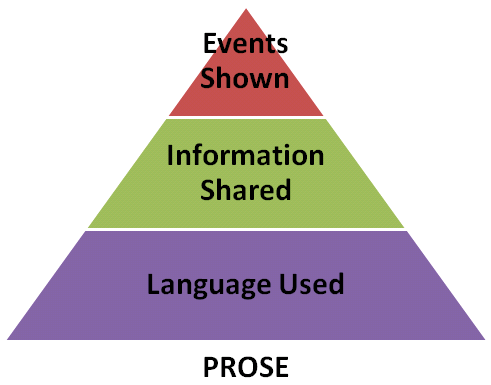
Narrative Tools in Prose: Events Shown, Information Shared, Language Used

The Narrative Tools in Prose

In prose, our primary tools are the events that we depict, the information we impart to the reader, and the language we use to do both. Of course, this is a gross over-simplification: I could probably talk about choosing a single metaphor for a day or two if given the chance. Yet nonetheless, it is our job as creators to choose what we want to present and how to present it. In prose, all of these tools are in the author’s control (although to be fair, good editors have their say, too). When we write, we make conscious choices as to what information our reader needs, when they need to get that information, and how that information is delivered to them.

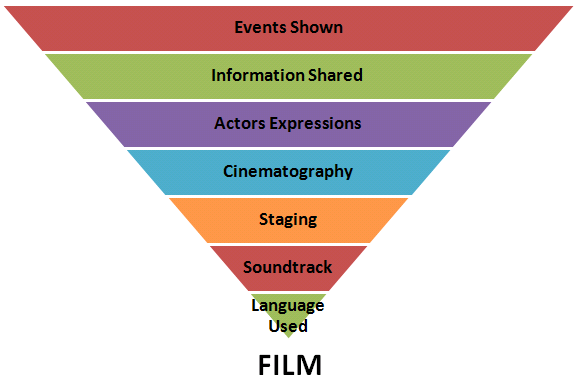
Narrative Tools in Film

Narrative Tools in Film

In film, it’s a little more complicated. At the most basic level, movie-makers have the same two basic tools as authors: they select the events they wish to show, and decide the information they wish to impart to their viewer. However, language is only one of the many devices they have available to accomplish both goals. Actors convey a wealth of information on multiple levels: their facial expressions, movement, and tone of voice all are part of the storytelling and are only partially (at best) under the screenwriter or director’s control. Then, directors choose what visuals are presented in the film, how shots are set up, how a scene gets lit, and how it gets staged. This is conveyed visually, but can be used to elicit an emotional or intellectual response in the audience. And the soundtrack adds an emotional undertone to the visual events, guiding the audience into a certain desired state. And finally, we get the language that is used in the dialog itself.

This is not to say that there are more moving parts in film-making. There aren’t, despite what movie makers might say. It’s just that the moving parts are very different from those faced in prose, and I think that when writing and directing an adaption it is incumbent upon us to bear in mind the differences in technique that both mediums work with.

Why Hugo Works as an Adaptation

Martin Scorsese’s Hugo is probably one of the best film adaptations I have ever seen for the simple reason that it tells the same story that the book told, hitting the same narrative notes and evoking the same emotions in me as an audience member. While Scorsese may have chosen different events to show, different information to share with the audience, and of course made his own choices on cinematography, soundtrack, etc., his adaptation stayed true to the overarching flow of Selznick’s story. Hugo achieved the same type of unity in plot, theme, and character as The Invention of Hugo Cabret, and as the original book’s story was excellent, so too was its film adaptation.

To be fair, Scorsese’s task was made easier by Selznick’s beautiful illustrations. The book was itself already heavily cinematic, with illustrations that conformed to most of the classic structures of visual storytelling: establishing shots, action shots, close-ups to communicate facts and emotions, etc. Since half of Selznick’s book consisted of detailed illustrations, much of the visual storytelling had already been done. I expect this made Scorsese’s task at least somewhat easier, since Selznick had already made a slew of decisions regarding the story’s visual narrative.

Of course, this is not to suggest that Scorsese, the actors, and the screenwriter John Logan didn’t have a lot to do with the finished product. But it is very clear that they were heavily influenced (as is only right for an adaptation) by Selznick’s original book. By letting Selznick’s illustrations and storytelling influence their choices, they were able to capture his thematic and tonal focus, leading to a finished work as beautiful, compelling, and moving as the original.

Why Tinker, Tailor, Soldier, Spy Does Not Work as an Adaptation

Unfortunately, Tomas Alfredson’s Tinker, Tailor, Soldier, Spy does not work nearly as well as Scorsese’s Hugo. It remains a good movie: the cinematography is solid, the music is excellent, the acting great, and the writing good. It clearly tried to stay true to the original source material, but by de-emphasizing the characters’ personal lives it weakened the overall product.

The film version of Tinker, Tailor, Soldier, Spy engages us on an intellectual level: George Smiley (played well by Gary Oldman) and company keep the audience at an emotional distance, presumably just as they keep themselves emotionally removed from the sordid work that they do. That leaves us with the intellectual mystery of the whodunit: we are engaged with the story because we want to identify the traitor…not because we care about what happens to any of the characters.

Superficially, this is consistent with the book: le Carré portrays most of his characters, and Smiley in particular, as emotionally distant. Yet le Carré shows us that their reticence to engage emotionally is a sham: by showing us their emotional reactions to their personal lives, we know the characters to be living, breathing, feeling human beings. Alfredson chose to de-emphasize this emotional dimension of the story, and his movie suffers for it.

It is telling that the two characters who I found most engaging in Tinker, Tailor, Soldier, Spy were the two shown to be emotionally invested in their own stories: the naive Ricki Tarr (Tom Hardy), who tragically falls in love with a Russian agent, and Peter Guilliam (Benedict Cumberbatch), who kicks his lover out of his flat to keep him safe. It is precisely because these two characters are shown to be more than cold-blooded apparatchiks that they evoke an emotional response. We can identify with their concerns, and can feel empathy for their troubles.

The emotional concerns of the other – more principal – characters are merely alluded to, and not really explored. It could be argued that those concerns are purposefully left between the lines, there for the discerning viewer to pick up and project onto the screen. That may well have been the reasoning, but I for one found the effect flawed: if that was the intent, it didn’t work for me. The movie was engaging on an intellectual level, but fell short of the unified intellectual/emotional impact evoked by the original book.

Advice for Book-to-Movie Adapters

It seems to me that putting together a good film adaptation of a great book relies on a careful examination of why a book worked, and then translating the techniques that worked in prose form to film. If the method by which a book worked were correctly identified, then a good filmmaker should be able to achieve similar effects using the tools available to them. Of course, this is easier said than done, especially in a Hollywood driven by consensus decision-making.

What are some other examples of good adaptations? Why did they work? Or how about some terrible adaptations, and why did they fall apart? Love to have some more perspectives!

Thinning and Accusations of Nostalgia in Fantasy


The other day I came across a comment somewhere (alas, I don’t remember on what blog/forum) that enjoyment of fantasy stems from a nostalgia for the medieval era when lives were “poor, nasty, brutish, and short.” This view is typically delivered with the rather heavy-handed (though often unstated) implication that only children and fools would enjoy stories set in a time period lacking women’s rights, flush toilets, and antibiotics. I suspect if you’re reading this blog you would agree when I label such a view simplistic and rather asinine. And yet…this opinion has been around for decades, and its staying power suggests that – just maybe – there might be something more at work here than haters hating.

Romanticizing the Past versus Being Nostalgic About It

So why then do people today still say fantasy just romanticizes the ugly past? I’ve never seen a child of the late ’90s and early ’00s make this statement. That’s understandable when we consider that for that generation, Harry Potter was the defining work of fantasy, and that its appeal and reach extended far beyond fandom’s traditional minority. In my experience, the accusation of nostalgia is most often made by folks who matured in the ’70s and ’80s. Unlike the Harry Potter generation, many of those my age or older could have grown up utterly insulated from the boom in genre. They would likely have only been exposed to the unavoidable hits of the generation that preceded them: Howard’s Conan, Tolkien’s Elves, Lewis’ Narnia, etc. Those formative books established their expectations, expectations which a cursory glance at fantasy covers in the ’70s and ’80s would have instantly confirmed. After all, contemporary urban fantasy at that time was the bleeding edge.

So fantasy’s predilection for medieval settings (whether secondary world or not) is an understandable stereotype. By volume, I would suspect (though I have no hard data) it remains warranted today. If someone were to tell me “Most fantasy is set in a quasi-medieval setting” I would say that this is likely a fact. But if somebody says that “Fantasy is nostalgic for the medieval era” I would take exception.

Contemporary fantasy owes many of its roots to romantic literature of the 19th century. In the literal sense, quasi-medieval fantasy does romanticize the past: images of the past are used as a cultural short-hand to set the tone of the work, establish a framework by which its themes can be explored, and set reader expectations. This focus on the reader’s frame of mind and emotional state is in many ways the defining rhetorical device of the Romantics. Realistic fiction does the same, but through the use of different imagery: contemporary imagery, objective or ironic presentation, etc. Both romanticize their subjects (however strenuously the realists might deny it). Fantasy just happens to use quasi-medieval window dressing.

However there is a line between romanticizing the past (a sin of which fantasy, historical fiction, and well-written biographies are all guilty), and being nostalgic for it. In fantasy, that line gets blurred by the genre’s reliance on thinning.

The Thinned End of the Wedge: Thinning vs Nostalgia

In The Encyclopedia of Fantasy, John Clute defines “thinning” as the weakening of some aspect of the world or character which then enables the story to be structured as a recovery fable. I won’t reprint the entire definition, but I strongly recommend you check it out: it’s a deep and meaningful concept, however fuzzy the borders of Clute’s definition. The classic way in which fantasy stories use thinning is to present a world in some form of decline. The reversal or slowing of that decline becomes the object of the plot or one of the story’s major themes.

Tolkien’s Middle Earth is replete with thinned elements yearning for restoration: the elves are leaving the world and going west, the line of Numenor is spent, Hobbits are no longer easy to find, dwarves are locked in their mountains, and the Ents have lost the Entwives (just to name a few examples that spring to mind: there are more). In The Lion, the Witch, and the Wardrobe we first find a Narnia where humans have died out, the land is blanketed in perpetual snow, and the White Witch oppresses the land and its people. Thinning is even used in non-medieval fantasy, such as in Marie Brennan’s Onyx Court series (see my earlier review).

Thematically, thinning is deployed with a nostalgic tone. The pre-thinning state is never shown, so the reader never sees what this idealized past was like. But the narrator and characters leave us with no doubt that it featured characteristics that they felt were good. It is their nostalgia which permeates the text, not the reader’s or (necessarily) the writer’s. It is merely a rhetorical device, analogous in kind to the use of framing stories or unreliable narrators. It can highlight themes that the writer seeks to dramatize, and can plant deeper emotional hooks in the reader. This isn’t a tool unique to fantasy, and in fact has a long pedigree.

Remember the Dark Ages? Even though it’s an awfully imprecise term, Petrarch’s origination of it really lends a fantastical narrative to the Middle Ages: the Dark Ages were western culture’s own period of thinning after the fall of the Roman Empire, and the influence of the Renaissance (which itself idealized the classical era) remains a powerful force in fantasy today. Contemporary portal/quest fantasies are the descendents of Dante’s Divine Comedy, and characteristic fantasy characters (rogues, merchants, warriors, etc.) can often trace their lineage back to Bocaccio, Chaucer, or Malory.

What Comes after Thinning?

Thinning, and the nostalgic tone it engenders, is clearly nothing new for fantasy. This makes the accusation that fantasy pines for the medieval past an understandable conflation of the terms. Yes, it is wooly-headed. Yes, it is imprecise. And yes, the people who level this accusation are dying out. But if there is some poorly articulated truth to their criticism, then what if they really have a different and far more valid point: is thinning played out as a rhetorical device? Does it remain relevant for the thematic concerns contemporary writers wish to address?

The backwards-looking Renaissance gave way to the striving of the Enlightenment. Thinning and its nostalgic tone became rarer, and tended to be confined to the (already more fantastic) Gothic novels. Though there was much writing we might today call speculative, the thinning popular during the Renaissance was replaced by satire, philosophy, and utopian texts which raised questions about society in the moment and postulated future directions for its development. If thinning as a device has become cliché, what comes next? Can we expect a new Enlightenment in fantasy which replaces thinning and the nostalgic tone with satire? I don’t think we’ve reached that point yet, but I suspect we may be on our way there. And who knows? Terry Pratchett’s Discworld might just be the satirical canary in the coalmine that drags us kicking and screaming into the century of the fruitbat.

Earning/Maintaining a Reader’s Trust: Character/Narrator Consistency and Reliability (part 3 of 3)


NOTE: This is the third and final installment in a three-part series on earning and maintaining a reader’s trust. The first part focuses on earning initial trust just at the start of a story, while the second part focuses on how world-building, consequential plotting, and story structure/pacing affect the reader’s trust. This part deals with character consistency/reliability, and I know it’s long. I do apologize for that, but there’s really a lot to talk about here.

Consistent Characterization and Reader Trust

When we write, we create a wide variety of characters, each of whom has different degrees of complexity. Like real people, our characters’ choices, attitudes, personalities, and decisions are shaped by their experiences. The most memorable characters are those that are shown to be complex, to have foibles and flaws as everyone else. Readers appreciate flawed characters, but what matters is that their flaws and behavior are consistent with the events of the story. Some people claim that they like to be surprised by characters, but there is a big difference between letting the plot surprise us, and letting a character do so. Character actions should be an inevitable consequence of their natures, and their experiences before and during the story.

Every decision a character makes must logically follow from the experiences our reader has observed through the story. In Les Misérables, Hugo shows us the moral quandary that Marius Pontmercy finds himself in on the eve of revolution: should he join his friends on the barricades or escape with the love of his life, Cosette? Hugo establishes this as a real choice for Marius, one that forces him to choose between two equally “right” values (according to his own value system). As the reader, we understand that he can believably go either way on the choice. Which makes his final decision and the reveal both a surprise (either of the two options would have been) and satisfying.

The seeds of every major (and most minor) choice should be planted well in advance. The hard part, is to plant seeds that allow for branches of equal probability. If the character only has one plausible recourse, then where does tension derive from? This is one of my most frequent complaints about portal/quest fantasies, in particular those of the “prophesied monarch” sub-type. As I’ve grown older (and more curmudgeonly) I have found it very difficult to get any emotional tension out of this kind of story. They become predictable and dull, because I know a priori that every complication the hero runs into will at some point be resolved, and that every mistake he makes will be fixed by the end. The prophecy (which is all too rarely actually ambiguous) will take care of matters in the end.

By setting up characters who have real choices to make internally, and who have real conflicts amongst themselves, we maintain the reader’s interest in the underlying story – which is a prerequisite for maintaining their trust. If the character does something that was not adequately prepared for, something so surprising that it comes out of left field, then the reader may be shocked into losing all trust in the story.

Consider for a moment Star Wars. Would the story have worked if in Return of the Jedi Princess Leia betrayed the rebels to the Empire? No. It might have worked (though yielded a very different story) if Han Solo had done so (for money), or if Luke turned to the Dark Side. But Leia? There was nothing in her character to make such a choice remotely plausible. It would have been a bridge too far, a leap of faith that the audience would have been unwilling to follow.

However, this does not mean that characters need to always be reliable. In fact, one of my favorite methods of playing with reader trust is the use of an unreliable narrator/character.

Structures that Enable Trusting in Unreliable Storytelling

Whether it’s in film (Rashomon, The Usual Suspects, or Citizen Kane) or in prose (Akutagawa’s In a Grove, Nabokov’s Lolita, or Larbalestier’s Liar), I love unreliable narration/characterization. It’s a lever on which my entire understanding of a story can hinge. Executed skillfully, it offers an exponentially broader story experience. But how does the reader trust in a story when the storyteller is shown to be a liar? That’s a question that has been on my mind quite a lot recently, as one of my current WIPs deals extensively with the concept of deception.

In thinking it through, I think I’ve managed to identify five different modes of unreliable storytelling, each of which plays with reader trust in different ways. This list is by no means exhaustive, and I’d love to know other examples:

1 Implicit Unreliability
The narrative voice is strongly imbued with the characteristics of the story’s narrator, thus adopting the inherent biases, idiosyncrasies, or fallacies held by the narrator. These may include a childlike naivete, a desire to rationalize/justify morally reprehensible actions, or strongly held opinions that color the narrator’s perspective. What matters in such stories is that the narrative voice must go beyond the merely functional, and present a particularly close “lived-in” feel.

The book’s character/narrator will likely be the most memorable aspect of the book, and this stems entirely from a reliance on the narrator’s voice. The source of the narrator’s underlying unreliability affects our emotional position vis á vis the character: we love Huck Finn or Evie Spooner for their childlike innocence, even as that innocence is shattered by their experiences. We love to recoil from Humbert Humbert, and his beguiling rationalization of his monstrous deeds. We judge Chaucer’s Merchant, and the Wife of Bath for the positions and opinions they hold. At no point in the story itself do we as the author insert ourselves and tell the reader about the veracity of our narrator’s statements. Our job is to present the story as if it were the narrator’s, with whatever inaccuracies or ugliness that entails.

The success or failure of these stories rests on their ability to draw us into the character/narrator’s viewpoint. To aid in this process, such stories are often told in first-person to accelerate us into the reader’s head, though that is by no means a requirement. Typically, the reader’s enjoyment derives from a multi-layered interpretation of the text. On the one hand, we can enjoy the events unfold as we share in the narrator’s experiences. On the other hand, we have an intellectual and emotional response to our own interpretation of those experiences based upon our own value systems. We take the facts of the story as given, and generally we do not dispute them. However the moral and emotional implications will be drawn from the reader’s own values and opinions.

So long as the narrator is consistent in terms of voice and characterization, the reader will trust that the narrator is supplying the basic facts of the events accurately. However, if the voice is distinct enough, the reader gains that degree of separation that enables that multi-layered interpretation. This makes apparent the fact that the reader is expected to have value judgments that are independent of the narrators’. As a result, the reader will supply their own emotional/moral “truth” , based upon the facts filtered by the narrator. In essence, the reader is expected to trust the facts of the story, but to question the narrator’s interpretation of those facts. The reader’s “trust” in this type of unreliable narrator rests entirely on that narrator’s voice, and its distinctiveness and attractiveness (even if the character is reprehensible).

2 Conflicting POVs
When we combine multiple implicitly unreliable POVs, the result is often an interesting structure which throws into doubt the facts of the story. Here, it is not only the moral/emotional implications which need to be supplied by the user, but the facts of the story as well. Most frequently this story relies on presenting a series of narrators, each of whom recounts the same or closely-related events from their own highly subjective perspective. This structure creates a more complex intellectual puzzle than most implicitly unreliable stories, as it requires the reader to parse and analyze what characters want, what they say, and what they do not say. By analyzing the gaps between what different narrators tell us, the reader can infer the “true” facts of the story.

The facts of the story are themselves in flux in such stories, and will never be explicitly stated by any of the narrators. And because the underlying facts are ambiguous, so too are the emotional and moral implications of the story as well. This mode relies more heavily on a careful analysis of the details included in particular narrators’ versions of the story. Who includes what details, who mentions what, who justifies what actions, who lies, and when they do so are all vital factors that we need to have carefully mapped out as we write the story. The reader’s trust relies on the non-obvious nature of the “truth”. Because this type of story is a puzzle-box, readers who figure out or intuit the puzzle within the first couple of chapters may lose interest: their intellectual investment will have been wasted. To maintain the reader’s trust, balance must be maintained between all of the perspective characters, in terms of level of detail offered and the reader’s expected emotional investment.

3 Explicit Unreliability
In many stories, we are explicitly told that we should not trust the narrator: that their words cannot necessarily be taken at face value. This may be because the character is a self-avowed liar, or is insane, or because a framing device tells us a priori that the story is untrue. In each case, this model puts the reader on alert that they are dealing with an unreliable narrator and forces the reader into a “problem solving” mode of story consumption.

This model seems to be especially popular in speculative fiction, where a number of authors (Gene Wolfe in particular) execute admirably. When we read stories like There Are Doors or Soldier of the Mist, we question every statement (however banal) that the narrator makes. In essence, we’re playing a perennial game of gotcha with a chimerical narrator: it is only through the narrator that we can glean insight into the author’s intent, and by catching the narrator out we hope to deepen our understanding of the story’s thematic implications.

This is my personal favorite type of unreliable narrator, as when done well, it leaves almost infinite room for conjecture. Books like Soldier of the Mist or Justine Larbalestier’s Liar leave us room for hours and hours of discussion and examination. These stories rely on a combination of factors to maintain reader trust:

First, we must balance the narrator’s stated unreliability against the need to ground our reader in the story. This balancing act rests on the idea of uncertainty. In Soldier of the Mist, Latro’s interactions with gods and monsters may be a result of the head wound that gave him his anterograde amnesia. The character acts as though they are real, because he is unaware of this uncertainty. We as the reader need to choose which interpretation we believe: the explicitly stated, skeptical viewpoint? Or the character’s credulous one? We face the same choice, though further complicated, in Justine Larbalestier’s Liar where on the first page our narrator tells us that she is a pathological liar:

I was born with a light covering of fur.

After three days it had all fallen off, but the damage was done. My mother stopped trusting my father because it was a family condition he had not told her about. One of many omissions and lies.

My father is a liar and so am I.

But I’m going to stop. I have to stop.

I will tell you my story and I will tell it straight. No lies, no omissions.

That’s my promise.

This time I truly mean it.

We are at first told that the narrator is a liar, explicitly letting us know that she is not to be trusted. But a moment later we are told that from here on in, everything she says is the truth (“No lies, no omissions.”). At first blush, we might be tempted to believe this. But then two paragraphs further we find two short words which again make us doubt: “This time I truly mean it” (emphasis mine). This push-me/pull-you dynamic is characteristic of these kinds of stories, even when the narrator’s unreliability is more of a background condition (as in Kesey’s One Flew Over the Cuckoo’s Nest).

In the stories where this explicit unreliability is effective and maintains the reader’s trust, there exists a thematic consistency that encourages dueling interpretations of the text. We can almost look at it has having two separate ways of reading the stories: one where we accept the narrator’s word, and one where we disbelieve most of it. If each interpretation wrestles with similar themes, and if each remains plausible based on the text, the reader’s trust will be maintained. By making the narrator explicitly unreliable, we are entering into a contract with the reader, promising that we will consciously play with “truth” in the story.

This is one reason why I was disappointed by James Clemens’ The Banned and the Banished series: in the first novel, Wit’ch Fire, Clemens uses an interesting framing device to establish that the story we are about to read is (ostensibly) false, with hints that this stems from political revisionism. However, as we get into the meat of the story this frame becomes practically forgotten: the story devolves into a fairly standard portal/quest fantasy, with marginal attempts at exploring the ambiguity introduced by the book’s forward. For those of us who like unreliable narrators, ambiguity is like an awesome toy. If the author puts it on the table, we want to play with it. If it’s there, but we aren’t allowed to play, then we feel cheated.

However, it is possible to have too much of a good thing. Much as I admire Larbalestier’s Liar, I found the constant retractions and restatements tiring. When we craft an explicitly unreliable narrator, we’re asking our reader to pay constant attention to the various plausible interpretations we offer them. The more variants the reader must store in their head, the more tiring the experience will become. In most successful cases, the author introduces the narrator’s unreliability and then leaves us with just two ways of interpreting the story: either based on the narrator’s prima facie interpretation, or taking the narrator’s statements with a grain of salt.

In Larbalestier’s case, her story rested upon a narrator who explicitly contradicted her story some twelve times (by my count). This created a swirling cloud of possible interpretations, with many fractal branches to consider. Of course, this was Larbalestier’s thematic goal. However, neither the voice nor the story’s underlying conflict were strong enough to justify the significant investment of effort demanded of me. This may simply be a question of taste, and my own ability to identify with Larbalestier’s character. Regardless of how much I might admire the book’s structural ambitions (which – unquestionably – Larbalestier delivers on excellently), the narrator’s voice was not quite strong enough to maintain my trust.

Bottom line: for explicitly unreliable narrators, make sure that their unreliability relates directly to the story’s thematic concerns, be careful of asking the reader to keep too many plausible interpretations in their heads, and try to offset the inherent complexity through an engaging voice and conflicts.

4 Revealed Unreliability
Revealed unreliability relies on a moment of anagnorisis or discovery regarding the narrator. While more commonly an element in film than in novels, this probably owes its origins to Agatha Christie’s classic mystery The Murder of Roger Ackroyd. Stories with revealed unreliability rely on a twist ending where some fact is revealed about the narrator (e.g. their identity, mental state, etc.) which forces the audience to re-evaluate the entirety of the preceding story.

Twist endings of this kind are very controversial, and difficult to pull off. Badly rendered twists (text: “It was all a dream!” author: Bahahaha!) are considered a trite cliché. Debate still abounds in the mystery community around whether Christie’s classic is good or bad. That book relies on a narrator who purposefully leaves out vital clues and inserts many red herrings to obscure the killer’s identify – up until the very end of the book, when the killer is revealed. As an early form of this kind of mystery, The Murder of Roger Ackroyd is ostentatious by most measures. Even astute and experienced readers of the genre have difficulty figuring out the mystery before the killer is revealed, which is no doubt one source of readers’ frustration.

Revealed unreliability has become much more accepted – particularly in the literary community. Nevertheless, it is a difficult feat to pull off effectively. To function properly, the author must take great care to lay the seeds of inevitability such that the “answer” becomes apparent on subsequent readings of the same story. Palahniuk’s Fight Club does this particularly well by establishing the tonal uncertainty of the narrator’s own mind: at no point before the reveal is the narrator explicitly shown to be unreliable, but the narrator’s own doubts as to his reliability create the possibility of the reveal near the end.

From what I can see, a revealed unreliability is easier to pull off in film, where the use of visual images can rapidly communicate the revelation to to the audience. Because the train moves very fast, the audience doesn’t have time to feel cheated. Prime examples of this include The Usual Suspects, A Beautiful Mind, and Christopher Nolan’s The Prestige.

In revealed unreliability, it is very easy for the audience to lose trust at the moment of revelation. The reader’s trust relies on a sense of not being cheated. This relies on the author salting the preceding events with enough hints that before the revelation are innocuous enough, but after the revelation make it seem inevitable. Furthermore, the revelation must fit smoothly and plausibly into the preceding events. If it does not (“It was all a dream!”) then the reader will feel like the author pulled a fast one, and cheated them of a satisfying experience.

Everything Relies on Everything Else

In conclusion, everything about reader trust relies on consistently and smoothly introducing the story’s building blocks such that the reader does not notice. I think the train metaphor is a good one for that trust: If the reader can count the rivets on the train, then the train isn’t moving fast enough. The speed at which it moves is only partially a question of pacing. The train’s engine is stoked by the cultural touchstones it relies upon, the narrative voice it is told in, and the author’s precise use of language. It runs on rails of world-building, and story structure, and consistent plotting. And it’s driven by characters who are internally consistent, whether they are reliable or not. If they’re not reliable, then at the very least they need to be functionally unreliable, to have that reliability carefully mapped out by the author so that the reader’s trust is maintained.

Speeding Train is Reader Trust

This is Reader Trust

Many good stories fall short on one or more of these components. And that’s okay. Honestly, I can’t think of any “perfect” stories that nail every aspect of this. It might be impossible (at least by us mere mortals). But even if they’re not all equally solid, the components do need to balance and work together to earn the reader’s initial investment, to earn their trust, and to keep them turning pages. Which is ultimately the goal: readers show us their trust by turning to the next page.

Earning/Maintaining a Reader’s Trust: Starting a Story with Cultural Touchstones, Narrative Voice, and Precision (part 1 of 3)


I mentioned last week about how I’ve been on a spy fiction kick recently, and all of the deceptions and double-crosses have left me thinking quite a bit about trust in fiction. Because really, every piece of fiction is a lie. And yet when we sit down to enjoy it, we’re willing to give the author the benefit of the doubt and offer some modicum of trust (on credit, of course). And this begs the question: why? How do writers earn that trust, and how can we manipulate it?

NOTE: This is the first in a three-part series of posts. This post is focused on initially gaining a reader’s trust with a story’s opening. On Saturday, I’ll post I posted the second installment focusing on how world-building, consequential plotting and story structure affect reader trust. And on Tuesday I’ll post I posted the final installment, focusing on character consistency and narrator/character reliability.

Reader Trust as the Foundation of Fiction

The act of reading is an act of profound trust: without ever articulating it, the reader tells us that they will approach our words as truth in order to derive some benefit (catharsis, enlightenment, etc.) at the end of the story. Coleridge called this a willing suspension of disbelief, and while I know many people have a problem with that phrase, I’ve always really liked it. When we read a story, we are giving the author the benefit of the doubt: we’re not scoring points and indicating every falsehood the author tells us. Instead, we’re accepting the author’s lies fiction at face value because we believe that at the story’s conclusion, the experience will have been worth it.

This trust is not automatic. Nor is it easy. Reading a story takes effort, and some (Italo Calvino, say) take more effort than others (Dan Brown). In speculative fiction, this trust is even more important because we ask more of our readers. When reading secondary world fantasy or far-future science fiction, the reader needs to internalize our world-building. To be immersed in our imagined environment takes more investment on the part of the reader (more new words to remember, more fictional context to internalize). When reading a locked-room mystery, the reader inherently trusts that everything will be explained at the story’s end. If the reader is to be emotionally invested in a character, they must trust that the character’s actions have meaning and consequence.

Trust is what gets the reader to read the next sentence, the next paragraph, to turn the page, and to read the next chapter. The reader needs to have confidence that the author will make their journey worthwhile: the moment they lose that confidence, the book gets put down and (at best) forgotten.

Reader Psychology, Reader Trust and Writer Control

Reader trust is only partially in the writer’s control. A reader’s willingness to trust an author is based partially in their own psychology, and partially in the writing itself. Obviously, a reader is likely to cut a much-loved author more slack than someone brand new to them. That’s because the author has built up a pre-existing level of trust, even if the text itself does not engender that trust. For example, I slogged through most of China Miéville’s Kraken despite the fact that I didn’t enjoy it because on past experience I trusted Miéville to make it worth the effort in the end. When the book didn’t satisfy, my level of trust in the author for subsequent books decreased (although so far Embassytown has been undoing the damage). Short of only writing books that don’t suck, there is nothing a writer can do about this: there will always be readers new to our books, so I figure it’s best not to stress over it.

The reader’s preconceived tastes are equally important. Many people know what they like and only read within that one particular genre or sub-genre. When reading outside of their comfort zone, their level of trust may be nonexistent. Someone who only ever reads police procedurals is likely to be a harder convert to Amish romance. As writers, we might deplore this kind of blinkered reading, but it remains a fact. And one that we can do very little about: there will always be readers who we can’t convert.

Equally important is the reader’s state of receptivity. While Frank Herbert’s Gurney Halleck might gripe that mood is a thing for cattle and love-play, the fact is that the reader’s state of mind affects how they read. Some days, I’m in the mood to be immersed. I want something fun, vivid, and escapist. Other days, I want the mental challenge of unreliable narrators and non-linear structure. And sometimes, I just want to read some dry non-fiction. If I try to force myself to read something I’m not in the mood for, my willingness to trust the author is decreased. However, the author does have some influence over the reader’s mood. Before the reader has even finished the first page, we have control over the book’s technical execution, its cultural touchstones, and the narrative voice. And all three affect the reader’s frame of mind.

Technical Execution: Sine qua non for Reader Trust

We’re always told not to judge a book by its cover, but the fact is that we do. When we see a book that is poorly designed, shoddily structured, or badly proof-read, the level of trust we’re willing to offer the author decreases. This, actually, is one of the issues I run into with self-published eBooks. When I see a traditionally published book, I know that a team of experienced people worked to make it the best book possible. That team worked for (typically) about a year after the book was finished to line-edit, copy-edit, proof-read, and design the final work. The fact that the editors actually acquired the book means that someone (actually a committee, more typically) thought the author worthy of their trust. Even if that book still has mistakes, even if it still has a lousy cover, the editorial team’s efforts contribute to increase my trust.

Many (and thankfully an increasing number of) self-published eBooks are well-edited, copy-edited, proof-read, and designed. But when compared to traditionally published novels, a greater share of self-pubbed eBooks are not. I have been burned so often by unprofessional self-pubbed eBooks that my level of trust for the entire category is (unfortunately) decreased by association. That may be unfair to those eBook publishers who work their butts off to execute well, but hey: that’s the capricious judgment of the consumer.

The quality of a book’s technical execution is the cost of entry to reader trust. A book can break all the rules of syntax (Anthony Burgess’ A Clockwork Orange comes to mind) and still be excellent. But there is an inherent difference between breaking rules by design and breaking them through inattention. That difference is precision, and the sense of the author’s ineluctable control over their words. If the reader cracks open the first page, and they see haphazardly misspelled words, broken clauses, and meaningless tense shifts, their level of trust will drop through the floor because we are asking them to work too hard to get to the story.

Language is the rail on which the story runs. Would you trust a train where the passengers needed to fix it while riding?

Cultural Touchstones, Clichés, and Psychological Baggage

Assuming the writing is technically well-executed, we still need to wrestle with the reader’s frame of mind. One of the tools for doing so is what I call cultural touchstones. Writers are told to avoid clichés like pestilential vermin, but I believe that clichés have a use in fiction. They are able to cast a concise and powerful spell on the reader, and used appropriately, they become a shortcut into the reader’s mental/emotional state. While they should not be relied upon to the exclusion of all else, they can be incredibly valuable for getting the reader into the desired frame of mind.

Imagine for a moment a preschool, where twenty toddlers (our readers) are running wild and screaming bloody murder. The teacher, a much put upon soul, claps and shouts “Story time!” All of the readers kids take their seats, and look up expectantly. In this idealized scenario, our brave teacher is able to shift her audience’s mental state just by giving them a practiced touchstone, a pair of words that establishes their expectations based on their past experiences. Clichés work the same way.

Consider the sonorous phrase “Once upon a time…” If we come from a western cultural background, this hackneyed cliché is steeped in history and associations. It brings to mind princesses, wicked queens, fairy godmothers, and wolves in the woods. It carries with it a host of psychological baggage associations, which we can use when we tell stories. If we start a story with that phrase, we set certain expectations in the reader’s mind. They can safely assume that we will be dealing with the tropes of fairy tale, that the story will follow certain conventions relevant to the subgenre. Unless the author subsequently shows us that they intend to subvert those conventions, we should not expect a cyberpunk dystopia to follow.

Famous clichés (“Once upon a time…”, “It was a dark and stormy night…”, “In a hole in the ground there lived a hobbit…”) only work effectively when put to use tactically and consciously. They are the literary equivalent of a cannon. If they sneak into our writing haphazardly, then our writing will quite simply suck. We will be pushing the reader’s emotional buttons not wisely, but too well. Used sparingly, they have the narrative effect of slamming the reader into the desired mental state. Their impact is fast and powerful, but lacks in subtlety and nuance. For more finely grained control of your reader’s mental state, consider using imagery as cultural touchstones and narrative voice as a modulator.

Cultural Touchstones and Narrative Voice without the Cliché

Patricia C. Wrede’s Enchanted Forest Chronicles are inherently concerned with the conventions of fairy tales, yet she has enormous discipline in avoiding the clichés of the sub-genre. Consider how she opens Dealing with Dragons, the first book in the series:

Linderwall was a large kingdom, just east of the Mountains of Morning, where philosophers were highly respected and the number five was fashionable. The climate was unremarkable. The knights kept their armor brightly polished mainly for show — it had been centuries since a dragon had come east. There were the usual periodic problems with royal children and uninvited fairy godmothers, but they were always the sort of thing that could be cleared up by finding the proper prince or princess to marry the unfortunate child a few years later. All in all, Linderwall was a very prosperous and pleasant place.

Cimorene hated it.

Patricia C. Wrede, Dealing with Dragons, 1990

Wrede does not use a single cliché, even though her subject matter is ostensibly fairy-tale related. Instead, she relies on imagery that is already associated with fairy tales (knights and dragons, royal children and uninvited fairy godmothers, etc.) to put the reader in a fairy tale frame of mind. But by avoiding a reliance on a hoary old cliché, Wrede also gains the space to employ the second tool for managing reader receptivity: narrative voice.

In her first paragraph, she describes a stereotypical fairy tale kingdom. But through the application of careful phrases she establishes a sense of whimsy (“…the number five was fashionable”, “knights kept their armor brightly polished mainly for show”). These images and concepts are not cultural touchstones the way dragons or fairy godmothers are. Instead, they are included to show the reader that the narrator has a sense of humor and acknowledges the inherent silliness of all fairy tales. This contributes to reader trust in two key fashions: juxtaposed against the fairy tale imagery, it establishes that the author is familiar with the conventions of the subgenre, which in turn establishes Wrede’s authority and instills confidence. Second, it undermines (though does not yet subvert) fairy tale conventions, telegraphing to the reader that the author intends to play with expectations. This second contribution sets the stage for Wrede’s masterful one-sentence second paragraph (“Cimorene hated it.”), where she packs characterization, theme, and pacing acceleration into three short words.

This use of voice draws the reader in through unity of character, purpose, and precise execution. Examining the text closely, every word serves a purpose. Even the design contributes to its effectiveness: we have three editions of this book in our house (and an eBook edition on my phone) and every single edition has the first and second paragraphs on the book’s first page. It is the totality of those two paragraphs that Wrede uses as a hook. If she dropped the first paragraph altogether, the second paragraph (the classically “interesting” paragraph with character and emotional engagement) would be meaningless and emotionally dull. It is that slow first paragraph that gives her second paragraph context, like a steep hill on a roller-coaster.

Timing and Reader Trust: When Should the Reader Be Hooked?

Just about every piece of writing advice tells us to hook the reader ASAP, preferably in the first sentence. Like all generalities, it is generally good advice. But there are alternatives available, which may potentially make more sense for our story. Wrede’s first sentence, while interesting, is not a classically interesting hook. It fails to introduce a character, conflict, dramatic action, or thematic factors. Yet the precision of its prose and the sense of whimsy communicated through the voice is likely to get us to the second sentence, which in turn brings us to the third, and so on. Until we get to the second paragraph, have finished the first page, and find ourselves thinking “Okay, Wrede, you’ve earned our trust (for now). Let’s see where this goes.”

When I write, I like to think of it as getting the reader to the next sentence, then the next paragraph, then the next page, then the next chapter. Every sentence and every paragraph is a chance for me to degrade, lose, or (worst of all) betray the reader’s trust. The more of their trust I’ve built up, and the sooner I do so, the better. If I can earn a page’s worth of trust in my first sentence, great. Sometimes, that is possible. But if not? Well, that’s not the end of the world. So long as I can identify the point by which I need their trust, and so long as the writing to earn and maintain that trust is precise, I’m ahead of the game.

I’ve read many stories that never really earned my trust and just meandered into the action. If you’ve read a lot of fantasy, you know what I’m talking about: front-loaded prologues offering backstory that only interests the author, epigraphs that I suspect most folks don’t even read, etc. Sometimes, slow beginnings are the best way to start a story. But the greatest tool an author has to get the reader through that slow start is the precision of their words. Nabokov pulls this off superlatively in Lolita, where even with a distancing framing device and an unreliable (and unsympathetic) narrator, every word follows inevitably and beautifully from its antecedent.

I generally don’t notice that precision consciously on my first reading of a text. When executed well, it should be invisible (if we can count the rivets on the engine, the train isn’t moving fast enough). But even if it’s not consciously noticed, it still affects how I perceive the story and the author. Precise control of language establishes confidence that the author’s expert hand is on the tiller, and thus builds reader trust. That trust isn’t limitless, and eventually the story must hook me. But precision will typically get me past the first paragraph, which in turn might earn the author the second paragraph, then the first page, and so on until I find myself immersed in the story. It’s a chain of chances, and precision connects the links.

Beyond the story’s opening, trust must be cultivated and maintained. In speculative fiction especially, that often hinges on how world-building is managed, or on the book’s plot structure, and the reliability/consistency of characterization and narration.

NEXT: Come back on Saturday Check out the second installment on world-building, story structure, and consequential plotting.

Leaping the Chasm of Imagination: Verisimilitude, Historical Fiction, and Speculative Fiction


The borders of genre are famously porous. Devices that start in one genre will get adopted, subsumed, and then modified in another. Then the cycle starts again, with the “new” device trickling back to its original progenitor. This tendency is why asking whether realistic or speculative fiction developed first is meaningless: anthropologists and fans can probably debate this ’til the heat death of the universe, and even then the answer won’t matter. But I’m curious as to how and why certain narrative techniques make this leap and others don’t.

Verisimilitude is the Heart of Storytelling

Every single genre – regardless of how speculative it is – relies on some degree of verisimilitude to enable comprehension. Sure, it’s theoretically possible to write a science fiction novel entirely in a made-up alien language with concepts for which there is no human analog…but who on this planet would actually read it? At the most basic level of language, we rely on mutually comprehensible words to communicate. This is the point where I call shenanigans on the pseudo-linguistic (read: intellectually irresponsible) school of critical theory that argues that text/words/language are inherently meaningless. If that were true, then we would not only never have fiction, we would also lose all written correspondence and spoken conversation. Community relies on communication: note their similar roots.

The sentence “John opened the door.” could appear in a hard science fiction story, an immersive secondary world fantasy, or in mimetic chick lit. Sure, we might need to replace the character’s name, and call John “Blaghosan” or something to maintain the illusion, but the act of opening a door can apply in any of these fictional modes. The richness of our lexicon and its corresponding flexibility enables us to assemble more complex, interesting, and layered sentences. But fiction (and any communication) relies on a shared ontological foundation.

At Viable Paradise (which I attended a couple of weeks ago), the amazing Teresa Nielsen Hayden said something utterly profound: “The subject verbed the object, and it was good.” The particulars might vary, but at the sentence level that basic principle underlies all communication, regardless of its realism. The fancy stuff (metaphors, similes, neologisms) that speculative fiction authors love is really a set of clothes hung on this incredibly flexible frame.

The Basic Devices of Fiction: Simile, Metaphor, and Neologism as Genre Markers

All writers use a certain basic arsenal in an infinite variety of combinations to communicate and manipulate their audiences. The most basic tools are such an indelible part of language, communication, and thought as to be near inseparable. But how we use them can actually be one of the markers of speculative fiction.

When we employ a simile (“John scuttled like an ant”) we are establishing a sense of apparency. The use of “like” indicates that John is not in actuality an ant. He merely acts with characteristics more commonly associated with one. Such a use of apparency can take place in any genre and is likely as old as language. Metaphor (“John was an ant scuttling across the floor.”) and neologism (“John the antyman scuttled”), however, are a little more complicated.

If we’re reading a work that is by definition realistic, then we recognize metaphor as a stronger way of evoking apparency. If we’re reading an F. Scott Fitzgerald novel, we know that John hasn’t actually become an arthropod. But if we’re reading something speculative than lacking other markers in the text, our hero John may have suddenly literally transmogrified into an insect (hey, it worked for Kafka, right?).

When we come across a neologism (“antyman”) we now have to decode the new word and incorporate it into our lexicon. Its semantic meaning may be unclear, and needs to be gleaned from context. In speculative fiction, that context may support fantastic concepts (antyman – the hybrid of a human and an ant) or merely extend our realistic lexicon (like Shakespeare coining terms like “assassination”).

This decoding process is part of what we love about science fiction, fantasy, and horror. Decoding where a given work’s fantastic borders are is an intellectual puzzle that gives us no small degree of satisfaction (whether escapist or otherwise). Traditionally, literal metaphor has been the plaything of speculative fiction writers. Realistic writers might have dallied in it a bit, but it is only with the relatively recent rise of magical realism and literary fiction’s “discovery” of science fictional devices that this technique has been fully appropriated. A similar process has happened over the centuries with narrative structures.

The Many Structures of the Novel

While many hardcore genre fans might disagree, I would argue that most innovative novel structures first appeared in “realistic” fiction. Whether it is the epistolary novel, the framed narrative, stream of consciousness, or non-linearity it probably appeared first in the realm of realistic mimetic fiction. There’s a good reason for that: like speculative fiction, innovative structures require effort on the part of the reader to decode and process them. To expect the reader to decode an innovative structure and process the speculative elements is likely expecting too much.

Consider the history of the epistolary novel. When it first grew to prominence in the seventeenth century (check out Aphra Behn’s Love-Letters Between a Nobleman and His Sister), we had to learn how to consume realistic epistolary novels before fantastical interpretations could flourish. As far as I know, it was not until 1818 that Mary Shelley’s Frankenstein or The Modern Prometheus successfully introduced early science fictional elements into the epistolary structure, and not until 1897 that Bram Stoker’s Dracula did the same for the nascent genre of horror. I suspect these novels owe much of their continued longevity and relevance to being early examples of speculative stories that made the imaginative leap and successfully appropriated a mimetic/realistic structure.

The pattern is quite similar for other innovative narrative structures. Could Delaney’s Dhalgren have appeared without the innovations of Kerouac? Or would Effinger’s When Gravity Fails have the same resonance without Raymond Chandler or Dashiell Hammett? As readers, we don’t need to have read the realistic taproot texts to experience and enjoy their speculative descendents. Because their structures are successful, they spawn a multiplicity of children: they become part of the cultural zeitgeist that soaks into our awareness.

This pattern actually holds even for the most basic taproot texts of literature. At the start of this post, I asked whether realistic or speculative fiction came first. And the answer is that they both appeared at the same time in the form of historical fiction. Wikipedia dates the first piece of historical fiction back to the 20th century BC. In those ancient days, there was little distinction between what today we characterize as “myth” and what they called “history”.

Even the earliest historical fiction had the same world-building challenges as speculative fiction. History is a foreign country we can never visit, and ancient Greece or Regency Britain are as foreign to our twenty-first century sensibilities as Middle-Earth or the Sagittarius Arm. The world-building techniques for the two genres are identical. Look at how Patrick O’Brian pulls us into his Napoleonic-era nautical understanding in his Aubrey and Maturin books. Then compare his methods to how Arthur C. Clarke introduces us to space-age technology in Rendezvous With Rama. The challenge is the same, and the craft to address it is the same as well.

Does the Pendulum Swing Both Ways?

With the rise of the modernists in the early twentieth century, we saw the fantastic get relegated to a pulp ghetto that we still struggle to escape. Yet even then, there were some “mainstream” authors who looked to fantastic fiction as a source of inspiration (Kingsley Amis and Shirley Jackson both come to mind). The last several decades have seen fantastical techniques gain acceptability within the realistic fiction community (provided they’re labeled “magical realism”). With post-apocalyptic texts like Cormac McCarthy’s The Road or blatantly science fictional novels like Charles Yu’s How to Live Safely in a Science Fictional Universe: A Novel being published as “mainstream literary fiction” we may be living through the pendulum’s reversal as we speak.

Which are the fantastical devices that will now hop back over that imaginative chasm? What are – and what will – contemporary “realistic” writers learn from their speculative peers? That the cycle will keep going I have no doubt, but I’m curious what lessons realistic authors are learning from those of us who like to mess about with elves and space ships and zombies. Regardless of the genre, my own predilections suggest that writers who want to innovate structurally should read widely and extensively across genres to internalize others’ innovations wherever we come across them. T.S. Eliot nailed it when he said “Mediocre writers borrow. Great writers steal.”

What should we be stealing nowadays?