Skip to content

Posts tagged ‘review’

REVIEW: Chasing the Moon by A. Lee Martinez


Title: Chasing the Moon
Author: A. Lee Martinez
Pub Date: May 25, 2011
Chris’ Rating (5 possible): 1 point 1 point 1 point 1 point
An Attempt at Categorization If You Like… / You Might Like…
An engaging, amusing read with decent characters.

A. Lee Martinez’ books are characterized by their serious plots, sympathetic characters, and an infectious humor that bubbles out of the cracks in his characters’ fictional lives. His latest novel, Chasing the Moon is a solid, enjoyable book that continues to showcase Martinez’ facility with genre tropes.

Chasing the Moon follows Diana, a vaguely-down-on-her-luck coat salesperson, who manages to land a great apartment. However, that apartment opens up Diana’s mind to all of the dark, Lovecraftian monsters that have stumbled into our reality. Diana must deal with the creatures in her apartment, the twisted realities of her entire apartment building, and ancient gods who want to devour the moon. All in a day’s work, right?

Martinez’ singular strength lies in portraying normal people in absolutely extraordinary situations. His ability to depict humanity, with all its shortcomings and strengths, is what imbues his books with humor. For Martinez, every monster – however alien, however monstrous, however evil – is just trying to get by, like you or me. Sure, that may mean destroying our universe, or devouring anything and everything in its path, but hey – nobody’s perfect. Martinez’ humor bubbles out of the clash of expectations created by these characters. Genre fans will expect the eternal embodiment of hunger to devour everything. That he might view his hunger as an eating disorder is unexpected, refreshing, and makes the character instantly sympathetic. Martinez places his heroes – human and inhuman alike – squarely before the abyss, and time after time he perfectly nails that moment when a nice person would reach out to shake the abyss’ hand.

While Martinez often gets compared to Douglas Adams or Terry Pratchett, I think a better comparison might be Tom Holt. Like Holt, Martinez tightly controls the lunacy of his worlds. Chasing the Moon – like Martinez’ earlier books – lacks the gonzo anything can-and-probably-will happen world-building of Adams’ Hitchhiker’s Guide to the Galaxy. And while it shares Pratchett’s serious-story-grounded-in-a-comedic-setting framework, Martinez’ world is more firmly grounded in our reality than Discworld, where everything becomes grist for Pratchett’s parody mill. I would argue that Chasing the Moon is not a parody at all, but that Martinez uses humor to show what makes us human.

While I greatly enjoyed Chasing the Moon, there were two aspects that left me vaguely unsatisfied. It’ll be a little difficult to explain without giving any spoilers, but here goes nothing:

The speed with which one of the principal secondary characters gets shuffled out of the story left me a little surprised. I suspect that was partially Martinez’ point: that someone we have invested in for much of the book, someone who bears under the strain for a while, may suddenly crack, or that the cracks might have been there all along and then suddenly give way. I also understand the need to contrast that character’s attitude and approach to the heroine’s. But that being said, the resolution to their interaction struck me as rushed. I would have preferred to have lingered on it a little longer, to explore that secondary character’s evolution a little more deeply. It was a choice, and I don’t necessarily think Martinez made a bad one. Just one that left me a little dissatisfied (which might equally well have been his point).

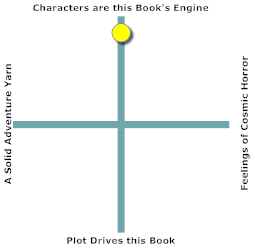
A less significant concern for me was the aspect of horror in this novel. Martinez clearly knows his science fiction, fantasy, and horror tropes, having played them like a violin in his earlier novels. The influence of Lovecraft and Clark Ashton Smith on Chasing the Moon is clear. But while Martinez manages tension very adroitly, that tension never veers into the gut-wrenching, abyssal horror that was emblematic of the classic Weird Tales pulps. Perhaps I’m a little jaded, or perhaps Martinez’ heroine is a little too plucky, a little too ready to deal with the horrors she faces. The tension escalates nicely, but I found myself reading it more like an adventure story than a cosmic horror tale. That being said, it reads as a very strong adventure story.

Overall, I strongly recommend Chasing the Moon. It is a fast-paced, really engaging read. Much like life, it has its moments of laugh-out-loud humor, coupled with moments of deep emotion. If you enjoy Tom Holt, John Scalzi’s Agent to the Stars, or Neil Gaiman and Terry Pratchett’s Good Omens, I expect you will get a particular kick out of it. It’s a great summer book, perfect for reading on the beach…although beware of tentacles reaching up from the depths.

REVIEW: Morlock Night by K.W. Jeter


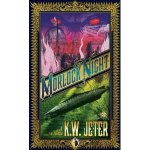
Morlock Night by K.W. Jeter Title: Morlock Night
Author: K.W. Jeter
Pub Date: Reprint: April 26th, 2011
(original: 1979)
Chris’ Rating (5 possible): 1 point 1 point 1 point 1 point
An Attempt at Categorization If You Like… / You Might Like…
A fast-paced steampunk adventure, with strong Arthurian roots and a well-grounded setting.

The best science fiction is protean by nature, combining facets of just about every other genre and defying neat classification within the bounds of SFdom. K.W. Jeter’s Morlock Night straddles many sub-genre fences: Victoriana secret history, steampunk, and Arthurian legend. Originally published in 1979, the book is judged one of the progenitors of the steampunk sub-genre, and its author as credited with inventing the steampunk label (in a 1987 letter to Locus). Having heard of the book but never read it, I was jazzed to read the new edition from Angry Robot. I was especially curious to see how one of the earliest steampunk novels compares against contemporary clockwork fare, and I am happy to report that thirty-two years from its initial publication Morlock Night remains an enthralling, atmospheric, and fast-paced read.

Morlock Night was originally written as part of a ten book Arthurian series which was to be written by Jeter, Tim Powers, and Ray Nelson (alas, the series never took off). The concept was to show King Arthur reincarnated (or awoken) at various points throughout history when Britain needs saving. This fact is intrinsic to Morlock Night, and at one level firmly sets the book in the Arthurian tradition. However, Jeter’s execution of this concept is unique and exceptional.

The book takes place in London in the autumn of the Victorian era. Like the best contemporary steampunk and alternate history authors (e.g. Cherie Priest or Michael A. Stackpole), Jeter uses voice to establish his character’s in time. The story is told in first-person perspective through the eyes of Edwin Hocker, and his word choices and sentence constructions are firmly rooted in the cadences of the late Victorian era. In the hands of a lesser author, such vocal tricks might make the prose dated or stilted to modern sensibilities. Perhaps, if Jeter had chosen to employ third-person perspective, that might well have been the case. But by choosing to tell the story through the eyes of Edwin Hocker, the story gains immediacy in spite of the distancing typical of late Victorian writing styles.

We meet the questing hero as he departs from a dinner party. At this dinner party, Hocker was regaled with an incredible story about travel to the far distant future, and the strange creatures his host encountered on the way. If this sounds familiar, that’s because it should: Morlock Night is actually a sequel to H.G. Wells The Time Machine (which itself was first published in 1895, three years after the events of Jeter’s book).

Jeter builds much more immediacy into his story by eschewing the framing narrative that Wells employed. We meet Edwin Hocker as he departs the dinner party that frames Wells’ classic, and our hero is then swiftly sent by the mysterious Doctor Ambrose (Merlin) to a war-torn future London where he must fight and flee Morlock invaders sweeping across time to take over the world. Jeter does an amazing job establishing the setting for the story. The first chapter takes place on the foggy streets of London, late at night, after the close of the dinner party. Jeter’s narration is atmospheric – literally, and figuratively – and the fog gradually seeps into both his character’s perception and the reader’s. The brooding city streets, the hazy lights gas lamps, the damp: these are elements that one feels reading the book. When Hocker is thrust into the future, the rubble-strewn London he finds himself in remains recognizable, though shattered as if by the Blitz.

Ambrose pulls Hocker (and a woman he meets in that war-torn London) back to the Victorian era, and uses the traumatic experience to convince Hocker to save Britain. Ambrose explains that the dim-witted Morlocks described in The Time Machine were but the Morlock’s uneducated working class, and that when Wells’ Time Traveller returned to the future following the dinner party, the ruling Morlocks captured him, and used the time machine to travel back to 1892. Now, with the aid of an Anti-Merlin character, the Morlocks intend to conquer the past. And this risks unraveling time and destroying the universe. To save the day, Merlin needs Hocker to free the reincarnation of King Arthur from the clutches of that Anti-Merlin, and to reunite the reincarnated king with the scattered pieces of Excalibur.

The plot itself is fairly straightforward, with a standard quest-based structure: step one, step two, complication, step three, complication, climax. But despite the prosaic structure, the characterization, world-building, and pacing make the book a delight to read. The quest for Excalibur takes Hocker into the sewers beneath London, and Jeter’s descriptions of this dark and dank environment are by turns chilling, thrilling, and fascinating. Loving the real London as much as I do, I can easily imagine the detritus of two thousand years washing up beneath London’s twisting alleyways.

It is in those subterranean environments that Jeter comes closest to employing the tropes of the modern steampunk movement. Looked at from the perspective of a modern reader, Morlock Night has a notable dearth of steampunk conventions. There is little (if any) real clockwork, no steam-powered machinery that I can recall, and certainly no airships. The closest approximation is an ancient Atlantean submarine which figures prominently in Hocker’s adventures in the London sewers. But that is a strange, foreign, and ancient technology: neither a product of the Victorian era, nor an extrapolation of Victorian-era technology.

Jeter doesn’t use the steoretypical steampunk devices because the story simply does not need them: it is centered around the character of Edwin Hocker, and the challenges he faces. Technology is incidental to that, and so Jeter wastes no time lovingly describing it. And despite the lack of steampunk window dressing, the book remains undeniably steampunk. In many ways, it is the quintessential steampunk novel: every element – including technology – is seen through the eyes of a late Victorian-era narrator, with the concomitant sensibilities, values, and preconceived notions. That grounds the book in the Victorian era, and conveys that undeniable feeling of almost-plausibility that is characteristic of the best steampunk. At the same time, Jeter’s careful attention to setting, and the atmospheric, layered descriptions root the story firmly in the London of 1892.

Despite its many strengths, the book does have two weaknesses. The first (minor) weakness is that I found the end of the story a bit predictable. That might be because I’ve read plot structures like this one many times over, or it might be because Jeter’s careful foreshadowing built a certain inevitability into the story. However, the book’s predictability is only a minor weakness; even if I was able to guess how it ended, I still loved the ride. The tension remained high, and I continued to be avidly engaged in the story long after I’d figured out the end. That fact is a testament to Jeter’s excellent management of pacing and tension.

The second weakness I consider more substantial. Early in the book, Hocker meets a woman named Tafe in the war-torn future version of London. She returns with him to his own time, and proceeds to be his companion on his various adventures. She represents Hocker’s love interest (of sorts), and a device for furthering plot and motivation in certain key scenes. When we first meet Tafe, she is in charge: much more strong-willed and competent than our hero, Hocker. But as the book progresses and Hocker takes the fore, Tafe recedes. I was disappointed by this perceived weakening of the character. I understand why it happened, and I understand why it might even have been necessary. But I would have preferred it if Tafe continued to have the strength of character and personality that she had initially.

On the whole, I am inordinately pleased that Angry Robot has reprinted Morlock Night. I especially enjoyed Tim Powers’ introduction and the afterward by Adam Roberts’. For fans of genre history, I recommend reading both essays as they provide valuable perspective on the significance of Jeter’s book. As for the book itself, I consider Morlock Night a must-read for any fan of steampunk. Three decades after its initial publication, it continues to be an excellent, enjoyable, fast-paced story. Fans of Cherie Priest, George Mann, and Gail Carriger will find much to love.

REVIEW: Mockingbird by Walter Tevis


Mockingbird by Walter Tevis Title: Mockingbird
Author: Walter Tevis
Pub Date: 1980 (original)
June 2007 (reprint)
Chris’ Rating (5 possible): 1 point 1 point 1 point 1 point 1 point
An Attempt at Categorization If You Like… / You Might Like…
Dystopia that can make you cry.

With Tor.com celebrating “dystopia week” not too long ago, I decided to read Mockingbird by Walter Tevis. Reprinted about four years ago in Gollancz’s fantastic SF Masterworks line, it had been sitting on one of my “to read” shelves for quite a while before I threw it into my travel bag for a business trip. I wasn’t reading it with an intent to review it: all I knew about the book was that it was supposed to be a classic dystopia that I’d never read. But the book had such an impact on me that I felt like I just had to share some of it with you.

The book opens with Bob Spofforth, a “Make Nine” android, enacting a private annual ritual: he tries to throw himself off of the top of the Empire State Building. But his programming prevents him from doing so. The narrative description in the the first chapter paints an utterly believable image of 25th century Manhattan: buildings still stand, buses still run (sort of). The city remains recognizably New York, but humanity has faded and turned inward. Skyscrapers line the streets like Mastodon bones bleached in the sun, and it is through the clinical, analytical description seen over the shoulder of Bob Spofforth that we get the sense of mankind receded, silent, and sad.

Through Spofforth, we learn that some time ago humanity came to believe in a principle of supreme privacy: that so much as talking to another person or looking them in the eye can impinge upon that privacy. Like soma in Huxley’s Brave New World, Tevis’ humans rely on drugs to help manage their moods and adjust their daily lifecycle. With machines to do everything for them, with indoctrinated cultural rules about privacy in force, humanity is rudderless, with no purpose, direction, or even concept of such. The robots are there to do it all for them. And since no humans remain who can repair the robots, the machinery that keeps society treading water is slowly breaking down.

Spofforth is a suicidal tyrant more human than many of the actual people we meet in the book. He knows that the species homo sapiens is dying out, with negative population growth. Into Spofforth’s Manhattan comes Paul Bentley. At first blush, the reader expects Paul to be a Promethean figure, having discovered a version of the Rosetta Stone (a film through which he could match words to a reading primer) and taught himself to read. Paul offers to teach others how to read, but instead Spofforth assigns him to do audio-recordings of the title cards in ancient silent films.

Paul is fundamentally a flawed hero. Despite his one act of initiative, he remains a product of his society: unwilling and unable to transcend the limits imposed by his value system. He does as instructed, despite niggling hints of rebellion in the back of his mind. Then, he meets Mary Lou: a dyed-in-the-wool rebel living in the city zoo who refuses to live by society’s neat rules. He introduces her to reading, and together the two of them re-discover the written word. It is this section of the book – perhaps the book’s first half – that reduced me to tears. Watching Paul and Mary Lou learn to read taps into everything wonderful about books, language, love, beauty, and what makes us human. Using the simple, limited vocabulary of a functional illiterate Tevis subtly broadens his characters’ horizons with masterful subtlety. Tevis suggests that our desire and ability to read are at the core of what makes us human, and that the moment we lose touch with the written word we risk fading into meaningless despondency.

The second half of the book remains solid, but I didn’t find it as emotionally powerful as the first. Shortly after Spofforth discovers Paul and Mary Lou’s exploration of reading, he has Paul arrested and sent to prison. In prison, Paul must develop the independence of spirit to break free and return to New York and Mary Lou. It would not be fair to say that the second half of the book is weak: it is not, and the final climax that resolves the fates of our three heroes (Paul, Mary Lou, and Spofforth) is particularly poignant. But despite the quality of the second half, it is the first which remains heart-wrenchingly perfect.

As I mentioned last week, I disagree with Jo Walton’s argument that dystopia isn’t science fiction. But Tevis’ Mockingbird does offer her POV some evidence. Looking at his career in total, it’s a bit of a stretch to call Walter Tevis a science fiction writer. Of his six novels, only two (Mockingbird and The Man Who Fell to Earth) can be called science fictional. The others (of which The Hustler and The Color of Money are probably the best known) are all mainstream literary works, several of which have been adapted into excellent movies.

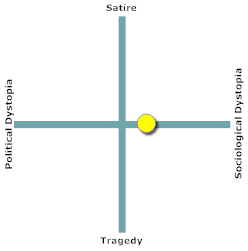
However, Mockingbird does employ some of the techniques earlier put to work in Orwell’s Nineteen Eighty-Four or Huxley’s Brave New World. Where Tevis departs from the earlier dystopian mode is to present his dystopia not as the consequence of people-who-know-better controlling the sheep. There is no “grand conspiracy” at work to keep mankind down. In fact, the only character who has the power to enforce such a conspiracy (Bob Spofforth) is as much a prisoner of the dystopia as our human heroes. This adds a dimension to Mockingbird which I find particularly interesting, as it places the blame on creating a dystopian world squarely on its creators: us.

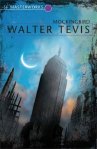
Gollancz has consistently excelled with their SF Masterworks and Fantasy Masterworks series, and the actual physical product of Mockingbird is very well done. It sports an attractive cover by Dominic Harman which really sets the tone for the grim, dark world of 25th century Manhattan. And – much like Tevis’ book – it suggests that hope may be just around the corner.

On the whole, Mockingbird is hands-down the best dystopia I have read in a very long time. It provides an emotional and philosophical gut-punch that is difficult to rival. I think this is a must-read book for anyone who loves books, who loves reading, and who loves language. In the passages where Paul discovers new words and ways of looking at his life we can find all the truths of the world.

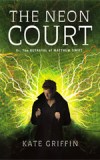
REVIEW: The Neon Court by Kate Griffin


The Neon Court: Or the Betrayal of Matthew Swift by Kate Griffin Title: The Neon Court: Or, the Betrayal of Matthew Swift
Author: Kate Griffin
Pub Date: March 24th, 2011
Chris’ Rating (5 possible): 1 point 1 point 1 point 1 point
An Attempt at Categorization If You Like… / You Might Like…
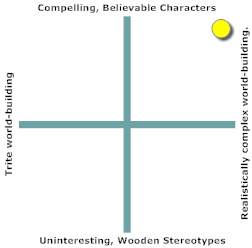
Excellent, evocative, and innovative world-building with ambitious characterization techniques.

Like many of my favorite fantasy finds, I first came across Kate Griffin’s Matthew Swift novels while on a business trip to London. This is kind of appropriate, considering how central London is to Griffin’s impressive urban fantasies. In her third Matthew Swift novel, The Neon Court: Or, the Betrayal of Matthew Swift, Griffin continues to impress with her unique take on contemporary magic and successfully strengthens her already-impressive characterization.

I first noticed Griffin’s writing with A Madness of Angels. In that book, she created a fascinating new spin on magic by inverting traditional eldritch trappings and fundamentally modernizing them. Her underlying conceit is that sorcery is a by-product of life, and because we lead ever more urban lives today, magic, too, must grow more urban. As a result, the magic of Griffin’s London is not that of moonlit rituals and twining ivy, but instead of subway cars and swirling fast food wrappers. What makes this conceit work in A Madness of Angels, and what continues to make it work through The Neon Court, is how solidly Griffin grounds her system in the real London, and how consistently she applies her new spin on magic.

Griffin’s images of contemporary London seep through into her characters and the urban magic of her world. The incidental characters we meet along the way are appropriate to their locales. Whether we’re talking about the professional Westminster-ish Aldermen (a bunch of bureaucrats…and more), the Tribe in the deepest parts of the East End, or an Irish seer living in Mile End, the characters are all believable because every one of their aspects is rooted in place: speech patterns, clothing, behavior, values, they all ring true to their environment.

This sense of place is also inextricably woven into the magic of her world. Every metropolitan idiosyncrasy becomes grist for Griffin’s magical mill. One gets the sense that there is sorcery lurking just beneath every insignificant fragment of Griffin’s London. Consider the Oyster travel card, or London’s many tourist traps. In the hands of a lesser author, the former would just be an incidental prop used to get on or off public transit, and the latter would just be settings. But Griffin makes them all potent magical talismans. This was impressive when first developed in A Madness of Angels, but even more impressive is how Griffin continues to expand and develop her magic system as the series progresses. In each of the Matthew Swift books, she introduces us to significant new facets of London’s magical underbelly, and nearly half of the fun in reading these books is seeing what new urban wizardry Griffin’s imagination will come up with. In The Neon Court, she asks how would the traditionally rural Faerie Court evolve in the modern urban world? Other authors – notably Emma Bull in her seminal War for the Oaks – have asked this question as well, and Griffin’s spin on it (the titular “Neon Court”) is innovative, unique, and fundamentally believable.

Her characterization – and especially that of her hero/narrator, Matthew Swift – is the next most impressive aspect of this series. Swift is a fractured hero, his mind merged with that of the blue electric angels (god-like personifications of the ghosts-in-the-wire who inhabit telephone and electric wires). Depending on which aspect of his personality is in ascendance, his narration veers from the perpendicular pronoun to first person plural, and at times shifts into a disjointed stream-of-consciousness. In the earlier books, this was a daring gamble on Griffin’s part. It made Swift’s struggle to re-assemble his mind and personality vivid, but risked disorienting an inattentive reader. Griffin walked a fine line in the earlier books, but she managed to pull it off. Swift’s fractured nature is so intrinsic to the first book’s plot, that the disjointed narrative added to the storytelling overall.

By the time we get to the third book, Griffin, Swift, and the electric blue angels are all more comfortable in Swift’s head. As a result, the narrative flow of The Neon Court is smoother, with fewer sudden shifts, and where those sudden shifts do occur, they are handled more subtly than in the earlier books. In general, I find the characters in The Neon Courtto be more carefully constructed than in the earlier books. As Swift’s focus shifts from internal (putting his mind back together) to external (saving London and his friends), Griffin’s characterization of secondary players strengthens as well. I felt that the third book does a much better job characterizing supporting characters like Penny (Swift’s apprentice), Dees (Swift’s Alderman lieutenant), and even Theydon (a thrall in the Neon Court) than the earlier books did.

If there is a weakness in the Matthew Swift novels, it is that it would be hard to start with the second or third installment. In The Neon Court, Matthew Swift struggles to save London and his friends from a terrifying magical threat amidst a burgeoning factional war amongst London’s magicians. The stakes, the characters, the plot, and the world are all adequately communicated. But a reader coming fresh to this world is likely to be confused by everything that came before. Swift’s history with R.J. Bakker (established in book 1), and his role as the Midnight Mayor (which was established in The Midnight Mayor: Or, the Inauguration of Matthew Swift), for example, are all central to The Neon Court’s plot. While there are passing explanations offered in the text, the book assumes the reader is already familiar with these events. However, their ramifications would be unclear to someone coming into the series with the third book.

Despite this fact, I recommend Griffin’s Matthew Swift novels, and especially The Neon Court: Or, the Betrayal of Matthew Swift. Readers who enjoy contemporary fantasy with innovative, vivid world-building will find a lot to enjoy in these novels. They are excellent examples of urban fantasy, particularly of the non-paranormal romance variety. If you enjoy the fantasies of Neil Gaiman, Emma Bull, Jim Butcher, or Harry Connolly, I suspect you will also enjoy Kate Griffin’s books. The entire series is good, and I found that it strengthens significantly in all of the right ways as it continues.

REVIEW: Second Sight by Cheryl Klein


Second Sight by Cheryl Klein Title: Second Sight
Author: Cheryl Klein
Pub Date: March 11th, 2011
Chris’ Rating (5 possible): 1 point 1 point 1 point 1 point
An Attempt at Categorization If You Like… / You Might Like…
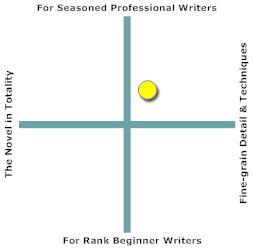
A strong reference compilation on writing from an experienced children's book editor.

Several years ago, The Professor (my fiancée) introduced me to children’s book editor Cheryl Klein’s blog, where I discovered several years’ worth of thoughtful, analytical, and insightful talks she has given on the craft of writing and its intersection with the craft of editing. Having found her thoughts interesting, I was excited to learn that Klein is now releasing a self-published, crowd-funded (via Kickstarter) book on writing entitled Second Sight. I was lucky enough to get my hands on a review copy not too long ago, and found it be challenging, insightful, and professional in all the right ways. This is a book for people seriously interested in writing as both a craft and a career: people looking for touchy-feely encouragement or platitudes on the “writing life” need not apply.

From my perspective, this is high praise. What I look for in books on writing is a serious discussion of the techniques used to construct effective, powerful, and publishable fiction. Whenever I read a new book on writing, I am always comparing it to the books on my “Writing on Writing Shelf,” which is primarily stocked with classics like E.M. Forster’s Aspects of the Novel, John Gardner’s The Art of Fiction, Ayn Rand’s (very different) The Art of Fiction, or Ursula K. Le Guin’s The Language of the Night: Essays on Fantasy and Science Fiction. Klein’s Second Sight is like these excellent books in many ways.

Second Sight demands a modicum of pre-existing knowledge. Someone still struggling to grasp the basics of writing (figuring out what a plot is, understanding the difference between point of view and voice, etc.) will likely find this book intimidating. An intermediate writer (as I like to consider myself) – who has been working at the craft for several years, who has a finished (though not yet published) novel or two under their belt, and who is looking for helpful ways to think about technique – will derive a lot of value from this book.

Like Forster, Gardner, and Rand, Klein flits effortlessly between the high-concept philosophy of writing (the nature of fiction, the nature of art) and the gritty reality of constructing a working novel (building point, character, plot, and voice). It is clear in reading this book that Klein has thought long and hard about what constitutes good writing, and what criteria to apply when judging the written word. However, unlike E.M. Forster, or John Gardner, (and certainly unlike Ayn Rand) Second Sight is far less didactic.

Reading Le Guin’s, Forster’s, or Gardner’s works on writing, I am often reminded of looking at a skyscraper. In Forster’s Aspects of the Novel, he takes 192 pages to walk us through the six pillars on which all novels rest. Each chapter builds on those that precede it to concisely outline the author’s vision of The Novel, like one floor resting atop another. This kind of writing on writing provides immense value, but it is by its very nature broad: it speaks in generalities from a hundred stories above the ground, glossing over many challenging aspects of writing. But if reading Forster is like looking at a finished skyscraper, reading Klein is like looking over an architect’s shoulder.

When I finish classic books on writing, I am often left with a feeling of “Whoa,” as my perception of The Novel has changed. Reading Klein cover to cover doesn’t produce that response. Instead, each chapter of Klein’s book leaves me with a smaller sense of “Neat!” that shifts my thinking on a particular facet of the craft. I wouldn’t be able to swallow a book like this in one or two sittings. In the two or three months that I’ve had my review copy, I’ve found that I would read a chapter or two, put it aside, and then return to it repeatedly when running into tough spots in my own writing. And that is its primary value: as a helpful tool for the dedicated writer struggling with the minutia of craft.

The primary meat of this book is framed by practicalities. It opens with a series of brief philosophical musings on the nature of good writing, and then dives right into the process of finding a publisher. That fact alone should tell you that this isn’t a book for someone who has never written anything. However, those early chapters are beautiful for their simple, straightforward discussion of the publishing process. The annotated query letters (one “from hell” and one which “gets it right”) are excellent, providing real-world lessons that can be applied by anyone intending to pitch editors or agents.

The middle of the book consists of independent chapters on various aspects of writing. The subjects range from a working definition of young adult literature, to techniques for constructing picture books, to the relationship between plot and emotion. There are commonalities across all of these sections, but they are not structured – and should not be read – as laying out a dialectical argument. Instead, they are insightful musings on varied aspects of writing, which may be relevant to some readers some of the time…but not to everyone, and not always.

It is only as she approaches the end of the “meaty” section that Klein veers into a Forster-esque mode of outlining a “theory of the novel.” Captured in a sixty-four page quartet of chapters (with their own introduction), Klein discusses what she considers the pillars on which a novel rests: point, character, plot, and voice. While these chapters are insightful and valuable, they represent the book’s one structural weakness: up to this point, the chapters all provided valuable insight without relying on the other chapters. Diving into the quartet on page 186, with its concomitant shift in structure and tone, struck me as inconsistent with the rest of the book’s structure. Without a doubt, the quartet deserves a place in this book, and I understand the difficulty Klein likely had in figuring out how to get it to fit. However, I suspect it could have benefited from either an alternative placement (perhaps earlier in the book, amidst the more “philosophical” chapters), or a better lead-in. But despite the inconsistency in structure and approach, the quartet – and the other independent chapters – still provide great value.

The last third of the book returns us to the brutal reality of revising a finished work. Her chapter on twenty-five revision techniques is immensely practical, the type of bare bones heavy lifting that every author should do, but that nobody likes to think or talk about. This section is immediately applicable to anyone who has finished a written work (of any length), and is now embarking on the revision process. The concrete advice given here clearly stems from years of editing books as a career. No shortcuts are given, no platitudes are offered: writing is hard work, and Klein lays out a series of techniques to produce higher quality work.

Second Sight is unlike most of my writing library. In general, that library consists of books that either try to lay out an all-encompassing theoretical framework (Forster, Gardner, Rand), analyze critical genre theory (Mendelsohn, Clute, Suvin), or exhaustively detail a particular facet of writing (Card, Kress, Propp). Some of the books in my library are well worn: the books I return to frequently as I think about my own writing. Since getting my review copy of Second Sight, it has never left my desk. It doesn’t answer the question of “What is The Novel?” but it does answer the question “What goes into an effective novel?” And for someone working on writing new works while revising what they have already written, I suspect this is the most important question.

NOTE: As I mention above, Second Sight is a self-published book, and can be ordered from Cheryl Klein’s web site at: http://cherylklein.com/buying-second-sight. Also, be sure to check out her great blog.

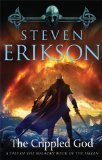
REVIEW: The Crippled God (Malazan Book of the Fallen, Book 10) by Steven Erikson


My apologies for posting this on Wednesday, rather than Tuesday. I know I’m late, but I got caught up with day-job work and so…sorry. Hope the timely review makes up for the delay.

The Crippled God by Steven Erikson Title: The Crippled God: Book Ten of The Malazan Book of the Fallen
Author: Steven Erikson
Pub Date: March 1st, 2011
Chris’ Rating (5 possible): 1 point 1 point 1 point 1 point 1 point
An Attempt at Categorization If You Like… / You Might Like…
The impressive culmination of an epic eleven years in the making.

The word “epic” gets thrown around more often when talking about fantasy than a well-aimed dagger. I’ve seen it applied (and done so myself) to Tolkien, Brooks, and Donaldson, to Jordan, Martin, and Eddings, to Jemisin, Rothfuss, and Sanderson, and the list goes on. In most of these cases, the word “epic” is an apt descriptor. But I would argue that Steven Erikson and his ten volume Malazan Book of the Fallen out-epic all of these other epics in its epic-ness. The world created by Steven Erikson and Ian C. Esselmont, each individual book in Erikson’s series, and the complexity of the story Erikson planned out from the beginning: each of these alone can be justly described as epic in scope, epic in scale. But in this genre that tosses around the E-word like it was going out of style, I believe that Erikson’s ambition is the most epic of all. And having now read Erikson’s The Crippled God, the tenth and final installment in his Malazan Book of the Fallen, I believe that Erikson delivered on the “epic” promised back in 1999.

DISCLAIMER: I am not saying that the Malazan Book of the Fallen is “better” than the Wheel of Time, or A Song of Ice and Fire, or the Belgariad, or Shannara, or insert-your-favorite-fantasy-series-here. However, I do believe that it is different. This difference especially applies to its world building and plot structure, and in many respects to its themes and characterization. In its plot structure and world building especially, I find it far more complex than those other series I just mentioned. But “more complex” does not mean better. It just means more complicated.

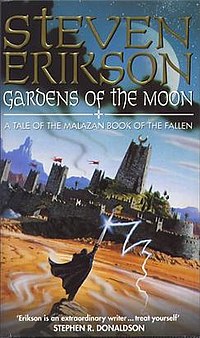
A little over eleven years ago I was waiting to board a transatlantic flight in Warsaw, Poland, idly browsing the tiny English-language section of a little airport bookstore, when I stumbled across a thick book. Tantalizingly titled Gardens of the Moon, by an author I’d never heard of before, and with a cover not-quite-sf/not-quite-fantasy by Chris Moore that instantly set it apart from the contemporary Chihuahua killer epic fantasies of Jordan, Martin, and Goodkind, I had to buy it. I spent the next nine or ten hours sucked into Steven Erikson’s visceral, violent, gripping world. Since that fateful afternoon, I have eagerly anticipated each new volume in Erikson’s opus, and so it was with childish delight (and squeeing) that I stumbled upon a copy of The Crippled God two days before its official pub date in my local Borders.

Gardens of the Moon (via Wikipedia)

Gardens of the Moon by Chris Moore (via Wikipedia)

To read Erikson’s work, one must be prepared to immediately suspend disbelief, and to dive headfirst into a world rich with layers of history, culture, politics, and mythology that would make Tolkien’s head spin. Readers not already well-versed in the conventions of the fantasy genre might find it all a bit confusing at first. But for those readers able to suspend their disbelief, and who are prepared to intuit or await elucidation, the Malazan Book of the Fallen is an immensely enjoyable series. The Malazan world was created by Steven Erikson and Ian C. Esselmont in their role-playing campaigns. But the two brought to their creation their extensive expertise in anthropology and archaeology, resulting in a world with intricate, distinct cultures, complex historical societal relationships, economic balances, and military history.

Over the course of the ten book series, we follow many (I lost count at around forty five) distinct groups of characters. Some groups are small, numbering maybe one or two members, while others are large factions with many characters going nameless. However, each of these groups is presented completely, meaning that they are drawn as round (using E.M. Forster’s definition), fully-fleshed characters. Erikson shows us everyone’s fears, doubts, concerns to such a degree that by the time we’re halfway through the first book, the very concept of “hero” and “villain” has lost all meaning. It is this moral ambiguity, this rationalization and justification of character choices and ethical mistakes, that drive the series’ themes.

The first five or six books in the series are self-contained wholes. The events of each book occur non-linearly, following several distinct “tracks” of events separated by both time and space. The main tracks comprise different books in the series, at least in the beginning. This makes it possible for a reader to start either with Gardens of the Moon (Book 1), or say Deadhouse Gates (Book 2), or Memories of Ice (Book 3).

Reading them in order of their publication, I was initially surprised and confused by their non-linearity. Where were the characters I had met and fallen in love with in the earlier books? What had happened to them? What were they doing? But like a master weaver, Erikson successfully introduces new strands while maintaining interest in those that came before. This separation across books in the series begins to collapse around Midnight Tides (Book 5), where a new reader coming into the story would be so completely lost in the whirling politics of gods, cities, armies, factions, squads, races, creeds, etc. as to make it an exercise in futility.

It is at this point in the series (books 6 – 8), that Erikson stumbles for the first time. This stumble is interesting to note, precisely because it touches upon his introduction of higher-level, more abstract philosophical themes into the story. The first six (arguably seven) books are largely plot driven. We follow the striving of different groups of characters – especially the Malazan military – as they attempt to achieve their goals. The books are thematically interesting, but there is a palpable sense that reader doesn’t yet know everything. In the sixth, seventh, and eighth books, Erikson thickens the plot by explaining more complex historical relationships, and introducing new gods, and new players. The introduction of this history, and metaphysical motivation for certain characters introduced in the eighth book, slows the pacing significantly. These latter books remain readable, but I had to read them at least twice in order to really understand what was happening. They are not bad, but they are much more dense than the other books in the series, and those books are already more dense than most epic fantasy fare. Thankfully, Erikson again hits his stride in Dust of Dreams (book nine) as he now has all of the actors on stage and moving towards the climax in The Crippled God.

And what a climax! The series tracks several hundred (again, I lost count) distinct plot lines. But they are all brought together in the tenth and final book. Perhaps more importantly, it is also in the The Crippled God that we see the thematic lines from the earlier books brought together. The thematic convergence in The Crippled God is one of the most impressive aspects of the series. Each of the earlier books has its own themes, which are in and of themselves complicated and well-executed. But after reading The Crippled God, the themes of earlier books are either clarified, corrected, or shown as illusory. Unifying these disparate (and oftentimes contradictory) themes without invalidating them is a neat trick, and makes the intellectual and emotional exercise of the whole series quite worth it.

From a stylistic standpoint, Erikson takes more from the gritty, boots-in-the-mud fantasy of Glen Cook than he does from the elf-and-dwarf high fantasy of J.R.R. Tolkien. Erikson’s primary characters are soldiers, and he draws them as imperfect, swearing, and swaggering. While dragons, and Erikson’s version of elves feature quite prominently, his characters are very far removed from Smaug or Legolas. It is the darkness and grit of his world that makes it compelling, that subverts the traditional tropes of the genre. Dragons as mad almost-gods? Heroes who (along with the reader) are ignorant of their quest, and just have to do as they’re ordered? These are fun subversions.

I found Erikson’s take on women in his books particularly interesting. Historically, I have often found fantasy to be full of stereotypical square-jawed male hero-types, with damsel-in-distress ladies swooning in the wings (if they are present at all). Erikson’s female characters are more likely to break a hero’s jaw than pine or swoon. They are soldiers, and conspirators, and commanders equal in all respects to the men, while still evidencing deft characterization that makes them fully believable. Both the men and women are flawed, emotional, sometimes angry, sometimes not. Erikson makes them complex, while retaining their intrinsic humanity. Which is refreshing in a genre often dominated by particular molds.

I have spent the past twelve years with these characters. Their stories have in many respects become a part of me, like old friends. The tenth book brings Erikson’s enormous cast of characters together, and wraps up their stories. With one or two (notable) exceptions, we learn what happens to everybody, how they end up. The tenth book is in many respects about closure, and Erikson unflinchingly brings the story of different groups and characters to a close. But – and this is one of his points – even though the book gets closed for some characters, life goes on. The unity of character, plot, theme, and execution in this tenth book is singularly impressive.

However, for everything good about his work, the complexity – of his characters, plots, themes – can be quite off-putting. One reader (whose opinions I respect greatly) very much dislikes Erikson’s work. She claims that it is too hard to follow, impossible to keep the myriad characters and plot lines straight even within a single book, let alone across a ten book series. For many readers, this will be a valid criticism. Erikson has produced a truly dense, complicated work of fiction. Myriad plot lines, more characters, complicated races that often go by different names, complex battle scenes shown from the perspective of multiple soldiers in the thick of it, this is writing that demands real work from the reader to keep things straight, to follow along with events. I found myself often having to read or re-read sections (and in some cases, entire books) just to really figure out what the heck actually happened. For many, this will be a weakness: why should I have to work so hard for my fiction? But I personally found that I enjoyed doing that work, that I enjoyed getting to spend time in an ugly, dark fantasy world that was realistically built while still employing the tropes of fantasy.

Back in 1999, Erikson told fans that the Malazan Book of the Fallen would be a nine book series. Like any gargantuan epic, this was an ambitious goal. However, Erikson executed on this ambition both in the creative sense, as well in the practical sense: publishers and fans like to see epic series come out with new installments on an annual basis. Publishers like it because it helps them push paperback editions of the earlier books, and fans like it because we can still remember what’s going on in the story. But in a sub-genre famous for delays (George R.R. Martin’s A Dance of Dragons has been delayed five years already and still counting), it is incredibly refreshing to come across an author whose ambition is so vast, whose story is so complicated, but who still manages to produce quality work reasonably on schedule. It’s refreshing, and my hat is off to Erikson for delivering on his vision.

Although I have read that Erikson is planning a new eleven book arc in the Malazan world, The Crippled God represents in many ways the end of an era. It is a masterfully-executed conclusion to a complicated, ambitious, dense opus. On the one hand, I am glad that the series is over, that Borders screwed up and I managed to get my hands on a copy several days before its official release, and that Erikson satisfied my (high) expectations from it. But on the other hand, I will miss the anticipation of the next book, will miss getting to laugh and cry with the characters I’ve enjoyed over the last twelve years.

Erikson’s Malazan Book of the Fallen is a complex, involving, and emotionally powerful epic fantasy series. There is no series more deserving of the word “epic”. Pick up a copy of Gardens of the Moon, and see if you like it. Be prepared to work at it, because it is difficult. But difficult does not mean bad, and rest assured that by the time you get to The Crippled God, you will find your investment has been fully justified and amply rewarded.

Malazan Book of the Fallen by Steven Erikson

REVIEW: Epic Mickey


Disney Epic Mickey Title: Disney Epic Mickey
Platform: Nintendo Wii
Pub Date: November 30, 2010
Chris’ Rating (5 possible): 1 point 1 point 1 point 1 point
An Attempt at Categorization If You Like… / You Might Like…
Rich Game Play and Well-crafted Storytelling

Epic Mickey is an excellent installation in the Mickey Mouse oevre from the designers at Disney Interactive. Combining excellent storytelling, appropriate art design, decent level construction, and varied and smooth gameplay, Epic Mickey is a great way for kids (and their parents) to meet Mickey Mouse.

In fact, let me start by saying that I have never been a Mickey Mouse fan. Forget Disney, I always thought. I loved Bugs, and Daffy, and Wile E. Coyote…no squeaky rodents or incomprehensible mallards for me, thank you very much. So while I was excited by Epic Mickey, I didn’t come to it with any particular affinity for the characters. In point of fact, having actively disliked the characters since childhood, I’d say I was initially skeptical about the whole affair. The premise of the game, however, abated my skepticism at least a little bit.

A sorceror uses a magic brush to create a home for all of the unwanted, unloved, forgotten cartoons. He tries to make a safe, welcoming, comfortable home for the rejects of the Disney universe: old Disney characters like Oswald the Lucky Rabbit (the prototype for Mickey Mouse), or Gremlin Gus (from the early Disney comics), etc. But of course, Mickey goes and screws it up by spilling paint and then paint thinner over the work-in-progress. This has two principle effects: first, it destroys much of the countryside, turning it into The Wasteland. And it introduces evil (a “blot”) into the rejects’ idyllic home. Mickey, of course, is oblivious to all of this and goes on his merry way. Some time later, Mickey gets sucked into the Wasteland by an alliance between the Shadow Blot (the personification of evil), the Mad Doctor (a crazy mad scientist), and Oswald the Lucky Rabbit (the de facto head of state in The Wasteland). Armed with magic paint and magic thinner, Mickey has to find some way of escaping The Wasteland. Along the way, he can either try to improve things (by painting objects using his paint brush) or make them worse (by thinning them using his thinner).

The idea of Mickey traveling a land of forgotten cartoons and having to constantly choose whether to do good or bad gives the game a thematic appeal that I’ve always found missing in Disney’s short cartoons. The game designers clearly held this premise foremost in mind when designing the game, because everything is subordinate to it. As most of these forgotten cartoons are old (from the ’20s, ’30s, ’40s, etc.) the art direction has a solid retro feel. But, this retro feel is most palpable during the game’s cinematic sequences, and in the “platform worlds” interspersed between major game chapters. When actually playing the game, it feels like walking through a stage set up to look like the 1950s: complete with cardboard cutouts that Mickey can either make more or less real. The net result is that art direction at each point in the game lends valuable support to the core premise.

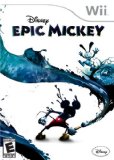
Epic Mickey Screenshot, Ostown

Epic Mickey, Screenshot originally from: http://www.n1ntendo.nl/article/35601/1/Wii/disney-epic-mickey

The writing within the game is excellent, and also tightly supports by both the wonderful art and the premise. The story follows Mickey through a logical progression of discovering The Wasteland and responding to a dizzying array of characters he meets there. During the game’s many cinematic sequences, the animation is fluid and the audio reasonably good. Some folks I’ve spoken to complain about not having much voice acting in the game, but that didn’t bother me in the slightest. I thought the choice actually contributed to the “retro” feel of the game. Within the game itself, Mickey interacts with characters (good and bad) who react to him in different ways based on the ongoing choices he makes. Not having been a big Disney fan, I can’t say if this interactions are true to these characters’ histories, but the writing for them is excellent, in that it accomplishes several valuable goals:

World-building Each of the characters Mickey interacts with has a past that starts before Wasteland was created. Some ask Mickey if he remembers them from when they had bit parts in early Mickey cartoons, for example. Others talk about what life was like before the disaster that turned their home into Wasteland. This serves to really cement the gamer in the world of Watseland.
Thematic Tension Because the characters have pasts, because they react to the disaster, and because their behavior changes based on the ongoing choices Mickey makes during the game, their writing serves to maintain the thematic tension introduced by the basic premise. Mickey holds the fate of Wasteland in his hand: what will he do? As the game progresses, this thematic tension increases and the writing reflects that.
Game Progression The writing for all of the characters, and the interactions and quests that they give Mickey serve to really round-out the storyline. It becomes multi-linear about an hour or so into the gameplay and really opens up the world for experimentation and enjoyment. The writing really serves to make this interaction and the branching game play paths it offers quite seamless.

The game play itself is reasonably varied. The primary action in the game occurs as a three-dimensional platform game, not unlike Super Mario Galaxy or the Sly Cooper (PS2) games. However, the level design is a lot less complicated than in Super Mario Galaxy, with a much greater focus on how levels relate to the world of Wasteland and the story of Epic Mickey. In this respect, the level design much more resembles Sly Cooper (PS2) franchise. And, in the case of this game, this is good because it more tightly links the level design to the underlying premise and story.

The initial worlds provide a decent orientation to the game play, introducing the player to the techniques they will use throughout the game (especially techniques for painting and thinning aspects of the world). However, I found that the “orientation” worlds lasted a little too long for my taste (about 10 – 15% of the game or so). However, that may be because I’m a video game player in my late 20s who has seven video game systems hooked up to his television. Don’t get me wrong, the orientation worlds were fun. But the game play changes when a more quest-oriented system is introduced after the first two worlds. The action continues to be three-dimensional and platform-style, but the motivation and the places that Mickey can go become much more broad. At that point, Mickey can choose which quests he wishes to complete, where he wants to go, and how he wants to complete those quests. With the game’s horizons opened in this fashion, I found I enjoyed the game much more from this point. It gave me greater engagement with the character and the story, and became about more than slogging may way through a bunch of linear worlds.

The quests break up the game play nicely, but so too do the “inter-world” levels. These are more traditional, two-dimensional platform levels. They are “traveling” worlds that Mickey needs to get through to proceed from one section of the Wasteland to another. What’s great about them is their design: they are designed like old 1930’s or 1940’s film strips, complete with undulating film reel border. Some are in color, while others are in black and white. This brief 2D switch up provides great variety in the game, while their design makes them a real treat to play.

Epic Mickey is a very solid game. With excellent writing and superb design, the game provides many hours of enjoyment. The biggest complaint I have about this game is its camera control. That’s not unique to this game (I find it’s a common problem on many Wii games), but this game was especially prone to placing me in positions where I could not position the camera such that I could see where I would be jumping, or to allow me to adequately aim my paintbrush at objects/enemies. While I still enjoyed the game and I was able to play through it without too much swearing, this problem was sufficient enough of me to knock a star off of my rating for it. However, despite that complaint I still think this is a great game for kids and adults alike. While the premise and the theme are dark and complex enough for adults to get a kick out of, like the best middle-grade novels, they are still presented in a fashion that an eight year old will enjoy just as much.

REVIEW: The Broken Kingdoms by N.K. Jemisin


The Broken Kingdoms by N.K. Jemisin Title: The Broken Kingdoms
Author: N.K. Jemisin
Pub Date: November 3rd, 2010
Chris’ Rating (5 possible): 1 point 1 point 1 point 1 point 1 point
An Attempt at Categorization If You Like… / You Might Like…

In The Broken Kingdoms (the second book in her Inheritance Trilogy, begun in The Hundred Thousand Kingdoms), Jemisin successfully avoids the middle-book-blues by constructing a beautiful mosaic of unique and skillfully executed traits rarely seen in fantasy. Most importantly (and most impressively), you can enjoy it without having read The Hundred Thousand Kingdoms), although the experience will be richer if you have.

It is hard enough to maintain momentum, pattern, and voice in a single novel. But publishers love multi-book series for good economic reasons (who doesn’t love reprint sales?), and so do authors (who doesn’t love contracted advances?). Unfortunately, very few authors are up to the challenge of constructing a story arc that will span multiple books, not drag, let each installment work on a standalone basis, and do something new, meaningful, and entertaining. If Broadway is littered with excellent first acts, then Borders is littered with excellent first books. Readers of The Hundred Thousand Kingdoms may be surprised to see few characters they recognize. While set in the same universe and dealing with the same (divine) conflict established earlier, this book is told from the perspective of a very different hero. It is a complete, and self-contained story that builds off of the events of the previous book and would be an excellent standalone novel in its own right. Jemisin is constructing a fascinating standalone epic trilogy that reminds me more of Homer’s Odyssey than Tolkien’s Lord of the Rings.

The Broken Kingdoms follows Oree Shoth, a blind artist living in Shadow, a city beneath the World Tree and the city of Sky perched atop it. Oree takes in a taciturn and mysterious lodger, and finds herself plunged into a conspiracy centered around the serial murders of godlings. The conspiracy, Oree’s involvement, and the steps she takes to survive give the book a solid rhythm and provide momentum that Jemisin maintains through to the end. And while this book’s plot is strong and engaging, the book’s real engine are the characters and their relationships and its fuel are the ways in which it subverts epic fantasy tropes.

Oree is a disabled member of a historically-oppressed minority. As a result, she represents a refreshing antithesis to the standard fantasy heroine (Oree is neither white, nor is she able to wield two swords at once in a spinning dance of death). In the hands of a lesser author, Oree’s race would turn this book into a simplistic caricature of contemporary racial relations, but Jemisin neatly avoids that trap. Oree’s background and the history of her race are intrinsic to the plot, but her character is woven of more complex strands than race alone. By taking the societal consequences of ancient choices and making them concrete through the experiences of her characters, Jemisin produces a rich and complex society, and avoids the solipsistic condemnation of either the majority or the minority. This enables Jemisin to introduce much stronger and deeper characterization for her principle actors, building a very subtle and effectively post-racial character without sacrificing the plot elements that hinge upon her narrator’s background.

Oree has some magical ability, but she neither understands it nor is it ever explained to her by a helpful teacher. Reading the book, we are as much in the dark as to her ability as she is, and we are pulled right along with her as she discovers the truth about herself. The emotional core of the book are Oree’s complicated relationships with the men in her life (the silent homeless man she names “Shiny”, and her godling lover Madding), and it is these relationships and her complex feelings for them that motivate her actions. The supporting characters are all drawn believably. The godlings – by their very nature – are flat characters yearning to break into three dimensions, and the sensitivity with which their efforts are handled really make you feel for them. Just like the mortal Oree, they are products of their own histories and their own family histories, and it is through this excellent characterization that Jemisin is able to explore her primary themes of choices, family, and relationships.

Oree, as the mortal narrator, provides us with a very identifiable perspective on these themes, both within herself (as a mortal Maro) and amongst the gods of her world. The characterization in this novel is the best part about it, although the characterization is so good precisely because everything else (the world-building, the language used, the magical system) contributes to it. Jemisin uses first person narration to extremely good effect, limiting the reader’s awareness to that which Oree herself would notice. But the real trick of characterization, and what seals the deal for me actually occurs at the end. I won’t spoil it here, but the denouement is used in an exceptional way to tie together the themes that Jemisin explores throughout. It brought tears to my eyes, which for jaded old me is not that easy to do.

By subverting so many fantasy tropes, it is difficult to categorize The Broken Kingdoms. It shares a palpable sense of consequence and history with Steven Erikson’s Malazan Book of the Fallen, but it is (thankfully) more approachable, less convoluted, and less gritty. It shares the playful and sensitive touch when twisting fantasy tropes that can be found in Brandon Sanderson’s Warbreaker and Elantris, but it is more powerful thematically than either. It has the gripping pacing and excellent characterization of Patrick Rothfuss’ The Name of the Wind, but Jemisin’s novel is more complete on a standalone basis. Probably the closest comparison I can come up with is Suzanne Collins’ excellent Hunger Games Trilogy, which similarly deals unflinchingly with delicate, complex, and powerful themes while keeping each book as an effective standalone novel.

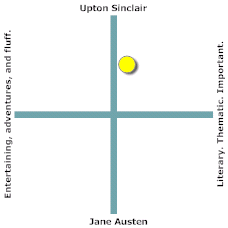
The Broken Kingdoms is an exceptional new chapter in the already-enjoyable Inheritance Trilogy. Jemisin has done everything right: her characters are rich and engaging, her world is complex and believable, and her plot is fast-paced. This is an ambitious book, and it satisfies by completely addressing important themes in an innovative and immensely readable fashion.

I will be eagerly looking forward to the third and final book in the series, The Kingdom of the Gods, which is due out from Orbit in 2011.

REVIEW: The Half-Made World by Felix Gilman


The Half-Made World by Felix Gilman Title: The Half-Made World
Author: Felix Gilman
Pub Date: October 12, 2010
Chris’ Rating (5 possible): 1 point 1 point 1 point 1 point
An Attempt at Categorization If You Like… / You Might Like…
Exciting, adventurous, thoughtful steampunk fantasy.

The Half-Made World by Felix Gilman is the gripping story of war on a brutal frontier. This is Gilman’s third book, after his excellent 2007 debut Thunderer and its disappointing sequel Gears of the City. Set in an entirely different universe, The Half-Made World shows that Gilman has clearly disciplined his imagination and gained a focus that had been lacking in his last novel.

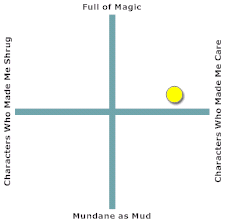
If you are looking for steampunk with Victorian mannerisms and airships, look elsewhere. While it shares elements of the steampunk aesthetic, it is firmly rooted in the oily, Wild West and Sinclair’s blood-stained Chicago stockyards. For those critics who complain that steampunk never has anything important to say, I recommend they read this book. It takes place in (as the title would suggest) a half-made world, where the east is settled and established, operating along “realistic” lines. The west remains wild, and reminds me of the aboriginal Dreaming. The rules that govern it are shifting, changing, and magic (of a sort) is real. From a thematic standpoint, The Half-Made World is a serious examination of the complex and conflicting values inherent in the romantic and manifest destiny movements of the 19th century. But despite its important themes and artful writing, it is an entertaining and exciting read, striking that rare balance between adventure and literature.

Gilman’s frontier is torn apart by an unending war between the Line (railroads, trains, manifest destiny) and the Gun (guns, fatalistically doomed heroes, romance). When the book opens, it is entirely plausible that the Line and the Gun are merely the colloquial names for a set of combating ethos: symbols, and little besides. But it quickly becomes apparent that these opposing forces are in fact very real spirits or demons, who embody particular mores and values and who attract particular types of followers. The opposing cultures of Line and Gun, and the setting they create, are some of the most important characters in this book.

The story is told from three perspectives:

  • Lowry, an agent of the Line,
  • John Creedmor an agent of the Gun, and;
  • Liv Alverhuysen, a “neutral party” from the settled East swept up in the frontier conflict.

While each of the perspective characters is engaging, the Line and the Gun themselves provide the text with a foundation. Gilman’s writing is extremely tight, and the natures of the Line and the Gun come through in the little details: the methods their agents employ, the territories they control, the people who live under their rule. Even the slight shifts in narrative voice used for the different perspectives help cement the setting. The Line and the Gun are not ephemeral constructs, or religious ideologies. They are real: dirty, smelly, and intensely human forces for all of their inhuman power.

Gilman does something very difficult with his three perspective characters. Each personifies a particular ethos: Lowry is the embodiment of the Line, with all its systematic and methodical values. Creedmor embodies the Gun, with its heroic strengths and tragic weaknesses. Liv personifies a third set of values (still nascent, I would say), which seems designed to balance the Line and the Gun. To paint characters who personify abstract values well is very difficult. It is so easy for them to become caricatures of their mores. Hugo pulls it off exceptionally in Les Miserables. Ayn Rand does it well, though less-reliably than Hugo. While Gilman is not quite as powerful as Hugo, nor (thankfully) as insistent as Rand, his characters remain true to the forces they personify, as well as to their own humanity. They are flawed and identifiable, in a most beautifully human way.

The jacket, designed by Jamie Stafford-Hill and with art by Ross MacDonald, drew my eye in the bookstore, reminding me of the futuristic designs drawn by Albert Robida in the late 19th century. While I don’t think the image depicted on the cover appears at any point in the action of the book, the design is elegant and understated. It captures the spirit of the text, if not its literal action. The book opens slowly, but gathers steam after the first eighty or so pages. The prose is dense, and rich throughout, and Gilman fleshes out his principal and supporting characters gradually over the course of the book. The last third is especially well-paced, and I found myself on the edge of my seat. The perspective and writing remain crisp, and at no point does it come off the rails (no pun intended).

While on the whole this book was excellent, I was mildly disappointed in how Gilman dealt with one of the characters at its end. It is difficult to explain the details without giving anything away, but this is clearly the first book in a larger whole, and to make it self-contained, certain strands needed to be tied up. I understand that, and I understand that there were equally-good or equally-bad options for how to do so. Gilman chose one of them, and his choice is not in and of itself bad and I suspect other readers might be satisfied with it. But when I read it, I found elements of its ending to be slightly anticlimactic, almost bathetic. However, it is entirely possible that bathos was part of Gilman’s point, and while it was disappointing, I find myself waffling on whether it is a weakness or not.

The book ends poised for a continuation of the adventure, without crossing the liminal boundary into cliff-hanger. As a result, I am eagerly looking forward to the sequel. I strongly recommend The Half-Made World to anyone looking for thoughtful steampunk, or who enjoys the frontier adventures of Emma Bull (Territory) or Jeffrey Ford (The Physiognomy). If (like me) you were turned off by Gilman’s earlier Gears of the City, I’d suggest you give him another shot: The Half-Made World is incomparably stronger in every way.

REVIEW: Under Heaven by Guy Gavriel Kay


Title: Under Heaven
Author: Guy Gavriel Kay
Pub Date: April 27, 2010
Chris’ Rating (5 possible): 1 point 1 point 1 point 1 point
An Attempt at Categorization If You Like… / You Might Like…
Fairly literary, slight fantasy and probably appropriate for young adult and up.

Under Heaven is a very good fantasy, heavily-inspired by 9th century (T’ang Dynasty) China. Its plot is solid, interesting, and the pacing moves well. The characters are complex, richly drawn and wrestle through questions of loyalty to family, self, and country. The setting is painstakingly crafted, and easily one of the most compelling elements of the story: for me, half of the fun lies in puzzling out what “real” things have been co-opted into Kay’s analog world.

I loved Kay’s earlier works, especially other history-based fantasies like A Song for Arbonne or The Lions of al-Rassan, until I abandoned the Sarantine Mosaic half-way through the second book (I rarely do this). I found that his Byzantium-inspired series moved very slowly with a plethora of uninteresting characters. Since then, I had avoided his work until picking up Under Heaven in a Boston bookstore. The cover drew my eye, and I thought “I might as well give him another shot.”

I’m very glad that I did.

You will like this book if you enjoy other well-written fantasies set in well-researched historical settings/cultures. Consider looking into books like On Stranger Tides by Tim Powers (pirates + magic, carefully researched), Latro in the Mist by Gene Wolfe (ancient Greece), or Liam Hearn’s Tales of the Otori series.

If you’re looking for more of a China fix and you enjoyed Under Heaven, then I can strongly recommend Barry Hughart’s Bridge of Birds: A Novel of an Ancient China That Never Was.

Under Heaven follows Shen Tai, the second son of a respected general. When we meet Shen Tai, he is nearing the end of an obligatory two years in mourning for his father. He has been living in a remote mountain valley, site of one of his father’s greatest battles, quietly burying the bones of the thousands who died there. For his piety, he receives a gift worthy of an emperor: two-hundred fifty Sardian (Persian) horses. Considering that a handful of these horse is a princely gift, two hundred fifty represent unheard of riches. This unwanted bargaining chip thrusts him into the dynastic politics of Kitai, and makes him the target of assassins, military governors, and civil servants vying for control of the nation’s wealth and future.

The story is told in close third-person, primarily from Shen Tai’s perspective. The writing is crisp and the insight into Shen Tai’s own thought processes gives us a delightful glimpse into his character. Practically from the first page, I found myself caring about Shen Tai and wanting to see how things worked out for him. Excellent job.

However, there was one weakness that made me give this book four stars rather than five. At the end of the book, I felt like there was little character growth on the part of Shen Tai. Generally the Shen Tai at the end of the book was pretty similar to the Shen Tai at the start of the book. There was some growth, don’t get me wrong: just less than I would have hoped for. Other characters change – often significantly – but our hero stays steady. That’s not necessarily a bad thing: I stayed engaged in the book and continued to care deeply about the hero because I still liked him. But some more evolution would have been nice.

I had only one stylistic quibble throughout the book. I admit, it’s a quibble: it might just be me. But Kay chose to write the narrative told from Shen Tai’s perspective in past tense, and side-plots told from women’s perspectives in present tense. I don’t know why. Just to differentiate them? I think the voices were distinct enough without that, and I found the tense shift jarring when first encountered (I thought it was a typo). This might just be my idiosyncrasy, but it did stand out as I was reading the book.

On the whole, I’m very pleased that I picked this book up. Kay’s writing style and technique are great, and the pacing is flawless. I was turning pages well into the night, and recommend this book for any lover of history.