Skip to content

Posts tagged ‘fantasy’

Writing an Episodic Genre Series (Part 1 of 3): Episodic Heroes


I recently had the pleasure of reading the first two books in Harry Connolly’s Twenty Palaces series, and this got me thinking about the nature of episodic science fiction and fantasy. By episodic series, I’m thinking a four, five, ten book series where each book is a standalone story where the series’ principal character goes on whatever type of adventure is typical for that character. Think books like Jim Butcher’s Harry Dresden books, or Charlaine Harris’ Sookie Stackhouse novels. How are these kinds of episodic books constructed? What makes them tick?

NOTE! This is the first in a three part series of posts. This post is focused on the episodic hero. On Saturday, I’ll post the next chapter, focusing on the episodic plot, and the final post on Tuesday will focus on the hero’s emotional journey.

Epic vs Episodic: What’s the difference?

Science fiction and fantasy are replete with series. That’s perfectly reasonable, when we consider that publishers, authors, and agents all love the “automatically” accumulating reprint sales that series make possible. But it is quite difficult to compare Robert Jordan’s Wheel of Time to Charlaine Harris’ Sookie Stackhouse novels. There just isn’t that much commonality there.

Series like The Lord of the Rings or the Wheel of Time are epic in scope. They tell one story, with a clear beginning, middle, and end. But that one story does not fit in one book: it has to be spread across multiple volumes. The vast majority of these epic series simply cannot be read on a standalone basis (for a great counter-example, see my review of N.K Jemisin’s The Broken Kingdoms).

If you look at an episodic series like Butcher’s Dresden Files or Connolly’s Twenty Palaces novels, the series itself has a very different structure. Each book is a completely self-contained story, with its own beginning and ending that can be read independently of the other books in the series. And in contemporary series, each book and the entire series focuses on the experiences of one particular character.

Building an Episodic Character

In the 1970s, ’80s and ’90s, series like Terry Brooks’ Shannara series, Anne McCaffery’s Dragonriders of Pern, and Mercedes Lackey’s Valdemar books were structured around a single universe (Shannara, Pern, and Valdemar, respectively) with standalone trilogies (or duologies) of books set within that universe. Each standalone sub-series could be described as an “epic” sub-series, while if we take the entire oevre together they begin to resemble episodic series. However, following the late ’90s’ rise of “Chihuahua-killer” fantasy tomes, these types of episodic/epic series seem to have vanished from publishers’ new lists.

With the contemporary focus on one character, that character becomes the most important aspect of an episodic series. This is true whether we’re writing an adult urban fantasy series like the Twenty Palaces, a paranormal romance mystery (à la Charlaine Harris), or a middle-grade adventure series (like Eoin Colfer’s Artemis Fowl). Of course, character matters in every book. But it is the foundation of any episodic series.

What would Sherlock Holmes be without Sherlock Holmes? Could we have the Dresden Files without Harry Dresden? Or the Sookie Stackhouse novels without Sookie? The identity of the series’ protagonist is intrinsically tied up with the identify of the series. Few people realize that the Sookie Stackhouse novels were in fact first dubbed the “Southern Vampires Mysteries”: the pervasive character of their protagonist eventually subsumed the publisher’s attempts to brand the series independently of its hero.

There is a lot of commonality in how episodic authors create their heroes. First, almost all episodic heroes have a Past (note the capital “P”). In many ways, this is a product of the history of episodic series, who are pretty clear descendants of the serialized mystery (Arthur Conan Doyle, Dashiell Hammett, Rex Stout, Ellery Queen, etc.). When we meet Connolly’s Ray Lilly, or when we meet Butcher’s Harry Dresden, or Steven Brust’s Vlad Taltos each brings to the table a checkered history.

Ray Lilly is an ex-con who survived an unpleasant run-in with magic, and now finds himself employed as a “wooden man” (a sort of enforcer) for a society of wizards (called the “Twenty Palaces Society”). Harry Dresden is a professional wizard private investigator who has had serious altercations with magical society. Vlad Taltos is a low-ranking minority (human) criminal in a larger criminal organization on a magic-filled secondary world.

Each is in some fashion iconoclastic. They have survived altercations with some form of authority in their world, which gives them some form of reputation. This reputation becomes a double-edged sword that both helps and hinders the hero on their adventures. As the books unfold, the reader learns more of this backstory through subtly planted information, for the most part avoiding an infodump that would stall the fast pace of the story. As the series winds to a conclusion, the overarching conclusion likely leads to some resolution of the lingering effects of that backstory.

Every one of these characters is gainfully employed. What’s more, they have jobs that will force them into adventures. Lilly is an enforcer. Dresden is a wizard/private-eye. Taltos is a low-level crime boss/private-eye/assassin. It is their means of employment that makes a long, episodic series possible. A detective will always have another case. An enforcer will always have another assignment. An assassin will always have another target. This enforces a certain structure, along with certain strictures, on each book in the series.

When we meet the hero, they are often inexperienced in some critical aspect. Ray Lilly knows almost nothing about magic, save that it exists. Harry Dresden has lots of magical power, but very little control. Any middle-grade or young adult episodic series (like Artemis Fowl or The 39 Clues) has inexperienced heroes by default: youth and inexperience go hand-in-hand! The use of inexperience makes it possible for the reader to learn alongside the hero, and for the hero to progress through adventures (books) with escalating challenges. As the hero’s experience increases over the course of the series, the challenges that they face can become more difficult, more challenging, more dangerous. Done artfully, this keeps the tension high in the later books in the series, and if tied back to the character’s emotional development can keep the character engaging, whether we’re in book two or twelve.

The use of iconoclasm and employment are both traditional tools of the mystery novel. Sherlock Holmes, Nero Wolfe, Miss Marple, even Sam Spade – all of the classic detectives were iconoclastic, and the vast majority were actively employed as detectives. The use of inexperience to provide character progression seems to be a newer development, and it is one that an increasing number of episodic series rely on.

NEXT: Come back on Saturday for the second installment for episodic plots, how to keep the reader reading in one book, and how to avoid flagging interest as the series progresses.

Words on a Fertile Shore: The Evolution of Science Fiction and Fantasy Language


While eating delicious (and incredibly over-filling) holiday meals this weekend, I found myself thinking about Google Labs’ new Ngram Viewer. In my day job I deal with statistics, semantics, ontologies, and computational linguistics all day long. Which makes the Ngram Viewer a really, really fun toy. It allows us to look at the frequency with which particular words and phrases were utilized across all books in the English language for the last 500 years.

Which is really cool.

So with such a tool at my finger tips, I thought I would have a little bit of a fun. What can the Ngram Viewer tell us about language in genre fiction? What can it tell us about the genres themselves? To attempt a semi-serious answer to this question, I got out my trusty copy of Brave New Words and flipped through it find some of the tasty neologisms that science fiction has given us over the years. And having written them down, I started banging away at the Ngram Viewer. Here’s what I found:

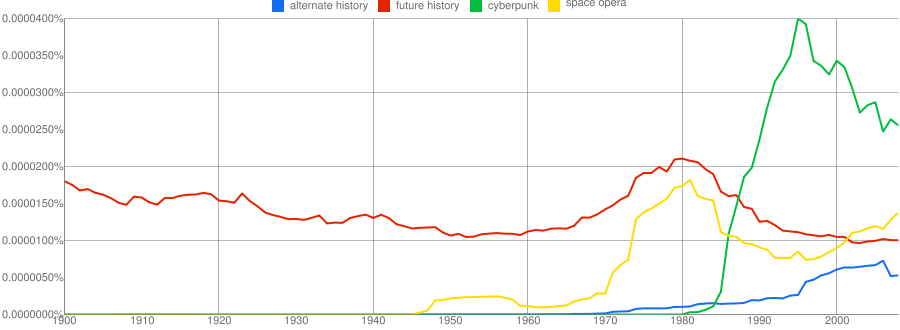
The Rise and Fall of Cyberpunk, The Fall and Limping Recovery of Space Opera, and the Gradual Climb of Alternate History

Science Fiction Sub-Genres, 1900 - 2008

Science Fiction Sub-Genres, 1900 - 2008

So the late ’80s and early ’90s saw cyberpunk explode, rise to meteoric heights and then begin a gradual decline that still seems ongoing. Cyberpunk hasn’t seemed to eclipse any of the other major science fiction sub-genres, although it did seem to coincide with a gradual decline in space opera and future history. It’s also neat to see a visual representation of alternate history’s slow growth over the last 40 years.

Sword and Sorcery vs. Epic Fantasy, Paranormal Romance vs. Steampunk and Urban Fantasy

Fantasy Sub-genres, 1900 - 2008

Fantasy Sub-genres, 1900 - 2008

Looking at fantasy, we can see the response to J.R.R. Tolkien‘s popularity. Looking at the 1970s and 1980s, we can see the impact of Terry Brooks, Stephen Donaldson, Michael Moorcock and Roger Zelazny. Then the 1990s show us the rise of Robert Jordan, Terry Goodkind, George R.R. Martin and the other kings of the Chihuahua-killer tomes. But what I think is most interesting is the relationship between steampunk, urban fantasy, and paranormal romance.

Steampunk has been getting a lot of buzz recently, leading some authors (most prominently Charles Stross and Cat Valente) to complain that it eclipses everything else going on. But this somewhat unscientific chart at least shows that while steampunk may generate buzz, that buzz is disproportional to the volume of published work. Of course, those complaints are recent and Google’s data only goes up to 2008. It’d be interesting to see if in 2009 and 2010 steampunk really did eclipse other sub-genres of fantasy and science fiction. Looking at the data through 2008, the trend looks pretty steady and in line with urban fantasy. The data actually suggests that paranormal romance is the sub-genre really breaking out. At least by 2008.

Some Fun Genre Tropes

And since I am – technically – on vacation this week, I want to go out vacation-ing in a few minutes, just three last fun charts. The charts above track some of the sub-genres, but what about some of the most-common science fiction, fantasy, and horror tropes? Some fun:

Space Travel Tropes, 1900 - 2008

Space Travel Tropes, 1900 - 2008

Hard science fiction and space opera both have their share of tropes, including (typically) some means of traveling at or near the speed of light. Of course, technology changes all the time so how have those tropes changed over the years? For one thing, the generic (and typically ill-defined) “hyperdrive” seems to be eclipsing anything with real science behind it. The equally fuzzy “warp drive” looks to have peaked around the turn of the century, while scientific or pseudo-scientific also-rans like the ramjet and gravity drive seem to be holding steady. Probably the most noticeable (and interesting) phenomenon was the brief but intense plateau of solar sails, which came to be pretty common right around the mid-1980’s before settling back down into a slow upward trajectory in the late ’90s.

Fantasy Tropes, 1900 - 2008

Fantasy Tropes, 1900 - 2008

Out of the stereo-typical fantasy tropes, dragons seem to be holding pretty steadily, but what’s notable is the rise of “wizard” in the late 1990s. Do I detect Harry Potter‘s wand at work?

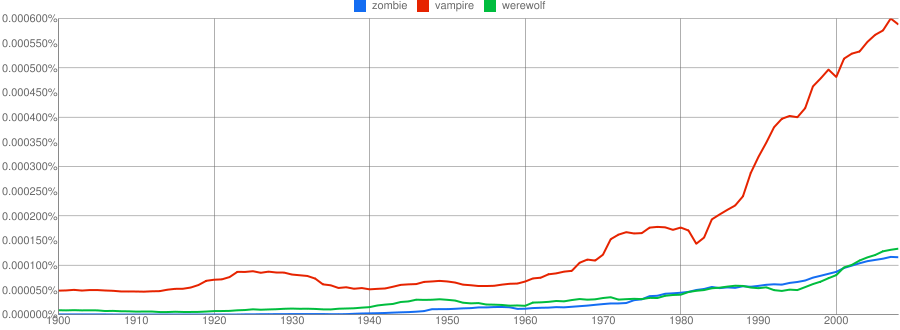
Horror Tropes, 1900 - 2008

Horror Tropes, 1900 - 2008

And here we can clearly see the impact of Anne Rice and her Lestat as the progenitors of the vampire craze. Vampires are clearly the monster of last thirty years, and by 2008, they still have nothing to fear from either werewolves or zombies.

The Difference Between Writing a Short Story and a Novel


So I finished writing my first novel last night. Typing it out like that makes it sound a lot more impressive than it actually is. It’s the first draft of an eighty-three thousand word fantasy novel, and is my first attempt at anything longer than a short story since I was twelve years old. Now, I’m going to put it aside for several weeks, work on other things, and then return to re-write it, and then maybe I’ll dance a little jig. Maybe. We’ll see how I feel about the finished product in a couple of months. But since this is NaNoWriMo, I thought it might be interesting to share some thoughts on how the process of writing this particular novel differed from my earlier experiences writing short stories.

DISCLAIMER: The experiences I’m describing here relate to this particular novel, and to me as a writer. Many of these experiences would not translate to a different novel with a different structure, and a different set of challenges. They might not translate to anyone else’s approach to writing, either. For that matter, I’m also new at this. This is my first novel, and so the observations and methods that worked for this one might be trashed by the time I’m on my sixth. So take anything you read here with a grain of salt, as I’m kind of making it up as I go.

Why I Write Short Stories, or Why I Didn’t Write Novels

At some point, I got it into my head that short stories demand tighter writing than novels do. I figured that if I could get my short story technique down, then when I applied my craft to the longer form, it would be better, faster, stronger. So in the last two years, I finished about fifty short stories, ranging in length from 1,300 words to 7,000 words. Mostly fantasy, spanning a variety of types from fairy tales, to (the very rare) sword and sorcery, some horror, and some mainstream literary stuff. I looked at it as good practice for when I started writing novels, and I definitely think that it helped me to write the novel in a number of ways:

1 Short stories are short enough to experiment with. Lots of people argue that writing exercises are a good way to practice, but somehow I’m always disappointed if I do a writing exercise that does not yield a fully functional story. I think of it like whipping up some pancake batter for the practice, then chucking it without putting it in the pan. It’s helpful, sure; but finishing something delicious is more so. Even if you write slowly, churning out a 2,000 word short story will take you far less than an 80,000 or 100,000 word novel – which makes them a great way to build confidence and develop skills, without the danger of discovering you’ve written yourself into a corner at 60,000 words.
2 Short stories have fewer moving parts. As I talked about in an earlier post, short stories just don’t have the room for a lot of complexity. This makes them easier to disassemble than a novel. I find that I can take a short story apart, look at all of the pieces that it’s composed of, and then re-assemble it differently, or fix a broken element, much faster than if I had to do that in a novel. It also makes it easier to learn the craft of plotting, or how characters get built, or how world-building works, than in a novel. I kind of think of it like learning architecture from LEGO’s, before moving onto bricks.
3 Short stories can teach you how to schedule productive writing time. I’ve got a full-time day job, I do volunteer work, I have a social life. Carving out time for writing is painful. But if I want to set a self-imposed deadline upon myself (e.g. “Write a novel by the end of the year”), I need to use an awareness of how quickly I write to schedule around it. That’s just the way my schedule, and my scheduling approach, works. Writing short stories taught me to think before I write. I learned to think through many different aspects of a story, starting from the voice, the plot, the characters, the setting, etc. By thinking (sometimes for weeks or months) before I ever write a single word lets me actually write the story extremely quickly once I do sit down. I know not everyone works this way. But with my schedule, it is easier to find time to think (shower, car, lying awake in bed) than it is to find time to actually write. So producing short stories trained me to think first, and then when I’ve thought it through enough, to sit down and write quickly.
4 Editorial Feedback Writing is all about waiting. You write something, ship it off to agents, editors, and someday (six months later if you’re lucky) somebody gets back to you with a response. In the novel market, my understanding is that it is almost always a form rejection. Thankfully, the professional (and semi-pro) short fiction markets have a faster turn-around. Taking what I considered my best short stories, I could expect a response in several weeks, rather than months. As my writing improved, I could see changes in the responses: fewer and fewer form letters, editors offering reasons (sometimes precise, sometimes not) on why a story didn’t work for them. This was enormously helpful. It helped focus my attention on what needed work in my writing, taught me to deal constructively with rejections (a vital skill for any aspiring writer), and gave me confidence that my hard work was paying off. By writing and trying to sell shorts, I was able to go through multiple feedback iterations in the same time it would have taken me to write a single 100,000 novel.

Novels Are Not Short Stories

Getting Ready to Write

But novels are not short stories. I usually write short stories in a two step process: I think about them enough to develop a narrative voice, identify my principal character, perhaps identify the general mood for the story. It’s the act of actually disciplining my imagination, and sometimes it can take five minutes or it can take weeks. But once this step is done, I can sit down and write the first draft of the story in a couple of hours. I don’t outline, I don’t take notes. I just write the story and then revise it after the fact.

I knew that this approach wouldn’t work for a novel. Structurally, it’s just too big: too many characters, too many side-plots, too many moving parts to figure them out in my head before sitting down to write. So I adopted a different approach. So I started by taking some notes. Not an outline, something a lot simpler. I started with my premise (“How a world built on magic responds to the invention of the printing press”). The world of my story would start from this premise. With a premise like that, I knew the conflict would be between groups in the society, and between specific characters within those groups. So I started by sketching a paragraph of notes about different groups in this society: their histories, their motivations, their value systems, etc. This didn’t let me identify any characters, yet, but it did allow me to sketch a basic plot. Each group would have to respond somehow to the printing press. And so these responses formed my high-level, basic plot outline. With that premise, with the social outline, the basic skeleton of a plot, I was able to (preliminary) identify my characters: after all, someone would have to actually do whatever the groups’ responses would be. I hadn’t had to do this kind of outlining for any of my short stories. They were simpler, with less complex relationships, and less complex conflicts. But if I hadn’t done this, I don’t think I would have found a way to actually start my novel.

Starting to Write

The first 17,000 words (20% of the finished draft) were very hard. I must have written the first several chapters five or six times before I was happy with them. I started with close third person, switched to first, swapped the point in my (very general) timeline where the story began once or twice, and changed a bunch of my initial character outlines. Getting past these false starts was the hardest part in actually writing the book.

In terms of my actual writing, I wrote each chapter as if it were a movement in a short story. When I write short stories, if I’m writing the beginning I’m already thinking about what needs to happen in the middle. By the time I’m working on the middle, I’m thinking about the end. I tried to do the same thing with chapters: while I was writing one chapter, I would be thinking about what needed to happen in the next. Characters would act in the “current” chapter, and what would follow could only be a logical continuation (a response) of that action, or a sidestep to establish a new side-plot.

At this stage, I didn’t have any kind of real plot outline. The focus was on setting the stage, establishing characters and side-plots. It was hard work to write each chapter, to set up the dominoes. But the next chapter would be that much easier to write, because by the time I had gotten there, I had narrowed down the places where I could go. Once I had set up one row of dominoes, I had limited where others could go if I wanted them to fall in sequence.

Getting over the Hump

The next 40,000 words (20 – 67% of the finished work) got much easier much faster. That’s not to say they were easy (they weren’t), but they did begin to flow easier. However, as the number of established side plots grew, I decided to get much more systematic in the writing. I actually made an outline, of sorts. It was an Excel worksheet, with one row for each chapter. Each row had four columns:

  • The chapter number,
  • The version number of my preferred draft for that chapter,
  • The word count of that chapter, and;
  • A couple of sentences summarizing the events of that chapter.

I had never needed anything like this for short stories, but this became an invaluable tool for me while writing the middle of the book. It allowed me to keep track of characters, events, pacing, and side-plots. The outline actually laid a road map for me as I wrote, because I was able to outline six or seven chapters ahead of my current place. As I wrote, I would revise the outline. I would decide to shift events to earlier (or later) chapters, and would revise as I went. But I didn’t actually extend the outline until I achieved certain key plot milestones in my writing.

During this phase of the writing, I was able to build a rhythm for the writing. While I couldn’t find the time to write every day (unfortunately), I was able to find a rhythm that let me write about 10,000 words a week, which struck me as a perfectly good rate if I could maintain it throughout the novel. The biggest trouble I ran into during this phase was my narrative voice. By the time I had written 20,000 words, I was certain I had lost my narrative voice somewhere around 10,000 words. I chose not to go back and revise. Instead, I chose to keep writing (trying to regain my original voice), and to focus particular attention on it when I re-wrote the book after it was done.

Whether this was a good choice or not, I don’t know. Whether my fear was real or not, I don’t know. I won’t know until after I have let the story sit for a couple of weeks and return to the re-write with a fresh mind.

Rushing to the End

By the time I had written 55,000 words, I had enough (plot) visibility to outline the last 20 chapters of the book. During this phase, my focus was on maintaining momentum and executing on the outline I had put together. I actually accelerated my writing pace during this phase, as if it were a sprint to the finish line. That may or may not have weakened the actual writing, but I also realize I am still too close to the story to judge that accurately. That goes onto the list of things to pay special attention to during the re-write.

As I neared the end, I also started to plan out the next phase: the re-write itself. I know that I’ll have to revisit the entire book. I know that before I do that, I’ll have to put it aside for several weeks, if not several months. I’ll work on something else, put it out of my mind, and only then return to the re-write. When I do start the re-write, I have a list of issues that I know I need to address. Some are major, functional issues (narrative voice). Others are problems that I know I need to fix (background that I came up with mid-way into the book, which I should have established early on). Or still others are thoughts I might have to put more meat on the book’s bones, since 83,000 words is a little light for a debut novel (most genre editors seem to seek 80 – 110k). But before I do any of that, I need to gain some distance from the book. Put the plot, the world, the characters from my mind so that I can look at it fresh.

Moving Beyond the First Novel

So now that I have finished my first novel-length work, there are two major things on my mind: first, the fact that most first novels become an author’s embarrassing baby photo. I don’t think I’ve ever heard of a multiple-book author who loves the first book they ever published. Usually, they seem to prefer their later (more experienced, mature) works for a variety of reasons. And I’ve heard too many stories of authors whose first (or first several) books collect dust in some desk drawer, never seeing the light of day. That’s probably not unlike my first short stories, and I would not be at all surprised if my first novel joins them. I am perfectly comfortable with that. Even if this book never sells, I know that I have written it and I have learned a lot about writing through the process. Probably the most important lesson is that I can write novel-length works, which is worth a lot. And is also one of the points of NaNoWriMo (even if this wasn’t a NaNoWriMo book, I still think NaNoWriMo is a great initiative for startup authors).

Which brings me to the second thing on my mind: writing my second novel. I’ve already got it well underway. This one is more ambitious, more complicated, and a bit more difficult (stylistically and thematically) than the novel I just finished. I’m already about 25,000 words into it, and I am well into its middle. It has a very different structure, and practically inverses the challenges of my first novel. Either way, I’m having fun writing it and I think it will be a good way to clear my first novel from my mind…in time to return to my first book in December for a re-write.

So if you’re a writer reading this blog post, or if you want to be, what do you think about the differences between writing a novel and short stories? What have your experiences been? There are probably about as many methodologies and lessons to be learned as there are writers, so I’d love to hear your experiences and thoughts.

REVIEW: The Half-Made World by Felix Gilman


The Half-Made World by Felix Gilman Title: The Half-Made World
Author: Felix Gilman
Pub Date: October 12, 2010
Chris’ Rating (5 possible): 1 point 1 point 1 point 1 point
An Attempt at Categorization If You Like… / You Might Like…
Exciting, adventurous, thoughtful steampunk fantasy.

The Half-Made World by Felix Gilman is the gripping story of war on a brutal frontier. This is Gilman’s third book, after his excellent 2007 debut Thunderer and its disappointing sequel Gears of the City. Set in an entirely different universe, The Half-Made World shows that Gilman has clearly disciplined his imagination and gained a focus that had been lacking in his last novel.

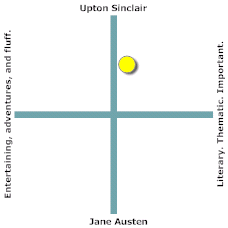
If you are looking for steampunk with Victorian mannerisms and airships, look elsewhere. While it shares elements of the steampunk aesthetic, it is firmly rooted in the oily, Wild West and Sinclair’s blood-stained Chicago stockyards. For those critics who complain that steampunk never has anything important to say, I recommend they read this book. It takes place in (as the title would suggest) a half-made world, where the east is settled and established, operating along “realistic” lines. The west remains wild, and reminds me of the aboriginal Dreaming. The rules that govern it are shifting, changing, and magic (of a sort) is real. From a thematic standpoint, The Half-Made World is a serious examination of the complex and conflicting values inherent in the romantic and manifest destiny movements of the 19th century. But despite its important themes and artful writing, it is an entertaining and exciting read, striking that rare balance between adventure and literature.

Gilman’s frontier is torn apart by an unending war between the Line (railroads, trains, manifest destiny) and the Gun (guns, fatalistically doomed heroes, romance). When the book opens, it is entirely plausible that the Line and the Gun are merely the colloquial names for a set of combating ethos: symbols, and little besides. But it quickly becomes apparent that these opposing forces are in fact very real spirits or demons, who embody particular mores and values and who attract particular types of followers. The opposing cultures of Line and Gun, and the setting they create, are some of the most important characters in this book.

The story is told from three perspectives:

  • Lowry, an agent of the Line,
  • John Creedmor an agent of the Gun, and;
  • Liv Alverhuysen, a “neutral party” from the settled East swept up in the frontier conflict.

While each of the perspective characters is engaging, the Line and the Gun themselves provide the text with a foundation. Gilman’s writing is extremely tight, and the natures of the Line and the Gun come through in the little details: the methods their agents employ, the territories they control, the people who live under their rule. Even the slight shifts in narrative voice used for the different perspectives help cement the setting. The Line and the Gun are not ephemeral constructs, or religious ideologies. They are real: dirty, smelly, and intensely human forces for all of their inhuman power.

Gilman does something very difficult with his three perspective characters. Each personifies a particular ethos: Lowry is the embodiment of the Line, with all its systematic and methodical values. Creedmor embodies the Gun, with its heroic strengths and tragic weaknesses. Liv personifies a third set of values (still nascent, I would say), which seems designed to balance the Line and the Gun. To paint characters who personify abstract values well is very difficult. It is so easy for them to become caricatures of their mores. Hugo pulls it off exceptionally in Les Miserables. Ayn Rand does it well, though less-reliably than Hugo. While Gilman is not quite as powerful as Hugo, nor (thankfully) as insistent as Rand, his characters remain true to the forces they personify, as well as to their own humanity. They are flawed and identifiable, in a most beautifully human way.

The jacket, designed by Jamie Stafford-Hill and with art by Ross MacDonald, drew my eye in the bookstore, reminding me of the futuristic designs drawn by Albert Robida in the late 19th century. While I don’t think the image depicted on the cover appears at any point in the action of the book, the design is elegant and understated. It captures the spirit of the text, if not its literal action. The book opens slowly, but gathers steam after the first eighty or so pages. The prose is dense, and rich throughout, and Gilman fleshes out his principal and supporting characters gradually over the course of the book. The last third is especially well-paced, and I found myself on the edge of my seat. The perspective and writing remain crisp, and at no point does it come off the rails (no pun intended).

While on the whole this book was excellent, I was mildly disappointed in how Gilman dealt with one of the characters at its end. It is difficult to explain the details without giving anything away, but this is clearly the first book in a larger whole, and to make it self-contained, certain strands needed to be tied up. I understand that, and I understand that there were equally-good or equally-bad options for how to do so. Gilman chose one of them, and his choice is not in and of itself bad and I suspect other readers might be satisfied with it. But when I read it, I found elements of its ending to be slightly anticlimactic, almost bathetic. However, it is entirely possible that bathos was part of Gilman’s point, and while it was disappointing, I find myself waffling on whether it is a weakness or not.

The book ends poised for a continuation of the adventure, without crossing the liminal boundary into cliff-hanger. As a result, I am eagerly looking forward to the sequel. I strongly recommend The Half-Made World to anyone looking for thoughtful steampunk, or who enjoys the frontier adventures of Emma Bull (Territory) or Jeffrey Ford (The Physiognomy). If (like me) you were turned off by Gilman’s earlier Gears of the City, I’d suggest you give him another shot: The Half-Made World is incomparably stronger in every way.