Skip to content

Artist Interview: Elizabeth Goldring


A little while ago, I had the pleasure of commissioning a work of art. Why it was necessary…well we won’t get into that. But I needed a practically life-size baby sky bison (as in, the six-legged flying bovines from the Avatar the Last Airbender cartoon). In doing so, I had the pleasure to work with Elizabeth Goldring, a young artist just starting in the business. Working with her, I thought it might be interesting to do an interview with her and get a visual artist’s perspective on some interesting questions:

1. As a new artist breaking into the field, how would you describe your work?
I like to make work that is subtle yet striking. I enjoy the idea of creating a beautiful object, be it a drawing or a sculpture, that has a quiet strength. The imagery that I use tends to be unusual or unsettling but not shocking or loud. I draw on nature, mostly plants and animals, though sometimes the figure as well. I like to do a lot of different things. I think one of my biggest issues is that I have so much I want to do but only 2 hands and 24 hours in a day.
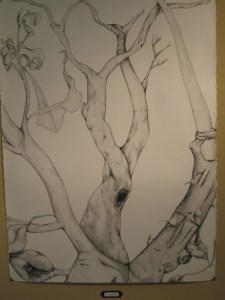
Cryptobotany by Elizabeth Goldring

Cryptobotany by Elizabeth Goldring

2. What do you think has had the greatest impact on your work? How do those influences affect the work you do on commission versus the work you do for yourself?
I would say that my own experiences have had the greatest impact on my work. My personal pieces tend to be heavily autobiographical though not necessarily in the conventional sense. It’s really in regard to the emotional content, not so much the subjects themselves. The pieces tend to require a lot of repetitive almost meditative actions and in that kind of mindset I end up imbuing the pieces with emotion as opposed to concept.

Commissions are always going to differ from the personal simply because I am producing something to please someone else as opposed to myself. Then there is the difference between commissions that are someone else’s concept that require approval from the buyer versus commissions where I am essentially given free reign. Even in those situations though, I still enjoy the process and I like to think that the work still has my mark.

3. Aspiring writers are usually told to read, read, read. Is there some similar advice for aspiring visual artists? What kind of value does it provide?
The usual advice is know your predecessors as well as your contemporaries, so its a combination of look look look and read read read. It’s important to know where you come from artistically, to know your influences. The past can inspire you in a lot of ways, whether it’s finding something in it that you admire or coming across something that shows what you don’t want to do. Art comes from Art, it does not exist in a vacuum.

4. When working on a piece, what’s your process like? How do you set the priorities for your work in general or for a particular piece?
My process varies depending on what I am working on. Drawings tend to be a little bit more organic while sculptures require more planning because of materials tests and mockups. Drawings still require some planning, but that’s usually just some loose sketches to get a feel for proportions and to try different compositions. Once the initial tests and sketches are done I try to just sit down and work for as long as I can. Sometimes I can work for 8 hours or so only stopping to eat or stretch, other times I can only focus for an hour. Even if I feel like I can keep working after a long sitting I try to walk away from it for a little while so I can come back to it with a fresh eye and see what needs changing. It can also be difficult to know when something is “Done;” walking away is key here so that the piece doesn’t get over worked. There is always more that can be done but there is not always more that should be done and some time away from the work helps in that decision. The finished piece is important to me, but honestly I tend to get lost in what I am doing. I really enjoy the process, it makes me feel calm in a way that few other activities do.

5. How do those priorities translate into your broader opinions on art and its role/function in society?
I was once told by a professor that making art is the most self indulgent thing a person can do with their life. I think that sums up how I feel about making art fairly well. I will admit, as an artist I am fairly selfish. I love what I do but I do it for me, I have no grandiose ideas about my work changing the world or the face of art or anything like that. I am not attempting to raise political or social awareness or make a “statement”. These are the functions generally associated with art and its purpose, and these are completely valid for some artists, but not really for me. I take a much more hermetic approach to what I do, it is about making things that I think are beautiful and convey the emotions that I need them to. If other people can connect with it on a similar level, then that is a really successful piece, but at the end of the day I am the one who has to be square with what I have created. Again, a lot of this is about the act of doing for me so it is difficult for me to think about their function outside of that. In an ideal world the person who looks at the piece finds something in it akin to what I felt while making it. For some art is a vehicle for some greater message or statement. For others its not.

6. Is there a divide between the “fine arts” and “illustration”? If so, where does that divide come from? Should it exist? And which side of it do you fall on?
There is a definite division between fine arts and illustration, though not as much in recent years. The division usually comes from the idea that fine artists decide what they will make and how they will make it, with only themselves and their intentions in mind. Illustrators have traditionally been seen in a commercial light; usually they are a way of realizing someone else’s vision. There are many illustrators being featured in fine art galleries now, and there is more acceptance of them than there was though I still hear the term “illustration” used as a derogatory term towards drawings. I think the difference really comes from the intention of the work. It’s all a gray area that is open to a lot of debate.

7. For writing, I’ve always believed that technique/craft is one half of what makes great art. Is it the same for the visual arts? And do all visual artists feel that way, or just you?
Personally I think technique is definitely a large part of a successful piece, this holds true for some artists and not others. For some people the concept is the entire point and execution is merely a formality. In the conceptual art movement of the 60s it got taken so far that some artists thought it was enough to come up with the idea or instructions and that it wasn’t even necessary to bring it into physical being. That approach: not for me.

8. Many writers say that the art of writing is the art of re-writing. Does your work go through any kind of editing or revision? How does (or doesn’t) that work?
I think the revision process is a huge part of art making. I do a lot of revisions and editing during the preliminary sketches; that is part of the entire reason to do them. They are like a rough draft. Just as in writing, it’s about trimming things down or adding things in. Revisions can vary in difficulty from piece to piece depending on the materials. A graphite drawing is easier to revise than ink, a clay sculpture is easier to revise than stone etc.

Regeneration by Elizabeth Goldring

Regeneration by Elizabeth Goldring

9. Can you tell us anything about the stuff you’re working on now? Or where can we see any of your work?
At the moment I am working on a series of drawings as well as some sculptures. The basic premise is documenting strange and anomalous occurrences in nature. Specifically plants and animals. It plays off the human tendency towards anthropomorphizing the world around us and our capacity to love what also repels us.

I am currently part of a show at the Visual Arts Gallery in New York City (601 West 26 Street, 15th Floor, New York, New York) that will run through February 15, 2011. I also have a blog where people can see my past and current work until I compose a more formal website: http://egfineart.blogspot.com/

So with great thanks to Elizabeth and her insightful answers, I think the best way to sign off is to show the results of my own commissioned piece. Here’s Baby Appa, relaxing in front of the fireplace (I apologize for being a lousy photographer – the picture doesn’t really do justice):

Baby Appa by Elizabeth Goldring

Baby Appa by Elizabeth Goldring (mediocre photo by King of Elfland's 2nd Cousin)

An Approach to Re-writing a First Novel


Several months ago, I wrote about my perspective on the differences between writing a novel and writing a short story. Now, several months later I’m knee-deep in re-writing that first draft of the novel, and so I thought it might be neat to follow up on my earlier comments:

Distance Buys Perspective

Writing a novel is an intensely personal investment, made over an extended period of time. It can take months or years of our cogitation, sweat, and emotional turmoil. It’s never far from our minds. We lie awake in bed thinking about how to do certain things with it (at least I do). By the time we write “The End” we’re relieved and rightly proud of our creation. And – I at least – wanted to dive right into re-writing it.

But that’s not wise. Because after we’ve just finished writing the book, it’s still up at the forefront of our minds. The characters names roll off our tongues, and we could recite the events of the plot backwards and blindfolded. Even if we can’t recite the text from memory, we still know what the sentences should say. At this point, we’re too close to it for effective revision. Where the story has narrative pot-holes – missing plot points, pacing issues, clumsy writing – our minds fill them in, gloss over them, because we know how it should work. It’s like having beer-goggles on: our minds won’t let us see the reality.

Which is why all of the smart advice out there tells us to wait. To put the book away. File it in a drawer, forget about it for a couple of weeks, or a couple of months, work on something else and then come back to it. Coincidentally, Kay Kenyon – one of my favorite science fiction authors – just posted about this exact issue. Unsurprisingly, I agree with her with all of my heart. But, like avoiding sweets and getting regular exercise, it’s not easy.

Letting it settle is one of the hardest aspects of writing a novel that I’ve discovered. While waiting to go back to my first novel, I took the time to write a second novel (okay, technically a graphic novel – but I figure it counts). Even though I intellectually know that I need to leave that graphic novel aside and let it settle, I still want to dive right into it and do the re-write. Which, much as I am loathe to admit it, is probably proof that I’m still too emotionally and intellectually close to it for proper revision. But it really makes sense to resist the temptation, because it lets us spot weaknesses that otherwise we would miss.

The Re-writing Attitude

Getting ready to re-write my first novel has been a mix of trepidation and hubris. On the one hand, I’m worried that as I take another look at it I’ll discover that it sucks. Then my ego kicks in and says “What are you talking about, the book is great, it can’t possibly suck.” Of course, that ego is a thin veneer over my own insecurities (which, of course, I quash). Which is why I found it helpful to keep the following statement in mind as I sit down to re-write:

Most first novels don’t get published. It’s okay if it sucks: we re-write to make it better.

Ask a bunch of authors how many books they wrote before they ever got an agent, or before they ever sold one to a major house. The number will surprise you. I’ve regularly heard debut authors talk about having five, six, seven finished novels (sometimes entire series!) in their drawers at home. That’s because writing a novel is a skill, and it is a skill that takes time to hone. Writing short stories can help with some of the craft, but it takes a different set of skills to write a great novel. In many ways, I think of it like playing a sport: how many games did Babe Ruth have to play before he could hit a homerun in the major leagues? How many pick-up basketball games did Michael Jordan play before setting foot on an NBA court?

It’s alright if the first draft of a novel sucks. That’s why it is the first draft. Because, if we’re serious about writing, we’ll produce a second draft that will be stronger than the first. And if need be, we’ll write a third draft that’s even better than the second. And at some point, perhaps, the finished product might be polished enough for publication. And if it isn’t, well then the skills we’ve picked up and practiced will help us write our next book, which will be better than our first. At least that’s the theory.

The Process of Re-writing

The Professor – my fiancée who edits YA books for a living – gave me some really good advice on the re-writing process. Of course, being male and knowing better, I promptly ignored her excellent advice and it bit me in the ass. Her advice on the process of re-writing:

Don’t sweat the small stuff.

When I initially picked up my first draft and started to read it, I did it with pen in hand. I dove in and attacked clumsy sentences, poor word choices, weak verbs. In the trade, this is called a line-edit and apparently it’s a classic first-time novelist mistake. The point of the re-write isn’t to fix the little flaws that have crept into the work. The point of the re-write is to spot the BIG structural weaknesses. If we’re bogged down in the minutiae of the sentences, we’ll never see the yawning pacing chasm or the gaping plot hole. We won’t see the forest for the trees.

I realized this about mid-way through my book. I had a niggling concern about a structural issue (the pacing), and it just wouldn’t leave me alone. But I couldn’t diagnose the problem effectively, because by jumping right into the sentences, I had gotten in too deep, too quickly. So I had to put it down again, walk away from it again, and then approach it a different way.

My second time around, I followed The Professor’s advice, and read it just as a first time reader would. I read through it – cover to cover – without a pen in hand. I was reading it like I hoped a typical reader (or an agent, or an editor) would. I was paying attention to my response to the text, to see where my interest flagged, where the story got my heart racing. I wanted to find where the book worked well, and where it lost me. Sure, I still saw the occasional weak sentence. But I resisted the (often difficult) temptation to pounce and fix it. Instead, I tried to figure out if the bones of the story worked.

Here’s what I found (in ascending order of importance):

  1. The events of the plot – at a general level – work reasonably well.
  2. The world-building seems reasonably solid, with compelling settings and believable (and interesting) factions/characters.
  3. The themes of the book can be emotionally and philosophically interesting.
  4. I lost interest around the 25% mark, and didn’t have interest until the last 5% of the book.

That last one is really important: reading through the book, it fundamentally failed the “So what?” test. That failure was evident in the way that the book slowed down and lost the reader’s interest. That, however, is just an observation: a fact. It told me nothing about why it lost the reader’s interest. In thinking it through, and discussing it with The Professor (who was awesome enough to take a look and give me a professional’s opinion on where I dropped the ball), the major failing’s cause was the protagonist’s motivation. It didn’t ring true, it didn’t work, and as a result, the reader just didn’t care.

Responding to a Major Flaw

That’s a major, major super-mega-important flaw. Characters are their motivations, and so if the hero’s motivation isn’t compelling…well, the story’s missing its fuel. That’s also not a quick fix. That’s not something that can be addressed by “sticking it in” as an editorial after-thought. To get that kind of motivation right, it needs to be ever-present throughout the story, from the first sentence all the way through to the last. And it should have really started with a question I’d failed to ask myself at the onset: why is my hero the hero?

The answer – if I’m being honest with myself – is that in the case of this novel, his was a convenient perspective and I wrote the opening chapters with a nifty voice that I happened to like. Alas, that’s not enough of a reason. So back to the drawing board. I took a look at the story, rotating it in my mind and considering all of the characters’ motivations and trying to determine how I could find/develop a more compelling hero. As I did this, I found the answer staring me in the face: the book had a major character, who did have motivation, and who was compelling…he just wasn’t the original focus. The solution (perhaps) would be to make that character, or someone like that character the hero.

Of course, this would mean re-writing the whole book. I wouldn’t be able to keep the eighty-three odd thousand words I’d written over the course of five months. I’d have to junk it, and basically start from scratch. That is not an easy call to make. It took a lot of work to write those words, and some of those words were (I think) pretty good. But I faced two basic choices: I could either trash the whole novel, or I could take another stab at it by writing it all over again from a different perspective. Rather than throwing in the towel, I decided to (literally) re-write it.

My reasoning was pretty straightforward: the bones of the plot, the world-building, the themes, they were all solid. I had gotten them right once, I could get them right again. It was my hero/narrator characterization which had failed. I’d written a book once, right? Surely I could do it again. So I decided to re-write it. This also gave me the opportunity to re-imagine what kind of motivation I wanted to give my (now-different) hero, and to play with the components of the plot to add more tension and raise the stakes. It’s an opportunity to take another stab at the whole project, and make the whole thing that much stronger.

Looking to the Future

And so now that’s what I’m doing. It’s early days yet. I’ve got a revised outline in place, and I’ve re-written the first couple of chapters. I’m thinking that maybe, as I get further along in the re-write, I might be able to re-use some select passages from my earlier draft. But I’m not certain of that. If I can, great. If not, no big loss. The actual process of writing the book is going smoother (and it seems faster) than on the first go-around. That’s probably because I’ve been living with these characters and this world in my head for almost a year now. It also suggests to me that I’m on a better track: the experience is reminiscent of writing the graphic novel I finished a couple of weeks ago, which has much simpler motivation (it might have other issues, but the motivation at least should be pretty solid).

I don’t know if this re-write will make the book good enough to vie for representation and publication. I’m hopeful, but if it ends up not being good enough…well, that’s alright, too. Because the process has taught me a lot about myself as a writer and about some of the skills that are essential for writing long-form work. And so even if this first novel ends up collecting dust in a drawer, I’ll still say it was damn well worth it.

Where are America’s science fiction, fantasy, and horror specialist retailers?


I spent last week in London on business. I love London, even in chilly, misty, drizzly January. One of the reasons why is because it is home to Forbidden Planet, the world’s largest and (to the best of my knowledge) only chain (though technically a pair of chains – see update below) retailer specializing in science fiction, fantasy, and horror products. The London megastore sits on two floors, stocked to the gills with action figures, comic books, graphic novels, trade and mass-market books, and DVDs: if it is genre, odds are you can find it there. Split between two somewhat-related separate companies (Forbidden Planet and Forbidden Planet International), the Forbidden Planet brand name offers twenty-five different locations in the United Kingdom. If the United Kingdom – home to sixty two million souls – can support twenty five chain outlets, why can’t the US – with five times the population – do the same?

UPDATE: Just a word of clarification since the above might not be clear: Forbidden Planet and Forbidden Planet International are in fact two separate companies. The former has nine stores in the UK, while the latter has thirteen branded outlets in the UK, one in Ireland, one in New York, and two other associated (though not branded) stores in the UK. While the two were related in the past (per Wikipedia), they are now operated as two completely independent companies. However, this fact does nothing to detract from the main point of this post: where are our genre chains in the United States?

Both countries have their share of general media retailers: the United States is home to Borders, Barnes & Noble, and Best Buy. The United Kingdom is home to W.H. Smith and Waterstone’s. Despite the ever-present moans of indie media outlets (whether booksellers or comic book shops), both have reasonably vibrant indie communities. I find it unlikely that the UK has a larger number of genre fans as a percentage of the population than the United States. If that were the case, then the UK would host a far greater number of genre publications (pro, small-press, and amateur) than it does.

Forbidden Planet (at least the London megastore, which admittedly may not be a representative sample) knows the genre business far better than its more general counterparts. The store is clearly divided by product type. Action figures, novelty items, and gaming are in one area. Anime, graphic novels, comic books, and regular books are in another. The book section is impressively stocked and organized along broad genre lines. Each section is consistently sub-divided, with its own “New Releases”, a “Chart” section where top-sellers are shown face-out with shelf talkers, and a general stock alphabetically arranged by author. This structure makes navigating the shelves a downright pleasure. Identifying what is new, and spotting what is performing well within a given category is very easy – whether you’re familiar with the genre or not.

This type of organizational scheme would be unimaginable at a general retailer. However, it is not a product of the stocking teams’ deep knowledge of the genre. Instead, it is the product of solid operational management. While visiting the store on a Tuesday mid-afternoon, I got to watch shelves being re-stocked. The stocking teams used netbook computers with bar code scanners to control inventory and shelf placement. This makes it possible for even new employees without genre familiarity to stock shelves properly. Forbidden Planet earns a gold star in shelf management in my book, especially when compared to recent experiences at (the admittedly beleaguered) Borders.

Several weeks ago, I was looking for a copy of Scott McCloud’s Understanding Comics: The Invisible Art. I went online, and the Borders web site told me that it was “likely in store” at my local retailer. I drove on over, and proceeded to check the in-store computer. It told me to check in the graphic novel section, where I was patently unable to identify any organizational method. Seeking help from an employee, I was told that it was in fact in stock, and that it would be in the criticism section. Of course, it was not. I checked with a different employee, and was told it would be in with the art books. And of course, it was not. Contrast this ordeal with the simple process of stopping by Forbidden Planet, wandering through the graphic novel section, and finding it precisely in the “M” section of independent graphic novels. I would expect to find this title in both stores, but the operational management of Forbidden Planet left me a satisfied customer while Borders failed me.

The United States has its share of specialist booksellers. Whether it is Borderlands Books in San Francisco, or Pandemonium Books and Games in Cambridge, Massachusetts, many offer a fine selection and deep understanding of genre style and history. However, as a general rule these bookstores are independent one-location operations. This is not a criticism, merely an observation. With so many genre fans in the US, perhaps we, too, could support a chain of specialist media stores like Forbidden Planet? Economies of scale would help with profitability (the interminable lament of the indie bookseller), while technology would make operations and quality-control easier across a network of locations. On an early Tuesday afternoon, the London store was reasonably full of shoppers and needed two cashiers to service the line of customers waiting to buy. Why doesn’t America have something comparable?

REVIEW: At the Queen’s Command by Michael A. Stackpole


At the Queen's Command by Michael A. Stackpole Title: At the Queen’s Command
Author: Michael A. Stackpole
Pub Date: November 16th, 2010
Chris’ Rating (5 possible): 1 point 1 point 1 point 1 point
An Attempt at Categorization If You Like… / You Might Like…
A fantastical alternate history with major differences from accepted history.

In At the Queen’s Command (the first installment in a new alternate history series designed to span a re-imagined American Revolution) Michael A. Stackpole strikes a careful balance between historical source material and fervent imagination. Stackpole’s book combines engaging characters, a palpable sense of place, and a strong sense of Georgian voice and mores to create a compelling alternate history that draws you in and leaves you eager for more.

One of the great challenges in writing an alternate history is to strike a balance between recognizable history, and the central conceit that sets the story apart from accepted truth. Sometimes, as in Harry Turtledove’s How Few Remain, the conceit is a tiny difference which leads to significant divergence: a message that in reality was intercepted, gets to its intended destination and as a consequence the Confederacy wins the American Civil War. In other alternate histories, like Patricia C. Wrede’s Frontier Magic series, the known world is entirely re-imagined by introducing a pervasive fictional element (like magic). The more foundational the alternate history’s conceit, the harder it becomes to maintain consistency with both the facts and values of acknowledged history. Which is why At the Queen’s Command, which adds dragons, magic, and necromancy to a re-imagined Colonial America is so impressive.

At the Queen’s Command follows Captain Owen Strake, a soldier in the Queen’s Own Wurm Guard. He has fought against the Tharyngians (read: the French) on the Auropan (read: European) continent, and now has been sent on a reconnaissance mission to the colonies in Mystria. He must win over the colonists, survey the frontier, and return to Norisle (read: England). Of course, the mission does not go as planned and the colonies are drawn into war with the Tharyngians on their frontier.

The publisher makes it very plain on the book’s cover that the series is meant to re-imagine the American revolution, but Stackpole made a brilliant choice to set the first book during his world’s analog to the French and Indian War. First, most readers are not going to be as familiar with that war as they would be with the American Revolution. If Stackpole had jumped right into historical events that most American readers are already acquainted with, he would have had a much harder time getting readers to accept his central conceit. By setting the book several years prior to the American Revolution, Stackpole has the opportunity to take more liberties with acknowledged history, draw the reader into his re-imagined world, and get reader investment in his characters.

The characters are one of the strongest aspects of this book. This time period in real history is fraught with the consequences of history, a burgeoning streak of independence among the colonists, a sense of financial peril amongst the colonizers “back home”. Stackpole manages to capture the complex social, economical, political, military, and philosophical interactions of this time period through his well-realized characters. Whether it is through Owen Strake wrestling with his loyalty to Norisle, Prince Vladimir insisting upon the scientific method, Caleb Frost pushing for self-determination, the frontier trappers bridling at rumored taxes, Stackpole places a filter on Colonial America but still captures its colors. It is through these characters and their values that Stackpole addresses his themes, which are – in effect – the themes of John Locke, Thomas Paine and the other Enlightenment philosophers.

The central conceit of this alternative world is the existence of magic. In Stackpole’s world, this is not a recent discovery but instead dates back to before the Romans. It has affected – to some extent – all technological and societal evolution that precedes the events of this book. For Owen Strake and the the other characters, magic is as much of a fact of life as breathing. While on the one hand this helps to ground the reader in the world, it also leads to one of the few moments that rings off true. Specifically, the magic of the colonies is wilder, less controlled, more free than the magic Owen Strake is familiar with. The narration supporting Strake’s initial explorations, especially the first introduction of the wendigo concept, are clumsy by comparison to the rest of the book’s smooth execution. In the hands of a lesser author, I would still consider them quite well done. However, once past the initial introduction, Stackpole’s seamless narration kicks in again and the book strengthens as it gathers pace.

The book itself is a handsome product released as a trade paperback from Night Shade Books. The book’s cover, with design by Claudia Noble and art by Ryan Pancoast, is beautiful. I was particularly struck by how Pancoast seamlessly introduced a dragon and Native Americans into John Trumbull’s The Death of General Mercer at the Battle of Princeton. Looking at Pancoast’s cover image, it is difficult to imagine that they don’t belong there in reality, which adds to the book’s sense of an alternate history:

The Death of General Mercer at the Battle of Princeton, by John Trumbull (circa 1795) via Wikipedia

The Death of General Mercer at the Battle of Princeton, by John Trumbull (circa 1795) via Wikipedia

At the Queen's Command, by Ryan Pancoast (2010)

At the Queen's Command, by Ryan Pancoast (2010) via ryanpancoast.com

At the Queen’s Command is an excellent new entry in the field of alternate history. Like any good book, it offers no easy solutions at its conclusion. Partially, this is to set up tension for subsequent books in the series, but in a very real sense it is because we still wrestle with the same questions as Stackpole’s fictional Mystria: where does the state’s responsibility end, and where does the citizen’s begin? I am eagerly looking forward to seeing how Mystria and how Stackpole’s characters wrestle with these questions in the books to come.

Writing an Episodic Genre Series (part 3 of 3): The Hero’s Emotional Journey


NOTE! This is the third installment in a three-part series on writing episodic genre series. This post will focus on using the hero’s emotional arc to link the standalone installments in the episodic series. The previous two posts focused on the episodic hero, and the episodic plot respectively.

This past week, I have been writing about episodic series in science fiction and fantasy. While the episodic hero is central to any episodic series, and while each book in such a series relies on a solid episodic plot to keep the reader turning pages, it is the hero’s emotional journey which keeps the reader buying new books in the series.

Each Book as a Step on the Emotional Path

Plot can keep an episodic book going, but plot alone will not carry a series. If the reader is to buy the next book, they have to care about the hero. If the hero does not evolve over the course of the series, if the hero doesn’t change or grow due to the choices made, then readers will quickly stop caring.

This is harder to do in a long-term episodic series than one might think. For one thing, the seeds of that character growth should show up early on. The defining characteristics of the hero’s personality, of their values, and of their emotional journey should already be there in book one. At the close of each book, the hero should have taken at least one (or more) steps on their emotional journey.

Ray Lilly’s journey in Game of Cages shows a good example of the hero having to come to terms with the reprehensible acts he might commit in the name of the greater good. Lilly’s squeamishness and his innate goodness are traits established early on in book one, and the hardening that occurs in book two was foreshadowed (predicted) by more experienced characters (his employer) in the first book. The fact that Connolly follows through with this hardening, and that this toughening becomes a key emotional facet of book two speaks well to both the author’s skill and to the overall emotional journey that the series will take.

Heroes Stumbling on the Emotional Journey

But that journey need not be a stately progression. Heroes can step forward, step backward, step sideways. Like real people, they can make mistakes and it is concern over those mistakes that can keep readers engaged. Within the confines of any single book, the direction of their evolution is immaterial. Heroes are allowed to make the wrong judgment call as much as we are. What matters is that in each book their character does change in some way, that the character’s state at the end of the book is clear, and that at the opening of the next book that state is maintained. This helps to make the books flow together, and leaves the reader satisfied with the overall series. If the character isn’t changed by their experiences, the series will quickly start to ring flat and eventually readers will just tune out.

One method that is frequently used is to introduce the hero’s personal life as a sub-plot that spans the series. Harry Dresden’s relationship with his mother, his fairy godmother, his half-brother, and other family members (including new ones that show up later in the series) becomes an evolving sub-plot that spans the books. This emotional sub-plot weaves into the fabric of the superficial plots, contributing to the more action-oriented conflicts that Harry has with various factions in his magical world.

In some books, relationships like these are tangential to the direct action of the plot. But they provide the hero with an emotional tension and concerns outside of the direct challenge in front of him. These relationships and the emotions they evoke in the hero and reader represent “the other shoe” that the reader knows will drop at some point.

Relationship between Emotional Arc and The Plot

Such emotional arcs can either be used tactically (to modify pacing, to foreshadow events for a future book, etc.) or they can be used thematically. The Sookie Stackhouse novels painstakingly explore themes of Sookie’s relationships with lovers, family, friends, society, etc. In a very real sense, this exploration is central to the entire series. However, this emotional arc should be separate from the plot arc of the story. And just as series plotting can become formulaic, so too can the emotional journey.

To a great extent, they’re like the double helix of an episodic series’ DNA: they move in parallel, but they rarely cross. In those instances where they do cross – namely when the emotional aspect of a relationship from one book becomes the plot engine for another – then it is best to have another emotional strand waiting in the wings to be introduced. If a particular book is such an emotional intersection, then the strand in waiting need not be introduced or focused on: doing so risks trying to pack too much into what should be a tightly-plotted, fast-paced book. But the seeds for that strand in waiting should be planted, such that they can be further developed or focused on in the next book.

The Denouement: Leaving the Reader Eager for More

I have always found the conclusion to an episodic series book to be absolutely critical to maintaining my interest in the subsequent books. The hero concludes the adventure, the monster is slain, and now it’s time for some well-earned rest. In an episodic series especially, the denouement sets the stage for the next book. It sums up the emotional changes that the character underwent as a consequence of their adventures. Because editors like to have episodic series published annually (keep those reprints rolling!), odds are the author is already aware of what the next book will bring. The denouement offers an excellent opportunity to plant the seeds without leaving the dreaded cliff-hanger ending.

It’s hard to get right, and it is especially hard to get right consistently across multiple books. An impression I get is that much episodic fiction tends to skimp on the denouement: the action is over, so the book just ends. While an abrupt denouement may work for some readers, I think it weakens the ties between books in the series.

If the denouement is an outgrowth of the hero’s emotional journey, it should effectively outline (or at least hint at) the starting conditions for the next installment’s emotional journey. If written well, it can also hint at the stakes of the next installment’s emotional arc as well, although this runs the risk of a cliff-hanger ending. A good example of an artfully-handled denouement can be found in Brust‘s Teckla. To avoid spoilers, I won’t go into what happens or how he handles the denouement, but it manages to avoid abruptness, provides closure for the plot, but leaves enough unresolved emotional strands that the door is open for future emotional evolution…which the author addresses in subsequent books. The end result is that the end of the first book increases our emotional investment in the hero, and makes us want to learn what happens to him in the next book.

Conclusion

There are critics inside and outside of the science fiction and fantasy community who tend to view episodic series as less worthy. Episodic series generally don’t win the Hugos, the Nebulas, or the World Fantasy Awards. But they do sell. And they sell a lot. Many episodic series regularly find themselves at the top of bestseller lists, whether we’re talking about Locus, or even The New York Times.

Many readers get their first and only exposure to genre from such episodic series. Consider the countless people who would never wander into the “horror” or “fantasy” aisles at their local bookstore, but who love Sookie Stackhouse. As a result, these episodic series are a powerful missionary force for the genre. They extend genre reading protocols across a broader audience, and they provide adults and children with plenty of enriching entertainment. While they may eschew lyrical prose styles and experimentation, I suggest that is not necessarily a bad thing. After all, the more people read any type of genre fiction the stronger the genre becomes. And if we look to our own history, who do we remember? We remember the episodic heroes: Sherlock Holmes, Miss Marple, Nero Wolfe, James Bond.

An Attempt at an Absolutely Non-exhaustive Episodic Reading List

Sub-genre Author Series First Book
Adult Urban Fantasy Jim Butcher The Dresden Files Storm Front
Adult Urban Fantasy Harry Connolly Twenty Palaces Child of Fire
Adult Urban Fantasy Kate Griffen The Mattew Swift Novels A Madness of Angels
Paranormal Romance Laurell K. Hamilton Anita Blake series Guilty Pleasures
Paranormal Romance Charlaine Harris Sookie Stackhouse Novels Dead Until Dark
Paranormal Romance Kim Harrison Rachel Morgan series Dead Witch Walking
Adult Fantasy / SF Steven Brust Vlad Taltos Novels Teckla
Adult Fantasy / SF Richard K. Morgan Takeshi Kovacs series Altered Carbon
YA / Middle-grade (various) The 39 Clues The Maze of Bones
YA / Middle-grade Eoin Colfer Artemis Fowl Artemis Fowl

Writing an Episodic Genre Series (part 2 of 3): Episodic Plots and Pacing


NOTE! This is the second in a three-part series on writing episodic genre series. The previous installment discussed the episodic hero, while the third installment (planned for Tuesday) will focus on the hero’s emotional journey.

This past Tuesday, I wrote about how episodic heroes are constructed in contemporary science fiction and fantasy series. While an episodic series relies on that hero, it is each individual book’s plot that keeps the reader turning pages. A good episodic plot will avoid formulaic writing, while providing an escalation in tension so that the reader keeps turning pages. The key to this is to establish momentum, and as the series progresses to vary the structure of each book’s plot. This keeps the reader interested in the book they’re holding in their hands right now, while the hero’s emotional journey (discussed in the next installment) keeps them buying the next book.

Pacing: Hitting the Ground Running

By leaving the character’s backstory off-stage, episodic books typically open with the hero actively starting the adventure. This is a page taken right out of the detective novel playbook. When we first meet Laurell K. Hamilton’s Anita Blake, we find her turning down work from a shadowy vampire organization. We first encounter Ray Lilly traveling to his latest case, or Harry Dresden getting a job. Episodic series sprinkle the hero’s backstory here and there, but no time is wasted by delving narrative-style into the hero’s psyche or providing an infodump on “what-came-before”. Episodic series hit the ground running, and they tend not to let up until the mystery is solved, the monster is slain, and the hero can put his feet up.

Middle-grade novels especially establish the stakes early on (often on the first page!). I strongly recommend reading middle-grade episodic novels (like The 39 Clues series) to find some tricks on how to establish stakes and simultaneously establish the hero’s characterization. From conversations I’ve had with children’s book editors, the speed with which readers are drawn into the story is one of the most important characteristics they look for. Adult episodic series, with their tendency towards functional prose and page-turner status, can learn much from the pacing techniques used by children’s authors.

The Shape and Structure of Episodic Plots

Most episodic series rely on mysteries for their plot structure. Many employ the classic mystery plot: clear identification of the mystery, broadening suspicion, a sub-plot intrinsic to the hero’s emotional arc, discovery that the hero has been on the wrong track, re-focusing of the hero on the right track, explanation, climax and denouement. This type of plot may seem a bit cliched, but the practical reality is that if it worked for Agatha Christie, it’ll work for people writing today. The originality and inventiveness of the individual authors shines through in how they flesh out these bones to create their books.

Urban fantasy series like The Dresden Files or the Twenty Palaces novels rely on a combination of characterization and world-building to enrich their basic plots. Paranormal romances like the Sookie Stackhouse novels or the later Anita Blake, Vampire Hunter books combine mystery plotting with the techniques of romance. Episodic adventure series like Artemis Fowl or Vlad Taltos invert traditional tropes (criminal vs sleuth, commit a crime vs solve a crime).

The Sense of Escalation

As the series progresses, building a sense of escalation becomes critical. Think of it this way: if the hero saves the universe in book one, what’s he going to do in book two? Many episodic series avoid this pitfall by focusing the plot on rather narrow concerns: if an epic hero saves the world, an episodic hero is more likely to save an individual. By keeping the scope focused, it makes it easier to escalate the stakes as the series progresses.

With her experience writing children’s books, Kate Griffen does an excellent job escalating the stakes across her Matthew Swift novels. In the initial installment (A Madness of Angels) Matthew Swift is focused first and foremost on his own survival. He is looking out for Number 1, and if others get swept up in his fight for survival that is their problem. In the second book (The Midnight Mayor) Swift has the (magical) mayoralty of London dumped in his lap, and he must deal with the consequences. At stake is the entire city of London and England itself.
Connolly uses a similar tactic to equally good effect: in the first Twenty Palaces novel (Child of Fire), the primary stakes are the hero’s life. Sure, there’s a town involved but Ray Lilly is focused on his own survival. In the second book (Game of Cages), his focus shifts to that of the town where a ravenous predator has escaped. What makes Connolly’s execution so strong is the unity he achieves between the explicit escalation of the stakes in the plot, and the escalating tension/stakes on Ray Lilly’s emotional journey (more on this in the next installment).

This kind of thematic and tactical escalation across books in the series can also tie into the character’s experiential growth: if the inexperienced hero can do something, it stands to reason that as their capabilities and understanding grow, so too will the stakes they fight for. The Harry Potter novels, themselves straddling the fence between epic and episodic, manage this experiential escalation very well.

The Danger of Formula and Using a Change-Up to Avoid It

The danger in all of this is that a plot model that works for the first, second, and third book in the series may seem formulaic and dull by the fourth, and fifth book in the same series. This is a point where the best episodic writers introduce what I call a “change-up”, a device which imbalances the hero’s routine and changes the plot structure of the books.

Different authors employ different change-ups: Steven Brust took away Vlad Taltos’ fortune, profession, and family by the fifth book. Jim Butcher introduces varying changes into Harry Dresden’s personal life (roommates, family members, etc.) while weaving strands for a super-plot that ties into Harry’s backstory and extends across the series.

By introducing such new elements, or by subverting the formulas employed in the earlier books, the plots can remain fresh for long-time readers and the momentum can be maintained throughout the series. But to be effective, the change-up has to do more than just intensify the predominant theme. For example, the Sookie Stackhouse novels are centered around romantic relationships. The characterization of Sookie represents the series’ greatest strength, with an iconic and engaging character and a distinct narrative voice. But as the series progresses, Harris attempts a change-up by complicating these romances through the introduction of new paramours and the removal of old flames. Because the books were already centered around relationships, the change-up rings flat and fails to build a sense of increasing stakes. As a consequence, the books rely upon the reader’s prior investment in the character and the world of the series. In Harris’ case, this gamble might work due to the audience’s strong emotional involvement with Sookie. But it is a big risk to take.

Plot versus Emotional Arc

This discussion of plot is centered around one book, within the context of a broader episodic series. The defining characteristic of episodic series is that each installment stands alone, and in order for that to work, each installment’s plot must stand alone. However, it must balance its independence with the foreshadowing and references necessary to link subsequent books and preceding installments. The key to this, I believe, is the hero’s emotional changes over the course of the series. This emotional development is not confined to any one book, and it represents the glue that binds the books to each other. The next installment (Tuesday) will focus on this.

NEXT: Come back on Tuesday for the third and final installment which focuses on using the hero’s emotional arc to keep readers engaged across books in the series.

Writing an Episodic Genre Series (Part 1 of 3): Episodic Heroes


I recently had the pleasure of reading the first two books in Harry Connolly’s Twenty Palaces series, and this got me thinking about the nature of episodic science fiction and fantasy. By episodic series, I’m thinking a four, five, ten book series where each book is a standalone story where the series’ principal character goes on whatever type of adventure is typical for that character. Think books like Jim Butcher’s Harry Dresden books, or Charlaine Harris’ Sookie Stackhouse novels. How are these kinds of episodic books constructed? What makes them tick?

NOTE! This is the first in a three part series of posts. This post is focused on the episodic hero. On Saturday, I’ll post the next chapter, focusing on the episodic plot, and the final post on Tuesday will focus on the hero’s emotional journey.

Epic vs Episodic: What’s the difference?

Science fiction and fantasy are replete with series. That’s perfectly reasonable, when we consider that publishers, authors, and agents all love the “automatically” accumulating reprint sales that series make possible. But it is quite difficult to compare Robert Jordan’s Wheel of Time to Charlaine Harris’ Sookie Stackhouse novels. There just isn’t that much commonality there.

Series like The Lord of the Rings or the Wheel of Time are epic in scope. They tell one story, with a clear beginning, middle, and end. But that one story does not fit in one book: it has to be spread across multiple volumes. The vast majority of these epic series simply cannot be read on a standalone basis (for a great counter-example, see my review of N.K Jemisin’s The Broken Kingdoms).

If you look at an episodic series like Butcher’s Dresden Files or Connolly’s Twenty Palaces novels, the series itself has a very different structure. Each book is a completely self-contained story, with its own beginning and ending that can be read independently of the other books in the series. And in contemporary series, each book and the entire series focuses on the experiences of one particular character.

Building an Episodic Character

In the 1970s, ’80s and ’90s, series like Terry Brooks’ Shannara series, Anne McCaffery’s Dragonriders of Pern, and Mercedes Lackey’s Valdemar books were structured around a single universe (Shannara, Pern, and Valdemar, respectively) with standalone trilogies (or duologies) of books set within that universe. Each standalone sub-series could be described as an “epic” sub-series, while if we take the entire oevre together they begin to resemble episodic series. However, following the late ’90s’ rise of “Chihuahua-killer” fantasy tomes, these types of episodic/epic series seem to have vanished from publishers’ new lists.

With the contemporary focus on one character, that character becomes the most important aspect of an episodic series. This is true whether we’re writing an adult urban fantasy series like the Twenty Palaces, a paranormal romance mystery (à la Charlaine Harris), or a middle-grade adventure series (like Eoin Colfer’s Artemis Fowl). Of course, character matters in every book. But it is the foundation of any episodic series.

What would Sherlock Holmes be without Sherlock Holmes? Could we have the Dresden Files without Harry Dresden? Or the Sookie Stackhouse novels without Sookie? The identity of the series’ protagonist is intrinsically tied up with the identify of the series. Few people realize that the Sookie Stackhouse novels were in fact first dubbed the “Southern Vampires Mysteries”: the pervasive character of their protagonist eventually subsumed the publisher’s attempts to brand the series independently of its hero.

There is a lot of commonality in how episodic authors create their heroes. First, almost all episodic heroes have a Past (note the capital “P”). In many ways, this is a product of the history of episodic series, who are pretty clear descendants of the serialized mystery (Arthur Conan Doyle, Dashiell Hammett, Rex Stout, Ellery Queen, etc.). When we meet Connolly’s Ray Lilly, or when we meet Butcher’s Harry Dresden, or Steven Brust’s Vlad Taltos each brings to the table a checkered history.

Ray Lilly is an ex-con who survived an unpleasant run-in with magic, and now finds himself employed as a “wooden man” (a sort of enforcer) for a society of wizards (called the “Twenty Palaces Society”). Harry Dresden is a professional wizard private investigator who has had serious altercations with magical society. Vlad Taltos is a low-ranking minority (human) criminal in a larger criminal organization on a magic-filled secondary world.

Each is in some fashion iconoclastic. They have survived altercations with some form of authority in their world, which gives them some form of reputation. This reputation becomes a double-edged sword that both helps and hinders the hero on their adventures. As the books unfold, the reader learns more of this backstory through subtly planted information, for the most part avoiding an infodump that would stall the fast pace of the story. As the series winds to a conclusion, the overarching conclusion likely leads to some resolution of the lingering effects of that backstory.

Every one of these characters is gainfully employed. What’s more, they have jobs that will force them into adventures. Lilly is an enforcer. Dresden is a wizard/private-eye. Taltos is a low-level crime boss/private-eye/assassin. It is their means of employment that makes a long, episodic series possible. A detective will always have another case. An enforcer will always have another assignment. An assassin will always have another target. This enforces a certain structure, along with certain strictures, on each book in the series.

When we meet the hero, they are often inexperienced in some critical aspect. Ray Lilly knows almost nothing about magic, save that it exists. Harry Dresden has lots of magical power, but very little control. Any middle-grade or young adult episodic series (like Artemis Fowl or The 39 Clues) has inexperienced heroes by default: youth and inexperience go hand-in-hand! The use of inexperience makes it possible for the reader to learn alongside the hero, and for the hero to progress through adventures (books) with escalating challenges. As the hero’s experience increases over the course of the series, the challenges that they face can become more difficult, more challenging, more dangerous. Done artfully, this keeps the tension high in the later books in the series, and if tied back to the character’s emotional development can keep the character engaging, whether we’re in book two or twelve.

The use of iconoclasm and employment are both traditional tools of the mystery novel. Sherlock Holmes, Nero Wolfe, Miss Marple, even Sam Spade – all of the classic detectives were iconoclastic, and the vast majority were actively employed as detectives. The use of inexperience to provide character progression seems to be a newer development, and it is one that an increasing number of episodic series rely on.

NEXT: Come back on Saturday for the second installment for episodic plots, how to keep the reader reading in one book, and how to avoid flagging interest as the series progresses.

REVIEW: Epic Mickey


Disney Epic Mickey Title: Disney Epic Mickey
Platform: Nintendo Wii
Pub Date: November 30, 2010
Chris’ Rating (5 possible): 1 point 1 point 1 point 1 point
An Attempt at Categorization If You Like… / You Might Like…
Rich Game Play and Well-crafted Storytelling

Epic Mickey is an excellent installation in the Mickey Mouse oevre from the designers at Disney Interactive. Combining excellent storytelling, appropriate art design, decent level construction, and varied and smooth gameplay, Epic Mickey is a great way for kids (and their parents) to meet Mickey Mouse.

In fact, let me start by saying that I have never been a Mickey Mouse fan. Forget Disney, I always thought. I loved Bugs, and Daffy, and Wile E. Coyote…no squeaky rodents or incomprehensible mallards for me, thank you very much. So while I was excited by Epic Mickey, I didn’t come to it with any particular affinity for the characters. In point of fact, having actively disliked the characters since childhood, I’d say I was initially skeptical about the whole affair. The premise of the game, however, abated my skepticism at least a little bit.

A sorceror uses a magic brush to create a home for all of the unwanted, unloved, forgotten cartoons. He tries to make a safe, welcoming, comfortable home for the rejects of the Disney universe: old Disney characters like Oswald the Lucky Rabbit (the prototype for Mickey Mouse), or Gremlin Gus (from the early Disney comics), etc. But of course, Mickey goes and screws it up by spilling paint and then paint thinner over the work-in-progress. This has two principle effects: first, it destroys much of the countryside, turning it into The Wasteland. And it introduces evil (a “blot”) into the rejects’ idyllic home. Mickey, of course, is oblivious to all of this and goes on his merry way. Some time later, Mickey gets sucked into the Wasteland by an alliance between the Shadow Blot (the personification of evil), the Mad Doctor (a crazy mad scientist), and Oswald the Lucky Rabbit (the de facto head of state in The Wasteland). Armed with magic paint and magic thinner, Mickey has to find some way of escaping The Wasteland. Along the way, he can either try to improve things (by painting objects using his paint brush) or make them worse (by thinning them using his thinner).

The idea of Mickey traveling a land of forgotten cartoons and having to constantly choose whether to do good or bad gives the game a thematic appeal that I’ve always found missing in Disney’s short cartoons. The game designers clearly held this premise foremost in mind when designing the game, because everything is subordinate to it. As most of these forgotten cartoons are old (from the ’20s, ’30s, ’40s, etc.) the art direction has a solid retro feel. But, this retro feel is most palpable during the game’s cinematic sequences, and in the “platform worlds” interspersed between major game chapters. When actually playing the game, it feels like walking through a stage set up to look like the 1950s: complete with cardboard cutouts that Mickey can either make more or less real. The net result is that art direction at each point in the game lends valuable support to the core premise.

Epic Mickey Screenshot, Ostown

Epic Mickey, Screenshot originally from: http://www.n1ntendo.nl/article/35601/1/Wii/disney-epic-mickey

The writing within the game is excellent, and also tightly supports by both the wonderful art and the premise. The story follows Mickey through a logical progression of discovering The Wasteland and responding to a dizzying array of characters he meets there. During the game’s many cinematic sequences, the animation is fluid and the audio reasonably good. Some folks I’ve spoken to complain about not having much voice acting in the game, but that didn’t bother me in the slightest. I thought the choice actually contributed to the “retro” feel of the game. Within the game itself, Mickey interacts with characters (good and bad) who react to him in different ways based on the ongoing choices he makes. Not having been a big Disney fan, I can’t say if this interactions are true to these characters’ histories, but the writing for them is excellent, in that it accomplishes several valuable goals:

World-building Each of the characters Mickey interacts with has a past that starts before Wasteland was created. Some ask Mickey if he remembers them from when they had bit parts in early Mickey cartoons, for example. Others talk about what life was like before the disaster that turned their home into Wasteland. This serves to really cement the gamer in the world of Watseland.
Thematic Tension Because the characters have pasts, because they react to the disaster, and because their behavior changes based on the ongoing choices Mickey makes during the game, their writing serves to maintain the thematic tension introduced by the basic premise. Mickey holds the fate of Wasteland in his hand: what will he do? As the game progresses, this thematic tension increases and the writing reflects that.
Game Progression The writing for all of the characters, and the interactions and quests that they give Mickey serve to really round-out the storyline. It becomes multi-linear about an hour or so into the gameplay and really opens up the world for experimentation and enjoyment. The writing really serves to make this interaction and the branching game play paths it offers quite seamless.

The game play itself is reasonably varied. The primary action in the game occurs as a three-dimensional platform game, not unlike Super Mario Galaxy or the Sly Cooper (PS2) games. However, the level design is a lot less complicated than in Super Mario Galaxy, with a much greater focus on how levels relate to the world of Wasteland and the story of Epic Mickey. In this respect, the level design much more resembles Sly Cooper (PS2) franchise. And, in the case of this game, this is good because it more tightly links the level design to the underlying premise and story.

The initial worlds provide a decent orientation to the game play, introducing the player to the techniques they will use throughout the game (especially techniques for painting and thinning aspects of the world). However, I found that the “orientation” worlds lasted a little too long for my taste (about 10 – 15% of the game or so). However, that may be because I’m a video game player in my late 20s who has seven video game systems hooked up to his television. Don’t get me wrong, the orientation worlds were fun. But the game play changes when a more quest-oriented system is introduced after the first two worlds. The action continues to be three-dimensional and platform-style, but the motivation and the places that Mickey can go become much more broad. At that point, Mickey can choose which quests he wishes to complete, where he wants to go, and how he wants to complete those quests. With the game’s horizons opened in this fashion, I found I enjoyed the game much more from this point. It gave me greater engagement with the character and the story, and became about more than slogging may way through a bunch of linear worlds.

The quests break up the game play nicely, but so too do the “inter-world” levels. These are more traditional, two-dimensional platform levels. They are “traveling” worlds that Mickey needs to get through to proceed from one section of the Wasteland to another. What’s great about them is their design: they are designed like old 1930’s or 1940’s film strips, complete with undulating film reel border. Some are in color, while others are in black and white. This brief 2D switch up provides great variety in the game, while their design makes them a real treat to play.

Epic Mickey is a very solid game. With excellent writing and superb design, the game provides many hours of enjoyment. The biggest complaint I have about this game is its camera control. That’s not unique to this game (I find it’s a common problem on many Wii games), but this game was especially prone to placing me in positions where I could not position the camera such that I could see where I would be jumping, or to allow me to adequately aim my paintbrush at objects/enemies. While I still enjoyed the game and I was able to play through it without too much swearing, this problem was sufficient enough of me to knock a star off of my rating for it. However, despite that complaint I still think this is a great game for kids and adults alike. While the premise and the theme are dark and complex enough for adults to get a kick out of, like the best middle-grade novels, they are still presented in a fashion that an eight year old will enjoy just as much.

Words on a Fertile Shore: The Evolution of Science Fiction and Fantasy Language


While eating delicious (and incredibly over-filling) holiday meals this weekend, I found myself thinking about Google Labs’ new Ngram Viewer. In my day job I deal with statistics, semantics, ontologies, and computational linguistics all day long. Which makes the Ngram Viewer a really, really fun toy. It allows us to look at the frequency with which particular words and phrases were utilized across all books in the English language for the last 500 years.

Which is really cool.

So with such a tool at my finger tips, I thought I would have a little bit of a fun. What can the Ngram Viewer tell us about language in genre fiction? What can it tell us about the genres themselves? To attempt a semi-serious answer to this question, I got out my trusty copy of Brave New Words and flipped through it find some of the tasty neologisms that science fiction has given us over the years. And having written them down, I started banging away at the Ngram Viewer. Here’s what I found:
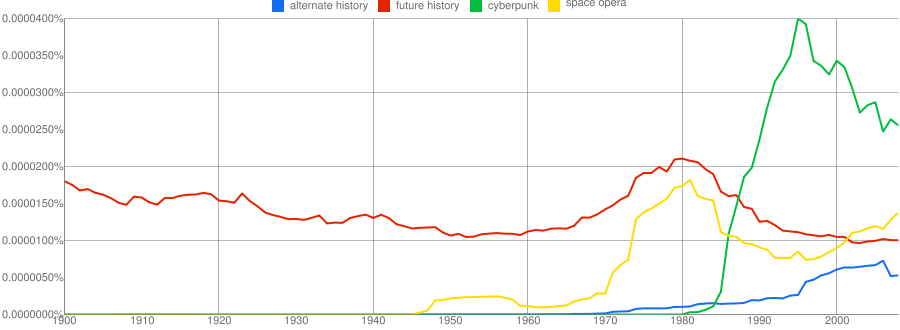
The Rise and Fall of Cyberpunk, The Fall and Limping Recovery of Space Opera, and the Gradual Climb of Alternate History

Science Fiction Sub-Genres, 1900 - 2008

Science Fiction Sub-Genres, 1900 - 2008

So the late ’80s and early ’90s saw cyberpunk explode, rise to meteoric heights and then begin a gradual decline that still seems ongoing. Cyberpunk hasn’t seemed to eclipse any of the other major science fiction sub-genres, although it did seem to coincide with a gradual decline in space opera and future history. It’s also neat to see a visual representation of alternate history’s slow growth over the last 40 years.

Sword and Sorcery vs. Epic Fantasy, Paranormal Romance vs. Steampunk and Urban Fantasy

Fantasy Sub-genres, 1900 - 2008

Fantasy Sub-genres, 1900 - 2008

Looking at fantasy, we can see the response to J.R.R. Tolkien‘s popularity. Looking at the 1970s and 1980s, we can see the impact of Terry Brooks, Stephen Donaldson, Michael Moorcock and Roger Zelazny. Then the 1990s show us the rise of Robert Jordan, Terry Goodkind, George R.R. Martin and the other kings of the Chihuahua-killer tomes. But what I think is most interesting is the relationship between steampunk, urban fantasy, and paranormal romance.

Steampunk has been getting a lot of buzz recently, leading some authors (most prominently Charles Stross and Cat Valente) to complain that it eclipses everything else going on. But this somewhat unscientific chart at least shows that while steampunk may generate buzz, that buzz is disproportional to the volume of published work. Of course, those complaints are recent and Google’s data only goes up to 2008. It’d be interesting to see if in 2009 and 2010 steampunk really did eclipse other sub-genres of fantasy and science fiction. Looking at the data through 2008, the trend looks pretty steady and in line with urban fantasy. The data actually suggests that paranormal romance is the sub-genre really breaking out. At least by 2008.

Some Fun Genre Tropes

And since I am – technically – on vacation this week, I want to go out vacation-ing in a few minutes, just three last fun charts. The charts above track some of the sub-genres, but what about some of the most-common science fiction, fantasy, and horror tropes? Some fun:

Space Travel Tropes, 1900 - 2008

Space Travel Tropes, 1900 - 2008

Hard science fiction and space opera both have their share of tropes, including (typically) some means of traveling at or near the speed of light. Of course, technology changes all the time so how have those tropes changed over the years? For one thing, the generic (and typically ill-defined) “hyperdrive” seems to be eclipsing anything with real science behind it. The equally fuzzy “warp drive” looks to have peaked around the turn of the century, while scientific or pseudo-scientific also-rans like the ramjet and gravity drive seem to be holding steady. Probably the most noticeable (and interesting) phenomenon was the brief but intense plateau of solar sails, which came to be pretty common right around the mid-1980’s before settling back down into a slow upward trajectory in the late ’90s.

Fantasy Tropes, 1900 - 2008

Fantasy Tropes, 1900 - 2008

Out of the stereo-typical fantasy tropes, dragons seem to be holding pretty steadily, but what’s notable is the rise of “wizard” in the late 1990s. Do I detect Harry Potter‘s wand at work?

Horror Tropes, 1900 - 2008

Horror Tropes, 1900 - 2008

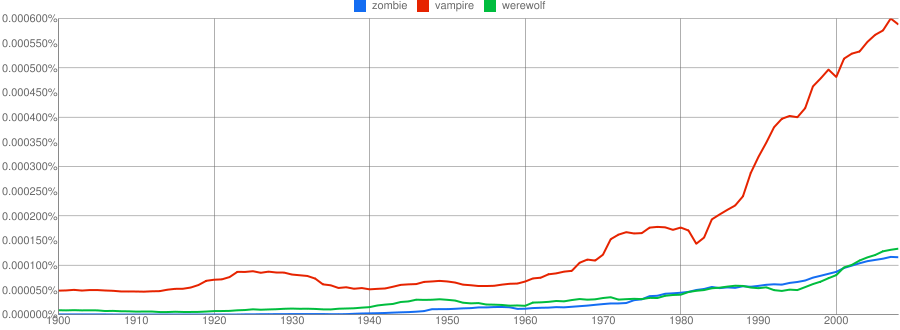
And here we can clearly see the impact of Anne Rice and her Lestat as the progenitors of the vampire craze. Vampires are clearly the monster of last thirty years, and by 2008, they still have nothing to fear from either werewolves or zombies.

The Future is Now: Is Hatsune Miku William Gibson’s Idoru made real?


There’s a new top-selling vocalist in the J-Pop genre: Hatsune Miku’s voice has been featured on gold-selling albums with Japanese bands like Supercell and Livetune (all links are to web sites in Japanese). Her singing has graced anime credits, and she has her own video game out from SEGA, and perhaps most impressively she’s performed live before crowds of 25,000 screaming fans. Of course, compared to the likes of Lady Gaga or Hannah Montana that’s not terribly impressive. But there’s a big difference between those standard pop-stars and Hatsune Miku: Hatsune Miku is not alive. She’s software. Think about that for a second: software, singing “live” to thousands of (real life) screaming fans. Don’t believe me? Take a look at the video:

Designed by Crypton Future Media, Hatsune Miku is the most popular of a type of software called vocaloids. These are programs designed to work with Yamaha’s vocaloid (vocal + android) software to synthesize human song. However, Hatsune Miku is more than the lines of code and signals that make up her synthesized voice. Her basic “look” was designed by the illustrator known as Kei, and features visual sensibilities familiar to fans of anime and manga. With this visual design and a distinctive (synthetic, mind you) singing voice capable of expressing complex emotions, Japan’s vibrant dojinshi music sub-culture soon developed the MikuMikuDance software to design 3D dance animations and music videos. The result is a complex community of lyricists, composers, illustrators, and choreographers/animators who collaborate and compete to create songs using their shared “instrument”.

The Consensus Mythology of Hatsune Miku

I freely admit, it is difficult for me to understand much of the nuance of this sub-culture as I (alas) don’t speak Japanese. However, from what I’ve been able to gleam from several hours of Internet research, Hatsune Miku is the logical meeting point of many Japanese sub-cultures. Her visual roots lie in manga and anime, but her initial genesis lies in the dojin music community. From there, Miku has spawned manga, anime, prose, itasha, and figures.

In the dojin music community, Miku is seen as an instrument first, not a character. And rightly, songwriters like Ryo (Supercell) are the true artists, since Miku sings what they write. Songwriters have utter control over every aspect of her performance: when she sings a note, she will always sing it the way the songwriter wanted (emotion included!). In this, she is no different than a keyboard or a guitar. The community collaborates through video and file sharing services, posting their work and soliciting feedback from other creators and fans. When Japanese media discusses Hatsune Miku artists, the focus is always on the songwriter: rarely the instrument.

But outside of the dojin music community, this “instrument” begins to resemble more popular manga, anime, and aidoru trends. With the plethora of (popular) dojin manga and fan-fiction, creators and fans build a consensus mythology around the character. Her history, her personality, all is built through the multi-faceted strands of her fan-base. Like many aidoru, she has publicized (and authorized by Crypton Future Media) measurements, the content of her songs is (in theory) limited by the license the creators agree to when using the software, etc. While it started with songs and videos, the Hatsune Miku community now creates stories, manga, and video games (Sega Hatsune Miku: Project Diva for PSP) that make use of this shared character.

Is Hatsune Miku William Gibson’s Rei Toei?

Fourteen years ago – long before the vocaloid technology was even close to possible – William Gibson wrote Idoru, the second novel in his Bridge trilogy. Set in an early 21st century Tokyo, Idoru examines a variety of cyberpunk themes, most particularly the relationship between artificial life and humanity which he explores through an artificially intelligent pop-idol construct named Rei Toei (after the Toei Company, one of Japan’s leading film and music studios).

In Gibson’s cyberpunk vision, Rei Toei is a self-actualizing adaptive composite intelligence. The point is that there are as many versions of Rei Toei as there are fans. Each fan builds a personalized album, songs, videos, performances, photographs, etc. of Rei based upon his or her particular preferences. When Rei performs in public, her style represents an averaging of the individual preferences across each fan in the audience, effectively becoming a consensus character. In a very real sense, Rei Toei represents the ur-idol: an “artist” with a perfect collection of traits that allow her to appeal to every single person in general, and to appeal to each fan in specific.

The parallels to Hatsune Miku are obvious. Like Rei, Hatsune Miku is a composite character: with the plethora of dojin songs, videos, and manga fans can gravitate to and select the content that specifically appeals to them. Don’t like a particular style? There are plenty more to choose from. In this sense, Hatsune Miku’s fans can consume their own concept of Hatsune Miku, selecting for a mythology and set of characteristics that appeals to them. No two Hatsune Miku fans will have the same preferences, but both can be equally pleased with what they get. In terms of predicting technology capabilities and the fan-base’s reaction, Gibson nailed it.

However, the differences between the two characters deal directly with some of Gibson’s (and cyberpunk’s) primary themes. Gibson painted Rei Toei as being strictly overseen by her owners. While her style and persona may be adjusted to the tastes of individual fans, it is the mega-corporation who enforces constraints on her choices. They provide her with the songs to perform and determine the types of behavior she can get into. Very purposefully, Gibson took the classic aidoru model of circumscribed managers, handlers, and controllers and applied it to an AI character. While the details of her public persona may be crowd-sourced and the personal consumption of her products personalized, the shared foundation for Rei Toei is prescribed by developer edict. In response, much of Gibson’s book focuses on Rei’s attempts to break free from the constraints imposed on her by the mega-corporation. Hatsune Miku, by contrast, is already free.

Every aspect of Miku’s “behavior” is determined by the distributed community of her creators. There is no single overseer who cashes in on her performances. Even Crypton Future Media – Miku’s ostensible “creators” and the owners of her code – do not try to limit the ways in which Miku can be expressed. As a result, Miku’s performances and behavior become just as crowd-sourced as her fan experiences become personalized. In dojinshi world of music, anime, manga and fan-fic there are no practical limits as to what Hatsune Miku can do.

Yet despite this freedom, Rei Toei is adaptive and self-actualizing, meaning that she represents an actual artificial intelligence that responds to human interaction, can converse freely, and can make independent decisions. She has become an emergent intelligence, capable of (seemingly) independent thought and action. Hatsune Miku – at least today – does not have any such properties. Modern technology has so far been unable to create emergent intelligence and as a result, Hatsune Miku is patently unable to choose her own destiny. Every choice is made for her by an individual and distinct creator.

The Ethics of Consensus Character Emergence

Is Hatsune Miku any more free than Rei Toei? On the one hand, Rei Toei is a perfectly adaptive self-actualizing AI. She is partially constrained by outside forces (her owners/creators), but she retains freedom of choice in certain limited arenas. Gibson’s book suggests that this represents slavery, despite Rei Toei’s artificial nature. Hatsune Miku, however, is perfectly constrained. She is not adaptive, not self-actualizing, and so is technologically unable to make any choices for herself. As a result, her creators maintain complete and utter control over her.

At first blush, this might seem like more oppressive slavery than what Rei Toei is subjected to, however I think the reality a little more complex. As anyone can create anything using the Hatsune Miku character, her range of effective choices is far broader than Rei Toei’s. She can do anything, so long as someone tells her what to do. This is at once more liberating and constraining, as it places the onus on the fans to determine who their consensus character will become. Many creators have a vested interest in the Hatsune Miku character, whether they are songwriters, music labels, authors, or publishers. The well-funded, well-organized creators have a far larger megaphone than the individual dojin working on their home computers. Will they hijack the Hatsune Miku character? Will they enforce their vision on her mythology? On the one hand, this may help popularize the Hatsune Miku character by making her more accessible to everyone. On the other, it will constrain the emerging consensus. Which would be better for art involving the character? What would be better for the fans?

I don’t have any answers, but I think we’ve entered a fascinating future where questions like this become practical concerns. When William Gibson wrote Idoru it was pure science fiction, set in a relatively near future, but involving technology so far beyond 486 processors and 32 MB of RAM that it was scarcely imaginable. But today, that science fiction has become very real. As a result, the questions that Gibson raised in 1996 have become much more relevant. How we answer them will affect the relationships between art, technology, and society. I don’t know if Gibson is aware of Hatsune Miku’s existence, but I hope he is. And I’d love to know what he thinks.