Skip to content

Tuesday at BEA11


Sorry for the brevity of this post, but I’m drafting it on my phone at the moment.

So I’m now after my first day here at BEA and I’ve got some thoughts and observations:

  • If there’s a single word on everybody’s lips here it is digital. With new eReaders and new digital distribution platforms, everyone’s discussing the shifting economics of the book industry. Much of the focus was on self-publishing platforms, marketing, and practices – which doubtless worries booksellers and traditional publishers.
  • Genre only counts if it’s YA (at least today – tomorrow might be better). With token panels for thrillers, I thought there was precious little core sf/f/horror programming.
  • Genre in every booth. While today’s programming was light on genre, I found it at just about every exhibitor’s booth. There are fewer genre specialists exhibiting this year, but they are offset by the number of non-genre imprints/publishers who are dabbling on the edges of genres. I’ll write more about this in a separate post later.
  • Small press publishers have – it seems – vanished from the floor. Independent or self-publishing outfits are springing up like mushrooms after the rain, but small-press exhibitors aren’t here. The economics are understandable, but it is curious considering the buyers wandering around in this crowd.

Okay, since they’re closing the press room and I’ve got another event to get to, I’ll wrap up for today. More to come tomorrow.

REVIEW: Chasing the Moon by A. Lee Martinez


Title: Chasing the Moon
Author: A. Lee Martinez
Pub Date: May 25, 2011
Chris’ Rating (5 possible): 1 point 1 point 1 point 1 point
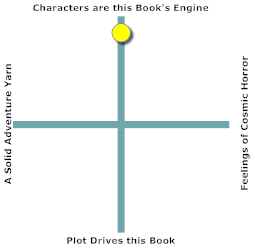
An Attempt at Categorization If You Like… / You Might Like…
An engaging, amusing read with decent characters.

A. Lee Martinez’ books are characterized by their serious plots, sympathetic characters, and an infectious humor that bubbles out of the cracks in his characters’ fictional lives. His latest novel, Chasing the Moon is a solid, enjoyable book that continues to showcase Martinez’ facility with genre tropes.

Chasing the Moon follows Diana, a vaguely-down-on-her-luck coat salesperson, who manages to land a great apartment. However, that apartment opens up Diana’s mind to all of the dark, Lovecraftian monsters that have stumbled into our reality. Diana must deal with the creatures in her apartment, the twisted realities of her entire apartment building, and ancient gods who want to devour the moon. All in a day’s work, right?

Martinez’ singular strength lies in portraying normal people in absolutely extraordinary situations. His ability to depict humanity, with all its shortcomings and strengths, is what imbues his books with humor. For Martinez, every monster – however alien, however monstrous, however evil – is just trying to get by, like you or me. Sure, that may mean destroying our universe, or devouring anything and everything in its path, but hey – nobody’s perfect. Martinez’ humor bubbles out of the clash of expectations created by these characters. Genre fans will expect the eternal embodiment of hunger to devour everything. That he might view his hunger as an eating disorder is unexpected, refreshing, and makes the character instantly sympathetic. Martinez places his heroes – human and inhuman alike – squarely before the abyss, and time after time he perfectly nails that moment when a nice person would reach out to shake the abyss’ hand.

While Martinez often gets compared to Douglas Adams or Terry Pratchett, I think a better comparison might be Tom Holt. Like Holt, Martinez tightly controls the lunacy of his worlds. Chasing the Moon – like Martinez’ earlier books – lacks the gonzo anything can-and-probably-will happen world-building of Adams’ Hitchhiker’s Guide to the Galaxy. And while it shares Pratchett’s serious-story-grounded-in-a-comedic-setting framework, Martinez’ world is more firmly grounded in our reality than Discworld, where everything becomes grist for Pratchett’s parody mill. I would argue that Chasing the Moon is not a parody at all, but that Martinez uses humor to show what makes us human.

While I greatly enjoyed Chasing the Moon, there were two aspects that left me vaguely unsatisfied. It’ll be a little difficult to explain without giving any spoilers, but here goes nothing:

The speed with which one of the principal secondary characters gets shuffled out of the story left me a little surprised. I suspect that was partially Martinez’ point: that someone we have invested in for much of the book, someone who bears under the strain for a while, may suddenly crack, or that the cracks might have been there all along and then suddenly give way. I also understand the need to contrast that character’s attitude and approach to the heroine’s. But that being said, the resolution to their interaction struck me as rushed. I would have preferred to have lingered on it a little longer, to explore that secondary character’s evolution a little more deeply. It was a choice, and I don’t necessarily think Martinez made a bad one. Just one that left me a little dissatisfied (which might equally well have been his point).

A less significant concern for me was the aspect of horror in this novel. Martinez clearly knows his science fiction, fantasy, and horror tropes, having played them like a violin in his earlier novels. The influence of Lovecraft and Clark Ashton Smith on Chasing the Moon is clear. But while Martinez manages tension very adroitly, that tension never veers into the gut-wrenching, abyssal horror that was emblematic of the classic Weird Tales pulps. Perhaps I’m a little jaded, or perhaps Martinez’ heroine is a little too plucky, a little too ready to deal with the horrors she faces. The tension escalates nicely, but I found myself reading it more like an adventure story than a cosmic horror tale. That being said, it reads as a very strong adventure story.

Overall, I strongly recommend Chasing the Moon. It is a fast-paced, really engaging read. Much like life, it has its moments of laugh-out-loud humor, coupled with moments of deep emotion. If you enjoy Tom Holt, John Scalzi’s Agent to the Stars, or Neil Gaiman and Terry Pratchett’s Good Omens, I expect you will get a particular kick out of it. It’s a great summer book, perfect for reading on the beach…although beware of tentacles reaching up from the depths.

Awesome Conceptual Tool: The Periodic Table of Storytelling


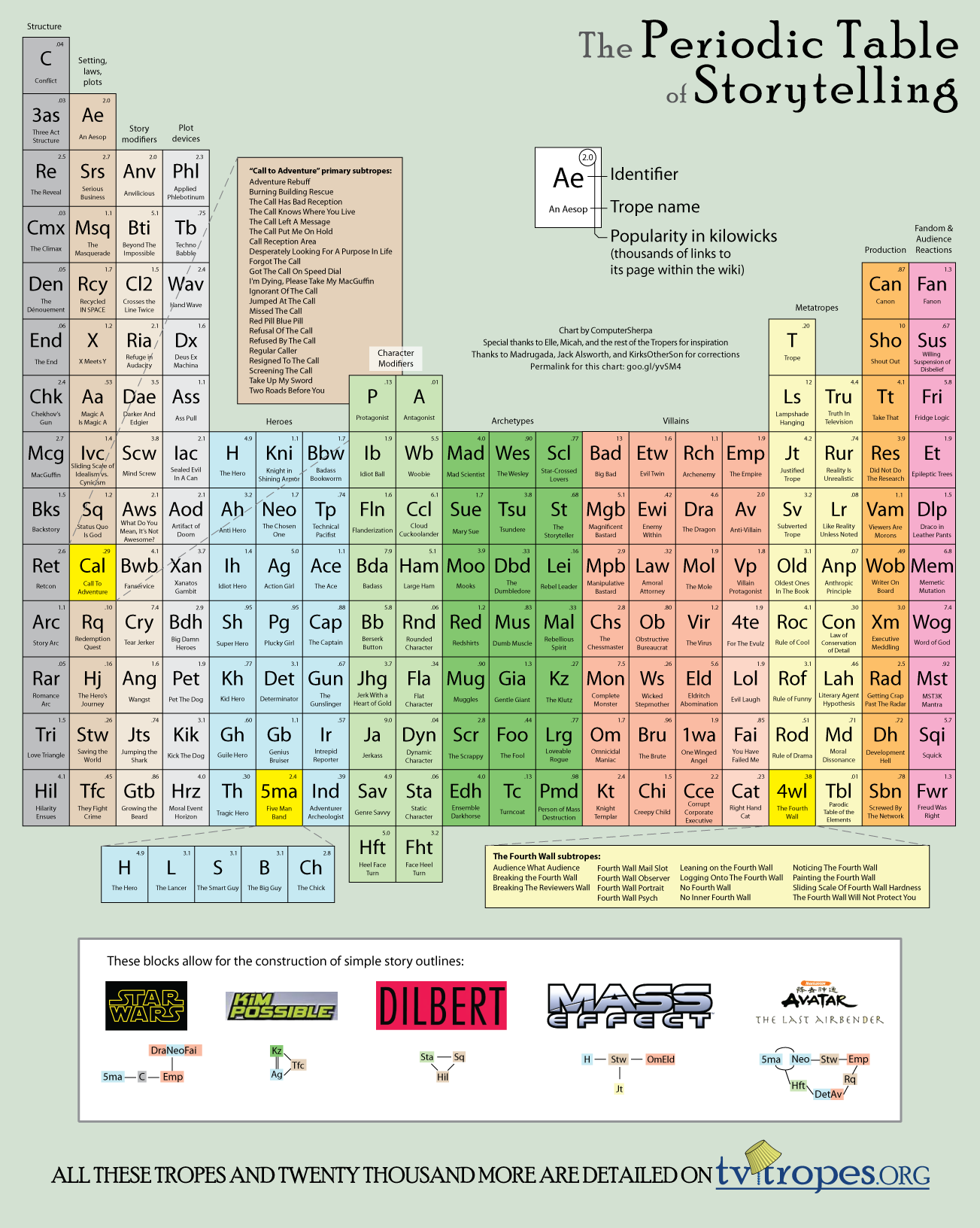
So thanks to The Professor (my fiancée), here’s an absolutely amazing infographic that may just become my favorite outlining / conceptual tool. It’s the Periodic Table of Storytelling, which was posted on DeviantArt by ComputerSherpa, a second-semester art student. Check out the table below:

Periodic Table of Storytelling by ComputerSherpa

Periodic Table of Storytelling by ComputerSherpa, via DeviantArt

What makes this infographic so amazing is its ability to map out just about any story structure using its “atoms.” ComputerSherpa included some great example molecules that lay out some really well-known stories, and I might just start using molecules like that when I outline my own stuff. What I really need is a smartphone app that will let me search and model those kind of storytelling molecules on my phone. That would be really helpful.

In the meantime, lacking such a smartphone app, you can order a poster print of this here. The example molecules have been removed from the bottom on the poster (which I think is a shame), but I think it’s really cool anyway.

Narrative Voice as Mind-control: Thoughts on Manipulating Reader Perception


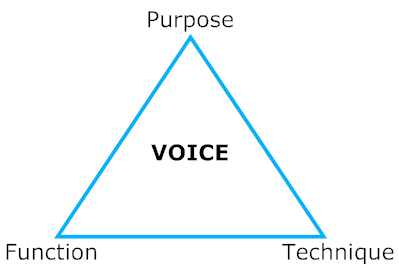
Voice: Purpose, Function, Technique

A Conceptual Framework for Narrative Voice

I’ve always considered voice one of the most important tools when writing alternate history, and over the past couple of weeks I’ve been thinking about how that tool really works (both within and outside the sub-genre).

There are probably as many valid descriptions of voice as there are writers, editors, and critics out there. For my part, I believe that voice has three components: its purpose, its function, and its technique.

The Purpose of Voice: Establishing a Relationship with the Text

The purpose of voice is to establish the reader’s relationship to the text. Different stories, different narrators, call for different relationships. Would Nabokov’s Lolita be as powerful if we weren’t sympathetically engaged with the monstrous Humbert Humbert? Would Doyle’s Sherlock Holmes stories be as effective if the narration were as coldly dispassionate as the detective himself? Voice – both in narration, and in dialog – establishes how we relate to a story. At its most basic level, it controls the emotional distance with which we perceive it, and is most powerful when wedded to the story’s themes.

Nabokov wants us to view Humbert Humbert up close and personal. The power of his book relies on juxtaposing our the intellectual horror at Humbert Humbert and the visceral engagement his voice engenders. Had Nabokov employed a distancing technique, for example making Humbert’s story epistolary, or telling it from the dispassionate perspective of a court stenographer, it would not have the resonance it does.

John Crowley in Little, Big uses voice to distance us at once from our reality, and the reality of the text. The lyrical, metaphoric voice he employs puts us in a liminal state, somewhere on the borders of what is, what was, and what might be. In this, the voice employed is fundamentally aligned with the book’s themes.

Olaf Stapledon in Last and First Men keeps the reader at arms length, so that we can view the events of his future history dispassionately, as if we were observing them from billions of years removed.

When Michael A. Stackpole employs a voice reminiscent of 17th century colonial texts in At the Queen’s Command it instantly links his book to that time in the reader’s mind.

The relationship created between us and the text is foundational in the act of reading. It sets the context for everything else, determining how we perceive a story’s pacing, how we engage with its characters, and how we identify its themes. In this sense, the purpose of voice transcends any individual sentence, or any paragraph. It is a combination of the voice’s expression in narration, in dialog, even in its epigraphs (shout out to @DDSyrdal for reminding me of this term!). But apart from its broad and abstract purpose, voice has a function within the story which is variable over the length of the text.

The Function of Voice: Manipulating the Reader’s Perception

I often think that it is the writer’s job to manipulate the reader, to take us on an emotional roller-coaster the author has designed. By influencing how we perceive events, settings, and characters, the narrative voice becomes the rail which guides us along the ride. It imparts the twists, falls, and rises. If well-constructed, it shouldn’t be noticeable (unless we’re looking for it). But if it’s shoddily put together, well…I’d rather not consider what happens when a roller-coaster comes off its rail.

Voice’s function can be modulated for specific effect. This is easiest to see in dialog, where each actor has their own voice, more or less distinct from the voices of other characters. Those differences exert a subtle influence on our perception of those characters. Consider the following exchange from George R.R. Martin’s A Game of Thrones:

“Boy,” a voice called out to him. Jon turned.

Tyrion Lannister was sitting on the ledge above the door to the Great Hall, looking for all the world like a gargoyle. The dwarf grinned down at him. “Is that animal a wolf?”

“A direwolf,” Jon said. “His name is Ghost.” He stared up at the little man, his disappointment suddenly forgotten. “What are you doing up there? Why aren’t you at the feast?”

“Too hot, too noisy, and I’d drunk too much wine,” the dwarf told him. “I learned long ago that it is considered rude to vomit on your brother. Might I have a closer look at your wolf?”

From his short, staccato sentences we get the sense that Jon is direct, straightforward. He answers the question asked of him, but by offering little additions he avoids being brusque. He asks direct questions, wanting to know the answers. By contrast, Tyrion Lannister’s dialog is more complicated. His first sentence is broken apart by prose narration, imbuing a meaningful pause that – were the text read aloud – might suggest either humor, or shock. His second sentence, with its precise list and brutally honest self-assessment shows us Tyrion’s precision and self-deprecation. His third sentence gives us further insight into both his sense of humor, and his relationship with his brother.

The entire exchange is used to manipulate us into liking both Tyrion Lannister and Jon Snow, though for different reasons. Even if we cannot articulate it, even if we don’t notice it at the first reading, we respond to Jon’s simple directness. And we appreciate Tyrion’s self-deprecating humor. And Martin achieves this subtle effect just using voice in his characters’ dialog.

Prose narration – descriptions of setting, of action – can similarly affect our perception of and emotional response to the story. Consider two brief passages, each describing the same actions (sorry for the quality of my example sentences – I’m coming up with these on the fly):

Version #1 Version #2
The rain-slick leaves left the tree like snowflakes, gently spinning to melt into the mud. Rain battered the leaves. Glop! Glop! Glop! And down into the mud.

Hopefully (if I’ve done my job right) the two example sentences establish an entirely different mood. The first is more laconic, gentler, quieter. While the second is harsher, more abrupt, and louder through the use of onomatopoeia. The events are identical, but the difference in voice puts the reader into a different frame of mind. Voice becomes the tool I use to control the reader’s response to a particular scene, passage, or sentence (even a particular word!). And like any tool, there are a variety of ways in which it can be applied.

Purpose and Function Applied: Techniques for Controlling Voice

The range of control that we choose to exert over voice lies on a spectrum. At one end is banally utilitarian prose – the bland monotone of “Dick and Jane run after the ball.” On the other end we find the inimitable mastery of Nabokov, whose fine-grain manipulation of voice makes its inner workings invisible to the reader. Most of us operate somewhere between these two extremes employing a variety of techniques that are universal:

Perspective as a Window to Voice
Every one of us uses perspective to imbue our story with voice, whether consciously or not. In terms of purpose, the choice between first, close third, omniscient third, or the rare second-person narration has an immediate and major impact on the reader’s relationship to the story.

First person narration – when executed well – earns the reader’s instant engagement precisely through its link to voice. The narrator is a character in the story, with their own perceptions, predilections, and foibles. They have their own way of seeing the world, a tendency to pay attention to certain aspects that others might not notice in the same way. One narrator might comment on people’s appearances. Another might pay closer attention to facial expressions. And just like a character’s personality should affect their speech patterns in dialog, the same affects a first person narrator. For example, in Lisa Yee’s excellent YA novel Millicent Min, Girl Genius the narrator (the titular genius) uses complex sentences, a refined vocabulary and sprinkles in a little Latin every now and again. Her defining characteristic – her intellect – is intrinsic to how the narrator’s voice is portrayed.

In first-person narration, we are generally locked into the narrator’s voice throughout the story. That’s the trade-off we make for building that super-close reader/narrator relationship. Close third-person narration trades a little more distance between the reader and the POV character, in exchange for greater latitude in vocal manipulation. With close-third narration, we can shift POV characters (typically at chapter or section breaks for decent narrative flow) employing different voices for different points of view, as well as make more gradual, subtle shifts in tone and mood within the confines of a scene. This facility to shift vocal strategy is a double-edged sword and must be used judiciously. Do it too often or too fast, and we risk either confusing the reader or putting too much distance between her and the characters. For a great example of this technique employed well, I recommend Tad Williams’ Otherland series.

The relationship between voice and distance is less clear-cut for omniscient third-person perspective. As the most emotionally distant of the perspectives, omniscient third may well suit our thematic or stylistic purposes. However, by requiring a consistent narrative voice throughout, omniscient third loses the vocal flexibility that close third enjoys. There are situations where this trade-off makes sense. For example, J.R.R. Tolkien’s Lord of the Rings requires an omniscient narrator and consistent voice to evoke its linkages to epic storytelling and myth.

Style and Structure as Voice
If we were to ask five writers to write one sentence describing something, we would inevitably get five different sentences. How those sentences are composed – how the writer employs clauses and adverbs and conjunctions and even punctuation – determine what is typically called the author’s “style” and represents one of the most influential aspects of voice.

Pick up any book from the 19th century. You’ll immediately see that the way 19th century authors put their sentences together differs dramatically from contemporary styles. When we say an old classic hasn’t aged well, what we are really saying is that the modern reader’s emotional response as controlled by the story’s voice differs from an original reader’s presumed response. The variegated, many-claused sentences that characterize 18th and 19th century texts have a distancing effect for the modern reader. Bulwer-Lytton is a great example of this at work. In his day, he was one of the most influential, most celebrated writers in the English language. Today, there are awards named after him that celebrate purple prose.

This is not to say that contemporary voices are simpler than their predecessors, or that such simplicity would be a good thing. Many excellent authors – John Crowley, Gene Wolfe, Gabriel Garcia Marquez, Jorge Luis Borges, to name a few – write lush, complex sentences. However their structure differs substantially from what came before. For one thing, contemporary authors adhere more strongly to the principle of “show, don’t tell.” Consider the following two sentences selected at random:

Sentence #1: “But they were entirely ignorant of what had passed; and their raptures continued with little intermission to the very day of Lydia’s leaving home.” Jane Austen, Pride And Prejudice, 1813
Sentence #2: “Then an expectant silence, followed by a firmer start, and the station wagon backed warily out into the drive, making two soft and delible marks in the wet leaves.” John Crowley, Little, Big, 1982

Both come from excellent books. I would in fact argue that the Crowley sentence is more structurally complex than the Austen. However, the voices are quite dissimilar: the Austen voice tells us that their raptures continued. It does not show us those raptures, nor does it provide any metaphor or analogy by which we can emotionally connect to them. The voice is – by design – at a remove from the emotional significance of the events. Austen’s voice leaves it to the reader to establish that connection, through the implications of certain facts dropped and hinted at: the “little intermission” and “to the very day”.

Crowley’s voice, by contrast, employs evocative imagery to show the reader a prosaic event. His adjectives, and the order in which they are placed all communicate an emotional significance (which may or may not be important). By calling the silence “expectant,” the start “firmer”, and the marks on the leaves “soft and delible”, Crowley anthropomorphizes insensate objects, imbuing them with emotions. The sentence describes no characters, yet we still have an arc that rises from expectation (expectant), to action (firmer), and descends through denouement (soft and delible).

The complexity of sentence structures is of course infinitely varied. However, stealing vocal tricks from other authors is a good idea and can lead to some truly impressive work. In her 1973 essay “From Elfland to Poughkeepsie” Ursula K. Le Guin calls Lord Dunsany “the First Terrible Fate that Awaiteth Unwary Beginners in Fantasy” – specifically because his mastery of voice and style is so inimitable and so frequently imitated. Lots of us fall victim to this trap (I know I’ve been guilty of it!), but this ability to imitate past masters, to emulate their voices and styles, is actually a skill for any writer. It broadens our vocabulary, adding new tools to our toolkit. Archaic voices have a place in fiction, as do Gothic voices, or Lovecraftian voices. Imitation is the finest form of flattery, after all, and a writer’s skill lies in deciding where to use which voice.

For example, The Phoenix Guards is Steven Brust’s homage to Alexandre Dumas’ The Three Musketeers. Of course, Brust’s story is an out-and-out fantasy, with dragons and semi-immortal elf-like people. But his plot structure has clear ties to the d’Artagnan romances and his sentence constructions echo Dumas’ voice flawlessly. Reading The Phoenix Guards today is an experience much like reading The Three Musketeers, and it is precisely because Brust not only built off of Dumas’ plot, but because he adopted Dumas’ vocal methods as well. Had he chosen to emulate only one facet (either the plot, or the sentence structures), the book would have rung off-true: somehow not quite complete.

As I’ve mentioned before, the best writers of alternate history and historical fiction employ such emulation to cement the reader in the time period depicted. Examples can be found in Michael A. Stackpole’s At the Queen’s Command, or Cherie Priest’s Dreadnought (see my reviews here and here).

But we can also have too much of a good thing. For example, in Freedom and Necessity Steven Brust and Emma Bull (otherwise, two masters of vocal technique) pull off their emulation too well. The combined effect of the novel’s epistolary frame and its flawless emulation of 19th century sentence construction create a sense that one is actually reading a genuine 19th century novel…despite the fact that it was written in 1997. Technically, it is a masterpiece of voice. However, I find that it establishes too much distance for the contemporary reader. The reader’s engagement with the events of the story is held at arm’s length, slowing the pace of what would otherwise be an amazing, exciting book.

The Invisible Voice
Voice is the ultimate mind-control, affecting how the story resonates with us, how we feel about the characters, and what we remember when the last page is turned. At its most impressive, it should be invisible. When we notice the voice, its influence on our responses and perceptions is lessened. I can’t think of anybody who has mastered voice more superlatively than Nabokov. His Lolita is the perfect union of purpose, function, and technique. No matter how many times I read the story, I still cannot figure out how Nabokov hooks me. I dream of finding the time to dissect his work word by word, sentence by sentence, paragraph by paragraph: to take it apart like clockwork and examine its movements and physics. Maybe someday I will. But until then, a more productive use of my time – and one which will probably get me farther – is to just imitate him. I’m sure anything I write won’t even approach the quality of his invisible voice (and I’m even more sure my practices won’t be fit for any editors eyes!), but by tracing over his lines maybe I’ll pick up a thing or two. And then when it’s time to apply those techniques, I’ll have some new and useful tricks up my sleeve.

What about you? How do you approach constructing and managing narrative voice in your own writing? What are some of the best-voiced books you’ve come across? If – like me – you’re looking for good books that use voice in interesting ways, below is the list of authors and books that I’ve mentioned in this post. I strongly recommend you pick up a copy from your local bookstore or library, and enjoy:

REVIEW: Stonewielder by Ian C. Esslemont


Title: Stonewielder: A Novel of the Malazan Empire
Author: Ian C. Esslemont
Pub Date: May 10th, 2011
Chris’ Rating (5 possible): 1 point 1 point 1 point 1 point
An Attempt at Categorization If You Like… / You Might Like…
Not as dense as Erikson's Malazan Book of the Fallen, but fast-paced and character driven.

I’ve mentioned my appreciation of Steven Erikson and Ian C. Esslemont’s gritty Malazan world before, and over the past several years I have eagerly been following Esslemont’s contributions. With Stonewielder, Esslemont’s third book in the Malazan universe, he artfully balances characterization, forward momentum, and complex plotting mechanics to deliver an accessible and enjoyable read.

From his debut with Night of Knives, Esslemont has faced a difficult challenge. By the time his first book was published in mass-market form (2007), Erikson had already released his seventh (Reaper’s Gale). This meant that Esslemont had a ready audience who would likely snap up his book, but that audience (myself included) had certain expectations.

The first fact that must be stated when describing Esslemont’s work is perhaps the most obvious: Esslemont is not Steven Erikson. The writing styles are different, the plot structures are different, and perhaps most significantly, the pacing is different. However, these differences are not a weakness: in many ways, they make Esslemont’s work more accessible than Erikson’s dense opus. In Night of Knives, Esslemont visibly struggled to get his sea legs. While it was competently executed, there was a tentativeness to his storytelling that had been noticeably absent from Erikson’s work. However, with his second novel – Return of the Crimson Guard, which takes place after the events of Erikson’s The Bonehunters – Esslemont clearly grows more comfortable with his plot structures and the intricate flow of multiple storylines. By the time we read Stonewielder, Esslemont has clearly hit his stride.

Esslemont’s books tell the story of events on the continent of Quon Tali, literally on the other side of the world from the events of Erikson’s ten book series. Despite the distances involved, the authors share a significant number of characters. Esslemont’s books focus on characters who notably left or vanished from Erikson’s books. This was my first area of concern: how often have we seen new hands mess up a beloved franchise by screwing up the characters? Thankfully, Esslemont neatly avoids this trap, perhaps helped by the fact that his books delve deeply into characters who received less focus in Erikson’s books. As a result, he creates characters that become firmly his own, shaped by and for his own plots and writing style.

The integration between Erikson and Esslemont’s plots – particularly Return of the Crimson Guard and Stonewielder is excellent. The events of Esslemont’s books have significant repercussions on Erikson’s, and vice versa. However, Esslemont shows us events which Erikson did not, or a different side of those historic events. Reading both Erikson and Esslemont lets us see their world’s history unfold from multiple perspectives. I like to think of it as reading two books on WWII history: one Russian, and one British. They will describe related events, but the different perspectives, cultural backgrounds, styles, and focus will fundamentally change how the same events are presented. Reading one side of the story can be enjoyable, but reading both provides a richer understanding of the events.

I suspect that read on a standalone basis, the Esslemont books may be easier to follow than Erikson’s. Like Erikson, Esslemont relies on chapter-based POV shifts, but with fewer characters and fewer plot lines it is easier to keep track of what is going on in the story. Stonewielder in particular unfolds in a more linear fashion than Erikson’s typical modus operandi. This focus also helps Esslemont’s pacing, giving the books a certain sense of implacability that draws the reader in. As the stakes rise in Stonewielder, the pacing likewise accelerates which makes the latter half of the book move very quickly.

Avoiding complex metaphysics helps Esslemont accomplish this feat. While he employs – and elucidates – much of the complex magic of the Malazan universe, he steers clear of the more esoteric metaphysical considerations that bogged down some of Erikson’s later books. The focus on characters in action (or avoiding action, at times) keeps Stonewielder close to its gritty, epic adventure roots.

However, readers unfamiliar with Erikson’s books may find it hard to get become grounded in Esslemont’s novels. My preexisting familiarity with the world’s bewildering factions, history, politics, and characters let me hit the ground running with Night of Knives, and smoothly follow Return of the Crimson Guard and Stonewielder. How daunting a fresh reader would find these titles and the unique world they present is difficult for me to judge.

On the whole, Ian C. Esslemont’s Stonewielder is a great addition to the Malazan canon. The plotting, characterization, and pacing are strong, and he continues to apply the excellent world-building characteristic of the Malazan universe. At its heart, Esslemont’s story strikes me as less complicated than Erikson’s. As such, I found it a welcome breath of fresh air coming off of the satisfyingly dense conclusion to Erikson’s series. Those who started reading Esslemont with Night of Knives will be pleased to see that his craft has significantly improved over the last several years.

If you’re a fan of gritty, complex, ambitious epic fantasy then Stonewielder will likely appeal to you. It combines the gritty boots-in-the-mud feel of Glen Cook’s Chronicles of the Black Company, with morally ambiguous eldritch magic like in Michael Moorcock’s Elric Saga, and the evocative world-building of Steven Erikson’s Malazan Book of the Fallen series (which shouldn’t be surprising, considering that Ian C. Esslemont co-created the Malazan world with Erikson).

To flatten the steep learning curve and get some of the characters’ backstory, I strongly recommend starting with Return of the Crimson Guard, or Steven Erikson’s Malazan Book of the Fallen series. If anyone reading this has instead started with the Esslemont books, I’d be curious to know how you found them. Were you able to get drawn into the world, fill in the blanks of backstory and factions, and generally follow along?

In the meantime, I’m going to be eagerly awaiting the next installment in Esslemont’s series. If his work continues to improve as it has so far, then his series might gain in heft to become more than a side story in the Malazan universe. The seeds are certainly there, and I’m rooting for the series’ continued upward trajectory.

An Argument for Writing Characters You Don’t Like


I’ve written before about some of the differences between novels and short stories, but for the past several days one of those differences has been sitting in the forefront of my mind: character. With only several thousand words to work with in a short story, there just isn’t space to really develop more than one character. But a novel needs at least a handful of well-defined characters, and the more complex the story’s plot, the more complex and varied the characters need to be.

My current WIP is more complex than any of the other (even novel-length) stories I’ve written before. With a Byzantine plot swirling with clockwork diplomacy, revolutionary intrigue, assassination, and Great Powers espionage, I’m juggling a more varied cast of characters than I’ve managed before. It’s hard work keeping their motivations straight, their voices distinct, and their reactions true. And while I would love to have coffee or play a game of chess with some of these people, others I’d want to throttle. And that brings me to the crux of the issue that I’ve been thinking about for the past week or two: how to tell a story from the perspective of a character that I don’t like?

Unsympathetic perspective characters are nothing new. They span a spectrum from the truly vile who we come to like despite our best instincts, like Vladimir Nabokov’s amazing Humbert Humbert (Lolita). Then there’s Charles Dickens’ amoral but ultimately redeemable Sidney Carton (A Tale of Two Cities). More true to life, the real Emma Goldman’s autobiography Living My Life comes across as unsettling today. And Gregory Maguire spends pretty much all of Wicked: The Life and Times of the Wicked Witch of the West humanizing an erstwhile villain. And finally, Nnedi Okorafor’s powerful Onyesonwu (Who Fears Death), whose heart is in the right place, but whose personality often made me gnash my teeth in frustration.
Each of these authors uses a different technique. Nabokov fills the book with Humbert Humbert: the monster in a very real sense transcends the role of narrator or memoirist. Every single word, every punctuation point, and every pause between sentences is filtered through the all-too-human mind of Humbert Humbert. By drawing us in through such a unique and compelling voice, Nabokov slides in Humbert’s vile nature almost surreptitiously. It is subtle, and oily, and all too awe-inspiringly impressive. Thankfully my current WIP lacks an unrepentant, irredeemable Humbert-esque villain, and so I won’t have to try pulling this off (Yet! I’ve got another book I want to write someday where I’ll hopefully give it a shot…just because it’ll be a lot of fun to try!).

But the unsympathetic Sidney Carton, the zealous Emma Goldman, the tragic Elphaba, and the quick-to-anger Onyesonwu all have at least one central trait fundamentally tied up in their very nature that shines pure and noble. The traits might vary across the characters, and the authors may choose to present them using different techniques, but for all of their pettiness, their villainy, their zealotry, and their fury there remains something inherently noble about them.

Dickens paints Carton as a professionally-stunted, self-indulgent alcoholic. We can see his nobility in his reaction to Lucie Manette, and in his self-deprecating gallows humor. He is drawn in stark opposition to his double: Charles Darnay, whose inner nobility is readily apparent and who fails to evidence the slightest doubt in himself. By showing us Carton’s struggle, by showing us his doubts, Dickens makes us identify with Carton and look past the superficially unsympathetic traits: his biting humor, his self-pity, his self-indulgence. He is the underdog, and we want to give him a firm kick because we know that Carton is worth more, even if he does not realize it himself until the very end.

Emma Goldman – an actual historical personage – was as complicated as any real individual could be, and I believe her positive and negative traits stem from the very same root. Her autobiography paints a picture of an unsettling and strangely compelling zealot. Throughout her amazing life, she was an unrepentant revolutionary: mere facts and science would not get in the way of her convictions! She practiced what she preached, both politically and in her personal life. She forced herself to live true to her mission, even when it caused her much heartache. This unwavering belief in her revolution – however misguided, misattributed, or wasted – offers her a nobility that her (more hypocritical) contemporaries lacked. Goldman remains an unsettling person, and while I cannot agree with her views, I can respect the lifelong commitment that speaks so clearly through her words.

Maguire shows us the Wicked Witch’s perspective in Wicked. He takes pains to show the development of a conflicted character, with noble intentions that just work out unfortunately. Elphaba’s primary flaw is that she has human failings, of which her quickness to anger and her father-issues are just two examples. In many ways, I always found the book to be almost a revisionist apologia for the Wicked Witch, but Maguire makes Elphaba’s tragic rise and fall compelling precisely by showing us her internal rationalizations and the noble intentions that went so wrong.

And Okorafor introduces us to Onyesonwu, whose intentions are noble, whose heart is pure, but whose failing is simply that of being too quick to anger. Alone of the characters I’ve mentioned in this post, I do not believe we are ever for a moment meant to believe her unsympathetic. Okorafor makes us feel deeply for Onyesonwu. We meet her as a young girl, and we are shown painfully the development of her defensiveness character. We understand how she came to have that defensiveness. We understand that her anger is a part of her, and that in fact it helps her with her magic. I consider her “unsympathetic” simply because of how infuriating I found her. I wanted to tell her to get a grip: that her anger would hurt more than it helped. But the root of my frustration with the character was my understanding of what had made her: through an understanding how she developed into the strong, angry young woman she became, Okorafor grounded Onyesonwu’s “unsympathetic” traits in sympathy: she made the character so sympathetic that I recognize her flaws and want to help her learn to deal with her flaws.

This is a technique frequently used in YA (I suspect it may come naturally to Okorafor, considering her earlier experiences in YA). Maybe it means I’m getting old, that the little foibles of human emotion that are so frustrating to me come so naturally to teenagers. Harumph. Those kids should get off my lawn. Nonetheless, I can appreciate it when an author pulls it off the way Okorafor has, and I can also see how introducing that flaw was natural to the character, given her history. The net result makes me more invested in the character, thus raising my engagement with the whole story.

And that – I think – is what unsympathetic perspective characters ultimately do. They make us invest more in the story, either because we root for the underdog (Carton), respect misguided nobility (Goldman), lament tragic failure (Elphaba), or sympathize with the source of the characters’ flaws (Onyesonwu).

What are some of your favorite unsympathetic characters? And how did their authors make them appeal to you?

Sufficiently Accurate for Poetry: Charles Babbage and the Analytical Mind


So doing research for an alternate history I’m working on, I read through the Wikipedia entry on Charles Babbage and was particularly struck by the following passage:

Babbage once contacted the poet Alfred Tennyson in response to his poem “The Vision of Sin”. Babbage wrote, “In your otherwise beautiful poem, one verse reads,[43]

Every moment dies a man,
Every moment one is born.

… If this were true, the population of the world would be at a standstill. In truth, the rate of birth is slightly in excess of that of death. I would suggest [that the next version of your poem should read]:

Every moment dies a man,
Every moment 1 1/16 is born.

Strictly speaking, the actual figure is so long I cannot get it into a line, but I believe the figure 1 1/16 will be sufficiently accurate for poetry.”

This made me LOL, and I thought I’d share.

REVIEW: Morlock Night by K.W. Jeter


Morlock Night by K.W. Jeter Title: Morlock Night
Author: K.W. Jeter
Pub Date: Reprint: April 26th, 2011
(original: 1979)
Chris’ Rating (5 possible): 1 point 1 point 1 point 1 point
An Attempt at Categorization If You Like… / You Might Like…
A fast-paced steampunk adventure, with strong Arthurian roots and a well-grounded setting.

The best science fiction is protean by nature, combining facets of just about every other genre and defying neat classification within the bounds of SFdom. K.W. Jeter’s Morlock Night straddles many sub-genre fences: Victoriana secret history, steampunk, and Arthurian legend. Originally published in 1979, the book is judged one of the progenitors of the steampunk sub-genre, and its author as credited with inventing the steampunk label (in a 1987 letter to Locus). Having heard of the book but never read it, I was jazzed to read the new edition from Angry Robot. I was especially curious to see how one of the earliest steampunk novels compares against contemporary clockwork fare, and I am happy to report that thirty-two years from its initial publication Morlock Night remains an enthralling, atmospheric, and fast-paced read.

Morlock Night was originally written as part of a ten book Arthurian series which was to be written by Jeter, Tim Powers, and Ray Nelson (alas, the series never took off). The concept was to show King Arthur reincarnated (or awoken) at various points throughout history when Britain needs saving. This fact is intrinsic to Morlock Night, and at one level firmly sets the book in the Arthurian tradition. However, Jeter’s execution of this concept is unique and exceptional.

The book takes place in London in the autumn of the Victorian era. Like the best contemporary steampunk and alternate history authors (e.g. Cherie Priest or Michael A. Stackpole), Jeter uses voice to establish his character’s in time. The story is told in first-person perspective through the eyes of Edwin Hocker, and his word choices and sentence constructions are firmly rooted in the cadences of the late Victorian era. In the hands of a lesser author, such vocal tricks might make the prose dated or stilted to modern sensibilities. Perhaps, if Jeter had chosen to employ third-person perspective, that might well have been the case. But by choosing to tell the story through the eyes of Edwin Hocker, the story gains immediacy in spite of the distancing typical of late Victorian writing styles.

We meet the questing hero as he departs from a dinner party. At this dinner party, Hocker was regaled with an incredible story about travel to the far distant future, and the strange creatures his host encountered on the way. If this sounds familiar, that’s because it should: Morlock Night is actually a sequel to H.G. Wells The Time Machine (which itself was first published in 1895, three years after the events of Jeter’s book).

Jeter builds much more immediacy into his story by eschewing the framing narrative that Wells employed. We meet Edwin Hocker as he departs the dinner party that frames Wells’ classic, and our hero is then swiftly sent by the mysterious Doctor Ambrose (Merlin) to a war-torn future London where he must fight and flee Morlock invaders sweeping across time to take over the world. Jeter does an amazing job establishing the setting for the story. The first chapter takes place on the foggy streets of London, late at night, after the close of the dinner party. Jeter’s narration is atmospheric – literally, and figuratively – and the fog gradually seeps into both his character’s perception and the reader’s. The brooding city streets, the hazy lights gas lamps, the damp: these are elements that one feels reading the book. When Hocker is thrust into the future, the rubble-strewn London he finds himself in remains recognizable, though shattered as if by the Blitz.

Ambrose pulls Hocker (and a woman he meets in that war-torn London) back to the Victorian era, and uses the traumatic experience to convince Hocker to save Britain. Ambrose explains that the dim-witted Morlocks described in The Time Machine were but the Morlock’s uneducated working class, and that when Wells’ Time Traveller returned to the future following the dinner party, the ruling Morlocks captured him, and used the time machine to travel back to 1892. Now, with the aid of an Anti-Merlin character, the Morlocks intend to conquer the past. And this risks unraveling time and destroying the universe. To save the day, Merlin needs Hocker to free the reincarnation of King Arthur from the clutches of that Anti-Merlin, and to reunite the reincarnated king with the scattered pieces of Excalibur.

The plot itself is fairly straightforward, with a standard quest-based structure: step one, step two, complication, step three, complication, climax. But despite the prosaic structure, the characterization, world-building, and pacing make the book a delight to read. The quest for Excalibur takes Hocker into the sewers beneath London, and Jeter’s descriptions of this dark and dank environment are by turns chilling, thrilling, and fascinating. Loving the real London as much as I do, I can easily imagine the detritus of two thousand years washing up beneath London’s twisting alleyways.

It is in those subterranean environments that Jeter comes closest to employing the tropes of the modern steampunk movement. Looked at from the perspective of a modern reader, Morlock Night has a notable dearth of steampunk conventions. There is little (if any) real clockwork, no steam-powered machinery that I can recall, and certainly no airships. The closest approximation is an ancient Atlantean submarine which figures prominently in Hocker’s adventures in the London sewers. But that is a strange, foreign, and ancient technology: neither a product of the Victorian era, nor an extrapolation of Victorian-era technology.

Jeter doesn’t use the steoretypical steampunk devices because the story simply does not need them: it is centered around the character of Edwin Hocker, and the challenges he faces. Technology is incidental to that, and so Jeter wastes no time lovingly describing it. And despite the lack of steampunk window dressing, the book remains undeniably steampunk. In many ways, it is the quintessential steampunk novel: every element – including technology – is seen through the eyes of a late Victorian-era narrator, with the concomitant sensibilities, values, and preconceived notions. That grounds the book in the Victorian era, and conveys that undeniable feeling of almost-plausibility that is characteristic of the best steampunk. At the same time, Jeter’s careful attention to setting, and the atmospheric, layered descriptions root the story firmly in the London of 1892.

Despite its many strengths, the book does have two weaknesses. The first (minor) weakness is that I found the end of the story a bit predictable. That might be because I’ve read plot structures like this one many times over, or it might be because Jeter’s careful foreshadowing built a certain inevitability into the story. However, the book’s predictability is only a minor weakness; even if I was able to guess how it ended, I still loved the ride. The tension remained high, and I continued to be avidly engaged in the story long after I’d figured out the end. That fact is a testament to Jeter’s excellent management of pacing and tension.

The second weakness I consider more substantial. Early in the book, Hocker meets a woman named Tafe in the war-torn future version of London. She returns with him to his own time, and proceeds to be his companion on his various adventures. She represents Hocker’s love interest (of sorts), and a device for furthering plot and motivation in certain key scenes. When we first meet Tafe, she is in charge: much more strong-willed and competent than our hero, Hocker. But as the book progresses and Hocker takes the fore, Tafe recedes. I was disappointed by this perceived weakening of the character. I understand why it happened, and I understand why it might even have been necessary. But I would have preferred it if Tafe continued to have the strength of character and personality that she had initially.

On the whole, I am inordinately pleased that Angry Robot has reprinted Morlock Night. I especially enjoyed Tim Powers’ introduction and the afterward by Adam Roberts’. For fans of genre history, I recommend reading both essays as they provide valuable perspective on the significance of Jeter’s book. As for the book itself, I consider Morlock Night a must-read for any fan of steampunk. Three decades after its initial publication, it continues to be an excellent, enjoyable, fast-paced story. Fans of Cherie Priest, George Mann, and Gail Carriger will find much to love.

Awesome list of Genre Review Blogs


Courtesy of Grasping for the Wind, I’ve just posted an awesome (and huge) list of science fiction and fantasy review blogs. You can find the full list here.

Why bother with science fiction, fantasy, or horror?


Article first published as Why Bother with Science Fiction, Fantasy, and Horror? on Blogcritics.

“That stuff’s for kids.”

“Elves and trolls and aliens are silly.”

“None of it’s real, anyway.”

“It’s all escapism.”

“Those are boy books.”

Many people wouldn’t be caught dead holding onto The Hobbit, or Stranger in a Strange Land, or The Haunting of Hill House. Of course, everyone’s entitled to their own opinions. Not everyone is going to enjoy SF, some people won’t get a kick out of fantasy, and others may shudder at the very thought of horror. That’s a question of taste, and really who am I to argue with individual’s tastes? But saying that a particular genre isn’t to your taste is very different from blithely discounting the entire oeuvre. The latter is like a toddler insisting that they don’t like a dish they’ve never tasted before.

Many grown-ups wave genre fiction away by saying that it’s for kids. I get it: it’s an easy argument, really. Society’s perception already pigeon-holes it, so playing to that misconception is an easy out. And history – genre’s roots in the pulps, the Victorian fairy tales for children, etc. – all lend it credence. But on closer examination, this argument falls apart on several levels:

On the one hand, it is factually inaccurate. No one can seriously argue that Ursula K. Le Guin’s The Dispossessed: An Ambiguous Utopia, Frank Herbert’s Dune, or John Scalzi’s Old Man’s War are books for children. Thoughtful kids might get some enjoyment out of the adventure, but the themes these books wrestle with are definitely of concern to adults. This applies across the genres, where at least since the 1950’s the majority has been written with an adult audience in mind.

On the other hand, this argument forgets that kids are much more discerning readers than adults. Consider how easily kids see through weak plots, how quickly they stop caring about milquetoast characters, how they lose interest when the pace sags. When was the last time you saw a ten-year old enjoy a Saul Bellow book? If the purpose of literature is to entertain, and to broaden our understanding of the human condition, then I think we’d be hard-pressed to find books that execute better than middle-grade and YA fiction. Consider Madeleine L’Engle’s A Wrinkle in Time, or A.A. Milne’s Pooh books, or J.M. Barrie’s Peter Pan. They’ve sure got some fantastical elements to them (teleportation to alien planets, talking animals, and Never Never Land respectively), don’t they? But they employ fantasy as entertainment and to highlight themes that speak to our hearts. Kids books – and all genre books, whether targeted to kids or not – use fantastical elements as tools to highlight their themes. Bear in mind that kids see right through pretension, and have no patience for it.

One can argue that elves and ray-guns and monsters are silly, unrealistic, and as a result offer no value. They might be entertaining, but who cares about entertainment? All of us, I’d wager. We read books, watch TV, listen to music to be entertained. Sure, we also want to have our horizons broadened but first and foremost we want to be distracted from the concerns of daily life. One can sneer at such escapism, but escapism relaxes us and makes us more productive. How is that a bad thing?

I’ve seen folks denounce genre fiction to a room full of fans as “mindless entertainment” – strangely enough, I’ve never seen anyone say the same about watching football at a sports bar. Entertainment in and of itself has value, and genre fiction simply employs a bigger toolkit than “mainstream” fiction. Using monsters to provide a concrete visualization of humanity’s dark side is a time-honored storytelling tradition that dates back to the first fireside ghost stories. If we reject genre for employing such tools, then so too must we reject classic myths, legends, and folk tales.

Sure, it’s not real. And there are plenty of people out there who don’t like fiction. Fine: if you only like reading non-fiction, more power to you. But if we accept that fiction of any kind has inherent value, then so too must all flavors of fiction. Why would realistic fiction have value and fantastic fiction not? Do George Orwell, Aldous Huxley, H.G. Wells have nothing to add to our understanding of humanity? All three wrote plenty of realistic fiction as well as speculative fiction. What are they remembered for?

The last argument I find most pernicious, since it continues to consistently crop up in circles where it shouldn’t. Just several days ago, Ginia Bellafante published a review of HBO’s ‘Game of Thrones’ in the New York Times. Putting aside her comments on the actual show, she patronizingly fobbed off George R.R. Martin’s bestselling Song of Ice and Fire series (and all of fantasy) as “boy fiction”. I guess twelve year old boys have much greater buying power than I thought. After all, the latest installment (A Feast for Crows) debuted at #1 on the New York Times Bestseller list. Such misogynistic disdain for genre fiction is equivalent to saying that only women enjoy romantic comedies. I’m a red-blooded, steak-eating, bacon-enjoying American male, and like many others I enjoy a good rom com with the best of ’em!

Science fiction, fantasy, and horror is enjoyed by people of all ages, all genders, all religions, all backgrounds. Yes, it is entertaining. But like Whitman, it contains multitudes. There’s something for everyone’s tastes on the genre shelves: Looking for Jane Austen-esque comedy of manners? Check out Jo Walton’s Tooth and Claw, or Mary Robinette Kowal’s Shades of Milk and Honey. Looking for beautiful magical realism? Check out Jorge Luis Borges’ Labyrinths or Italo Calvino. In the mood for fast-paced quasi-corporate thrillers? Take a look at William Gibson’s cyberpunk (Neuromancer, Idoru). Want some light-hearted parody? Pick up some Terry Pratchett (any of the Discworld novels) or Douglas Adams (The Hitchhiker’s Guide to the Galaxy). Want blistering social satire? Pick up James Morrow’s City of Truth or Walter Tevis’ Mockingbird. Want political intrigue? Pick up George R.R. Martin’s Game of Thrones. In the mood for some thoughtful, soul-searching philosophical musings? Read some Samuel Delany, or Ursula K. Le Guin.

The science fiction, fantasy, and horror genres do as much as the mainstream literary genre. Yes, mainstream literary is a genre. In many ways, its reliance realism as a storytelling tool is one of its defining characteristics. Mainstream literary fiction and speculative fiction have the same job: to entertain and to elucidate. Rejecting the fantastical genres just because they have a greater variety of screwdrivers and hammers in their narrative toolbox is silly.

Would you do the same when hiring a plumber?