Skip to content

eBooks and the Death and Ongoing Life of Genre


So the last couple of weeks have seen a lot of interesting discussion around the nature of genre, and the future of speculative fiction. What really got me going on this started in a fascinating Twitter discussion with @JMMcDermott and @EruditeOgre, and was then furthered by Elizabeth Bear’s hilarious essay at Clarkesworld, to which Abi Sutherland at Making Light offered a poignant rejoinder, and then Charles Stross posited that e-books will kill the concept of genre within our lifetimes. These essays are part of the periodic paroxysm of existential fright that grips genre aficionados about once every eighteen months. I wouldn’t be surprised to learn that the second book printed on a Gutenberg press was a polemic about the death of genre.

And yet, we come back to this question time and again because it does have value. It is valuable to us as both creators and consumers of speculative fiction, in that it forces us to explore our consensus definition of genre, and shapes the borders at which innovative creators strain. I have nothing significant to add to either Bear’s essay or Sutherland’s response, but Stross’ contention that “within another decade, two at most, science fiction as a literary genre category may well die” (emphasis his) is one with which I strongly disagree.

Stross argues that the concept of genre is relevant inasmuch as it assists in channeling economic activity: facilitating the organization of physical books in a bookstore so as to aid consumer navigation, and indicating to consumers books which share characteristics with other titles they might have enjoyed. And yes, genre and the genre markers that adorn (so often laughably) book covers do serve these two purposes. And Stross is absolutely correct that as digital distribution of narrative increases (and potentially overtakes its analog ancestor) the relevance of genre to these economic functions will decrease (possibly to zero, though I doubt that). But this will not mark the death knell of genre for the simple reason that genre’s uses go beyond the two economic purposes he focuses on. To paraphrase V for Vendetta, genre is an idea. And ideas are very hard to kill.

The Idea of Genre

When we talk about genre – about speculative fiction, historical romance, literary fiction – we are engaging in an activity that separates homo sapiens from the rest of the animal kingdom: pattern recognition. As we read and write, we notice patterns. Pattern recognition is hard-wired into our neurology, and it is something that our brain just does. And it is precisely this capacity for pattern recognition that gave rise to genres: when the first audience told the first storyteller to tell them a new story “like that previous one” genre was created.

Whenever we compare one work of art to another we are engaging in a discussion of genre. When we label a genre (mysteries, for example) we use that to define what Brian Attebery calls a “fuzzy set”: a porous, inexact understanding of shared characteristics. What I understand as “mystery” might differ significantly from your understanding. But if there is enough overlap in the characteristics that comprise our definitions, then my mystery and yours become compatible. And we can discuss them. At its heart, this is the core of genre. It does not have a purpose other than to group a set of narratives which share some common pattern. But such a pattern can be utilized for a variety of purposes – including, but not limited to those that Stross suggests may be doomed.

The Utility of Genre

Because genre is a construct that emerges from our human nature, we all use it. Consumers use it. Booksellers use it. So do publishers. And writers. And yes, even critics. But the ways in which each actor makes use of genre differ.

In essence, a consumer’s primary relationship with genre is to identify it when they see it. Whether consumers apply a genre label to a work of art or not, it is their consensus view of shared characteristics that ultimately defines a genre. Even if – as Stross describes – traditional genre labels (science fiction) grow more fragmented (becoming police procedural, cyberpunk, near-future), consumers will still rely on the concept of genre to differentiate between types of texts. But consumers do not operate in a vacuum: their view of characteristics is shaped by (and in turn shapes that of) all the other actors, especially other consumers.

It is in this sense that the idea of genre defining and being defined by a community arises: a mutual appreciation for a set of narrative characteristics implies further commonalities between people. It’s that old pattern recognition deal again: if we both like X, then we have similar tastes, we think the same way, we are fans, we are friends. And at extremes of identification, it becomes “we are Borg”. This natural sense of community is centered around the thorniest aspect of consumers’ relationship to genre: value (which stems partially from individual taste, and partially from socially-constructed norms). When we mix genre and community with value (which is wholly independent from either), then we get conflict. Bear in mind, however, that this conflict can occur either between genres (SF versus mainstream literary fiction) or even within a genre (e.g. light-hearted vs grimdark). Yet when such conflict arises, it ultimately strengthens community ties within genre, though this can lead to ghettoisation of genre (or sub-genre). And this evolving identification and valorization of genre and its constituent components feeds back into the other actors’ and their view of genre.

The backdrop to Stross’, Bear’s, and Sutherland’s points is that we now live in a world where the traditional lines conflict between various genre labels is fading. Today, one traditional genre (mainstream literary fiction) can blithely adopt the devices and conventions of another (magic, imaginary technology, etc.) and vice versa, all without finding its genre label changed. This is not – contrary to Stross’ point – an erosion of the concept of genre. It is merely the evolution of our current genre labels.

Booksellers – whose goal is to get a consumer to purchase a book – have the narrowest set of uses for genre, and rely most heavily upon genre labels and their external markers. They use the concept of genre in exactly the sense that Stross discusses: to help consumers find books that may appeal to them. The conventions of a genre and the intertextual dialog within and across genres is irrelevant to their needs: such an understanding will rarely help them sell a book. But having the ability to identify the characteristics endemic to a particular genre will tell the bookseller where to shelve the book, and give them a sense of what it may be similar to. For this particular group of actors, Stross is correct: ebooks are starting and will continue to disrupt both the process by which consumers find books that will appeal to them, and the reliance on physical genre markers (which brick and mortar stores need). But this is not to say that genre distinctions will become irrelevant. More fragmented, as Stross suggests, possibly. The list of “usual suspects” might change. Tag clouds might replace menu systems. And yes, “science fiction” may become a sub-genre of literary fiction. But writers will still write, and they will still write in dialog with one another, and they will still rely on conventions and characteristics in creative ways…thus perpetuating the existence of genre itself.

At one level, all writers are fervent consumers of the written word. They are passionate and vocal members of a self-defined community centered around the object of their appreciation: the genre of writing they enjoy and produce. But because writers are engaged in the production of art, they are by necessity forced to a greater awareness of the characteristics that constitute their chosen genre. And that awareness seeps into the writing, and manifests itself in the intertextuality many genres are known for. When we write, our oblique references and thematic responses to, and structural divergences from earlier writing within and outside of genre represents a dialog across years and bookshelves. Intertextuality is not limited to speculative fiction, though sometimes it seems like we think it is. All genres are intertextual, whether it is mainstream southern gothic or paranormal romance, and it is the writers’ role to direct the progression of their genres’ evolution. By choosing which characteristics to reject, which to adopt, and which to tweak writers are steering the ship of genre. Of course, provided that publishers print what they write.

I suspect that publishers have the most complicated relationship with genre, because they exist at the nexus of all other actors. In one sense, a publisher can be thought of as a collection of more specialized actors: senior management, editorial, design, sales, marketing/publicity, etc. Just as booksellers use genre to facilitate a consumers’ purchase of a book, publishers use genre to optimize their unit sales. Across all of the specialists within a publishing house, everyone must have an awareness of consumers’ approach to genre for the simple reason that the publisher is always chasing consumer taste, desperate to get ahead of it.

Consider how senior management responds to new trends through their imprint portfolio and list management strategy: is leprechaun fiction the hot new sub-genre? That makes it time to either buy an imprint that understands that sub-genre, or to expand the list into that arena. Which falls to editorial, who rely on their sense of genre to identify and position titles within their lists, as well as to provide a vocabulary for interacting with their writers. Editors work with writers to “make the best possible book” – but what that really means is that editors use an in-depth knowledge of narrative conventions (spanning all genres or particular to a particular one) to coax writers into optimizing their work such that value (the subjective assessment of quality simplistically represented through sales) can be maximized. Editors’ familiarity with genre conventions, with the bones of storytelling and structure, facilitate this discussion and help them to select the best (read: most likely to sell or earn critical acclaim) titles. Designers must use their awareness of how booksellers utilize genre to make choices about book specs and cover art. And marketing, sales, and publicity must all understand the relationship that consumers, critics, and booksellers all have with genre so as to engage with each group of stakeholders when and where appropriate. If the publisher or some department thereof does not understand the genre, then performance (as measured by sales) will be weakened. From the publishers’ perspective, value is equivalent to sales. But that is not necessarily the case: a book may be immensely valuable, but have rather abysmal sales. And to a great extent it falls to critics (and consumers) to direct this consideration.

In this context, I mean critics in a broader fashion than that of people who write book reviews. Instead, I mean all those individuals who engage with writing in a critical, exploratory fashion and who – as a consequence and over generations – shape consumer opinion and understanding. This includes professional reviewers, book bloggers, vocal consumers, and university professors. Each of these uses genre to explore four different subjects:

Quality The readability, entertainment value, and philosophical worth of a work of art.
Intertextual Relationships The relationship of one work of art to other works (essentially the exploration of the genre itself).
Cultural Observation The relationship between one work of art and our society or a subset thereof.
Writing Techniques The techniques through which a work of art achieves its effects.

The latter three subjects all require a fluency with genre characteristics to be successful. One cannot comment meaningfully on the intertextual relationship between John le Carré and Ian Fleming without being familiar with spy fiction. One cannot meaningfully explore SF fandom without knowing its community. And one cannot explore the structure and content of Diana Wynne Jones’ Tough Guide to Fantasyland without knowing both epic fantasy and travel guide conventions. But it is the first critical subject – that of assessing quality – that is most problematic.

Critics are consumers first: they have their own tastes and their own predilections just as any other consumer. They are part of a community of readers and fans, whether they self-identify as such or not. Their tastes and membership of a particular community centered around one or more genres shapes their perception of quality: I know what I like, and I like what I know. The broader a critic’s familiarity with multiple genres, the deeper and more insightful the criticism they can provide. But the critics most (educated) consumers interact with are university professors, who are often woefully narrow in their tastes: whereas professional reviewers and bloggers tend to read widely, the modern academic world puts a premium on specialization. And when these critics’ critical assessments of quality run up against a consumer’s or another critic’s tastes, conflict is produced. When this happens repeatedly, we get into a conflict of community that gives us a ghettoisation of a particular genre. And so the cycle continues.

Quo vadis, genre?

So is Stross right that ebooks will doom genre? I don’t think so. As I’ve outlined above, ebooks will mostly affect two actors in the space that defines genre: booksellers and publishers. Consumers, writers, and critics (and for that matter editors and to a lesser extent designers) will continue to spot patterns in what they read and write, and they will continue to make future decisions/purchases based on the patterns they have identified. Until and unless our neural wiring gets completely redesigned, that is not going to change. At least, I hope it won’t.

The concept of genre is, I think, quite safe. But the particular genre labels and the relationships between those labels is likely to change. For one thing, as Stross points out, it will become more fragmented. But that fragmentation is the fate of every genre, as it fissions into sub-genre after sub-genre, until eventually a sub-genre eclipses in relevance the genre that spawned it. After all, that is exactly what happened with mainstream literary postmodern texts and the modernist fiction that preceded them. We will just have to work that much harder to stay abreast of changing genre labels and conventions. But this is nothing new (see my earlier rant about ignorance of contemporary YA SF).

But just because ebooks won’t wipe the concept of genre from the planet, the world of literature will nevertheless be changed by them. The internet is lousy with insight into how ebooks will affect publishers, and booksellers, and consumers, and writers. But I have seen no real discussion of how ebooks will affect literary criticism. I’d love to know what you folks think about that: I have only just started to think about this dimension of ebooks, and as it stands I don’t have any real opinions yet. What implications do ebooks have for literary criticism?

Where lie the borders between Voice and Style?


Where does voice end and style begin? And while we’re at it, what is the sound of one hand clapping? No, seriously, my question about voice and style is not meant to be a Zen koan but is completely sincere. I have heard and read plenty of people (many of whom have been reading, writing, editing, and publishing for longer than I have been alive) talk about voice and style as if they are identical, or as if they constitute an indelible stamp the artist places on each piece of work. And, as I ratchet up the momentum on a highly stylized WIP, it has me thinking about what constitutes a “narrative voice” and how it relates to a writer’s (or a story’s) “style”.

If I had a nickel for every time I’d heard/read that “it takes time for a writer to find their voice” I’d probably have…well, at least a couple of bucks. But here’s my underlying problem with this statement: it assumes that an artist only ever has one “mature” voice, that it is theirs and theirs alone, that it is so intrinsically tied to them as an individual that it permeates everything they ever produce. And much as I respect the folks who say that, I have to wonder: is not voice the most fundamental facet of writing that we as writers exert control over? And because it is wholly in our control, can’t we employ different voices for different stories and to different effects? When we write, don’t we employ different voices for exposition by different narrators and dialog by different characters?

A Working Definition of Narrative/Authorial Voice

Bear with me, because despite thinking about this for the last several months, I find this a pretty difficult concept to articulate: The way I see it, a narrative voice is to a story as individual brushstrokes are to a painting. Every one of us writes one word at a time. What sets my writing apart – both from that of other writers, and from work I have written before or will write after – is the words that I employ, and how I put them together. Each story – regardless of what it is about – is composed of words and punctuation marks, which together form sentences, which in turn assemble into paragraphs, which coalesce into scenes, chapters, acts, and after much heartache, hopefully a finished story. Narrative voice is the shorthand we use to describe patterns in word selection, punctuation, sentence construction, and rhetorical structure.

That’s it. But despite its superficial simplicity, this is an enormous tool in the writer’s hand. In fact, it is the only tool that as writers we have. Because at the end of the day, the only facets of the writing we have any control over are the words we choose to use, the order we put them in, the punctuation we delineate them with, and the structures that we build out of them. Every higher-order facet of our writing – the structure, the characters, the themes – are constructed by narrative voice. Which makes it, in my opinion, the most important part of the craft, the most visible, and the hardest to understand.

The Purpose and Tools of Voice

The patterns in our writing are above all else purposeful. We might have many goals in writing (Fast cars! Beautiful women! The love and adoration of thousands! Oh, wait…) but at the most basic, all writing means to move the reader. We might want to move the reader emotionally or intellectually, but we want some degree of engagement and response. And narrative voice is the tool through which we effect that manipulation.

This isn’t so different from spoken conversation. When we speak with someone, we use our words and the structure of our rhetoric to achieve certain goals: it might be to keep our conversant interested, to amuse them, to anger them, to convince them – the particular goal is immaterial, but it is always there. However, auditory communication has an advantage over the written word: through the use of facial expression, body language, or the timbre at which we speak, the spoken word communicates emotion and intent in a far more condensed and physiologically evocative manner than writing ever can.

Consider a shrill scream. When heard aloud, it communicates instantaneously the speaker’s (screamer’s) emotional state: frightened, surprised, or excited. It also communicates the intensity of their emotion, ranging from mild to extreme. And all of this in less time than it takes us to read this sentence. But even if we engage in the most crass onomatopoeia or in clumsy adverbial writing (“Chris screamed shrilly.”) we cannot possibly evoke the same response with the same economy. Instead of using timbre, volume, or body language we are reduced to using words, punctuation, and sentence structure.

There are multiple levels at which these tools operate. When we write, the words we choose to use bring to the reader’s mind sounds. The phonemes and punctuation imbue our sentences with rhythm, which in turn contributes to pace and flow. They affect how caught up in the story we are. The words evoke images in the reader’s mind, which in turn color the text with emotional overtones. And they can invoke cultural touchstones, which add a further extra-textual layer of meaning to even the most prosaic sentences. Long, convoluted sentences with multiple clauses, often nested within one another, or recursively referring to initial clauses and thus extending their length, produce a certain set of effects. Syncopated sentences yield different results. The adjective “red” communicates one set of meanings, and “bloody” another.

These are the tools of the writer’s craft, and much as I love thinking about structure, and character, and pacing – at the end of the day, each of those higher-order tools is applied through the use of our narrative voice. And that is a voice dependent on the story we are telling.

The Narrator’s Voice and Not the Author’s

Most of us will write many stories over the course of our lives. Consider Anthony Burgess, who wrote the highly stylized A Clockwork Orange in the early ’60s where he employed highly stylized language, sentence construction, and neologistic vocabulary to achieve his narrative goals. At about the same time, he published The Wanting Seed which employed entirely different patterns of construction. To have written The Wanting Seed in the Nadsat argot of A Clockwork Orange would not have worked. And to have written A Clockwork Orange in the relatively accessible constructions of The Wanting Seed would have destroyed it just as well.

Burgess understood that the voice employed must above all service the narrative being told. The same holds true in the spoken word: if we had to tell a relative that a family member had died, would we present it in the form of a bouncy song? Probably not. The intent of the message, the goal of the communication, ultimately determines the narrative voice most appropriate. When we write, our job is not to find our “one voice” – but to master all voices, and to understand which vocal technique to apply when. Which, given the impossible flexibility of language, might be a Sisyphean task.

Some writers find a voice they are particularly comfortable with, and use it in story after story. Damon Runyon is a great example of this. His Broadway stories use a highly stylized narrative voice, communicated through a fictional first person narrator, with idiosyncratic speech patterns and word choices (including the extensive use of neologisms that have since entered the vernacular). But though he wrote many short stories, most were written in precisely this idiosyncratic voice. Is that the only voice Runyon used? Absolutely not. He also wrote perfectly “normal” newspaper articles for many years. But the stylized voice of his fictional narrator makes his prose instantly recognizable – and this is where his (consistent) narrative voice evolves into “style”.

The Difference Between Style and Voice

Voice is always contained. It is bounded by the covers of a book or by a given narrator within that book. And it is locked in the reader’s head, where we shape the voice in our own minds. I distinctly remember one of my favorite writers (who shall remain nameless) who uses words like a scalpel. He has written single sentences that brought me to tears. And so when I had the opportunity to go to a reading of his a couple of years ago, I jumped at the chance. And the story he read was a good one, utilizing the same flowing sentences and flawless word choices as I had come to expect. But he read in a horrendously thick Chicago accent completely at odds with the beautiful sentences he was using. Don’t get me wrong: I don’t fault him his accent (with the amount of time I’ve spent abroad, I’ve got heavy accents in several languages!), but this wonderful author’s speaking voice was completely at odds with the narrative voice I had built in my own head. It was a clash of expectations: I had naively expected the voice in my brain, and was confronted with a far different reality.

But if voice is internal to the narrator and the reader, then style is external: it is always comparative, as when we say someone writes “in the style of.” When we talk about a writer’s style we are talking about how a particular narrative voice they employed compares to narrative voices employed elsewhere. If they have written many stories employing similar narrative voices – as in Runyon’s case – we can say that they have a “distinctive style”. In this case, we are merely comparing them against themselves: the comparison is still there.

Compare for a moment the narrative voice employed in Steven Brust’s excellent The Phoenix Guards against the narrative voices employed in his To Reign in Hell. Two completely different books both by the same author, the former of which is in the style of Dumas, while the latter is wholly his own. Stylistically, the two books are very different. At the level of their prose, that difference boils down to their different narrative voices. And the difference in those voices is ultimately determined by their narrator.

The Narrator’s Voice

If there is a question about how a narrative voice should be a constructed, always look to the narrator. The narrator is a fictional construct in the story: the narrator is not the author. What would the narrator notice? How would they communicate it? The narrator – even if they are unnamed, omniscient, and outside of the action of the story – is always present, and always separate from the author. When we write, we put the words in the narrator’s mouth. They are a character like any other, even if a transparent one. Our job when we write is to consider the words we make the narrator say, and choose the words that are best able to achieve our narrative goals. Every narrator we create may well have a different voice, particularly suited to the needs of the specific story they tell.

Samuel Delany, in his excellent essay “About 5,570 Words”, says: “A sixty-thousand word novel is one picture corrected fifty-nine thousand, nine hundred and ninety-nine times.” The art and craft of writing lies in making the right corrections. And those choices constitute a story’s narrative voice.

The Circus as a Fantastic Device


I grew up devouring the works of Ray Bradbury, and I have no doubt that Dandelion Wine, Something Wicked This Way Comes, and The Illustrated Man all had an enormous influence on my love of fantasy. Add to that the fact that I grew up in New Jersey, where the dilapidated boardwalks of the Jersey Shore eerily embody the same carnival creepiness, and I suppose it is no wonder that I love stories that feature circuses, carnivals, freak shows or anything at all related to them. And now that I am a little older (and can look two out of three circus clowns in the eye without crying), and having just finished Robert Jackson Bennett’s The Troupe, I find myself considering what makes the device so compelling.

The Many Faces of the Circus

I group a pretty broad assortment of devices into my “circus” or “carnival” category: on one end of the spectrum, we have the traditional traveling circus as brilliantly depicted in Genevieve Valentine’s recent Mechanique: A Tale of the Circus Tresaulti or Charles G. Finney’s The Circus of Dr. Lao. The focus in these stories is performative: the players in the circus play certain roles which stand either in contrast to or in embodiment of their true natures. Where play ends and player begins is purposefully blurred, and the stories often explore this fuzzy gray area explicitly. On the opposite end of the spectrum, we have the traveling carnival, such as those that Bradbury so adores or the one used in Jonathan L. Howard’s Johannes Cabal the Necromancer. In these stories, the roles that the performers play do matter but they are counter-balanced and contrasted against their lives outside of their performances, and further balanced by the devices employed in their show. The performances matter, but these stories feature an assumption that there is more to the players than their performances. Between these two extremes, lies the Vaudeville circuit that Robert Jackson Bennett explores in The Troupe.

The borders between these variants are fluid, and it is entirely possible that The Encyclopedia of Fantasy is right to call them interchangeable: they share many of the same structural and aesthetic features. What such enterprises represent for the reader is a portal into the world of fantasy. When we read a story that features this device, the circus marks the jumping off point between a representation of reality and the wild adventure of fiction.

As a device, the circus taps into a primal cultural touchstone (you can find my earlier thoughts on such touchstones and their relationship to reader trust here). By the time we are ten, most of us will have had the disorienting experience of going to an amusement park, visiting a fair, or seeing a circus. As a result, we will have already internalized the mental shift that the circus’ superficial fantasy demands of us. The process by which we accept the (clearly fictional) conceit of the real-life circus is close cousin to Coleridge’s suspension of disbelief when reading fiction. By tapping into this physiological and emotional memory, writers who employ the circus as a narrative device boost the signal of their fiction, and significantly accelerate the reader’s acceptance of the story. Everyone, after all, loves the circus.

The Real-world Circus as an Imperfect Portal

Despite its power as a cultural touchstone, the circus is not a perfect portal from reality to fantasy. And part of its strength as a narrative device stems from its very imperfection. When we go to the movies, we experience a complete immersion into the film’s fantasy. If we see the wires, if we see the camera, we scoff and complain about the film’s poor production quality. But at a real-life circus or carnival it is impossible to make such a complete break from reality. Even children will see the carnival worker smoking behind the tent, will catch the cracks in the face paint, or spot the smudges in the hall of mirrors.

This creates a certain level of cognitive dissonance: on the one hand, we want to immerse ourselves in the fiction of the circus, but on the other hand we are unable to divorce ourselves from its seedy reality. As a portal, the real-life circus is flawed. And the fictional portrayals of such circuses rely on that flawed nature by asking us to hold two conflicting thoughts in our head at the same time: that the circus is fake, a glamour, a sham. And that it is real, that the fantasy it asks us to concede is true. If that is not a perfect description of how fantasy – or fiction itself – works, I don’t know what is.

The Circus as a Means of Transition

Many stories that involve the circus device feature young characters signing onto the troupe or at least peaking behind its curtain. Whether it is Bradbury’s Will Halloway, Jim Nightshade, or Douglas Spaulding, Valentine’s Little George, or Bennett’s George Carole, it is children who are the natural window through which we can experience the circus. This extends the portal concept: we run away to join the circus, we transition from a “normal” existence into a fantastical one, and in many ways we grow from the innocence of childhood where we hew closely to the fantasy into the more cynical reality of adulthood where we sneer at the greasepaint.

Circus stories often use a child’s innocent perspective to deepen their basic cognitive dissonance. They use the circus, and their young protagonist’s gradual understanding of its nature as a concrete expression of the dissonance of adolescence. Whether it is Douglas Spaulding, Holden Caulfield, or Katniss Everdeen, every young adult must wrestle with the transition from childhood to adulthood: it is the literal foundation of every bildungsroman ever written.

The Circus as the Anti-Quest

There is an (over-simplistic) interpretation of Joseph Campbell’s theory of the hero that has given us the “hero’s journey” as an almost write-by-the-numbers recipe for fantasy. With its nature as a portal device, its coterie of unusual characters, and its predilection for young protagonists, one might think that circus stories naturally lend themselves to the heroic quest model. It is a tempting theory, but from a thematic perspective, I find that circus stories are almost the anti-thesis of the traditional quest narrative.

Consider the object of the quest: it is an object, an achievement, a moment that is distinct in both time and space. The destruction of the ring in Mount Doom. The recovery of Henwen the Oracular Pig. Such specificity is anathema to the circus: they are traveling shows, by their very nature transient. From the perspective of the performers, there is no quest: there is simply a never-ending progression of indistinct towns. From the perspective of the towns they visit: there is merely a brief sojourn in a fantastical realm. When the circus itself is given a specific goal, as it is in Howard’s Johannes Cabal the Necromancer, its thematic efficacy is sorely weakened. And when, as in most narrative fiction, our characters create for themselves a tangible goal – as in Valentine’s Mechanique, Bennett’s The Troupe, Howard’s Johannes Cabal, Philip Reeve’s A Web of Air, or Peter S. Beagle’s The Last Unicorn – they will leave the confines of the circus to ultimately achieve it. To do otherwise would elide the cognitive dissonance the device relies on.

The Troupe as the Anti-Band of Heroes

The attractions of the circus – in real life as in fiction – are invariably the characters that it invites us to meet. They are always distinct, extremely varied, and most importantly led by a charismatic, engaging, and mysterious leader. In much heroic fantasy, especially in the hero’s journey school of quest fantasies, one might think that a circus offers the perfect source for our hero’s plucky band of entertaining companions. But just as the hero’s quest structure eviscerates the circus’ effectiveness as a narrative device, its performers are the antithesis to the stereotypical band of companions.

The Encyclopedia of Fantasy talks about how companions in heroic fantasy tend to either appear in “dirty dozen” configurations (where external circumstances force them together) or as “seven samurai” (where their association to achieve a shared goal is voluntary). Despite their superficial resemblance to a pariah elite, the circus performers by definition do not conform to either configuration. The defining characteristic of circus performers is their independence: both from each other, and from the broader society. This independence further heightens their fantastical disassociation from reality, and gives greater scope for the exploration of character themes. They are not brought together by some external circumstance, even if it might seem that way. Even if – as in Something Wicked This Way Comes – they serve the circus under duress, it is almost always their choices that put them there. Yet despite this, their association is rarely voluntary: they do not share goals with their fellow travelers, and their friendships are tenuous at best. Three threads bind them: the circus master, the circus itself, and the fact that they are all – in some way – broken.

And this represents the greatest departure from either the Dirty Dozen or Seven Samurai trope: in most heroic fantasy, and especially in the bildungsroman, the youthful hero’s companions represent facets of the fully mature ur-hero. From the disreputable thief companion our hero might learn tactical flexibility and cunning wit, the noble knight companion might teach honor in the face of certain death, the magus might teach wisdom, etc. Each companion plays a certain role and embodies a certain facet of the mature hero’s ultimate personality. Not so in a circus story. If anything, the youthful protagonist must build their mature self in opposition to their companions.

And this is something which Bennett nails perfectly in The Troupe. Each of the members of Silenus’ vaudeville troupe is, as all fictional circus performers are, broken. Their fracture lines are intensely private, and tie directly into the themes of the book. The unity with which Bennett structures his story is very impressive, and a significant improvement over his debut Mr. Shivers. But his young hero, George Carole, must navigate the minefields of his companion’s tragic histories. In some cases, he pours salt on their wounds. In others, he is oblivious until almost too late. But he grows to define himself not as an amalgamation of his companion’s value systems, but with a worldview distinctly his own.

And it is this, the defining of oneself, and negotiating the border between fantasy and reality, that lies at the heart of every circus story. It is the primary theme of Valentine’s Mechanique, of Finney’s The Circus of Dr. Lao, and of just about every circus story I have ever read. And I suspect that is a greater truth that lies at the heart of every fantasy. And, for that matter, at the heart of every work of fiction.

REVIEW: The Night Sessions by Ken MacLeod


Title: The Night Sessions
Author: Ken MacLeod
Pub Date: April 3rd, 2012 (US reprint)
August 7th, 2008 (UK original)
Chris’ Rating (5 possible): 1 point 1 point
An Attempt at Categorization If You Like… / You Might Like…
A near-future SF thriller with painstakingly-explained world-building that slows the pace significantly in its first half.

Science fictional world building is a double-handed balancing act. On the one hand, it teeters between the communication of relevant facts to the reader and the maintenance of the narrative’s forward momentum. On the other hand, it wobbles between the implausibility of the conceit and the effort the reader must make to accept it. When either of these two balancing acts tilts in any direction, it threatens to upend the other. And in Ken MacLeod’s hard SF thriller The Night Sessions, the string that ties them together is the year 2037, when the book is set.

The Night Sessions is a near-future police thriller: it has a crime (the murder of a Roman Catholic priest), and it stars an engaging though forgettable crime solver (DI Adam Ferguson), who uncovers a complicated conspiracy with extremely high stakes. What sets MacLeod’s thriller apart from the usual fare is its near-future science fictional world. The book is set in 2037, in a society that has managed to erect a pair of space elevators, developed ubiquitous self-aware robotics, and whose recent religious wars have led to the global primacy of political and cultural secularism/atheism.

It is an ambitious work that tries to marry the thriller’s frenetic pace with classic hard SF themes of robotic faith. And in this case, I found the marriage a bit rocky. Structurally, police thrillers count on their high-stakes action and non-stop pacing to keep the reader flipping pages. We get so wrapped up in the events of the story that we don’t have time to consider its plausibility, or to really examine the hero’s leaps in logic. Thrillers rely on the speed of the narrative train to keep us from counting its rivets. But in the case of The Night Sessions, MacLeod’s pacing gets swamped by world-building.

The book features a fascinating vision of a future Edinburgh (and to a lesser extent, a future New Zealand). The settings, and the characters’ interactions with them, make for a great extrapolation of contemporary technology trends (MacLeod’s conjectures about augmented reality and self-aware AI are particularly well-rendered). The sociological concept of people willingly abandoning religion, of faith becoming an embarrassing family secret, is the type of high-concept theme that brings to mind classics like Walter Miller’s A Canticle for Leibowitz, James Blish’s A Case of Conscience, Robert J. Sawyer’s Calculating God, or Anthony Boucher’s “The Quest for St Aquin”. It was the idea of exploring how such a society came about and what life in such a society might be like which first drew me to the book. Yet because the story is set in 2037 (which isn’t that far off), MacLeod bent over backwards to establish how our world gets from where we are today to where his fictional environment becomes possible, and in doing so slowed the book’s pace significantly.

World-building is a particular challenge for near-future SF. When we write a story set one, two, or even twenty years from now, we always run the risk that life will outpace fiction. Far-future SF, or SF that is utterly removed from our contemporary environment, ducks this problem by asking us to accept the fictional environment as-is. Larry Niven’s Ringworld, Iain M. Banks’ Culture novels, Alistair Reynolds’ Revelation Space stories, or Frank Herbert’s original Dune are great examples of this at work: the scientific, sociological, and cultural conceits that are needed to make the story possible are easily accepted because the setting is fundamentally divorced from our reality. In one sense, they are secondary world fantasies, however plausible the science in their construction. Yet when a story is set in the near-future and on our planet no less, it automatically asks the reader to consider how our world gets to become the fictional one.
It is a challenge that some authors, notably Ian McDonald (especially in The Dervish House, see my earlier review), Paulo Bacigalupi, William Gibson, or Cory Doctorow (particularly in Down and Out in the Magic Kingdom) do very well. The trick, it seems to me, rests in avoiding history lessons. For example, in The Windup Girl, Bacigalupi wastes very little time on a high-level, abstract discussion of the ecological disaster that makes his fictional world possible. Instead, we see the near-future environment that his ecological disaster wrought filtered through the prism of his characters’ experiences. His characters know their world, live in their world, and we learn its dimensions and history through their perceptions of it. This technique is one which the New Wave’s sociological SF popularized in the ’70s, and which was further honed by the cyberpunk movement in the ’80s and ’90s. When done well, it takes a book’s themes and artfully expresses them through the story’s unfolding action, wasting no time (read: word count) on explanation when implication will suffice.

MacLeod, unfortunately, chose a different route. He painstakingly explains to us the history of his world’s Faith Wars (which he tells us began on September 11, 2011, and which were economically tied up with oil), and how they led to a (apparently global) rejection of religion, how global society grew disgusted the atrocities of war, and by society’s subsequent rejection of the faiths that spawned it. The book’s first half is essentially devoted to explaining this history and to establishing the characters’ relationships to it. This is a significant departure from a thriller or police procedural structure, and it is one which does the story no favors. Because so much of the book’s first half was explanatory, I found myself spending too much time questioning its conceits.

Even if I accept global disillusionment with faith, thirty years is an awfully short period of time for people to forget basic components of major global religions. MacLeod expects us to believe that his hero, who was raised in a society where religion was present, who served on the police force’s “God Squads” in persecuting religious citizens, has forgotten basic terminology associated with Christianity. I have difficulty believing that cultural concepts like the privacy of the confessional would be forgotten so quickly.

Furthermore, the book focuses exclusively on the Judeo-Christian faiths, with some off-hand references to Islam. This is somewhat understandable considering that the book is primarily set in Edinborough, with its strong Presbyterian and Calvinist traditions. But with MacLeod’s painstaking explanation of his world’s history, the lack of reference to Hinduism, Buddhism, or any of the other non-Catholic/Protestant denominations of Christianity (Greek or Russian Orthodox, for example) was striking. I suppose that it is possible that I missed a glancing reference somewhere, but as far as I noticed, there was precious little discussion of any religion outside of the Christian worldview. Where were the world’s other major religions during the Faith Wars? Where are they in MacLeod’s 2037?

Second, thirty years is an incredibly short period of time for a war-ravaged society to develop self-aware artificial intelligences and deploy them ubiquitously throughout society. The technological concept is interesting, the way that the robots operate within MacLeod’s fictional society is insightful, and the thematic exploration of AI and faith is reasonably well-executed. But frankly, I thought it unlikely that in twenty-five short years we might be at that point…especially if – as MacLeod makes clear – the United States was ravaged by a second civil war after the Faith Wars. I might be willing to offer a pass on the advanced technology: the Faith Wars would likely have spawned a lot of frenetic technological development, and MacLeod makes clear that the AIs were initially military technology. But for such technology to get broad distribution throughout society (rich and poor alike) in so short a time period also struck me as somewhat implausible.

However, these issues really only affected the book’s first half. By the second half, the world-building is mostly out of the way and allows us to buckle up for an exciting thriller. Though there is a bit of deus ex machina in places, and the unmarked perspective shifts were a bit jarring, the second half is paced well enough to be fun and intellectually engaging. While the doubts I experienced about MacLeod’s world-building continued to flutter in the back of my mind, I was able to get past them to enjoy the overall story.

The themes of faith, ecology, economics, justice, and identity that MacLeod explores were all interesting, but I felt that they all got fairly short shrift. With so many interesting concepts raising so many compelling questions, the relatively short novel was spread too thin to adequately explore all of them. Thankfully, novel’s the central question of machine faith gets just enough attention to ultimately be satisfying.

To be clear, despite its weaknesses Night Sessions is an enjoyable book, and it is ambitious. But it is not without its problems. It would have benefited greatly, I felt, from more rigorous attention to the methods of world-building, and to their relationship with the book’s pacing.

Fans of hard science fiction who are looking for an intellectual, mind-game playing book will likely enjoy Night Sessions, though they may find some of its conjecture irregular and implausible. Readers looking for a science fictional thriller will likely be disappointed by the book’s slow-paced first half, but may find that the conclusion makes up for the first half’s weakness. But readers who enjoy near future SF, and in particular those who are willing to deal with the challenges endemic to that sub-genre in exchange for stimulating extrapolation of current technological/economic trends, will find a lot to enjoy in Night Sessions.

Railing against Consensus Taste: Why We Complain about Literary Awards


Awards season is in full swing: we’ve got the Hugos, the Nebulas, the BSFAs, the Aurealis, the Bram Stokers. It seems that every week a different shortlist gets announced or a different grand prize is given out. And this year, just as in previous years, these awards have become a good excuse for folks (e.g. Christopher Priest, James at Big Dumb Object, Larry at The OF Blog, and plenty more) to wring their hands about competing tastes and the biases inherent in awards’ selection processes. And with this award kvetching as the backdrop, Sherwood Smith over at the Book View Café posted a thought-provoking essay about literary versus commercial writing which got my brain cells ticking.

One of Smith’s key points is that assessments of literary as opposed to commercial merit are ever-changing in line with our tastes. What the “tastemakers” might consider commercial trash when first published, with time might migrate into the “classic” column…and vice versa (consider how critics routinely panned Wodehouse or Doyle). Tastes and standards change with time. That’s pretty obvious. And yet, in a real sense, the awards that we bestow give us a snapshot of where our cultural priorities are in any particular year. And when we grouse about the shortlists and the winners, what we really rail against is the consensus taste that they imply.

Here are the five most common award criticisms I was able to come up with (What are some other ones? Please let me know what I missed!)

Criticism Translation
1 The award played it safe / ignored the cutting edge. The award selection process favored accessibility over innovation/complexity.
2 The award favored elitist “literary” writing over the fun stuff. The award selection process favored innovation/complexity over accessibility.
3 The award is biased in favor of/against [insert noun here]. Either:

  • The award selection process evidenced our society’s continuing discrimination against [noun], or;
  • Not enough books by/about/for [noun] were published/met award criteria.

4 The same people always win the award. The award selection process is inequitable/excludes the interests of [noun].
5 The award is irrelevant for the audience that matters. The award selection process failed to account for the interests of [noun].

Literary vs Commercial : Accessible vs Complex

I see the first two complaints most frequently, often about the exact same award. The reason for that is that they most readily tap into what we as readers consider our preferences. It is the rare reader (and yes, the rare critic) who is able to divorce their assessment of quality from their personal preferences. It’s only natural. And, as Smith points out, we naturally expect everyone else to share our (obviously wise) tastes. When they don’t, it is only natural for us to get defensive…and in some cases, offensive.

But what this unending see-saw really represents is the constant tug-of-war between accessibility and literary complexity. This is particularly relevant for speculative fiction, which by definition estranges the reader from their most accessible experiences. Readers of speculative fiction are, by definition, boundary pushers. Every fantasy or every space opera we read is pushing against the boundaries of the real world, against the literary boundaries of mimesis. But different readers want to push in different directions, and at different rates. This process is the grease that leads reader tastes to evolve, which in turn drives a further evolution of the genre.

A more interesting question, I think, than whether an award skewed too literary/not literary enough is why it skewed the way it did. There is no easy answer for this question, and to even approach an explanation necessitates an awareness of both the genre and the selection process. Whether the Hugo nominees push the envelope or not is less important than what their selection tells us about fandom, about the genre, and about the tastes of readers. Whether the Clarke Award shines a beacon on the future of science fiction does not matter. What matter is what its nominees tell us about our industry and culture today, as filtered through the prism of the jury whose opinions were deemed authoritative enough to select them.

The Thorny Question of Bias in Awards

Bias – positive or negative, and for/against any [noun] – is probably the second most frequent award criticism I see. And it is a more difficult issue, because the identification of bias is inherently associated with the (rightful) condemnation of the discriminators. But the identification of bias is, unfortunately, clouded by two issues that vary from one award to the next: the criteria for consideration, and the award selection process.

Consider the Hugos, which are selected by a ballot of the members of that year’s and the preceding year’s Worldcon. The awards are routinely criticized for favoring male over female writers. And yes, I happen to believe that those criticisms are valid and accurate. And yet, that is a criticism that can only be levied at an aggregate level: if we get into the weeds of any particular category, we get into a discussion of the relative merits of title X by male writer Y as opposed to title Z by female writer Q. That is a discussion that I am happy to have. And yet, taking the award to task for gender bias misdirects our criticism.

Bias in any award slate shows that as a society we still have work to do. The award slate is a snapshot of our cultural values, and if in a particular year the shortlist skews for/against any particular group, it demands an exploration of why it does so. It may do so because the award selection process fell prey to the bias inherent in our society, or because that year’s crop of titles “just worked out that way.” Ultimately, I believe that in most cases it is an unanswerable question and a discussion which will never (and should never) end. Hence its thorniness.

But does that mean we have lived and fought in vain? No. Because that never-ending discussion moves our society forward, shapes our cultural awareness, and shines a light both on the dark corners of our cultural judgment and on the clouded stars who deserve more recognition.

The Nepotism Argument

When people criticize an award as being for the “in crowd,” that really represents an exploration of the process by which that award is given. Every award is a contract which says “The titles which have earned this award were selected in good faith and through due process.” It is that due process which bestows upon an award its legitimacy. In a small community like speculative fiction, it is certainly possible that the same suspects will show up on multiple shortlists every year or two. But for the awards to retain their relevance and legitimacy, they require a process that is both transparent and that clearly enables competition.

In many cases, the gripe that the “same people” win every year is just a gripe. But each time it arises, it demands of us an examination of the process. As a community of readers, and critics, and award selectors it is our fiduciary duty to ensure the legitimacy of our awards. When in extreme cases the justice of that due process is called into question (as it was in last year’s British Fantasy Awards), it may necessitate a re-examination or re-design of the award’s entire process. Any legitimate award must have processes and procedures in place to support this, if for no other reason, than to keep itself honest. And for its own good, that honesty should be periodically called into question.

The Irrelevance Argument: Who really matters?

Like the bias critique, the irrelevance argument is thorny. In actuality it centers around an unstated facet of the award: who is the award’s audience? And does the awarding body identify the same audience as the awards’ critic?

The best example of this that I am familiar with is the Newbery Medal, which every year is awarded to the author of the most distinguished children’s book as selected by a jury of librarians through the auspices of the American Library Association. Someone always complains that the ALA picks books which appeal to adult librarians, irrespective of their appeal to children. But the audience for the Newbery Medal, I suspect, is not the same as for a given book.

In the case of the Newbery Medal, the award’s stated goal is to select the book that the librarians feel is most important for children. As such, the implied audience isn’t the kids themselves. Instead, it is those adult individuals (parents, teachers, and yes, librarians) who can help put such important books into children’s hands. The logic underlying the award is that – left to their own devices – kids will favor highly accessible, entertaining books over more challenging but meaningful ones, and so adults need a useful pictorial medal to draw attention to those which are worthwhile.

Is this logic correct? I don’t know (though, to be fair, I suspect it is). But is this the only way to do it? Is this the best way to do it? Here, I am less certain. But to meaningfully discuss such questions mandates an exploration of an award’s audience as compared to the literature’s audience, and the economic process which takes books from the slushpile and ultimately puts them in reader’s hands. And at the end of the day, I think those are some of the most interesting, relevant, and important discussions we can have about books.

What do you think? I’d love to know whether my way of looking at the criticism of awards makes sense to anyone other than me. What is it about awards that makes them interesting and important to us as readers, as writers, and as critics? Why do they – or why should they – matter? And how can we foster intelligent, meaningful discussion about them?

BEA’s Follow-up to the “Press Pass” Controversy


As I wrote yesterday, Reed Exhibitions (the organizers of Book Expo America) stirred up bit of controversy by unexpectedly and summarily rejecting press passes for a large swathe of book bloggers. Perhaps unsurprisingly, many folks took to their keyboards with blog posts and tweets questioning both Reed’s decision and its handling (thanks everyone!). Today, BEA show director Steve Rosato posted an official response to this controversy over on The BEAN, and I urge everyone to take a look here.

Looking at this response, I have somewhat mixed opinions. As I said yesterday, my concerns were with the transparency of Reed’s criteria, the timing of their communication, and the broader implications suggested by both. So how does the official response score on these points?

First, I have to give them credit for recognizing that the timing/process of these press pass rejections was unfortunate. Since many bloggers (most of whom do it as a labor of love) have already shelled out cash for hotels and flights, it is encouraging that Rosato says:

For that we are very sorry and we apologize to those individuals (and are working with those individuals to resolve amicably in a way that will make sure they are able to still attend BEA).

What this means concretely, I don’t know. But it is an encouraging sign, and I’m pleased that BEA was able to both recognize that a mistake had been made, and to proactively try to address it. How they will do so, it is likely too early to know, but nonetheless this is encouraging.

On the transparency front, the post goes a little ways to help explain the criteria according to which press passes are issued. On the one hand, it is helpful that BEA lays out some of their criteria. It is a valid, and worthwhile step in the direction of transparency. And yet, I don’t think they’ve managed to actually achieve meaningful and helpful clarity.

Reading these criteria I don’t know if I qualify or not, and I imagine many book bloggers are in the same boat. Here’s a detailed breakdown of what does and doesn’t work about these “standards”:

BEA Criteria My Comments
No one under 18 years of age. This is great! It is clear, unequivocal, and absolutely unambiguous.
Professional editorial coverage of BEA in trade magazines, electronic media (TV, Radio, etc.), blogs, periodicals, etc. What does this mean? By “professional” does that mean that the journalist needs to be paid for it? Or does “professional” in this case imply a certain level of quality/professionalism? Would bloggers – most of whom are unpaid – be disqualified by this criteria?
Subject Matter & Focus A good, common sense criterion. If the journalist doesn’t write about books or publishing, why should they go to BEA?
Content Update Frequency A good criterion to judge on, but what’s the cut-off? Does someone who writes a monthly column not make the cut? What about (like me) a weekly columnist? What matters more: frequency or regularity?
Community & Traffic Also a reasonable criterion. Someone who is only read by their pet cat might not be right for a press pass. But what level of readership sets the cut-off and according to whose numbers? The bloggers’ own? comScore? Nielsen Online? Alexa? Compete? For print, you’ve got the ABC, MRI, and a host of other sources. I know book bloggers with the kind of traffic that I’d love who got rejected while others (much smaller) got through.

Overall, I’m encouraged by BEA’s response to this issue. They’ve at least recognized that a problem exists, and are trying to address the community’s concerns. But if BEA wants to maintain good relations with the book blogging world, I’d suggest that they make their criteria less ambiguous.

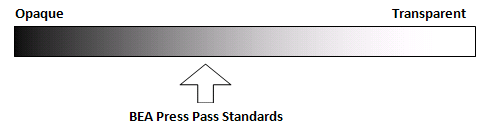
BEA Press Pass Standards Still a bit Translucent

Transparency and translucency aren’t the same at all, and as it stands I find their criteria a little translucent…which is still an improvement over opaque.

BookExpo America and the Definition of “Press”


Those of you who follow this blog regularly know that I’m pretty passionate about books. I read many, and every week I write either an in-depth analysis of some book/writing-related issue, or I post a detailed, analytical review of a science fiction, fantasy, or horror title. In the almost two years that I’ve been at this, I’ve had the opportunity to meet and work with some of the greatest, most professional publicists and authors in the world. It’s been an awesome experience, and one that (judging by the traffic of my blog and by my Technorati ranking) it seems folks appreciate (at least a little!). And yet, this blog no longer meets Book Expo America’s “standards that are required to qualify for a Press Pass”. Which is odd, considering that it qualified last year when my readership was about 10% of what it is now.

Here’s the form e-mail that I, and many other popular book bloggers, received from Reed Exhibitions today:

Thank you for submitting your Press application to attend BEA as a working member of the media. Unfortunately you did not meet the standards that are required to qualify for a Press Pass. The standards have been determined for BEA by our exhibitors as to what are considered benchmarks of a professional “press credential”. We review all applications very carefully due to limits on the number of press passes that are issued. Unfortunately, your application does not meet the guidelines we have been given in order to maintain the expected standard of trade and general media. We greatly appreciate your time and consideration, hoping you can still participate in BEA or follow the coverage through our video and podcast initiatives.

Best regards, -R
Roger Bilheimer
BEA Public Relations Director

Despite the fact that I’ve made lots of productive relationships through BEA in the past and covered the event on this blog, I understand if they’ve established criteria that I now fail to meet. It’s their event, and the guest list is in their purview. And yet, this whole process raises a number of questions. To whit:

1 What are the “standards [that] have been determined for BEA by our exhibitors as to what are considered benchmarks of a professional “press credential”” ?
2 Why are people only getting this notice today, two months before the event and several months after registering, when hotels and flights have already been booked?
3 Are Reed Exhibitions, and their publisher exhibitors intentionally sending a message to book bloggers that we don’t count as press, that our POV on industry events is less worthy?

To be clear, I’m not grousing about the fact that I’m not getting a press pass. At this point in my blogging career, I have enough relationships in the industry that I’ll still have plenty of stuff to cover even if I never set foot on the show floor. Yes, I might miss a lot of interesting developments…but I’ll still have plenty to write about, regardless. But, Reed Exhibitions’ lack of transparency, the lateness of their communication, and its implications are all troubling.

Is this the kind of relationship Book Expo America and its exhibitors want to foster with the book blogger community? Don’t book bloggers count as press? Shouldn’t we be given the professional courtesy of clearly communicated criteria before we’ve booked our flights and hotels, scheduled meetings and interviews? In short, if book bloggers act as professional media, don’t we deserve to be treated as such?

If, like me, if you’ve got a problem with Reed’s approach to this whole process and would appreciate some more transparency, please make Book Expo America aware of it. You can tweet stuff @BookExpoAmerica, as well as e-mail inquiry@bookexpoamerica.com. I’ve e-mailed and tweeted at them asking for clarification, and I know a lot of other book bloggers are doing the same.

If you care about books and their coverage on blogs, boost the signal!

REVIEW: The Steel Seraglio by Mike Carey, Linda Carey, Louise Carey


Title: The Steel Seraglio
Author: Mike Carey, Linda Carey, Louise Carey
Pub Date: March 13th, 2012
Chris’ Rating (5 possible): 1 point 1 point 1 point 1 point
An Attempt at Categorization If You Like… / You Might Like…
A mythic novel-in-stories that maintains a fast, unified pace

Several years ago, I discovered N.M. Penzer’s The Harem: Inside the Grand Seraglio of the Turkish Sultans, which opened my eyes to the fascinating history of the Ottoman sultan’s harem. What could be more fertile soil for an awesome story than a group of educated women from diverse backgrounds, locked away by a patriarchal society yet with intimate access to the heart of political, military, and religious power, and simultaneously grooming the next generation of the same? The real intrigue and blood-soaked history of the Ottoman Empire’s seraglio might well be called “implausible” if it were to show up in a fantasy novel, but with my pre-existing fascination, the moment I saw a book entitled The Steel Seraglio, I had to read it.

The Steel Seraglio is an impressively structured and well-executed fantasy that follows the experiences of three hundred sixty five concubines who – when their sultan is overthrown by an ascetic zealot – find themselves exiled into the desert, fighting for their lives, and their futures.

The Steel Seraglio is loosely structured as a novel-in-stories recounted by Rem, a librarian from the harem’s home city. With its mythic feel and folktale overtones, I was strongly reminded of Catherynne M. Valente’s The Orphan’s Tale and Gregory Frost’s Shadowbridge. However, The Steel Seraglio is more accessible and features more consistent momentum than either of these titles. Like most novels-in-stories, it features both nested and discrete, self-contained tales, but in this case each addresses and expands upon the conflict at the heart of this book: the concubines’ battle for self-determination.

The book opens with not one but two prologues, which is an interesting and rather unusual choice. The prologues firmly establish the book’s mythic tone, give a good sense of its flowing, evocative descriptions, and introduce us to the Careys’ daring technical choices. The first of the two prologues transports us to a dry, desert environment and establishes a decidedly non-Western, patriarchal culture heavily influenced by Middle Eastern traditions. At this point, it is entirely unclear whether we are dealing with a secondary world fantasy or find ourselves in some strange quasi-historical environment.

The first prologue does a good job of communicating the flavor of the novel, introducing us to both a setting and style that heavily reminded me of The Arabian Nights and The Shahnameh. Considering how much I like both, and how rare it is to find fantasy which eschews quasi-medieval northern European settings, The Steel Seraglio was quite refreshing.

The second of the two prologues further introduces us to our narrator, the librarian Rem, and lays out some of the background essential to the novel which follows. At the same time, this second prologues shifts to a slightly different, more self-aware narrative voice that strategically abandons some of the mythic tone – and it is this shift in voice that most caught my eye, as a bold and risky stylistic gamble that I felt ultimately paid off.

Despite the fact that I enjoyed both prologues on their own terms, I found the first to be one of the weaker parts of an otherwise strong novel. As mentioned above, the Careys successfully avoid the trap of most novels-in-stories by ensuring that each embedded tale shares and focuses on the novel’s driving conflict. Of all of the disparate sections of the book, the first prologue alone ignores this central conflict. While it does a good job of grounding the reader in tone, style, and setting through some wonderfully evocative writing, when considered as the first movement in the larger score, I felt it to be somewhat out of place. The second prologue, however, does a good job of easing us into the book’s central conflict.

The rest of the book maintains the prologues’ lush descriptions and combines them with a momentum-charged focus on character and conflict. The over-arching story is of how the sultan’s concubines are exiled after a coup d’état, and how they carve out self-determination for themselves. The story skillfully focuses on the experiences of the harem’s leaders (and those of the narrator Rem herself).

The principal characters are a delight: the pragmatic wisdom of the elderly Gursoon, the icy passion of the assassin-cum-concubine Zuleika, the terrifying zealotry of the usurper Hakkim Mehdad, the hilarious cunning of the camel thief Anwar Das, or the self-absorbed immaturity of the surviving prince Jamal are a delight on the page. I found the narrator’s own story a little self-absorbed for my taste, but this is not actually a weakness: the character remained well-drawn and interesting. I just found the others more compelling. Despite the myriad characters, and their many embedded stories, the Careys do an excellent job of capturing the conflicting, complicated, messy, and beautiful relationships of a disparate group thrust into one another’s orbits by powers beyond their control. The fact that the characters are so rich and varied is a testament to the Careys’ skill, and is the primary pillar on which the book’s success rests.

The narrative voice is interesting, and takes a notable (and ultimately successful) risk: the narrator, Rem, is gifted by the djinni with the ability to see possible futures. She is a seer, and a librarian, and a storyteller, embedded in of her own mythic time while cognizant of our somewhat more egalitarian future. The seer character is a trope much over-used in fantasy, but the Careys freshen it with a realistic conceit: with her ability to see into the future, Rem’s voice becomes peppered with anachronisms. Idioms and words that have no business in a mythic tale salt her prose: in the second paragraph of the second prologue, we are told that for a seer who can see the future “Tenses get a bit confused…and unravelling them again can be a bitch.” This departure from the somewhat florid style so commonly associated with myth is shocking, and I found it refreshing.

This is a daring choice of technique, because it risks our immersion in the story: at first blush, we read The Steel Seraglio as a mythic, folktale style narrative. The prose is evocative, lush, flowing: it reads like legend. But by inserting contemporary, anachronistic constructions into otherwise mythic prose, we are forced to reconsider and reevaluate the words and themes introduced by the story. The effect may be jarring. Although some readers might find that it lessens the sense of mythic immersion the prose otherwise produces, I found that the technique was used sparingly enough, and with just enough strategic precision, to heighten my own sense of immersion. After all, wouldn’t someone perceptually unmoored from their own time end up with some rather odd verbal tics? Because the Careys play this narrative device straight, making Rem’s anachronistic tics and stories strange or incomprehensible to her own contemporaries, the effect heightens the world’s remove from our contemporary mores, enhancing the gap between the novel’s patriarchal world and our own.

Just as the novel’s non-traditional setting is refreshing, so too is its thematic focus on women and their self-determination in a patriarchal society. This is the kind of theme that fantasy, a genre stereotypically known for its lantern-jawed (male) heroes, too rarely addresses. While the book wears its feminist themes on its sleeve, the Careys avoid the polemical trap by focusing on the complicated and at times messy emotional journeys that their (predominantly female) characters must take. As a result, the (perhaps obvious) themes are treated with a skill, compassion, and empathy which diffuses and dramatizes any moralizing agenda.

The core thrust of the novel is divided into two “books” within the larger novel, a “Book the First” and a “Book the Second”. While both are well-told, well-structured, and maintain a well-paced momentum, I found that the second of these two books felt somewhat rushed. It focuses on the consequences of the events of the first, but it does so in a much more sweeping, view-from-thirty-thousand-feet fashion than the first eighty percent of the novel. In some respects, as a work of history within the fictional narrative, it works well. And my discomfort with this approach may simply stem from the fact that I wanted to spend more time in the Careys’ world, and in the city of Bessa, and with the characters they introduced me to. But nevertheless, I found it felt to some degree like an attempt at a duology crammed into one volume.

Overall, The Steel Seraglio is a delight. Fans of mythic fantasy like Valente’s The Orphan’s Tale or Frost’s Shadowbridge will likely enjoy both its characterization and evocative description, while readers looking for a fun, action-packed story can find the same in its fast-moving pace. The weaknesses I saw, whether in its initial prologue or in the rushed second book, are on the whole quibbles: the book is great fun, and a rich, lovely work of art. The excellent interior illustrations by Nimit Malavia further add to its artistry, though from a design standpoint the artistry might have been heightened by illustrations more evocative of or otherwise tied to the Arabian, Persian, or Ottoman traditions which feature so strongly in the text itself, and in the excellent cover by Erik Mohr.

The Steel Seraglio is a wonderful, resonant book and I would love to see more such novels from its authors, illustrator, and publisher.

Stumbling through the Arena: Thoughts on the Hunger Games Movie


Folks who’ve been reading this blog for a while probably realize that I’m a big fan of Suzanne Collins’ Hunger Games trilogy. I frequently use it as an example, and have written up some more in-depth discussions of the books, as well. And having recently seen two very different yet still compelling film adaptations (see my write-up here), I was looking forward to Gary Ross’ adaptation of The Hunger Games. Here’s what I thought:

NOTE: What follows doesn’t really have any spoilers as to what happens, but it does discuss particular scenes that worked or didn’t work in the movie itself. So be warned.

Pacing is the Heart of the Hunger Games

In the book, Collins nails a slew of narrative techniques: her characters are compelling, the world she describes is vivid, and the story itself is fast-paced. There are plenty of iconic moments in the book, scenes and passages that leave the reader crying, terrified, or cheering. One can’t help but invest in the characters. But if the characters are the lifeblood of The Hunger Games, then it is Collins’ deft management of the story’s pace that keeps that blood pumping.

Regardless of the medium, uniform pacing kills narrative momentum. Yes, the audience wants the story to move forward. But for that movement to be emotionally satisfying, it needs to be modulated. We need moments where we’re on the edge of our seats, our hearts hammering. And we need moments when the action slows, where we can take a moment to breathe, and to savor deeper emotional content. Despite the action at the heart of Collins’ story, she still manages to include enough introspective moments to imbue her characters with an emotional progression, which in turn gives their actions and choices emotional meaning for the audience. Stories whose pace is unmodulated, where the rate at which we are asked to invest in the characters is unchanged, are exhausting.

Unfortunately, Gary Ross’ adaptation of The Hunger Games evidences a clear lack of analysis into why the original book worked so well. While it gets the window-dressing right, it stumbles on the most important points.

The Hunger Games According to Gary Ross

A story is more than a collection of scenes. Each moment serves a particular purpose, be it expository, emotional, inertial, etc. Often, a moment works to fulfill multiple purposes simultaneously. When I talk about the unity of a story, I mean having each moment and each level of the story working in concert towards a shared purpose. Collins’ books evidence great and powerful unity throughout. Key inflection points are able to escalate our emotional investment through their drama, which in turn builds upon the foundations laid through preceding moments.

On the face of it, Gary Ross’ adaptation can be called faithful: most of the key moments from the book are there (FWIW, io9’s got a good analysis of what’s missing), from the reaping, Katniss’ heartfelt goodbyes, the arrival in the Capitol, the tribute parade, the interviews, the training sequences, etc. So yes, on the superficial level of “what happens” the movie remains reasonably faithful to the book.

However, though every scene contributes to a story’s overall emotional impact, different scenes demand, need, and produce varying degrees of emotional investment. One of the differences between good storytelling and bad lies in knowing which scenes should evoke stronger and weaker emotions. In her prose, Collins gets this right. In his movie, Gary Ross does not.

Shortly before the movie’s premiere, I came across an answer Gary Ross gave to a question about his favorite scene in the movie. It was the kind of standard question for which every director has some sort of diplomatic throw-away response, perfectly geared to not offend any fan. Ross’ answer was that for him, every scene was just as important as every other, and thus he didn’t have a favorite. At first blush, I thought this was just a diplomatic non-answer. But after seeing the movie, I realized that this value judgment carries through Ross’ directorial vision.

In his adaptation, Ross imbues each and every scene with the exact same level of emotional intensity. The actors deliver solid performances (though in some scenes I found Jennifer Lawrence’s Katniss a touch wooden), but I had no sense of which moments in the story were supposed to be more or less dramatic/important than any other. In most movies, a scene’s cinematography, editing, music, and the transitions between its preceding and following scenes give some indication of its relative importance. Not so in Ross’ The Hunger Games, where Katniss’ appearance in the Tribute Parade is apparently just as important as her stroll through the woods at the movie’s opening.

Many reviewers have called the movie exhausting – and they’re right. With no variability in its pace, or with the audience’s emotional investment, its uniformity turns it into a slog. Whether the audience’s emotions run high or low doesn’t matter: what matters is that because they are relatively unchanging, the entire experience is lessened.

Tent-pole Moments that Fall Flat

In reading the book, there were several key moments that (for me) rang with resonant power. These are the scenes that – several years after first reading the book – have stayed with me. They are, in order of their occurrence:

  1. The Reaping, where Katniss volunteers on her sister’s behalf,
  2. The Tribute Parade, where Katniss’ dress lights on fire,
  3. The Interviews (Katniss and Peeta’s) where they begin their conscious manipulation of the games’ audience,
  4. The Training Evaluation, where Katniss’ demonstrates her skills, and;
  5. The Games themselves (which to avoid spoilers I won’t get into).

Each of these scenes represents an inflection point in the story, both for the characters and for all events that follow. They are the tent-poles on which the story hangs. One would think, therefore, that these scenes would demand more of the director’s attention. But in the film itself, almost all of these points fall flat. Let me consider each in turn:

The Reaping The book’s first-person, present-tense narration rapidly invests us in Katniss’ perspective of the events. We perceive the Reaping, and her sister, and her sister’s selection, through her eyes. This gives the moment poignancy, relevance, and immediacy. The movie, however, is not a first-person experience. And by the time the Reaping takes place, we lack the world-building background or emotional investment in the characters to really care about Prim’s selection, or to understand the implications of Katniss’ volunteering.
The Tribute Parade Katniss is “the girl on fire” and it is at this moment in the story that she receives that sobriquet, and when she realizes that she can affect the games’ audience. It is a turning point for the character, both in terms of how she perceives herself and how we as the audience are meant to perceive her. When her and Peeta’s costumes light on fire, it is a visual dramatization of their characters, which in the book unifies in that one moment the book’s themes, the characters’ journeys, and the imagery in the prose. But on film, this (very brief) moment rings hollow because of terrible costume design and even worse CG (seriously, I’ve seen animated GIFs with better rendered flame animations).
The Interviews The interviews with Caesar Flickerman further drive home the shift in both Katniss and Peeta’s awareness of themselves. They are the denouement to the Tribute Parade, deepening our understanding of the characters’ changes. As such, they are central to the progression of each character, to their relationships with Haymitch, and to their relationships with each other. They also fundamentally drive our awareness of each character, respectively. Here, too, Collins’ relies on the symmetrical visual imagery of Katniss as the “girl on fire”, where in one scene her dress lights on fire…and then becomes a completely different dress. As a symbol, this works on every level: it ties into the series’ over-arching themes of revolution and dramatizes the character’s growth…and again, the CG and direction fall flat on film: the fact that the dress doesn’t actually change ruins the effect. The scene itself is only saved by the excellent acting of Stanley Tucci (Caesar Flickerman) and Josh Hutcherson (Peeta Mallark).
The Training Evaluation The training evaluation gives us further insight into Katniss’ character, and into the lengths to which she is willing to go. It is a visual, dramatic moment in the storytelling that focuses entirely on Katniss’, her relationship with Haymitch and the unspoken relationship with the gamesmaster Seneca Crane. In the movie, it gets about as much focus as Peeta giving Katniss burnt bread.Both are necessary, but I would argue that the training evaluation raises the stakes for the character and thus deserves more focus (screen time, directorial consideration).

I won’t comment on the Games themselves, since doing so would include far too many spoilers to be helpful. But the uniformity of tension and emotional engagement is almost perfectly maintained throughout. There are, in fact, only two moments which deviate from this uniformity – and both make for some of the best acting in the entire movie.

Overall Assessment of The Hunger Games (movie)?

Overall, the movie was “okay”. As far as adaptations go, it wasn’t anywhere near as well directed as Scorsese’s Hugo (see my earlier post), yet it was infinitely better than Chris Wietz’s adaptation of The Golden Compass.

The Hunger Games’ weaknesses are not inherent to the story, nor as far as I can tell do they stem from the screenplay, and certainly not from the actors’ performances. They are – in each case – a consequence of the director’s understanding of narrative. As such, they were all avoidable.

Despite these weaknesses, fans of the book will enjoy the movie…but they (like me) will be relying on their experiences of the book to support their experience of the film. People who come to the story fresh, without having read the book, will likely respond with a “meh”. The book will surely be a fan favorite for years to come, but I suspect this movie adaptation will be forgotten relatively quickly.

With three more movies to come (because apparently every third book in a trilogy needs to be two movies, e.g. Harry Potter and the Deathly Hallows, Twilight: Breaking Dawn, Peter Jackson’s The Hobbit, etc.), I hope that Lionsgate either gets a new director who understands pacing, or that Gary Ross learns something about storytelling. Considering the amount of money the first movie made opening weekend, I think that they could afford to do either.

Explorations of Religion in Science Fiction…but what about Fantasy?


In the real world, organized religion is messy. It has inspired wars and peace treaties, marriages and shunnings, art and book burnings. It is incredibly varied, both between areas where different organized religions predominate and within each area as well. There is no aspect of human history – anywhere on the planet – where organized religion has not influenced and been influenced. It is only natural that our species’ fascination with the divine and its concomitant expression in the organized structures of society would figure prominently in our fiction. And when we look at speculative fiction, some of the greatest works explicitly deal with it (A Case of Conscience, The Sparrow, A Canticle for Leibowitz, etc.) and yet I find that they are almost always science fictional, as opposed to fantasy. Which leads me to wonder why?

In the Encyclopedia of Science Fiction, Brian Stableford and David Langford point out that science fiction’s roots lie in sixteenth and seventeenth century organized religion. And while fewer SF titles today deal explicitly with religion, it remains a theme that we return to time and time again. Here’s a brief overview of the ways in which science fiction explores religion:

Faith versus Reason One of religion’s functions is to provide an explanation for the reality we live in, and when scientific discovery expands the boundaries of that reality, organized religions have to either incorporate it into their faith or reject it. Naturally, science fiction – which pushes the boundaries of science – can mine this vein for rich conflict.

Syncretic Science Fiction By couching the descriptions and events of a story in scientific terms, some authors are able to construct a metaphor which achieves a syncretic unity between religion/faith and science.

Time Traveler vs Facts of Faith By taking certain articles of faith at face value, science fiction authors can explore the events and implications of the underlying tenets of (a usually Christian) faith.

Religion as Sociological Construct The role that religion – and in particular, organized religion – plays within society is another dimension that science fiction often explores.

The Identity of God An exploration of the borders between humanity and God, as well as an exploration of the more metaphysical/spiritual aspects of faith.

But is a similar table even possible for fantasy? I wracked my brain to come up with one, and simply couldn’t do it. Instead, when I trolled through my library looking for interesting secondary-world fantasies that explore religion, I almost always found:

  • A thinly-disguised version of the late medieval or early Renaissance Catholic Church.
  • A Corrupt Church riven by internal power struggles more tied to politics than faith.
  • A Church which usually bans the practice of magic, and hunts and kills magic practitioners.
  • A Church which dominates militarily and sociologically its sphere of influence…with relatively little diversity in its practitioners or its practice.
  • A Church which is opposed by some (usually implicitly pagan or animistic) external (read: savage) religion.

In the cases of some books, Christian religious scripture is literally appropriated to serve the purposes of the story. And while I don’t have a problem with this per se, the sheer frequency with which I see it makes me scratch my head. Shouldn’t secondary world fantasy be able to support and explore the more complex dimensions of religion? Must it always boil down to the (I think false) dichotomy of dogma versus magic?

To some extent, science fiction has an easier time of it because it can assume some reader familiarity with most major religions. As a result, there is less risk of bogging the story down with the world-building that a realistically complicated imagined religion demands. Is this weight of world-building the only reason why religion is so superficially addressed through fantasy? Or have I just missed the really interesting fantasy books that explore religion the way science fiction does?

The only examples that I can think of that do a good job with it are Elizabeth Moon’s The Deed of Paksenarrion, David Eddings’ Belgariad series (though this is somewhat debatable), Robert Jordan’s Wheel of Time series, and Ursula K. Le Guin’s Earthsea series. Surely there are others? Am I just missing them?