Skip to content

Posts from the ‘Writing’ Category

REVIEW: Second Sight by Cheryl Klein


Second Sight by Cheryl Klein Title: Second Sight
Author: Cheryl Klein
Pub Date: March 11th, 2011
Chris’ Rating (5 possible): 1 point 1 point 1 point 1 point
An Attempt at Categorization If You Like… / You Might Like…
A strong reference compilation on writing from an experienced children's book editor.

Several years ago, The Professor (my fiancée) introduced me to children’s book editor Cheryl Klein’s blog, where I discovered several years’ worth of thoughtful, analytical, and insightful talks she has given on the craft of writing and its intersection with the craft of editing. Having found her thoughts interesting, I was excited to learn that Klein is now releasing a self-published, crowd-funded (via Kickstarter) book on writing entitled Second Sight. I was lucky enough to get my hands on a review copy not too long ago, and found it be challenging, insightful, and professional in all the right ways. This is a book for people seriously interested in writing as both a craft and a career: people looking for touchy-feely encouragement or platitudes on the “writing life” need not apply.

From my perspective, this is high praise. What I look for in books on writing is a serious discussion of the techniques used to construct effective, powerful, and publishable fiction. Whenever I read a new book on writing, I am always comparing it to the books on my “Writing on Writing Shelf,” which is primarily stocked with classics like E.M. Forster’s Aspects of the Novel, John Gardner’s The Art of Fiction, Ayn Rand’s (very different) The Art of Fiction, or Ursula K. Le Guin’s The Language of the Night: Essays on Fantasy and Science Fiction. Klein’s Second Sight is like these excellent books in many ways.

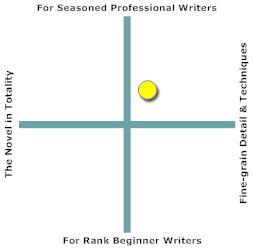
Second Sight demands a modicum of pre-existing knowledge. Someone still struggling to grasp the basics of writing (figuring out what a plot is, understanding the difference between point of view and voice, etc.) will likely find this book intimidating. An intermediate writer (as I like to consider myself) – who has been working at the craft for several years, who has a finished (though not yet published) novel or two under their belt, and who is looking for helpful ways to think about technique – will derive a lot of value from this book.

Like Forster, Gardner, and Rand, Klein flits effortlessly between the high-concept philosophy of writing (the nature of fiction, the nature of art) and the gritty reality of constructing a working novel (building point, character, plot, and voice). It is clear in reading this book that Klein has thought long and hard about what constitutes good writing, and what criteria to apply when judging the written word. However, unlike E.M. Forster, or John Gardner, (and certainly unlike Ayn Rand) Second Sight is far less didactic.

Reading Le Guin’s, Forster’s, or Gardner’s works on writing, I am often reminded of looking at a skyscraper. In Forster’s Aspects of the Novel, he takes 192 pages to walk us through the six pillars on which all novels rest. Each chapter builds on those that precede it to concisely outline the author’s vision of The Novel, like one floor resting atop another. This kind of writing on writing provides immense value, but it is by its very nature broad: it speaks in generalities from a hundred stories above the ground, glossing over many challenging aspects of writing. But if reading Forster is like looking at a finished skyscraper, reading Klein is like looking over an architect’s shoulder.

When I finish classic books on writing, I am often left with a feeling of “Whoa,” as my perception of The Novel has changed. Reading Klein cover to cover doesn’t produce that response. Instead, each chapter of Klein’s book leaves me with a smaller sense of “Neat!” that shifts my thinking on a particular facet of the craft. I wouldn’t be able to swallow a book like this in one or two sittings. In the two or three months that I’ve had my review copy, I’ve found that I would read a chapter or two, put it aside, and then return to it repeatedly when running into tough spots in my own writing. And that is its primary value: as a helpful tool for the dedicated writer struggling with the minutia of craft.

The primary meat of this book is framed by practicalities. It opens with a series of brief philosophical musings on the nature of good writing, and then dives right into the process of finding a publisher. That fact alone should tell you that this isn’t a book for someone who has never written anything. However, those early chapters are beautiful for their simple, straightforward discussion of the publishing process. The annotated query letters (one “from hell” and one which “gets it right”) are excellent, providing real-world lessons that can be applied by anyone intending to pitch editors or agents.

The middle of the book consists of independent chapters on various aspects of writing. The subjects range from a working definition of young adult literature, to techniques for constructing picture books, to the relationship between plot and emotion. There are commonalities across all of these sections, but they are not structured – and should not be read – as laying out a dialectical argument. Instead, they are insightful musings on varied aspects of writing, which may be relevant to some readers some of the time…but not to everyone, and not always.

It is only as she approaches the end of the “meaty” section that Klein veers into a Forster-esque mode of outlining a “theory of the novel.” Captured in a sixty-four page quartet of chapters (with their own introduction), Klein discusses what she considers the pillars on which a novel rests: point, character, plot, and voice. While these chapters are insightful and valuable, they represent the book’s one structural weakness: up to this point, the chapters all provided valuable insight without relying on the other chapters. Diving into the quartet on page 186, with its concomitant shift in structure and tone, struck me as inconsistent with the rest of the book’s structure. Without a doubt, the quartet deserves a place in this book, and I understand the difficulty Klein likely had in figuring out how to get it to fit. However, I suspect it could have benefited from either an alternative placement (perhaps earlier in the book, amidst the more “philosophical” chapters), or a better lead-in. But despite the inconsistency in structure and approach, the quartet – and the other independent chapters – still provide great value.

The last third of the book returns us to the brutal reality of revising a finished work. Her chapter on twenty-five revision techniques is immensely practical, the type of bare bones heavy lifting that every author should do, but that nobody likes to think or talk about. This section is immediately applicable to anyone who has finished a written work (of any length), and is now embarking on the revision process. The concrete advice given here clearly stems from years of editing books as a career. No shortcuts are given, no platitudes are offered: writing is hard work, and Klein lays out a series of techniques to produce higher quality work.

Second Sight is unlike most of my writing library. In general, that library consists of books that either try to lay out an all-encompassing theoretical framework (Forster, Gardner, Rand), analyze critical genre theory (Mendelsohn, Clute, Suvin), or exhaustively detail a particular facet of writing (Card, Kress, Propp). Some of the books in my library are well worn: the books I return to frequently as I think about my own writing. Since getting my review copy of Second Sight, it has never left my desk. It doesn’t answer the question of “What is The Novel?” but it does answer the question “What goes into an effective novel?” And for someone working on writing new works while revising what they have already written, I suspect this is the most important question.

NOTE: As I mention above, Second Sight is a self-published book, and can be ordered from Cheryl Klein’s web site at: http://cherylklein.com/buying-second-sight. Also, be sure to check out her great blog.

Techniques in Writing Alternate History


For the past several months, I’ve been having a lot of fun reading recent alternate histories and historical fantasies (I’ve reviewed a couple in earlier posts). As a result, I’ve been thinking about how alternate history works, and what techniques apply to the sub-genre.

Divergence as the Elephant in the Room

At some point, all of us wonder about the road not taken. In our private lives, we wonder how life would have turned out if we’d gone to college B rather than college A, if we’d gotten (or kept) a particular job, etc. The same “what if” question gives rise to alternate history, where we try to imagine our world as made different. Whether the portrayal is fairly realistic (as in Harry Turtledove’s Timeline 191) or completely fantastical (e.g. Jonathon Stroud’s Bartimaeus trilogy), alternate history gives us the chance to consider what our world would be like in entirely different circumstances. And that’s fun, because it can give us insight into our own world, culture, and history today.

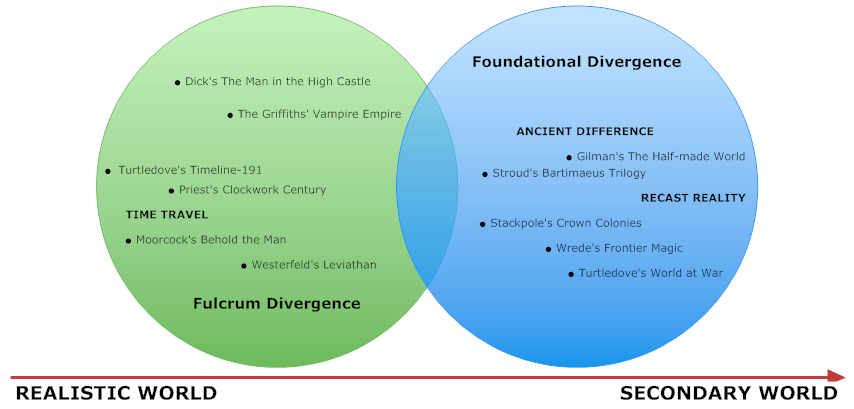
Because alternate history is so centrally concerned with what sets the imagined reality apart from our current reality, how the timeline diverges must be established very early on. Thinking about it, I’ve spotted a kind of spectrum of divergence in alternate history:

Spectrum of Divergence Techniques in Alternate History

Spectrum of Divergence Techniques in Alternate History

On the one hand, we have what I call fulcrum divergences. This method is most commonly found in “realistic” alternate histories, which lack magic, monsters, or really anything that could not exist in the real world. Some event is identified as a fulcrum on which history swings, and when creating the story we have things work out differently.

The best example I can think of for this type of alternate history has to be Harry Turtledove’s How Few Remain. In our real history, a Confederate messenger lost General Lee’s plans for the invasion of the North. The Union found the plans, and General McLellan was able to turn the Confederates back at the Battle of Antietam. Turtledove asks “what if the message never fell into Union hands?” and proceeds to create an excellent series of realistic novels that paint a Confederate victory and map out the consequences through World War II. Such “little differences” need not be so minor, however: Philip K. Dick posited a world where the Axis Powers won WWII in his classic The Man in the High Castle, nor need the resulting world be particularly realistic (consider Scott Westerfeld’s Leviathan series, where Darwin discovers DNA). Even fairly fantastical stories like Clay and Susan Griffith’s Vampire Empire series still rely on that one point where history changed. Universal within these stories is that the world’s history follows the familiar path we should all know up to that one key fulcrum moment when it skews Doc Brown-like into an alternate timeline.

The other end of the spectrum are foundational divergences. Typically used in more fantastical alternate histories, foundational divergence occurs so far back in the story’s timeline that its effects percolate through all aspects of the world. The place names, some of the personalities involved may be familiar to us, but they are already skewed relative to our timeline based on events that happened significantly prior to the events of the story.

In Stroud’s Bartimaeus trilogy, Patricia C. Wrede’s Frontier Magic series, or Michael A. Stackpole’s At the Queen’s Command magic has been known and applied within the world for centuries. There is no “point of divergence” with our known history, because instead the impacts of magic diffuse throughout all aspects of society, history, and cultural development. The key difference between such alternate histories and those relying on fulcrum divergence is that all recorded history has to be different from what is known. In these books, the foundational difference (e.g. the presence of magic) occurred or was discovered so far in antiquity that its consequences have percolated throughout the world. As a result, such books can often be enjoyed as secondary-world fantasies.

Between these two poles lie a variety of techniques that authors can use to establish that divergence. Often, authors use a time traveler from our timeline to introduce the divergence. Once in the past, the time traveler proceeds to change (or – sometimes not) the past as we know it.

Excellent examples of this kind of alternate history include books like Eric Flint’s 1632, Michael Moorcock’s Behold the Man and Mary Gentle’s First History sequence. In many respects, these books are similar to those that use a fulcrum divergence: in this case, the time traveler becomes the fulcrum. However, they differ significantly in that typically the protagonist (the time traveler) is aware of the divergence or its possibility. This changes the dynamic of the story and significantly alters the reader’s relationship with the hero.

On the opposite end of the spectrum, one can have an “alternate history” that completely recasts our known reality, which does not take place in any kind of recognizable version of our history. Here, the events of the book are modeled on actual events in our history, but they are depicted in a completely secondary world.

Turtledove’s World at War series employs this technique, depicting the events of WWII in a completely secondary world. Felix Gilman’s The Half-Made World (see my earlier review) similarly (though less historically) models aspects of his world on the American frontier.

Maintaining Suspension of Disbelief in Alternate Histories

The key to constructing an effective alternate history is to keep the reader locked in what Gardner calls the “dream” of the novel. This task is particularly challenging in alternate histories, where the reader knows they are reading something inimical to their pre-existing knowledge of the world. As a result, readers are likely to quickly pounce on perceived flaws, places where the author’s research or techniques fell short. There are several tools that can be used to maintain the reader’s acceptance of the alternate history.

The perspective that the book is written from, and the narrative voice that is employed, are both essential tools to maintain the reader’s disbelief. This is doubly-so if the book is written in first-person, but even when written in third the speech patterns, word choices, and value systems that our narrator employs contribute to the milieu of the era we are depicting. Recently, I read two alternate histories that execute on this aspect perfectly: Cherie Priest’s Dreadnought and Michael A. Stackpole’s At the Queen’s Command (see my earlier reviews here and here, respectively).

In both books, the narrative voice and the dialog employed by the characters rings (at least to my ear) true to the period when the books are set. The words key characters employ, the value systems inherent in their views, the differences in how different characters speak, in both books the quality of voice and dialog help to lock the reader into the alternate history. In At the Queen’s Command, the dialog is strongly reminiscent of other accounts of the late 18th century. As a result, I am able to believe that while there may be magic, I am still reading a story set in the 18th century I am familiar with. The same applies to Dreadnought, which follows a southern Confederate nurse across the frontier.

Nailing the voice like this is partly a question of the writer’s natural ear, but it is also heavily influenced by research. Reading books written in and written about the time period can help provide the “feel” of that time period. And solid research on word use and etymology can help make sure that the dialog is period-appropriate (as Mary Robinette Kowal pointed out recently, people swore differently even one hundred years ago). Research and extensive reading are the keys to nailing this aspect of an alternate history.

But there is a flip side to this coin: When we write alternate histories (or even historical fantasies) there is an understandable temptation to shoe-horn massive amounts of research into the text. After all, not everyone is as familiar with the time period as the author. But this natural tendency has to be handled very delicately because people who enjoy alternate histories are likely those who enjoy history. As a result, they are likely to already have substantial knowledge about history, and thus overloading them with historical information may weaken their engagement with the story.

In historical fantasy, this is a danger that I recently observed in Jasper Kent’s otherwise excellent Twelve. Kent clearly knows the history of 19th century Russia, however in many places he assumes that his readers do not. For some readers, this is likely not a problem. But for those of us who are familiar with that time period, the extensive expository background that Kent provides detracts from the rising action of the story. Striking a balance between that need for background and the forward motion of the story is key to writing any story based in history. When I think about the authors who do this well, they apply the rule of “less is more” and leave the reader to infer whatever background they do not already know. If we have to pick between momentum and background, I say always go for momentum.

Imagining a Different Today

If futuristic science fiction is about imagining a possible tomorrow, then alternate histories are about imagining a possible present. This at once constrains our world-building (to a greater or lesser degree, we have to conform to known history) while providing the opportunity for very focused imagination. When I read excellent alternate histories, I often think that it is much harder to paint a maserpiece by coloring within the lines. But the best authors of alternate history manage to do exactly that.

If you’re looking for fun alternate histories, below is a list of the authors and books that I’ve mentioned in this post. I strongly recommend you pick up a copy, from your local bookstore or your library and enjoy:

An Approach to Re-writing a First Novel


Several months ago, I wrote about my perspective on the differences between writing a novel and writing a short story. Now, several months later I’m knee-deep in re-writing that first draft of the novel, and so I thought it might be neat to follow up on my earlier comments:

Distance Buys Perspective

Writing a novel is an intensely personal investment, made over an extended period of time. It can take months or years of our cogitation, sweat, and emotional turmoil. It’s never far from our minds. We lie awake in bed thinking about how to do certain things with it (at least I do). By the time we write “The End” we’re relieved and rightly proud of our creation. And – I at least – wanted to dive right into re-writing it.

But that’s not wise. Because after we’ve just finished writing the book, it’s still up at the forefront of our minds. The characters names roll off our tongues, and we could recite the events of the plot backwards and blindfolded. Even if we can’t recite the text from memory, we still know what the sentences should say. At this point, we’re too close to it for effective revision. Where the story has narrative pot-holes – missing plot points, pacing issues, clumsy writing – our minds fill them in, gloss over them, because we know how it should work. It’s like having beer-goggles on: our minds won’t let us see the reality.

Which is why all of the smart advice out there tells us to wait. To put the book away. File it in a drawer, forget about it for a couple of weeks, or a couple of months, work on something else and then come back to it. Coincidentally, Kay Kenyon – one of my favorite science fiction authors – just posted about this exact issue. Unsurprisingly, I agree with her with all of my heart. But, like avoiding sweets and getting regular exercise, it’s not easy.

Letting it settle is one of the hardest aspects of writing a novel that I’ve discovered. While waiting to go back to my first novel, I took the time to write a second novel (okay, technically a graphic novel – but I figure it counts). Even though I intellectually know that I need to leave that graphic novel aside and let it settle, I still want to dive right into it and do the re-write. Which, much as I am loathe to admit it, is probably proof that I’m still too emotionally and intellectually close to it for proper revision. But it really makes sense to resist the temptation, because it lets us spot weaknesses that otherwise we would miss.

The Re-writing Attitude

Getting ready to re-write my first novel has been a mix of trepidation and hubris. On the one hand, I’m worried that as I take another look at it I’ll discover that it sucks. Then my ego kicks in and says “What are you talking about, the book is great, it can’t possibly suck.” Of course, that ego is a thin veneer over my own insecurities (which, of course, I quash). Which is why I found it helpful to keep the following statement in mind as I sit down to re-write:

Most first novels don’t get published. It’s okay if it sucks: we re-write to make it better.

Ask a bunch of authors how many books they wrote before they ever got an agent, or before they ever sold one to a major house. The number will surprise you. I’ve regularly heard debut authors talk about having five, six, seven finished novels (sometimes entire series!) in their drawers at home. That’s because writing a novel is a skill, and it is a skill that takes time to hone. Writing short stories can help with some of the craft, but it takes a different set of skills to write a great novel. In many ways, I think of it like playing a sport: how many games did Babe Ruth have to play before he could hit a homerun in the major leagues? How many pick-up basketball games did Michael Jordan play before setting foot on an NBA court?

It’s alright if the first draft of a novel sucks. That’s why it is the first draft. Because, if we’re serious about writing, we’ll produce a second draft that will be stronger than the first. And if need be, we’ll write a third draft that’s even better than the second. And at some point, perhaps, the finished product might be polished enough for publication. And if it isn’t, well then the skills we’ve picked up and practiced will help us write our next book, which will be better than our first. At least that’s the theory.

The Process of Re-writing

The Professor – my fiancée who edits YA books for a living – gave me some really good advice on the re-writing process. Of course, being male and knowing better, I promptly ignored her excellent advice and it bit me in the ass. Her advice on the process of re-writing:

Don’t sweat the small stuff.

When I initially picked up my first draft and started to read it, I did it with pen in hand. I dove in and attacked clumsy sentences, poor word choices, weak verbs. In the trade, this is called a line-edit and apparently it’s a classic first-time novelist mistake. The point of the re-write isn’t to fix the little flaws that have crept into the work. The point of the re-write is to spot the BIG structural weaknesses. If we’re bogged down in the minutiae of the sentences, we’ll never see the yawning pacing chasm or the gaping plot hole. We won’t see the forest for the trees.

I realized this about mid-way through my book. I had a niggling concern about a structural issue (the pacing), and it just wouldn’t leave me alone. But I couldn’t diagnose the problem effectively, because by jumping right into the sentences, I had gotten in too deep, too quickly. So I had to put it down again, walk away from it again, and then approach it a different way.

My second time around, I followed The Professor’s advice, and read it just as a first time reader would. I read through it – cover to cover – without a pen in hand. I was reading it like I hoped a typical reader (or an agent, or an editor) would. I was paying attention to my response to the text, to see where my interest flagged, where the story got my heart racing. I wanted to find where the book worked well, and where it lost me. Sure, I still saw the occasional weak sentence. But I resisted the (often difficult) temptation to pounce and fix it. Instead, I tried to figure out if the bones of the story worked.

Here’s what I found (in ascending order of importance):

  1. The events of the plot – at a general level – work reasonably well.
  2. The world-building seems reasonably solid, with compelling settings and believable (and interesting) factions/characters.
  3. The themes of the book can be emotionally and philosophically interesting.
  4. I lost interest around the 25% mark, and didn’t have interest until the last 5% of the book.

That last one is really important: reading through the book, it fundamentally failed the “So what?” test. That failure was evident in the way that the book slowed down and lost the reader’s interest. That, however, is just an observation: a fact. It told me nothing about why it lost the reader’s interest. In thinking it through, and discussing it with The Professor (who was awesome enough to take a look and give me a professional’s opinion on where I dropped the ball), the major failing’s cause was the protagonist’s motivation. It didn’t ring true, it didn’t work, and as a result, the reader just didn’t care.

Responding to a Major Flaw

That’s a major, major super-mega-important flaw. Characters are their motivations, and so if the hero’s motivation isn’t compelling…well, the story’s missing its fuel. That’s also not a quick fix. That’s not something that can be addressed by “sticking it in” as an editorial after-thought. To get that kind of motivation right, it needs to be ever-present throughout the story, from the first sentence all the way through to the last. And it should have really started with a question I’d failed to ask myself at the onset: why is my hero the hero?

The answer – if I’m being honest with myself – is that in the case of this novel, his was a convenient perspective and I wrote the opening chapters with a nifty voice that I happened to like. Alas, that’s not enough of a reason. So back to the drawing board. I took a look at the story, rotating it in my mind and considering all of the characters’ motivations and trying to determine how I could find/develop a more compelling hero. As I did this, I found the answer staring me in the face: the book had a major character, who did have motivation, and who was compelling…he just wasn’t the original focus. The solution (perhaps) would be to make that character, or someone like that character the hero.

Of course, this would mean re-writing the whole book. I wouldn’t be able to keep the eighty-three odd thousand words I’d written over the course of five months. I’d have to junk it, and basically start from scratch. That is not an easy call to make. It took a lot of work to write those words, and some of those words were (I think) pretty good. But I faced two basic choices: I could either trash the whole novel, or I could take another stab at it by writing it all over again from a different perspective. Rather than throwing in the towel, I decided to (literally) re-write it.

My reasoning was pretty straightforward: the bones of the plot, the world-building, the themes, they were all solid. I had gotten them right once, I could get them right again. It was my hero/narrator characterization which had failed. I’d written a book once, right? Surely I could do it again. So I decided to re-write it. This also gave me the opportunity to re-imagine what kind of motivation I wanted to give my (now-different) hero, and to play with the components of the plot to add more tension and raise the stakes. It’s an opportunity to take another stab at the whole project, and make the whole thing that much stronger.

Looking to the Future

And so now that’s what I’m doing. It’s early days yet. I’ve got a revised outline in place, and I’ve re-written the first couple of chapters. I’m thinking that maybe, as I get further along in the re-write, I might be able to re-use some select passages from my earlier draft. But I’m not certain of that. If I can, great. If not, no big loss. The actual process of writing the book is going smoother (and it seems faster) than on the first go-around. That’s probably because I’ve been living with these characters and this world in my head for almost a year now. It also suggests to me that I’m on a better track: the experience is reminiscent of writing the graphic novel I finished a couple of weeks ago, which has much simpler motivation (it might have other issues, but the motivation at least should be pretty solid).

I don’t know if this re-write will make the book good enough to vie for representation and publication. I’m hopeful, but if it ends up not being good enough…well, that’s alright, too. Because the process has taught me a lot about myself as a writer and about some of the skills that are essential for writing long-form work. And so even if this first novel ends up collecting dust in a drawer, I’ll still say it was damn well worth it.

Writing an Episodic Genre Series (part 3 of 3): The Hero’s Emotional Journey


NOTE! This is the third installment in a three-part series on writing episodic genre series. This post will focus on using the hero’s emotional arc to link the standalone installments in the episodic series. The previous two posts focused on the episodic hero, and the episodic plot respectively.

This past week, I have been writing about episodic series in science fiction and fantasy. While the episodic hero is central to any episodic series, and while each book in such a series relies on a solid episodic plot to keep the reader turning pages, it is the hero’s emotional journey which keeps the reader buying new books in the series.

Each Book as a Step on the Emotional Path

Plot can keep an episodic book going, but plot alone will not carry a series. If the reader is to buy the next book, they have to care about the hero. If the hero does not evolve over the course of the series, if the hero doesn’t change or grow due to the choices made, then readers will quickly stop caring.

This is harder to do in a long-term episodic series than one might think. For one thing, the seeds of that character growth should show up early on. The defining characteristics of the hero’s personality, of their values, and of their emotional journey should already be there in book one. At the close of each book, the hero should have taken at least one (or more) steps on their emotional journey.

Ray Lilly’s journey in Game of Cages shows a good example of the hero having to come to terms with the reprehensible acts he might commit in the name of the greater good. Lilly’s squeamishness and his innate goodness are traits established early on in book one, and the hardening that occurs in book two was foreshadowed (predicted) by more experienced characters (his employer) in the first book. The fact that Connolly follows through with this hardening, and that this toughening becomes a key emotional facet of book two speaks well to both the author’s skill and to the overall emotional journey that the series will take.

Heroes Stumbling on the Emotional Journey

But that journey need not be a stately progression. Heroes can step forward, step backward, step sideways. Like real people, they can make mistakes and it is concern over those mistakes that can keep readers engaged. Within the confines of any single book, the direction of their evolution is immaterial. Heroes are allowed to make the wrong judgment call as much as we are. What matters is that in each book their character does change in some way, that the character’s state at the end of the book is clear, and that at the opening of the next book that state is maintained. This helps to make the books flow together, and leaves the reader satisfied with the overall series. If the character isn’t changed by their experiences, the series will quickly start to ring flat and eventually readers will just tune out.

One method that is frequently used is to introduce the hero’s personal life as a sub-plot that spans the series. Harry Dresden’s relationship with his mother, his fairy godmother, his half-brother, and other family members (including new ones that show up later in the series) becomes an evolving sub-plot that spans the books. This emotional sub-plot weaves into the fabric of the superficial plots, contributing to the more action-oriented conflicts that Harry has with various factions in his magical world.

In some books, relationships like these are tangential to the direct action of the plot. But they provide the hero with an emotional tension and concerns outside of the direct challenge in front of him. These relationships and the emotions they evoke in the hero and reader represent “the other shoe” that the reader knows will drop at some point.

Relationship between Emotional Arc and The Plot

Such emotional arcs can either be used tactically (to modify pacing, to foreshadow events for a future book, etc.) or they can be used thematically. The Sookie Stackhouse novels painstakingly explore themes of Sookie’s relationships with lovers, family, friends, society, etc. In a very real sense, this exploration is central to the entire series. However, this emotional arc should be separate from the plot arc of the story. And just as series plotting can become formulaic, so too can the emotional journey.

To a great extent, they’re like the double helix of an episodic series’ DNA: they move in parallel, but they rarely cross. In those instances where they do cross – namely when the emotional aspect of a relationship from one book becomes the plot engine for another – then it is best to have another emotional strand waiting in the wings to be introduced. If a particular book is such an emotional intersection, then the strand in waiting need not be introduced or focused on: doing so risks trying to pack too much into what should be a tightly-plotted, fast-paced book. But the seeds for that strand in waiting should be planted, such that they can be further developed or focused on in the next book.

The Denouement: Leaving the Reader Eager for More

I have always found the conclusion to an episodic series book to be absolutely critical to maintaining my interest in the subsequent books. The hero concludes the adventure, the monster is slain, and now it’s time for some well-earned rest. In an episodic series especially, the denouement sets the stage for the next book. It sums up the emotional changes that the character underwent as a consequence of their adventures. Because editors like to have episodic series published annually (keep those reprints rolling!), odds are the author is already aware of what the next book will bring. The denouement offers an excellent opportunity to plant the seeds without leaving the dreaded cliff-hanger ending.

It’s hard to get right, and it is especially hard to get right consistently across multiple books. An impression I get is that much episodic fiction tends to skimp on the denouement: the action is over, so the book just ends. While an abrupt denouement may work for some readers, I think it weakens the ties between books in the series.

If the denouement is an outgrowth of the hero’s emotional journey, it should effectively outline (or at least hint at) the starting conditions for the next installment’s emotional journey. If written well, it can also hint at the stakes of the next installment’s emotional arc as well, although this runs the risk of a cliff-hanger ending. A good example of an artfully-handled denouement can be found in Brust‘s Teckla. To avoid spoilers, I won’t go into what happens or how he handles the denouement, but it manages to avoid abruptness, provides closure for the plot, but leaves enough unresolved emotional strands that the door is open for future emotional evolution…which the author addresses in subsequent books. The end result is that the end of the first book increases our emotional investment in the hero, and makes us want to learn what happens to him in the next book.

Conclusion

There are critics inside and outside of the science fiction and fantasy community who tend to view episodic series as less worthy. Episodic series generally don’t win the Hugos, the Nebulas, or the World Fantasy Awards. But they do sell. And they sell a lot. Many episodic series regularly find themselves at the top of bestseller lists, whether we’re talking about Locus, or even The New York Times.

Many readers get their first and only exposure to genre from such episodic series. Consider the countless people who would never wander into the “horror” or “fantasy” aisles at their local bookstore, but who love Sookie Stackhouse. As a result, these episodic series are a powerful missionary force for the genre. They extend genre reading protocols across a broader audience, and they provide adults and children with plenty of enriching entertainment. While they may eschew lyrical prose styles and experimentation, I suggest that is not necessarily a bad thing. After all, the more people read any type of genre fiction the stronger the genre becomes. And if we look to our own history, who do we remember? We remember the episodic heroes: Sherlock Holmes, Miss Marple, Nero Wolfe, James Bond.

An Attempt at an Absolutely Non-exhaustive Episodic Reading List

Sub-genre Author Series First Book
Adult Urban Fantasy Jim Butcher The Dresden Files Storm Front
Adult Urban Fantasy Harry Connolly Twenty Palaces Child of Fire
Adult Urban Fantasy Kate Griffen The Mattew Swift Novels A Madness of Angels
Paranormal Romance Laurell K. Hamilton Anita Blake series Guilty Pleasures
Paranormal Romance Charlaine Harris Sookie Stackhouse Novels Dead Until Dark
Paranormal Romance Kim Harrison Rachel Morgan series Dead Witch Walking
Adult Fantasy / SF Steven Brust Vlad Taltos Novels Teckla
Adult Fantasy / SF Richard K. Morgan Takeshi Kovacs series Altered Carbon
YA / Middle-grade (various) The 39 Clues The Maze of Bones
YA / Middle-grade Eoin Colfer Artemis Fowl Artemis Fowl

Writing an Episodic Genre Series (part 2 of 3): Episodic Plots and Pacing


NOTE! This is the second in a three-part series on writing episodic genre series. The previous installment discussed the episodic hero, while the third installment (planned for Tuesday) will focus on the hero’s emotional journey.

This past Tuesday, I wrote about how episodic heroes are constructed in contemporary science fiction and fantasy series. While an episodic series relies on that hero, it is each individual book’s plot that keeps the reader turning pages. A good episodic plot will avoid formulaic writing, while providing an escalation in tension so that the reader keeps turning pages. The key to this is to establish momentum, and as the series progresses to vary the structure of each book’s plot. This keeps the reader interested in the book they’re holding in their hands right now, while the hero’s emotional journey (discussed in the next installment) keeps them buying the next book.

Pacing: Hitting the Ground Running

By leaving the character’s backstory off-stage, episodic books typically open with the hero actively starting the adventure. This is a page taken right out of the detective novel playbook. When we first meet Laurell K. Hamilton’s Anita Blake, we find her turning down work from a shadowy vampire organization. We first encounter Ray Lilly traveling to his latest case, or Harry Dresden getting a job. Episodic series sprinkle the hero’s backstory here and there, but no time is wasted by delving narrative-style into the hero’s psyche or providing an infodump on “what-came-before”. Episodic series hit the ground running, and they tend not to let up until the mystery is solved, the monster is slain, and the hero can put his feet up.

Middle-grade novels especially establish the stakes early on (often on the first page!). I strongly recommend reading middle-grade episodic novels (like The 39 Clues series) to find some tricks on how to establish stakes and simultaneously establish the hero’s characterization. From conversations I’ve had with children’s book editors, the speed with which readers are drawn into the story is one of the most important characteristics they look for. Adult episodic series, with their tendency towards functional prose and page-turner status, can learn much from the pacing techniques used by children’s authors.

The Shape and Structure of Episodic Plots

Most episodic series rely on mysteries for their plot structure. Many employ the classic mystery plot: clear identification of the mystery, broadening suspicion, a sub-plot intrinsic to the hero’s emotional arc, discovery that the hero has been on the wrong track, re-focusing of the hero on the right track, explanation, climax and denouement. This type of plot may seem a bit cliched, but the practical reality is that if it worked for Agatha Christie, it’ll work for people writing today. The originality and inventiveness of the individual authors shines through in how they flesh out these bones to create their books.

Urban fantasy series like The Dresden Files or the Twenty Palaces novels rely on a combination of characterization and world-building to enrich their basic plots. Paranormal romances like the Sookie Stackhouse novels or the later Anita Blake, Vampire Hunter books combine mystery plotting with the techniques of romance. Episodic adventure series like Artemis Fowl or Vlad Taltos invert traditional tropes (criminal vs sleuth, commit a crime vs solve a crime).

The Sense of Escalation

As the series progresses, building a sense of escalation becomes critical. Think of it this way: if the hero saves the universe in book one, what’s he going to do in book two? Many episodic series avoid this pitfall by focusing the plot on rather narrow concerns: if an epic hero saves the world, an episodic hero is more likely to save an individual. By keeping the scope focused, it makes it easier to escalate the stakes as the series progresses.

With her experience writing children’s books, Kate Griffen does an excellent job escalating the stakes across her Matthew Swift novels. In the initial installment (A Madness of Angels) Matthew Swift is focused first and foremost on his own survival. He is looking out for Number 1, and if others get swept up in his fight for survival that is their problem. In the second book (The Midnight Mayor) Swift has the (magical) mayoralty of London dumped in his lap, and he must deal with the consequences. At stake is the entire city of London and England itself.

Connolly uses a similar tactic to equally good effect: in the first Twenty Palaces novel (Child of Fire), the primary stakes are the hero’s life. Sure, there’s a town involved but Ray Lilly is focused on his own survival. In the second book (Game of Cages), his focus shifts to that of the town where a ravenous predator has escaped. What makes Connolly’s execution so strong is the unity he achieves between the explicit escalation of the stakes in the plot, and the escalating tension/stakes on Ray Lilly’s emotional journey (more on this in the next installment).

This kind of thematic and tactical escalation across books in the series can also tie into the character’s experiential growth: if the inexperienced hero can do something, it stands to reason that as their capabilities and understanding grow, so too will the stakes they fight for. The Harry Potter novels, themselves straddling the fence between epic and episodic, manage this experiential escalation very well.

The Danger of Formula and Using a Change-Up to Avoid It

The danger in all of this is that a plot model that works for the first, second, and third book in the series may seem formulaic and dull by the fourth, and fifth book in the same series. This is a point where the best episodic writers introduce what I call a “change-up”, a device which imbalances the hero’s routine and changes the plot structure of the books.

Different authors employ different change-ups: Steven Brust took away Vlad Taltos’ fortune, profession, and family by the fifth book. Jim Butcher introduces varying changes into Harry Dresden’s personal life (roommates, family members, etc.) while weaving strands for a super-plot that ties into Harry’s backstory and extends across the series.

By introducing such new elements, or by subverting the formulas employed in the earlier books, the plots can remain fresh for long-time readers and the momentum can be maintained throughout the series. But to be effective, the change-up has to do more than just intensify the predominant theme. For example, the Sookie Stackhouse novels are centered around romantic relationships. The characterization of Sookie represents the series’ greatest strength, with an iconic and engaging character and a distinct narrative voice. But as the series progresses, Harris attempts a change-up by complicating these romances through the introduction of new paramours and the removal of old flames. Because the books were already centered around relationships, the change-up rings flat and fails to build a sense of increasing stakes. As a consequence, the books rely upon the reader’s prior investment in the character and the world of the series. In Harris’ case, this gamble might work due to the audience’s strong emotional involvement with Sookie. But it is a big risk to take.

Plot versus Emotional Arc

This discussion of plot is centered around one book, within the context of a broader episodic series. The defining characteristic of episodic series is that each installment stands alone, and in order for that to work, each installment’s plot must stand alone. However, it must balance its independence with the foreshadowing and references necessary to link subsequent books and preceding installments. The key to this, I believe, is the hero’s emotional changes over the course of the series. This emotional development is not confined to any one book, and it represents the glue that binds the books to each other. The next installment (Tuesday) will focus on this.

NEXT: Come back on Tuesday for the third and final installment which focuses on using the hero’s emotional arc to keep readers engaged across books in the series.

Writing an Episodic Genre Series (Part 1 of 3): Episodic Heroes


I recently had the pleasure of reading the first two books in Harry Connolly’s Twenty Palaces series, and this got me thinking about the nature of episodic science fiction and fantasy. By episodic series, I’m thinking a four, five, ten book series where each book is a standalone story where the series’ principal character goes on whatever type of adventure is typical for that character. Think books like Jim Butcher’s Harry Dresden books, or Charlaine Harris’ Sookie Stackhouse novels. How are these kinds of episodic books constructed? What makes them tick?

NOTE! This is the first in a three part series of posts. This post is focused on the episodic hero. On Saturday, I’ll post the next chapter, focusing on the episodic plot, and the final post on Tuesday will focus on the hero’s emotional journey.

Epic vs Episodic: What’s the difference?

Science fiction and fantasy are replete with series. That’s perfectly reasonable, when we consider that publishers, authors, and agents all love the “automatically” accumulating reprint sales that series make possible. But it is quite difficult to compare Robert Jordan’s Wheel of Time to Charlaine Harris’ Sookie Stackhouse novels. There just isn’t that much commonality there.

Series like The Lord of the Rings or the Wheel of Time are epic in scope. They tell one story, with a clear beginning, middle, and end. But that one story does not fit in one book: it has to be spread across multiple volumes. The vast majority of these epic series simply cannot be read on a standalone basis (for a great counter-example, see my review of N.K Jemisin’s The Broken Kingdoms).

If you look at an episodic series like Butcher’s Dresden Files or Connolly’s Twenty Palaces novels, the series itself has a very different structure. Each book is a completely self-contained story, with its own beginning and ending that can be read independently of the other books in the series. And in contemporary series, each book and the entire series focuses on the experiences of one particular character.

Building an Episodic Character

In the 1970s, ’80s and ’90s, series like Terry Brooks’ Shannara series, Anne McCaffery’s Dragonriders of Pern, and Mercedes Lackey’s Valdemar books were structured around a single universe (Shannara, Pern, and Valdemar, respectively) with standalone trilogies (or duologies) of books set within that universe. Each standalone sub-series could be described as an “epic” sub-series, while if we take the entire oevre together they begin to resemble episodic series. However, following the late ’90s’ rise of “Chihuahua-killer” fantasy tomes, these types of episodic/epic series seem to have vanished from publishers’ new lists.

With the contemporary focus on one character, that character becomes the most important aspect of an episodic series. This is true whether we’re writing an adult urban fantasy series like the Twenty Palaces, a paranormal romance mystery (à la Charlaine Harris), or a middle-grade adventure series (like Eoin Colfer’s Artemis Fowl). Of course, character matters in every book. But it is the foundation of any episodic series.

What would Sherlock Holmes be without Sherlock Holmes? Could we have the Dresden Files without Harry Dresden? Or the Sookie Stackhouse novels without Sookie? The identity of the series’ protagonist is intrinsically tied up with the identify of the series. Few people realize that the Sookie Stackhouse novels were in fact first dubbed the “Southern Vampires Mysteries”: the pervasive character of their protagonist eventually subsumed the publisher’s attempts to brand the series independently of its hero.

There is a lot of commonality in how episodic authors create their heroes. First, almost all episodic heroes have a Past (note the capital “P”). In many ways, this is a product of the history of episodic series, who are pretty clear descendants of the serialized mystery (Arthur Conan Doyle, Dashiell Hammett, Rex Stout, Ellery Queen, etc.). When we meet Connolly’s Ray Lilly, or when we meet Butcher’s Harry Dresden, or Steven Brust’s Vlad Taltos each brings to the table a checkered history.

Ray Lilly is an ex-con who survived an unpleasant run-in with magic, and now finds himself employed as a “wooden man” (a sort of enforcer) for a society of wizards (called the “Twenty Palaces Society”). Harry Dresden is a professional wizard private investigator who has had serious altercations with magical society. Vlad Taltos is a low-ranking minority (human) criminal in a larger criminal organization on a magic-filled secondary world.

Each is in some fashion iconoclastic. They have survived altercations with some form of authority in their world, which gives them some form of reputation. This reputation becomes a double-edged sword that both helps and hinders the hero on their adventures. As the books unfold, the reader learns more of this backstory through subtly planted information, for the most part avoiding an infodump that would stall the fast pace of the story. As the series winds to a conclusion, the overarching conclusion likely leads to some resolution of the lingering effects of that backstory.

Every one of these characters is gainfully employed. What’s more, they have jobs that will force them into adventures. Lilly is an enforcer. Dresden is a wizard/private-eye. Taltos is a low-level crime boss/private-eye/assassin. It is their means of employment that makes a long, episodic series possible. A detective will always have another case. An enforcer will always have another assignment. An assassin will always have another target. This enforces a certain structure, along with certain strictures, on each book in the series.

When we meet the hero, they are often inexperienced in some critical aspect. Ray Lilly knows almost nothing about magic, save that it exists. Harry Dresden has lots of magical power, but very little control. Any middle-grade or young adult episodic series (like Artemis Fowl or The 39 Clues) has inexperienced heroes by default: youth and inexperience go hand-in-hand! The use of inexperience makes it possible for the reader to learn alongside the hero, and for the hero to progress through adventures (books) with escalating challenges. As the hero’s experience increases over the course of the series, the challenges that they face can become more difficult, more challenging, more dangerous. Done artfully, this keeps the tension high in the later books in the series, and if tied back to the character’s emotional development can keep the character engaging, whether we’re in book two or twelve.

The use of iconoclasm and employment are both traditional tools of the mystery novel. Sherlock Holmes, Nero Wolfe, Miss Marple, even Sam Spade – all of the classic detectives were iconoclastic, and the vast majority were actively employed as detectives. The use of inexperience to provide character progression seems to be a newer development, and it is one that an increasing number of episodic series rely on.

NEXT: Come back on Saturday for the second installment for episodic plots, how to keep the reader reading in one book, and how to avoid flagging interest as the series progresses.

The Uses of Food in Science Fiction, Fantasy, and Horror


Thanksgiving’s secular ethos built around food, family, and friends (three things I love) make this my favorite holiday of the year. Superficially, it’s all about the great feast centered around the Thanksgiving turkey, and so I thought why not post about how food is used in science fiction, fantasy, and horror?

The Difficulties with Food

Perhaps unsurprisingly, we are evolutionarily wired to pay attention to food. That makes it very difficult for food to appear in a story or scene without becoming a major facet. Genre films use the visual of food to great effect: who can forget the scene in The Return of the King when Denethor is feasting during the charge for Osgiliath? Or the dinner scene in Beetlejuice? And let’s not forget those movies that are all about the dangers of late night snacking: Gremlins and Gremlins 2?

The filmmakers all knew that the instant food appears on screen, at least for a moment, our eyes are naturally drawn to it, our focus shifts and – depending on how it’s depicted – our mouths start watering. It’s a Pavlovian response, and the best film-makers make use of it in their movie making. The same thing happens when we read. The feast-time strategy session is a trope of epic fantasy, and much horror (including the recent zombie resurgence) is centered around food (of one sort or another). Avoiding the cliche and making food a seamless, important part of the story is much more difficult. Too little focus, and the food becomes incidental, a cliche distraction. Too much focus, and the food becomes the point of the scene (which sometimes is what you want).

So how does genre fiction actually make use of food? Well, from a brief persual of my bookshelves, it seems that I can see four different uses:

  1. As a metaphor.
  2. As a characterization device.
  3. As a distancing device.
  4. As imagery of the sublime.

Food as a Metaphor

This is one of the more obvious uses, but can be quite difficult to do tastefully. Consider two different works and their metaphoric use of food:


A Christmas Carol
, by Charles Dickens

Dandelion Wine
, by Ray Bradbury

In A Christmas Carol, Dickens uses dinner as symbols of class division. The Spirit of Christmas Present shows us many people eating on Christmas Eve, the most memorable of which is surely the Cratchit’s feast. Poor, down-trodden Bob Cratchit and his family put together a lovely spread. Dickens knows that food is not just about the meal itself, but about the way it is presented, the way it is served, the company in which it is enjoyed. He puts all of this to mouth-watering use as he describes their (meager) fare of Christmas goose and pudding:

Such a bustle ensued that you might have thought a goose the rarest of all birds, a feathered phenomenon, to which a black swan was a matter of course – and in truth it was something very like it in that house. Mrs. Cratchit made the gravy (ready beforehand in a little saucepan) hissing hot, Master Peter mashed the potatoes with incredible vigor, Miss Belinda sweetened up the apple sauce, Martha dusted the hot plates, Bob took Tiny Tim beside him in a tiny corner at the table, the two young Cratchits set chairs for everybody, not forgetting themselves, and, mounting guard upon their posts, crammed spoons into their mouths, lest they should shriek for goose before their turn came to be helped.

Setting up the table, laying out the plates, anticipating the taste, these are the rituals of most any family. The “pre-game” sets the mood, establishes the characters, the joy of a holiday meal. Note how Dickens points out that geese are not that rare, that they are easy to be had…but that the Cratchits still rarely enjoy them: “you might have thought a goose the rarest of all birds…and in truth it was something very like it in that house“. Or consider how the Cratchits react to the pudding:

Oh, a wonderful pudding! Bob Cratchit said, and calmly, too, that he regarded it as the greatest success achieved by Mrs. Cratchit since their marriage. Mrs. Cratchit said that, now the weight was off her mind, she would confess she had her doubts about the quantity of flour. Everybody had something to say about it, but nobody said or thought it was at all a small pudding for a large family. It would been flat heresy to do so. Any Cratchit would have blushed to hint at such a thing.

The metaphor works here because Dickens does not beat us over the head with it. Granted, he beats us over the head with Scrooge’s mistreatment of Cratchit. But when describing the scene with the food, he implies its meaning quite rightly. The fact that the Cratchits eat a poor man’s meal are subtly implied, not stated. The focus is not on the meagerness of their meal: the text instead focuses on their dignity under duress, and that is what makes the metaphor effective. When, after his ordeal, Scrooge sends them the giant Christmas turkey (“It’s twice the size of Tiny Tim.“) the contrast with the goose and the small pudding resonates that much more strongly because it is not pointed out to the reader.

Bradbury’s Dandelion Wine uses a very different tact. Unlike Dickens, Bradbury hands us the key to his metaphor directly:

Danelion wine. The words were summer on the tongue. The wine was summer caught and stoppered.

The entire third chapter of Dandelion Wine describes how the wine represents the joys of summer, bottled to bring a taste of summer into the cold winter months. With a book so nostalgic, the book itself represents an analogous metaphor. Just as the bottles of dandelion wine bring summer into winter, so too does the book itself bring magical childhood into adult life. Both Dickens and Bradbury use metaphor: one by implication and understatement, the other explicitly and structurally. Other authors in genre use food metaphors more obliquely (Oscar Wilde, Lewis Carroll, Christina Rosetti) but I find Dickens’ and Bradbury’s methods the most memorable.

Food as Characterization

One of my favorite scenes involving food takes place in Mervyn Peake’s Titus Groan (first of his Gormenghast novels). The scene is a conversation between the ruthlessly ambitious social-climber Steerpike, the somewhat embittered Dr. Prunesquallor, the flighty but loving Fuchsia, and her shattered Nannie Slagg. In this scene, Steerpike endeavors to secure employment with Doctor Prunesquallor, and has coerced Fuchsia and Nannie Slagg into bringing him to the good doctor.

They do not eat at this meeting, but they do drink. And Peake uses the act of drinking to further establish his characters. Western culture associates certain traits with certain alcohols. Advertisers rely on this when crafting their brand messages: think of the archetypal images you see in the typical whiskey ad. Peake was a master of characterization (arguably, his trilogy is one long study in characterization), and he knew that he could use his characters’ chosen libations as a window into their souls:

‘Drink, my Fuchsia dear,’ [Prunesquallor] said. ‘Drink to all those things that you love best. I know. I know,’ he added with his hands folded at his chin again. ‘Drink to everything that’s bright and glossy. Drink to the Coloured Things.’

Fuchsia nodded her head unsmilingly at the toast and took a gulp. She looked up at the Doctor very seriously. ‘It’s nice,’ she said. ‘I like elderberry wine. Do you like your drink, Nannie?’

Mrs. Slagg very nearly spilt her port over the arm of the chair when she heard herself addressed. She nodded her head violently.

‘And now for the brandy,’ said the Doctor. ‘The brandy for Master…Master…’

‘Steerpike,’ said the youth. ‘My name is Steerpike, sir.’

The whole scene goes on for some paragraphs more. Fuchsia is confused, and easily distracted, and whether this is a result of the wine or her own nature is a matter of conjecture. Slagg falls asleep. Prunesquallor does not even so much as taste his cognac. And Steerpike? Steerpike keeps his distance. Verbally, he remains aloof and speaks and sips only to underline the specific points of his dialog and as a tool to help him achieve his goals. The differences in what they drink, and the differences in how they drink it, create a perfect alignment between character and action. If the characters all drank the same way (sipped, gulped, or ignored their glasses), we would finish the passage with a weaker understanding. If they were all drinking sherry, or wine, or beer, so too we would have a less strongly-formed sense of the characters. Using such half-measures would have weakened the unity between their words and deeds. But Peake draws characters too well for that.

Food as a Distancing Device

Food is often used for comedic/tragic effect in science fiction (“It’s a cookbook! It’s a cookbook!”). But perhaps one of the best ways that it is used is as a distancing device. The most memorable (for me) scene in Julie E. Czerneda’s Survival is when the heroine Mac finds herself aboard a Dhryn (alien) spaceship. In order for the rest of the book (and the rest of the series) to work, Czerneda needs to ensure that we view the Dhryn as aliens. They need to have alien value systems, alien biologies, alien everything, to establish that sense of Other.

When Mac first comes aboard the ship, there are no Dhryn to be seen. Instead, she is alone in her quarters, and must figure out how she is to eat and drink. She is offered what is – ostensibly – food, but it is so unlike any food she has ever seen that she has no way of knowing if it is even edible (for humans). With no food, and no water, and no ability to communicate with her hosts she finds herself in dire straits, until she attempts the following experiment:

Step one. After her experiment with the Dhryn shower, Mac wasn’t going to risk herself without due care. She chose the outside of her left arm as most expendable and pressed it against one of the cylinders.

It felt cold, which didn’t mean it was chilled. Room temperature, Mac concluded. She examined the skin that had touched the food. No reddening or swelling. She brought her forearm close to her nostrils and sniffed.

Blah! Mac wrinkled her nose. She wasn’t sure if it smelled more like hot tar or sulfur. It certainly didn’t smell edible.

Step two. She picked up one of the cylinders, doing her best not to react to its slimy feel or rubbery consistency, and brought it to her mouth. Slowly, fighting the urge to vomit – a potentially disastrous loss of fluid – she stuck out her tongue and touched it to the side of the cylinder.

Nothing.

Her tongue might be too dry. Mac brought her tongue back inside her mouth, letting its tip contact what saliva she had left, then, cautiously, she moved that saliva around so it contacted all the taste buds on her tongue.

BLAH! Mac barely succeeded in keeping her gorge in her throat. God, it was bitter. Putting down the cylinder, she crushed a bit of nutrient bar in her hand and licked up the crumbs. The sweetness helped, barely. She resisted the urge to take another sip. Thirty minutes until her next.

Step three. Mac breathed in through her nose, out through her mouth, centering herself, slowing her heart rate from frantic to tolerably terrified. Then she picked up a cylinder and took a bite.

BITTER! Before she could spit it out, moist sweetness flooded her senses as her teeth fully closed. Startled, she poked the jellylike msas around in her mouth. A tang of bitterness remained, but the overall impression was of having bitten off a piece of…

…overripe banana. Not that flavor, but the same consistency and texture. This taste was complex, more spicy than bland, and seemed to change as the material sat in her mouth. A good sign, Mac thought, chewing cautiously. The enzyme in her saliva was acting on what had to be carbohydrate. The moisture in the mouthful was more than welcome.

She swallowed. When nothing worse happened than the impact of a mouthful thudding into her empty stomach, Mac examined the cylinder. Where she’d bitten it, glistening material was slowly oozing onto her hand, as if through a hole.

Mac laughed. If the sound had a tinge of hysteria to it, she felt entitled. “I ate the damn wrapper,” she said, wiping her eyes.

The use of humor is an effective tool, a way of releasing the tension built up in the preceding pages. The systematic, experimental nature of the meal is in keeping with the character’s profession (scientist). And the description of the food itself is sufficiently alien that up until that last sentence, we can believe that this is whatever food the Dhryn normally eat. An effective way of establishing Mac as the only human aboard this very alien starship headed for alien lands.

Food as the Sublime

The final way for food to be used is as sublime imagery. There are many ways to do that, whether in genre or out of genre. But in genre, horror stories probably do this most frequently. A disturbingly fun example that makes me squirm whenever I read it is Micaela Morrissette’s Wendigo, published in Weird Tales. The whole story is one long description of banquets, and cooking, and feasting. But Morrissette’s language artfully sets up images that are unsettling, disturbing, but still clearly food that her character finds sumptuous:

She swallowed the wine that paused in her mouth, clung there, spreading itself. She swallowed the black soup: thin, sour broth swimming with clots that trailed delicate filaments. She swallowed the tempura of cobra lily, and, inside its cup, the pale, limp moth that seemed to sigh and dissolve on her tongue. When the songbirds were served, her gracious companion, sensing her confusion, placed a steadying hand on the back of her neck and guided her head under the starched napkin. She ate the scorching meat, needled with tiny bones her teeth had splintered. She felt little ruptures where they scratched her throat. Her companion was missing the fifth and second fingertips of his right hand, the entire middle finger of his left. Bluntly, blindly, fondly, the stubs knocked against her skin. The manservant brought the baby octopi in shallow bowls filled with, her host informed the company, vibrio fischeri, which sent a faint gold-green luminescence throughout the water. She dipped an octopus in the spicy sauce and trapped it lightly between her teeth. Its small heavings and sucks brushed against the pads of her cheeks like tiny kisses. She kissed back.

The imagery is sublime, and we’re drawn along with its magic. But what gradually becomes clear is that the sublime in this case is horrific, as the story descends into a rivetingly unsettling tale of cannibalism. This is horror at its finest, using sublime imagery to simultaneously repulse the reader and keep them rapt.

Fun Food Links in Conclusion

So now that we’ve talked about how science fiction, fantasy and horror often use food, maybe as you’re enjoying Thanksgiving this week you can benefit from some fun science fictional recipes and other fun resources:

I hope you’ll be having some fantastic food this week, and above all else sharing it with your family and friends!

TOKEN: MXV3N4RDRBHG

The Difference Between Writing a Short Story and a Novel


So I finished writing my first novel last night. Typing it out like that makes it sound a lot more impressive than it actually is. It’s the first draft of an eighty-three thousand word fantasy novel, and is my first attempt at anything longer than a short story since I was twelve years old. Now, I’m going to put it aside for several weeks, work on other things, and then return to re-write it, and then maybe I’ll dance a little jig. Maybe. We’ll see how I feel about the finished product in a couple of months. But since this is NaNoWriMo, I thought it might be interesting to share some thoughts on how the process of writing this particular novel differed from my earlier experiences writing short stories.

DISCLAIMER: The experiences I’m describing here relate to this particular novel, and to me as a writer. Many of these experiences would not translate to a different novel with a different structure, and a different set of challenges. They might not translate to anyone else’s approach to writing, either. For that matter, I’m also new at this. This is my first novel, and so the observations and methods that worked for this one might be trashed by the time I’m on my sixth. So take anything you read here with a grain of salt, as I’m kind of making it up as I go.

Why I Write Short Stories, or Why I Didn’t Write Novels

At some point, I got it into my head that short stories demand tighter writing than novels do. I figured that if I could get my short story technique down, then when I applied my craft to the longer form, it would be better, faster, stronger. So in the last two years, I finished about fifty short stories, ranging in length from 1,300 words to 7,000 words. Mostly fantasy, spanning a variety of types from fairy tales, to (the very rare) sword and sorcery, some horror, and some mainstream literary stuff. I looked at it as good practice for when I started writing novels, and I definitely think that it helped me to write the novel in a number of ways:

1 Short stories are short enough to experiment with. Lots of people argue that writing exercises are a good way to practice, but somehow I’m always disappointed if I do a writing exercise that does not yield a fully functional story. I think of it like whipping up some pancake batter for the practice, then chucking it without putting it in the pan. It’s helpful, sure; but finishing something delicious is more so. Even if you write slowly, churning out a 2,000 word short story will take you far less than an 80,000 or 100,000 word novel – which makes them a great way to build confidence and develop skills, without the danger of discovering you’ve written yourself into a corner at 60,000 words.
2 Short stories have fewer moving parts. As I talked about in an earlier post, short stories just don’t have the room for a lot of complexity. This makes them easier to disassemble than a novel. I find that I can take a short story apart, look at all of the pieces that it’s composed of, and then re-assemble it differently, or fix a broken element, much faster than if I had to do that in a novel. It also makes it easier to learn the craft of plotting, or how characters get built, or how world-building works, than in a novel. I kind of think of it like learning architecture from LEGO’s, before moving onto bricks.
3 Short stories can teach you how to schedule productive writing time. I’ve got a full-time day job, I do volunteer work, I have a social life. Carving out time for writing is painful. But if I want to set a self-imposed deadline upon myself (e.g. “Write a novel by the end of the year”), I need to use an awareness of how quickly I write to schedule around it. That’s just the way my schedule, and my scheduling approach, works. Writing short stories taught me to think before I write. I learned to think through many different aspects of a story, starting from the voice, the plot, the characters, the setting, etc. By thinking (sometimes for weeks or months) before I ever write a single word lets me actually write the story extremely quickly once I do sit down. I know not everyone works this way. But with my schedule, it is easier to find time to think (shower, car, lying awake in bed) than it is to find time to actually write. So producing short stories trained me to think first, and then when I’ve thought it through enough, to sit down and write quickly.
4 Editorial Feedback Writing is all about waiting. You write something, ship it off to agents, editors, and someday (six months later if you’re lucky) somebody gets back to you with a response. In the novel market, my understanding is that it is almost always a form rejection. Thankfully, the professional (and semi-pro) short fiction markets have a faster turn-around. Taking what I considered my best short stories, I could expect a response in several weeks, rather than months. As my writing improved, I could see changes in the responses: fewer and fewer form letters, editors offering reasons (sometimes precise, sometimes not) on why a story didn’t work for them. This was enormously helpful. It helped focus my attention on what needed work in my writing, taught me to deal constructively with rejections (a vital skill for any aspiring writer), and gave me confidence that my hard work was paying off. By writing and trying to sell shorts, I was able to go through multiple feedback iterations in the same time it would have taken me to write a single 100,000 novel.

Novels Are Not Short Stories

Getting Ready to Write

But novels are not short stories. I usually write short stories in a two step process: I think about them enough to develop a narrative voice, identify my principal character, perhaps identify the general mood for the story. It’s the act of actually disciplining my imagination, and sometimes it can take five minutes or it can take weeks. But once this step is done, I can sit down and write the first draft of the story in a couple of hours. I don’t outline, I don’t take notes. I just write the story and then revise it after the fact.

I knew that this approach wouldn’t work for a novel. Structurally, it’s just too big: too many characters, too many side-plots, too many moving parts to figure them out in my head before sitting down to write. So I adopted a different approach. So I started by taking some notes. Not an outline, something a lot simpler. I started with my premise (“How a world built on magic responds to the invention of the printing press”). The world of my story would start from this premise. With a premise like that, I knew the conflict would be between groups in the society, and between specific characters within those groups. So I started by sketching a paragraph of notes about different groups in this society: their histories, their motivations, their value systems, etc. This didn’t let me identify any characters, yet, but it did allow me to sketch a basic plot. Each group would have to respond somehow to the printing press. And so these responses formed my high-level, basic plot outline. With that premise, with the social outline, the basic skeleton of a plot, I was able to (preliminary) identify my characters: after all, someone would have to actually do whatever the groups’ responses would be. I hadn’t had to do this kind of outlining for any of my short stories. They were simpler, with less complex relationships, and less complex conflicts. But if I hadn’t done this, I don’t think I would have found a way to actually start my novel.

Starting to Write

The first 17,000 words (20% of the finished draft) were very hard. I must have written the first several chapters five or six times before I was happy with them. I started with close third person, switched to first, swapped the point in my (very general) timeline where the story began once or twice, and changed a bunch of my initial character outlines. Getting past these false starts was the hardest part in actually writing the book.

In terms of my actual writing, I wrote each chapter as if it were a movement in a short story. When I write short stories, if I’m writing the beginning I’m already thinking about what needs to happen in the middle. By the time I’m working on the middle, I’m thinking about the end. I tried to do the same thing with chapters: while I was writing one chapter, I would be thinking about what needed to happen in the next. Characters would act in the “current” chapter, and what would follow could only be a logical continuation (a response) of that action, or a sidestep to establish a new side-plot.

At this stage, I didn’t have any kind of real plot outline. The focus was on setting the stage, establishing characters and side-plots. It was hard work to write each chapter, to set up the dominoes. But the next chapter would be that much easier to write, because by the time I had gotten there, I had narrowed down the places where I could go. Once I had set up one row of dominoes, I had limited where others could go if I wanted them to fall in sequence.

Getting over the Hump

The next 40,000 words (20 – 67% of the finished work) got much easier much faster. That’s not to say they were easy (they weren’t), but they did begin to flow easier. However, as the number of established side plots grew, I decided to get much more systematic in the writing. I actually made an outline, of sorts. It was an Excel worksheet, with one row for each chapter. Each row had four columns:

  • The chapter number,
  • The version number of my preferred draft for that chapter,
  • The word count of that chapter, and;
  • A couple of sentences summarizing the events of that chapter.

I had never needed anything like this for short stories, but this became an invaluable tool for me while writing the middle of the book. It allowed me to keep track of characters, events, pacing, and side-plots. The outline actually laid a road map for me as I wrote, because I was able to outline six or seven chapters ahead of my current place. As I wrote, I would revise the outline. I would decide to shift events to earlier (or later) chapters, and would revise as I went. But I didn’t actually extend the outline until I achieved certain key plot milestones in my writing.

During this phase of the writing, I was able to build a rhythm for the writing. While I couldn’t find the time to write every day (unfortunately), I was able to find a rhythm that let me write about 10,000 words a week, which struck me as a perfectly good rate if I could maintain it throughout the novel. The biggest trouble I ran into during this phase was my narrative voice. By the time I had written 20,000 words, I was certain I had lost my narrative voice somewhere around 10,000 words. I chose not to go back and revise. Instead, I chose to keep writing (trying to regain my original voice), and to focus particular attention on it when I re-wrote the book after it was done.

Whether this was a good choice or not, I don’t know. Whether my fear was real or not, I don’t know. I won’t know until after I have let the story sit for a couple of weeks and return to the re-write with a fresh mind.

Rushing to the End

By the time I had written 55,000 words, I had enough (plot) visibility to outline the last 20 chapters of the book. During this phase, my focus was on maintaining momentum and executing on the outline I had put together. I actually accelerated my writing pace during this phase, as if it were a sprint to the finish line. That may or may not have weakened the actual writing, but I also realize I am still too close to the story to judge that accurately. That goes onto the list of things to pay special attention to during the re-write.

As I neared the end, I also started to plan out the next phase: the re-write itself. I know that I’ll have to revisit the entire book. I know that before I do that, I’ll have to put it aside for several weeks, if not several months. I’ll work on something else, put it out of my mind, and only then return to the re-write. When I do start the re-write, I have a list of issues that I know I need to address. Some are major, functional issues (narrative voice). Others are problems that I know I need to fix (background that I came up with mid-way into the book, which I should have established early on). Or still others are thoughts I might have to put more meat on the book’s bones, since 83,000 words is a little light for a debut novel (most genre editors seem to seek 80 – 110k). But before I do any of that, I need to gain some distance from the book. Put the plot, the world, the characters from my mind so that I can look at it fresh.

Moving Beyond the First Novel

So now that I have finished my first novel-length work, there are two major things on my mind: first, the fact that most first novels become an author’s embarrassing baby photo. I don’t think I’ve ever heard of a multiple-book author who loves the first book they ever published. Usually, they seem to prefer their later (more experienced, mature) works for a variety of reasons. And I’ve heard too many stories of authors whose first (or first several) books collect dust in some desk drawer, never seeing the light of day. That’s probably not unlike my first short stories, and I would not be at all surprised if my first novel joins them. I am perfectly comfortable with that. Even if this book never sells, I know that I have written it and I have learned a lot about writing through the process. Probably the most important lesson is that I can write novel-length works, which is worth a lot. And is also one of the points of NaNoWriMo (even if this wasn’t a NaNoWriMo book, I still think NaNoWriMo is a great initiative for startup authors).

Which brings me to the second thing on my mind: writing my second novel. I’ve already got it well underway. This one is more ambitious, more complicated, and a bit more difficult (stylistically and thematically) than the novel I just finished. I’m already about 25,000 words into it, and I am well into its middle. It has a very different structure, and practically inverses the challenges of my first novel. Either way, I’m having fun writing it and I think it will be a good way to clear my first novel from my mind…in time to return to my first book in December for a re-write.

So if you’re a writer reading this blog post, or if you want to be, what do you think about the differences between writing a novel and short stories? What have your experiences been? There are probably about as many methodologies and lessons to be learned as there are writers, so I’d love to hear your experiences and thoughts.

Liking Little Things: Dissecting Short Stories and Flash Fiction


This past Friday, @tordotcom tweeted a fun challenge asking for six-word fantasy stories. Like all such challenges, it’s inspired by (what I consider to be) the best short story ever written (supposedly by Ernest Hemingway to win a bet):

For sale: baby shoes, never worn.

This challenge got me thinking about what it takes to write a great short story or flash piece, which I think is especially relevant to anyone writing in the science fiction, fantasy or horror genres. Basically, if we write short stories or flash fiction, odds are we’re writing in genre for the simple reason that there aren’t many markets outside of the genres for us to sell to. The literary journals are few and far between, literary anthologies tend to reprint old stories written by past masters, and there just don’t seem to be that many places for us to place something that isn’t a genre story. So given all of this, what does it take to write a great genre short story?

If they are successful, shorts can pack the emotional punch of a novel into a space one tenth the size. I find it hard not to appreciate the economy – the discipline – that demands. If you’re bumping up against your publisher’s 2000 or 3000 word cap, every single word matters. Of course, we like to think that every word in a novel matters too…but the fact is they don’t. They should, but with the reality of deadlines and the challenge of completing the novel-writing marathon, some poor constructions just squeak through the editorial cracks. It happens to every writer, good and great included. It’s just the way it works. But short fiction – whether short stories or the relatively nascent form of flash fiction – does not have that luxury.

Artistic Techniques of Good Short Stories

The Reader’s Investment Our reader is always going to be less invested in a ten-page, 2000-word story than the two-hundred page, 100,000-word novel they’re halfway into. If at any point our short story loses their interest, our reader might say “Screw it, this story sucks” and go back to playing Fallout. What have they lost? With a short story, a very small amount of time. Short stories are a lot less forgiving as a form, in relation to their length. As I write, I always try to remember:

  • Writing is re-writing. Revise the story with the eye of a zealot. Trim all of the fat we can find.
  • Big things are made of smaller things. For each act, each character, each paragraph, each sentence, we should ask ourselves: is this really needed? Can we say this more economically?
  • Don’t fear the delete key. It can be tough to cut something we’ve written. But whatever tightens the story, strengthens it.

Limited Cast of Characters We’ve all read the massive epics that require a dramatis personae either before or after the text to keep track of the cast of characters. Ever seen a short story with one? I always try to think about this in terms of:

  • Purpose. Any character (certainly any named character) in our story has to serve a specific thematic or plot purpose. He or she needs to perform some action, and every action adds words to our length. To keep it tight, we should limit these characters and their actions to that which is essential to the story.

Limited Perspective Each time we shift perspective, we have to pull the reader out of the character they have already invested in and convince them to re-invest elsewhere. Sometimes, this is necessary. But it should be used very judiciously. I usually think about:

  • Speed. Perspective is the key to getting our reader invested in our character and the world we create. We should grab our reader quickly and hold onto him or her throughout the story.
  • Narrative Voice. Who is our narrator? Can we tell the story from a first-person perspective? Can we give our narrator a distinct voice, spicing it with opinions/values to rapidly build our world around our reader?
  • Use of the First-Person. A great trick for maximizing speed is to tell our story from a first-person perspective. When we read something from an “I”-perspective, it instantly puts us in the character’s head, instantly builds the character’s world around us.

Limited Plot I love Byzantine side-plots, with twists and turns and double-agents and triple-crosses and all that fun stuff. Unfortunately, we just don’t have the space to cram a lot of that complexity into our short stories.

  • Choose your battles. Pick the plot arc that is most important to our story and its themes. Stick with that.
  • High stakes yield high emotion. If we want our reader to be invested in our story, the stakes at play must matter to our characters. If they don’t care, if they are not invested, why should our reader be?

The Ongoing Dialog in Letters Every editor is looking for stories that are “new” and “fresh.” Genre fiction pre-supposes some reader familiarity with its history and tropes. Back in January, Jo Walton posted a great piece on Tor.com about the concept of “reading protocols”, which should be required reading for anyone writing or editing in genre. For our short story to be fresh it has to be one step ahead of what the best writers are producing today. To figure out what that is, we need to:

  • Know our markets. This is more than just reading submission guidelines carefully. It means following what the best writers are producing today.
  • Track trends. What are the over-saturated sub-genres in the marketplace? Seeing too many vampires, too much steampunk, too much “insert-trope-here”? Use what we see to stake a new claim.
  • Learn editorial preferences. Each editor has different tastes. By reading her submission guidelines, by tracking what else she buys, and by submitting different stuff of our own to her, we can (over time) learn what her tastes are.

The Rise of On-screen Reading As the markets for short fiction increasingly go online-only, odds are people will read our short story on a screen rather than a page. This fact has tremendous implications for how we construct our story: have you ever tried to read a 200-word paragraph on screen? Did you get through it all? Reading on screen is (for better or for worse) different than reading on paper, and it does affect how we should write our stories:

  • Use shorter paragraphs. They are easier to read on-screen, and they force a certain economy of thought into our writing, thus contributing to the story’s overall tightness.
  • Use clearly delineated sentences. This is another trend in English literature championed by Hemingway. Clarity in sentence construction is also a more economical use of words, and contributes to shorter paragraphs.
  • Avoid typographic chicanery. I love the poems of ee cummings. But in today’s short prose markets, there is precious little demand for typographic tricks of that nature. It takes a lot of work for a publisher to make complex typography display consistently across multiple different devices, browsers, screen resolutions, etc. Which is why if our story relies on typographic sleight of hand, it’ll be a much tougher sell.

The Economics of Good Short Stories

Competition in the Short Markets Two facts contribute to increased competition in the short fiction markets:

  1. The number of markets paying professional rates has shrunk. New markets are increasingly cropping up online, however the majority of them can afford to publish 2 – 4 short stories per month (as opposed to the 8 – 10 stories the old print magazines used to run).
  2. Computers and the Internet make writing easier. Everyone has one, and everyone (myself included) thinks they have a story or two in them. This means that slush piles today are larger than they were thirty years ago.

Thus, there are more stories out there fighting for fewer publishing spaces. And that’s just if we’re talking about slush: let’s not forget many published stories are solicited, by-passing the slush piles entirely. This makes short fiction an extremely competitive market, and it means that in order to break into the space we need to:

  • Write better.
  • Not give up.
  • Know what the markets we’re submitting to like to buy.
  • Write better.
  • Network: meet the people (online and offline), because people buy from people.
  • Write better.
  • Keep at it.

Less Money in Short Fiction The last ten years have seen a huge shift in how short fiction gets paid for (at least in science fiction, fantasy and horror). A quick glance at the listings on Duotrope suggests that a majority of short fiction markets paying professional rates are now online-only, and donation-funded. This introduces revenue uncertainty and irregularity for the publishers, which drives down what they can pay for stories, and limits the number of stories they can buy/publish. If an editor can buy two powerful (but shorter) stories for the price of one longer story of similar resonance, which would make the most sense? This is one of the main factors that is driving the increased call for flash fiction (short shorts < 1000 words, though definitions/preferences vary).

The Art of Implication

So given all of the above, what makes Hemingway’s six-word story so damned good? Why does it resonate so well? Because it adheres to all of the principles outlined above, while packing a tremendous emotional punch in only six short words. How does he do it? He employs what I call “the art of implication”. It’s a theory that Hemingway himself outlined in Death in the Afternoon and which since has come to be called the “iceberg theory”.

In a grossly over-simplified version, the theory says that the reader will fill in the blanks if the author leaves things out of the written story. The author can leave out events, characters, opinions, plot, etc. If what remains is written well enough, if there are enough context clues embedded in the text, the reader should be able to intuit or imagine what was left out. Each reader might intuit something different, but that would not detract from the overall emotional resonance of the story: if anything, it would strengthen the story by making it more resonant across a broader range of readers. That short, six-word sentence is a perfect example of this theory in practice:

For sale: baby shoes, never worn.
The Reader’s Investment This story is six words long. Hemingway is asking us for a very small investment of time. Who wouldn’t invest the time to read six short words?
Limited Cast of Characters This story – ostensibly – lacks characters. The characters are implied by the text. Who is the narrator? Who is selling these shoes? Is it the baby’s mother? The father? Some other relative? A stranger? A neighbor? Each of us fills in this blank for ourselves, putting a character into the story that they we will identify closely with.
Limited Perspective This is one of the very few stories I can think of that has no perspective. No matter how hard I try, I cannot read that sentence and determine (based on the evidence in the text) who is speaking. It does not feel like an omniscient narrator, but there is no evidence to the contrary. There is no hint of first person narration in the text itself, but (to me) it feels like there is. There is only one perspective in this story, and that perspective is whatever we put into it.
Limited Plot This story lacks a plot. That’s not a bad thing: some of the best stories lack a classic plot. In this case, the plot, the conflict, the events of the story are also implied. They take place in a time leading up to those six little words, and whatever occurred is something we intuit or imagine.
Economics

The urban legend states that Hemingway put this six-word story together to win a bet. He didn’t sell it anywhere, it wasn’t published anywhere, it is just one of the many anecdotes that follow legendary writers. Of course, it’s impossible to state definitively whether it would sell today. I doubt there’s an editor working in the English language today who isn’t familiar with this story.

However, if we’re looking to make a living writing six-word stories, I’d suggest we reconsider: while it’s an interesting exercise, there isn’t terribly much commercial demand for it. While stories of this length are clever, and can be momentarily satisfying, the investment and payoff are not – in and of themselves – quite satisfying enough. It’s a nice entre cours, but what readers are looking for is an plat principal with a little more meat on its bones.

So what do you think makes short stories work well? What kind of structures do you like to see? What are some of the best six-word stories you like? If you want to see the stories people came up with in response to Tor.com’s Twitter challenge, just do a Twitter search for #sixwordfantasy (or today’s #sixwordscifi).

And in case you’re wondering what I came up with:

#sixwordfantasy:

Murder! Hungry witch roasted by kids!

#sixwordscifi:

Traveler constructs her own quantum fates.

Nowhere near as good as Hemingway’s, but hopefully fun.

The Grisly Anatomy of Horror: Methods in Horror Fiction


Halloween is upon us, and I can’t think of a better season to consider the anatomy of the horror genre. I’m not looking for a definition of the genre (most definitions run along the lines of “the horror genre generates a feeling of terror or horror in the audience” – DUH!). Instead, the ghouls and ghosts and ninja pirates outside my door ravenously seeking my candy inspire me to ask the following questions:

  1. What kinds of emotional response can be evoked by the horror genre?
  2. How does the horror genre evoke that emotional response?

Terror, Horror, and Identification/Realization

Of course, all writing is manipulative to a greater or lesser degree. But horror especially plays on our ethos to achieve the author’s goal: eliciting a strong emotional response. This is the case whether we’re considering:

Horror makes use of three primary modes:

Terror (Dread) The fear of predicted or anticipated events. The fear of what is to come.
Horror (Revulsion) The fear of events or facts that have already happened/been shown. Revulsion at what is perceived.
Identification (Realization) Lingering terror or horror at the conclusion of a story that relies upon internalization of the story’s themes.

Any particular work of horror can (and often does) utilize all three modes at different points in the story. I won’t bother commenting much on the first two (Terror vs. Horror) because a lot has already been said about that. If you’re looking for some of that discussion, a good starting point is the Wikipedia entry on Horror and Terror.

I would, however, like to spend a moment discussing the concept of identification. This is not horror in the “what’s that behind the door” (terror) or “my god that’s disgusting” (horror) variety. Instead, it is a thematic horror that lingers after the book has been closed. This type of horror relies on the reader’s self-identification with the story elements that had – until the climax – been the object of terror/horror. It is fundamentally the realization that “The monster is Us” and is often used in the most memorable horror stories. It is that sensation at the end of a horror story that leaves you feeling like:

  • you could see yourself as the monster, and/or
  • you would behave as the (doomed) protagonists were you in their shoes.

While the entire horror genre uses terror, horror, or both, I believe that the most-memorable horror also relies on this third mode for its resonance. Matheson’s I Am Legend would be unremarkable if not for its use of realization. Poe’s The Masque of the Red Death is powerful precisely because we identify with the doomed revelers.

So how does the horror genre evoke these three emotional modes? Just as with any genre, horror has its share of tropes. But I believe there are two tools which are universal across all of the sub-genres of horror (intrusion horror, zombie horror, vampire horror, etc.) and all of the mediums of horror (books, film, comics, etc.): uncertainty and horrific imagery.

Uncertainty: The Gasoline in the Horror Plot

Every story – regardless of genre – relies to some extent on uncertainty. We (the reader) are uncertain of what our hero is going to do next, or of how a situation will resolve itself, and so we keep turning pages. In the horror genre, our uncertainty is typically shared by the hero. The hero is uncertain of the monster: is it real? What is it? What are its weaknesses? What does it want? While on the journey with our hero, we share that uncertainty. Good horror is frequently written in either first-person narration or close-perspective third person. This is done specifically to put us in the hero’s head, to understand his perceptions of his situation. If the hero (and the reader by extension) were certain of the situation, then there would no fear, and thus no horror.

From a plotting standpoint, resolving this uncertainty gives the story its forward motion. It’s the gasoline that powers the story’s engine. Consider Stephen King’s Needful Things. In that novel, Sheriff Pangborn tries to unravel the mystery of why Castle Rock’s residents are suddenly killing each other. He is uncertain of Leland Gaunt’s intentions, and initially of his guilt. Similarly, Dan Simmons’ Drood is propelled by Dickens’ and the narrator’s desire to uncover the mystery of Edwin Drood. In James Cameron’s Alien, the uncertainty rests around if and how Ripley and the rest of the crew will escape the xenomorphs. In the 1997 film Event Horizon, the uncertainty stems from the Event Horizon‘s appearance and its strange gravity drive.

How the characters respond to these uncertainties elicits the sensation of dread (terror) or revulsion (horror). Just as your characters’ reaction to magic systems makes them believable in fantasy, so the characters’ reaction to uncertainty generates fear in the reader. This effect can be enhanced through the use of horrific imagery.

Imagery: The Keys to Horror

Effective horror imagery manipulates that part of our brain which our ancestors used to identify (and fight or flee) from threats. I believe that there are five principle types of horror imagery, each of which has different components and different effects:

Imagery Typical Effect, Method, & Examples
Mood
  • Establishes the mood of a story.
  • Puts the reader in a receptive frame of mind.
  • Builds a feeling of palpable anticipation (dread).
Manipulates our limbic system (that reptilian part of our brain that controls the fight or flight response). Dark, chilly rain forests replete with mysterious sounds still make us wary, despite the fact that most of us left the forest floor millenia ago. A fog-covered city street in the dead of night automatically puts us on our guard because our brain knows that “unnamed threats” can lurk in the mists. If your setting is built with imagery that can hide or hint at monsters, it can be used to make your audience receptive to the sensation of dread you’re seeking to instill. It can be a subtle effect, gradually building through layers of disconcerting and slightly shadowed images. Look to Poe or HP Lovecraft for great examples of how this can be done.
Pin-point Terror
  • Elicits a sense of immediate threat.
  • Places the hero and reader in a state of perceived jeopardy.
A more direct type of horrific imagery used to “jump start” the limbic system. If layering horrific imagery throughout your story produces the appropriate mood, throwing in explicit imagery of your monsters can be excellent punctuation. Be careful not to over-do it. You want to show enough of your monster to terrify your audience, but leave enough uncertainty for them to keep jumping at shadows. The classic image that comes to mind is eyes glowing in the dark. It makes us think of wolves in the night, monsters whose eyes you can see without any idea of how large or dangerous they are. This combination of immediate danger while maintaining uncertainty is a great way to up your audience’s heart rate.
Repugnance
  • Generates a sense of revulsion.
  • Explicitly describes what the reader would rather not see.
The explicit description of the repugnant (cannibalism, gore, viscera, etc.). Repugnant imagery is straightforward and understandable: it is the pulling back of the curtain on the uglier sides of fantasy; showing the reader things they would rather not see.
“Wrongness”
  • Generates a sense of revulsion.
  • Describes something impossible which our mind rejects as contrary to our sense of right and wrong.
“Wrong” imagery takes an image that the reader is intimately familiar with (e.g. the human body) and twists it, placing it at odds with the reader’s accepted norms. Think of the grotesque, hunched physique of Mr. Hyde in Stevenson’s The Strange Case of Dr. Jekyll and Mr. Hyde, or horror film’s usage of twisted body shapes (head-spinning in The Exorcist or the contorted “spider-walk” in many horror movies), or the shambling, broken gait of the walking dead. These are images which when our eye sees (or imagines) them our brain instantly classifies them as wrong: incorrect and unnatural.
Cultural Legacy
  • Uses cultural tropes to evoke an emotional response.
  • Relies on cultural background (folk tales, pop culture, etc.) for the audience to “fill in the blank”.
Every culture has its ghost stories, folk tales, and frightening myths. Devils, demons, cannibals, etc. lurk somewhere in every zeitgeist. George A. Romero’s living dead are a recent addition. These images can be utilized by creators as a short-hand for all of the other imagery. The very word “zombie” conjures certain images in the reader’s mind, and creators can use that cultural legacy either to “shortcut” some narrative or to “level-set” the reader’s mind-set. Or consider Stephen King’s usage of the clown Pennywise in It. While this is a useful (and often powerful) tool, it should be used judiciously as over-reliance can leave the work feeling trite or comedic in nature.

So as you lie in wait for monsters to come trick or treating to your door, try to think a little bit about the horror genre. What makes it good? What makes it horrific? Maybe you can add a little more horror into your Halloween? And please, let me know if you can think of any other tools that creators of excellent horror utilize. I’d love to add them to my ghoulish toolkit.

With that being said, and in the spirit of Halloween, allow me to leave you with an image I have always found fun and terrifying. Happy Halloween!

Pennywise the Clown from Stephen King's It

Pennywise the Clown from Stephen King's It