Skip to content

Posts from the ‘Writing’ Category

Oblique Wisdom: The Secret of Evergreen Middle-Grade?


Probably right around the age of nine, I discovered Lloyd Alexander’s Chronicles of Prydain. These books opened up a world of adventure, mystery, and wisdom for me – and are probably the reason why I love fantasy so much. Fast forward twenty years, and this past weekend I cracked open The Book of Three, the first book in the series. Reading it over the course of an afternoon (it’s a much faster read today than I remember it being), I think I stumbled on an aspect of middle-grade fiction that I think might be universal in evergreen titles (the classics that never go out of print, never stop being popular): oblique wisdom transparent for the reader but opaque for the hero.

Some Thoughts on the Heart of Middle-Grade Fiction

There is a world of difference between middle-grade (MG) and even young adult (YA) fiction. While both are lumped together as “children’s fiction,” everyone knows that an eight year old looks at the world very differently from a sixteen year old. Differences in awareness, concerns, and our ability to articulate our thoughts and emotions drive many of the fundamental differences between MG and YA books. An eight year old can love Norton Juster’s The Phantom Tollbooth, but the themes and concerns of Suzanne Collins’ The Hunger Games would likely go over that same child’s head.

Classic MG titles like The Phantom Tollbooth and Dealing with Dragons show us fundamental truths about the world. Most of these truths are foundational, and so basic that MG readers will already understand them before they ever pick up a book. Research has shown that by the age of five, kids understand and apply complex rules of “fairness” in their behavior. They might not be able to articulate those rules, or explain why something is right or wrong, but they have already formed a sense of it.

The best YA fiction helps us to negotiate the muddier waters of an adult reality. Books like Collins’ The Hunger Games, or Pullman’s The Golden Compass transition a child’s black-and-white value system to the shades of grey that (unfortuntely) operate in the adult world. But middle-grade, at its heart, is there to provide the initial vocabulary. It teaches us how to articulate values every child knows, but might not be able to otherwise express.

Fairy Tales, Learning Better, and the Role of the Teacher

The 18th and 19th centuries saw the rise of popular children’s literature. In particular, Charles Perrault, the brothers Grimm, Alexander Afanasyev, Hans Christen Andersen, and Gregory MacDonald all contributed to popularizing stories with magical characters that grew to be beloved by children in their respective countries. These early fairy tales were often based on oral storytelling traditions, and employed a remarkably consistent morphology (I recommend Propp’s Morphology of the Folktale and Luthi’s The European Folktale: Form and Nature for a detailed discussion).

In the 20th century, Robert A. Heinlein argued that all stories (irrespective of audience) could be reduced to three categories: Boy Meets Girl, the Brave Little Tailor, or the Person Who Learns Better. The vast majority of early fairy tales – and the majority of middle-grade fiction – fall into either the Brave Little Tailor or Learns Better structures. Within the confines of these archetypes, the mentor (or dispatcher, in Propp’s terminology) is a standard element. Consider Merlyn in T.H. White’s The Sword in the Stone, Dallben (and Coll, and Gwydion) in The Book of Three, Morwen and Kazul in Dealing with Dragons, Mrs. Whatsit, Mrs. Who, and Mrs. What in A Wrinkle in Time, or Mrs. Frankweiler in From the Mixed-up Files of Mrs. Basil E. Frankweiler:

Each of these mentors is an adult, placed by the story’s plot in a parental/guardian position relative to the story’s hero. That the hero may be a hidden monarch or a prophesied savior is immaterial for the mentor’s role. From a plotting standpoint, the mentor is there to initiate and end the adventure.

Pushing the Hero Towards Adventure

Parents typically protect the hero. They want to keep the hero guarded against all of the vicissitudes of the outside world. The mentor, however, does not. The mentor recognizes – in their infinite wisdom – that the hero needs to face danger to grow. Merlyn puts Wart in potentially life-threatening situations because he hopes the lessons will make Wart a better king. Mrs. Whatsit, Mrs. Who, and Mrs. Which fetch Meg, Charles Wallace, and Calvin and put them directly in harm’s way. Kazul and Morwen – ostensibly – have few qualms about placing Cimorene in what the novel’s society considers danger. In this sense, the mentor often adopts the role of dispatcher in Propp’s morphology. In some cases, as in Morwen and Kazul, the mentor can play the role of helper just as easily.

Starting Points: Explaining the Lesson at the Start of the Book

Mentors are by definition wise. And invariably they share that wisdom with the middle-grade hero before the adventure starts. Consider Dallben’s exchange with Taran the Assistant Pig-keeper:

“Tut,” said Dallben, “there are worse things. Do you set yourself to be a glorious hero? Do you believe it is all flashing swords and galloping about on horses? As for being glorious…”

“What of Prince Gwydion?” cried Taran. “Yes! I wish I might be like him!”

“I fear,” Dallben said, “that is entirely out of the question.”

“Buy why?” Taran sprang to his feet. “I know if I had the chance…”

“Why?” Dallben interrupted. “In some cases,” he said, “we learn more by looking for the answer to a question and not finding it than we do from learning the answer itself. This is one of those cases. I could tell you why, but at the moment it would only be more confusing. If you grow up with any kind of sense – which you sometimes make me doubt – you will very likely reach your own conclusions.

“They will probably be wrong,” he added. “However, since they will be yours, you will feel a little more satisfied with them.”

This exchange – which we find in chapter one – outlines the arc at the heart of The Book of Three. Taran obviously fails to grasp the wisdom of Dallben’s warnings – otherwise, he would never run off after Hen Wen and begin his exciting adventures. But reading this exchange, an adult reader instantly sees the timeless wisdom of Dallben’s teaching. And I would argue that a nine year old reader gets it just as well.

The Triangle of Understanding in Middle-grade Fiction

The Triangle of Understanding in Middle-grade Fiction

The reason for that is because of Dallben’s obvious wisdom. A nine year old might not be able to articulate this wisdom, to communicate it anew, yet nonetheless it strikes a chord. We know Dallben’s interdiction will be broken, that Taran will go out on an adventure. And we know that the adventure will change him, make him recognize at least a part of Dallben’s teachings. The same model can be found in Madeleine L’Engle, Susan Cooper, Diana Wynne-Jones, L. Frank Baum: all of the classic middle-grade fantasists understood the power of foreshadowing the lesson at the start of their books.

Contrary to what many grown-ups believe, children well understand the difference between reality and fiction. They know that Taran’s adventures are dangerous. If they did not grasp the inherent wisdom of Dallben’s warnings, why would they be scared or excited when Taran faces Achren or the Horned King? While Dallben’s warnings might go right over Taran’s head, even a young reader will still understand and recognize their wisdom. They may not be able to explain what they have understood, but that does not mean they have failed to grasp its underlying significance. The reader knows what lesson is coming before they’re even finished with chapter one: which is why the book’s conclusion – when Taran has had his adventures, and has learned at least a little more wisdom – is so satisfying.

The Obliquity of Wisdom: Mediating the Mentor and the Hero

This structure is satisfying because the reader not only understands the mentor’s wisdom, but the hero’s desires. What nine year old doesn’t want an exciting adventure slaying monsters? We want Taran to have his adventure, we want him to face down monsters and evil, and to come out stronger, smarter, and happier at the end. We know that Taran will get into trouble by breaking Dallben’s interdiction, but there remains that niggling little voice inside that says adventure is worth it.

The relationship brings to a mind the best line of the trailer for Martin Scorsese’s film adaptation of Brian Selznick’s The Invention of Hugo Cabret, where Isabelle warns Hugo that they can get into trouble and Hugo responds “That’s how you know it’s an adventure.” That exchange encapsulates the reader’s mediation between grasping the hero’s immature desires, and internalizing the mentor’s wisdom. If the hero were not in danger, if the hero did not break the mentor’s rules, then there would be no adventure.

Developing One’s Own Vocabulary: The Learning Hero in Middle Grade

As MG novels progress, the hero has to gradually develop their own vocabulary for the mentor’s teachings. The hero cannot just parrot the mentor’s lessons: that would not show any development on the part of the character, and would thus be fundamentally unsatisfying. Instead, the hero rationalizes an initial rejection of the mentor’s lesson and then builds an acceptance of the lesson by getting (proverbially – or literally) kicked in the teeth by life.

Note that there are examples where authors have tried to deviate from this pattern. Joseph Delaney – in his 2004 novel The Last Apprentice – tries to invert the classic structure. Delaney’s hero understands the wisdom of the Spook’s interdictions. However, he finds that certain rules are overly stringent. He does not break them due to a failure of understanding: instead, he breaks them because he actively disagrees with their universality. These books are a little too recent to be deemed evergreen, but I am curious as to how they will age over time. They have not resonated with me the way the more classic structure has, but that may have more to do with my own tastes (my fiancée accuses me of being an old-fashioned curmudgeon) than with any actual weakness in an inverted structure. Eventually, time will tell whether the mirror image of the classic structure can function as well as the original.

Regardless of whether the author plays it straight or flips the structure, at the end of the story the hero has learned a lesson and articulates it in words different from those of the mentor. What matters is that the lesson cannot be presented didactically: kids can smell that kind of condescension a mile away, and overt morals ruin good stories. Nobody likes to be patronized, least of all a nine year old. If the action and emotion of a story cannot imply a lesson through subtext, then it is a weak lesson that simply won’t resonate.

By finding a different subtext-driven way of articulating (or potentially refuting) the mentor’s earlier wisdom, a classic MG novel can show the reader how that wisdom can be applied in a fictional context. Just as the hero’s understanding of reality is broadened, so too is the reader’s conceptual vocabulary. Like Dallben says:

“…If you grow up with any kind of sense – which you sometimes make me doubt – you will very likely reach your own conclusions.

“They will probably be wrong,” he added. “However, since they will be yours, you will feel a little more satisfied with them.”

And that, ultimately is what childhood and fiction are both about.

Negotiating the Borders of Intimacy and Imagination: Romance and Fantasy


Last week, I came across Jacqueline Lichtenberg’s Big Love Sci-Fi series of blog posts (part 1, part 2, and part 3). I had been thinking about how romance, sexual tension, and emotional intimacy is built and maintained in books, and so her suggestion that romance in fiction is actually a negotiation of the borders of intimacy particularly struck me. As I thought about it some more, I realized that in some ways the romance genre and fantasy are analogous. If romance derives its power from the borders of intimacy, then fantasy builds its sense of wonder from negotiating the borders of imagination.

Borders of Intimacy: A Framework for Thinking about Romance

Romance may well be the oldest genre in existence. Since before the written word, stories and myths were full of love, sex, and betrayal. And why not? It’s fun! It grabs our attention, focuses our minds, and gets our hearts racing. What’s not to like? Artists have known for millenia that sex sells, but the methods by which it’s portrayed are culturally dependent.

Jane Austen’s Pride and Prejudice manages romantic/sexual tension very differently from Laurell K. Hamilton’s Guilty Pleasures. 19th century readers had different standards of intimacy: the kind of hot-and-heavy sex scenes we take for granted today would have been off limits back then. Even more graphic 17th century romances like Eliza Haywood’s Love in Excess; or, the Fatal Enquiry (which was called pornographic when first published) lack the overtly-described throbbing body parts of today’s sex scenes. Despite the changing standards of intimacy, romances from Ovid to Danielle Steele engage us by bringing characters to an emotional precipice, and then having them finally plunge over it.

The Facets of Intimacy in Romance

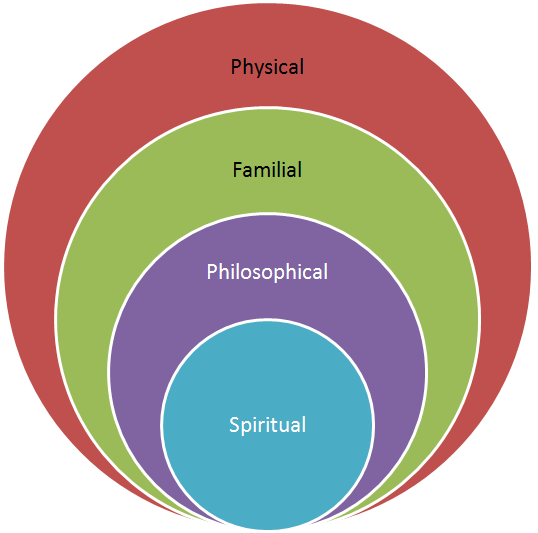
An overly-simplistic view of romance says that it’s just sex. But Jacqueline is exactly right when she says that a sex scene lacking emotional depth is just boring. In western culture, the physical act of sex has always been used as a proxy for other intimacies:

Aspects of Intimacy

Aspects of Intimacy

Marriage (which traditionally precedes sex) represents a type of familial intimacy: one person’s family opens up and accepts a new member, or two families join. Probably the best example of this is Shakespeare’s Romeo and Juliet. Of course, the two families alike in dignity reject that intimacy. But nonetheless, the underlying tension of that love story rests on Romeo and Juliet trying – and failing – to negotiate that familial intimacy. Here, death plays the role that sex often does: it represents the culmination and climax of their negotiation.

A different type of intimacy is the philosophical or worldview model that Austen nailed so perfectly: both Pride and Prejudice and Sense and Sensibility deal with the protagonists adjusting how they perceive other characters. This is a philosophical intimacy, where the climax is the moment of acceptance rather than the moment of marriage (let alone sex). For Austen, sex – of course preceded by marriage – is in fact the denouement, never shown but instead implied by her heroes’ betrothal.

Spiritual intimacy between characters can likewise be negotiated. Unfortunately, I had some difficulty thinking of romances that deal with this facet of intimacy, but ultimately I think Ayn Rand’s Atlas Shrugged is probably the most succinct example. Dagny Taggart’s relationships with Hank Rearden, Francisco D’Anconia, and John Galt all oscillate around her most fundamental spiritual values. While Rand might well have spit nails to see those values described as spiritual, there is no change in Dagny’s philosophy over the course of her relationships. Instead, the climax of these relationships is her finding her idealized counterpart, the impossible superman who personifies her ideals. If we were to swap Rand’s Objectivism for any religion, the relationships would still function the same way (though the plot’s MacGuffins would not).

The Borders of Imagination and the Fantasy Spectrum

If the core of romance is characters negotiating the borders of their intimacy, then I suspect the core of fantasy might be negotiating the borders of the reader’s imagination. Love titillates us because it speaks to something deep within our hearts, touching on our innermost desires, exciting us with the promise of fulfillment. But intimacy doesn’t lurk alone in the deep, dark corners of our soul. It shares those caverns with our imagination.

A romance hinges on the borders of intimacy between the story’s characters. Typically, that intimacy is indelibly linked to the story’s plot. For example, the plot of Romeo and Juliet would fall to pieces without the Capulets and the Montagues. But fantasy’s relationship with imagination tends to be slightly more removed from the story’s plot, and it does not need to rely so heavily on proxies the way intimacy often does.

The Borders of Imagination

The Borders of Imagination

Fantasies make us look at reality sideways, utilizing evocative imagery, secondary worlds, strange creatures, and magical powers to broaden our understanding of our own reality. Superficially, elves, monsters, and wizards are cool plotting devices that let us tell entertaining stories. Who doesn’t like magic and monsters? But beneath that surface level, they give us a new lens through which we can see an oblique picture of the world.

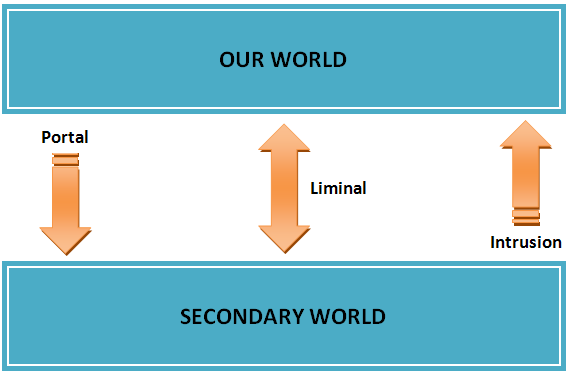
Imagination operates on a spectrum that describes a relationship between the story’s characters, the reader, and their environment. At one extreme we have our world, in all its mundane glory. It is at this end that we find mainstream literary fiction, where the world operates according to the real-life rules that govern our everyday existence. The range of plot options or the focus of characterization at this end of the spectrum is nearly limitless: we can deal with a plot-driven mystery, or a character-driven rumination. The focus can be narrow, internal, psychological or just as easily societal, philosophical, or spiritual.

At the other extreme we have a secondary world, where anything goes. A secondary world does not even need to have human characters – consider Edwin A. Abbott’s Flatland. Immersive fantasies – which force the reader to suspend disbelief and to accept the prima facie rules that govern the secondary world – operate at this level. Just as with mainstream literary texts, their range of plotting options and focuses is nearly limitless. However, unlike mainstream literary fiction, immersive fantasies have the ability to use different rules of existence and their accompanying imagery to cast a different light on aspects of our reality.

Portals and the Broad World Perspective

If we start in our real world, then we can gain access to the rich imaginative vocabulary of the secondary world. But to do that, we have to take our characters from our world and bring them to the secondary world, typically through the use of a portal of some kind. In her excellent Rhetorics of Fantasy, Farah Mendlesohn conflates the portal fantasy with the quest fantasy, and while this works at the level of plot, it does little to explain how portal fantasies interact with the reader’s imagination. That’s because we can have an immersive quest fantasy that takes place in a completely secondary world (think Tolkien, Brooks, etc.), but the thematic, plot, and character focus tends to be different if we start in our world.

The moment our characters go through the portal, everything in their new reality is contrasted to our world. Whether it is in Stephen R. Donaldson’s Lord Foul’s Bane, C.S. Lewis’ The Lion, the Witch and the Wardrobe, or Rowling’s Harry Potter and the Philosopher’s Stone, by starting the story in mundane reality we establish the reader’s (and characters’) initial state. Whatever imagery follows can then be related back to our real life, and can be interpreted as a thematic symbol. From a plotting standpoint, the secondary world is often thinned and ultimately by the climax of the book, comes back to some sort of eucatastrophe that leads to its restoration.

Intrusions and Narrow Focus

Intrusion fantasies – where the secondary world inserts itself into our reality – are the mirror image of portal fantasies. Consider Shirley Jackson’s The Haunting of Hill House, Emma Bull’s War for the Oaks, or China Miéville’s King Rat. Here, the secondary world is dark, dangerous, and forbidding as a general rule. Its intrusion into our own world tends to be frightening, disorienting, and leaves our heroes struggling to find their own place in the world.

Just as in the portal fantasies, the fantastical elements can be interpreted as thematic symbols. But the mood tends to be darker, and the focus of the story narrower. While portal fantasies tend to focus on the world at large and build towards eucatastrophe, intrusion fantasies focus on the narrower, private world of the principle protagonists. Rather than building towards a climactic eucatastrophe, they instead build towards a moment of personal climax/realization/rejection.

Liminal Fantasies: Philosophical by Design

Liminal fantasies either dance on the border between two worlds (like John Crowley’s Little, Big) or ambiguously hint at the existence of a secondary world (Graham Joyce’s How to Make Friends with Demons). In these cases, fantastical imagery is often used allegorically and the reader’s position relative to the events of the text is always ambiguous. Reading these books, we wonder if we are – in fact – operating within a fantastical reality? Or are we instead merely using allegory to highlight and comment upon philosophical, emotional, and spiritual considerations?

Understandably, the focus for such liminal fantasies is always narrow, focusing on the values of the protagonist. Their emotional climax typically lies not in picking a side: choosing our “real” world or the secondary world. Instead, it rests in becoming comfortable with that middle ground between the two. Acceptance on an emotional, philosophical or spiritual level, as opposed to the more conflict-oriented eucatastrophe or resolution.

Symbols, Imagination, Plot, and Emotion

While fantasy makes it possible to use a rich palette of imagery, fantasy is not merely symbolic: sometimes, a talking tree is just a talking tree. Plot is just as important as the underlying themes of a story, and images are used not just to represent values and thoughts in the real world. They can just as easily be used to evoke certain emotions, to raise tension and the like. What specific imagery we utilize should tie into our goals for a particular scene, whether those goals are emotional, thematic, or both.

And of course, part of the fun is when we combine aspects of romance (negotiating the borders of intimacy) with aspects of the fantastic (negotiating the borders of imagination). Fantasy and romance are genres that can contain multitudes, after all.

Flirting and Writing Good Dialogue


I love exposition: flowing sentences, tight action, enveloping description. Prose is great. But for the past couple of weeks, I’ve been wondering what makes dialogue tick.

Well-written dialogue is not conversation. Have you ever listened to the way people speak? Our conversations (regardless of our erudition) are almost always inane. Want proof? Spend an hour or two in a cafe listening to the conversations around you. Are they interesting? Do they raise tension? Do they give us deeper, subtle insight into the speakers? Only marginally. We waste words, meander around topics, count on body language to fill in gaps, and stutter over halting words like “Umm” and “Uhh” and “Well”. It’s a signal-to-noise problem: in our everyday discussions, there is far too much noise to isolate a clean narrative signal. Well-written dialogue may not be conversation, but I think of it as a particular type of conversation: flirting.

Writing Dialogue with Game

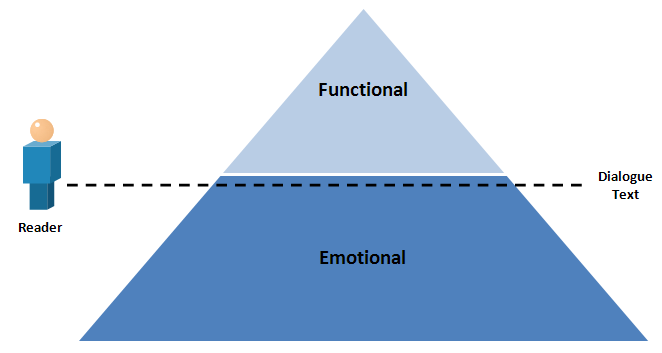
It’s a great feeling when our game is on, and every exchange is tantalizing, enticing, teasing, and provocative. Our goal in flirting is always to draw someone in deeper: into our heart, our head, or – fine – our pants. Sure, there’s a functional level to it: on the surface, we might be talking about where to get dinner that night. But we all know what’s really going on, and odds are it doesn’t have much to do with oysters on the half-shell.

Conceptual Diagram for Good Dialogue

Functional versus Emotional Dialogue

Good dialogue works the same way. Superficially, information needs to be exchanged and decisions need to be made to either move the plot forward or lay the groundwork for doing so later. That’s the functional level of dialogue. But as the writer, we use that exchange to flirt with the reader. Below that functional level, we want to draw them in, heighten the underlying tension, and make them care deeply about the characters involved. So how can we do that?

Less is More: Make Every Word Count

When I have been particularly flirtatious (not that it happens often, but it has happened…once…I think), I feel like every sentence, every word I uttered made the other person dig me more. That’s not because my every utterance was gold. It’s because everything I said was just enough and not too much to accomplish my functional and emotional goals.

Imagine you’re trying to ask someone out to dinner. Your functional goal is for them to share a meal with you. Your emotional goal is for them to want to. If you come at them with a multiple-paragraph emotion-laden monologue, at best you’ll be shot down. At worst, out comes the pepper spray. In that conversation, you want to give them just enough to want more – more conversation, more shared experiences, more of you. Brevity – in this instance – is your friend. Of course, you don’t want to just bark “Yo! Dinner?” That’s probably going a little too far in the opposite direction. It has no emotional resonance, no hidden layers of private meaning.

Probably the best tool I’ve found to find the happy medium is the comic book panel. As I’ve talked about before, panels are the basic building block of sequential art. Each panel uses both art and dialogue to manage the reader’s experience. But here’s the thing: a panel is a limited space. If we want the art to do its job, then the panel naturally constrains the amount of dialogue it can contain.

A good rule of thumb is for panels to not exceed twenty-five words of dialogue. That previous sentence has fifteen. Now we’re up to twenty.

There. That paragraph directly above is the amount of dialogue that will typically fit comfortably in a panel. That doesn’t leave a lot of room for wasted clauses, wasted words, wasted feelings. It needs to be absolutely tight: one sentence, two sentences, maybe three. It may be an exchange, or in that one panel one person may be the only one speaking. But thinking about dialogue in terms of twenty-five word panels within a scene really helps me to pare my characters’ dialogue to the bare essentials.

What did you say? Making Every Word Clear

Clarity’s another important factor. When flirting, if every other sentence is “What? What did you say?” odds are it’ll be quite a turn off. The same holds true for dialogue. We want our readers to instantly understand the surface level of dialogue so that they can internalize the underlying emotional level.

This is why I’m always nervous about dialect in dialogue, especially in genre fiction. One of the defining characteristics of speculative literature is the use of neologism to signify new concepts. The creation of new terms and new concepts is so important that Istvan Csicsery-Ronay dubbed it science fiction’s “first beauty” in his excellent The Seven Beauties of Science Fiction. We use new words and alien languages as a world-building tool, to defamiliarize the user and transport them to a reality where our fantastical story can take place. But before we can grok Valentine Michael Smith’s dialogue, we need to grok the word itself.

Like so many aspects of writing, this is a balancing act. And one that even experienced and skilled authors can get wrong. For example, I have loved China Miéville’s writing since his first novel, King Rat. Yet I found myself unable to enjoy his more recent Kraken because I found that it took so much effort to understand what the characters were saying on a superficial level, that I lacked the energy to get emotionally invested. Were the dialogue there slightly clearer, no doubt I would have loved the characters and the story as much as his other books.

Coming at Dialogue From the Side

Flirting is as much about what is left unsaid as what is stated. Good dialogue is the same. Sol Stein describes it as obliquity in Stein On Writing, and I think that’s a pretty good description of both flirting and writing good dialogue. Consider the following two exchanges:

DIRECT “What would you like to do tonight?” John asked.

“I want to eat a garden salad, have two glasses of red wine, and engage in coitus with you,” Jane said.

OBLIQUE “What would you like to do tonight?” John asked.

“A little of this, a little of that,” Jane said.

The first is painfully direct and clinical. It leaves nothing to either John’s or the reader’s imagination. The second does not – in fact – answer John’s question. It leaves the entire answer to the imagination. The entire experience – and its emotional significance – is left for our reader to find between the lines.

In some cases, the direct approach is smart. Used in counterpoint to oblique dialog, it can be used to drive the point home. Consider a slightly modified direct approach:

DIRECT “What would you like to do tonight?” John asked.

“Have sex,” Jane said.

Here, the frank approach to the underlying subject matter stands out against more oblique dialogue. If every exchange read like this one, the book would turn monotone. And if every exchange were perfectly oblique, the book would be abstruse. When focusing on principal characters and particularly meaningful scenes, I try to go beyond the merely functional and lean towards obliquity. But with judicious application, a little directness adds extra spice.

Blending Prose and Dialogue

In one sense, comic books have it easy. Sequential artists have an extremely expressive medium (art) to place the dialog in context. They can communicate tone, setting, attitude in fractions of a second. Those of us laboring in prose have exposition to do the same, but text is by its nature less expressive than illustration. So how do we intersperse prose into dialogue for best effect?

Just about any good writing book or teacher will tell you to avoid active reporting clauses (he said/she said). It’s still like flirting. If someone were trying to flirt with us and they screamed every statement, growled every question, and sighed every punctuation mark, odds are we’d remember a pressing engagement elsewhere pretty quickly (unless both people involved are angsty teenagers, in which case they might not even notice). But that does not mean we’re limited to the factual he said/she said.

We can also play with placement. Consider our earlier oblique passage. What would happen if we moved the reporting clause elsewhere in the second sentence?

ORIGINAL OBLIQUE “What would you like to do tonight?” John asked.

“A little of this, a little of that,” Jane said.

MODIFIED OBLIQUE “What would you like to do tonight?” John asked.

“A little of this,” Jane said, “a little of that.”

Moving the reporting clause to the middle of the sentence introduces a beat that the reader won’t even consciously notice. Instead, they’ll pause for a half-second as they read it and fill that pause with meaning. Maybe they’ll picture Jane winking, or giving a mischievous little smile.

We can also substitute actions for the reporting clauses, though this may be a slippery slope. Consider:

ORIGINAL OBLIQUE “What would you like to do tonight?” John asked.

“A little of this, a little of that,” Jane said.

MODIFIED OBLIQUE “What would you like to do tonight?” John asked.

“A little of this,” Jane said, “a little of that.”

ACTIVE OBLIQUE “What would you like to do tonight?” John asked.

Jane took his hand. “A little of this, a little of that.”

ACTIVE DIRECT “What would you like to do tonight?” John asked.

Jane took his hand. “Have sex.”

By prefacing Jane’s statement with a simple action, we can help put it in context. It’s like a marker guiding the reader to the conclusion we want them to reach. This should be used sparingly however, because it can otherwise lead to problems. For example, if a character says something while “spinning” many readers will imagine them twirling like a top while speaking…which is probably not the effect you were going for.

The Transparency of Great Dialogue

I’ve never heard a book described as “having great dialogue but really lousy prose.” (though the opposite is unfortunately common). The reason for that is that truly great dialogue is utterly transparent: its effects on us are palpable, but indistinguishable from the those of the book as a whole. We can’t truly say whether we’re invested because of the dialogue or the prose. What we know is that the dialogue supplements the prose and gives us pulls us deeper into the story. If the prose is an attractive person spotted across a dance floor, then the dialogue is the test of whether they’re nice. And can hold a conversation.

Some Assembly Required: Building Pacing and Emotional Flow with Legos


The other week, I pulled a sentence at random out of John Crowley’s classic Little, Big. I used it to illustrate a point about narrative voice, but a couple of days later I had an epiphany: the same sentence can also illuminate pacing and a story’s emotional flow.

Legos Tell Stories

When I was a kid, I spent just about every waking moment building adventures out of Legos. Back then (despite my fiancée’s assertions, dinosaurs did not roam the earth), Legos lacked variety. There were blocks…and blocks. A handful of different sizes, and that was about it. But despite their limited palette, I could tell just about any story my five year old self could imagine using those blocks. I built castles, and spaceships, and horses, and windmills. Fantasy, science fiction, monsters: I was only limited by my imagination.

Handful of Standard Lego Bricks

Lego Color Bricks, via Wikipedia

Fast forward a few years, and you’ll still find me playing with building blocks. Only now, I use words, sentences, and paragraphs to tell stories instead of little plastic bricks. At its most basic, a story is composed of letters. Those letters build up words, which in turn comprise sentences, then paragraphs, then chapters, then acts, then books, then series, and so on. But those letters are not necessarily our story’s real building blocks: instead, think of them as the long-chain polymers that make up our true Lego pieces. And the specific mix of Legos will differ across stories and media.

Literal Building Blocks: Panels, Scenes, and Shots in Visual Mediums

Jumbo Comics #1 (September 1938) “Hawks of the Sea” by Will Eisner, via kirbymuseum.org

It’s easiest to see these building blocks at work in visual media like sequential art (comics, graphic novels) and film. Some people might argue that dialog is key to these media, but I disagree. Dialog doesn’t frame the story: dialog is what gets framed.

For sequential art, Scott McCloud1 and Will Eisner2 both explained brilliantly how the page is the medium’s real building block. Each page is composed of one or more panels that depict some action occurring in time. The composition of each panel and its relationship to others on the page establishes tension and moves us from one state to another. The page frames a finite emotional progression, while the panels that make up that page control our sensation of time (the story’s pacing) throughout the journey.

The same paradigm works for film. A screenwriter’s scenes function the same way as a comic book page, where each scene represents a finite emotional arc through which the audience and characters travel. Each scene takes us from an initial point A to a subsequent point B, and the director uses one or more shots to get us there. Shots structure and control the flow of time and tension throughout the encapsulating scene, just as sequential panels structure the flow on a comic book page.

Visual media impose structural constraints by their very nature, which helps make their building blocks easier to spot. But when writing prose, those constraints go right out the window.

The Building Blocks of Prose Pacing: Sentences

The structure of our prose affects how we perceive the flow of time. Hemingway’s short declarative sentences communicate speed. Proust’s meandering sentences, with their convoluted clauses and tangential commentary, establish a more laconic feeling. Short paragraphs and short chapters read faster than longer ones. But it is their relationship to emotion that determines the real pace of the story.

In Little, Big, Crowley uses the sentence as his primary building block. Practically every sentence in that book takes the reader on its own miniature emotional arc:

Sentence #1: “Then an expectant silence, followed by a firmer start, and the station wagon backed warily out into the drive, making two soft and delible marks in the wet leaves.”
Sentence #2: “That there was such a house in the world, lit and open and empty, became a story in those days; there were other stories, people were in motion, stories were all they cared to hear, stories were all they believed in, life had got that hard.”
Sentence #3: “But life is wakings-up, all unexpected, all surprising.”
John Crowley, Little, Big, 1982

Even the utilitarian sentences that describe an almost-incidental action contain an emotional arc. If Little, Big is composed of Legos, then they are sentence-shaped.

The sentence length, structure, punctuation, and emotion-laden words control the story’s pace. Each sentence demands that we pause and savor what it has done to us. Without those miniature emotional arcs, the text would be meandering, dull, and lifeless. But by employing brilliant tricks of emotional association, Crowley’s manipulation of our emotional state becomes transparent and, like Smoky Barnable, we find ourselves enraptured in the liminal fairyland of Edgewood.

Paragraphs as Building Blocks

Compare this to G.K. Chesteron’s The Man Who Was Thursday. While his individual sentences lack the emotional depth of Crowley’s, we remain moved by his paragraphs (again, selected at random):

Paragraph #1: As the wood grew first thinner and then smaller with distance, he could see the sunlit slopes beyond it and above it; and across these was still moving the square black mob like one monstrous beetle. In the very strong sunlight and with his own very strong eyes, which were almost telescopic, Syme could see this mass of men quite plainly. He could see them as separate human figures; but he was increasingly surprised by the way in which they moved as one man. They seemed to be dressed in dark clothes and plain hats, like any common crowd out of the streets; but they did not spread and sprawl and trail by various lines to the attack, as would be natural in an ordinary mob. They moved with a sort of dreadful and wicked woodenness, like a staring army of automatons.
Paragraph #2: Syme’s laughter at all this had about it a wild weakness of relief. He laughed at the idea of the paralytic Professor being really a young actor dressed up as if for the foot-lights. But he felt that he would have laughed as loudly if a pepperpot had fallen over.
Paragraph #3: At first the large stone stair seemed to Syme as deserted as a pyramid; but before he reached the top he had realised that there was a man leaning over the parapet of the Embankment and looking out across the river. As a figure he was quite conventional, clad in a silk hat and frock-coat of the more formal type of fashion; he had a red flower in his buttonhole. As Syme drew nearer to him step by step, he did not even move a hair; and Syme could come close enough to notice even in the dim, pale morning light that his face was long, pale and intellectual, and ended in a small triangular tuft of dark beard at the very point of the chin, all else being clean-shaven. This scrap of hair almost seemed a mere oversight; the rest of the face was of the type that is best shaven—clear-cut, ascetic, and in its way noble. Syme drew closer and closer, noting all this, and still the figure did not stir.
G.K. Chesterton, The Man Who Was Thursday: A Nightmare, 1908

Taken individually, the sentences are utilitarian. Most are solely descriptive, with no emotional imagery employed to direct our mental state. Yet in each paragraph, certain imaginative descriptions are employed with laser precision to manipulate our emotions (a “staring army of automatons”, “wild weakness of relief”, or “deserted as a pyramid”). Each sentence is just a sentence, but with his paragraphs Chesterton increases and decreases tension like a sound engineer mixing in a recording studio.

Still other authors use scenes or whole chapters as their basic building block. While I won’t quote entire chapters here, I recommend taking a look at how Steven Erikson or Yasunari Kawabata manage it (particularly in Gardens of the Moon and The Master of Go, respectively).

Picking Legos out of the Box

So enough theory: what practical conclusions can we draw from this? If each story has a set of natural building blocks, then we have to identify it. The set will depend on the story’s medium, its audience, and the emotions we want to evoke. I suspect a spy thriller is unlikely to use sentences as its building blocks: to get an emotional response from individual sentences would slow the action too much to work within spy thriller conventions. By contrast an introspective memoir might luxuriate in the kind of sentence-level emotional manipulation that Crowley executes.

While this may just be my own idiosyncrasy, I find that once I know what the basic building block of a story is, it becomes much easier to write. If I know that I start a [sentence / paragraph / scene / chapter] at emotional point A, and need to get to point B by its end, the amorphous task of writing becomes easier. It’s not just a question of knowing where to go: that’s just plotting. Instead, it’s grokking the space I have to operate in. While I’m not a painter, I imagine it’s like understanding the bounds imposed by a piece of canvas. Within those bounds, I am limited solely by my imagination. But by figuring out which Legos I’m really using, it lets me have fun building stories.

In Conclusion: Some Fun Lego Constructions

And to conclude with the Lego metaphor, here are some fun Lego projects that some amazingly talented people have constructed:

10,000-piece Sandcrawler

Functional Antikythera Mechanism

Awesome Conceptual Tool: The Periodic Table of Storytelling


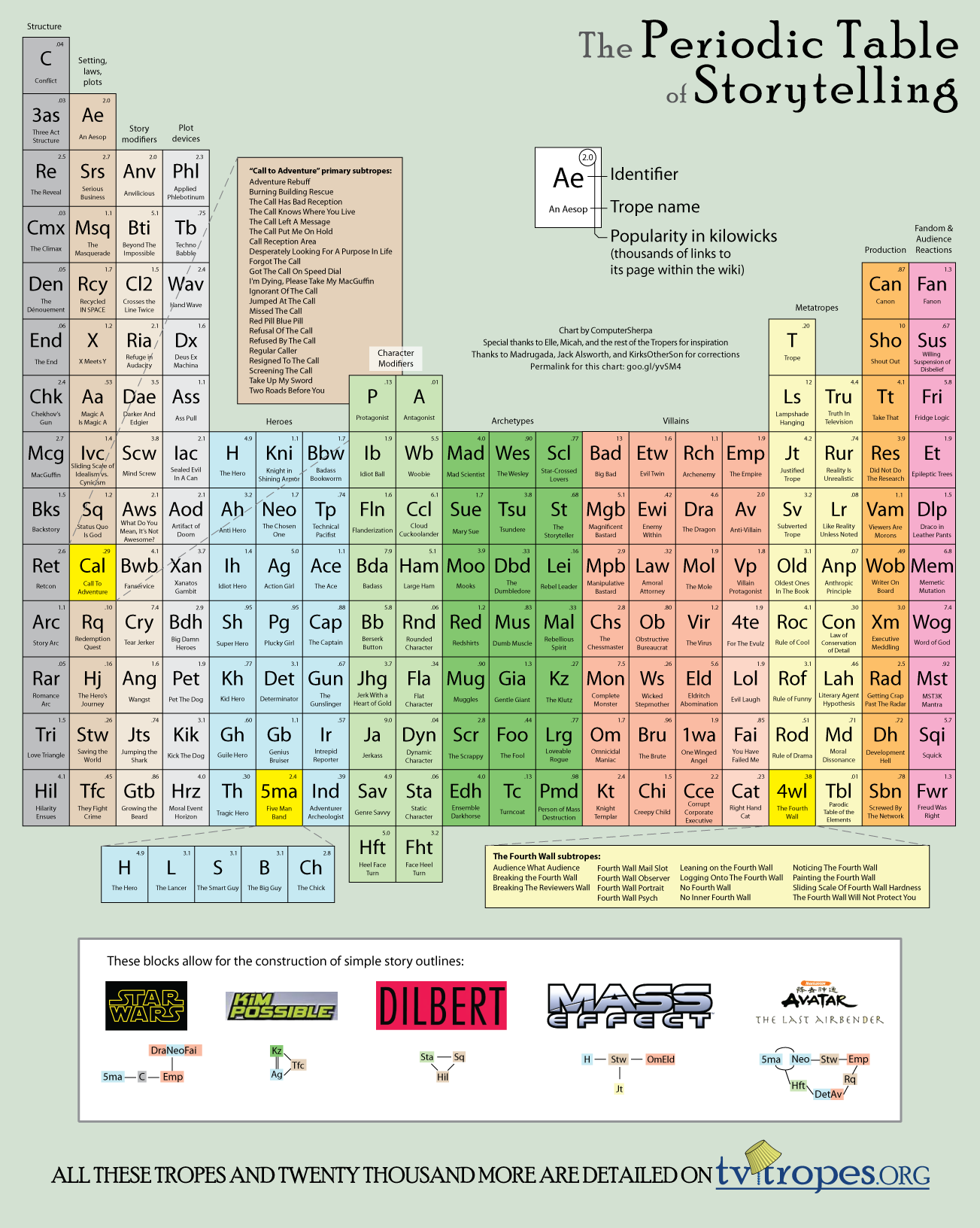
So thanks to The Professor (my fiancée), here’s an absolutely amazing infographic that may just become my favorite outlining / conceptual tool. It’s the Periodic Table of Storytelling, which was posted on DeviantArt by ComputerSherpa, a second-semester art student. Check out the table below:

Periodic Table of Storytelling by ComputerSherpa

Periodic Table of Storytelling by ComputerSherpa, via DeviantArt

What makes this infographic so amazing is its ability to map out just about any story structure using its “atoms.” ComputerSherpa included some great example molecules that lay out some really well-known stories, and I might just start using molecules like that when I outline my own stuff. What I really need is a smartphone app that will let me search and model those kind of storytelling molecules on my phone. That would be really helpful.

In the meantime, lacking such a smartphone app, you can order a poster print of this here. The example molecules have been removed from the bottom on the poster (which I think is a shame), but I think it’s really cool anyway.

Narrative Voice as Mind-control: Thoughts on Manipulating Reader Perception


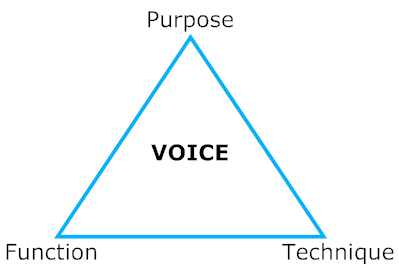
Voice: Purpose, Function, Technique

A Conceptual Framework for Narrative Voice

I’ve always considered voice one of the most important tools when writing alternate history, and over the past couple of weeks I’ve been thinking about how that tool really works (both within and outside the sub-genre).

There are probably as many valid descriptions of voice as there are writers, editors, and critics out there. For my part, I believe that voice has three components: its purpose, its function, and its technique.

The Purpose of Voice: Establishing a Relationship with the Text

The purpose of voice is to establish the reader’s relationship to the text. Different stories, different narrators, call for different relationships. Would Nabokov’s Lolita be as powerful if we weren’t sympathetically engaged with the monstrous Humbert Humbert? Would Doyle’s Sherlock Holmes stories be as effective if the narration were as coldly dispassionate as the detective himself? Voice – both in narration, and in dialog – establishes how we relate to a story. At its most basic level, it controls the emotional distance with which we perceive it, and is most powerful when wedded to the story’s themes.

Nabokov wants us to view Humbert Humbert up close and personal. The power of his book relies on juxtaposing our the intellectual horror at Humbert Humbert and the visceral engagement his voice engenders. Had Nabokov employed a distancing technique, for example making Humbert’s story epistolary, or telling it from the dispassionate perspective of a court stenographer, it would not have the resonance it does.

John Crowley in Little, Big uses voice to distance us at once from our reality, and the reality of the text. The lyrical, metaphoric voice he employs puts us in a liminal state, somewhere on the borders of what is, what was, and what might be. In this, the voice employed is fundamentally aligned with the book’s themes.

Olaf Stapledon in Last and First Men keeps the reader at arms length, so that we can view the events of his future history dispassionately, as if we were observing them from billions of years removed.

When Michael A. Stackpole employs a voice reminiscent of 17th century colonial texts in At the Queen’s Command it instantly links his book to that time in the reader’s mind.

The relationship created between us and the text is foundational in the act of reading. It sets the context for everything else, determining how we perceive a story’s pacing, how we engage with its characters, and how we identify its themes. In this sense, the purpose of voice transcends any individual sentence, or any paragraph. It is a combination of the voice’s expression in narration, in dialog, even in its epigraphs (shout out to @DDSyrdal for reminding me of this term!). But apart from its broad and abstract purpose, voice has a function within the story which is variable over the length of the text.

The Function of Voice: Manipulating the Reader’s Perception

I often think that it is the writer’s job to manipulate the reader, to take us on an emotional roller-coaster the author has designed. By influencing how we perceive events, settings, and characters, the narrative voice becomes the rail which guides us along the ride. It imparts the twists, falls, and rises. If well-constructed, it shouldn’t be noticeable (unless we’re looking for it). But if it’s shoddily put together, well…I’d rather not consider what happens when a roller-coaster comes off its rail.

Voice’s function can be modulated for specific effect. This is easiest to see in dialog, where each actor has their own voice, more or less distinct from the voices of other characters. Those differences exert a subtle influence on our perception of those characters. Consider the following exchange from George R.R. Martin’s A Game of Thrones:

“Boy,” a voice called out to him. Jon turned.

Tyrion Lannister was sitting on the ledge above the door to the Great Hall, looking for all the world like a gargoyle. The dwarf grinned down at him. “Is that animal a wolf?”

“A direwolf,” Jon said. “His name is Ghost.” He stared up at the little man, his disappointment suddenly forgotten. “What are you doing up there? Why aren’t you at the feast?”

“Too hot, too noisy, and I’d drunk too much wine,” the dwarf told him. “I learned long ago that it is considered rude to vomit on your brother. Might I have a closer look at your wolf?”

From his short, staccato sentences we get the sense that Jon is direct, straightforward. He answers the question asked of him, but by offering little additions he avoids being brusque. He asks direct questions, wanting to know the answers. By contrast, Tyrion Lannister’s dialog is more complicated. His first sentence is broken apart by prose narration, imbuing a meaningful pause that – were the text read aloud – might suggest either humor, or shock. His second sentence, with its precise list and brutally honest self-assessment shows us Tyrion’s precision and self-deprecation. His third sentence gives us further insight into both his sense of humor, and his relationship with his brother.

The entire exchange is used to manipulate us into liking both Tyrion Lannister and Jon Snow, though for different reasons. Even if we cannot articulate it, even if we don’t notice it at the first reading, we respond to Jon’s simple directness. And we appreciate Tyrion’s self-deprecating humor. And Martin achieves this subtle effect just using voice in his characters’ dialog.

Prose narration – descriptions of setting, of action – can similarly affect our perception of and emotional response to the story. Consider two brief passages, each describing the same actions (sorry for the quality of my example sentences – I’m coming up with these on the fly):

Version #1 Version #2
The rain-slick leaves left the tree like snowflakes, gently spinning to melt into the mud. Rain battered the leaves. Glop! Glop! Glop! And down into the mud.

Hopefully (if I’ve done my job right) the two example sentences establish an entirely different mood. The first is more laconic, gentler, quieter. While the second is harsher, more abrupt, and louder through the use of onomatopoeia. The events are identical, but the difference in voice puts the reader into a different frame of mind. Voice becomes the tool I use to control the reader’s response to a particular scene, passage, or sentence (even a particular word!). And like any tool, there are a variety of ways in which it can be applied.

Purpose and Function Applied: Techniques for Controlling Voice

The range of control that we choose to exert over voice lies on a spectrum. At one end is banally utilitarian prose – the bland monotone of “Dick and Jane run after the ball.” On the other end we find the inimitable mastery of Nabokov, whose fine-grain manipulation of voice makes its inner workings invisible to the reader. Most of us operate somewhere between these two extremes employing a variety of techniques that are universal:

Perspective as a Window to Voice
Every one of us uses perspective to imbue our story with voice, whether consciously or not. In terms of purpose, the choice between first, close third, omniscient third, or the rare second-person narration has an immediate and major impact on the reader’s relationship to the story.

First person narration – when executed well – earns the reader’s instant engagement precisely through its link to voice. The narrator is a character in the story, with their own perceptions, predilections, and foibles. They have their own way of seeing the world, a tendency to pay attention to certain aspects that others might not notice in the same way. One narrator might comment on people’s appearances. Another might pay closer attention to facial expressions. And just like a character’s personality should affect their speech patterns in dialog, the same affects a first person narrator. For example, in Lisa Yee’s excellent YA novel Millicent Min, Girl Genius the narrator (the titular genius) uses complex sentences, a refined vocabulary and sprinkles in a little Latin every now and again. Her defining characteristic – her intellect – is intrinsic to how the narrator’s voice is portrayed.

In first-person narration, we are generally locked into the narrator’s voice throughout the story. That’s the trade-off we make for building that super-close reader/narrator relationship. Close third-person narration trades a little more distance between the reader and the POV character, in exchange for greater latitude in vocal manipulation. With close-third narration, we can shift POV characters (typically at chapter or section breaks for decent narrative flow) employing different voices for different points of view, as well as make more gradual, subtle shifts in tone and mood within the confines of a scene. This facility to shift vocal strategy is a double-edged sword and must be used judiciously. Do it too often or too fast, and we risk either confusing the reader or putting too much distance between her and the characters. For a great example of this technique employed well, I recommend Tad Williams’ Otherland series.

The relationship between voice and distance is less clear-cut for omniscient third-person perspective. As the most emotionally distant of the perspectives, omniscient third may well suit our thematic or stylistic purposes. However, by requiring a consistent narrative voice throughout, omniscient third loses the vocal flexibility that close third enjoys. There are situations where this trade-off makes sense. For example, J.R.R. Tolkien’s Lord of the Rings requires an omniscient narrator and consistent voice to evoke its linkages to epic storytelling and myth.

Style and Structure as Voice
If we were to ask five writers to write one sentence describing something, we would inevitably get five different sentences. How those sentences are composed – how the writer employs clauses and adverbs and conjunctions and even punctuation – determine what is typically called the author’s “style” and represents one of the most influential aspects of voice.

Pick up any book from the 19th century. You’ll immediately see that the way 19th century authors put their sentences together differs dramatically from contemporary styles. When we say an old classic hasn’t aged well, what we are really saying is that the modern reader’s emotional response as controlled by the story’s voice differs from an original reader’s presumed response. The variegated, many-claused sentences that characterize 18th and 19th century texts have a distancing effect for the modern reader. Bulwer-Lytton is a great example of this at work. In his day, he was one of the most influential, most celebrated writers in the English language. Today, there are awards named after him that celebrate purple prose.

This is not to say that contemporary voices are simpler than their predecessors, or that such simplicity would be a good thing. Many excellent authors – John Crowley, Gene Wolfe, Gabriel Garcia Marquez, Jorge Luis Borges, to name a few – write lush, complex sentences. However their structure differs substantially from what came before. For one thing, contemporary authors adhere more strongly to the principle of “show, don’t tell.” Consider the following two sentences selected at random:

Sentence #1: “But they were entirely ignorant of what had passed; and their raptures continued with little intermission to the very day of Lydia’s leaving home.” Jane Austen, Pride And Prejudice, 1813
Sentence #2: “Then an expectant silence, followed by a firmer start, and the station wagon backed warily out into the drive, making two soft and delible marks in the wet leaves.” John Crowley, Little, Big, 1982

Both come from excellent books. I would in fact argue that the Crowley sentence is more structurally complex than the Austen. However, the voices are quite dissimilar: the Austen voice tells us that their raptures continued. It does not show us those raptures, nor does it provide any metaphor or analogy by which we can emotionally connect to them. The voice is – by design – at a remove from the emotional significance of the events. Austen’s voice leaves it to the reader to establish that connection, through the implications of certain facts dropped and hinted at: the “little intermission” and “to the very day”.

Crowley’s voice, by contrast, employs evocative imagery to show the reader a prosaic event. His adjectives, and the order in which they are placed all communicate an emotional significance (which may or may not be important). By calling the silence “expectant,” the start “firmer”, and the marks on the leaves “soft and delible”, Crowley anthropomorphizes insensate objects, imbuing them with emotions. The sentence describes no characters, yet we still have an arc that rises from expectation (expectant), to action (firmer), and descends through denouement (soft and delible).

The complexity of sentence structures is of course infinitely varied. However, stealing vocal tricks from other authors is a good idea and can lead to some truly impressive work. In her 1973 essay “From Elfland to Poughkeepsie” Ursula K. Le Guin calls Lord Dunsany “the First Terrible Fate that Awaiteth Unwary Beginners in Fantasy” – specifically because his mastery of voice and style is so inimitable and so frequently imitated. Lots of us fall victim to this trap (I know I’ve been guilty of it!), but this ability to imitate past masters, to emulate their voices and styles, is actually a skill for any writer. It broadens our vocabulary, adding new tools to our toolkit. Archaic voices have a place in fiction, as do Gothic voices, or Lovecraftian voices. Imitation is the finest form of flattery, after all, and a writer’s skill lies in deciding where to use which voice.

For example, The Phoenix Guards is Steven Brust’s homage to Alexandre Dumas’ The Three Musketeers. Of course, Brust’s story is an out-and-out fantasy, with dragons and semi-immortal elf-like people. But his plot structure has clear ties to the d’Artagnan romances and his sentence constructions echo Dumas’ voice flawlessly. Reading The Phoenix Guards today is an experience much like reading The Three Musketeers, and it is precisely because Brust not only built off of Dumas’ plot, but because he adopted Dumas’ vocal methods as well. Had he chosen to emulate only one facet (either the plot, or the sentence structures), the book would have rung off-true: somehow not quite complete.

As I’ve mentioned before, the best writers of alternate history and historical fiction employ such emulation to cement the reader in the time period depicted. Examples can be found in Michael A. Stackpole’s At the Queen’s Command, or Cherie Priest’s Dreadnought (see my reviews here and here).

But we can also have too much of a good thing. For example, in Freedom and Necessity Steven Brust and Emma Bull (otherwise, two masters of vocal technique) pull off their emulation too well. The combined effect of the novel’s epistolary frame and its flawless emulation of 19th century sentence construction create a sense that one is actually reading a genuine 19th century novel…despite the fact that it was written in 1997. Technically, it is a masterpiece of voice. However, I find that it establishes too much distance for the contemporary reader. The reader’s engagement with the events of the story is held at arm’s length, slowing the pace of what would otherwise be an amazing, exciting book.

The Invisible Voice
Voice is the ultimate mind-control, affecting how the story resonates with us, how we feel about the characters, and what we remember when the last page is turned. At its most impressive, it should be invisible. When we notice the voice, its influence on our responses and perceptions is lessened. I can’t think of anybody who has mastered voice more superlatively than Nabokov. His Lolita is the perfect union of purpose, function, and technique. No matter how many times I read the story, I still cannot figure out how Nabokov hooks me. I dream of finding the time to dissect his work word by word, sentence by sentence, paragraph by paragraph: to take it apart like clockwork and examine its movements and physics. Maybe someday I will. But until then, a more productive use of my time – and one which will probably get me farther – is to just imitate him. I’m sure anything I write won’t even approach the quality of his invisible voice (and I’m even more sure my practices won’t be fit for any editors eyes!), but by tracing over his lines maybe I’ll pick up a thing or two. And then when it’s time to apply those techniques, I’ll have some new and useful tricks up my sleeve.

What about you? How do you approach constructing and managing narrative voice in your own writing? What are some of the best-voiced books you’ve come across? If – like me – you’re looking for good books that use voice in interesting ways, below is the list of authors and books that I’ve mentioned in this post. I strongly recommend you pick up a copy from your local bookstore or library, and enjoy:

An Argument for Writing Characters You Don’t Like


I’ve written before about some of the differences between novels and short stories, but for the past several days one of those differences has been sitting in the forefront of my mind: character. With only several thousand words to work with in a short story, there just isn’t space to really develop more than one character. But a novel needs at least a handful of well-defined characters, and the more complex the story’s plot, the more complex and varied the characters need to be.

My current WIP is more complex than any of the other (even novel-length) stories I’ve written before. With a Byzantine plot swirling with clockwork diplomacy, revolutionary intrigue, assassination, and Great Powers espionage, I’m juggling a more varied cast of characters than I’ve managed before. It’s hard work keeping their motivations straight, their voices distinct, and their reactions true. And while I would love to have coffee or play a game of chess with some of these people, others I’d want to throttle. And that brings me to the crux of the issue that I’ve been thinking about for the past week or two: how to tell a story from the perspective of a character that I don’t like?

Unsympathetic perspective characters are nothing new. They span a spectrum from the truly vile who we come to like despite our best instincts, like Vladimir Nabokov’s amazing Humbert Humbert (Lolita). Then there’s Charles Dickens’ amoral but ultimately redeemable Sidney Carton (A Tale of Two Cities). More true to life, the real Emma Goldman’s autobiography Living My Life comes across as unsettling today. And Gregory Maguire spends pretty much all of Wicked: The Life and Times of the Wicked Witch of the West humanizing an erstwhile villain. And finally, Nnedi Okorafor’s powerful Onyesonwu (Who Fears Death), whose heart is in the right place, but whose personality often made me gnash my teeth in frustration.
Each of these authors uses a different technique. Nabokov fills the book with Humbert Humbert: the monster in a very real sense transcends the role of narrator or memoirist. Every single word, every punctuation point, and every pause between sentences is filtered through the all-too-human mind of Humbert Humbert. By drawing us in through such a unique and compelling voice, Nabokov slides in Humbert’s vile nature almost surreptitiously. It is subtle, and oily, and all too awe-inspiringly impressive. Thankfully my current WIP lacks an unrepentant, irredeemable Humbert-esque villain, and so I won’t have to try pulling this off (Yet! I’ve got another book I want to write someday where I’ll hopefully give it a shot…just because it’ll be a lot of fun to try!).

But the unsympathetic Sidney Carton, the zealous Emma Goldman, the tragic Elphaba, and the quick-to-anger Onyesonwu all have at least one central trait fundamentally tied up in their very nature that shines pure and noble. The traits might vary across the characters, and the authors may choose to present them using different techniques, but for all of their pettiness, their villainy, their zealotry, and their fury there remains something inherently noble about them.

Dickens paints Carton as a professionally-stunted, self-indulgent alcoholic. We can see his nobility in his reaction to Lucie Manette, and in his self-deprecating gallows humor. He is drawn in stark opposition to his double: Charles Darnay, whose inner nobility is readily apparent and who fails to evidence the slightest doubt in himself. By showing us Carton’s struggle, by showing us his doubts, Dickens makes us identify with Carton and look past the superficially unsympathetic traits: his biting humor, his self-pity, his self-indulgence. He is the underdog, and we want to give him a firm kick because we know that Carton is worth more, even if he does not realize it himself until the very end.

Emma Goldman – an actual historical personage – was as complicated as any real individual could be, and I believe her positive and negative traits stem from the very same root. Her autobiography paints a picture of an unsettling and strangely compelling zealot. Throughout her amazing life, she was an unrepentant revolutionary: mere facts and science would not get in the way of her convictions! She practiced what she preached, both politically and in her personal life. She forced herself to live true to her mission, even when it caused her much heartache. This unwavering belief in her revolution – however misguided, misattributed, or wasted – offers her a nobility that her (more hypocritical) contemporaries lacked. Goldman remains an unsettling person, and while I cannot agree with her views, I can respect the lifelong commitment that speaks so clearly through her words.

Maguire shows us the Wicked Witch’s perspective in Wicked. He takes pains to show the development of a conflicted character, with noble intentions that just work out unfortunately. Elphaba’s primary flaw is that she has human failings, of which her quickness to anger and her father-issues are just two examples. In many ways, I always found the book to be almost a revisionist apologia for the Wicked Witch, but Maguire makes Elphaba’s tragic rise and fall compelling precisely by showing us her internal rationalizations and the noble intentions that went so wrong.

And Okorafor introduces us to Onyesonwu, whose intentions are noble, whose heart is pure, but whose failing is simply that of being too quick to anger. Alone of the characters I’ve mentioned in this post, I do not believe we are ever for a moment meant to believe her unsympathetic. Okorafor makes us feel deeply for Onyesonwu. We meet her as a young girl, and we are shown painfully the development of her defensiveness character. We understand how she came to have that defensiveness. We understand that her anger is a part of her, and that in fact it helps her with her magic. I consider her “unsympathetic” simply because of how infuriating I found her. I wanted to tell her to get a grip: that her anger would hurt more than it helped. But the root of my frustration with the character was my understanding of what had made her: through an understanding how she developed into the strong, angry young woman she became, Okorafor grounded Onyesonwu’s “unsympathetic” traits in sympathy: she made the character so sympathetic that I recognize her flaws and want to help her learn to deal with her flaws.

This is a technique frequently used in YA (I suspect it may come naturally to Okorafor, considering her earlier experiences in YA). Maybe it means I’m getting old, that the little foibles of human emotion that are so frustrating to me come so naturally to teenagers. Harumph. Those kids should get off my lawn. Nonetheless, I can appreciate it when an author pulls it off the way Okorafor has, and I can also see how introducing that flaw was natural to the character, given her history. The net result makes me more invested in the character, thus raising my engagement with the whole story.

And that – I think – is what unsympathetic perspective characters ultimately do. They make us invest more in the story, either because we root for the underdog (Carton), respect misguided nobility (Goldman), lament tragic failure (Elphaba), or sympathize with the source of the characters’ flaws (Onyesonwu).

What are some of your favorite unsympathetic characters? And how did their authors make them appeal to you?

REVIEW: The Neon Court by Kate Griffin


The Neon Court: Or the Betrayal of Matthew Swift by Kate Griffin Title: The Neon Court: Or, the Betrayal of Matthew Swift
Author: Kate Griffin
Pub Date: March 24th, 2011
Chris’ Rating (5 possible): 1 point 1 point 1 point 1 point
An Attempt at Categorization If You Like… / You Might Like…
Excellent, evocative, and innovative world-building with ambitious characterization techniques.

Like many of my favorite fantasy finds, I first came across Kate Griffin’s Matthew Swift novels while on a business trip to London. This is kind of appropriate, considering how central London is to Griffin’s impressive urban fantasies. In her third Matthew Swift novel, The Neon Court: Or, the Betrayal of Matthew Swift, Griffin continues to impress with her unique take on contemporary magic and successfully strengthens her already-impressive characterization.

I first noticed Griffin’s writing with A Madness of Angels. In that book, she created a fascinating new spin on magic by inverting traditional eldritch trappings and fundamentally modernizing them. Her underlying conceit is that sorcery is a by-product of life, and because we lead ever more urban lives today, magic, too, must grow more urban. As a result, the magic of Griffin’s London is not that of moonlit rituals and twining ivy, but instead of subway cars and swirling fast food wrappers. What makes this conceit work in A Madness of Angels, and what continues to make it work through The Neon Court, is how solidly Griffin grounds her system in the real London, and how consistently she applies her new spin on magic.

Griffin’s images of contemporary London seep through into her characters and the urban magic of her world. The incidental characters we meet along the way are appropriate to their locales. Whether we’re talking about the professional Westminster-ish Aldermen (a bunch of bureaucrats…and more), the Tribe in the deepest parts of the East End, or an Irish seer living in Mile End, the characters are all believable because every one of their aspects is rooted in place: speech patterns, clothing, behavior, values, they all ring true to their environment.

This sense of place is also inextricably woven into the magic of her world. Every metropolitan idiosyncrasy becomes grist for Griffin’s magical mill. One gets the sense that there is sorcery lurking just beneath every insignificant fragment of Griffin’s London. Consider the Oyster travel card, or London’s many tourist traps. In the hands of a lesser author, the former would just be an incidental prop used to get on or off public transit, and the latter would just be settings. But Griffin makes them all potent magical talismans. This was impressive when first developed in A Madness of Angels, but even more impressive is how Griffin continues to expand and develop her magic system as the series progresses. In each of the Matthew Swift books, she introduces us to significant new facets of London’s magical underbelly, and nearly half of the fun in reading these books is seeing what new urban wizardry Griffin’s imagination will come up with. In The Neon Court, she asks how would the traditionally rural Faerie Court evolve in the modern urban world? Other authors – notably Emma Bull in her seminal War for the Oaks – have asked this question as well, and Griffin’s spin on it (the titular “Neon Court”) is innovative, unique, and fundamentally believable.

Her characterization – and especially that of her hero/narrator, Matthew Swift – is the next most impressive aspect of this series. Swift is a fractured hero, his mind merged with that of the blue electric angels (god-like personifications of the ghosts-in-the-wire who inhabit telephone and electric wires). Depending on which aspect of his personality is in ascendance, his narration veers from the perpendicular pronoun to first person plural, and at times shifts into a disjointed stream-of-consciousness. In the earlier books, this was a daring gamble on Griffin’s part. It made Swift’s struggle to re-assemble his mind and personality vivid, but risked disorienting an inattentive reader. Griffin walked a fine line in the earlier books, but she managed to pull it off. Swift’s fractured nature is so intrinsic to the first book’s plot, that the disjointed narrative added to the storytelling overall.

By the time we get to the third book, Griffin, Swift, and the electric blue angels are all more comfortable in Swift’s head. As a result, the narrative flow of The Neon Court is smoother, with fewer sudden shifts, and where those sudden shifts do occur, they are handled more subtly than in the earlier books. In general, I find the characters in The Neon Courtto be more carefully constructed than in the earlier books. As Swift’s focus shifts from internal (putting his mind back together) to external (saving London and his friends), Griffin’s characterization of secondary players strengthens as well. I felt that the third book does a much better job characterizing supporting characters like Penny (Swift’s apprentice), Dees (Swift’s Alderman lieutenant), and even Theydon (a thrall in the Neon Court) than the earlier books did.

If there is a weakness in the Matthew Swift novels, it is that it would be hard to start with the second or third installment. In The Neon Court, Matthew Swift struggles to save London and his friends from a terrifying magical threat amidst a burgeoning factional war amongst London’s magicians. The stakes, the characters, the plot, and the world are all adequately communicated. But a reader coming fresh to this world is likely to be confused by everything that came before. Swift’s history with R.J. Bakker (established in book 1), and his role as the Midnight Mayor (which was established in The Midnight Mayor: Or, the Inauguration of Matthew Swift), for example, are all central to The Neon Court’s plot. While there are passing explanations offered in the text, the book assumes the reader is already familiar with these events. However, their ramifications would be unclear to someone coming into the series with the third book.

Despite this fact, I recommend Griffin’s Matthew Swift novels, and especially The Neon Court: Or, the Betrayal of Matthew Swift. Readers who enjoy contemporary fantasy with innovative, vivid world-building will find a lot to enjoy in these novels. They are excellent examples of urban fantasy, particularly of the non-paranormal romance variety. If you enjoy the fantasies of Neil Gaiman, Emma Bull, Jim Butcher, or Harry Connolly, I suspect you will also enjoy Kate Griffin’s books. The entire series is good, and I found that it strengthens significantly in all of the right ways as it continues.

Where are the massive epic science fiction series?


I’ve really been enjoying the invective-laden “debate” between Sam Sykes and Ari Marmell over at Babel Clash this past week. Their discussion, essentially on “standalone fantasy novels” versus “single-story epic fantasy series” raised an interesting question in my mind. With door-stopper tomes so common in fantasy, why does fantasy’s cousin science fiction not have similar Chihuahua-killers?

It’s hard to think of contemporary fantasy without the likes of Robert Jordan, Terry Goodkind, David & Leigh Eddings, George R.R. Martin, Brandon Sanderson, Patrick Rothfuss, Steven Erikson, Brent Weeks, etc. There’s quite a bit of commonality across these authors: first, they have written (or are writing) series telling a single story across more than four books, which take up entire shelves at the bookstore, and where each individual book is heavy enough to weigh down a tent.

The last thirty years in fantasy can generally be described as giving us longer series, and longer individual titles within those series. Back in the 1960’s and 1970’s, the Tolkien-inspired, 300-page apiece trilogy was the general rule. In the 1980’s, David and Leigh Eddings gave us the quintet (where again, each title was about 300 pages). In the ’90s, Robert Jordan, Terry Goodkind, and George R.R. Martin gave us the N-teen volume epic series, with each title clocking in at 600 – 1000 pages. In the 2000’s, we have a fresh bevy of fantasists like Brandon Sanderson, Patrick Rothfuss, Brent Weeks, and Steven Erikson continuing the process. Where are science fiction’s gargantuan multi-volume epics?

If we can generally say that over the last thirty years, a significant portion of fantasy has used (a) more books, and (b) longer books, to tell a single story, why has this trend not appeared in science fiction? Sure, science fiction has its share of series. But these series tend to be trilogies or duologies (with a very rare quartet). Each of the novels in best-selling “series” by authors like Alastair Reynolds or Iain M. Banks is a standalone title, sharing a universe with its siblings, but little else. So…why is this?

I’ll be the first to say it: I don’t know. I don’t have an answer, although I do have some thoughts on narrowing down the cause. The way I see it, the reason that science fiction hasn’t expanded the way fantasy has can be laid at the feet of one of four actors in the process: the readers, the writers, the publishers, or the stories.
Saying that “science fiction readers are different from fantasy readers” doesn’t fly for me. Sure, the two audiences differ. But there is very significant overlap between the two, and, fundamentally, people are people. The drive to lose oneself in a fantasy universe applies just as strongly to a science fictional universe. That’s one of the many reasons why Iain M. Banks’ Culture novels are so popular, as are Reynolds’ Revelation Space novels or Larry Niven’s Ringworld. So I don’t buy any argument that says “readers of science fiction wouldn’t like it.” To me, that’s the equivalent of someone in 1965 saying that readers of fantasy would never accept a quintet. Time and time again, readers have proven such accepted wisdom wrong.

So if the readers aren’t at fault, what about the writers? Are science fiction writers too good to produce what some would call bloated epics? Or – to apply the flip side of that coin – are they too limited in their outlook to conceive of a story/universe on so grand a scale? I think the answer to both questions would have to be “no.” Science fiction writers are just as talented – and just as fallible – as their fantasist counterparts. Saying that there are no multi-volume, large science fiction epics because of the writers is too simplistic. Nature and publishing abhor a vacuum, and sooner or later a new author would come along and write one. After all, the fantasy genre didn’t typically expand beyond trilogies until the 80’s. And the door-stoppers didn’t show up until the 1990s. It all starts somewhere.

So maybe the fault lies with the publishers. Here, my natural cynicism makes me want to say “Aha!” and blame editors and acquisitions departments. But again, I fear that’s too much of an oversimplification. If at some point an author tried to write a multi-volume science fiction epic, then sooner or later some editor would take a chance on it. And if it did well, then others would quickly follow suit. That’s the nature of the industry (Vampires, anyone? Zombies?). So I don’t think this is a case of publishers not wanting to publish books like that because they don’t want to take a chance. Eventually, someone would try it out and a new trend would start.
If the reader, the writer, and the publisher aren’t at fault, is there something intrinsic to the science fictional story that precludes a 10+ volume series? Is fantasy somehow exceptional as a genre in that it either enables or requires such series where other genres do not? If the story is to blame, then the fault must lie in its setting, characters, or plot.

We fantasy fans talk about these giant series in terms of losing ourselves in a fictional universe. We love to take our time exploring the richly imagined lands of Westeros, or Genabckis, or Randland. But science fictional settings can be just as richly imagined, just as Other, as fantastical ones. What’s the difference between Arrakis and Westeros? Or the universe of the Culture and Randland? From a technical standpoint, the real differences are window-dressing: spacecraft and ray-guns rather than galleons and swords. Sure, that’s flippant and over-simplified, but any science fictional world is just as fantastical as a fantasy world. This applies just as much to space opera, sociological SF, the future (whether post-apocalyptic or not), time travel stories, etc. The quality of the world-building rests in the author’s hands, and science fiction presents just as much opportunity for involved and interesting world-building. I don’t believe that fantasy settings do something that science fictional settings don’t (or vice versa). They’re settings, imagined universes with rules and actors and factions as complex or as simplistic as the author wishes to make them. Alien is alien, whether they carry swords or blasters.

So what about the characters? Huge fantasy series are replete with a dizzying cast of characters – so much so, that the appendices to keep dramatis personae and their factions straight are a cliché feature. Typically, these large casts effectively comprise different protagonists who we follow at different points in the story. Farah Mendelsohn makes a great point in her Rhetorics of Fantasy, which – if I may paraphrase somewhat – suggests that this is really a shell-game: It takes what are essentially separate epic plots, and disperses the reader’s attention across them. We think that there’s one complex story going on, but really we’re watching ten or twelve simple stories happening in parallel. This isn’t a bad device, and it is one which I enjoy very much when done well. But why does this device appear in fantasy, but not in science fiction? A complicated cast of deeply personified characters is not unique to fantasy. Ever read Victor Hugo? Or Tolstoy? Or Iain M. Banks? There is no reason why this technique, or why this character structure, cannot apply in any genre.

So that leaves the science fiction plot as the remaining culprit. Perhaps there is something in science fiction’s plots that precludes such epic myth-making. I’ve read quite a bit of theory on fantasy, and rather a lot of excellent research on the morphologies of fantasy plots (I cannot recommend Mendelsohn’s Rhetorics of Fantasy enough). But I haven’t come across much morphological research on science fiction. When I think about all of the criticism of SF that I’ve read over the years, I can’t think of a single piece of criticism that tries to postulate a morphology of plot structures in SF. There are many great books on the history of the genre’s evolution, on the different themes that crop up in SF, and even on the techniques by which these themes are communicated. But I can’t find anything that deals with the sequence or structure of science fiction narrative.

So rather than try and come up with some back-of-the-envelope set of structures based on the books I can remember right now, I’ll instead leave you with three questions:

1 First, does science fiction have broad categories of plots the way fantasy does?
2 If it does, then do those categories somehow preclude the development of multi-volume door-stopper epics in science fiction?
3 And if not, then why aren’t we seeing series like that get published?

The Desperate Horror of Suburbia: Thoughts on Shirley Jackson


A couple of months ago, I wrote about different modes of horror, and while enjoying the Library of America collection Shirley Jackson: Novels and Stories, it got me thinking about how Jackson employed (and mastered) the art of identification in her stories.

The Library of America collection, selected by Joyce Carol Oates, contains forty-nine of Jackson’s stories. Except for the previously-unpublished works, the collection effectively spans the entire twenty-year period in which Jackson wrote before her untimely death in 1965. The stories range in length from what today would be considered flash fiction (like the two-page Colloquoy) to Jackson’s short novels (including the classic The Haunting of Hill House). The book starts with Jackson’s earliest stories that were originally collected in The Lottery and Other Stories, and when I think of Shirley Jackson, these are without a doubt my favorites.

As a genre, horror has a great many tropes: moonlit streets, foggy nights, sexy gentlemen with a dark side, the unrelenting psychopath, et cetera, et cetera, et cetera. However, most of the stories that rely on these tropes tend to either utilize revulsion or dread to induce the delightful frisson of horror. For folks who look for their horror to be splatterpunk blood-fests, or for sexy vampires lurking languidly in the night, most of Shirley Jackson’s work would disappoint. The reason for that is that she utilizes every tool of the horror trade like a scalpel, and in her earliest works the tool she most relied on was identification (or realization).

Most of the stories collected in the original The Lottery and Other Stories (and which are now reprinted) have zero supernatural elements, depict no violence, and arguably lack the thriller-tension that most readers think of as horror. If it were not for the subtle manipulation of the reader’s morality, these stories would be utterly forgettable slice-of-life or Americana stories, accurate, in their representation of small-town life but insignificant as to the broader human condition. However, what makes Jackson unique in my view is the way that she can ellicit abject horror and revulsion from these utterly plebian events.

Consider Flower Garden, which on its face tracks the musings of a young Mrs. Winning, a 1940′s housewife, as she goes about her life in a small country town. She interacts with people like her neighbors, the grocer, her family. Shortly into the story, we learn that a new woman (a Mrs. MacLane) has moved into town from the city, and that she has a son of an age with Mrs. Winning’s boy. However, as the story proceeds, Jackson shows us the underside of small-town life, with its small-town prejudices. As the newcomer forms a friendship with one of the town’s few African American families, the “respectable” portion of small-town society begins to draw away. What Jackson does amazingly in this story is in the way that she portrays Mrs. Winning’s rationalization of their ostracization. Mrs. Winning isn’t guilty of any such prejudice: no, that’s only for more small-minded people. But ultimately, she adopts a similar stance to the other townsfolk and effectively isolates poor Mrs. MacLane in this new community. The story works because Jackson makes us care – deeply – about the characters, both Mrs. Winning (who we know isn’t all bad) and Mrs. MacLane (who is the victim). Jackson accomplishes this using three tools:

  • Keeping Her Point of View Character Oblivious to the Theme. This is a technique which Jackson uses frequently in the best of her stories. In Flower Garden, Mrs. Winning is completely oblivious to the prejudice that is going on around her. She notices that her relationships in town are weakened by her friendship with Mrs. MacLane, and so she begins to avoid her friend without even drawing attention to it. But when eventually she does notice it, she rationalizes it such that she never recognizes the moral choice that she has already made. Because we – the reader – are aware of this choice, our emotions are engaged and our minds focused on the theme: it’s like watching a movie where you want to shout at the heroine “Don’t go in there!” because you know something she doesn’t. Jackson elicits the same emotional response, only without the knife-wielding psychopath.
  • Employing Minutia to Ground the Reader. Jackson takes much time to show us the petty, inconsequential elements of Mrs. Winning’s daily life. Her conversation with the green grocer, the fact that she went to high school with him, her relationship with her mother-in-law: these facts have zero bearing on the primary plot. However, they lay the foundation for Jackson’s character, and for the broader community. As such, they establish the “feel” of the world Jackson paints for us. And it is a world that anyone who has lived in small-town America (even seventy years later) would instantly recognize. The reader places themselves into the nameless small-town, precisely because the prosaic details are so true-to-life and believable.
  • The Tragic Triumph of Moral Failure.When we read Flower Garden, we know what the “right” outcome should be. We know – morally, intellectually – that the community’s prejudice against Mrs. MacLane is abhorrent. However, in the end, it is their prejudices – and Mrs. MacLane’s own inverted prejudices against the small-town set – which triumph. The story ends tragically, not in the dramatic sense of everyone on stage dying, but rather in the Aristotelian sense of characters changing state from good to bad.

There is nothing to suggest that Flower Garden is a horror story: there is no violence, no fear, no physical tension of any kind. There are no ghosts or other supernatural elements. Yet it leaves the reader horrified at the underlying truth dramatized through the story’s actors. It ensures that we not only understand the author’s message but that we recognize it as an inevitable (and morally repugnant) consequence of human nature. And nowhere does Jackson come out and spell this message out for us: it is in the pauses between her characters’ thoughts, in the punctuation of her sentences, in the selection of her words. The story leaves us uneasy because it is all too easy to see ourselves in it.

Jackson applies this pattern in many of her works, and I find that it is put to best effect in her short stories. There, she evokes similar sensations of horror, disgust, revulsion, and tragic catharsis but with admirable economy. In her later novels, Jackson employed more supernatural (or ambiguously supernatural) elements, which often serve as sleight-of-hand to provide us a cozy rationalization for the real cause of our horror. Of course, even this interpretation is likely an over-simplification because even in her “supernatural” stories, Jackson leaves everything delightfully ambiguous: perhaps we need to blame our terror on ghosts and demons because the alternative – that humanity itself produces such horror – is too unsettling.

For anyone looking for an excellent author – whether a literary/mainstream author, or for one of the greatest horror writers ever to put pen to paper – I strongly recommend Shirley Jackson. Having come to her stories some sixty years after they were first published, I often wonder how my modern values affect my interpretation. I suspect, however, that the themes that Jackson addresses are universal and timeless. The foibles of humanity, the petty iniquities of small-town life, the dark secrets that lurk unspoken in our hearts: these never go away. It is easy to paint a black and white moralizing picture and say a character’s actions are morally repugnant: that does not mean those actions are unrealistic, or that they are not presented in cathartic and artistic fashion. Jackson offers no easy solutions. In fact, she doesn’t offer any solutions at all. But she raises questions that go to the heart of what we value as individuals, as a community, and as a broader society. That alone makes her worth reading. The fact that her works are fun, and unsettling, and in some cases absolutely horrifying, makes it that much better.