Skip to content

Posts from the ‘Reviews’ Category

REVIEW: Second Sight by Cheryl Klein


Second Sight by Cheryl Klein Title: Second Sight
Author: Cheryl Klein
Pub Date: March 11th, 2011
Chris’ Rating (5 possible): 1 point 1 point 1 point 1 point
An Attempt at Categorization If You Like… / You Might Like…
A strong reference compilation on writing from an experienced children's book editor.

Several years ago, The Professor (my fiancée) introduced me to children’s book editor Cheryl Klein’s blog, where I discovered several years’ worth of thoughtful, analytical, and insightful talks she has given on the craft of writing and its intersection with the craft of editing. Having found her thoughts interesting, I was excited to learn that Klein is now releasing a self-published, crowd-funded (via Kickstarter) book on writing entitled Second Sight. I was lucky enough to get my hands on a review copy not too long ago, and found it be challenging, insightful, and professional in all the right ways. This is a book for people seriously interested in writing as both a craft and a career: people looking for touchy-feely encouragement or platitudes on the “writing life” need not apply.

From my perspective, this is high praise. What I look for in books on writing is a serious discussion of the techniques used to construct effective, powerful, and publishable fiction. Whenever I read a new book on writing, I am always comparing it to the books on my “Writing on Writing Shelf,” which is primarily stocked with classics like E.M. Forster’s Aspects of the Novel, John Gardner’s The Art of Fiction, Ayn Rand’s (very different) The Art of Fiction, or Ursula K. Le Guin’s The Language of the Night: Essays on Fantasy and Science Fiction. Klein’s Second Sight is like these excellent books in many ways.

Second Sight demands a modicum of pre-existing knowledge. Someone still struggling to grasp the basics of writing (figuring out what a plot is, understanding the difference between point of view and voice, etc.) will likely find this book intimidating. An intermediate writer (as I like to consider myself) – who has been working at the craft for several years, who has a finished (though not yet published) novel or two under their belt, and who is looking for helpful ways to think about technique – will derive a lot of value from this book.

Like Forster, Gardner, and Rand, Klein flits effortlessly between the high-concept philosophy of writing (the nature of fiction, the nature of art) and the gritty reality of constructing a working novel (building point, character, plot, and voice). It is clear in reading this book that Klein has thought long and hard about what constitutes good writing, and what criteria to apply when judging the written word. However, unlike E.M. Forster, or John Gardner, (and certainly unlike Ayn Rand) Second Sight is far less didactic.

Reading Le Guin’s, Forster’s, or Gardner’s works on writing, I am often reminded of looking at a skyscraper. In Forster’s Aspects of the Novel, he takes 192 pages to walk us through the six pillars on which all novels rest. Each chapter builds on those that precede it to concisely outline the author’s vision of The Novel, like one floor resting atop another. This kind of writing on writing provides immense value, but it is by its very nature broad: it speaks in generalities from a hundred stories above the ground, glossing over many challenging aspects of writing. But if reading Forster is like looking at a finished skyscraper, reading Klein is like looking over an architect’s shoulder.

When I finish classic books on writing, I am often left with a feeling of “Whoa,” as my perception of The Novel has changed. Reading Klein cover to cover doesn’t produce that response. Instead, each chapter of Klein’s book leaves me with a smaller sense of “Neat!” that shifts my thinking on a particular facet of the craft. I wouldn’t be able to swallow a book like this in one or two sittings. In the two or three months that I’ve had my review copy, I’ve found that I would read a chapter or two, put it aside, and then return to it repeatedly when running into tough spots in my own writing. And that is its primary value: as a helpful tool for the dedicated writer struggling with the minutia of craft.

The primary meat of this book is framed by practicalities. It opens with a series of brief philosophical musings on the nature of good writing, and then dives right into the process of finding a publisher. That fact alone should tell you that this isn’t a book for someone who has never written anything. However, those early chapters are beautiful for their simple, straightforward discussion of the publishing process. The annotated query letters (one “from hell” and one which “gets it right”) are excellent, providing real-world lessons that can be applied by anyone intending to pitch editors or agents.

The middle of the book consists of independent chapters on various aspects of writing. The subjects range from a working definition of young adult literature, to techniques for constructing picture books, to the relationship between plot and emotion. There are commonalities across all of these sections, but they are not structured – and should not be read – as laying out a dialectical argument. Instead, they are insightful musings on varied aspects of writing, which may be relevant to some readers some of the time…but not to everyone, and not always.

It is only as she approaches the end of the “meaty” section that Klein veers into a Forster-esque mode of outlining a “theory of the novel.” Captured in a sixty-four page quartet of chapters (with their own introduction), Klein discusses what she considers the pillars on which a novel rests: point, character, plot, and voice. While these chapters are insightful and valuable, they represent the book’s one structural weakness: up to this point, the chapters all provided valuable insight without relying on the other chapters. Diving into the quartet on page 186, with its concomitant shift in structure and tone, struck me as inconsistent with the rest of the book’s structure. Without a doubt, the quartet deserves a place in this book, and I understand the difficulty Klein likely had in figuring out how to get it to fit. However, I suspect it could have benefited from either an alternative placement (perhaps earlier in the book, amidst the more “philosophical” chapters), or a better lead-in. But despite the inconsistency in structure and approach, the quartet – and the other independent chapters – still provide great value.

The last third of the book returns us to the brutal reality of revising a finished work. Her chapter on twenty-five revision techniques is immensely practical, the type of bare bones heavy lifting that every author should do, but that nobody likes to think or talk about. This section is immediately applicable to anyone who has finished a written work (of any length), and is now embarking on the revision process. The concrete advice given here clearly stems from years of editing books as a career. No shortcuts are given, no platitudes are offered: writing is hard work, and Klein lays out a series of techniques to produce higher quality work.

Second Sight is unlike most of my writing library. In general, that library consists of books that either try to lay out an all-encompassing theoretical framework (Forster, Gardner, Rand), analyze critical genre theory (Mendelsohn, Clute, Suvin), or exhaustively detail a particular facet of writing (Card, Kress, Propp). Some of the books in my library are well worn: the books I return to frequently as I think about my own writing. Since getting my review copy of Second Sight, it has never left my desk. It doesn’t answer the question of “What is The Novel?” but it does answer the question “What goes into an effective novel?” And for someone working on writing new works while revising what they have already written, I suspect this is the most important question.

NOTE: As I mention above, Second Sight is a self-published book, and can be ordered from Cheryl Klein’s web site at: http://cherylklein.com/buying-second-sight. Also, be sure to check out her great blog.
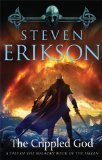
REVIEW: The Crippled God (Malazan Book of the Fallen, Book 10) by Steven Erikson


My apologies for posting this on Wednesday, rather than Tuesday. I know I’m late, but I got caught up with day-job work and so…sorry. Hope the timely review makes up for the delay.

The Crippled God by Steven Erikson Title: The Crippled God: Book Ten of The Malazan Book of the Fallen
Author: Steven Erikson
Pub Date: March 1st, 2011
Chris’ Rating (5 possible): 1 point 1 point 1 point 1 point 1 point
An Attempt at Categorization If You Like… / You Might Like…
The impressive culmination of an epic eleven years in the making.

The word “epic” gets thrown around more often when talking about fantasy than a well-aimed dagger. I’ve seen it applied (and done so myself) to Tolkien, Brooks, and Donaldson, to Jordan, Martin, and Eddings, to Jemisin, Rothfuss, and Sanderson, and the list goes on. In most of these cases, the word “epic” is an apt descriptor. But I would argue that Steven Erikson and his ten volume Malazan Book of the Fallen out-epic all of these other epics in its epic-ness. The world created by Steven Erikson and Ian C. Esselmont, each individual book in Erikson’s series, and the complexity of the story Erikson planned out from the beginning: each of these alone can be justly described as epic in scope, epic in scale. But in this genre that tosses around the E-word like it was going out of style, I believe that Erikson’s ambition is the most epic of all. And having now read Erikson’s The Crippled God, the tenth and final installment in his Malazan Book of the Fallen, I believe that Erikson delivered on the “epic” promised back in 1999.

DISCLAIMER: I am not saying that the Malazan Book of the Fallen is “better” than the Wheel of Time, or A Song of Ice and Fire, or the Belgariad, or Shannara, or insert-your-favorite-fantasy-series-here. However, I do believe that it is different. This difference especially applies to its world building and plot structure, and in many respects to its themes and characterization. In its plot structure and world building especially, I find it far more complex than those other series I just mentioned. But “more complex” does not mean better. It just means more complicated.

A little over eleven years ago I was waiting to board a transatlantic flight in Warsaw, Poland, idly browsing the tiny English-language section of a little airport bookstore, when I stumbled across a thick book. Tantalizingly titled Gardens of the Moon, by an author I’d never heard of before, and with a cover not-quite-sf/not-quite-fantasy by Chris Moore that instantly set it apart from the contemporary Chihuahua killer epic fantasies of Jordan, Martin, and Goodkind, I had to buy it. I spent the next nine or ten hours sucked into Steven Erikson’s visceral, violent, gripping world. Since that fateful afternoon, I have eagerly anticipated each new volume in Erikson’s opus, and so it was with childish delight (and squeeing) that I stumbled upon a copy of The Crippled God two days before its official pub date in my local Borders.
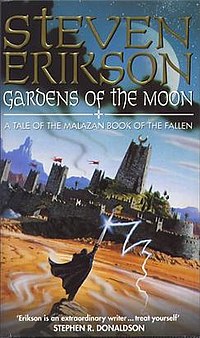
Gardens of the Moon (via Wikipedia)

Gardens of the Moon by Chris Moore (via Wikipedia)

To read Erikson’s work, one must be prepared to immediately suspend disbelief, and to dive headfirst into a world rich with layers of history, culture, politics, and mythology that would make Tolkien’s head spin. Readers not already well-versed in the conventions of the fantasy genre might find it all a bit confusing at first. But for those readers able to suspend their disbelief, and who are prepared to intuit or await elucidation, the Malazan Book of the Fallen is an immensely enjoyable series. The Malazan world was created by Steven Erikson and Ian C. Esselmont in their role-playing campaigns. But the two brought to their creation their extensive expertise in anthropology and archaeology, resulting in a world with intricate, distinct cultures, complex historical societal relationships, economic balances, and military history.

Over the course of the ten book series, we follow many (I lost count at around forty five) distinct groups of characters. Some groups are small, numbering maybe one or two members, while others are large factions with many characters going nameless. However, each of these groups is presented completely, meaning that they are drawn as round (using E.M. Forster’s definition), fully-fleshed characters. Erikson shows us everyone’s fears, doubts, concerns to such a degree that by the time we’re halfway through the first book, the very concept of “hero” and “villain” has lost all meaning. It is this moral ambiguity, this rationalization and justification of character choices and ethical mistakes, that drive the series’ themes.

The first five or six books in the series are self-contained wholes. The events of each book occur non-linearly, following several distinct “tracks” of events separated by both time and space. The main tracks comprise different books in the series, at least in the beginning. This makes it possible for a reader to start either with Gardens of the Moon (Book 1), or say Deadhouse Gates (Book 2), or Memories of Ice (Book 3).

Reading them in order of their publication, I was initially surprised and confused by their non-linearity. Where were the characters I had met and fallen in love with in the earlier books? What had happened to them? What were they doing? But like a master weaver, Erikson successfully introduces new strands while maintaining interest in those that came before. This separation across books in the series begins to collapse around Midnight Tides (Book 5), where a new reader coming into the story would be so completely lost in the whirling politics of gods, cities, armies, factions, squads, races, creeds, etc. as to make it an exercise in futility.

It is at this point in the series (books 6 – 8), that Erikson stumbles for the first time. This stumble is interesting to note, precisely because it touches upon his introduction of higher-level, more abstract philosophical themes into the story. The first six (arguably seven) books are largely plot driven. We follow the striving of different groups of characters – especially the Malazan military – as they attempt to achieve their goals. The books are thematically interesting, but there is a palpable sense that reader doesn’t yet know everything. In the sixth, seventh, and eighth books, Erikson thickens the plot by explaining more complex historical relationships, and introducing new gods, and new players. The introduction of this history, and metaphysical motivation for certain characters introduced in the eighth book, slows the pacing significantly. These latter books remain readable, but I had to read them at least twice in order to really understand what was happening. They are not bad, but they are much more dense than the other books in the series, and those books are already more dense than most epic fantasy fare. Thankfully, Erikson again hits his stride in Dust of Dreams (book nine) as he now has all of the actors on stage and moving towards the climax in The Crippled God.

And what a climax! The series tracks several hundred (again, I lost count) distinct plot lines. But they are all brought together in the tenth and final book. Perhaps more importantly, it is also in the The Crippled God that we see the thematic lines from the earlier books brought together. The thematic convergence in The Crippled God is one of the most impressive aspects of the series. Each of the earlier books has its own themes, which are in and of themselves complicated and well-executed. But after reading The Crippled God, the themes of earlier books are either clarified, corrected, or shown as illusory. Unifying these disparate (and oftentimes contradictory) themes without invalidating them is a neat trick, and makes the intellectual and emotional exercise of the whole series quite worth it.

From a stylistic standpoint, Erikson takes more from the gritty, boots-in-the-mud fantasy of Glen Cook than he does from the elf-and-dwarf high fantasy of J.R.R. Tolkien. Erikson’s primary characters are soldiers, and he draws them as imperfect, swearing, and swaggering. While dragons, and Erikson’s version of elves feature quite prominently, his characters are very far removed from Smaug or Legolas. It is the darkness and grit of his world that makes it compelling, that subverts the traditional tropes of the genre. Dragons as mad almost-gods? Heroes who (along with the reader) are ignorant of their quest, and just have to do as they’re ordered? These are fun subversions.

I found Erikson’s take on women in his books particularly interesting. Historically, I have often found fantasy to be full of stereotypical square-jawed male hero-types, with damsel-in-distress ladies swooning in the wings (if they are present at all). Erikson’s female characters are more likely to break a hero’s jaw than pine or swoon. They are soldiers, and conspirators, and commanders equal in all respects to the men, while still evidencing deft characterization that makes them fully believable. Both the men and women are flawed, emotional, sometimes angry, sometimes not. Erikson makes them complex, while retaining their intrinsic humanity. Which is refreshing in a genre often dominated by particular molds.

I have spent the past twelve years with these characters. Their stories have in many respects become a part of me, like old friends. The tenth book brings Erikson’s enormous cast of characters together, and wraps up their stories. With one or two (notable) exceptions, we learn what happens to everybody, how they end up. The tenth book is in many respects about closure, and Erikson unflinchingly brings the story of different groups and characters to a close. But – and this is one of his points – even though the book gets closed for some characters, life goes on. The unity of character, plot, theme, and execution in this tenth book is singularly impressive.

However, for everything good about his work, the complexity – of his characters, plots, themes – can be quite off-putting. One reader (whose opinions I respect greatly) very much dislikes Erikson’s work. She claims that it is too hard to follow, impossible to keep the myriad characters and plot lines straight even within a single book, let alone across a ten book series. For many readers, this will be a valid criticism. Erikson has produced a truly dense, complicated work of fiction. Myriad plot lines, more characters, complicated races that often go by different names, complex battle scenes shown from the perspective of multiple soldiers in the thick of it, this is writing that demands real work from the reader to keep things straight, to follow along with events. I found myself often having to read or re-read sections (and in some cases, entire books) just to really figure out what the heck actually happened. For many, this will be a weakness: why should I have to work so hard for my fiction? But I personally found that I enjoyed doing that work, that I enjoyed getting to spend time in an ugly, dark fantasy world that was realistically built while still employing the tropes of fantasy.

Back in 1999, Erikson told fans that the Malazan Book of the Fallen would be a nine book series. Like any gargantuan epic, this was an ambitious goal. However, Erikson executed on this ambition both in the creative sense, as well in the practical sense: publishers and fans like to see epic series come out with new installments on an annual basis. Publishers like it because it helps them push paperback editions of the earlier books, and fans like it because we can still remember what’s going on in the story. But in a sub-genre famous for delays (George R.R. Martin’s A Dance of Dragons has been delayed five years already and still counting), it is incredibly refreshing to come across an author whose ambition is so vast, whose story is so complicated, but who still manages to produce quality work reasonably on schedule. It’s refreshing, and my hat is off to Erikson for delivering on his vision.

Although I have read that Erikson is planning a new eleven book arc in the Malazan world, The Crippled God represents in many ways the end of an era. It is a masterfully-executed conclusion to a complicated, ambitious, dense opus. On the one hand, I am glad that the series is over, that Borders screwed up and I managed to get my hands on a copy several days before its official release, and that Erikson satisfied my (high) expectations from it. But on the other hand, I will miss the anticipation of the next book, will miss getting to laugh and cry with the characters I’ve enjoyed over the last twelve years.

Erikson’s Malazan Book of the Fallen is a complex, involving, and emotionally powerful epic fantasy series. There is no series more deserving of the word “epic”. Pick up a copy of Gardens of the Moon, and see if you like it. Be prepared to work at it, because it is difficult. But difficult does not mean bad, and rest assured that by the time you get to The Crippled God, you will find your investment has been fully justified and amply rewarded.

Malazan Book of the Fallen by Steven Erikson

REVIEW: The Keep by F. Paul Wilson


The Keep by F. Paul Wilson Title: The Keep
Author: F. Paul Wilson
Pub Date: December 7th, 2010 (reprint)
August 1981 (original)
Chris’ Rating (5 possible): 1 point 1 point 1 point
An Attempt at Categorization If You Like… / You Might Like…
A gothic horror novel with an interesting monster, solid early tension but a disappointing climax.

In The Keep (first in his Adversary Cycle), F. Paul Wilson does an excellent job subverting staid vampire tropes and reveling in the devices of Gothic horror. Wilson’s deft command of craft as shown in his management of setting, and the gradual reveal of his monster make this book a worthwhile purchase.

Set in 1941 in a remote mountain keep high in the Romanian Alps, the book pits two inhuman monsters against each other. On the one hand, we have the Nazi army. The Nazis are realists, hard-hearted murderers marching across Europe, slaughtering innocents by the millions. On the other hand, we have a supernatural monster (possibly a vampire, possibly not) who brutally murders Nazis one-by-one in the night. With a setup like this, Wilson has an opportunity to do one of four things: he can turn the vampire into a hero (a fun role reversal for a traditional monster), he can turn one of the Nazis into a hero (a challenging prospect, considering their historical baggage), he can show both as somewhat-justified, or he can show both as monstrous. Wilson primarily chooses to take the easiest of these four paths, keeping both the Nazis and the creature who murders them monstrous.

Klaus Woermann, a disillusioned Nazi officer, is given a somewhat-punitive assignment to guard a remote Romanian castle. Throughout the book, Woermann is the only Nazi depicted in any kind of positive light. He is painted as conflicted, not enamoured of the fuhrer, and disgusted by what the Nazis are doing to the Jews. The scenes written from Woermann’s perspective are interesting in that they show a tentativeness in Wilson’s characterization that is absent when he writes from other (less morally ambiguous) characters, like Magda Cuza or the SS commander Kaempffer. It is unclear to me whether this tentativeness stems from the author’s uncertainty as to how sympathetic to make the Nazi, or whether it stems from Woermann’s own uncertainties as to his loyalty. Irrespective of the source of this tentativeness, I found it an interesting aspect of the character that lent some degree of depth to him.

When Woermann’s troops are stationed in the mysterious keep, they inadvertently set loose a monster that had been trapped there, presumably for centuries. The monster proceeds to murder Woermann’s men, one Nazi per night. As more of his troops are murdered, Woermann eventually gets assistance from the SS through Erich Kaempffer, an absolutely monstrous officer who gleefully intends to set up concentration camps in Romania. The SS officer, and all of the troops under his command, are painted as absolutely inhuman creatures. There is no moral ambiguity, no tentativeness in their characterization. They are vile, cruel, and vicious. Thankfully, they don’t quite veer into the realm of caricature, but their commander at times comes perilously close.

The scenes of terror told from the Nazis point of view are absolutely delightful: Wilson never shows us the monster directly, instead revealing the effects the monster has on the environment and the Nazis themselves. Because the Nazis are never made entirely sympathetic, our fear is kept slightly distanced. Some might view this as a weakening of the book’s horror, but I felt that it actually helped make me more aware of the monster and his actions. The result was to leave the reader uncertain what kind of monster we are dealing with, while slowly building the tension through solid pacing. The monster shares certain traits with a Dracula-esque vampire, but there are enough new and different traits to leave the Nazis (and the reader) unsure of what we are dealing with. Wilson’s restraint is used to excellent effect in these scenes, and they leave the reader hungry to learn more about the monster’s nature.

Unable to stem the loss of life, the terrified Nazis turn to Josef Cuza, an ailing Jewish expert on local folklore, and his daughter Magda. These two characters are the only purely noble characters in the book. The scenes told from their standpoint make it clear that they are sympathetic, righteous, honorable folk…nothing like either the Nazis or the monster. This portrayal of the Cuzas is perhaps one of the better pieces of characterization executed in this book. By setting the Cuzas up as purely good, fundamentally righteous, innocent, and noble, Wilson sets them up for a beautiful fall. To avoid spoilers, I won’t go into the details but it is exactly the Cuzas characterization and how it subtly changes over the course of the book that lends the novel its thematic tension.

The readers learn more about the monster as the Cuzas work to unravel the mystery of what is killing the Germans. The gradual reveal of the monster continues Wilson’s tweaking of the vampire mythos. Throughout, Wilson keeps the monster almost, but not quite, a classical vampire. At one point, Josef Cuza remarks that the monster might not be a real vampire as the myths give us, but that it might be a real creature that at one point inspired those myths. That the reader can believe this theory is a testament to the fine line between classic tropes and innovation that Wilson used to depict the supernatural monster at the heart of this book.

The tension in the book is very well managed, right up to the moment of the final reveal. Throughout the first eighty percent of the novel, Wilson raises the stakes and the reader’s expectations. By the time the truth (and the monster) are fully revealed, the reader expects something powerful, dark, and gritty. Instead, the explanation introduces a cosmology that the reader had little preparation for earlier in the book. The surprising cosmology is clearly a setup for subsequent books in the Adversary Cycle, but here in that series’ first book it struck me as deus ex machina. While the surprising cosmology weakened the climax, the climax remains reasonably solid: the action is dramatic, the stakes and tension significant. But the climax falls just shy of the very high expectations created by the excellent majority of the novel.

In all, I would say that The Keep is a solid work of horror, with good characterization, excellent tone and setting management, and fine control of tension right up to the climax. Wilson’s depiction and gradual explanation of the monster is exceptionally well done, and the way he undermines certain character’s righteousness is poignant and sensitive. However, the excellent ingredients that make up the bulk of the book leave the expectations very high for the climax, which is weakened by the introduction of an unestablished cosmology. Fans of Gothic horror will find much to enjoy in this book, and I am curious how the remaining books in the Adversary Cycle develop the cosmology further. Having introduced it in the series’ first book, I suspect (and hope) that the subsequent installments will make more effective use of it.

REVIEW: At the Queen’s Command by Michael A. Stackpole


At the Queen's Command by Michael A. Stackpole Title: At the Queen’s Command
Author: Michael A. Stackpole
Pub Date: November 16th, 2010
Chris’ Rating (5 possible): 1 point 1 point 1 point 1 point
An Attempt at Categorization If You Like… / You Might Like…
A fantastical alternate history with major differences from accepted history.

In At the Queen’s Command (the first installment in a new alternate history series designed to span a re-imagined American Revolution) Michael A. Stackpole strikes a careful balance between historical source material and fervent imagination. Stackpole’s book combines engaging characters, a palpable sense of place, and a strong sense of Georgian voice and mores to create a compelling alternate history that draws you in and leaves you eager for more.

One of the great challenges in writing an alternate history is to strike a balance between recognizable history, and the central conceit that sets the story apart from accepted truth. Sometimes, as in Harry Turtledove’s How Few Remain, the conceit is a tiny difference which leads to significant divergence: a message that in reality was intercepted, gets to its intended destination and as a consequence the Confederacy wins the American Civil War. In other alternate histories, like Patricia C. Wrede’s Frontier Magic series, the known world is entirely re-imagined by introducing a pervasive fictional element (like magic). The more foundational the alternate history’s conceit, the harder it becomes to maintain consistency with both the facts and values of acknowledged history. Which is why At the Queen’s Command, which adds dragons, magic, and necromancy to a re-imagined Colonial America is so impressive.

At the Queen’s Command follows Captain Owen Strake, a soldier in the Queen’s Own Wurm Guard. He has fought against the Tharyngians (read: the French) on the Auropan (read: European) continent, and now has been sent on a reconnaissance mission to the colonies in Mystria. He must win over the colonists, survey the frontier, and return to Norisle (read: England). Of course, the mission does not go as planned and the colonies are drawn into war with the Tharyngians on their frontier.

The publisher makes it very plain on the book’s cover that the series is meant to re-imagine the American revolution, but Stackpole made a brilliant choice to set the first book during his world’s analog to the French and Indian War. First, most readers are not going to be as familiar with that war as they would be with the American Revolution. If Stackpole had jumped right into historical events that most American readers are already acquainted with, he would have had a much harder time getting readers to accept his central conceit. By setting the book several years prior to the American Revolution, Stackpole has the opportunity to take more liberties with acknowledged history, draw the reader into his re-imagined world, and get reader investment in his characters.

The characters are one of the strongest aspects of this book. This time period in real history is fraught with the consequences of history, a burgeoning streak of independence among the colonists, a sense of financial peril amongst the colonizers “back home”. Stackpole manages to capture the complex social, economical, political, military, and philosophical interactions of this time period through his well-realized characters. Whether it is through Owen Strake wrestling with his loyalty to Norisle, Prince Vladimir insisting upon the scientific method, Caleb Frost pushing for self-determination, the frontier trappers bridling at rumored taxes, Stackpole places a filter on Colonial America but still captures its colors. It is through these characters and their values that Stackpole addresses his themes, which are – in effect – the themes of John Locke, Thomas Paine and the other Enlightenment philosophers.

The central conceit of this alternative world is the existence of magic. In Stackpole’s world, this is not a recent discovery but instead dates back to before the Romans. It has affected – to some extent – all technological and societal evolution that precedes the events of this book. For Owen Strake and the the other characters, magic is as much of a fact of life as breathing. While on the one hand this helps to ground the reader in the world, it also leads to one of the few moments that rings off true. Specifically, the magic of the colonies is wilder, less controlled, more free than the magic Owen Strake is familiar with. The narration supporting Strake’s initial explorations, especially the first introduction of the wendigo concept, are clumsy by comparison to the rest of the book’s smooth execution. In the hands of a lesser author, I would still consider them quite well done. However, once past the initial introduction, Stackpole’s seamless narration kicks in again and the book strengthens as it gathers pace.

The book itself is a handsome product released as a trade paperback from Night Shade Books. The book’s cover, with design by Claudia Noble and art by Ryan Pancoast, is beautiful. I was particularly struck by how Pancoast seamlessly introduced a dragon and Native Americans into John Trumbull’s The Death of General Mercer at the Battle of Princeton. Looking at Pancoast’s cover image, it is difficult to imagine that they don’t belong there in reality, which adds to the book’s sense of an alternate history:

The Death of General Mercer at the Battle of Princeton, by John Trumbull (circa 1795) via Wikipedia

The Death of General Mercer at the Battle of Princeton, by John Trumbull (circa 1795) via Wikipedia

At the Queen's Command, by Ryan Pancoast (2010)

At the Queen's Command, by Ryan Pancoast (2010) via ryanpancoast.com

At the Queen’s Command is an excellent new entry in the field of alternate history. Like any good book, it offers no easy solutions at its conclusion. Partially, this is to set up tension for subsequent books in the series, but in a very real sense it is because we still wrestle with the same questions as Stackpole’s fictional Mystria: where does the state’s responsibility end, and where does the citizen’s begin? I am eagerly looking forward to seeing how Mystria and how Stackpole’s characters wrestle with these questions in the books to come.

REVIEW: Epic Mickey


Disney Epic Mickey Title: Disney Epic Mickey
Platform: Nintendo Wii
Pub Date: November 30, 2010
Chris’ Rating (5 possible): 1 point 1 point 1 point 1 point
An Attempt at Categorization If You Like… / You Might Like…
Rich Game Play and Well-crafted Storytelling

Epic Mickey is an excellent installation in the Mickey Mouse oevre from the designers at Disney Interactive. Combining excellent storytelling, appropriate art design, decent level construction, and varied and smooth gameplay, Epic Mickey is a great way for kids (and their parents) to meet Mickey Mouse.

In fact, let me start by saying that I have never been a Mickey Mouse fan. Forget Disney, I always thought. I loved Bugs, and Daffy, and Wile E. Coyote…no squeaky rodents or incomprehensible mallards for me, thank you very much. So while I was excited by Epic Mickey, I didn’t come to it with any particular affinity for the characters. In point of fact, having actively disliked the characters since childhood, I’d say I was initially skeptical about the whole affair. The premise of the game, however, abated my skepticism at least a little bit.

A sorceror uses a magic brush to create a home for all of the unwanted, unloved, forgotten cartoons. He tries to make a safe, welcoming, comfortable home for the rejects of the Disney universe: old Disney characters like Oswald the Lucky Rabbit (the prototype for Mickey Mouse), or Gremlin Gus (from the early Disney comics), etc. But of course, Mickey goes and screws it up by spilling paint and then paint thinner over the work-in-progress. This has two principle effects: first, it destroys much of the countryside, turning it into The Wasteland. And it introduces evil (a “blot”) into the rejects’ idyllic home. Mickey, of course, is oblivious to all of this and goes on his merry way. Some time later, Mickey gets sucked into the Wasteland by an alliance between the Shadow Blot (the personification of evil), the Mad Doctor (a crazy mad scientist), and Oswald the Lucky Rabbit (the de facto head of state in The Wasteland). Armed with magic paint and magic thinner, Mickey has to find some way of escaping The Wasteland. Along the way, he can either try to improve things (by painting objects using his paint brush) or make them worse (by thinning them using his thinner).

The idea of Mickey traveling a land of forgotten cartoons and having to constantly choose whether to do good or bad gives the game a thematic appeal that I’ve always found missing in Disney’s short cartoons. The game designers clearly held this premise foremost in mind when designing the game, because everything is subordinate to it. As most of these forgotten cartoons are old (from the ’20s, ’30s, ’40s, etc.) the art direction has a solid retro feel. But, this retro feel is most palpable during the game’s cinematic sequences, and in the “platform worlds” interspersed between major game chapters. When actually playing the game, it feels like walking through a stage set up to look like the 1950s: complete with cardboard cutouts that Mickey can either make more or less real. The net result is that art direction at each point in the game lends valuable support to the core premise.

Epic Mickey Screenshot, Ostown

Epic Mickey, Screenshot originally from: http://www.n1ntendo.nl/article/35601/1/Wii/disney-epic-mickey

The writing within the game is excellent, and also tightly supports by both the wonderful art and the premise. The story follows Mickey through a logical progression of discovering The Wasteland and responding to a dizzying array of characters he meets there. During the game’s many cinematic sequences, the animation is fluid and the audio reasonably good. Some folks I’ve spoken to complain about not having much voice acting in the game, but that didn’t bother me in the slightest. I thought the choice actually contributed to the “retro” feel of the game. Within the game itself, Mickey interacts with characters (good and bad) who react to him in different ways based on the ongoing choices he makes. Not having been a big Disney fan, I can’t say if this interactions are true to these characters’ histories, but the writing for them is excellent, in that it accomplishes several valuable goals:

World-building Each of the characters Mickey interacts with has a past that starts before Wasteland was created. Some ask Mickey if he remembers them from when they had bit parts in early Mickey cartoons, for example. Others talk about what life was like before the disaster that turned their home into Wasteland. This serves to really cement the gamer in the world of Watseland.
Thematic Tension Because the characters have pasts, because they react to the disaster, and because their behavior changes based on the ongoing choices Mickey makes during the game, their writing serves to maintain the thematic tension introduced by the basic premise. Mickey holds the fate of Wasteland in his hand: what will he do? As the game progresses, this thematic tension increases and the writing reflects that.
Game Progression The writing for all of the characters, and the interactions and quests that they give Mickey serve to really round-out the storyline. It becomes multi-linear about an hour or so into the gameplay and really opens up the world for experimentation and enjoyment. The writing really serves to make this interaction and the branching game play paths it offers quite seamless.

The game play itself is reasonably varied. The primary action in the game occurs as a three-dimensional platform game, not unlike Super Mario Galaxy or the Sly Cooper (PS2) games. However, the level design is a lot less complicated than in Super Mario Galaxy, with a much greater focus on how levels relate to the world of Wasteland and the story of Epic Mickey. In this respect, the level design much more resembles Sly Cooper (PS2) franchise. And, in the case of this game, this is good because it more tightly links the level design to the underlying premise and story.

The initial worlds provide a decent orientation to the game play, introducing the player to the techniques they will use throughout the game (especially techniques for painting and thinning aspects of the world). However, I found that the “orientation” worlds lasted a little too long for my taste (about 10 – 15% of the game or so). However, that may be because I’m a video game player in my late 20s who has seven video game systems hooked up to his television. Don’t get me wrong, the orientation worlds were fun. But the game play changes when a more quest-oriented system is introduced after the first two worlds. The action continues to be three-dimensional and platform-style, but the motivation and the places that Mickey can go become much more broad. At that point, Mickey can choose which quests he wishes to complete, where he wants to go, and how he wants to complete those quests. With the game’s horizons opened in this fashion, I found I enjoyed the game much more from this point. It gave me greater engagement with the character and the story, and became about more than slogging may way through a bunch of linear worlds.

The quests break up the game play nicely, but so too do the “inter-world” levels. These are more traditional, two-dimensional platform levels. They are “traveling” worlds that Mickey needs to get through to proceed from one section of the Wasteland to another. What’s great about them is their design: they are designed like old 1930’s or 1940’s film strips, complete with undulating film reel border. Some are in color, while others are in black and white. This brief 2D switch up provides great variety in the game, while their design makes them a real treat to play.

Epic Mickey is a very solid game. With excellent writing and superb design, the game provides many hours of enjoyment. The biggest complaint I have about this game is its camera control. That’s not unique to this game (I find it’s a common problem on many Wii games), but this game was especially prone to placing me in positions where I could not position the camera such that I could see where I would be jumping, or to allow me to adequately aim my paintbrush at objects/enemies. While I still enjoyed the game and I was able to play through it without too much swearing, this problem was sufficient enough of me to knock a star off of my rating for it. However, despite that complaint I still think this is a great game for kids and adults alike. While the premise and the theme are dark and complex enough for adults to get a kick out of, like the best middle-grade novels, they are still presented in a fashion that an eight year old will enjoy just as much.

REVIEW: The Broken Kingdoms by N.K. Jemisin


The Broken Kingdoms by N.K. Jemisin Title: The Broken Kingdoms
Author: N.K. Jemisin
Pub Date: November 3rd, 2010
Chris’ Rating (5 possible): 1 point 1 point 1 point 1 point 1 point
An Attempt at Categorization If You Like… / You Might Like…

In The Broken Kingdoms (the second book in her Inheritance Trilogy, begun in The Hundred Thousand Kingdoms), Jemisin successfully avoids the middle-book-blues by constructing a beautiful mosaic of unique and skillfully executed traits rarely seen in fantasy. Most importantly (and most impressively), you can enjoy it without having read The Hundred Thousand Kingdoms), although the experience will be richer if you have.

It is hard enough to maintain momentum, pattern, and voice in a single novel. But publishers love multi-book series for good economic reasons (who doesn’t love reprint sales?), and so do authors (who doesn’t love contracted advances?). Unfortunately, very few authors are up to the challenge of constructing a story arc that will span multiple books, not drag, let each installment work on a standalone basis, and do something new, meaningful, and entertaining. If Broadway is littered with excellent first acts, then Borders is littered with excellent first books. Readers of The Hundred Thousand Kingdoms may be surprised to see few characters they recognize. While set in the same universe and dealing with the same (divine) conflict established earlier, this book is told from the perspective of a very different hero. It is a complete, and self-contained story that builds off of the events of the previous book and would be an excellent standalone novel in its own right. Jemisin is constructing a fascinating standalone epic trilogy that reminds me more of Homer’s Odyssey than Tolkien’s Lord of the Rings.

The Broken Kingdoms follows Oree Shoth, a blind artist living in Shadow, a city beneath the World Tree and the city of Sky perched atop it. Oree takes in a taciturn and mysterious lodger, and finds herself plunged into a conspiracy centered around the serial murders of godlings. The conspiracy, Oree’s involvement, and the steps she takes to survive give the book a solid rhythm and provide momentum that Jemisin maintains through to the end. And while this book’s plot is strong and engaging, the book’s real engine are the characters and their relationships and its fuel are the ways in which it subverts epic fantasy tropes.

Oree is a disabled member of a historically-oppressed minority. As a result, she represents a refreshing antithesis to the standard fantasy heroine (Oree is neither white, nor is she able to wield two swords at once in a spinning dance of death). In the hands of a lesser author, Oree’s race would turn this book into a simplistic caricature of contemporary racial relations, but Jemisin neatly avoids that trap. Oree’s background and the history of her race are intrinsic to the plot, but her character is woven of more complex strands than race alone. By taking the societal consequences of ancient choices and making them concrete through the experiences of her characters, Jemisin produces a rich and complex society, and avoids the solipsistic condemnation of either the majority or the minority. This enables Jemisin to introduce much stronger and deeper characterization for her principle actors, building a very subtle and effectively post-racial character without sacrificing the plot elements that hinge upon her narrator’s background.

Oree has some magical ability, but she neither understands it nor is it ever explained to her by a helpful teacher. Reading the book, we are as much in the dark as to her ability as she is, and we are pulled right along with her as she discovers the truth about herself. The emotional core of the book are Oree’s complicated relationships with the men in her life (the silent homeless man she names “Shiny”, and her godling lover Madding), and it is these relationships and her complex feelings for them that motivate her actions. The supporting characters are all drawn believably. The godlings – by their very nature – are flat characters yearning to break into three dimensions, and the sensitivity with which their efforts are handled really make you feel for them. Just like the mortal Oree, they are products of their own histories and their own family histories, and it is through this excellent characterization that Jemisin is able to explore her primary themes of choices, family, and relationships.

Oree, as the mortal narrator, provides us with a very identifiable perspective on these themes, both within herself (as a mortal Maro) and amongst the gods of her world. The characterization in this novel is the best part about it, although the characterization is so good precisely because everything else (the world-building, the language used, the magical system) contributes to it. Jemisin uses first person narration to extremely good effect, limiting the reader’s awareness to that which Oree herself would notice. But the real trick of characterization, and what seals the deal for me actually occurs at the end. I won’t spoil it here, but the denouement is used in an exceptional way to tie together the themes that Jemisin explores throughout. It brought tears to my eyes, which for jaded old me is not that easy to do.

By subverting so many fantasy tropes, it is difficult to categorize The Broken Kingdoms. It shares a palpable sense of consequence and history with Steven Erikson’s Malazan Book of the Fallen, but it is (thankfully) more approachable, less convoluted, and less gritty. It shares the playful and sensitive touch when twisting fantasy tropes that can be found in Brandon Sanderson’s Warbreaker and Elantris, but it is more powerful thematically than either. It has the gripping pacing and excellent characterization of Patrick Rothfuss’ The Name of the Wind, but Jemisin’s novel is more complete on a standalone basis. Probably the closest comparison I can come up with is Suzanne Collins’ excellent Hunger Games Trilogy, which similarly deals unflinchingly with delicate, complex, and powerful themes while keeping each book as an effective standalone novel.

The Broken Kingdoms is an exceptional new chapter in the already-enjoyable Inheritance Trilogy. Jemisin has done everything right: her characters are rich and engaging, her world is complex and believable, and her plot is fast-paced. This is an ambitious book, and it satisfies by completely addressing important themes in an innovative and immensely readable fashion.

I will be eagerly looking forward to the third and final book in the series, The Kingdom of the Gods, which is due out from Orbit in 2011.

REVIEW: The Half-Made World by Felix Gilman


The Half-Made World by Felix Gilman Title: The Half-Made World
Author: Felix Gilman
Pub Date: October 12, 2010
Chris’ Rating (5 possible): 1 point 1 point 1 point 1 point
An Attempt at Categorization If You Like… / You Might Like…
Exciting, adventurous, thoughtful steampunk fantasy.

The Half-Made World by Felix Gilman is the gripping story of war on a brutal frontier. This is Gilman’s third book, after his excellent 2007 debut Thunderer and its disappointing sequel Gears of the City. Set in an entirely different universe, The Half-Made World shows that Gilman has clearly disciplined his imagination and gained a focus that had been lacking in his last novel.

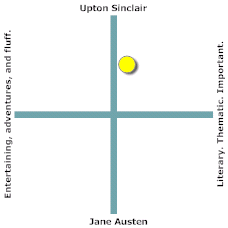
If you are looking for steampunk with Victorian mannerisms and airships, look elsewhere. While it shares elements of the steampunk aesthetic, it is firmly rooted in the oily, Wild West and Sinclair’s blood-stained Chicago stockyards. For those critics who complain that steampunk never has anything important to say, I recommend they read this book. It takes place in (as the title would suggest) a half-made world, where the east is settled and established, operating along “realistic” lines. The west remains wild, and reminds me of the aboriginal Dreaming. The rules that govern it are shifting, changing, and magic (of a sort) is real. From a thematic standpoint, The Half-Made World is a serious examination of the complex and conflicting values inherent in the romantic and manifest destiny movements of the 19th century. But despite its important themes and artful writing, it is an entertaining and exciting read, striking that rare balance between adventure and literature.

Gilman’s frontier is torn apart by an unending war between the Line (railroads, trains, manifest destiny) and the Gun (guns, fatalistically doomed heroes, romance). When the book opens, it is entirely plausible that the Line and the Gun are merely the colloquial names for a set of combating ethos: symbols, and little besides. But it quickly becomes apparent that these opposing forces are in fact very real spirits or demons, who embody particular mores and values and who attract particular types of followers. The opposing cultures of Line and Gun, and the setting they create, are some of the most important characters in this book.

The story is told from three perspectives:

  • Lowry, an agent of the Line,
  • John Creedmor an agent of the Gun, and;
  • Liv Alverhuysen, a “neutral party” from the settled East swept up in the frontier conflict.

While each of the perspective characters is engaging, the Line and the Gun themselves provide the text with a foundation. Gilman’s writing is extremely tight, and the natures of the Line and the Gun come through in the little details: the methods their agents employ, the territories they control, the people who live under their rule. Even the slight shifts in narrative voice used for the different perspectives help cement the setting. The Line and the Gun are not ephemeral constructs, or religious ideologies. They are real: dirty, smelly, and intensely human forces for all of their inhuman power.

Gilman does something very difficult with his three perspective characters. Each personifies a particular ethos: Lowry is the embodiment of the Line, with all its systematic and methodical values. Creedmor embodies the Gun, with its heroic strengths and tragic weaknesses. Liv personifies a third set of values (still nascent, I would say), which seems designed to balance the Line and the Gun. To paint characters who personify abstract values well is very difficult. It is so easy for them to become caricatures of their mores. Hugo pulls it off exceptionally in Les Miserables. Ayn Rand does it well, though less-reliably than Hugo. While Gilman is not quite as powerful as Hugo, nor (thankfully) as insistent as Rand, his characters remain true to the forces they personify, as well as to their own humanity. They are flawed and identifiable, in a most beautifully human way.

The jacket, designed by Jamie Stafford-Hill and with art by Ross MacDonald, drew my eye in the bookstore, reminding me of the futuristic designs drawn by Albert Robida in the late 19th century. While I don’t think the image depicted on the cover appears at any point in the action of the book, the design is elegant and understated. It captures the spirit of the text, if not its literal action. The book opens slowly, but gathers steam after the first eighty or so pages. The prose is dense, and rich throughout, and Gilman fleshes out his principal and supporting characters gradually over the course of the book. The last third is especially well-paced, and I found myself on the edge of my seat. The perspective and writing remain crisp, and at no point does it come off the rails (no pun intended).

While on the whole this book was excellent, I was mildly disappointed in how Gilman dealt with one of the characters at its end. It is difficult to explain the details without giving anything away, but this is clearly the first book in a larger whole, and to make it self-contained, certain strands needed to be tied up. I understand that, and I understand that there were equally-good or equally-bad options for how to do so. Gilman chose one of them, and his choice is not in and of itself bad and I suspect other readers might be satisfied with it. But when I read it, I found elements of its ending to be slightly anticlimactic, almost bathetic. However, it is entirely possible that bathos was part of Gilman’s point, and while it was disappointing, I find myself waffling on whether it is a weakness or not.

The book ends poised for a continuation of the adventure, without crossing the liminal boundary into cliff-hanger. As a result, I am eagerly looking forward to the sequel. I strongly recommend The Half-Made World to anyone looking for thoughtful steampunk, or who enjoys the frontier adventures of Emma Bull (Territory) or Jeffrey Ford (The Physiognomy). If (like me) you were turned off by Gilman’s earlier Gears of the City, I’d suggest you give him another shot: The Half-Made World is incomparably stronger in every way.

REVIEW: The Dervish House by Ian McDonald


Title: The Dervish House
Author: Ian McDonald
Pub Date: July 27, 2010
Chris’ Rating (5 possible): 1 point 1 point 1 point 1 point
An Attempt at Categorization If You Like… / You Might Like…
Exceptionally well-crafted setting and utterly believable.

The Dervish House is Ian McDonald’s new novel set in a near-future Istanbul. Soaked in history, nanotechnology, and McDonald’s always-amazing settings, this book is arguably one of the best science fiction titles I’ve read this year.

I have loved “traveling” with McDonald since I first picked up River of Gods, his 2004 novel set in a near-future India. Following that book, he has carved a very nice niche for himself by setting his novels in somewhat unusual (read: non-American/British) settings. Chaga (published in the US as Evolution’s Shore) took us to Kenya, River of Gods took us to India, Brasyl took us to (surprise!) Brazil, and now The Dervish House brings us to Istanbul.

Setting has always been central to McDonald’s works (even in his earliest novels like the harsh yet beautiful Desolation Road). I’ve traveled a lot in my life, but I’d never visited India, Brazil, or Kenya. So when I read his earlier books, the settings were lush and fascinating to me, but still alien. But Istanbul, I’m familiar with. I lived in Europe for ten years and spent quite some time in Turkey on business, so for the first time I was able to read a McDonald book with pre-existing familiarity with the setting and culture. And as far as I can tell, McDonald nails it.

Istanbul has always been a crossroads of commerce, history and religion. Today, it’s at the heart of a maelstrom of geopolitics, religious debate, and energy economics. McDonald captures that intersection and projects outwards from it, taking us to a Turkey that just-recently joined the European Union and still struggles with its identity as a nation, its religious history, its place in the region, and its internal politics (generals vs. intelligentsia vs. religious fundamentalists of various types). His Istanbul is recognizable to anyone who has even spent a day in that city, capturing the Byzantine streets and the culture of a city that straddles two continents. A writer of lesser skill would have simplified the reality, perhaps skimped on the economics or drawn caricatures of the complex cultures that intertwine in the city. But McDonald doesn’t. He balances the different interests and cultural backgrounds of his characters deftly, showcasing a nation that waking up to its dreaming potential.

The book follows the lives of six characters who live in an old building that long ago had belonged to or been involved with an ascetic Sufi fraternity. The dervish house is the hub, the connecting strand that joins together the six characters in this story. The events of the book unfold starting with a suicide bombing, and how it affects – directly and indirectly – the lives of the people who live in the tekke (dervish house). The story is told from the perspectives of each:

  • An academic economist forced into retirement,
  • A nine-year old boy with a dangerous heart condition,
  • A rural young woman determined to make it as a professional in the big city,
  • An ambitious young woman who runs a religious art gallery,
  • A ruthless energy trader, and;
  • A troubled, screw-up caught up in the development of street sharia.

Their lives are tied to together by the tekke, by the suicide bombing several blocks away, and by a near-mythical relic from Istanbul’s past. Each character is painstakingly crafted. Their voices are distinct, their judgments and values a clear outgrowth of their background. These characters have depth, and plainly show McDonald’s careful research into some of the more esoteric branches of market theory, contemporary futures contracts, and obscure kabbalistic sects. This research gives this book its lush, rich texture and bring the characters and setting alive.

The intersecting character arcs are exceptionally well done, and they are at once the book’s primary strength and its greatest weakness. In fact, that’s the only reason why I’m giving this book four stars instead of five: I feel like I have seen this device used before. When I think about McDonald’s works, the ones that instantly come to mind are Desolation Road, its sequel Ares Express, and River of Gods. Each of these books relies on the same narrative structure: different characters whose lives intersect through one (or a handful) of locations. McDonald does this better than anyone I can think of just now. But I’d like to see him stretch more, maybe try some different structures out. It would be nice to see, because having read most of his work I find that I know how it will flow. I can’t predict the events of the plot, but I can predict its cadences and rhythms. It’s like listening to a new symphony by a beloved composer: you can just tell how the music will swell next, even if you’ve never heard it. Much as I enjoy McDonald’s symphonies, I’d like to be surprised.

The physical book itself is great. Pyr did an excellent job with the hardcover, designed by Jacqueline Nasso Cooke and with a cover illustration by Stephan Martiniere. The cover illustration sets the tone for the whole work, showing the crowded streets of 2027 Istanbul, the combination of history (old buildings, traditional clothes) and uber-modernity (neon advertisements, robots, etc.). That cover image captures the mixing pot that is Istanbul, and captures the intersections of its residents lives just as well as the text. Martiniere’s covers and McDonald’s prose are a great pairing, and I’m glad to see that Pyr has maintained that connection through all of McDonald’s books they have published. Great job with that, and I hope they maintain it since I think that combination is just getting better and better.

This is not a rip-through-it-in-one-night, page-turning adventure. It has its moments of high tension and danger, but this is the kind of book that you want to enjoy over the course of several nights. This prose should be savored. If you have had your fill of anglophone settings and cultures in your science fiction, you should pick this up. If you are interested in high-quality literary fiction that just happens to be set in the future, pick this up. I think this is one of McDonald’s better works, and I definitely enjoyed the trip he took me on. If you find that you like this, there’s a variety of other great science fiction set outside of the American/British cultural background that you might enjoy, most notably the books by George Alec Effinger and Lucius Shepard‘s Life During Wartime.

REVIEW: New York Comic Con


Whew…I’d forgotten how exhausting Comic Con can be. This weekend saw Comic Con return to New York City for the first time in 18 months, and this triumphant return saw several improvements over the previous show:

  • The floor space was doubled. Artist Alley and Autograph Alley seemed significantly larger, and there were more exhibitors.
  • Comic Con was held parallel to the New York Anime Festival. What could be more fun than comics, science fiction, fantasy, video games and anime?
  • Massive gaming stations (for multiplayer computer games as well as tabletop gaming)  were added if you were so inclined.

Unfortunately, I think the organizers underestimated the number of people interested in comics, video games and speculative fiction. This has been a chronic problem with the NYCC, dating back to several years ago when the fire marshal had to kick people out. By Saturday afternoon, this year’s show had sold out, and crossing from one end to the other was a 45 minute battle against a rising tide of costumed humanity. Next time, rather than squeeze another booth into every last square inch the organizers just drop one row of exhibitors and expand the traffic aisles so that the crowd can have better flow. It will make the experience a lot more pleasant for everyone.

That being said, there was a lot to do at Comic Con. Between walking the booths, talking to people, demo’ing upcoming video games and trying to grab a couple of panels it was a wild and exhausting couple of days. I tried to divide my explorations into some specific categories, and so here are the highlights that I walked away from the event with:

Literary (books, as opposed to comics)

I spent quite a bit of time wandering around the book publisher aisles. I had some general observations and some specific comments:

General Observations

  • The expanded floor space gave the publishers the opportunity to really stretch their space. Most of the big publishers had large booths (double, triple or quadruple booths seemed the norm).
  • The publishers relied less on ARC’s (advanced reader copies) and galleys to pimp their titles: most (even the big houses) were making visitors purchase their books to a far greater degree than I remembered.
  • I saw far more mass-market titles than trade, which while not terribly surprising was a little disappointing.
  • Most publishers (large and small) offered good author signings. Standard practice was for an author with a new title out to be signing copies of a previous book that the publisher was giving away. A handful of publishers dropped the free give-aways and instead made people buy the books.
  • There were several significant genre publishers whose absence was notable for me:
    • Scholastic. This is a shame considering their excellent line-up of middle-grade and YA books (especially strong in the paranormal teen romance and quirky science fiction). While the other publishers there were all pimping their YA lists/imprints, Scholastic’s absence really stood out.
    • Pyr did not have a booth. Considering the impressive list that they have put together and their excellent blend of commercial and literary appeal, I was really surprised. This audience would have eaten their stuff up like there was no tomorrow.
    • Night Shade Books did not have a booth. This is not really surprising, considering their size: NYCC would have been an expensive proposition. But there were a bunch of other smaller-press publishers doing a brisk trade at the event, and considering what Night Shade’s list looks like, I’m sure they would have benefited from a presence.
    • Genre magazine publishers were completely absent. Again, not a surprise considering the cost of exhibiting. But I can guarantee that most of the people on that floor are completely unaware of the existence of magazines like F&SF, Asimov’s Science Fiction, Strange Horizons, Apex, etc. I’m not sure if it’ll ever happen, but they may want to consider banding together and sharing a booth in the future if for no other reason than for mutual promotion. Couldn’t hurt and may help expand the audience.

Specific Observations

  • Tom Doherty Associates (Tor/Forge) had the best-organized booth layout, keeping it simple and classic and always having it manned by well-informed publicists, marketing reps and the occasional editor. The booth itself wasn’t terribly large, but the displays were thoughtfully set up and very well managed. On display were a handful of books from their 2010 lineup and book plates for titles on their 2011 list. I was a little disappointed by the paucity of their author signings however, as they only had a handful of authors there (their major headliner being Brandon Sanderson).
  • HarperCollins had the weakest booth of the lot. That’s not to say that they have weak books – but their event management just sucked. They had some interesting looking books displayed, but the booth was so understaffed that I couldn’t ask anyone about them. I was there all day on Friday and Saturday and spent quite a lot of time in the vicinity of their booth, but only saw one (rather beleaguered) person manning it both days. The displays themselves were not terribly well done, typically displaying only a handful of copies of select titles. The impression I had was that they were not really serious about marketing to the NYCC crowd, which is somewhat surprising considering the popularity of their competitors’ booths.
  • Penguin Group had a rather sizable showing. The staff were generally knowledgeable, friendly, and had decent displays. Their primary strength was their large number of author signings (including Jim Butcher, Seanan McGuire/Mira Grant, etc.) but the downside was that you either had to bring the authors’ books to the signing or buy them beforehand on the other side of the booth…about 30 feet away. That might not seem bad, but it’s really crappy event management: traveling 30 feet at Comic Con is a challenge, and having to do so after spending 15 minutes in line and then spending another 15 minutes in line after the purchase is quite annoying. It wouldn’t have been that hard to have a stack of books at the signing and tell people to pay for them after they’ve been signed. First Second Books (a smaller graphic novel press) managed that type of setup quite well and if Penguin had tried it, things would have flowed smoother and far fewer people would have been frustrated.
  • Random House had by far the biggest showing of the lot. They practically took up two whole sections of one aisle, although all of their imprints were basically doing their own thing. I didn’t have too many notable comments on the Random House crowd, other than a general observation that they seemed to have fewer author signings than the other publishers.

Video Games

Video games seemed to occupy a third of the floor space (that’s not a complaint). There were far too many upcoming games for me to comment on all of them, so instead I’ll just focus on the ones that most appealed to me:

  • James Bond 007: GoldenEye for the Wii. I loved the original Goldeneye game on the N64, and they have made an awesome new version of it for the Wii. Gameplay will be instantly recognizable to anyone who played the N64 version. The graphics have been updated (though seeing this on an Xbox-360 or PS3 would be even cooler), and the multiplayer is awesome as it ever was. Don’t know how the single-player mode runs, but multiplayer was great.
  • Disney Epic Mickey for the Wii. This game looks awesome. Set in a dark and twisted world of rejected cartoons, you play as Mickey trying to bring some brightness with a magic paint brush. The graphics are great, the gameplay looks fun (I didn’t get a chance to play myself, alas), and the story is just dark and twisted enough to be awesome.
  • Captain America: Super Soldier for every system out there. If you loved Batman: Arkham Asylum, odds are you’ll love Captain America: Super Solider. The gameplay looks very similar (they weren’t letting anyone play the demo, but the videos and the in-person demo’s by the reps looked identical). I loved Arkham Asylum and I’m definitely buying the new Cap game as soon as it hits the shelves.
  • Dead Space 2 for all the major systems. Looks like the original, only with some cool new gameplay features thrown in (jetpack!). The fun part seems to be what they’re doing with the story, basically giving Isaac a little more character and initiative than he had in the first game.

Manga/Anime

It is incredibly unfortunate that the New York Anime Festival was relegated to a single room in the deep underbelly of the Javitz Center. I found it near the end of my second day at the Comic Con, when I only had the strength to dash through the aisles pretty quickly. It seemed to be primarily full of anime artists and cosplay fans – which on the whole seemed neat – but its location was unfortunate. I wanted to find more dark, interesting anime/manga (Naruto is not my scene) but I was too late getting there to have the patience to find any. Maybe if it were better positioned, I would have thought to spend more time there sooner and found something cool. Maybe next time.

Panels

I attended (or tried to attend) several panels that I thought might be cool, but again the organizers let me down. The first panel I tried to attend had a neat title: “The Search for Humanity through Utopias and Dystopias”. Just the kind of dorky little panel that I find fascinating and fun. The panel started thirty five minutes late because of technical blunders. By that point, boredom had set in and the presentation didn’t help. Maybe I’m spoiled by corporate presentations and research papers from my day job, but I know people in the comic book industry can present well. Unfortunately, the organization of this panel was atrocious and the content ended up uninteresting.

The second panel I went to – “Editors on Editing Comic Books” – actually came off without a hitch. I found it really interesting and informative. On stage were veteran editors from the three big houses (DC, Marvel and IDW) and they basically told the audience the truth about breaking into the business. It was refreshing to see the editors pull no punches. They told the packed room that each editor has writers, pencillers, letterers, inkers and colorists who they have worked with successfully in the past, and that these colleagues are looking for work. Translation: if you want to break into the business, you need to be technically better than the current professionals, and overcome the “relationship advantage” that your entrenched competition already has. That’s a tall order, and I saw a lot of disappointed faces in the crowd. But hey, that’s the truth of it. Probably the truth of it in any medium. Those creators who internalize that message will do better work because of it, and invest the time (often years) needed to build relationship in the industry.

The organizers dropped the ball on the third panel I tried to attend as well. It was the fantasy writers’ panel, and it sounded like it would be a lot of fun with Joe Abercrombie, Brandon Sanderson, Naomi Novik and Peter V. Brett. But alas, the organizers shoehorned the event into a tiny room far off in a distant corner. By the time I got there (fifteen minutes before the panel was due to start) it was standing room only. I was three people away from the door when the organizers said “No one else! Get out of here!” and shut the door. Did the organizers think that comic book fans wouldn’t be interested in fantasy? They should have given this panel one of the larger rooms available.

Comics

I have become so disillusioned over the writing in comic books over the years, that I have to admit they’re last on my list. That’s ironic, considering that I spent about twenty hours wandering amidst the crowd of the New York Comic Con. But it was really telling that when listening to comics editors speak about their work, they openly admit to focusing entirely on the art and not caring so much for the writing. That’s understandable, considering that good art is a must-have for a decent comic book, but it’s still sad to hear editors (editors!) say “I’m in comics so I don’t have to deal with words.” There are a few exceptionally-well-written comics out there (Fables?). I tried to find some more, but alas no luck. Oh well.
I’ll definitely be looking forward to NYCC next year. Mark your calendars for October 14 – 16, 2011!

REVIEW: Dreadnought by Cherie Priest


Dreadnought by Cherie Priest Title: Dreadnought
Author: Cherie Priest
Pub Date: September 28, 2010
Chris’ Rating (5 possible): 1 point 1 point 1 point 1 point 1 point
An Attempt at Categorization If You Like… / You Might Like…
Exciting steampunk set in an alternate nineteenth century America.

Dreadnought by Cherie Priest is an excellent steampunk novel set in an alternate 19th century America: replete with airships, trains, walking war machines, and zombies; what more could you ask? While set in the same universe as her 2009 Boneshaker, Dreadnought is a standalone novel and can certainly be enjoyed without having read Boneshaker.

I’ve been a fan of Priest’s since she knocked the ball out of the park with her Hugo-and-Nebula-nominated Boneshaker in 2009. Boneshaker introduced me to her “Clockwork Century,” a nineteenth century United States where the Civil War has gone on for twenty years. The characters, the pacing, and the writing of that book sucked me in and left me thinking about it months after I’d read it and so I was eagerly looking forward to Dreadnought. Thankfully, Priest did not disappoint.

Dreadnought follows Venita “Mercy” Lynch, a southern nurse working at a military hospital in Virginia as she travels across the country to see her estranged father in Seattle. Her trip takes us down the front lines of the Civil War and across the frontier. Mercy is just passing through all of the places she visits, and we’re just passing through with her. As a result, Dreadnought is understandably not as grounded in place as Boneshaker was. But Mercy focuses her attention on the people she encounters during her trip, and this performs two admirable tricks: it grounds the book in time, and it instantly makes us care about our hero.

The characters and the voice are the best part of this book: they are what kept me turning pages on the edge of my seat. While written in close-perspective third person, I felt like I was reading a first-person book. The details mentioned in the prose observations and the cadence of individual sentences cemented me in Mercy’s head. Priest admirably avoids typographic sleight-of-hand (which I usually find annoying as all hell) to establish her characters as “southern” or “western” or “Mexican”: her dialog is generally written in clear, understandable English. But the way she constructs her sentences gives each character and even the third-person narrator a distinct “flavor” that establishes them in time and place. Even the narrator spoke in my head with a slight southern accent, the kind one might hear from northern Virginia. Throughout Dreadnought’s 400 pages, there was only one (exactly one!) sentence that rang off-true and knocked me out of Mercy’s head. The rarity of such a misstep is a testament to the skill with which Priest draws her characters and grounds them in her fictionalized history.

Fans of alternate history might want to take Priest’s fictional history with a grain of salt: this is not a Harry Turtledove alternate history that painstakingly considers actual history and how it might have played out differently. Instead, Priest makes a sweeping conceit and uses it to buttress a fantasy world. In this, her work is closer to Emma Bull’s Territory or Patricia C. Wrede’s Frontier Magic than to Harry Turtledove’s Timeline-191.

Nonetheless, the book is heavily informed by Civil War history. In her acknowledgments, Priest mentions using the Louisa May Alcott letters to research her fictional Civil War hospital and this homework shows: the opening chapters bring to mind Walt Whitman’s Memoranda During the War, with all of the pain and hardship of nineteenth century medical care. If the facts of history are altered, the basic feeling, lifestyles, and value systems are consistent with what I have read about late nineteenth century America. This firmly establishes Dreadnought in time, making Priest’s “alternate USA” plausible.

“Classic” steampunk motifs – airships, steam/diesel-powered “walkers”, trains – are rendered believably: Mercy is ignorant of much of the mechanics, but she is forced to deal with them and we learn about them along with her. These devices struck me as more prevalent in Dreadnought than they were in Boneshaker, but as methods-of-conveyance they played a more central role to the story so it makes sense.

If there is anything to criticize in this book, it is not the author’s fault. If you buy this book and want to avoid spoilers, avoid the back cover copy. I made the mistake of reading it, and was given a very neat little synopsis of the first 65% of the book. Thank you for that, but I’d rather read the book: next time, just “vague it up” a bit, please. Barring this (minor) complaint, the rest of the book’s design is superb: excellent cover art by Jon Foster (who also did the cover for Boneshaker), and a brilliant sepia ink really make the book an attractive object in its own right.

Dreadnought is an improvement over the already-excellent Boneshaker. It is a simpler story, but that simplicity gives us greater richness. I thought Boneshaker was a good example of steampunk being the new gothic, and Dreadnought continues this tradition. It feels less Gothic, but that is due to its lack of a solitary villain and its persistent sense of motion (which isn’t really surprising in a travel story).

This book is tremendously fun to read. It is exciting, the characters engaging and the monsters scary. If you like zombies and the steampunk aesthetic, you will love this book.