Skip to content

Posts from the ‘Reviews’ Category

REVIEW: Supernatural Noir ed. Ellen Datlow


Title: Supernatural Noir
Editor: Ellen Datlow
Pub Date: June 22nd, 2011
Chris’ Rating (5 possible): 1 point 1 point 1 point 1 point
An Attempt at Categorization If You Like… / You Might Like…
Excellent storytelling, though slightly more supernatural than dark.  


First, let me start by saying that I love noir fiction and film. Give me a good hard-boiled detective story, and I’ll lap it up – typically not looking for much beyond entertainment. I also love dark fantasy and horror, and so the thought of blending them in a new anthology fittingly titled Supernatural Noir sounded great to me. Throw in one of the best editors working in the business today – Ellen Datlow – and I am definitely there. Having read a digital review copy, I can say that Dark Horse’s Supernatural Noir delivers as advertised, even if it may lean closer to dark fantasy than I would have liked.

With Datlow’s editorial pedigree, this should come as no surprise. On my shelves at home, I have over fifteen anthologies edited by Datlow (often with excellent collaborators like Terri Windling). I admit, I’m a bit of a fan. Historically, her anthologies have demonstrated a particularly consistent ability to showcase top-flight authors and stories, and to assemble them into collections unified along whatever dimension is relevant to a particular book. The table of contents for Supernatural Noir is no different in this regards.

The authors read like a “who’s who” of dark fantasy (more so than noir): Gregory Frost, Melanie Tem, Paul G. Tremblay, Laird Barron, Jeffrey Ford, Joe R. Lansdale. Sixteen authors contributed original short stories for the anthology, and all of them come from a dark fantasy / supernatural / horror background in their writing. This is not a complaint, but it should be an indicative fact: the authors selected for this book skew by experience towards the “supernatural” part of the anthology’s title, so it should not be surprising that their stories lean in that direction. If you are looking for horror stories written by hard-boiled mystery writers, you won’t find them here. Instead, this collection offers dark fantasists’ spins on the hard-boiled crime story. Which – I would argue – is just as fun, although it means the noir elements might get a little de-emphasized in some places.

A large number of stories (either explicitly or plausibly/implicitly) are set in the time period from the late ’40s to the late ’70s. Considering noir‘s roots in the late ’40’s and ’50’s, this makes sense to me: the square-jawed hero (or stalwart heroine – more on this in a sec) in a worn trenchcoat is emblematic of the post-War period. But the difference in tone between the stories set in this post-War period and the stories set in a contemporary (or vaguely futuristic) setting is striking. The stories set closer to WWII – like Richard Bowes‘ “Mortal Bait”, or Joe R. Lansdale’s “Dead Sister” – tend to employ a greater number of noir tropes. The later a story is set, the less prevalent noir‘s emblematic elements become. What does this say about modern society and the evergreen qualities of noir as a sub-genre? Is noir possible in a world with mobile information and instant access? Judging by the excellent contributions from Melanie Tem (“Little Shit”) and Nick Mamatas (“Dreamer of the Day”), the tropes of traditional noir fiction need to be adjusted and updated to operate in our modern reality: the tropes that worked in the days of vacuum tube televisions may not work any longer.

The second stand-out was the number of female and queer heroes featured. In many ways, this is representative of noir‘s original values: it should be only natural for a genre typified by a frank treatment of violence and sex to grow beyond the “haunted square-jawed hetero male detective” trope. The variety of heroes employed in these stories was encouraging, although at times it stretched some bounds of credulity. For example, while I thought Caitlin R. Kiernan‘s story “The Maltese Unicorn” was great fun, I was haunted by an inability to completely buy its heroine in 1935 New York.

Coming to it looking for fantastical noir, the anthology will be reasonably satisfying. If you come to it looking for noirish dark fantasy, I suspect you will be more satisfied. All of the stories here are competently executed. Some including Jeffrey Ford’s “The Last Triangle” and Elizabeth Bear‘s “The Romance” (which snuck up on me delightfully) will stay with me for a long time. Others, like Laird Barron’s “The Carrion Gods in Their Heaven” just didn’t suit my own tastes, although I recognize their quality. Only two stories (Joe R. Lansdale’s “Dead Sister” and “Mortal Bait”) didn’t work for me for critical reasons: in both cases, they featured characters/voices that did not stand out, and plot structures that I found predictable. Interestingly, both were among the stories that adhered most closely to traditional noir structures. I believe their weaknesses highlight the single greatest challenge in modern noir: crafting a hero and voice that is distinctive and interesting. Most of the stories in this anthology – even those that did not particularly appeal to me – manage to get it right.

If I have one complaint to register, it’s a relatively minor (and inordinately geeky) one. I really enjoyed reading this anthology for its entertainment value. But I would have loved to see one or two critical essays discussing noir and its long relationship with the fantastic (and the Gothic). While I would have loved to see that, I freely admit to being a the kind of dork who likes reading literary analysis.

I recommend Supernatural Noir for fans of hard-boiled detective fiction who want to dabble in the fantastic, or for fans of dark fantasy/horror who want a touch of hard-boiled crime. And that recommendation really says it all: Supernatural Noir delivers as advertised.

REVIEW: Cowboy Angels by Paul McAuley


Title: Cowboy Angels
Author: Paul McAuley
Pub Date: January 11th, 2011
Chris’ Rating (5 possible): 1 point 1 point 1 point
An Attempt at Categorization If You Like… / You Might Like…
High-concept, hard SF alternate history with a spy-thriller edge.

I first came across Paul McAuley’s work sometime in the mid-to-late ’90s with his genetic cyberpunk (genepunk? I’ve always thought this should be a term) masterpiece Fairyland. Since then, I’ve always kept my eyes open for new McAuley novels and have found far more hits than misses among them. While his books span a variety of sub-genres (space opera, alternate history, genepunk, etc.), they share that high-concept imagination that underpins the best in science fiction. It was that same high-concept approach to alternate history which attracted me to his new novel, Cowboy Angels.

Books employing the many worlds interpretation of quantum physics are a dime-a-dozen, and so that on its own isn’t really enough to grab me. However, in Cowboy Angels, McAuley asks a question: what if the United States had found a way to travel between alternate versions of Earth at the height of the Cold War? In our real history, the Cold War was characterized by the domino theory, containment, détente, and proxy wars fought all over the world (Central America, Afghanistan, Southeast Asia, South Asia, etc.). A downright fascinating time period in history, with the all-too-real primacy of the CIA, KGB, Mossad and other espionage agencies. McAuley’s brilliant concept is to introduce parallel worlds as a new front in this Cold War, which to my history-loving mind made me sit up and say: “Right on, this is going to be awesome!”

Cowboy Angels follows one Adam Stone, a retired special operations agent for the CIG (Central Intelligence Group). He has made his career as a spy working to spread US-style democracy across alternate versions of America. We first meet Adam Stone at the end of an era: American policy is changing with the election of the “peacenik” President Carter, and the nature of the Company’s missions is evolving. Adam Stone is comfortable with this change, having grown disillusioned by the manifest destiny ideology that had put him in moral quandaries in alternate Americas. But not all of his fellow agents are as comfortable with their country’s shifting values, and the book’s plot explores the lengths some people will go to in service of their ideology.

The novel’s plot is structured like a spy thriller, with Stone being called out of retirement to track down his friend and former partner, Tom Waverly. Waverly has gone on a killing spree across multiple alternate realities – killing the exact same woman over and over again. Neither the local authorities in those realities nor the Company know why. And so Stone gets reactivated to try and bring his friend in. What follows is a spy-thriller, but rather than have us jet off to exotic locales, McAuley takes us to exotic versions of the United States. Stone’s hunt for Waverly takes us to a kleptocratic New York decimated by nuclear war, to a United States that had been leveled in an apocalyptic World War III, and to a version of history very much like our own.

This is not a James Bond-style spy caper, where our hero gets to enjoy the good life in sunny Macao, Monaco, or other fancy places that begin with the letter “M”. While some of the alternate realities our hero visits seem bucolic, even pastoral “untouched” realities have their gritty undersides. And McAuley artfully exposes us to that, using blood and sinew to temper the novel’s escapism.

In terms of general concept, Cowboy Angels gets ten out of ten points for me. The idea of Kennedy-era expansionist/messianical foreign policy applying across alternate worlds practically begs to be written. Once again, McAuley’s ability to identify and execute on a particular concept is compelling.

However, for me, the book relied too heavily on this (admittedly awesome) concept to carry it. There were three weaknesses that detracted from my enjoyment of the book. Successful execution of both the novel’s concept as well as its spy-thriller plot structure requires distinctive settings, and the concept enables for some fascinating alternate versions of our world. While we get tantalizing glances into some fascinating settings (Nuclear Winter America, an American government-in-exile in Cuba, etc.), the majority of the book takes place in settings only slightly different from what we know. The settings we explore are different enough to remain distinct, but I think there was a wasted opportunity to explore some really interesting alternate versions of America. With so much of the book’s backstory dealing with the Cold War and the fight against Communism, it struck me as particularly odd that at no time did our hero venture into a Communist version of the USA.

The second, less significant, issue I found lay in some aspects of McAuley’s characterization. In particular, Stone’s romantic interest (which serves as a significant motivator through much of the book) struck me as particularly under-developed. Overall, I bought the character: I felt Stone was believable, and engaging. But I was unable to shake that arms-length disconnect and engage enough with the character enough to lose myself in his world(s). It was close – almost nailed just right – but I found that I just didn’t feel enough of Stone’s motivation. The solid plotting and awesome concept were enough to carry me over this weakness, but I wasn’t close enough to the character for McAuley’s gears and cogs at work to disappear.

The third, and least significant, problem I came across lay in the book’s pacing. Please don’t get me wrong, this is a fast-paced book, and it reads very quickly. However, the pacing is relatively unvaried throughout the text. This is an issue I often find in spy-thrillers: too often, I suspect their authors and editors believe readers equate escalating, no-respite events with being a page-turner. This leads to a go-go-go pacing which can be tiring if not offset and balanced against the emotional arc of the story. Just yesterday, Ursula K. Le Guin posted a great essay on this very subject. By giving his character – and the reader – room to catch one’s breath, McAuley could have deepened my emotional connection to the character and the story. By slowing down the story in a couple of places, the overall result would have been more emotionally powerful.

Cowboy Angels Cover by Sparth

Cowboy Angels Cover by Sparth

Visually, the novel is attractive and stands out nicely. The cover was designed by Jacqueline Nasso Cooke and features an illustration by Sparth (aka nicolas bouvier). The cover really communicates the novel’s feel, contrasting futuristic Turing Gates against the decidedly-less-futuristic trains emerging from them.

Much as I enjoyed Stone’s adventure, my own personal tastes would likely have preferred to see the book’s backstory moved to the front. The transition from “manifest destiny” to “peace and reconciliation” and how that transition unfolds amongst the Company’s agents would be a really fascinating story, and one particularly relevant in today’s geopolitical environment. McAuley has set up a fascinating universe with infinite potential for clever, high-concept, and emotionally powerful stories. I would love to see a prequel set in this same universe exploring the Church Committee’s investigations into the Company’s clandestine operations.

Cowboy Angels is a very enjoyable book. The underlying concept is strong enough to overcome the minor weaknesses in setting, characterization, and pacing. That concept was enough to get my imagination firing, and often that’s exactly what I look for in SF. If you enjoy a good spy thriller, or get a kick out of playing with alternate histories, this book is definitely worth your time.

Representing Genres at BookExpoAmerica 2011


So last week was pretty fun, what with BEA 2011 and the Book Bloggers Convention (BBC) both taking place in New York. This was my second year attending BEA, although my first as a blogger. While I did manage to post some brief thoughts last week, I wanted to take a little time to discuss a disconnect I noticed during both events.

Genre, Genre Everywhere…

Everywhere I turned at BEA and at the BBC, genre was plainly visible. Whether it was mystery, thrillers, horror, science fiction, fantasy, paranormal romance, steampunk – every major publisher was promoting the heck out of genre titles. Even those who traditionally keep their toes out of genre waters seemed to dabbling, with “magical realism” or “magical romance” offerings.

Particularly noticeable was the degree to which young adult and middle-grade publishers were aligning their publicity machines with speculative sensibilities. While there are few YA/MG publishers who specialize within science fiction, fantasy, or horror, almost all of the galleys handed out at BEA had some fantastical element – however sleight. Many of these galleys were riding the post-apocalyptic/dystopian wave currently cresting, but nonetheless it was clear that publishers feel that kids read books about monsters, fairies, and ghosts.

…and Not a Home for It

Despite the ubiquity of science fiction, fantasy, and horror titles, there was a noticeable absence of niche booths. The major publishers had consolidated their imprints’ such that niche-market imprints were exhibited under their corporate umbrella. This trend was universal across the major publishers, and I would argue that it failed to serve the niche imprints well. As a general rule, it made it harder (though not impossible) to find people at the booths who could cogently discuss either the galleys being handed out, or the niche imprint’s other speculative titles. Don’t get me wrong – the Javitz floor was full of niche imprint editors, publicists, salespeople, and authors. But they had other things to do there than man their imprints’ booths, and so the folks stuck “back at base” ended up getting mobbed.

There are – of course – notable exceptions. Prometheus Books in particular stands out for how they handled their PYR imprint. Not only was the PYR side of the booth well-supported, but even PYR’s non-fiction cousins were well-prepared to talk about PYR’s list. That ability to cross-promote books across imprint lines was unique on the Javitz floor, at least from what I could see.

A Lack of Genre Programming…

Equally startling – from my perspective – was the lack of science fiction, fantasy, and horror programming. While there were some “author buzz” sessions, outside of the YA and middle-grade segment, there was a startling lack of BEA sessions devoted to discussing trends in SF/F/H. Instead, just about every session focused on one aspect or another of digital publishing.

Are booksellers and librarians no longer interested in learning about trends in particular genres? Or has BEA gone astray by focusing too heavily on promoting individual books and particular authors? I for one suspect the latter: while it’s great to hear about author X and their new genre book Y, there is clearly a place for a discussion of the aisles that by some counts, are the most frequented in any bookstore/library. Is BEA that place? Judged by the conversations on the floor with booksellers and librarians: certainly. Judged by the programming set up by BEA’s organizers? Not so much.

…Especially at the Book Blogger Convention

Even more startling was the paucity of niche programming at the second-annual Book Blogger Convention. Don’t get me wrong, this was an excellent event – and one which I cannot recommend strongly enough to anyone who wishes to attend next year. As a relative newcomer to the world of book blogging, I walked away from the one-day BBC with insights and relationships just as valuable as those I developed during the four-day BEA. But the genres represented at the BBC both within the audience and on the BBC’s programming were surprising.

First, the BBC’s audience struck me as primarily focused on romance and YA. That probably shouldn’t come as a big surprise, considering the size of the romance and kidlit blogospheres respectively. And while my own speculative predilections might bias me, I think the SF/F/H genres generally don’t slouch when it comes to online representation. Heck, just a couple of weeks ago I mentioned the awesome list of SF/F review blogs curated by Grasping for the Wind. Were so few speculative bloggers able to attend BBC? For whatever reason, we were thin on the ground in the audience on Friday. Perhaps as a consequence of this skewing of the BBC’s audience, speculative fiction didn’t get much representation in the programming. For example, the “niche blogging” panel had one speculative fiction representative, compared to four YA bloggers. And during the (incredibly valuable) publicist panels, only mainstream or YA publishers were represented.

Representing Speculative Fiction at BEA and the BBC

Despite all of this, both BEA and the BBC were useful for different reasons. BEA remains a great place to get new galleys and chat with industry professionals about books and the industry. Plus, it’s always fun to meet authors and get books signed. The BBC was useful because it allowed me to learn more about book blogging, to share techniques and best practices with other book bloggers who’ve been at it for longer than I have. Would both events have been better for more speculative programming? Overall, yes. Consolidating for cost purposes makes sense, but ultimately it’s a balancing act between being penny wise and pound foolish. Hopefully, they’ll nail the balancing act next year.

Tuesday at BEA11


Sorry for the brevity of this post, but I’m drafting it on my phone at the moment.

So I’m now after my first day here at BEA and I’ve got some thoughts and observations:

  • If there’s a single word on everybody’s lips here it is digital. With new eReaders and new digital distribution platforms, everyone’s discussing the shifting economics of the book industry. Much of the focus was on self-publishing platforms, marketing, and practices – which doubtless worries booksellers and traditional publishers.
  • Genre only counts if it’s YA (at least today – tomorrow might be better). With token panels for thrillers, I thought there was precious little core sf/f/horror programming.
  • Genre in every booth. While today’s programming was light on genre, I found it at just about every exhibitor’s booth. There are fewer genre specialists exhibiting this year, but they are offset by the number of non-genre imprints/publishers who are dabbling on the edges of genres. I’ll write more about this in a separate post later.
  • Small press publishers have – it seems – vanished from the floor. Independent or self-publishing outfits are springing up like mushrooms after the rain, but small-press exhibitors aren’t here. The economics are understandable, but it is curious considering the buyers wandering around in this crowd.

Okay, since they’re closing the press room and I’ve got another event to get to, I’ll wrap up for today. More to come tomorrow.

REVIEW: Chasing the Moon by A. Lee Martinez


Title: Chasing the Moon
Author: A. Lee Martinez
Pub Date: May 25, 2011
Chris’ Rating (5 possible): 1 point 1 point 1 point 1 point
An Attempt at Categorization If You Like… / You Might Like…
An engaging, amusing read with decent characters.

A. Lee Martinez’ books are characterized by their serious plots, sympathetic characters, and an infectious humor that bubbles out of the cracks in his characters’ fictional lives. His latest novel, Chasing the Moon is a solid, enjoyable book that continues to showcase Martinez’ facility with genre tropes.

Chasing the Moon follows Diana, a vaguely-down-on-her-luck coat salesperson, who manages to land a great apartment. However, that apartment opens up Diana’s mind to all of the dark, Lovecraftian monsters that have stumbled into our reality. Diana must deal with the creatures in her apartment, the twisted realities of her entire apartment building, and ancient gods who want to devour the moon. All in a day’s work, right?

Martinez’ singular strength lies in portraying normal people in absolutely extraordinary situations. His ability to depict humanity, with all its shortcomings and strengths, is what imbues his books with humor. For Martinez, every monster – however alien, however monstrous, however evil – is just trying to get by, like you or me. Sure, that may mean destroying our universe, or devouring anything and everything in its path, but hey – nobody’s perfect. Martinez’ humor bubbles out of the clash of expectations created by these characters. Genre fans will expect the eternal embodiment of hunger to devour everything. That he might view his hunger as an eating disorder is unexpected, refreshing, and makes the character instantly sympathetic. Martinez places his heroes – human and inhuman alike – squarely before the abyss, and time after time he perfectly nails that moment when a nice person would reach out to shake the abyss’ hand.

While Martinez often gets compared to Douglas Adams or Terry Pratchett, I think a better comparison might be Tom Holt. Like Holt, Martinez tightly controls the lunacy of his worlds. Chasing the Moon – like Martinez’ earlier books – lacks the gonzo anything can-and-probably-will happen world-building of Adams’ Hitchhiker’s Guide to the Galaxy. And while it shares Pratchett’s serious-story-grounded-in-a-comedic-setting framework, Martinez’ world is more firmly grounded in our reality than Discworld, where everything becomes grist for Pratchett’s parody mill. I would argue that Chasing the Moon is not a parody at all, but that Martinez uses humor to show what makes us human.

While I greatly enjoyed Chasing the Moon, there were two aspects that left me vaguely unsatisfied. It’ll be a little difficult to explain without giving any spoilers, but here goes nothing:

The speed with which one of the principal secondary characters gets shuffled out of the story left me a little surprised. I suspect that was partially Martinez’ point: that someone we have invested in for much of the book, someone who bears under the strain for a while, may suddenly crack, or that the cracks might have been there all along and then suddenly give way. I also understand the need to contrast that character’s attitude and approach to the heroine’s. But that being said, the resolution to their interaction struck me as rushed. I would have preferred to have lingered on it a little longer, to explore that secondary character’s evolution a little more deeply. It was a choice, and I don’t necessarily think Martinez made a bad one. Just one that left me a little dissatisfied (which might equally well have been his point).

A less significant concern for me was the aspect of horror in this novel. Martinez clearly knows his science fiction, fantasy, and horror tropes, having played them like a violin in his earlier novels. The influence of Lovecraft and Clark Ashton Smith on Chasing the Moon is clear. But while Martinez manages tension very adroitly, that tension never veers into the gut-wrenching, abyssal horror that was emblematic of the classic Weird Tales pulps. Perhaps I’m a little jaded, or perhaps Martinez’ heroine is a little too plucky, a little too ready to deal with the horrors she faces. The tension escalates nicely, but I found myself reading it more like an adventure story than a cosmic horror tale. That being said, it reads as a very strong adventure story.

Overall, I strongly recommend Chasing the Moon. It is a fast-paced, really engaging read. Much like life, it has its moments of laugh-out-loud humor, coupled with moments of deep emotion. If you enjoy Tom Holt, John Scalzi’s Agent to the Stars, or Neil Gaiman and Terry Pratchett’s Good Omens, I expect you will get a particular kick out of it. It’s a great summer book, perfect for reading on the beach…although beware of tentacles reaching up from the depths.

REVIEW: Stonewielder by Ian C. Esslemont


Title: Stonewielder: A Novel of the Malazan Empire
Author: Ian C. Esslemont
Pub Date: May 10th, 2011
Chris’ Rating (5 possible): 1 point 1 point 1 point 1 point
An Attempt at Categorization If You Like… / You Might Like…
Not as dense as Erikson's Malazan Book of the Fallen, but fast-paced and character driven.

I’ve mentioned my appreciation of Steven Erikson and Ian C. Esslemont’s gritty Malazan world before, and over the past several years I have eagerly been following Esslemont’s contributions. With Stonewielder, Esslemont’s third book in the Malazan universe, he artfully balances characterization, forward momentum, and complex plotting mechanics to deliver an accessible and enjoyable read.

From his debut with Night of Knives, Esslemont has faced a difficult challenge. By the time his first book was published in mass-market form (2007), Erikson had already released his seventh (Reaper’s Gale). This meant that Esslemont had a ready audience who would likely snap up his book, but that audience (myself included) had certain expectations.

The first fact that must be stated when describing Esslemont’s work is perhaps the most obvious: Esslemont is not Steven Erikson. The writing styles are different, the plot structures are different, and perhaps most significantly, the pacing is different. However, these differences are not a weakness: in many ways, they make Esslemont’s work more accessible than Erikson’s dense opus. In Night of Knives, Esslemont visibly struggled to get his sea legs. While it was competently executed, there was a tentativeness to his storytelling that had been noticeably absent from Erikson’s work. However, with his second novel – Return of the Crimson Guard, which takes place after the events of Erikson’s The Bonehunters – Esslemont clearly grows more comfortable with his plot structures and the intricate flow of multiple storylines. By the time we read Stonewielder, Esslemont has clearly hit his stride.

Esslemont’s books tell the story of events on the continent of Quon Tali, literally on the other side of the world from the events of Erikson’s ten book series. Despite the distances involved, the authors share a significant number of characters. Esslemont’s books focus on characters who notably left or vanished from Erikson’s books. This was my first area of concern: how often have we seen new hands mess up a beloved franchise by screwing up the characters? Thankfully, Esslemont neatly avoids this trap, perhaps helped by the fact that his books delve deeply into characters who received less focus in Erikson’s books. As a result, he creates characters that become firmly his own, shaped by and for his own plots and writing style.

The integration between Erikson and Esslemont’s plots – particularly Return of the Crimson Guard and Stonewielder is excellent. The events of Esslemont’s books have significant repercussions on Erikson’s, and vice versa. However, Esslemont shows us events which Erikson did not, or a different side of those historic events. Reading both Erikson and Esslemont lets us see their world’s history unfold from multiple perspectives. I like to think of it as reading two books on WWII history: one Russian, and one British. They will describe related events, but the different perspectives, cultural backgrounds, styles, and focus will fundamentally change how the same events are presented. Reading one side of the story can be enjoyable, but reading both provides a richer understanding of the events.

I suspect that read on a standalone basis, the Esslemont books may be easier to follow than Erikson’s. Like Erikson, Esslemont relies on chapter-based POV shifts, but with fewer characters and fewer plot lines it is easier to keep track of what is going on in the story. Stonewielder in particular unfolds in a more linear fashion than Erikson’s typical modus operandi. This focus also helps Esslemont’s pacing, giving the books a certain sense of implacability that draws the reader in. As the stakes rise in Stonewielder, the pacing likewise accelerates which makes the latter half of the book move very quickly.

Avoiding complex metaphysics helps Esslemont accomplish this feat. While he employs – and elucidates – much of the complex magic of the Malazan universe, he steers clear of the more esoteric metaphysical considerations that bogged down some of Erikson’s later books. The focus on characters in action (or avoiding action, at times) keeps Stonewielder close to its gritty, epic adventure roots.

However, readers unfamiliar with Erikson’s books may find it hard to get become grounded in Esslemont’s novels. My preexisting familiarity with the world’s bewildering factions, history, politics, and characters let me hit the ground running with Night of Knives, and smoothly follow Return of the Crimson Guard and Stonewielder. How daunting a fresh reader would find these titles and the unique world they present is difficult for me to judge.

On the whole, Ian C. Esslemont’s Stonewielder is a great addition to the Malazan canon. The plotting, characterization, and pacing are strong, and he continues to apply the excellent world-building characteristic of the Malazan universe. At its heart, Esslemont’s story strikes me as less complicated than Erikson’s. As such, I found it a welcome breath of fresh air coming off of the satisfyingly dense conclusion to Erikson’s series. Those who started reading Esslemont with Night of Knives will be pleased to see that his craft has significantly improved over the last several years.

If you’re a fan of gritty, complex, ambitious epic fantasy then Stonewielder will likely appeal to you. It combines the gritty boots-in-the-mud feel of Glen Cook’s Chronicles of the Black Company, with morally ambiguous eldritch magic like in Michael Moorcock’s Elric Saga, and the evocative world-building of Steven Erikson’s Malazan Book of the Fallen series (which shouldn’t be surprising, considering that Ian C. Esslemont co-created the Malazan world with Erikson).
To flatten the steep learning curve and get some of the characters’ backstory, I strongly recommend starting with Return of the Crimson Guard, or Steven Erikson’s Malazan Book of the Fallen series. If anyone reading this has instead started with the Esslemont books, I’d be curious to know how you found them. Were you able to get drawn into the world, fill in the blanks of backstory and factions, and generally follow along?

In the meantime, I’m going to be eagerly awaiting the next installment in Esslemont’s series. If his work continues to improve as it has so far, then his series might gain in heft to become more than a side story in the Malazan universe. The seeds are certainly there, and I’m rooting for the series’ continued upward trajectory.

REVIEW: Morlock Night by K.W. Jeter


Morlock Night by K.W. Jeter Title: Morlock Night
Author: K.W. Jeter
Pub Date: Reprint: April 26th, 2011
(original: 1979)
Chris’ Rating (5 possible): 1 point 1 point 1 point 1 point
An Attempt at Categorization If You Like… / You Might Like…
A fast-paced steampunk adventure, with strong Arthurian roots and a well-grounded setting.

The best science fiction is protean by nature, combining facets of just about every other genre and defying neat classification within the bounds of SFdom. K.W. Jeter’s Morlock Night straddles many sub-genre fences: Victoriana secret history, steampunk, and Arthurian legend. Originally published in 1979, the book is judged one of the progenitors of the steampunk sub-genre, and its author as credited with inventing the steampunk label (in a 1987 letter to Locus). Having heard of the book but never read it, I was jazzed to read the new edition from Angry Robot. I was especially curious to see how one of the earliest steampunk novels compares against contemporary clockwork fare, and I am happy to report that thirty-two years from its initial publication Morlock Night remains an enthralling, atmospheric, and fast-paced read.

Morlock Night was originally written as part of a ten book Arthurian series which was to be written by Jeter, Tim Powers, and Ray Nelson (alas, the series never took off). The concept was to show King Arthur reincarnated (or awoken) at various points throughout history when Britain needs saving. This fact is intrinsic to Morlock Night, and at one level firmly sets the book in the Arthurian tradition. However, Jeter’s execution of this concept is unique and exceptional.

The book takes place in London in the autumn of the Victorian era. Like the best contemporary steampunk and alternate history authors (e.g. Cherie Priest or Michael A. Stackpole), Jeter uses voice to establish his character’s in time. The story is told in first-person perspective through the eyes of Edwin Hocker, and his word choices and sentence constructions are firmly rooted in the cadences of the late Victorian era. In the hands of a lesser author, such vocal tricks might make the prose dated or stilted to modern sensibilities. Perhaps, if Jeter had chosen to employ third-person perspective, that might well have been the case. But by choosing to tell the story through the eyes of Edwin Hocker, the story gains immediacy in spite of the distancing typical of late Victorian writing styles.

We meet the questing hero as he departs from a dinner party. At this dinner party, Hocker was regaled with an incredible story about travel to the far distant future, and the strange creatures his host encountered on the way. If this sounds familiar, that’s because it should: Morlock Night is actually a sequel to H.G. Wells The Time Machine (which itself was first published in 1895, three years after the events of Jeter’s book).
Jeter builds much more immediacy into his story by eschewing the framing narrative that Wells employed. We meet Edwin Hocker as he departs the dinner party that frames Wells’ classic, and our hero is then swiftly sent by the mysterious Doctor Ambrose (Merlin) to a war-torn future London where he must fight and flee Morlock invaders sweeping across time to take over the world. Jeter does an amazing job establishing the setting for the story. The first chapter takes place on the foggy streets of London, late at night, after the close of the dinner party. Jeter’s narration is atmospheric – literally, and figuratively – and the fog gradually seeps into both his character’s perception and the reader’s. The brooding city streets, the hazy lights gas lamps, the damp: these are elements that one feels reading the book. When Hocker is thrust into the future, the rubble-strewn London he finds himself in remains recognizable, though shattered as if by the Blitz.

Ambrose pulls Hocker (and a woman he meets in that war-torn London) back to the Victorian era, and uses the traumatic experience to convince Hocker to save Britain. Ambrose explains that the dim-witted Morlocks described in The Time Machine were but the Morlock’s uneducated working class, and that when Wells’ Time Traveller returned to the future following the dinner party, the ruling Morlocks captured him, and used the time machine to travel back to 1892. Now, with the aid of an Anti-Merlin character, the Morlocks intend to conquer the past. And this risks unraveling time and destroying the universe. To save the day, Merlin needs Hocker to free the reincarnation of King Arthur from the clutches of that Anti-Merlin, and to reunite the reincarnated king with the scattered pieces of Excalibur.

The plot itself is fairly straightforward, with a standard quest-based structure: step one, step two, complication, step three, complication, climax. But despite the prosaic structure, the characterization, world-building, and pacing make the book a delight to read. The quest for Excalibur takes Hocker into the sewers beneath London, and Jeter’s descriptions of this dark and dank environment are by turns chilling, thrilling, and fascinating. Loving the real London as much as I do, I can easily imagine the detritus of two thousand years washing up beneath London’s twisting alleyways.

It is in those subterranean environments that Jeter comes closest to employing the tropes of the modern steampunk movement. Looked at from the perspective of a modern reader, Morlock Night has a notable dearth of steampunk conventions. There is little (if any) real clockwork, no steam-powered machinery that I can recall, and certainly no airships. The closest approximation is an ancient Atlantean submarine which figures prominently in Hocker’s adventures in the London sewers. But that is a strange, foreign, and ancient technology: neither a product of the Victorian era, nor an extrapolation of Victorian-era technology.

Jeter doesn’t use the steoretypical steampunk devices because the story simply does not need them: it is centered around the character of Edwin Hocker, and the challenges he faces. Technology is incidental to that, and so Jeter wastes no time lovingly describing it. And despite the lack of steampunk window dressing, the book remains undeniably steampunk. In many ways, it is the quintessential steampunk novel: every element – including technology – is seen through the eyes of a late Victorian-era narrator, with the concomitant sensibilities, values, and preconceived notions. That grounds the book in the Victorian era, and conveys that undeniable feeling of almost-plausibility that is characteristic of the best steampunk. At the same time, Jeter’s careful attention to setting, and the atmospheric, layered descriptions root the story firmly in the London of 1892.

Despite its many strengths, the book does have two weaknesses. The first (minor) weakness is that I found the end of the story a bit predictable. That might be because I’ve read plot structures like this one many times over, or it might be because Jeter’s careful foreshadowing built a certain inevitability into the story. However, the book’s predictability is only a minor weakness; even if I was able to guess how it ended, I still loved the ride. The tension remained high, and I continued to be avidly engaged in the story long after I’d figured out the end. That fact is a testament to Jeter’s excellent management of pacing and tension.

The second weakness I consider more substantial. Early in the book, Hocker meets a woman named Tafe in the war-torn future version of London. She returns with him to his own time, and proceeds to be his companion on his various adventures. She represents Hocker’s love interest (of sorts), and a device for furthering plot and motivation in certain key scenes. When we first meet Tafe, she is in charge: much more strong-willed and competent than our hero, Hocker. But as the book progresses and Hocker takes the fore, Tafe recedes. I was disappointed by this perceived weakening of the character. I understand why it happened, and I understand why it might even have been necessary. But I would have preferred it if Tafe continued to have the strength of character and personality that she had initially.

On the whole, I am inordinately pleased that Angry Robot has reprinted Morlock Night. I especially enjoyed Tim Powers’ introduction and the afterward by Adam Roberts’. For fans of genre history, I recommend reading both essays as they provide valuable perspective on the significance of Jeter’s book. As for the book itself, I consider Morlock Night a must-read for any fan of steampunk. Three decades after its initial publication, it continues to be an excellent, enjoyable, fast-paced story. Fans of Cherie Priest, George Mann, and Gail Carriger will find much to love.

REVIEW: Mockingbird by Walter Tevis


Mockingbird by Walter Tevis Title: Mockingbird
Author: Walter Tevis
Pub Date: 1980 (original)
June 2007 (reprint)
Chris’ Rating (5 possible): 1 point 1 point 1 point 1 point 1 point
An Attempt at Categorization If You Like… / You Might Like…
Dystopia that can make you cry.

With Tor.com celebrating “dystopia week” not too long ago, I decided to read Mockingbird by Walter Tevis. Reprinted about four years ago in Gollancz’s fantastic SF Masterworks line, it had been sitting on one of my “to read” shelves for quite a while before I threw it into my travel bag for a business trip. I wasn’t reading it with an intent to review it: all I knew about the book was that it was supposed to be a classic dystopia that I’d never read. But the book had such an impact on me that I felt like I just had to share some of it with you.

The book opens with Bob Spofforth, a “Make Nine” android, enacting a private annual ritual: he tries to throw himself off of the top of the Empire State Building. But his programming prevents him from doing so. The narrative description in the the first chapter paints an utterly believable image of 25th century Manhattan: buildings still stand, buses still run (sort of). The city remains recognizably New York, but humanity has faded and turned inward. Skyscrapers line the streets like Mastodon bones bleached in the sun, and it is through the clinical, analytical description seen over the shoulder of Bob Spofforth that we get the sense of mankind receded, silent, and sad.

Through Spofforth, we learn that some time ago humanity came to believe in a principle of supreme privacy: that so much as talking to another person or looking them in the eye can impinge upon that privacy. Like soma in Huxley’s Brave New World, Tevis’ humans rely on drugs to help manage their moods and adjust their daily lifecycle. With machines to do everything for them, with indoctrinated cultural rules about privacy in force, humanity is rudderless, with no purpose, direction, or even concept of such. The robots are there to do it all for them. And since no humans remain who can repair the robots, the machinery that keeps society treading water is slowly breaking down.

Spofforth is a suicidal tyrant more human than many of the actual people we meet in the book. He knows that the species homo sapiens is dying out, with negative population growth. Into Spofforth’s Manhattan comes Paul Bentley. At first blush, the reader expects Paul to be a Promethean figure, having discovered a version of the Rosetta Stone (a film through which he could match words to a reading primer) and taught himself to read. Paul offers to teach others how to read, but instead Spofforth assigns him to do audio-recordings of the title cards in ancient silent films.

Paul is fundamentally a flawed hero. Despite his one act of initiative, he remains a product of his society: unwilling and unable to transcend the limits imposed by his value system. He does as instructed, despite niggling hints of rebellion in the back of his mind. Then, he meets Mary Lou: a dyed-in-the-wool rebel living in the city zoo who refuses to live by society’s neat rules. He introduces her to reading, and together the two of them re-discover the written word. It is this section of the book – perhaps the book’s first half – that reduced me to tears. Watching Paul and Mary Lou learn to read taps into everything wonderful about books, language, love, beauty, and what makes us human. Using the simple, limited vocabulary of a functional illiterate Tevis subtly broadens his characters’ horizons with masterful subtlety. Tevis suggests that our desire and ability to read are at the core of what makes us human, and that the moment we lose touch with the written word we risk fading into meaningless despondency.

The second half of the book remains solid, but I didn’t find it as emotionally powerful as the first. Shortly after Spofforth discovers Paul and Mary Lou’s exploration of reading, he has Paul arrested and sent to prison. In prison, Paul must develop the independence of spirit to break free and return to New York and Mary Lou. It would not be fair to say that the second half of the book is weak: it is not, and the final climax that resolves the fates of our three heroes (Paul, Mary Lou, and Spofforth) is particularly poignant. But despite the quality of the second half, it is the first which remains heart-wrenchingly perfect.

As I mentioned last week, I disagree with Jo Walton’s argument that dystopia isn’t science fiction. But Tevis’ Mockingbird does offer her POV some evidence. Looking at his career in total, it’s a bit of a stretch to call Walter Tevis a science fiction writer. Of his six novels, only two (Mockingbird and The Man Who Fell to Earth) can be called science fictional. The others (of which The Hustler and The Color of Money are probably the best known) are all mainstream literary works, several of which have been adapted into excellent movies.

However, Mockingbird does employ some of the techniques earlier put to work in Orwell’s Nineteen Eighty-Four or Huxley’s Brave New World. Where Tevis departs from the earlier dystopian mode is to present his dystopia not as the consequence of people-who-know-better controlling the sheep. There is no “grand conspiracy” at work to keep mankind down. In fact, the only character who has the power to enforce such a conspiracy (Bob Spofforth) is as much a prisoner of the dystopia as our human heroes. This adds a dimension to Mockingbird which I find particularly interesting, as it places the blame on creating a dystopian world squarely on its creators: us.

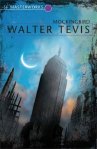
Gollancz has consistently excelled with their SF Masterworks and Fantasy Masterworks series, and the actual physical product of Mockingbird is very well done. It sports an attractive cover by Dominic Harman which really sets the tone for the grim, dark world of 25th century Manhattan. And – much like Tevis’ book – it suggests that hope may be just around the corner.

On the whole, Mockingbird is hands-down the best dystopia I have read in a very long time. It provides an emotional and philosophical gut-punch that is difficult to rival. I think this is a must-read book for anyone who loves books, who loves reading, and who loves language. In the passages where Paul discovers new words and ways of looking at his life we can find all the truths of the world.

REVIEW: The Neon Court by Kate Griffin


The Neon Court: Or the Betrayal of Matthew Swift by Kate Griffin Title: The Neon Court: Or, the Betrayal of Matthew Swift
Author: Kate Griffin
Pub Date: March 24th, 2011
Chris’ Rating (5 possible): 1 point 1 point 1 point 1 point
An Attempt at Categorization If You Like… / You Might Like…
Excellent, evocative, and innovative world-building with ambitious characterization techniques.

Like many of my favorite fantasy finds, I first came across Kate Griffin’s Matthew Swift novels while on a business trip to London. This is kind of appropriate, considering how central London is to Griffin’s impressive urban fantasies. In her third Matthew Swift novel, The Neon Court: Or, the Betrayal of Matthew Swift, Griffin continues to impress with her unique take on contemporary magic and successfully strengthens her already-impressive characterization.

I first noticed Griffin’s writing with A Madness of Angels. In that book, she created a fascinating new spin on magic by inverting traditional eldritch trappings and fundamentally modernizing them. Her underlying conceit is that sorcery is a by-product of life, and because we lead ever more urban lives today, magic, too, must grow more urban. As a result, the magic of Griffin’s London is not that of moonlit rituals and twining ivy, but instead of subway cars and swirling fast food wrappers. What makes this conceit work in A Madness of Angels, and what continues to make it work through The Neon Court, is how solidly Griffin grounds her system in the real London, and how consistently she applies her new spin on magic.

Griffin’s images of contemporary London seep through into her characters and the urban magic of her world. The incidental characters we meet along the way are appropriate to their locales. Whether we’re talking about the professional Westminster-ish Aldermen (a bunch of bureaucrats…and more), the Tribe in the deepest parts of the East End, or an Irish seer living in Mile End, the characters are all believable because every one of their aspects is rooted in place: speech patterns, clothing, behavior, values, they all ring true to their environment.

This sense of place is also inextricably woven into the magic of her world. Every metropolitan idiosyncrasy becomes grist for Griffin’s magical mill. One gets the sense that there is sorcery lurking just beneath every insignificant fragment of Griffin’s London. Consider the Oyster travel card, or London’s many tourist traps. In the hands of a lesser author, the former would just be an incidental prop used to get on or off public transit, and the latter would just be settings. But Griffin makes them all potent magical talismans. This was impressive when first developed in A Madness of Angels, but even more impressive is how Griffin continues to expand and develop her magic system as the series progresses. In each of the Matthew Swift books, she introduces us to significant new facets of London’s magical underbelly, and nearly half of the fun in reading these books is seeing what new urban wizardry Griffin’s imagination will come up with. In The Neon Court, she asks how would the traditionally rural Faerie Court evolve in the modern urban world? Other authors – notably Emma Bull in her seminal War for the Oaks – have asked this question as well, and Griffin’s spin on it (the titular “Neon Court”) is innovative, unique, and fundamentally believable.

Her characterization – and especially that of her hero/narrator, Matthew Swift – is the next most impressive aspect of this series. Swift is a fractured hero, his mind merged with that of the blue electric angels (god-like personifications of the ghosts-in-the-wire who inhabit telephone and electric wires). Depending on which aspect of his personality is in ascendance, his narration veers from the perpendicular pronoun to first person plural, and at times shifts into a disjointed stream-of-consciousness. In the earlier books, this was a daring gamble on Griffin’s part. It made Swift’s struggle to re-assemble his mind and personality vivid, but risked disorienting an inattentive reader. Griffin walked a fine line in the earlier books, but she managed to pull it off. Swift’s fractured nature is so intrinsic to the first book’s plot, that the disjointed narrative added to the storytelling overall.

By the time we get to the third book, Griffin, Swift, and the electric blue angels are all more comfortable in Swift’s head. As a result, the narrative flow of The Neon Court is smoother, with fewer sudden shifts, and where those sudden shifts do occur, they are handled more subtly than in the earlier books. In general, I find the characters in The Neon Courtto be more carefully constructed than in the earlier books. As Swift’s focus shifts from internal (putting his mind back together) to external (saving London and his friends), Griffin’s characterization of secondary players strengthens as well. I felt that the third book does a much better job characterizing supporting characters like Penny (Swift’s apprentice), Dees (Swift’s Alderman lieutenant), and even Theydon (a thrall in the Neon Court) than the earlier books did.

If there is a weakness in the Matthew Swift novels, it is that it would be hard to start with the second or third installment. In The Neon Court, Matthew Swift struggles to save London and his friends from a terrifying magical threat amidst a burgeoning factional war amongst London’s magicians. The stakes, the characters, the plot, and the world are all adequately communicated. But a reader coming fresh to this world is likely to be confused by everything that came before. Swift’s history with R.J. Bakker (established in book 1), and his role as the Midnight Mayor (which was established in The Midnight Mayor: Or, the Inauguration of Matthew Swift), for example, are all central to The Neon Court’s plot. While there are passing explanations offered in the text, the book assumes the reader is already familiar with these events. However, their ramifications would be unclear to someone coming into the series with the third book.

Despite this fact, I recommend Griffin’s Matthew Swift novels, and especially The Neon Court: Or, the Betrayal of Matthew Swift. Readers who enjoy contemporary fantasy with innovative, vivid world-building will find a lot to enjoy in these novels. They are excellent examples of urban fantasy, particularly of the non-paranormal romance variety. If you enjoy the fantasies of Neil Gaiman, Emma Bull, Jim Butcher, or Harry Connolly, I suspect you will also enjoy Kate Griffin’s books. The entire series is good, and I found that it strengthens significantly in all of the right ways as it continues.

The Desperate Horror of Suburbia: Thoughts on Shirley Jackson


A couple of months ago, I wrote about different modes of horror, and while enjoying the Library of America collection Shirley Jackson: Novels and Stories, it got me thinking about how Jackson employed (and mastered) the art of identification in her stories.

The Library of America collection, selected by Joyce Carol Oates, contains forty-nine of Jackson’s stories. Except for the previously-unpublished works, the collection effectively spans the entire twenty-year period in which Jackson wrote before her untimely death in 1965. The stories range in length from what today would be considered flash fiction (like the two-page Colloquoy) to Jackson’s short novels (including the classic The Haunting of Hill House). The book starts with Jackson’s earliest stories that were originally collected in The Lottery and Other Stories, and when I think of Shirley Jackson, these are without a doubt my favorites.

As a genre, horror has a great many tropes: moonlit streets, foggy nights, sexy gentlemen with a dark side, the unrelenting psychopath, et cetera, et cetera, et cetera. However, most of the stories that rely on these tropes tend to either utilize revulsion or dread to induce the delightful frisson of horror. For folks who look for their horror to be splatterpunk blood-fests, or for sexy vampires lurking languidly in the night, most of Shirley Jackson’s work would disappoint. The reason for that is that she utilizes every tool of the horror trade like a scalpel, and in her earliest works the tool she most relied on was identification (or realization).

Most of the stories collected in the original The Lottery and Other Stories (and which are now reprinted) have zero supernatural elements, depict no violence, and arguably lack the thriller-tension that most readers think of as horror. If it were not for the subtle manipulation of the reader’s morality, these stories would be utterly forgettable slice-of-life or Americana stories, accurate, in their representation of small-town life but insignificant as to the broader human condition. However, what makes Jackson unique in my view is the way that she can ellicit abject horror and revulsion from these utterly plebian events.

Consider Flower Garden, which on its face tracks the musings of a young Mrs. Winning, a 1940′s housewife, as she goes about her life in a small country town. She interacts with people like her neighbors, the grocer, her family. Shortly into the story, we learn that a new woman (a Mrs. MacLane) has moved into town from the city, and that she has a son of an age with Mrs. Winning’s boy. However, as the story proceeds, Jackson shows us the underside of small-town life, with its small-town prejudices. As the newcomer forms a friendship with one of the town’s few African American families, the “respectable” portion of small-town society begins to draw away. What Jackson does amazingly in this story is in the way that she portrays Mrs. Winning’s rationalization of their ostracization. Mrs. Winning isn’t guilty of any such prejudice: no, that’s only for more small-minded people. But ultimately, she adopts a similar stance to the other townsfolk and effectively isolates poor Mrs. MacLane in this new community. The story works because Jackson makes us care – deeply – about the characters, both Mrs. Winning (who we know isn’t all bad) and Mrs. MacLane (who is the victim). Jackson accomplishes this using three tools:

  • Keeping Her Point of View Character Oblivious to the Theme. This is a technique which Jackson uses frequently in the best of her stories. In Flower Garden, Mrs. Winning is completely oblivious to the prejudice that is going on around her. She notices that her relationships in town are weakened by her friendship with Mrs. MacLane, and so she begins to avoid her friend without even drawing attention to it. But when eventually she does notice it, she rationalizes it such that she never recognizes the moral choice that she has already made. Because we – the reader – are aware of this choice, our emotions are engaged and our minds focused on the theme: it’s like watching a movie where you want to shout at the heroine “Don’t go in there!” because you know something she doesn’t. Jackson elicits the same emotional response, only without the knife-wielding psychopath.
  • Employing Minutia to Ground the Reader. Jackson takes much time to show us the petty, inconsequential elements of Mrs. Winning’s daily life. Her conversation with the green grocer, the fact that she went to high school with him, her relationship with her mother-in-law: these facts have zero bearing on the primary plot. However, they lay the foundation for Jackson’s character, and for the broader community. As such, they establish the “feel” of the world Jackson paints for us. And it is a world that anyone who has lived in small-town America (even seventy years later) would instantly recognize. The reader places themselves into the nameless small-town, precisely because the prosaic details are so true-to-life and believable.
  • The Tragic Triumph of Moral Failure.When we read Flower Garden, we know what the “right” outcome should be. We know – morally, intellectually – that the community’s prejudice against Mrs. MacLane is abhorrent. However, in the end, it is their prejudices – and Mrs. MacLane’s own inverted prejudices against the small-town set – which triumph. The story ends tragically, not in the dramatic sense of everyone on stage dying, but rather in the Aristotelian sense of characters changing state from good to bad.

There is nothing to suggest that Flower Garden is a horror story: there is no violence, no fear, no physical tension of any kind. There are no ghosts or other supernatural elements. Yet it leaves the reader horrified at the underlying truth dramatized through the story’s actors. It ensures that we not only understand the author’s message but that we recognize it as an inevitable (and morally repugnant) consequence of human nature. And nowhere does Jackson come out and spell this message out for us: it is in the pauses between her characters’ thoughts, in the punctuation of her sentences, in the selection of her words. The story leaves us uneasy because it is all too easy to see ourselves in it.

Jackson applies this pattern in many of her works, and I find that it is put to best effect in her short stories. There, she evokes similar sensations of horror, disgust, revulsion, and tragic catharsis but with admirable economy. In her later novels, Jackson employed more supernatural (or ambiguously supernatural) elements, which often serve as sleight-of-hand to provide us a cozy rationalization for the real cause of our horror. Of course, even this interpretation is likely an over-simplification because even in her “supernatural” stories, Jackson leaves everything delightfully ambiguous: perhaps we need to blame our terror on ghosts and demons because the alternative – that humanity itself produces such horror – is too unsettling.

For anyone looking for an excellent author – whether a literary/mainstream author, or for one of the greatest horror writers ever to put pen to paper – I strongly recommend Shirley Jackson. Having come to her stories some sixty years after they were first published, I often wonder how my modern values affect my interpretation. I suspect, however, that the themes that Jackson addresses are universal and timeless. The foibles of humanity, the petty iniquities of small-town life, the dark secrets that lurk unspoken in our hearts: these never go away. It is easy to paint a black and white moralizing picture and say a character’s actions are morally repugnant: that does not mean those actions are unrealistic, or that they are not presented in cathartic and artistic fashion. Jackson offers no easy solutions. In fact, she doesn’t offer any solutions at all. But she raises questions that go to the heart of what we value as individuals, as a community, and as a broader society. That alone makes her worth reading. The fact that her works are fun, and unsettling, and in some cases absolutely horrifying, makes it that much better.