Skip to content

Posts from the ‘Book Reviews’ Category

REVIEW: The Half-Made World by Felix Gilman


The Half-Made World by Felix Gilman Title: The Half-Made World
Author: Felix Gilman
Pub Date: October 12, 2010
Chris’ Rating (5 possible): 1 point 1 point 1 point 1 point
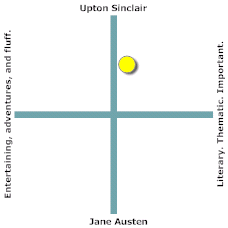
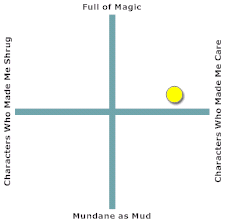
An Attempt at Categorization If You Like… / You Might Like…
Exciting, adventurous, thoughtful steampunk fantasy.

The Half-Made World by Felix Gilman is the gripping story of war on a brutal frontier. This is Gilman’s third book, after his excellent 2007 debut Thunderer and its disappointing sequel Gears of the City. Set in an entirely different universe, The Half-Made World shows that Gilman has clearly disciplined his imagination and gained a focus that had been lacking in his last novel.

If you are looking for steampunk with Victorian mannerisms and airships, look elsewhere. While it shares elements of the steampunk aesthetic, it is firmly rooted in the oily, Wild West and Sinclair’s blood-stained Chicago stockyards. For those critics who complain that steampunk never has anything important to say, I recommend they read this book. It takes place in (as the title would suggest) a half-made world, where the east is settled and established, operating along “realistic” lines. The west remains wild, and reminds me of the aboriginal Dreaming. The rules that govern it are shifting, changing, and magic (of a sort) is real. From a thematic standpoint, The Half-Made World is a serious examination of the complex and conflicting values inherent in the romantic and manifest destiny movements of the 19th century. But despite its important themes and artful writing, it is an entertaining and exciting read, striking that rare balance between adventure and literature.

Gilman’s frontier is torn apart by an unending war between the Line (railroads, trains, manifest destiny) and the Gun (guns, fatalistically doomed heroes, romance). When the book opens, it is entirely plausible that the Line and the Gun are merely the colloquial names for a set of combating ethos: symbols, and little besides. But it quickly becomes apparent that these opposing forces are in fact very real spirits or demons, who embody particular mores and values and who attract particular types of followers. The opposing cultures of Line and Gun, and the setting they create, are some of the most important characters in this book.

The story is told from three perspectives:

  • Lowry, an agent of the Line,
  • John Creedmor an agent of the Gun, and;
  • Liv Alverhuysen, a “neutral party” from the settled East swept up in the frontier conflict.

While each of the perspective characters is engaging, the Line and the Gun themselves provide the text with a foundation. Gilman’s writing is extremely tight, and the natures of the Line and the Gun come through in the little details: the methods their agents employ, the territories they control, the people who live under their rule. Even the slight shifts in narrative voice used for the different perspectives help cement the setting. The Line and the Gun are not ephemeral constructs, or religious ideologies. They are real: dirty, smelly, and intensely human forces for all of their inhuman power.

Gilman does something very difficult with his three perspective characters. Each personifies a particular ethos: Lowry is the embodiment of the Line, with all its systematic and methodical values. Creedmor embodies the Gun, with its heroic strengths and tragic weaknesses. Liv personifies a third set of values (still nascent, I would say), which seems designed to balance the Line and the Gun. To paint characters who personify abstract values well is very difficult. It is so easy for them to become caricatures of their mores. Hugo pulls it off exceptionally in Les Miserables. Ayn Rand does it well, though less-reliably than Hugo. While Gilman is not quite as powerful as Hugo, nor (thankfully) as insistent as Rand, his characters remain true to the forces they personify, as well as to their own humanity. They are flawed and identifiable, in a most beautifully human way.

The jacket, designed by Jamie Stafford-Hill and with art by Ross MacDonald, drew my eye in the bookstore, reminding me of the futuristic designs drawn by Albert Robida in the late 19th century. While I don’t think the image depicted on the cover appears at any point in the action of the book, the design is elegant and understated. It captures the spirit of the text, if not its literal action. The book opens slowly, but gathers steam after the first eighty or so pages. The prose is dense, and rich throughout, and Gilman fleshes out his principal and supporting characters gradually over the course of the book. The last third is especially well-paced, and I found myself on the edge of my seat. The perspective and writing remain crisp, and at no point does it come off the rails (no pun intended).

While on the whole this book was excellent, I was mildly disappointed in how Gilman dealt with one of the characters at its end. It is difficult to explain the details without giving anything away, but this is clearly the first book in a larger whole, and to make it self-contained, certain strands needed to be tied up. I understand that, and I understand that there were equally-good or equally-bad options for how to do so. Gilman chose one of them, and his choice is not in and of itself bad and I suspect other readers might be satisfied with it. But when I read it, I found elements of its ending to be slightly anticlimactic, almost bathetic. However, it is entirely possible that bathos was part of Gilman’s point, and while it was disappointing, I find myself waffling on whether it is a weakness or not.

The book ends poised for a continuation of the adventure, without crossing the liminal boundary into cliff-hanger. As a result, I am eagerly looking forward to the sequel. I strongly recommend The Half-Made World to anyone looking for thoughtful steampunk, or who enjoys the frontier adventures of Emma Bull (Territory) or Jeffrey Ford (The Physiognomy). If (like me) you were turned off by Gilman’s earlier Gears of the City, I’d suggest you give him another shot: The Half-Made World is incomparably stronger in every way.

REVIEW: The Dervish House by Ian McDonald


Title: The Dervish House
Author: Ian McDonald
Pub Date: July 27, 2010
Chris’ Rating (5 possible): 1 point 1 point 1 point 1 point
An Attempt at Categorization If You Like… / You Might Like…
Exceptionally well-crafted setting and utterly believable.

The Dervish House is Ian McDonald’s new novel set in a near-future Istanbul. Soaked in history, nanotechnology, and McDonald’s always-amazing settings, this book is arguably one of the best science fiction titles I’ve read this year.

I have loved “traveling” with McDonald since I first picked up River of Gods, his 2004 novel set in a near-future India. Following that book, he has carved a very nice niche for himself by setting his novels in somewhat unusual (read: non-American/British) settings. Chaga (published in the US as Evolution’s Shore) took us to Kenya, River of Gods took us to India, Brasyl took us to (surprise!) Brazil, and now The Dervish House brings us to Istanbul.

Setting has always been central to McDonald’s works (even in his earliest novels like the harsh yet beautiful Desolation Road). I’ve traveled a lot in my life, but I’d never visited India, Brazil, or Kenya. So when I read his earlier books, the settings were lush and fascinating to me, but still alien. But Istanbul, I’m familiar with. I lived in Europe for ten years and spent quite some time in Turkey on business, so for the first time I was able to read a McDonald book with pre-existing familiarity with the setting and culture. And as far as I can tell, McDonald nails it.

Istanbul has always been a crossroads of commerce, history and religion. Today, it’s at the heart of a maelstrom of geopolitics, religious debate, and energy economics. McDonald captures that intersection and projects outwards from it, taking us to a Turkey that just-recently joined the European Union and still struggles with its identity as a nation, its religious history, its place in the region, and its internal politics (generals vs. intelligentsia vs. religious fundamentalists of various types). His Istanbul is recognizable to anyone who has even spent a day in that city, capturing the Byzantine streets and the culture of a city that straddles two continents. A writer of lesser skill would have simplified the reality, perhaps skimped on the economics or drawn caricatures of the complex cultures that intertwine in the city. But McDonald doesn’t. He balances the different interests and cultural backgrounds of his characters deftly, showcasing a nation that waking up to its dreaming potential.

The book follows the lives of six characters who live in an old building that long ago had belonged to or been involved with an ascetic Sufi fraternity. The dervish house is the hub, the connecting strand that joins together the six characters in this story. The events of the book unfold starting with a suicide bombing, and how it affects – directly and indirectly – the lives of the people who live in the tekke (dervish house). The story is told from the perspectives of each:

  • An academic economist forced into retirement,
  • A nine-year old boy with a dangerous heart condition,
  • A rural young woman determined to make it as a professional in the big city,
  • An ambitious young woman who runs a religious art gallery,
  • A ruthless energy trader, and;
  • A troubled, screw-up caught up in the development of street sharia.

Their lives are tied to together by the tekke, by the suicide bombing several blocks away, and by a near-mythical relic from Istanbul’s past. Each character is painstakingly crafted. Their voices are distinct, their judgments and values a clear outgrowth of their background. These characters have depth, and plainly show McDonald’s careful research into some of the more esoteric branches of market theory, contemporary futures contracts, and obscure kabbalistic sects. This research gives this book its lush, rich texture and bring the characters and setting alive.

The intersecting character arcs are exceptionally well done, and they are at once the book’s primary strength and its greatest weakness. In fact, that’s the only reason why I’m giving this book four stars instead of five: I feel like I have seen this device used before. When I think about McDonald’s works, the ones that instantly come to mind are Desolation Road, its sequel Ares Express, and River of Gods. Each of these books relies on the same narrative structure: different characters whose lives intersect through one (or a handful) of locations. McDonald does this better than anyone I can think of just now. But I’d like to see him stretch more, maybe try some different structures out. It would be nice to see, because having read most of his work I find that I know how it will flow. I can’t predict the events of the plot, but I can predict its cadences and rhythms. It’s like listening to a new symphony by a beloved composer: you can just tell how the music will swell next, even if you’ve never heard it. Much as I enjoy McDonald’s symphonies, I’d like to be surprised.

The physical book itself is great. Pyr did an excellent job with the hardcover, designed by Jacqueline Nasso Cooke and with a cover illustration by Stephan Martiniere. The cover illustration sets the tone for the whole work, showing the crowded streets of 2027 Istanbul, the combination of history (old buildings, traditional clothes) and uber-modernity (neon advertisements, robots, etc.). That cover image captures the mixing pot that is Istanbul, and captures the intersections of its residents lives just as well as the text. Martiniere’s covers and McDonald’s prose are a great pairing, and I’m glad to see that Pyr has maintained that connection through all of McDonald’s books they have published. Great job with that, and I hope they maintain it since I think that combination is just getting better and better.

This is not a rip-through-it-in-one-night, page-turning adventure. It has its moments of high tension and danger, but this is the kind of book that you want to enjoy over the course of several nights. This prose should be savored. If you have had your fill of anglophone settings and cultures in your science fiction, you should pick this up. If you are interested in high-quality literary fiction that just happens to be set in the future, pick this up. I think this is one of McDonald’s better works, and I definitely enjoyed the trip he took me on. If you find that you like this, there’s a variety of other great science fiction set outside of the American/British cultural background that you might enjoy, most notably the books by George Alec Effinger and Lucius Shepard‘s Life During Wartime.

REVIEW: Dreadnought by Cherie Priest


Dreadnought by Cherie Priest Title: Dreadnought
Author: Cherie Priest
Pub Date: September 28, 2010
Chris’ Rating (5 possible): 1 point 1 point 1 point 1 point 1 point
An Attempt at Categorization If You Like… / You Might Like…
Exciting steampunk set in an alternate nineteenth century America.

Dreadnought by Cherie Priest is an excellent steampunk novel set in an alternate 19th century America: replete with airships, trains, walking war machines, and zombies; what more could you ask? While set in the same universe as her 2009 Boneshaker, Dreadnought is a standalone novel and can certainly be enjoyed without having read Boneshaker.

I’ve been a fan of Priest’s since she knocked the ball out of the park with her Hugo-and-Nebula-nominated Boneshaker in 2009. Boneshaker introduced me to her “Clockwork Century,” a nineteenth century United States where the Civil War has gone on for twenty years. The characters, the pacing, and the writing of that book sucked me in and left me thinking about it months after I’d read it and so I was eagerly looking forward to Dreadnought. Thankfully, Priest did not disappoint.

Dreadnought follows Venita “Mercy” Lynch, a southern nurse working at a military hospital in Virginia as she travels across the country to see her estranged father in Seattle. Her trip takes us down the front lines of the Civil War and across the frontier. Mercy is just passing through all of the places she visits, and we’re just passing through with her. As a result, Dreadnought is understandably not as grounded in place as Boneshaker was. But Mercy focuses her attention on the people she encounters during her trip, and this performs two admirable tricks: it grounds the book in time, and it instantly makes us care about our hero.

The characters and the voice are the best part of this book: they are what kept me turning pages on the edge of my seat. While written in close-perspective third person, I felt like I was reading a first-person book. The details mentioned in the prose observations and the cadence of individual sentences cemented me in Mercy’s head. Priest admirably avoids typographic sleight-of-hand (which I usually find annoying as all hell) to establish her characters as “southern” or “western” or “Mexican”: her dialog is generally written in clear, understandable English. But the way she constructs her sentences gives each character and even the third-person narrator a distinct “flavor” that establishes them in time and place. Even the narrator spoke in my head with a slight southern accent, the kind one might hear from northern Virginia. Throughout Dreadnought’s 400 pages, there was only one (exactly one!) sentence that rang off-true and knocked me out of Mercy’s head. The rarity of such a misstep is a testament to the skill with which Priest draws her characters and grounds them in her fictionalized history.

Fans of alternate history might want to take Priest’s fictional history with a grain of salt: this is not a Harry Turtledove alternate history that painstakingly considers actual history and how it might have played out differently. Instead, Priest makes a sweeping conceit and uses it to buttress a fantasy world. In this, her work is closer to Emma Bull’s Territory or Patricia C. Wrede’s Frontier Magic than to Harry Turtledove’s Timeline-191.

Nonetheless, the book is heavily informed by Civil War history. In her acknowledgments, Priest mentions using the Louisa May Alcott letters to research her fictional Civil War hospital and this homework shows: the opening chapters bring to mind Walt Whitman’s Memoranda During the War, with all of the pain and hardship of nineteenth century medical care. If the facts of history are altered, the basic feeling, lifestyles, and value systems are consistent with what I have read about late nineteenth century America. This firmly establishes Dreadnought in time, making Priest’s “alternate USA” plausible.

“Classic” steampunk motifs – airships, steam/diesel-powered “walkers”, trains – are rendered believably: Mercy is ignorant of much of the mechanics, but she is forced to deal with them and we learn about them along with her. These devices struck me as more prevalent in Dreadnought than they were in Boneshaker, but as methods-of-conveyance they played a more central role to the story so it makes sense.

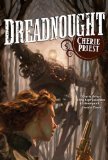
If there is anything to criticize in this book, it is not the author’s fault. If you buy this book and want to avoid spoilers, avoid the back cover copy. I made the mistake of reading it, and was given a very neat little synopsis of the first 65% of the book. Thank you for that, but I’d rather read the book: next time, just “vague it up” a bit, please. Barring this (minor) complaint, the rest of the book’s design is superb: excellent cover art by Jon Foster (who also did the cover for Boneshaker), and a brilliant sepia ink really make the book an attractive object in its own right.

Dreadnought is an improvement over the already-excellent Boneshaker. It is a simpler story, but that simplicity gives us greater richness. I thought Boneshaker was a good example of steampunk being the new gothic, and Dreadnought continues this tradition. It feels less Gothic, but that is due to its lack of a solitary villain and its persistent sense of motion (which isn’t really surprising in a travel story).

This book is tremendously fun to read. It is exciting, the characters engaging and the monsters scary. If you like zombies and the steampunk aesthetic, you will love this book.

REVIEW: Under Heaven by Guy Gavriel Kay


Title: Under Heaven
Author: Guy Gavriel Kay
Pub Date: April 27, 2010
Chris’ Rating (5 possible): 1 point 1 point 1 point 1 point
An Attempt at Categorization If You Like… / You Might Like…
Fairly literary, slight fantasy and probably appropriate for young adult and up.

Under Heaven is a very good fantasy, heavily-inspired by 9th century (T’ang Dynasty) China. Its plot is solid, interesting, and the pacing moves well. The characters are complex, richly drawn and wrestle through questions of loyalty to family, self, and country. The setting is painstakingly crafted, and easily one of the most compelling elements of the story: for me, half of the fun lies in puzzling out what “real” things have been co-opted into Kay’s analog world.

I loved Kay’s earlier works, especially other history-based fantasies like A Song for Arbonne or The Lions of al-Rassan, until I abandoned the Sarantine Mosaic half-way through the second book (I rarely do this). I found that his Byzantium-inspired series moved very slowly with a plethora of uninteresting characters. Since then, I had avoided his work until picking up Under Heaven in a Boston bookstore. The cover drew my eye, and I thought “I might as well give him another shot.”

I’m very glad that I did.

You will like this book if you enjoy other well-written fantasies set in well-researched historical settings/cultures. Consider looking into books like On Stranger Tides by Tim Powers (pirates + magic, carefully researched), Latro in the Mist by Gene Wolfe (ancient Greece), or Liam Hearn’s Tales of the Otori series.

If you’re looking for more of a China fix and you enjoyed Under Heaven, then I can strongly recommend Barry Hughart’s Bridge of Birds: A Novel of an Ancient China That Never Was.

Under Heaven follows Shen Tai, the second son of a respected general. When we meet Shen Tai, he is nearing the end of an obligatory two years in mourning for his father. He has been living in a remote mountain valley, site of one of his father’s greatest battles, quietly burying the bones of the thousands who died there. For his piety, he receives a gift worthy of an emperor: two-hundred fifty Sardian (Persian) horses. Considering that a handful of these horse is a princely gift, two hundred fifty represent unheard of riches. This unwanted bargaining chip thrusts him into the dynastic politics of Kitai, and makes him the target of assassins, military governors, and civil servants vying for control of the nation’s wealth and future.

The story is told in close third-person, primarily from Shen Tai’s perspective. The writing is crisp and the insight into Shen Tai’s own thought processes gives us a delightful glimpse into his character. Practically from the first page, I found myself caring about Shen Tai and wanting to see how things worked out for him. Excellent job.

However, there was one weakness that made me give this book four stars rather than five. At the end of the book, I felt like there was little character growth on the part of Shen Tai. Generally the Shen Tai at the end of the book was pretty similar to the Shen Tai at the start of the book. There was some growth, don’t get me wrong: just less than I would have hoped for. Other characters change – often significantly – but our hero stays steady. That’s not necessarily a bad thing: I stayed engaged in the book and continued to care deeply about the hero because I still liked him. But some more evolution would have been nice.

I had only one stylistic quibble throughout the book. I admit, it’s a quibble: it might just be me. But Kay chose to write the narrative told from Shen Tai’s perspective in past tense, and side-plots told from women’s perspectives in present tense. I don’t know why. Just to differentiate them? I think the voices were distinct enough without that, and I found the tense shift jarring when first encountered (I thought it was a typo). This might just be my idiosyncrasy, but it did stand out as I was reading the book.

On the whole, I’m very pleased that I picked this book up. Kay’s writing style and technique are great, and the pacing is flawless. I was turning pages well into the night, and recommend this book for any lover of history.

The Secret to Great YA Science Fiction & Fantasy Characters


The other week, my girlfriend brought Suzanne Collins’ Mockingjay home from work. I did what any reasonable fan would: I grabbed it out of her hands and locked myself in the family room to read it cover to cover in one sitting. Needless to say, I love Collins’ dystopian future, her characters, themes, the whole gripping plot. I think Mockingjay is the best YA science fiction published in the last several years. But this begs the question: why? What makes the Hunger Games series so good, when other “giants” of epic YA failed to grip me?
Read more