Skip to content

Posts from the ‘Genre Observations’ Category

Techniques in Writing Alternate History


For the past several months, I’ve been having a lot of fun reading recent alternate histories and historical fantasies (I’ve reviewed a couple in earlier posts). As a result, I’ve been thinking about how alternate history works, and what techniques apply to the sub-genre.

Divergence as the Elephant in the Room

At some point, all of us wonder about the road not taken. In our private lives, we wonder how life would have turned out if we’d gone to college B rather than college A, if we’d gotten (or kept) a particular job, etc. The same “what if” question gives rise to alternate history, where we try to imagine our world as made different. Whether the portrayal is fairly realistic (as in Harry Turtledove’s Timeline 191) or completely fantastical (e.g. Jonathon Stroud’s Bartimaeus trilogy), alternate history gives us the chance to consider what our world would be like in entirely different circumstances. And that’s fun, because it can give us insight into our own world, culture, and history today.

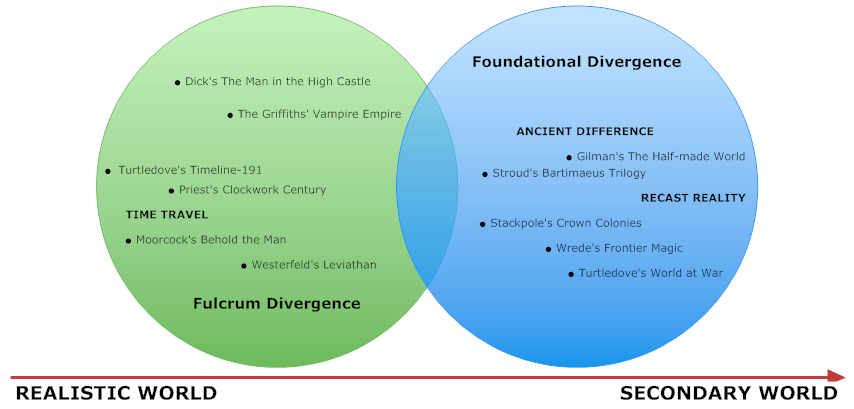
Because alternate history is so centrally concerned with what sets the imagined reality apart from our current reality, how the timeline diverges must be established very early on. Thinking about it, I’ve spotted a kind of spectrum of divergence in alternate history:

Spectrum of Divergence Techniques in Alternate History

Spectrum of Divergence Techniques in Alternate History

On the one hand, we have what I call fulcrum divergences. This method is most commonly found in “realistic” alternate histories, which lack magic, monsters, or really anything that could not exist in the real world. Some event is identified as a fulcrum on which history swings, and when creating the story we have things work out differently.

The best example I can think of for this type of alternate history has to be Harry Turtledove’s How Few Remain. In our real history, a Confederate messenger lost General Lee’s plans for the invasion of the North. The Union found the plans, and General McLellan was able to turn the Confederates back at the Battle of Antietam. Turtledove asks “what if the message never fell into Union hands?” and proceeds to create an excellent series of realistic novels that paint a Confederate victory and map out the consequences through World War II. Such “little differences” need not be so minor, however: Philip K. Dick posited a world where the Axis Powers won WWII in his classic The Man in the High Castle, nor need the resulting world be particularly realistic (consider Scott Westerfeld’s Leviathan series, where Darwin discovers DNA). Even fairly fantastical stories like Clay and Susan Griffith’s Vampire Empire series still rely on that one point where history changed. Universal within these stories is that the world’s history follows the familiar path we should all know up to that one key fulcrum moment when it skews Doc Brown-like into an alternate timeline.

The other end of the spectrum are foundational divergences. Typically used in more fantastical alternate histories, foundational divergence occurs so far back in the story’s timeline that its effects percolate through all aspects of the world. The place names, some of the personalities involved may be familiar to us, but they are already skewed relative to our timeline based on events that happened significantly prior to the events of the story.

In Stroud’s Bartimaeus trilogy, Patricia C. Wrede’s Frontier Magic series, or Michael A. Stackpole’s At the Queen’s Command magic has been known and applied within the world for centuries. There is no “point of divergence” with our known history, because instead the impacts of magic diffuse throughout all aspects of society, history, and cultural development. The key difference between such alternate histories and those relying on fulcrum divergence is that all recorded history has to be different from what is known. In these books, the foundational difference (e.g. the presence of magic) occurred or was discovered so far in antiquity that its consequences have percolated throughout the world. As a result, such books can often be enjoyed as secondary-world fantasies.

Between these two poles lie a variety of techniques that authors can use to establish that divergence. Often, authors use a time traveler from our timeline to introduce the divergence. Once in the past, the time traveler proceeds to change (or – sometimes not) the past as we know it.

Excellent examples of this kind of alternate history include books like Eric Flint’s 1632, Michael Moorcock’s Behold the Man and Mary Gentle’s First History sequence. In many respects, these books are similar to those that use a fulcrum divergence: in this case, the time traveler becomes the fulcrum. However, they differ significantly in that typically the protagonist (the time traveler) is aware of the divergence or its possibility. This changes the dynamic of the story and significantly alters the reader’s relationship with the hero.

On the opposite end of the spectrum, one can have an “alternate history” that completely recasts our known reality, which does not take place in any kind of recognizable version of our history. Here, the events of the book are modeled on actual events in our history, but they are depicted in a completely secondary world.

Turtledove’s World at War series employs this technique, depicting the events of WWII in a completely secondary world. Felix Gilman’s The Half-Made World (see my earlier review) similarly (though less historically) models aspects of his world on the American frontier.

Maintaining Suspension of Disbelief in Alternate Histories

The key to constructing an effective alternate history is to keep the reader locked in what Gardner calls the “dream” of the novel. This task is particularly challenging in alternate histories, where the reader knows they are reading something inimical to their pre-existing knowledge of the world. As a result, readers are likely to quickly pounce on perceived flaws, places where the author’s research or techniques fell short. There are several tools that can be used to maintain the reader’s acceptance of the alternate history.

The perspective that the book is written from, and the narrative voice that is employed, are both essential tools to maintain the reader’s disbelief. This is doubly-so if the book is written in first-person, but even when written in third the speech patterns, word choices, and value systems that our narrator employs contribute to the milieu of the era we are depicting. Recently, I read two alternate histories that execute on this aspect perfectly: Cherie Priest’s Dreadnought and Michael A. Stackpole’s At the Queen’s Command (see my earlier reviews here and here, respectively).

In both books, the narrative voice and the dialog employed by the characters rings (at least to my ear) true to the period when the books are set. The words key characters employ, the value systems inherent in their views, the differences in how different characters speak, in both books the quality of voice and dialog help to lock the reader into the alternate history. In At the Queen’s Command, the dialog is strongly reminiscent of other accounts of the late 18th century. As a result, I am able to believe that while there may be magic, I am still reading a story set in the 18th century I am familiar with. The same applies to Dreadnought, which follows a southern Confederate nurse across the frontier.

Nailing the voice like this is partly a question of the writer’s natural ear, but it is also heavily influenced by research. Reading books written in and written about the time period can help provide the “feel” of that time period. And solid research on word use and etymology can help make sure that the dialog is period-appropriate (as Mary Robinette Kowal pointed out recently, people swore differently even one hundred years ago). Research and extensive reading are the keys to nailing this aspect of an alternate history.

But there is a flip side to this coin: When we write alternate histories (or even historical fantasies) there is an understandable temptation to shoe-horn massive amounts of research into the text. After all, not everyone is as familiar with the time period as the author. But this natural tendency has to be handled very delicately because people who enjoy alternate histories are likely those who enjoy history. As a result, they are likely to already have substantial knowledge about history, and thus overloading them with historical information may weaken their engagement with the story.

In historical fantasy, this is a danger that I recently observed in Jasper Kent’s otherwise excellent Twelve. Kent clearly knows the history of 19th century Russia, however in many places he assumes that his readers do not. For some readers, this is likely not a problem. But for those of us who are familiar with that time period, the extensive expository background that Kent provides detracts from the rising action of the story. Striking a balance between that need for background and the forward motion of the story is key to writing any story based in history. When I think about the authors who do this well, they apply the rule of “less is more” and leave the reader to infer whatever background they do not already know. If we have to pick between momentum and background, I say always go for momentum.

Imagining a Different Today

If futuristic science fiction is about imagining a possible tomorrow, then alternate histories are about imagining a possible present. This at once constrains our world-building (to a greater or lesser degree, we have to conform to known history) while providing the opportunity for very focused imagination. When I read excellent alternate histories, I often think that it is much harder to paint a maserpiece by coloring within the lines. But the best authors of alternate history manage to do exactly that.

If you’re looking for fun alternate histories, below is a list of the authors and books that I’ve mentioned in this post. I strongly recommend you pick up a copy, from your local bookstore or your library and enjoy:

Where are America’s science fiction, fantasy, and horror specialist retailers?


I spent last week in London on business. I love London, even in chilly, misty, drizzly January. One of the reasons why is because it is home to Forbidden Planet, the world’s largest and (to the best of my knowledge) only chain (though technically a pair of chains – see update below) retailer specializing in science fiction, fantasy, and horror products. The London megastore sits on two floors, stocked to the gills with action figures, comic books, graphic novels, trade and mass-market books, and DVDs: if it is genre, odds are you can find it there. Split between two somewhat-related separate companies (Forbidden Planet and Forbidden Planet International), the Forbidden Planet brand name offers twenty-five different locations in the United Kingdom. If the United Kingdom – home to sixty two million souls – can support twenty five chain outlets, why can’t the US – with five times the population – do the same?

UPDATE: Just a word of clarification since the above might not be clear: Forbidden Planet and Forbidden Planet International are in fact two separate companies. The former has nine stores in the UK, while the latter has thirteen branded outlets in the UK, one in Ireland, one in New York, and two other associated (though not branded) stores in the UK. While the two were related in the past (per Wikipedia), they are now operated as two completely independent companies. However, this fact does nothing to detract from the main point of this post: where are our genre chains in the United States?

Both countries have their share of general media retailers: the United States is home to Borders, Barnes & Noble, and Best Buy. The United Kingdom is home to W.H. Smith and Waterstone’s. Despite the ever-present moans of indie media outlets (whether booksellers or comic book shops), both have reasonably vibrant indie communities. I find it unlikely that the UK has a larger number of genre fans as a percentage of the population than the United States. If that were the case, then the UK would host a far greater number of genre publications (pro, small-press, and amateur) than it does.

Forbidden Planet (at least the London megastore, which admittedly may not be a representative sample) knows the genre business far better than its more general counterparts. The store is clearly divided by product type. Action figures, novelty items, and gaming are in one area. Anime, graphic novels, comic books, and regular books are in another. The book section is impressively stocked and organized along broad genre lines. Each section is consistently sub-divided, with its own “New Releases”, a “Chart” section where top-sellers are shown face-out with shelf talkers, and a general stock alphabetically arranged by author. This structure makes navigating the shelves a downright pleasure. Identifying what is new, and spotting what is performing well within a given category is very easy – whether you’re familiar with the genre or not.

This type of organizational scheme would be unimaginable at a general retailer. However, it is not a product of the stocking teams’ deep knowledge of the genre. Instead, it is the product of solid operational management. While visiting the store on a Tuesday mid-afternoon, I got to watch shelves being re-stocked. The stocking teams used netbook computers with bar code scanners to control inventory and shelf placement. This makes it possible for even new employees without genre familiarity to stock shelves properly. Forbidden Planet earns a gold star in shelf management in my book, especially when compared to recent experiences at (the admittedly beleaguered) Borders.

Several weeks ago, I was looking for a copy of Scott McCloud’s Understanding Comics: The Invisible Art. I went online, and the Borders web site told me that it was “likely in store” at my local retailer. I drove on over, and proceeded to check the in-store computer. It told me to check in the graphic novel section, where I was patently unable to identify any organizational method. Seeking help from an employee, I was told that it was in fact in stock, and that it would be in the criticism section. Of course, it was not. I checked with a different employee, and was told it would be in with the art books. And of course, it was not. Contrast this ordeal with the simple process of stopping by Forbidden Planet, wandering through the graphic novel section, and finding it precisely in the “M” section of independent graphic novels. I would expect to find this title in both stores, but the operational management of Forbidden Planet left me a satisfied customer while Borders failed me.

The United States has its share of specialist booksellers. Whether it is Borderlands Books in San Francisco, or Pandemonium Books and Games in Cambridge, Massachusetts, many offer a fine selection and deep understanding of genre style and history. However, as a general rule these bookstores are independent one-location operations. This is not a criticism, merely an observation. With so many genre fans in the US, perhaps we, too, could support a chain of specialist media stores like Forbidden Planet? Economies of scale would help with profitability (the interminable lament of the indie bookseller), while technology would make operations and quality-control easier across a network of locations. On an early Tuesday afternoon, the London store was reasonably full of shoppers and needed two cashiers to service the line of customers waiting to buy. Why doesn’t America have something comparable?

Writing an Episodic Genre Series (part 3 of 3): The Hero’s Emotional Journey


NOTE! This is the third installment in a three-part series on writing episodic genre series. This post will focus on using the hero’s emotional arc to link the standalone installments in the episodic series. The previous two posts focused on the episodic hero, and the episodic plot respectively.

This past week, I have been writing about episodic series in science fiction and fantasy. While the episodic hero is central to any episodic series, and while each book in such a series relies on a solid episodic plot to keep the reader turning pages, it is the hero’s emotional journey which keeps the reader buying new books in the series.

Each Book as a Step on the Emotional Path

Plot can keep an episodic book going, but plot alone will not carry a series. If the reader is to buy the next book, they have to care about the hero. If the hero does not evolve over the course of the series, if the hero doesn’t change or grow due to the choices made, then readers will quickly stop caring.

This is harder to do in a long-term episodic series than one might think. For one thing, the seeds of that character growth should show up early on. The defining characteristics of the hero’s personality, of their values, and of their emotional journey should already be there in book one. At the close of each book, the hero should have taken at least one (or more) steps on their emotional journey.

Ray Lilly’s journey in Game of Cages shows a good example of the hero having to come to terms with the reprehensible acts he might commit in the name of the greater good. Lilly’s squeamishness and his innate goodness are traits established early on in book one, and the hardening that occurs in book two was foreshadowed (predicted) by more experienced characters (his employer) in the first book. The fact that Connolly follows through with this hardening, and that this toughening becomes a key emotional facet of book two speaks well to both the author’s skill and to the overall emotional journey that the series will take.

Heroes Stumbling on the Emotional Journey

But that journey need not be a stately progression. Heroes can step forward, step backward, step sideways. Like real people, they can make mistakes and it is concern over those mistakes that can keep readers engaged. Within the confines of any single book, the direction of their evolution is immaterial. Heroes are allowed to make the wrong judgment call as much as we are. What matters is that in each book their character does change in some way, that the character’s state at the end of the book is clear, and that at the opening of the next book that state is maintained. This helps to make the books flow together, and leaves the reader satisfied with the overall series. If the character isn’t changed by their experiences, the series will quickly start to ring flat and eventually readers will just tune out.

One method that is frequently used is to introduce the hero’s personal life as a sub-plot that spans the series. Harry Dresden’s relationship with his mother, his fairy godmother, his half-brother, and other family members (including new ones that show up later in the series) becomes an evolving sub-plot that spans the books. This emotional sub-plot weaves into the fabric of the superficial plots, contributing to the more action-oriented conflicts that Harry has with various factions in his magical world.

In some books, relationships like these are tangential to the direct action of the plot. But they provide the hero with an emotional tension and concerns outside of the direct challenge in front of him. These relationships and the emotions they evoke in the hero and reader represent “the other shoe” that the reader knows will drop at some point.

Relationship between Emotional Arc and The Plot

Such emotional arcs can either be used tactically (to modify pacing, to foreshadow events for a future book, etc.) or they can be used thematically. The Sookie Stackhouse novels painstakingly explore themes of Sookie’s relationships with lovers, family, friends, society, etc. In a very real sense, this exploration is central to the entire series. However, this emotional arc should be separate from the plot arc of the story. And just as series plotting can become formulaic, so too can the emotional journey.

To a great extent, they’re like the double helix of an episodic series’ DNA: they move in parallel, but they rarely cross. In those instances where they do cross – namely when the emotional aspect of a relationship from one book becomes the plot engine for another – then it is best to have another emotional strand waiting in the wings to be introduced. If a particular book is such an emotional intersection, then the strand in waiting need not be introduced or focused on: doing so risks trying to pack too much into what should be a tightly-plotted, fast-paced book. But the seeds for that strand in waiting should be planted, such that they can be further developed or focused on in the next book.

The Denouement: Leaving the Reader Eager for More

I have always found the conclusion to an episodic series book to be absolutely critical to maintaining my interest in the subsequent books. The hero concludes the adventure, the monster is slain, and now it’s time for some well-earned rest. In an episodic series especially, the denouement sets the stage for the next book. It sums up the emotional changes that the character underwent as a consequence of their adventures. Because editors like to have episodic series published annually (keep those reprints rolling!), odds are the author is already aware of what the next book will bring. The denouement offers an excellent opportunity to plant the seeds without leaving the dreaded cliff-hanger ending.

It’s hard to get right, and it is especially hard to get right consistently across multiple books. An impression I get is that much episodic fiction tends to skimp on the denouement: the action is over, so the book just ends. While an abrupt denouement may work for some readers, I think it weakens the ties between books in the series.

If the denouement is an outgrowth of the hero’s emotional journey, it should effectively outline (or at least hint at) the starting conditions for the next installment’s emotional journey. If written well, it can also hint at the stakes of the next installment’s emotional arc as well, although this runs the risk of a cliff-hanger ending. A good example of an artfully-handled denouement can be found in Brust‘s Teckla. To avoid spoilers, I won’t go into what happens or how he handles the denouement, but it manages to avoid abruptness, provides closure for the plot, but leaves enough unresolved emotional strands that the door is open for future emotional evolution…which the author addresses in subsequent books. The end result is that the end of the first book increases our emotional investment in the hero, and makes us want to learn what happens to him in the next book.

Conclusion

There are critics inside and outside of the science fiction and fantasy community who tend to view episodic series as less worthy. Episodic series generally don’t win the Hugos, the Nebulas, or the World Fantasy Awards. But they do sell. And they sell a lot. Many episodic series regularly find themselves at the top of bestseller lists, whether we’re talking about Locus, or even The New York Times.

Many readers get their first and only exposure to genre from such episodic series. Consider the countless people who would never wander into the “horror” or “fantasy” aisles at their local bookstore, but who love Sookie Stackhouse. As a result, these episodic series are a powerful missionary force for the genre. They extend genre reading protocols across a broader audience, and they provide adults and children with plenty of enriching entertainment. While they may eschew lyrical prose styles and experimentation, I suggest that is not necessarily a bad thing. After all, the more people read any type of genre fiction the stronger the genre becomes. And if we look to our own history, who do we remember? We remember the episodic heroes: Sherlock Holmes, Miss Marple, Nero Wolfe, James Bond.

An Attempt at an Absolutely Non-exhaustive Episodic Reading List

Sub-genre Author Series First Book
Adult Urban Fantasy Jim Butcher The Dresden Files Storm Front
Adult Urban Fantasy Harry Connolly Twenty Palaces Child of Fire
Adult Urban Fantasy Kate Griffen The Mattew Swift Novels A Madness of Angels
Paranormal Romance Laurell K. Hamilton Anita Blake series Guilty Pleasures
Paranormal Romance Charlaine Harris Sookie Stackhouse Novels Dead Until Dark
Paranormal Romance Kim Harrison Rachel Morgan series Dead Witch Walking
Adult Fantasy / SF Steven Brust Vlad Taltos Novels Teckla
Adult Fantasy / SF Richard K. Morgan Takeshi Kovacs series Altered Carbon
YA / Middle-grade (various) The 39 Clues The Maze of Bones
YA / Middle-grade Eoin Colfer Artemis Fowl Artemis Fowl

Writing an Episodic Genre Series (part 2 of 3): Episodic Plots and Pacing


NOTE! This is the second in a three-part series on writing episodic genre series. The previous installment discussed the episodic hero, while the third installment (planned for Tuesday) will focus on the hero’s emotional journey.

This past Tuesday, I wrote about how episodic heroes are constructed in contemporary science fiction and fantasy series. While an episodic series relies on that hero, it is each individual book’s plot that keeps the reader turning pages. A good episodic plot will avoid formulaic writing, while providing an escalation in tension so that the reader keeps turning pages. The key to this is to establish momentum, and as the series progresses to vary the structure of each book’s plot. This keeps the reader interested in the book they’re holding in their hands right now, while the hero’s emotional journey (discussed in the next installment) keeps them buying the next book.

Pacing: Hitting the Ground Running

By leaving the character’s backstory off-stage, episodic books typically open with the hero actively starting the adventure. This is a page taken right out of the detective novel playbook. When we first meet Laurell K. Hamilton’s Anita Blake, we find her turning down work from a shadowy vampire organization. We first encounter Ray Lilly traveling to his latest case, or Harry Dresden getting a job. Episodic series sprinkle the hero’s backstory here and there, but no time is wasted by delving narrative-style into the hero’s psyche or providing an infodump on “what-came-before”. Episodic series hit the ground running, and they tend not to let up until the mystery is solved, the monster is slain, and the hero can put his feet up.

Middle-grade novels especially establish the stakes early on (often on the first page!). I strongly recommend reading middle-grade episodic novels (like The 39 Clues series) to find some tricks on how to establish stakes and simultaneously establish the hero’s characterization. From conversations I’ve had with children’s book editors, the speed with which readers are drawn into the story is one of the most important characteristics they look for. Adult episodic series, with their tendency towards functional prose and page-turner status, can learn much from the pacing techniques used by children’s authors.

The Shape and Structure of Episodic Plots

Most episodic series rely on mysteries for their plot structure. Many employ the classic mystery plot: clear identification of the mystery, broadening suspicion, a sub-plot intrinsic to the hero’s emotional arc, discovery that the hero has been on the wrong track, re-focusing of the hero on the right track, explanation, climax and denouement. This type of plot may seem a bit cliched, but the practical reality is that if it worked for Agatha Christie, it’ll work for people writing today. The originality and inventiveness of the individual authors shines through in how they flesh out these bones to create their books.

Urban fantasy series like The Dresden Files or the Twenty Palaces novels rely on a combination of characterization and world-building to enrich their basic plots. Paranormal romances like the Sookie Stackhouse novels or the later Anita Blake, Vampire Hunter books combine mystery plotting with the techniques of romance. Episodic adventure series like Artemis Fowl or Vlad Taltos invert traditional tropes (criminal vs sleuth, commit a crime vs solve a crime).

The Sense of Escalation

As the series progresses, building a sense of escalation becomes critical. Think of it this way: if the hero saves the universe in book one, what’s he going to do in book two? Many episodic series avoid this pitfall by focusing the plot on rather narrow concerns: if an epic hero saves the world, an episodic hero is more likely to save an individual. By keeping the scope focused, it makes it easier to escalate the stakes as the series progresses.

With her experience writing children’s books, Kate Griffen does an excellent job escalating the stakes across her Matthew Swift novels. In the initial installment (A Madness of Angels) Matthew Swift is focused first and foremost on his own survival. He is looking out for Number 1, and if others get swept up in his fight for survival that is their problem. In the second book (The Midnight Mayor) Swift has the (magical) mayoralty of London dumped in his lap, and he must deal with the consequences. At stake is the entire city of London and England itself.

Connolly uses a similar tactic to equally good effect: in the first Twenty Palaces novel (Child of Fire), the primary stakes are the hero’s life. Sure, there’s a town involved but Ray Lilly is focused on his own survival. In the second book (Game of Cages), his focus shifts to that of the town where a ravenous predator has escaped. What makes Connolly’s execution so strong is the unity he achieves between the explicit escalation of the stakes in the plot, and the escalating tension/stakes on Ray Lilly’s emotional journey (more on this in the next installment).

This kind of thematic and tactical escalation across books in the series can also tie into the character’s experiential growth: if the inexperienced hero can do something, it stands to reason that as their capabilities and understanding grow, so too will the stakes they fight for. The Harry Potter novels, themselves straddling the fence between epic and episodic, manage this experiential escalation very well.

The Danger of Formula and Using a Change-Up to Avoid It

The danger in all of this is that a plot model that works for the first, second, and third book in the series may seem formulaic and dull by the fourth, and fifth book in the same series. This is a point where the best episodic writers introduce what I call a “change-up”, a device which imbalances the hero’s routine and changes the plot structure of the books.

Different authors employ different change-ups: Steven Brust took away Vlad Taltos’ fortune, profession, and family by the fifth book. Jim Butcher introduces varying changes into Harry Dresden’s personal life (roommates, family members, etc.) while weaving strands for a super-plot that ties into Harry’s backstory and extends across the series.

By introducing such new elements, or by subverting the formulas employed in the earlier books, the plots can remain fresh for long-time readers and the momentum can be maintained throughout the series. But to be effective, the change-up has to do more than just intensify the predominant theme. For example, the Sookie Stackhouse novels are centered around romantic relationships. The characterization of Sookie represents the series’ greatest strength, with an iconic and engaging character and a distinct narrative voice. But as the series progresses, Harris attempts a change-up by complicating these romances through the introduction of new paramours and the removal of old flames. Because the books were already centered around relationships, the change-up rings flat and fails to build a sense of increasing stakes. As a consequence, the books rely upon the reader’s prior investment in the character and the world of the series. In Harris’ case, this gamble might work due to the audience’s strong emotional involvement with Sookie. But it is a big risk to take.

Plot versus Emotional Arc

This discussion of plot is centered around one book, within the context of a broader episodic series. The defining characteristic of episodic series is that each installment stands alone, and in order for that to work, each installment’s plot must stand alone. However, it must balance its independence with the foreshadowing and references necessary to link subsequent books and preceding installments. The key to this, I believe, is the hero’s emotional changes over the course of the series. This emotional development is not confined to any one book, and it represents the glue that binds the books to each other. The next installment (Tuesday) will focus on this.

NEXT: Come back on Tuesday for the third and final installment which focuses on using the hero’s emotional arc to keep readers engaged across books in the series.

Writing an Episodic Genre Series (Part 1 of 3): Episodic Heroes


I recently had the pleasure of reading the first two books in Harry Connolly’s Twenty Palaces series, and this got me thinking about the nature of episodic science fiction and fantasy. By episodic series, I’m thinking a four, five, ten book series where each book is a standalone story where the series’ principal character goes on whatever type of adventure is typical for that character. Think books like Jim Butcher’s Harry Dresden books, or Charlaine Harris’ Sookie Stackhouse novels. How are these kinds of episodic books constructed? What makes them tick?

NOTE! This is the first in a three part series of posts. This post is focused on the episodic hero. On Saturday, I’ll post the next chapter, focusing on the episodic plot, and the final post on Tuesday will focus on the hero’s emotional journey.

Epic vs Episodic: What’s the difference?

Science fiction and fantasy are replete with series. That’s perfectly reasonable, when we consider that publishers, authors, and agents all love the “automatically” accumulating reprint sales that series make possible. But it is quite difficult to compare Robert Jordan’s Wheel of Time to Charlaine Harris’ Sookie Stackhouse novels. There just isn’t that much commonality there.

Series like The Lord of the Rings or the Wheel of Time are epic in scope. They tell one story, with a clear beginning, middle, and end. But that one story does not fit in one book: it has to be spread across multiple volumes. The vast majority of these epic series simply cannot be read on a standalone basis (for a great counter-example, see my review of N.K Jemisin’s The Broken Kingdoms).

If you look at an episodic series like Butcher’s Dresden Files or Connolly’s Twenty Palaces novels, the series itself has a very different structure. Each book is a completely self-contained story, with its own beginning and ending that can be read independently of the other books in the series. And in contemporary series, each book and the entire series focuses on the experiences of one particular character.

Building an Episodic Character

In the 1970s, ’80s and ’90s, series like Terry Brooks’ Shannara series, Anne McCaffery’s Dragonriders of Pern, and Mercedes Lackey’s Valdemar books were structured around a single universe (Shannara, Pern, and Valdemar, respectively) with standalone trilogies (or duologies) of books set within that universe. Each standalone sub-series could be described as an “epic” sub-series, while if we take the entire oevre together they begin to resemble episodic series. However, following the late ’90s’ rise of “Chihuahua-killer” fantasy tomes, these types of episodic/epic series seem to have vanished from publishers’ new lists.

With the contemporary focus on one character, that character becomes the most important aspect of an episodic series. This is true whether we’re writing an adult urban fantasy series like the Twenty Palaces, a paranormal romance mystery (à la Charlaine Harris), or a middle-grade adventure series (like Eoin Colfer’s Artemis Fowl). Of course, character matters in every book. But it is the foundation of any episodic series.

What would Sherlock Holmes be without Sherlock Holmes? Could we have the Dresden Files without Harry Dresden? Or the Sookie Stackhouse novels without Sookie? The identity of the series’ protagonist is intrinsically tied up with the identify of the series. Few people realize that the Sookie Stackhouse novels were in fact first dubbed the “Southern Vampires Mysteries”: the pervasive character of their protagonist eventually subsumed the publisher’s attempts to brand the series independently of its hero.

There is a lot of commonality in how episodic authors create their heroes. First, almost all episodic heroes have a Past (note the capital “P”). In many ways, this is a product of the history of episodic series, who are pretty clear descendants of the serialized mystery (Arthur Conan Doyle, Dashiell Hammett, Rex Stout, Ellery Queen, etc.). When we meet Connolly’s Ray Lilly, or when we meet Butcher’s Harry Dresden, or Steven Brust’s Vlad Taltos each brings to the table a checkered history.

Ray Lilly is an ex-con who survived an unpleasant run-in with magic, and now finds himself employed as a “wooden man” (a sort of enforcer) for a society of wizards (called the “Twenty Palaces Society”). Harry Dresden is a professional wizard private investigator who has had serious altercations with magical society. Vlad Taltos is a low-ranking minority (human) criminal in a larger criminal organization on a magic-filled secondary world.

Each is in some fashion iconoclastic. They have survived altercations with some form of authority in their world, which gives them some form of reputation. This reputation becomes a double-edged sword that both helps and hinders the hero on their adventures. As the books unfold, the reader learns more of this backstory through subtly planted information, for the most part avoiding an infodump that would stall the fast pace of the story. As the series winds to a conclusion, the overarching conclusion likely leads to some resolution of the lingering effects of that backstory.

Every one of these characters is gainfully employed. What’s more, they have jobs that will force them into adventures. Lilly is an enforcer. Dresden is a wizard/private-eye. Taltos is a low-level crime boss/private-eye/assassin. It is their means of employment that makes a long, episodic series possible. A detective will always have another case. An enforcer will always have another assignment. An assassin will always have another target. This enforces a certain structure, along with certain strictures, on each book in the series.

When we meet the hero, they are often inexperienced in some critical aspect. Ray Lilly knows almost nothing about magic, save that it exists. Harry Dresden has lots of magical power, but very little control. Any middle-grade or young adult episodic series (like Artemis Fowl or The 39 Clues) has inexperienced heroes by default: youth and inexperience go hand-in-hand! The use of inexperience makes it possible for the reader to learn alongside the hero, and for the hero to progress through adventures (books) with escalating challenges. As the hero’s experience increases over the course of the series, the challenges that they face can become more difficult, more challenging, more dangerous. Done artfully, this keeps the tension high in the later books in the series, and if tied back to the character’s emotional development can keep the character engaging, whether we’re in book two or twelve.

The use of iconoclasm and employment are both traditional tools of the mystery novel. Sherlock Holmes, Nero Wolfe, Miss Marple, even Sam Spade – all of the classic detectives were iconoclastic, and the vast majority were actively employed as detectives. The use of inexperience to provide character progression seems to be a newer development, and it is one that an increasing number of episodic series rely on.

NEXT: Come back on Saturday for the second installment for episodic plots, how to keep the reader reading in one book, and how to avoid flagging interest as the series progresses.

Words on a Fertile Shore: The Evolution of Science Fiction and Fantasy Language


While eating delicious (and incredibly over-filling) holiday meals this weekend, I found myself thinking about Google Labs’ new Ngram Viewer. In my day job I deal with statistics, semantics, ontologies, and computational linguistics all day long. Which makes the Ngram Viewer a really, really fun toy. It allows us to look at the frequency with which particular words and phrases were utilized across all books in the English language for the last 500 years.

Which is really cool.

So with such a tool at my finger tips, I thought I would have a little bit of a fun. What can the Ngram Viewer tell us about language in genre fiction? What can it tell us about the genres themselves? To attempt a semi-serious answer to this question, I got out my trusty copy of Brave New Words and flipped through it find some of the tasty neologisms that science fiction has given us over the years. And having written them down, I started banging away at the Ngram Viewer. Here’s what I found:

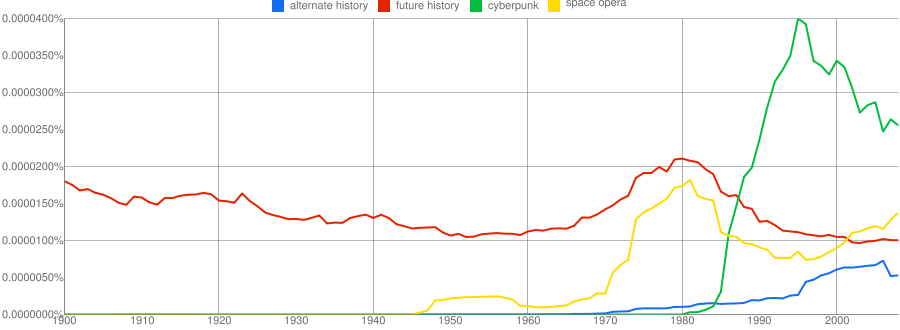
The Rise and Fall of Cyberpunk, The Fall and Limping Recovery of Space Opera, and the Gradual Climb of Alternate History

Science Fiction Sub-Genres, 1900 - 2008

Science Fiction Sub-Genres, 1900 - 2008

So the late ’80s and early ’90s saw cyberpunk explode, rise to meteoric heights and then begin a gradual decline that still seems ongoing. Cyberpunk hasn’t seemed to eclipse any of the other major science fiction sub-genres, although it did seem to coincide with a gradual decline in space opera and future history. It’s also neat to see a visual representation of alternate history’s slow growth over the last 40 years.

Sword and Sorcery vs. Epic Fantasy, Paranormal Romance vs. Steampunk and Urban Fantasy

Fantasy Sub-genres, 1900 - 2008

Fantasy Sub-genres, 1900 - 2008

Looking at fantasy, we can see the response to J.R.R. Tolkien‘s popularity. Looking at the 1970s and 1980s, we can see the impact of Terry Brooks, Stephen Donaldson, Michael Moorcock and Roger Zelazny. Then the 1990s show us the rise of Robert Jordan, Terry Goodkind, George R.R. Martin and the other kings of the Chihuahua-killer tomes. But what I think is most interesting is the relationship between steampunk, urban fantasy, and paranormal romance.

Steampunk has been getting a lot of buzz recently, leading some authors (most prominently Charles Stross and Cat Valente) to complain that it eclipses everything else going on. But this somewhat unscientific chart at least shows that while steampunk may generate buzz, that buzz is disproportional to the volume of published work. Of course, those complaints are recent and Google’s data only goes up to 2008. It’d be interesting to see if in 2009 and 2010 steampunk really did eclipse other sub-genres of fantasy and science fiction. Looking at the data through 2008, the trend looks pretty steady and in line with urban fantasy. The data actually suggests that paranormal romance is the sub-genre really breaking out. At least by 2008.

Some Fun Genre Tropes

And since I am – technically – on vacation this week, I want to go out vacation-ing in a few minutes, just three last fun charts. The charts above track some of the sub-genres, but what about some of the most-common science fiction, fantasy, and horror tropes? Some fun:

Space Travel Tropes, 1900 - 2008

Space Travel Tropes, 1900 - 2008

Hard science fiction and space opera both have their share of tropes, including (typically) some means of traveling at or near the speed of light. Of course, technology changes all the time so how have those tropes changed over the years? For one thing, the generic (and typically ill-defined) “hyperdrive” seems to be eclipsing anything with real science behind it. The equally fuzzy “warp drive” looks to have peaked around the turn of the century, while scientific or pseudo-scientific also-rans like the ramjet and gravity drive seem to be holding steady. Probably the most noticeable (and interesting) phenomenon was the brief but intense plateau of solar sails, which came to be pretty common right around the mid-1980’s before settling back down into a slow upward trajectory in the late ’90s.

Fantasy Tropes, 1900 - 2008

Fantasy Tropes, 1900 - 2008

Out of the stereo-typical fantasy tropes, dragons seem to be holding pretty steadily, but what’s notable is the rise of “wizard” in the late 1990s. Do I detect Harry Potter‘s wand at work?

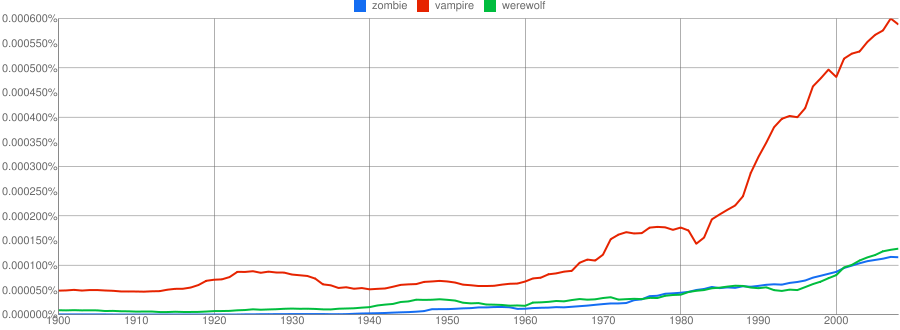
Horror Tropes, 1900 - 2008

Horror Tropes, 1900 - 2008

And here we can clearly see the impact of Anne Rice and her Lestat as the progenitors of the vampire craze. Vampires are clearly the monster of last thirty years, and by 2008, they still have nothing to fear from either werewolves or zombies.

The Future is Now: Is Hatsune Miku William Gibson’s Idoru made real?


There’s a new top-selling vocalist in the J-Pop genre: Hatsune Miku’s voice has been featured on gold-selling albums with Japanese bands like Supercell and Livetune (all links are to web sites in Japanese). Her singing has graced anime credits, and she has her own video game out from SEGA, and perhaps most impressively she’s performed live before crowds of 25,000 screaming fans. Of course, compared to the likes of Lady Gaga or Hannah Montana that’s not terribly impressive. But there’s a big difference between those standard pop-stars and Hatsune Miku: Hatsune Miku is not alive. She’s software. Think about that for a second: software, singing “live” to thousands of (real life) screaming fans. Don’t believe me? Take a look at the video:

Designed by Crypton Future Media, Hatsune Miku is the most popular of a type of software called vocaloids. These are programs designed to work with Yamaha’s vocaloid (vocal + android) software to synthesize human song. However, Hatsune Miku is more than the lines of code and signals that make up her synthesized voice. Her basic “look” was designed by the illustrator known as Kei, and features visual sensibilities familiar to fans of anime and manga. With this visual design and a distinctive (synthetic, mind you) singing voice capable of expressing complex emotions, Japan’s vibrant dojinshi music sub-culture soon developed the MikuMikuDance software to design 3D dance animations and music videos. The result is a complex community of lyricists, composers, illustrators, and choreographers/animators who collaborate and compete to create songs using their shared “instrument”.

The Consensus Mythology of Hatsune Miku

I freely admit, it is difficult for me to understand much of the nuance of this sub-culture as I (alas) don’t speak Japanese. However, from what I’ve been able to gleam from several hours of Internet research, Hatsune Miku is the logical meeting point of many Japanese sub-cultures. Her visual roots lie in manga and anime, but her initial genesis lies in the dojin music community. From there, Miku has spawned manga, anime, prose, itasha, and figures.

In the dojin music community, Miku is seen as an instrument first, not a character. And rightly, songwriters like Ryo (Supercell) are the true artists, since Miku sings what they write. Songwriters have utter control over every aspect of her performance: when she sings a note, she will always sing it the way the songwriter wanted (emotion included!). In this, she is no different than a keyboard or a guitar. The community collaborates through video and file sharing services, posting their work and soliciting feedback from other creators and fans. When Japanese media discusses Hatsune Miku artists, the focus is always on the songwriter: rarely the instrument.

But outside of the dojin music community, this “instrument” begins to resemble more popular manga, anime, and aidoru trends. With the plethora of (popular) dojin manga and fan-fiction, creators and fans build a consensus mythology around the character. Her history, her personality, all is built through the multi-faceted strands of her fan-base. Like many aidoru, she has publicized (and authorized by Crypton Future Media) measurements, the content of her songs is (in theory) limited by the license the creators agree to when using the software, etc. While it started with songs and videos, the Hatsune Miku community now creates stories, manga, and video games (Sega Hatsune Miku: Project Diva for PSP) that make use of this shared character.

Is Hatsune Miku William Gibson’s Rei Toei?

Fourteen years ago – long before the vocaloid technology was even close to possible – William Gibson wrote Idoru, the second novel in his Bridge trilogy. Set in an early 21st century Tokyo, Idoru examines a variety of cyberpunk themes, most particularly the relationship between artificial life and humanity which he explores through an artificially intelligent pop-idol construct named Rei Toei (after the Toei Company, one of Japan’s leading film and music studios).

In Gibson’s cyberpunk vision, Rei Toei is a self-actualizing adaptive composite intelligence. The point is that there are as many versions of Rei Toei as there are fans. Each fan builds a personalized album, songs, videos, performances, photographs, etc. of Rei based upon his or her particular preferences. When Rei performs in public, her style represents an averaging of the individual preferences across each fan in the audience, effectively becoming a consensus character. In a very real sense, Rei Toei represents the ur-idol: an “artist” with a perfect collection of traits that allow her to appeal to every single person in general, and to appeal to each fan in specific.

The parallels to Hatsune Miku are obvious. Like Rei, Hatsune Miku is a composite character: with the plethora of dojin songs, videos, and manga fans can gravitate to and select the content that specifically appeals to them. Don’t like a particular style? There are plenty more to choose from. In this sense, Hatsune Miku’s fans can consume their own concept of Hatsune Miku, selecting for a mythology and set of characteristics that appeals to them. No two Hatsune Miku fans will have the same preferences, but both can be equally pleased with what they get. In terms of predicting technology capabilities and the fan-base’s reaction, Gibson nailed it.

However, the differences between the two characters deal directly with some of Gibson’s (and cyberpunk’s) primary themes. Gibson painted Rei Toei as being strictly overseen by her owners. While her style and persona may be adjusted to the tastes of individual fans, it is the mega-corporation who enforces constraints on her choices. They provide her with the songs to perform and determine the types of behavior she can get into. Very purposefully, Gibson took the classic aidoru model of circumscribed managers, handlers, and controllers and applied it to an AI character. While the details of her public persona may be crowd-sourced and the personal consumption of her products personalized, the shared foundation for Rei Toei is prescribed by developer edict. In response, much of Gibson’s book focuses on Rei’s attempts to break free from the constraints imposed on her by the mega-corporation. Hatsune Miku, by contrast, is already free.

Every aspect of Miku’s “behavior” is determined by the distributed community of her creators. There is no single overseer who cashes in on her performances. Even Crypton Future Media – Miku’s ostensible “creators” and the owners of her code – do not try to limit the ways in which Miku can be expressed. As a result, Miku’s performances and behavior become just as crowd-sourced as her fan experiences become personalized. In dojinshi world of music, anime, manga and fan-fic there are no practical limits as to what Hatsune Miku can do.

Yet despite this freedom, Rei Toei is adaptive and self-actualizing, meaning that she represents an actual artificial intelligence that responds to human interaction, can converse freely, and can make independent decisions. She has become an emergent intelligence, capable of (seemingly) independent thought and action. Hatsune Miku – at least today – does not have any such properties. Modern technology has so far been unable to create emergent intelligence and as a result, Hatsune Miku is patently unable to choose her own destiny. Every choice is made for her by an individual and distinct creator.

The Ethics of Consensus Character Emergence

Is Hatsune Miku any more free than Rei Toei? On the one hand, Rei Toei is a perfectly adaptive self-actualizing AI. She is partially constrained by outside forces (her owners/creators), but she retains freedom of choice in certain limited arenas. Gibson’s book suggests that this represents slavery, despite Rei Toei’s artificial nature. Hatsune Miku, however, is perfectly constrained. She is not adaptive, not self-actualizing, and so is technologically unable to make any choices for herself. As a result, her creators maintain complete and utter control over her.

At first blush, this might seem like more oppressive slavery than what Rei Toei is subjected to, however I think the reality a little more complex. As anyone can create anything using the Hatsune Miku character, her range of effective choices is far broader than Rei Toei’s. She can do anything, so long as someone tells her what to do. This is at once more liberating and constraining, as it places the onus on the fans to determine who their consensus character will become. Many creators have a vested interest in the Hatsune Miku character, whether they are songwriters, music labels, authors, or publishers. The well-funded, well-organized creators have a far larger megaphone than the individual dojin working on their home computers. Will they hijack the Hatsune Miku character? Will they enforce their vision on her mythology? On the one hand, this may help popularize the Hatsune Miku character by making her more accessible to everyone. On the other, it will constrain the emerging consensus. Which would be better for art involving the character? What would be better for the fans?

I don’t have any answers, but I think we’ve entered a fascinating future where questions like this become practical concerns. When William Gibson wrote Idoru it was pure science fiction, set in a relatively near future, but involving technology so far beyond 486 processors and 32 MB of RAM that it was scarcely imaginable. But today, that science fiction has become very real. As a result, the questions that Gibson raised in 1996 have become much more relevant. How we answer them will affect the relationships between art, technology, and society. I don’t know if Gibson is aware of Hatsune Miku’s existence, but I hope he is. And I’d love to know what he thinks.

A Holiday Gift Guide for the Genre-inclined


If you’re like me, then you probably haven’t started your holiday shopping yet. If that’s the case, then let me borrow from Douglas Adams and offer some advice: DON’T PANIC! (I hope those letters are friendly on your display). Regardless of what holiday you’re celebrating, buying stuff for loved ones into science fiction, fantasy, and horror can often be difficult. So this week, I want to offer a little holiday gift guide to help you shop for those folks in your life who love genre:

For the Zombie-lover


American Zombie
We’ve seen what happens when the re-animated dead hunger. We’ve seen blood, and guts, and above all braaaaaiiins. But have we ever considered the zombies’ perspective? Have we ever wondered what it’s like to be part of that maligned, feared underclass in American society? American Zombie is a fun and creative documentary that follows the lives and dreams of several zombies living (un-living?) in Los Angeles. Fun, intelligent satire on our fascination with the walking dead.

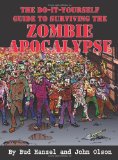
The Do-it-Yourself Guide to Surviving the Zombie Apocalypse
The zombie lover in your life probably thinks about the coming apocalypse pretty frequently. They might have escape routes, fortification schematics, weapons caches, the whole nine yards. If that’s the case, or even if not, this book makes a very practical addition to your loved one’s library. With easy to follow guidance, it is sure to keep your loved ones safe. After all, at 10″ by 7.4″ and 160 pages, it could do some damage in a pinch.

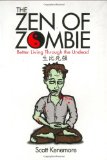
The Zen of Zombie: Better Living Through the Undead
This self-help book is a perfect distillation of the zombie ethos. With a practical twelve-step guide to zombiefication, and lessons to learn about adaptability and being your own boss, this book can make your loved ones more satisfied with their life and happier in the work.

Gerber 22-41576 Gator Machete with Sheath
Movies and books aside, the gift that keeps on giving might be a good idea. Your zombie-phile loved ones will definitely appreciate a sturdy, 15″ double-edged (straight on one edge, and saw-toothed on the other) machete perfect for slicing and dicing anything out to eat some brains. Also makes a great companion gift to The Do-it-Yourself Guide to Surviving the Zombie Apocalypse

For the Epic Fantasy Fan


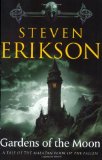
Gardens of the Moon (Malazan Book of the Fallen)
If they haven’t read Steven Erikson, this is a gift guaranteed to blow the mind of any epic fantasy fan: a 10-book, doorstopper-sized epic fantasy series that actually finishes! Unlike most epic fantasy series that go beyond three (let alone six) books, Erikson and his publishers have consistently delivered books more-or-less on-time. The last book in the series (number 10) is currently set to be released on March 1, 2011 and Amazon is already taking pre-orders for it. With great writing, well-textured world-building, and fun characters Erikson’s Malazan books of the fallen are probably the best epic fantasy written in the last twenty years.

World of Warcraft: Cataclysm
Alright, I admit it: I myself am not that big a fan of WoW. However, I know that lots of people (and lots of epic fantasy fans especially) are. So if the epic fantasy fan in your life enjoys WoW, or MMORPGs, or RPGs then they’re likely to enjoy the new world-changing experience of Cataclysm.

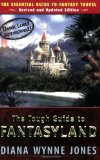
The Tough Guide to Fantasyland: The Essential Guide to Fantasy Travel
The essential guide book for anyone setting out on a fantasy adventure. Written by Dianna Wynne-Jones, who has taken many an intrepid tourist on a fantasy vacation, this book offers practical advice for navigating the wilds of fantasyland, the etiquette of interacting with the locals, and helpful guidance on what to bring, what to wear, and how to get about. Be sure to get an edition that is Dark Lord Approved!

For Vampire Fans who Hate Glitter


I Am Legend
Okay, I know I talk about this book a lot on this blog. But it really is one of the best vampire novels ever written. Dark, frightening, and leaves you faint and reeling at the end. Isn’t that what a good vampire should do?

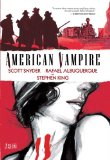
American Vampire Vol. 1
With stories written by Stephen King and Scott Snyder and illustration by Rafael Albuquereque, American Vampire offers some grisly blood-sucking fun set in the Wild West and 1920’s Hollywood. An entertaining read, with restrained illustration capable of exploding into bloody viscera where and when needed, this graphic novel will be appreciated by those of us who enjoy evolving vampire myths.

Shadow of the Vampire
John Malkovich and Willem Defoe star as F.W. Murnau and Max Schrek (of silent movie fame) respectively in this fictionalized account of the filming of Nosferatu. Of course, in this version, Max Schrek in fact is a monstrous vampire, who preys on the cast and crew of the movie.

For the Steampunk Aficionado


Steampunk II: Steampunk Reloaded
A second steampunk anthology edited by the inestimable Ann and Jeff VanderMeer, this book collects twenty three short stories, two essays, and one roundtable interview that delves into the vagaries of steampunk literature. The fiction makes this anthology worth it, with some really great stories from authors like Jeffrey Ford and Tanith Lee.

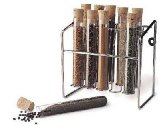
Test Tube Spice Rack
Credit where credit is due, I actually found this concept on the STEAMED! blog. This is a great gift for any mad scientist who likes to experiment in the kitchen. The only advice I would have is to make sure your test tubes are properly labeled. It is – alas – all too easy to mistake strychnine for salt, after all.

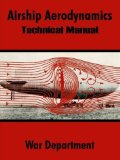
Airship Aerodynamics: Technical Manual
While this military manual dates from 1941, your loved ones are sure to appreciate the detailed specs on flying and maintaining airships found in this treatise. Sure it’s dry and full of engineering and pilot jargon, but if your loved ones want to pilot an airship, shouldn’t they do it right?

For the Robot or Alien Lover


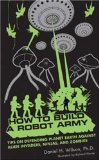
How to Build a Robot Army: Tips on Defending Planet Earth Against Alien Invaders, Ninjas, and Zombies
A very practical guide to building and utilizing a robot army for dealing with the myriad dangers lurking just around the corner, including (but not limited to) ninjas, aliens, Godzilla, and great white sharks. Written by Daniel Wilson, who holds a doctorate in robotics (no fooling!), the book is firmly grounded in science. With its sections on using robots against the zombie hordes, this might make a great cross-over gift for the zombie-lover in your life as well!

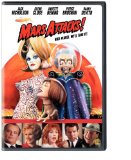
Mars Attacks!
This wonderfully sweet, heart-warming family movie directed by Tim Burton and starring the always even-keeled Jack Nicholson will reach out and touch the heart of any alien aficionado. Also, the sweet dulcet tones of Slim Whitman are sure to appeal to any science fiction music lovers!

Bottled Water
It should go without saying that you want to keep your loved ones safe from aliens. And if the cat on a hot skillet yowling of Slim Whitman is too much for you, thankfully M. Night Shyamalan shows us an alternative alien-bashing weapon: good old-fashioned H2O. A couple drops of this stuff, and those aliens will go the way of the Wicked Witch of the West! Of course, why hydrophobic aliens capable of interstellar travel would come to a planet 70% covered with the stuff, only Shyamalan could possibly tell us (I can picture the aliens’ reasoning now: what a world, what a world…).

What are some other gifts out there for those of us who love science fiction, fantasy, and horror? I’m certain there are tons of other ideas out there, and I’d love to hear some of them (whether serious or not).

Where Do We Go from Here? Utopia in Contemporary Science Fiction


Over the weekend, science fiction author Charles Stross posted a call for more utopian speculation in contemporary science fiction. I was weaned on Huxley, Wells, Skinner, and Orwell, and so Charles’ call got me thinking: why has the utopian sub-genre fizzled out of style in the last fifty or so years? Why has the search for a good place (eutopia) ended up going no place (utopia)? (I’m sorry, I couldn’t resist the pun). I think the decline of utopian fiction is linked to the lack of a cogent utopian response to dystopian critique. What makes the dystopian critique so effective? How are the best dystopias constructed?

The Structures of Utopia and Dystopia

How to Make Perfection Entertaining

The vast majority of utopian fiction was written during the end of the industrial revolution (1880 – 1950), riding on the popularization of socialist philosophy in western Europe. Dystopias rose in parallel, although in far greater number due to their greater entertainment value. The brutal fact is that dystopias sell better than utopias because perfection makes it very hard for an author to introduce conflict.

Starting with Sir Thomas More’s Utopia, every piece of utopian fiction has been written like a travelogue. The reader follows a protagonist who comes from our imperfect society, and who enters (one way or another) the perfect society. Given this set up, it becomes almost impossible to introduce tension. Why would the visitor ever want to leave? What would the hero need to fight against? Conflict is out-moded in a utopia, and this makes storytelling very difficult.

The vast majority of utopian fiction appeals to logos first and pathos second, and it wasn’t until Heinlein, Le Guin, and Delaney that those priorities were revsered. In the 1960s and ’70s, authors like Robert A. Heinlein (The Moon Is a Harsh Mistress), Ursula K. Le Guin (The Dispossessed: An Ambiguous Utopia), and Samuel R. Delany (Trouble on Triton: An Ambiguous Heterotopia) introduced real conflict into their utopian plots. Each did this by throwing the utopia or its representatives (Heinlein’s anarcho-libertarian Luna, Le Guin’s collectivist Shevek/Anarres, Delany’s sex/gender heterotopia Triton) into armed conflict with a non-utopian society (Earth, Urras, and Earth respectively).

As Heinlein, Le Guin, and Delany made clear, the entertainment value of contemporary utopian fiction relies upon the relationship between the utopia and a different (possibly opposed) society. More recently, Iain M. Banks has done this to good effect in his Culture novels, where his protagonists tend to be Special Circumstances operatives (spies) interacting with non-utopian planets/societies/situations. While retaining some aspects of the travelogue, these books take a page out of Victor Hugo’s work and embody the utopian ideal into a principle character. Similarly, they then take the opposing viewpoint and embody that value system into a different character and let the two collide.

Le Guin effectively reversed the utopian travelogue structure: her hero Shevek is the collectivist utopian, but the world he visits (Urras) is the anti-thesis of his collectivist home planet. By making her visitor the utopian, she was able to explore more clearly the strengths and flaws of her collectivist/anarchist society and the opposed individualist/capitalist society. Delany does something similar by sending a visitor (Brom) whose values are inimical to those of the utopia he visits. This sets the stage for a gripping and powerful conflict between him and those he has relationships with, which is mirrored by the interplanetary conflict with Earth.

For those looking to write entertaining utopian fiction that has a hope of competing against dystopias, the lessons are deceptively simple:

  1. Personify your value systems.
  2. Play with perspective, by shifting which character is either narrating the story or the viewpoint character.
  3. Focus on individual relationships, instead of on the philosophical ones.

Viva la Revolucion!

Dystopias, by contrast, are stories of revolution. An ostensibly perfect society is shown to be deeply flawed, hypocritical, unjust. Our hero – usually a died-in-the-wool believer at the story’s opening – realizes his perfect society is a lie and either brings the system down or escapes to a liberated area outside of the proscribed area. The conflict practically writes itself: the situation is dire (our hero is usually alone against oppressive odds), and the stakes are high (death, or worse: conversion).

Structurally, dystopias tend to be logical extrapolations of a central conceit, a conceit that tends to be tied to the philosophical, sociological, and economic concerns of the time:

  • Yevgeny Zamyatin’s 1921 classic We takes the early 20th century’s industrialization, Bentham’s concept of the Panopticon, and constructs a totalitarian world state where individuals are referred to only by number and any burgeoning individuality is earnestly squashed.
  • Aldous Huxley’s Brave New World, where the principles of assembly-line manufacturing are now applied to individuals, whose roles in life are rigidly determined based on their genetic engineering.
  • George Orwell’s Nineteen Eighty-Four, directly inspired by Zamyatin’s work and extrapolating the concept of a society founded on the Panopticon.
  • Ray Bradbury’s Fahrenheit 451, which depicts censorship taken to a logical extreme.
  • Kurt Vonnegut’s Harrison Bergeron (published in Welcome to the Monkey House: Stories), which shows a state in which everyone is forced to be average in all aspects of their being.
  • Jack Vance’s Alastor trilogy, where each book explores a different society built around a particular social concept (respectively gambling, fuedalism, collectivism).
  • John Brunner’s Stand on Zanzibar and The Sheep Look Up, which take show plausible consequences of Malthusian overpopulation and ecological collapse.
  • Alan Moore’s V for Vendetta, which takes 1980’s Thatcherite politics and postulates a future based upon them.
  • Margaret Atwood’s The Handmaid’s Tale, which shows a society built on religious fundamentalism and male chauvinism.
  • James Morrow’s City of Truth, which posits a society founded upon (always) telling the truth.
  • Suzanne Collins’ The Hunger Games, which builds a society around providing the masses with “bread and circuses” (gladiatorial conflict) to keep them in line.

All of the examples listed above hinge upon a central character who comes to doubt the society they are a part of. Whether it is Bradbury’s Montag, or Morrow’s Jack Sperry, the protagonist is a product of the dystopian society who comes to vehemently oppose it. This opposition lends even early dystopias powerful conflict, rising tension, and thematic tension. Even the earlier dystopias established the pattern of embodying opposing principles in their characters. For every Winston Smith, we have an O’Brien (Orwell’s Nineteen Eighty-Four). For every Bernard Marx and John the Savage, we have a Mustapha Mond (Huxley’s Brave New World). This gives the opposing philosophies a face, makes them personable and – in the case of Mustapha Mond, at least – deceptively sympathetic.

If utopian fiction has traditionally appealed to logos, and then pathos, then dystopian fiction has traditionally reversed that order. As a result, the success or failure of dystopian fiction lies in its world-building. The memorable dystopian works tend to have fully-realized characters, and conflict-prone plots that put their heroes in desperate situations philosophically and physically.

The Dystopian Critique of Utopia

If Charles Stross is looking for more utopian fiction, then he should be looking for more utopias that apply lessons from their dystopian cousins. By relying upon more three-dimensional characters, dystopian fiction better illustrates how flawed humans may react to situations and choices. “Human nature” is often cited as a criticism of utopian philosophy, and only the works of Heinlein, Le Guin, and Delaney have tried to respond to that criticism. Heinlein’s utopia takes the cynical, ultra-libertarian view of individualism and applies it. Le Guin readily admits to the flaws in her utopia, and posits that society as an aspirational work-in-progress reliant upon the ethos of its inhabitants. Delaney shows that any utopia is indelibly based upon a shared value system, and elements which “don’t fit in” may or may not have a place within that society…even if by ostensible definition, it is an all-encompassing, all-permitting society.

These are not the techniques of H.G. Wells or earlier utopian authors. They are instead the techniques of dystopian fiction, applied to utopian concepts. And if we are to look for modern-day utopian fiction, we should try to write more books that attempt the same. Thinly-veiled imperative lectures (à la Wells or Morris) would not sell today, and though well-written utopian travelogues (like Michal Ajvaz’s The Golden Age) may win awards and earn respect, they are extremely difficult to get right. I also suspect there is limited demand for them.

If we want to see contemporary utopian fiction, one option is to take a page out of Iain M. Banks’ playbook: establish the utopia in the far-distant future, so far removed as to make it effectively fait accomplit, then use Le Guin’s tactic of taking a dyed-in-the-wool utopian and putting them in conflict/interaction with opposing viewpoints. It’s a technique that works for the most-recent utopias, whether Iain M. Banks’ Culture or the Star Trek Federation. While this technique makes for compelling reading, but the fact that there are few “new” types of utopia limits the potential thematic impact.

Another option is to do as John C. Wright does in his Golden Age trilogy. There, the author takes a page out of the dystopian playbook: he uses a dyed-in-the-wool utopian character to uncover the flaws in his own utopia. Whereas in a truly dystopian work, that hero would then go on to either destroy or escape his society, Wright’s hero instead tries to save his society despite its flaws. Structurally, this is probably the most interesting utopian fiction I have seen in many years. While the utopia itself is of the nearly-ubiquitous individualist/anarchist mold, the technique by which Wright explores his themes is quite refreshing.

A third – and perhaps most challenging – option is to actually come up with some fresh utopian philosophies. In many ways, utopian philosophy has become almost synonymous with either libertarian anarchy or collectivist anarchy, and I question whether there is much more to be said on either subject. Instead, perhaps we should come up with some new models for looking at society, for structuring our relationships. If we do that, then we should apply the structural lessons of dystopian fiction to make the characters compelling, the plots full of conflict, and fundamentally resonant.

One possibility which I see is for utopian fiction that actually precedes the utopia itself. Utopia is – by definition – a static place. But the process of building a utopia, whatever its value system, surely is not. Why not utopian fiction that is directly aspirational? The reality of watching a utopia be built might be like the making of law and sausages: best left unwatched. But if we’re dealing with fiction, then I’m sure we can squeeze some entertainment and thematic resonance out of the struggle for a better world. After all, once that struggle is won, we’ll have no more conflict to write about.

The Uses of Food in Science Fiction, Fantasy, and Horror


Thanksgiving’s secular ethos built around food, family, and friends (three things I love) make this my favorite holiday of the year. Superficially, it’s all about the great feast centered around the Thanksgiving turkey, and so I thought why not post about how food is used in science fiction, fantasy, and horror?

The Difficulties with Food

Perhaps unsurprisingly, we are evolutionarily wired to pay attention to food. That makes it very difficult for food to appear in a story or scene without becoming a major facet. Genre films use the visual of food to great effect: who can forget the scene in The Return of the King when Denethor is feasting during the charge for Osgiliath? Or the dinner scene in Beetlejuice? And let’s not forget those movies that are all about the dangers of late night snacking: Gremlins and Gremlins 2?

The filmmakers all knew that the instant food appears on screen, at least for a moment, our eyes are naturally drawn to it, our focus shifts and – depending on how it’s depicted – our mouths start watering. It’s a Pavlovian response, and the best film-makers make use of it in their movie making. The same thing happens when we read. The feast-time strategy session is a trope of epic fantasy, and much horror (including the recent zombie resurgence) is centered around food (of one sort or another). Avoiding the cliche and making food a seamless, important part of the story is much more difficult. Too little focus, and the food becomes incidental, a cliche distraction. Too much focus, and the food becomes the point of the scene (which sometimes is what you want).

So how does genre fiction actually make use of food? Well, from a brief persual of my bookshelves, it seems that I can see four different uses:

  1. As a metaphor.
  2. As a characterization device.
  3. As a distancing device.
  4. As imagery of the sublime.

Food as a Metaphor

This is one of the more obvious uses, but can be quite difficult to do tastefully. Consider two different works and their metaphoric use of food:


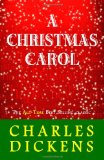
A Christmas Carol
, by Charles Dickens

Dandelion Wine
, by Ray Bradbury

In A Christmas Carol, Dickens uses dinner as symbols of class division. The Spirit of Christmas Present shows us many people eating on Christmas Eve, the most memorable of which is surely the Cratchit’s feast. Poor, down-trodden Bob Cratchit and his family put together a lovely spread. Dickens knows that food is not just about the meal itself, but about the way it is presented, the way it is served, the company in which it is enjoyed. He puts all of this to mouth-watering use as he describes their (meager) fare of Christmas goose and pudding:

Such a bustle ensued that you might have thought a goose the rarest of all birds, a feathered phenomenon, to which a black swan was a matter of course – and in truth it was something very like it in that house. Mrs. Cratchit made the gravy (ready beforehand in a little saucepan) hissing hot, Master Peter mashed the potatoes with incredible vigor, Miss Belinda sweetened up the apple sauce, Martha dusted the hot plates, Bob took Tiny Tim beside him in a tiny corner at the table, the two young Cratchits set chairs for everybody, not forgetting themselves, and, mounting guard upon their posts, crammed spoons into their mouths, lest they should shriek for goose before their turn came to be helped.

Setting up the table, laying out the plates, anticipating the taste, these are the rituals of most any family. The “pre-game” sets the mood, establishes the characters, the joy of a holiday meal. Note how Dickens points out that geese are not that rare, that they are easy to be had…but that the Cratchits still rarely enjoy them: “you might have thought a goose the rarest of all birds…and in truth it was something very like it in that house“. Or consider how the Cratchits react to the pudding:

Oh, a wonderful pudding! Bob Cratchit said, and calmly, too, that he regarded it as the greatest success achieved by Mrs. Cratchit since their marriage. Mrs. Cratchit said that, now the weight was off her mind, she would confess she had her doubts about the quantity of flour. Everybody had something to say about it, but nobody said or thought it was at all a small pudding for a large family. It would been flat heresy to do so. Any Cratchit would have blushed to hint at such a thing.

The metaphor works here because Dickens does not beat us over the head with it. Granted, he beats us over the head with Scrooge’s mistreatment of Cratchit. But when describing the scene with the food, he implies its meaning quite rightly. The fact that the Cratchits eat a poor man’s meal are subtly implied, not stated. The focus is not on the meagerness of their meal: the text instead focuses on their dignity under duress, and that is what makes the metaphor effective. When, after his ordeal, Scrooge sends them the giant Christmas turkey (“It’s twice the size of Tiny Tim.“) the contrast with the goose and the small pudding resonates that much more strongly because it is not pointed out to the reader.

Bradbury’s Dandelion Wine uses a very different tact. Unlike Dickens, Bradbury hands us the key to his metaphor directly:

Danelion wine. The words were summer on the tongue. The wine was summer caught and stoppered.

The entire third chapter of Dandelion Wine describes how the wine represents the joys of summer, bottled to bring a taste of summer into the cold winter months. With a book so nostalgic, the book itself represents an analogous metaphor. Just as the bottles of dandelion wine bring summer into winter, so too does the book itself bring magical childhood into adult life. Both Dickens and Bradbury use metaphor: one by implication and understatement, the other explicitly and structurally. Other authors in genre use food metaphors more obliquely (Oscar Wilde, Lewis Carroll, Christina Rosetti) but I find Dickens’ and Bradbury’s methods the most memorable.

Food as Characterization

One of my favorite scenes involving food takes place in Mervyn Peake’s Titus Groan (first of his Gormenghast novels). The scene is a conversation between the ruthlessly ambitious social-climber Steerpike, the somewhat embittered Dr. Prunesquallor, the flighty but loving Fuchsia, and her shattered Nannie Slagg. In this scene, Steerpike endeavors to secure employment with Doctor Prunesquallor, and has coerced Fuchsia and Nannie Slagg into bringing him to the good doctor.

They do not eat at this meeting, but they do drink. And Peake uses the act of drinking to further establish his characters. Western culture associates certain traits with certain alcohols. Advertisers rely on this when crafting their brand messages: think of the archetypal images you see in the typical whiskey ad. Peake was a master of characterization (arguably, his trilogy is one long study in characterization), and he knew that he could use his characters’ chosen libations as a window into their souls:

‘Drink, my Fuchsia dear,’ [Prunesquallor] said. ‘Drink to all those things that you love best. I know. I know,’ he added with his hands folded at his chin again. ‘Drink to everything that’s bright and glossy. Drink to the Coloured Things.’

Fuchsia nodded her head unsmilingly at the toast and took a gulp. She looked up at the Doctor very seriously. ‘It’s nice,’ she said. ‘I like elderberry wine. Do you like your drink, Nannie?’

Mrs. Slagg very nearly spilt her port over the arm of the chair when she heard herself addressed. She nodded her head violently.

‘And now for the brandy,’ said the Doctor. ‘The brandy for Master…Master…’

‘Steerpike,’ said the youth. ‘My name is Steerpike, sir.’

The whole scene goes on for some paragraphs more. Fuchsia is confused, and easily distracted, and whether this is a result of the wine or her own nature is a matter of conjecture. Slagg falls asleep. Prunesquallor does not even so much as taste his cognac. And Steerpike? Steerpike keeps his distance. Verbally, he remains aloof and speaks and sips only to underline the specific points of his dialog and as a tool to help him achieve his goals. The differences in what they drink, and the differences in how they drink it, create a perfect alignment between character and action. If the characters all drank the same way (sipped, gulped, or ignored their glasses), we would finish the passage with a weaker understanding. If they were all drinking sherry, or wine, or beer, so too we would have a less strongly-formed sense of the characters. Using such half-measures would have weakened the unity between their words and deeds. But Peake draws characters too well for that.

Food as a Distancing Device

Food is often used for comedic/tragic effect in science fiction (“It’s a cookbook! It’s a cookbook!”). But perhaps one of the best ways that it is used is as a distancing device. The most memorable (for me) scene in Julie E. Czerneda’s Survival is when the heroine Mac finds herself aboard a Dhryn (alien) spaceship. In order for the rest of the book (and the rest of the series) to work, Czerneda needs to ensure that we view the Dhryn as aliens. They need to have alien value systems, alien biologies, alien everything, to establish that sense of Other.

When Mac first comes aboard the ship, there are no Dhryn to be seen. Instead, she is alone in her quarters, and must figure out how she is to eat and drink. She is offered what is – ostensibly – food, but it is so unlike any food she has ever seen that she has no way of knowing if it is even edible (for humans). With no food, and no water, and no ability to communicate with her hosts she finds herself in dire straits, until she attempts the following experiment:

Step one. After her experiment with the Dhryn shower, Mac wasn’t going to risk herself without due care. She chose the outside of her left arm as most expendable and pressed it against one of the cylinders.

It felt cold, which didn’t mean it was chilled. Room temperature, Mac concluded. She examined the skin that had touched the food. No reddening or swelling. She brought her forearm close to her nostrils and sniffed.

Blah! Mac wrinkled her nose. She wasn’t sure if it smelled more like hot tar or sulfur. It certainly didn’t smell edible.

Step two. She picked up one of the cylinders, doing her best not to react to its slimy feel or rubbery consistency, and brought it to her mouth. Slowly, fighting the urge to vomit – a potentially disastrous loss of fluid – she stuck out her tongue and touched it to the side of the cylinder.

Nothing.

Her tongue might be too dry. Mac brought her tongue back inside her mouth, letting its tip contact what saliva she had left, then, cautiously, she moved that saliva around so it contacted all the taste buds on her tongue.

BLAH! Mac barely succeeded in keeping her gorge in her throat. God, it was bitter. Putting down the cylinder, she crushed a bit of nutrient bar in her hand and licked up the crumbs. The sweetness helped, barely. She resisted the urge to take another sip. Thirty minutes until her next.

Step three. Mac breathed in through her nose, out through her mouth, centering herself, slowing her heart rate from frantic to tolerably terrified. Then she picked up a cylinder and took a bite.

BITTER! Before she could spit it out, moist sweetness flooded her senses as her teeth fully closed. Startled, she poked the jellylike msas around in her mouth. A tang of bitterness remained, but the overall impression was of having bitten off a piece of…

…overripe banana. Not that flavor, but the same consistency and texture. This taste was complex, more spicy than bland, and seemed to change as the material sat in her mouth. A good sign, Mac thought, chewing cautiously. The enzyme in her saliva was acting on what had to be carbohydrate. The moisture in the mouthful was more than welcome.

She swallowed. When nothing worse happened than the impact of a mouthful thudding into her empty stomach, Mac examined the cylinder. Where she’d bitten it, glistening material was slowly oozing onto her hand, as if through a hole.

Mac laughed. If the sound had a tinge of hysteria to it, she felt entitled. “I ate the damn wrapper,” she said, wiping her eyes.

The use of humor is an effective tool, a way of releasing the tension built up in the preceding pages. The systematic, experimental nature of the meal is in keeping with the character’s profession (scientist). And the description of the food itself is sufficiently alien that up until that last sentence, we can believe that this is whatever food the Dhryn normally eat. An effective way of establishing Mac as the only human aboard this very alien starship headed for alien lands.

Food as the Sublime

The final way for food to be used is as sublime imagery. There are many ways to do that, whether in genre or out of genre. But in genre, horror stories probably do this most frequently. A disturbingly fun example that makes me squirm whenever I read it is Micaela Morrissette’s Wendigo, published in Weird Tales. The whole story is one long description of banquets, and cooking, and feasting. But Morrissette’s language artfully sets up images that are unsettling, disturbing, but still clearly food that her character finds sumptuous:

She swallowed the wine that paused in her mouth, clung there, spreading itself. She swallowed the black soup: thin, sour broth swimming with clots that trailed delicate filaments. She swallowed the tempura of cobra lily, and, inside its cup, the pale, limp moth that seemed to sigh and dissolve on her tongue. When the songbirds were served, her gracious companion, sensing her confusion, placed a steadying hand on the back of her neck and guided her head under the starched napkin. She ate the scorching meat, needled with tiny bones her teeth had splintered. She felt little ruptures where they scratched her throat. Her companion was missing the fifth and second fingertips of his right hand, the entire middle finger of his left. Bluntly, blindly, fondly, the stubs knocked against her skin. The manservant brought the baby octopi in shallow bowls filled with, her host informed the company, vibrio fischeri, which sent a faint gold-green luminescence throughout the water. She dipped an octopus in the spicy sauce and trapped it lightly between her teeth. Its small heavings and sucks brushed against the pads of her cheeks like tiny kisses. She kissed back.

The imagery is sublime, and we’re drawn along with its magic. But what gradually becomes clear is that the sublime in this case is horrific, as the story descends into a rivetingly unsettling tale of cannibalism. This is horror at its finest, using sublime imagery to simultaneously repulse the reader and keep them rapt.

Fun Food Links in Conclusion

So now that we’ve talked about how science fiction, fantasy and horror often use food, maybe as you’re enjoying Thanksgiving this week you can benefit from some fun science fictional recipes and other fun resources:

I hope you’ll be having some fantastic food this week, and above all else sharing it with your family and friends!

TOKEN: MXV3N4RDRBHG