Skip to content

Archive for

REVIEW: The Neon Court by Kate Griffin


The Neon Court: Or the Betrayal of Matthew Swift by Kate Griffin Title: The Neon Court: Or, the Betrayal of Matthew Swift
Author: Kate Griffin
Pub Date: March 24th, 2011
Chris’ Rating (5 possible): 1 point 1 point 1 point 1 point
An Attempt at Categorization If You Like… / You Might Like…
Excellent, evocative, and innovative world-building with ambitious characterization techniques.

Like many of my favorite fantasy finds, I first came across Kate Griffin’s Matthew Swift novels while on a business trip to London. This is kind of appropriate, considering how central London is to Griffin’s impressive urban fantasies. In her third Matthew Swift novel, The Neon Court: Or, the Betrayal of Matthew Swift, Griffin continues to impress with her unique take on contemporary magic and successfully strengthens her already-impressive characterization.

I first noticed Griffin’s writing with A Madness of Angels. In that book, she created a fascinating new spin on magic by inverting traditional eldritch trappings and fundamentally modernizing them. Her underlying conceit is that sorcery is a by-product of life, and because we lead ever more urban lives today, magic, too, must grow more urban. As a result, the magic of Griffin’s London is not that of moonlit rituals and twining ivy, but instead of subway cars and swirling fast food wrappers. What makes this conceit work in A Madness of Angels, and what continues to make it work through The Neon Court, is how solidly Griffin grounds her system in the real London, and how consistently she applies her new spin on magic.

Griffin’s images of contemporary London seep through into her characters and the urban magic of her world. The incidental characters we meet along the way are appropriate to their locales. Whether we’re talking about the professional Westminster-ish Aldermen (a bunch of bureaucrats…and more), the Tribe in the deepest parts of the East End, or an Irish seer living in Mile End, the characters are all believable because every one of their aspects is rooted in place: speech patterns, clothing, behavior, values, they all ring true to their environment.

This sense of place is also inextricably woven into the magic of her world. Every metropolitan idiosyncrasy becomes grist for Griffin’s magical mill. One gets the sense that there is sorcery lurking just beneath every insignificant fragment of Griffin’s London. Consider the Oyster travel card, or London’s many tourist traps. In the hands of a lesser author, the former would just be an incidental prop used to get on or off public transit, and the latter would just be settings. But Griffin makes them all potent magical talismans. This was impressive when first developed in A Madness of Angels, but even more impressive is how Griffin continues to expand and develop her magic system as the series progresses. In each of the Matthew Swift books, she introduces us to significant new facets of London’s magical underbelly, and nearly half of the fun in reading these books is seeing what new urban wizardry Griffin’s imagination will come up with. In The Neon Court, she asks how would the traditionally rural Faerie Court evolve in the modern urban world? Other authors – notably Emma Bull in her seminal War for the Oaks – have asked this question as well, and Griffin’s spin on it (the titular “Neon Court”) is innovative, unique, and fundamentally believable.

Her characterization – and especially that of her hero/narrator, Matthew Swift – is the next most impressive aspect of this series. Swift is a fractured hero, his mind merged with that of the blue electric angels (god-like personifications of the ghosts-in-the-wire who inhabit telephone and electric wires). Depending on which aspect of his personality is in ascendance, his narration veers from the perpendicular pronoun to first person plural, and at times shifts into a disjointed stream-of-consciousness. In the earlier books, this was a daring gamble on Griffin’s part. It made Swift’s struggle to re-assemble his mind and personality vivid, but risked disorienting an inattentive reader. Griffin walked a fine line in the earlier books, but she managed to pull it off. Swift’s fractured nature is so intrinsic to the first book’s plot, that the disjointed narrative added to the storytelling overall.

By the time we get to the third book, Griffin, Swift, and the electric blue angels are all more comfortable in Swift’s head. As a result, the narrative flow of The Neon Court is smoother, with fewer sudden shifts, and where those sudden shifts do occur, they are handled more subtly than in the earlier books. In general, I find the characters in The Neon Courtto be more carefully constructed than in the earlier books. As Swift’s focus shifts from internal (putting his mind back together) to external (saving London and his friends), Griffin’s characterization of secondary players strengthens as well. I felt that the third book does a much better job characterizing supporting characters like Penny (Swift’s apprentice), Dees (Swift’s Alderman lieutenant), and even Theydon (a thrall in the Neon Court) than the earlier books did.

If there is a weakness in the Matthew Swift novels, it is that it would be hard to start with the second or third installment. In The Neon Court, Matthew Swift struggles to save London and his friends from a terrifying magical threat amidst a burgeoning factional war amongst London’s magicians. The stakes, the characters, the plot, and the world are all adequately communicated. But a reader coming fresh to this world is likely to be confused by everything that came before. Swift’s history with R.J. Bakker (established in book 1), and his role as the Midnight Mayor (which was established in The Midnight Mayor: Or, the Inauguration of Matthew Swift), for example, are all central to The Neon Court’s plot. While there are passing explanations offered in the text, the book assumes the reader is already familiar with these events. However, their ramifications would be unclear to someone coming into the series with the third book.

Despite this fact, I recommend Griffin’s Matthew Swift novels, and especially The Neon Court: Or, the Betrayal of Matthew Swift. Readers who enjoy contemporary fantasy with innovative, vivid world-building will find a lot to enjoy in these novels. They are excellent examples of urban fantasy, particularly of the non-paranormal romance variety. If you enjoy the fantasies of Neil Gaiman, Emma Bull, Jim Butcher, or Harry Connolly, I suspect you will also enjoy Kate Griffin’s books. The entire series is good, and I found that it strengthens significantly in all of the right ways as it continues.

Where are the massive epic science fiction series?


I’ve really been enjoying the invective-laden “debate” between Sam Sykes and Ari Marmell over at Babel Clash this past week. Their discussion, essentially on “standalone fantasy novels” versus “single-story epic fantasy series” raised an interesting question in my mind. With door-stopper tomes so common in fantasy, why does fantasy’s cousin science fiction not have similar Chihuahua-killers?

It’s hard to think of contemporary fantasy without the likes of Robert Jordan, Terry Goodkind, David & Leigh Eddings, George R.R. Martin, Brandon Sanderson, Patrick Rothfuss, Steven Erikson, Brent Weeks, etc. There’s quite a bit of commonality across these authors: first, they have written (or are writing) series telling a single story across more than four books, which take up entire shelves at the bookstore, and where each individual book is heavy enough to weigh down a tent.

The last thirty years in fantasy can generally be described as giving us longer series, and longer individual titles within those series. Back in the 1960’s and 1970’s, the Tolkien-inspired, 300-page apiece trilogy was the general rule. In the 1980’s, David and Leigh Eddings gave us the quintet (where again, each title was about 300 pages). In the ’90s, Robert Jordan, Terry Goodkind, and George R.R. Martin gave us the N-teen volume epic series, with each title clocking in at 600 – 1000 pages. In the 2000’s, we have a fresh bevy of fantasists like Brandon Sanderson, Patrick Rothfuss, Brent Weeks, and Steven Erikson continuing the process. Where are science fiction’s gargantuan multi-volume epics?

If we can generally say that over the last thirty years, a significant portion of fantasy has used (a) more books, and (b) longer books, to tell a single story, why has this trend not appeared in science fiction? Sure, science fiction has its share of series. But these series tend to be trilogies or duologies (with a very rare quartet). Each of the novels in best-selling “series” by authors like Alastair Reynolds or Iain M. Banks is a standalone title, sharing a universe with its siblings, but little else. So…why is this?

I’ll be the first to say it: I don’t know. I don’t have an answer, although I do have some thoughts on narrowing down the cause. The way I see it, the reason that science fiction hasn’t expanded the way fantasy has can be laid at the feet of one of four actors in the process: the readers, the writers, the publishers, or the stories.
Saying that “science fiction readers are different from fantasy readers” doesn’t fly for me. Sure, the two audiences differ. But there is very significant overlap between the two, and, fundamentally, people are people. The drive to lose oneself in a fantasy universe applies just as strongly to a science fictional universe. That’s one of the many reasons why Iain M. Banks’ Culture novels are so popular, as are Reynolds’ Revelation Space novels or Larry Niven’s Ringworld. So I don’t buy any argument that says “readers of science fiction wouldn’t like it.” To me, that’s the equivalent of someone in 1965 saying that readers of fantasy would never accept a quintet. Time and time again, readers have proven such accepted wisdom wrong.

So if the readers aren’t at fault, what about the writers? Are science fiction writers too good to produce what some would call bloated epics? Or – to apply the flip side of that coin – are they too limited in their outlook to conceive of a story/universe on so grand a scale? I think the answer to both questions would have to be “no.” Science fiction writers are just as talented – and just as fallible – as their fantasist counterparts. Saying that there are no multi-volume, large science fiction epics because of the writers is too simplistic. Nature and publishing abhor a vacuum, and sooner or later a new author would come along and write one. After all, the fantasy genre didn’t typically expand beyond trilogies until the 80’s. And the door-stoppers didn’t show up until the 1990s. It all starts somewhere.

So maybe the fault lies with the publishers. Here, my natural cynicism makes me want to say “Aha!” and blame editors and acquisitions departments. But again, I fear that’s too much of an oversimplification. If at some point an author tried to write a multi-volume science fiction epic, then sooner or later some editor would take a chance on it. And if it did well, then others would quickly follow suit. That’s the nature of the industry (Vampires, anyone? Zombies?). So I don’t think this is a case of publishers not wanting to publish books like that because they don’t want to take a chance. Eventually, someone would try it out and a new trend would start.
If the reader, the writer, and the publisher aren’t at fault, is there something intrinsic to the science fictional story that precludes a 10+ volume series? Is fantasy somehow exceptional as a genre in that it either enables or requires such series where other genres do not? If the story is to blame, then the fault must lie in its setting, characters, or plot.

We fantasy fans talk about these giant series in terms of losing ourselves in a fictional universe. We love to take our time exploring the richly imagined lands of Westeros, or Genabckis, or Randland. But science fictional settings can be just as richly imagined, just as Other, as fantastical ones. What’s the difference between Arrakis and Westeros? Or the universe of the Culture and Randland? From a technical standpoint, the real differences are window-dressing: spacecraft and ray-guns rather than galleons and swords. Sure, that’s flippant and over-simplified, but any science fictional world is just as fantastical as a fantasy world. This applies just as much to space opera, sociological SF, the future (whether post-apocalyptic or not), time travel stories, etc. The quality of the world-building rests in the author’s hands, and science fiction presents just as much opportunity for involved and interesting world-building. I don’t believe that fantasy settings do something that science fictional settings don’t (or vice versa). They’re settings, imagined universes with rules and actors and factions as complex or as simplistic as the author wishes to make them. Alien is alien, whether they carry swords or blasters.

So what about the characters? Huge fantasy series are replete with a dizzying cast of characters – so much so, that the appendices to keep dramatis personae and their factions straight are a cliché feature. Typically, these large casts effectively comprise different protagonists who we follow at different points in the story. Farah Mendelsohn makes a great point in her Rhetorics of Fantasy, which – if I may paraphrase somewhat – suggests that this is really a shell-game: It takes what are essentially separate epic plots, and disperses the reader’s attention across them. We think that there’s one complex story going on, but really we’re watching ten or twelve simple stories happening in parallel. This isn’t a bad device, and it is one which I enjoy very much when done well. But why does this device appear in fantasy, but not in science fiction? A complicated cast of deeply personified characters is not unique to fantasy. Ever read Victor Hugo? Or Tolstoy? Or Iain M. Banks? There is no reason why this technique, or why this character structure, cannot apply in any genre.

So that leaves the science fiction plot as the remaining culprit. Perhaps there is something in science fiction’s plots that precludes such epic myth-making. I’ve read quite a bit of theory on fantasy, and rather a lot of excellent research on the morphologies of fantasy plots (I cannot recommend Mendelsohn’s Rhetorics of Fantasy enough). But I haven’t come across much morphological research on science fiction. When I think about all of the criticism of SF that I’ve read over the years, I can’t think of a single piece of criticism that tries to postulate a morphology of plot structures in SF. There are many great books on the history of the genre’s evolution, on the different themes that crop up in SF, and even on the techniques by which these themes are communicated. But I can’t find anything that deals with the sequence or structure of science fiction narrative.

So rather than try and come up with some back-of-the-envelope set of structures based on the books I can remember right now, I’ll instead leave you with three questions:

1 First, does science fiction have broad categories of plots the way fantasy does?
2 If it does, then do those categories somehow preclude the development of multi-volume door-stopper epics in science fiction?
3 And if not, then why aren’t we seeing series like that get published?

The Desperate Horror of Suburbia: Thoughts on Shirley Jackson


A couple of months ago, I wrote about different modes of horror, and while enjoying the Library of America collection Shirley Jackson: Novels and Stories, it got me thinking about how Jackson employed (and mastered) the art of identification in her stories.

The Library of America collection, selected by Joyce Carol Oates, contains forty-nine of Jackson’s stories. Except for the previously-unpublished works, the collection effectively spans the entire twenty-year period in which Jackson wrote before her untimely death in 1965. The stories range in length from what today would be considered flash fiction (like the two-page Colloquoy) to Jackson’s short novels (including the classic The Haunting of Hill House). The book starts with Jackson’s earliest stories that were originally collected in The Lottery and Other Stories, and when I think of Shirley Jackson, these are without a doubt my favorites.

As a genre, horror has a great many tropes: moonlit streets, foggy nights, sexy gentlemen with a dark side, the unrelenting psychopath, et cetera, et cetera, et cetera. However, most of the stories that rely on these tropes tend to either utilize revulsion or dread to induce the delightful frisson of horror. For folks who look for their horror to be splatterpunk blood-fests, or for sexy vampires lurking languidly in the night, most of Shirley Jackson’s work would disappoint. The reason for that is that she utilizes every tool of the horror trade like a scalpel, and in her earliest works the tool she most relied on was identification (or realization).

Most of the stories collected in the original The Lottery and Other Stories (and which are now reprinted) have zero supernatural elements, depict no violence, and arguably lack the thriller-tension that most readers think of as horror. If it were not for the subtle manipulation of the reader’s morality, these stories would be utterly forgettable slice-of-life or Americana stories, accurate, in their representation of small-town life but insignificant as to the broader human condition. However, what makes Jackson unique in my view is the way that she can ellicit abject horror and revulsion from these utterly plebian events.

Consider Flower Garden, which on its face tracks the musings of a young Mrs. Winning, a 1940′s housewife, as she goes about her life in a small country town. She interacts with people like her neighbors, the grocer, her family. Shortly into the story, we learn that a new woman (a Mrs. MacLane) has moved into town from the city, and that she has a son of an age with Mrs. Winning’s boy. However, as the story proceeds, Jackson shows us the underside of small-town life, with its small-town prejudices. As the newcomer forms a friendship with one of the town’s few African American families, the “respectable” portion of small-town society begins to draw away. What Jackson does amazingly in this story is in the way that she portrays Mrs. Winning’s rationalization of their ostracization. Mrs. Winning isn’t guilty of any such prejudice: no, that’s only for more small-minded people. But ultimately, she adopts a similar stance to the other townsfolk and effectively isolates poor Mrs. MacLane in this new community. The story works because Jackson makes us care – deeply – about the characters, both Mrs. Winning (who we know isn’t all bad) and Mrs. MacLane (who is the victim). Jackson accomplishes this using three tools:

  • Keeping Her Point of View Character Oblivious to the Theme. This is a technique which Jackson uses frequently in the best of her stories. In Flower Garden, Mrs. Winning is completely oblivious to the prejudice that is going on around her. She notices that her relationships in town are weakened by her friendship with Mrs. MacLane, and so she begins to avoid her friend without even drawing attention to it. But when eventually she does notice it, she rationalizes it such that she never recognizes the moral choice that she has already made. Because we – the reader – are aware of this choice, our emotions are engaged and our minds focused on the theme: it’s like watching a movie where you want to shout at the heroine “Don’t go in there!” because you know something she doesn’t. Jackson elicits the same emotional response, only without the knife-wielding psychopath.
  • Employing Minutia to Ground the Reader. Jackson takes much time to show us the petty, inconsequential elements of Mrs. Winning’s daily life. Her conversation with the green grocer, the fact that she went to high school with him, her relationship with her mother-in-law: these facts have zero bearing on the primary plot. However, they lay the foundation for Jackson’s character, and for the broader community. As such, they establish the “feel” of the world Jackson paints for us. And it is a world that anyone who has lived in small-town America (even seventy years later) would instantly recognize. The reader places themselves into the nameless small-town, precisely because the prosaic details are so true-to-life and believable.
  • The Tragic Triumph of Moral Failure.When we read Flower Garden, we know what the “right” outcome should be. We know – morally, intellectually – that the community’s prejudice against Mrs. MacLane is abhorrent. However, in the end, it is their prejudices – and Mrs. MacLane’s own inverted prejudices against the small-town set – which triumph. The story ends tragically, not in the dramatic sense of everyone on stage dying, but rather in the Aristotelian sense of characters changing state from good to bad.

There is nothing to suggest that Flower Garden is a horror story: there is no violence, no fear, no physical tension of any kind. There are no ghosts or other supernatural elements. Yet it leaves the reader horrified at the underlying truth dramatized through the story’s actors. It ensures that we not only understand the author’s message but that we recognize it as an inevitable (and morally repugnant) consequence of human nature. And nowhere does Jackson come out and spell this message out for us: it is in the pauses between her characters’ thoughts, in the punctuation of her sentences, in the selection of her words. The story leaves us uneasy because it is all too easy to see ourselves in it.

Jackson applies this pattern in many of her works, and I find that it is put to best effect in her short stories. There, she evokes similar sensations of horror, disgust, revulsion, and tragic catharsis but with admirable economy. In her later novels, Jackson employed more supernatural (or ambiguously supernatural) elements, which often serve as sleight-of-hand to provide us a cozy rationalization for the real cause of our horror. Of course, even this interpretation is likely an over-simplification because even in her “supernatural” stories, Jackson leaves everything delightfully ambiguous: perhaps we need to blame our terror on ghosts and demons because the alternative – that humanity itself produces such horror – is too unsettling.

For anyone looking for an excellent author – whether a literary/mainstream author, or for one of the greatest horror writers ever to put pen to paper – I strongly recommend Shirley Jackson. Having come to her stories some sixty years after they were first published, I often wonder how my modern values affect my interpretation. I suspect, however, that the themes that Jackson addresses are universal and timeless. The foibles of humanity, the petty iniquities of small-town life, the dark secrets that lurk unspoken in our hearts: these never go away. It is easy to paint a black and white moralizing picture and say a character’s actions are morally repugnant: that does not mean those actions are unrealistic, or that they are not presented in cathartic and artistic fashion. Jackson offers no easy solutions. In fact, she doesn’t offer any solutions at all. But she raises questions that go to the heart of what we value as individuals, as a community, and as a broader society. That alone makes her worth reading. The fact that her works are fun, and unsettling, and in some cases absolutely horrifying, makes it that much better.

REVIEW: Second Sight by Cheryl Klein


Second Sight by Cheryl Klein Title: Second Sight
Author: Cheryl Klein
Pub Date: March 11th, 2011
Chris’ Rating (5 possible): 1 point 1 point 1 point 1 point
An Attempt at Categorization If You Like… / You Might Like…
A strong reference compilation on writing from an experienced children's book editor.

Several years ago, The Professor (my fiancée) introduced me to children’s book editor Cheryl Klein’s blog, where I discovered several years’ worth of thoughtful, analytical, and insightful talks she has given on the craft of writing and its intersection with the craft of editing. Having found her thoughts interesting, I was excited to learn that Klein is now releasing a self-published, crowd-funded (via Kickstarter) book on writing entitled Second Sight. I was lucky enough to get my hands on a review copy not too long ago, and found it be challenging, insightful, and professional in all the right ways. This is a book for people seriously interested in writing as both a craft and a career: people looking for touchy-feely encouragement or platitudes on the “writing life” need not apply.

From my perspective, this is high praise. What I look for in books on writing is a serious discussion of the techniques used to construct effective, powerful, and publishable fiction. Whenever I read a new book on writing, I am always comparing it to the books on my “Writing on Writing Shelf,” which is primarily stocked with classics like E.M. Forster’s Aspects of the Novel, John Gardner’s The Art of Fiction, Ayn Rand’s (very different) The Art of Fiction, or Ursula K. Le Guin’s The Language of the Night: Essays on Fantasy and Science Fiction. Klein’s Second Sight is like these excellent books in many ways.

Second Sight demands a modicum of pre-existing knowledge. Someone still struggling to grasp the basics of writing (figuring out what a plot is, understanding the difference between point of view and voice, etc.) will likely find this book intimidating. An intermediate writer (as I like to consider myself) – who has been working at the craft for several years, who has a finished (though not yet published) novel or two under their belt, and who is looking for helpful ways to think about technique – will derive a lot of value from this book.

Like Forster, Gardner, and Rand, Klein flits effortlessly between the high-concept philosophy of writing (the nature of fiction, the nature of art) and the gritty reality of constructing a working novel (building point, character, plot, and voice). It is clear in reading this book that Klein has thought long and hard about what constitutes good writing, and what criteria to apply when judging the written word. However, unlike E.M. Forster, or John Gardner, (and certainly unlike Ayn Rand) Second Sight is far less didactic.

Reading Le Guin’s, Forster’s, or Gardner’s works on writing, I am often reminded of looking at a skyscraper. In Forster’s Aspects of the Novel, he takes 192 pages to walk us through the six pillars on which all novels rest. Each chapter builds on those that precede it to concisely outline the author’s vision of The Novel, like one floor resting atop another. This kind of writing on writing provides immense value, but it is by its very nature broad: it speaks in generalities from a hundred stories above the ground, glossing over many challenging aspects of writing. But if reading Forster is like looking at a finished skyscraper, reading Klein is like looking over an architect’s shoulder.

When I finish classic books on writing, I am often left with a feeling of “Whoa,” as my perception of The Novel has changed. Reading Klein cover to cover doesn’t produce that response. Instead, each chapter of Klein’s book leaves me with a smaller sense of “Neat!” that shifts my thinking on a particular facet of the craft. I wouldn’t be able to swallow a book like this in one or two sittings. In the two or three months that I’ve had my review copy, I’ve found that I would read a chapter or two, put it aside, and then return to it repeatedly when running into tough spots in my own writing. And that is its primary value: as a helpful tool for the dedicated writer struggling with the minutia of craft.

The primary meat of this book is framed by practicalities. It opens with a series of brief philosophical musings on the nature of good writing, and then dives right into the process of finding a publisher. That fact alone should tell you that this isn’t a book for someone who has never written anything. However, those early chapters are beautiful for their simple, straightforward discussion of the publishing process. The annotated query letters (one “from hell” and one which “gets it right”) are excellent, providing real-world lessons that can be applied by anyone intending to pitch editors or agents.

The middle of the book consists of independent chapters on various aspects of writing. The subjects range from a working definition of young adult literature, to techniques for constructing picture books, to the relationship between plot and emotion. There are commonalities across all of these sections, but they are not structured – and should not be read – as laying out a dialectical argument. Instead, they are insightful musings on varied aspects of writing, which may be relevant to some readers some of the time…but not to everyone, and not always.

It is only as she approaches the end of the “meaty” section that Klein veers into a Forster-esque mode of outlining a “theory of the novel.” Captured in a sixty-four page quartet of chapters (with their own introduction), Klein discusses what she considers the pillars on which a novel rests: point, character, plot, and voice. While these chapters are insightful and valuable, they represent the book’s one structural weakness: up to this point, the chapters all provided valuable insight without relying on the other chapters. Diving into the quartet on page 186, with its concomitant shift in structure and tone, struck me as inconsistent with the rest of the book’s structure. Without a doubt, the quartet deserves a place in this book, and I understand the difficulty Klein likely had in figuring out how to get it to fit. However, I suspect it could have benefited from either an alternative placement (perhaps earlier in the book, amidst the more “philosophical” chapters), or a better lead-in. But despite the inconsistency in structure and approach, the quartet – and the other independent chapters – still provide great value.

The last third of the book returns us to the brutal reality of revising a finished work. Her chapter on twenty-five revision techniques is immensely practical, the type of bare bones heavy lifting that every author should do, but that nobody likes to think or talk about. This section is immediately applicable to anyone who has finished a written work (of any length), and is now embarking on the revision process. The concrete advice given here clearly stems from years of editing books as a career. No shortcuts are given, no platitudes are offered: writing is hard work, and Klein lays out a series of techniques to produce higher quality work.

Second Sight is unlike most of my writing library. In general, that library consists of books that either try to lay out an all-encompassing theoretical framework (Forster, Gardner, Rand), analyze critical genre theory (Mendelsohn, Clute, Suvin), or exhaustively detail a particular facet of writing (Card, Kress, Propp). Some of the books in my library are well worn: the books I return to frequently as I think about my own writing. Since getting my review copy of Second Sight, it has never left my desk. It doesn’t answer the question of “What is The Novel?” but it does answer the question “What goes into an effective novel?” And for someone working on writing new works while revising what they have already written, I suspect this is the most important question.

NOTE: As I mention above, Second Sight is a self-published book, and can be ordered from Cheryl Klein’s web site at: http://cherylklein.com/buying-second-sight. Also, be sure to check out her great blog.

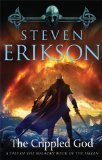
REVIEW: The Crippled God (Malazan Book of the Fallen, Book 10) by Steven Erikson


My apologies for posting this on Wednesday, rather than Tuesday. I know I’m late, but I got caught up with day-job work and so…sorry. Hope the timely review makes up for the delay.

The Crippled God by Steven Erikson Title: The Crippled God: Book Ten of The Malazan Book of the Fallen
Author: Steven Erikson
Pub Date: March 1st, 2011
Chris’ Rating (5 possible): 1 point 1 point 1 point 1 point 1 point
An Attempt at Categorization If You Like… / You Might Like…
The impressive culmination of an epic eleven years in the making.

The word “epic” gets thrown around more often when talking about fantasy than a well-aimed dagger. I’ve seen it applied (and done so myself) to Tolkien, Brooks, and Donaldson, to Jordan, Martin, and Eddings, to Jemisin, Rothfuss, and Sanderson, and the list goes on. In most of these cases, the word “epic” is an apt descriptor. But I would argue that Steven Erikson and his ten volume Malazan Book of the Fallen out-epic all of these other epics in its epic-ness. The world created by Steven Erikson and Ian C. Esselmont, each individual book in Erikson’s series, and the complexity of the story Erikson planned out from the beginning: each of these alone can be justly described as epic in scope, epic in scale. But in this genre that tosses around the E-word like it was going out of style, I believe that Erikson’s ambition is the most epic of all. And having now read Erikson’s The Crippled God, the tenth and final installment in his Malazan Book of the Fallen, I believe that Erikson delivered on the “epic” promised back in 1999.

DISCLAIMER: I am not saying that the Malazan Book of the Fallen is “better” than the Wheel of Time, or A Song of Ice and Fire, or the Belgariad, or Shannara, or insert-your-favorite-fantasy-series-here. However, I do believe that it is different. This difference especially applies to its world building and plot structure, and in many respects to its themes and characterization. In its plot structure and world building especially, I find it far more complex than those other series I just mentioned. But “more complex” does not mean better. It just means more complicated.

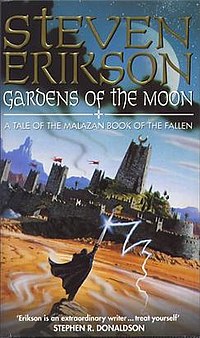
A little over eleven years ago I was waiting to board a transatlantic flight in Warsaw, Poland, idly browsing the tiny English-language section of a little airport bookstore, when I stumbled across a thick book. Tantalizingly titled Gardens of the Moon, by an author I’d never heard of before, and with a cover not-quite-sf/not-quite-fantasy by Chris Moore that instantly set it apart from the contemporary Chihuahua killer epic fantasies of Jordan, Martin, and Goodkind, I had to buy it. I spent the next nine or ten hours sucked into Steven Erikson’s visceral, violent, gripping world. Since that fateful afternoon, I have eagerly anticipated each new volume in Erikson’s opus, and so it was with childish delight (and squeeing) that I stumbled upon a copy of The Crippled God two days before its official pub date in my local Borders.

Gardens of the Moon (via Wikipedia)

Gardens of the Moon by Chris Moore (via Wikipedia)

To read Erikson’s work, one must be prepared to immediately suspend disbelief, and to dive headfirst into a world rich with layers of history, culture, politics, and mythology that would make Tolkien’s head spin. Readers not already well-versed in the conventions of the fantasy genre might find it all a bit confusing at first. But for those readers able to suspend their disbelief, and who are prepared to intuit or await elucidation, the Malazan Book of the Fallen is an immensely enjoyable series. The Malazan world was created by Steven Erikson and Ian C. Esselmont in their role-playing campaigns. But the two brought to their creation their extensive expertise in anthropology and archaeology, resulting in a world with intricate, distinct cultures, complex historical societal relationships, economic balances, and military history.

Over the course of the ten book series, we follow many (I lost count at around forty five) distinct groups of characters. Some groups are small, numbering maybe one or two members, while others are large factions with many characters going nameless. However, each of these groups is presented completely, meaning that they are drawn as round (using E.M. Forster’s definition), fully-fleshed characters. Erikson shows us everyone’s fears, doubts, concerns to such a degree that by the time we’re halfway through the first book, the very concept of “hero” and “villain” has lost all meaning. It is this moral ambiguity, this rationalization and justification of character choices and ethical mistakes, that drive the series’ themes.

The first five or six books in the series are self-contained wholes. The events of each book occur non-linearly, following several distinct “tracks” of events separated by both time and space. The main tracks comprise different books in the series, at least in the beginning. This makes it possible for a reader to start either with Gardens of the Moon (Book 1), or say Deadhouse Gates (Book 2), or Memories of Ice (Book 3).

Reading them in order of their publication, I was initially surprised and confused by their non-linearity. Where were the characters I had met and fallen in love with in the earlier books? What had happened to them? What were they doing? But like a master weaver, Erikson successfully introduces new strands while maintaining interest in those that came before. This separation across books in the series begins to collapse around Midnight Tides (Book 5), where a new reader coming into the story would be so completely lost in the whirling politics of gods, cities, armies, factions, squads, races, creeds, etc. as to make it an exercise in futility.

It is at this point in the series (books 6 – 8), that Erikson stumbles for the first time. This stumble is interesting to note, precisely because it touches upon his introduction of higher-level, more abstract philosophical themes into the story. The first six (arguably seven) books are largely plot driven. We follow the striving of different groups of characters – especially the Malazan military – as they attempt to achieve their goals. The books are thematically interesting, but there is a palpable sense that reader doesn’t yet know everything. In the sixth, seventh, and eighth books, Erikson thickens the plot by explaining more complex historical relationships, and introducing new gods, and new players. The introduction of this history, and metaphysical motivation for certain characters introduced in the eighth book, slows the pacing significantly. These latter books remain readable, but I had to read them at least twice in order to really understand what was happening. They are not bad, but they are much more dense than the other books in the series, and those books are already more dense than most epic fantasy fare. Thankfully, Erikson again hits his stride in Dust of Dreams (book nine) as he now has all of the actors on stage and moving towards the climax in The Crippled God.

And what a climax! The series tracks several hundred (again, I lost count) distinct plot lines. But they are all brought together in the tenth and final book. Perhaps more importantly, it is also in the The Crippled God that we see the thematic lines from the earlier books brought together. The thematic convergence in The Crippled God is one of the most impressive aspects of the series. Each of the earlier books has its own themes, which are in and of themselves complicated and well-executed. But after reading The Crippled God, the themes of earlier books are either clarified, corrected, or shown as illusory. Unifying these disparate (and oftentimes contradictory) themes without invalidating them is a neat trick, and makes the intellectual and emotional exercise of the whole series quite worth it.

From a stylistic standpoint, Erikson takes more from the gritty, boots-in-the-mud fantasy of Glen Cook than he does from the elf-and-dwarf high fantasy of J.R.R. Tolkien. Erikson’s primary characters are soldiers, and he draws them as imperfect, swearing, and swaggering. While dragons, and Erikson’s version of elves feature quite prominently, his characters are very far removed from Smaug or Legolas. It is the darkness and grit of his world that makes it compelling, that subverts the traditional tropes of the genre. Dragons as mad almost-gods? Heroes who (along with the reader) are ignorant of their quest, and just have to do as they’re ordered? These are fun subversions.

I found Erikson’s take on women in his books particularly interesting. Historically, I have often found fantasy to be full of stereotypical square-jawed male hero-types, with damsel-in-distress ladies swooning in the wings (if they are present at all). Erikson’s female characters are more likely to break a hero’s jaw than pine or swoon. They are soldiers, and conspirators, and commanders equal in all respects to the men, while still evidencing deft characterization that makes them fully believable. Both the men and women are flawed, emotional, sometimes angry, sometimes not. Erikson makes them complex, while retaining their intrinsic humanity. Which is refreshing in a genre often dominated by particular molds.

I have spent the past twelve years with these characters. Their stories have in many respects become a part of me, like old friends. The tenth book brings Erikson’s enormous cast of characters together, and wraps up their stories. With one or two (notable) exceptions, we learn what happens to everybody, how they end up. The tenth book is in many respects about closure, and Erikson unflinchingly brings the story of different groups and characters to a close. But – and this is one of his points – even though the book gets closed for some characters, life goes on. The unity of character, plot, theme, and execution in this tenth book is singularly impressive.

However, for everything good about his work, the complexity – of his characters, plots, themes – can be quite off-putting. One reader (whose opinions I respect greatly) very much dislikes Erikson’s work. She claims that it is too hard to follow, impossible to keep the myriad characters and plot lines straight even within a single book, let alone across a ten book series. For many readers, this will be a valid criticism. Erikson has produced a truly dense, complicated work of fiction. Myriad plot lines, more characters, complicated races that often go by different names, complex battle scenes shown from the perspective of multiple soldiers in the thick of it, this is writing that demands real work from the reader to keep things straight, to follow along with events. I found myself often having to read or re-read sections (and in some cases, entire books) just to really figure out what the heck actually happened. For many, this will be a weakness: why should I have to work so hard for my fiction? But I personally found that I enjoyed doing that work, that I enjoyed getting to spend time in an ugly, dark fantasy world that was realistically built while still employing the tropes of fantasy.

Back in 1999, Erikson told fans that the Malazan Book of the Fallen would be a nine book series. Like any gargantuan epic, this was an ambitious goal. However, Erikson executed on this ambition both in the creative sense, as well in the practical sense: publishers and fans like to see epic series come out with new installments on an annual basis. Publishers like it because it helps them push paperback editions of the earlier books, and fans like it because we can still remember what’s going on in the story. But in a sub-genre famous for delays (George R.R. Martin’s A Dance of Dragons has been delayed five years already and still counting), it is incredibly refreshing to come across an author whose ambition is so vast, whose story is so complicated, but who still manages to produce quality work reasonably on schedule. It’s refreshing, and my hat is off to Erikson for delivering on his vision.

Although I have read that Erikson is planning a new eleven book arc in the Malazan world, The Crippled God represents in many ways the end of an era. It is a masterfully-executed conclusion to a complicated, ambitious, dense opus. On the one hand, I am glad that the series is over, that Borders screwed up and I managed to get my hands on a copy several days before its official release, and that Erikson satisfied my (high) expectations from it. But on the other hand, I will miss the anticipation of the next book, will miss getting to laugh and cry with the characters I’ve enjoyed over the last twelve years.

Erikson’s Malazan Book of the Fallen is a complex, involving, and emotionally powerful epic fantasy series. There is no series more deserving of the word “epic”. Pick up a copy of Gardens of the Moon, and see if you like it. Be prepared to work at it, because it is difficult. But difficult does not mean bad, and rest assured that by the time you get to The Crippled God, you will find your investment has been fully justified and amply rewarded.

Malazan Book of the Fallen by Steven Erikson
Techniques in Writing Alternate History


For the past several months, I’ve been having a lot of fun reading recent alternate histories and historical fantasies (I’ve reviewed a couple in earlier posts). As a result, I’ve been thinking about how alternate history works, and what techniques apply to the sub-genre.

Divergence as the Elephant in the Room

At some point, all of us wonder about the road not taken. In our private lives, we wonder how life would have turned out if we’d gone to college B rather than college A, if we’d gotten (or kept) a particular job, etc. The same “what if” question gives rise to alternate history, where we try to imagine our world as made different. Whether the portrayal is fairly realistic (as in Harry Turtledove’s Timeline 191) or completely fantastical (e.g. Jonathon Stroud’s Bartimaeus trilogy), alternate history gives us the chance to consider what our world would be like in entirely different circumstances. And that’s fun, because it can give us insight into our own world, culture, and history today.

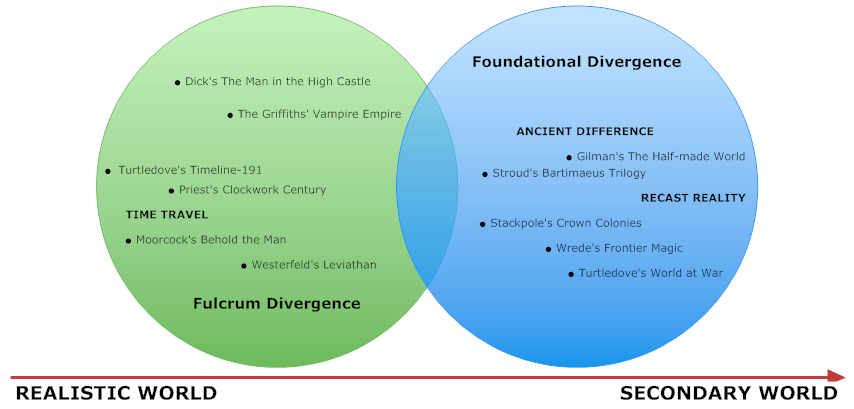
Because alternate history is so centrally concerned with what sets the imagined reality apart from our current reality, how the timeline diverges must be established very early on. Thinking about it, I’ve spotted a kind of spectrum of divergence in alternate history:

Spectrum of Divergence Techniques in Alternate History

Spectrum of Divergence Techniques in Alternate History

On the one hand, we have what I call fulcrum divergences. This method is most commonly found in “realistic” alternate histories, which lack magic, monsters, or really anything that could not exist in the real world. Some event is identified as a fulcrum on which history swings, and when creating the story we have things work out differently.

The best example I can think of for this type of alternate history has to be Harry Turtledove’s How Few Remain. In our real history, a Confederate messenger lost General Lee’s plans for the invasion of the North. The Union found the plans, and General McLellan was able to turn the Confederates back at the Battle of Antietam. Turtledove asks “what if the message never fell into Union hands?” and proceeds to create an excellent series of realistic novels that paint a Confederate victory and map out the consequences through World War II. Such “little differences” need not be so minor, however: Philip K. Dick posited a world where the Axis Powers won WWII in his classic The Man in the High Castle, nor need the resulting world be particularly realistic (consider Scott Westerfeld’s Leviathan series, where Darwin discovers DNA). Even fairly fantastical stories like Clay and Susan Griffith’s Vampire Empire series still rely on that one point where history changed. Universal within these stories is that the world’s history follows the familiar path we should all know up to that one key fulcrum moment when it skews Doc Brown-like into an alternate timeline.

The other end of the spectrum are foundational divergences. Typically used in more fantastical alternate histories, foundational divergence occurs so far back in the story’s timeline that its effects percolate through all aspects of the world. The place names, some of the personalities involved may be familiar to us, but they are already skewed relative to our timeline based on events that happened significantly prior to the events of the story.

In Stroud’s Bartimaeus trilogy, Patricia C. Wrede’s Frontier Magic series, or Michael A. Stackpole’s At the Queen’s Command magic has been known and applied within the world for centuries. There is no “point of divergence” with our known history, because instead the impacts of magic diffuse throughout all aspects of society, history, and cultural development. The key difference between such alternate histories and those relying on fulcrum divergence is that all recorded history has to be different from what is known. In these books, the foundational difference (e.g. the presence of magic) occurred or was discovered so far in antiquity that its consequences have percolated throughout the world. As a result, such books can often be enjoyed as secondary-world fantasies.

Between these two poles lie a variety of techniques that authors can use to establish that divergence. Often, authors use a time traveler from our timeline to introduce the divergence. Once in the past, the time traveler proceeds to change (or – sometimes not) the past as we know it.

Excellent examples of this kind of alternate history include books like Eric Flint’s 1632, Michael Moorcock’s Behold the Man and Mary Gentle’s First History sequence. In many respects, these books are similar to those that use a fulcrum divergence: in this case, the time traveler becomes the fulcrum. However, they differ significantly in that typically the protagonist (the time traveler) is aware of the divergence or its possibility. This changes the dynamic of the story and significantly alters the reader’s relationship with the hero.

On the opposite end of the spectrum, one can have an “alternate history” that completely recasts our known reality, which does not take place in any kind of recognizable version of our history. Here, the events of the book are modeled on actual events in our history, but they are depicted in a completely secondary world.

Turtledove’s World at War series employs this technique, depicting the events of WWII in a completely secondary world. Felix Gilman’s The Half-Made World (see my earlier review) similarly (though less historically) models aspects of his world on the American frontier.

Maintaining Suspension of Disbelief in Alternate Histories

The key to constructing an effective alternate history is to keep the reader locked in what Gardner calls the “dream” of the novel. This task is particularly challenging in alternate histories, where the reader knows they are reading something inimical to their pre-existing knowledge of the world. As a result, readers are likely to quickly pounce on perceived flaws, places where the author’s research or techniques fell short. There are several tools that can be used to maintain the reader’s acceptance of the alternate history.

The perspective that the book is written from, and the narrative voice that is employed, are both essential tools to maintain the reader’s disbelief. This is doubly-so if the book is written in first-person, but even when written in third the speech patterns, word choices, and value systems that our narrator employs contribute to the milieu of the era we are depicting. Recently, I read two alternate histories that execute on this aspect perfectly: Cherie Priest’s Dreadnought and Michael A. Stackpole’s At the Queen’s Command (see my earlier reviews here and here, respectively).

In both books, the narrative voice and the dialog employed by the characters rings (at least to my ear) true to the period when the books are set. The words key characters employ, the value systems inherent in their views, the differences in how different characters speak, in both books the quality of voice and dialog help to lock the reader into the alternate history. In At the Queen’s Command, the dialog is strongly reminiscent of other accounts of the late 18th century. As a result, I am able to believe that while there may be magic, I am still reading a story set in the 18th century I am familiar with. The same applies to Dreadnought, which follows a southern Confederate nurse across the frontier.

Nailing the voice like this is partly a question of the writer’s natural ear, but it is also heavily influenced by research. Reading books written in and written about the time period can help provide the “feel” of that time period. And solid research on word use and etymology can help make sure that the dialog is period-appropriate (as Mary Robinette Kowal pointed out recently, people swore differently even one hundred years ago). Research and extensive reading are the keys to nailing this aspect of an alternate history.

But there is a flip side to this coin: When we write alternate histories (or even historical fantasies) there is an understandable temptation to shoe-horn massive amounts of research into the text. After all, not everyone is as familiar with the time period as the author. But this natural tendency has to be handled very delicately because people who enjoy alternate histories are likely those who enjoy history. As a result, they are likely to already have substantial knowledge about history, and thus overloading them with historical information may weaken their engagement with the story.

In historical fantasy, this is a danger that I recently observed in Jasper Kent’s otherwise excellent Twelve. Kent clearly knows the history of 19th century Russia, however in many places he assumes that his readers do not. For some readers, this is likely not a problem. But for those of us who are familiar with that time period, the extensive expository background that Kent provides detracts from the rising action of the story. Striking a balance between that need for background and the forward motion of the story is key to writing any story based in history. When I think about the authors who do this well, they apply the rule of “less is more” and leave the reader to infer whatever background they do not already know. If we have to pick between momentum and background, I say always go for momentum.

Imagining a Different Today

If futuristic science fiction is about imagining a possible tomorrow, then alternate histories are about imagining a possible present. This at once constrains our world-building (to a greater or lesser degree, we have to conform to known history) while providing the opportunity for very focused imagination. When I read excellent alternate histories, I often think that it is much harder to paint a maserpiece by coloring within the lines. But the best authors of alternate history manage to do exactly that.

If you’re looking for fun alternate histories, below is a list of the authors and books that I’ve mentioned in this post. I strongly recommend you pick up a copy, from your local bookstore or your library and enjoy:

REVIEW: The Keep by F. Paul Wilson


The Keep by F. Paul Wilson Title: The Keep
Author: F. Paul Wilson
Pub Date: December 7th, 2010 (reprint)
August 1981 (original)
Chris’ Rating (5 possible): 1 point 1 point 1 point
An Attempt at Categorization If You Like… / You Might Like…
A gothic horror novel with an interesting monster, solid early tension but a disappointing climax.

In The Keep (first in his Adversary Cycle), F. Paul Wilson does an excellent job subverting staid vampire tropes and reveling in the devices of Gothic horror. Wilson’s deft command of craft as shown in his management of setting, and the gradual reveal of his monster make this book a worthwhile purchase.

Set in 1941 in a remote mountain keep high in the Romanian Alps, the book pits two inhuman monsters against each other. On the one hand, we have the Nazi army. The Nazis are realists, hard-hearted murderers marching across Europe, slaughtering innocents by the millions. On the other hand, we have a supernatural monster (possibly a vampire, possibly not) who brutally murders Nazis one-by-one in the night. With a setup like this, Wilson has an opportunity to do one of four things: he can turn the vampire into a hero (a fun role reversal for a traditional monster), he can turn one of the Nazis into a hero (a challenging prospect, considering their historical baggage), he can show both as somewhat-justified, or he can show both as monstrous. Wilson primarily chooses to take the easiest of these four paths, keeping both the Nazis and the creature who murders them monstrous.

Klaus Woermann, a disillusioned Nazi officer, is given a somewhat-punitive assignment to guard a remote Romanian castle. Throughout the book, Woermann is the only Nazi depicted in any kind of positive light. He is painted as conflicted, not enamoured of the fuhrer, and disgusted by what the Nazis are doing to the Jews. The scenes written from Woermann’s perspective are interesting in that they show a tentativeness in Wilson’s characterization that is absent when he writes from other (less morally ambiguous) characters, like Magda Cuza or the SS commander Kaempffer. It is unclear to me whether this tentativeness stems from the author’s uncertainty as to how sympathetic to make the Nazi, or whether it stems from Woermann’s own uncertainties as to his loyalty. Irrespective of the source of this tentativeness, I found it an interesting aspect of the character that lent some degree of depth to him.

When Woermann’s troops are stationed in the mysterious keep, they inadvertently set loose a monster that had been trapped there, presumably for centuries. The monster proceeds to murder Woermann’s men, one Nazi per night. As more of his troops are murdered, Woermann eventually gets assistance from the SS through Erich Kaempffer, an absolutely monstrous officer who gleefully intends to set up concentration camps in Romania. The SS officer, and all of the troops under his command, are painted as absolutely inhuman creatures. There is no moral ambiguity, no tentativeness in their characterization. They are vile, cruel, and vicious. Thankfully, they don’t quite veer into the realm of caricature, but their commander at times comes perilously close.

The scenes of terror told from the Nazis point of view are absolutely delightful: Wilson never shows us the monster directly, instead revealing the effects the monster has on the environment and the Nazis themselves. Because the Nazis are never made entirely sympathetic, our fear is kept slightly distanced. Some might view this as a weakening of the book’s horror, but I felt that it actually helped make me more aware of the monster and his actions. The result was to leave the reader uncertain what kind of monster we are dealing with, while slowly building the tension through solid pacing. The monster shares certain traits with a Dracula-esque vampire, but there are enough new and different traits to leave the Nazis (and the reader) unsure of what we are dealing with. Wilson’s restraint is used to excellent effect in these scenes, and they leave the reader hungry to learn more about the monster’s nature.

Unable to stem the loss of life, the terrified Nazis turn to Josef Cuza, an ailing Jewish expert on local folklore, and his daughter Magda. These two characters are the only purely noble characters in the book. The scenes told from their standpoint make it clear that they are sympathetic, righteous, honorable folk…nothing like either the Nazis or the monster. This portrayal of the Cuzas is perhaps one of the better pieces of characterization executed in this book. By setting the Cuzas up as purely good, fundamentally righteous, innocent, and noble, Wilson sets them up for a beautiful fall. To avoid spoilers, I won’t go into the details but it is exactly the Cuzas characterization and how it subtly changes over the course of the book that lends the novel its thematic tension.

The readers learn more about the monster as the Cuzas work to unravel the mystery of what is killing the Germans. The gradual reveal of the monster continues Wilson’s tweaking of the vampire mythos. Throughout, Wilson keeps the monster almost, but not quite, a classical vampire. At one point, Josef Cuza remarks that the monster might not be a real vampire as the myths give us, but that it might be a real creature that at one point inspired those myths. That the reader can believe this theory is a testament to the fine line between classic tropes and innovation that Wilson used to depict the supernatural monster at the heart of this book.

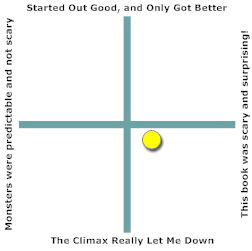
The tension in the book is very well managed, right up to the moment of the final reveal. Throughout the first eighty percent of the novel, Wilson raises the stakes and the reader’s expectations. By the time the truth (and the monster) are fully revealed, the reader expects something powerful, dark, and gritty. Instead, the explanation introduces a cosmology that the reader had little preparation for earlier in the book. The surprising cosmology is clearly a setup for subsequent books in the Adversary Cycle, but here in that series’ first book it struck me as deus ex machina. While the surprising cosmology weakened the climax, the climax remains reasonably solid: the action is dramatic, the stakes and tension significant. But the climax falls just shy of the very high expectations created by the excellent majority of the novel.

In all, I would say that The Keep is a solid work of horror, with good characterization, excellent tone and setting management, and fine control of tension right up to the climax. Wilson’s depiction and gradual explanation of the monster is exceptionally well done, and the way he undermines certain character’s righteousness is poignant and sensitive. However, the excellent ingredients that make up the bulk of the book leave the expectations very high for the climax, which is weakened by the introduction of an unestablished cosmology. Fans of Gothic horror will find much to enjoy in this book, and I am curious how the remaining books in the Adversary Cycle develop the cosmology further. Having introduced it in the series’ first book, I suspect (and hope) that the subsequent installments will make more effective use of it.

Artist Interview: Elizabeth Goldring


A little while ago, I had the pleasure of commissioning a work of art. Why it was necessary…well we won’t get into that. But I needed a practically life-size baby sky bison (as in, the six-legged flying bovines from the Avatar the Last Airbender cartoon). In doing so, I had the pleasure to work with Elizabeth Goldring, a young artist just starting in the business. Working with her, I thought it might be interesting to do an interview with her and get a visual artist’s perspective on some interesting questions:

1. As a new artist breaking into the field, how would you describe your work?
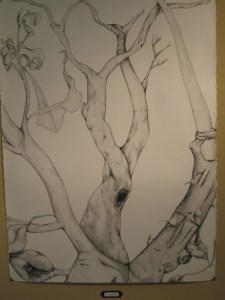
I like to make work that is subtle yet striking. I enjoy the idea of creating a beautiful object, be it a drawing or a sculpture, that has a quiet strength. The imagery that I use tends to be unusual or unsettling but not shocking or loud. I draw on nature, mostly plants and animals, though sometimes the figure as well. I like to do a lot of different things. I think one of my biggest issues is that I have so much I want to do but only 2 hands and 24 hours in a day.

Cryptobotany by Elizabeth Goldring

Cryptobotany by Elizabeth Goldring

2. What do you think has had the greatest impact on your work? How do those influences affect the work you do on commission versus the work you do for yourself?
I would say that my own experiences have had the greatest impact on my work. My personal pieces tend to be heavily autobiographical though not necessarily in the conventional sense. It’s really in regard to the emotional content, not so much the subjects themselves. The pieces tend to require a lot of repetitive almost meditative actions and in that kind of mindset I end up imbuing the pieces with emotion as opposed to concept.

Commissions are always going to differ from the personal simply because I am producing something to please someone else as opposed to myself. Then there is the difference between commissions that are someone else’s concept that require approval from the buyer versus commissions where I am essentially given free reign. Even in those situations though, I still enjoy the process and I like to think that the work still has my mark.

3. Aspiring writers are usually told to read, read, read. Is there some similar advice for aspiring visual artists? What kind of value does it provide?
The usual advice is know your predecessors as well as your contemporaries, so its a combination of look look look and read read read. It’s important to know where you come from artistically, to know your influences. The past can inspire you in a lot of ways, whether it’s finding something in it that you admire or coming across something that shows what you don’t want to do. Art comes from Art, it does not exist in a vacuum.

4. When working on a piece, what’s your process like? How do you set the priorities for your work in general or for a particular piece?
My process varies depending on what I am working on. Drawings tend to be a little bit more organic while sculptures require more planning because of materials tests and mockups. Drawings still require some planning, but that’s usually just some loose sketches to get a feel for proportions and to try different compositions. Once the initial tests and sketches are done I try to just sit down and work for as long as I can. Sometimes I can work for 8 hours or so only stopping to eat or stretch, other times I can only focus for an hour. Even if I feel like I can keep working after a long sitting I try to walk away from it for a little while so I can come back to it with a fresh eye and see what needs changing. It can also be difficult to know when something is “Done;” walking away is key here so that the piece doesn’t get over worked. There is always more that can be done but there is not always more that should be done and some time away from the work helps in that decision. The finished piece is important to me, but honestly I tend to get lost in what I am doing. I really enjoy the process, it makes me feel calm in a way that few other activities do.

5. How do those priorities translate into your broader opinions on art and its role/function in society?
I was once told by a professor that making art is the most self indulgent thing a person can do with their life. I think that sums up how I feel about making art fairly well. I will admit, as an artist I am fairly selfish. I love what I do but I do it for me, I have no grandiose ideas about my work changing the world or the face of art or anything like that. I am not attempting to raise political or social awareness or make a “statement”. These are the functions generally associated with art and its purpose, and these are completely valid for some artists, but not really for me. I take a much more hermetic approach to what I do, it is about making things that I think are beautiful and convey the emotions that I need them to. If other people can connect with it on a similar level, then that is a really successful piece, but at the end of the day I am the one who has to be square with what I have created. Again, a lot of this is about the act of doing for me so it is difficult for me to think about their function outside of that. In an ideal world the person who looks at the piece finds something in it akin to what I felt while making it. For some art is a vehicle for some greater message or statement. For others its not.

6. Is there a divide between the “fine arts” and “illustration”? If so, where does that divide come from? Should it exist? And which side of it do you fall on?
There is a definite division between fine arts and illustration, though not as much in recent years. The division usually comes from the idea that fine artists decide what they will make and how they will make it, with only themselves and their intentions in mind. Illustrators have traditionally been seen in a commercial light; usually they are a way of realizing someone else’s vision. There are many illustrators being featured in fine art galleries now, and there is more acceptance of them than there was though I still hear the term “illustration” used as a derogatory term towards drawings. I think the difference really comes from the intention of the work. It’s all a gray area that is open to a lot of debate.

7. For writing, I’ve always believed that technique/craft is one half of what makes great art. Is it the same for the visual arts? And do all visual artists feel that way, or just you?
Personally I think technique is definitely a large part of a successful piece, this holds true for some artists and not others. For some people the concept is the entire point and execution is merely a formality. In the conceptual art movement of the 60s it got taken so far that some artists thought it was enough to come up with the idea or instructions and that it wasn’t even necessary to bring it into physical being. That approach: not for me.

8. Many writers say that the art of writing is the art of re-writing. Does your work go through any kind of editing or revision? How does (or doesn’t) that work?
I think the revision process is a huge part of art making. I do a lot of revisions and editing during the preliminary sketches; that is part of the entire reason to do them. They are like a rough draft. Just as in writing, it’s about trimming things down or adding things in. Revisions can vary in difficulty from piece to piece depending on the materials. A graphite drawing is easier to revise than ink, a clay sculpture is easier to revise than stone etc.

Regeneration by Elizabeth Goldring

Regeneration by Elizabeth Goldring

9. Can you tell us anything about the stuff you’re working on now? Or where can we see any of your work?
At the moment I am working on a series of drawings as well as some sculptures. The basic premise is documenting strange and anomalous occurrences in nature. Specifically plants and animals. It plays off the human tendency towards anthropomorphizing the world around us and our capacity to love what also repels us.

I am currently part of a show at the Visual Arts Gallery in New York City (601 West 26 Street, 15th Floor, New York, New York) that will run through February 15, 2011. I also have a blog where people can see my past and current work until I compose a more formal website: http://egfineart.blogspot.com/

So with great thanks to Elizabeth and her insightful answers, I think the best way to sign off is to show the results of my own commissioned piece. Here’s Baby Appa, relaxing in front of the fireplace (I apologize for being a lousy photographer – the picture doesn’t really do justice):

Baby Appa by Elizabeth Goldring

Baby Appa by Elizabeth Goldring (mediocre photo by King of Elfland's 2nd Cousin)

An Approach to Re-writing a First Novel


Several months ago, I wrote about my perspective on the differences between writing a novel and writing a short story. Now, several months later I’m knee-deep in re-writing that first draft of the novel, and so I thought it might be neat to follow up on my earlier comments:

Distance Buys Perspective

Writing a novel is an intensely personal investment, made over an extended period of time. It can take months or years of our cogitation, sweat, and emotional turmoil. It’s never far from our minds. We lie awake in bed thinking about how to do certain things with it (at least I do). By the time we write “The End” we’re relieved and rightly proud of our creation. And – I at least – wanted to dive right into re-writing it.

But that’s not wise. Because after we’ve just finished writing the book, it’s still up at the forefront of our minds. The characters names roll off our tongues, and we could recite the events of the plot backwards and blindfolded. Even if we can’t recite the text from memory, we still know what the sentences should say. At this point, we’re too close to it for effective revision. Where the story has narrative pot-holes – missing plot points, pacing issues, clumsy writing – our minds fill them in, gloss over them, because we know how it should work. It’s like having beer-goggles on: our minds won’t let us see the reality.

Which is why all of the smart advice out there tells us to wait. To put the book away. File it in a drawer, forget about it for a couple of weeks, or a couple of months, work on something else and then come back to it. Coincidentally, Kay Kenyon – one of my favorite science fiction authors – just posted about this exact issue. Unsurprisingly, I agree with her with all of my heart. But, like avoiding sweets and getting regular exercise, it’s not easy.

Letting it settle is one of the hardest aspects of writing a novel that I’ve discovered. While waiting to go back to my first novel, I took the time to write a second novel (okay, technically a graphic novel – but I figure it counts). Even though I intellectually know that I need to leave that graphic novel aside and let it settle, I still want to dive right into it and do the re-write. Which, much as I am loathe to admit it, is probably proof that I’m still too emotionally and intellectually close to it for proper revision. But it really makes sense to resist the temptation, because it lets us spot weaknesses that otherwise we would miss.

The Re-writing Attitude

Getting ready to re-write my first novel has been a mix of trepidation and hubris. On the one hand, I’m worried that as I take another look at it I’ll discover that it sucks. Then my ego kicks in and says “What are you talking about, the book is great, it can’t possibly suck.” Of course, that ego is a thin veneer over my own insecurities (which, of course, I quash). Which is why I found it helpful to keep the following statement in mind as I sit down to re-write:

Most first novels don’t get published. It’s okay if it sucks: we re-write to make it better.

Ask a bunch of authors how many books they wrote before they ever got an agent, or before they ever sold one to a major house. The number will surprise you. I’ve regularly heard debut authors talk about having five, six, seven finished novels (sometimes entire series!) in their drawers at home. That’s because writing a novel is a skill, and it is a skill that takes time to hone. Writing short stories can help with some of the craft, but it takes a different set of skills to write a great novel. In many ways, I think of it like playing a sport: how many games did Babe Ruth have to play before he could hit a homerun in the major leagues? How many pick-up basketball games did Michael Jordan play before setting foot on an NBA court?

It’s alright if the first draft of a novel sucks. That’s why it is the first draft. Because, if we’re serious about writing, we’ll produce a second draft that will be stronger than the first. And if need be, we’ll write a third draft that’s even better than the second. And at some point, perhaps, the finished product might be polished enough for publication. And if it isn’t, well then the skills we’ve picked up and practiced will help us write our next book, which will be better than our first. At least that’s the theory.

The Process of Re-writing

The Professor – my fiancée who edits YA books for a living – gave me some really good advice on the re-writing process. Of course, being male and knowing better, I promptly ignored her excellent advice and it bit me in the ass. Her advice on the process of re-writing:

Don’t sweat the small stuff.

When I initially picked up my first draft and started to read it, I did it with pen in hand. I dove in and attacked clumsy sentences, poor word choices, weak verbs. In the trade, this is called a line-edit and apparently it’s a classic first-time novelist mistake. The point of the re-write isn’t to fix the little flaws that have crept into the work. The point of the re-write is to spot the BIG structural weaknesses. If we’re bogged down in the minutiae of the sentences, we’ll never see the yawning pacing chasm or the gaping plot hole. We won’t see the forest for the trees.

I realized this about mid-way through my book. I had a niggling concern about a structural issue (the pacing), and it just wouldn’t leave me alone. But I couldn’t diagnose the problem effectively, because by jumping right into the sentences, I had gotten in too deep, too quickly. So I had to put it down again, walk away from it again, and then approach it a different way.

My second time around, I followed The Professor’s advice, and read it just as a first time reader would. I read through it – cover to cover – without a pen in hand. I was reading it like I hoped a typical reader (or an agent, or an editor) would. I was paying attention to my response to the text, to see where my interest flagged, where the story got my heart racing. I wanted to find where the book worked well, and where it lost me. Sure, I still saw the occasional weak sentence. But I resisted the (often difficult) temptation to pounce and fix it. Instead, I tried to figure out if the bones of the story worked.

Here’s what I found (in ascending order of importance):

  1. The events of the plot – at a general level – work reasonably well.
  2. The world-building seems reasonably solid, with compelling settings and believable (and interesting) factions/characters.
  3. The themes of the book can be emotionally and philosophically interesting.
  4. I lost interest around the 25% mark, and didn’t have interest until the last 5% of the book.

That last one is really important: reading through the book, it fundamentally failed the “So what?” test. That failure was evident in the way that the book slowed down and lost the reader’s interest. That, however, is just an observation: a fact. It told me nothing about why it lost the reader’s interest. In thinking it through, and discussing it with The Professor (who was awesome enough to take a look and give me a professional’s opinion on where I dropped the ball), the major failing’s cause was the protagonist’s motivation. It didn’t ring true, it didn’t work, and as a result, the reader just didn’t care.

Responding to a Major Flaw

That’s a major, major super-mega-important flaw. Characters are their motivations, and so if the hero’s motivation isn’t compelling…well, the story’s missing its fuel. That’s also not a quick fix. That’s not something that can be addressed by “sticking it in” as an editorial after-thought. To get that kind of motivation right, it needs to be ever-present throughout the story, from the first sentence all the way through to the last. And it should have really started with a question I’d failed to ask myself at the onset: why is my hero the hero?

The answer – if I’m being honest with myself – is that in the case of this novel, his was a convenient perspective and I wrote the opening chapters with a nifty voice that I happened to like. Alas, that’s not enough of a reason. So back to the drawing board. I took a look at the story, rotating it in my mind and considering all of the characters’ motivations and trying to determine how I could find/develop a more compelling hero. As I did this, I found the answer staring me in the face: the book had a major character, who did have motivation, and who was compelling…he just wasn’t the original focus. The solution (perhaps) would be to make that character, or someone like that character the hero.

Of course, this would mean re-writing the whole book. I wouldn’t be able to keep the eighty-three odd thousand words I’d written over the course of five months. I’d have to junk it, and basically start from scratch. That is not an easy call to make. It took a lot of work to write those words, and some of those words were (I think) pretty good. But I faced two basic choices: I could either trash the whole novel, or I could take another stab at it by writing it all over again from a different perspective. Rather than throwing in the towel, I decided to (literally) re-write it.

My reasoning was pretty straightforward: the bones of the plot, the world-building, the themes, they were all solid. I had gotten them right once, I could get them right again. It was my hero/narrator characterization which had failed. I’d written a book once, right? Surely I could do it again. So I decided to re-write it. This also gave me the opportunity to re-imagine what kind of motivation I wanted to give my (now-different) hero, and to play with the components of the plot to add more tension and raise the stakes. It’s an opportunity to take another stab at the whole project, and make the whole thing that much stronger.

Looking to the Future

And so now that’s what I’m doing. It’s early days yet. I’ve got a revised outline in place, and I’ve re-written the first couple of chapters. I’m thinking that maybe, as I get further along in the re-write, I might be able to re-use some select passages from my earlier draft. But I’m not certain of that. If I can, great. If not, no big loss. The actual process of writing the book is going smoother (and it seems faster) than on the first go-around. That’s probably because I’ve been living with these characters and this world in my head for almost a year now. It also suggests to me that I’m on a better track: the experience is reminiscent of writing the graphic novel I finished a couple of weeks ago, which has much simpler motivation (it might have other issues, but the motivation at least should be pretty solid).

I don’t know if this re-write will make the book good enough to vie for representation and publication. I’m hopeful, but if it ends up not being good enough…well, that’s alright, too. Because the process has taught me a lot about myself as a writer and about some of the skills that are essential for writing long-form work. And so even if this first novel ends up collecting dust in a drawer, I’ll still say it was damn well worth it.

Where are America’s science fiction, fantasy, and horror specialist retailers?


I spent last week in London on business. I love London, even in chilly, misty, drizzly January. One of the reasons why is because it is home to Forbidden Planet, the world’s largest and (to the best of my knowledge) only chain (though technically a pair of chains – see update below) retailer specializing in science fiction, fantasy, and horror products. The London megastore sits on two floors, stocked to the gills with action figures, comic books, graphic novels, trade and mass-market books, and DVDs: if it is genre, odds are you can find it there. Split between two somewhat-related separate companies (Forbidden Planet and Forbidden Planet International), the Forbidden Planet brand name offers twenty-five different locations in the United Kingdom. If the United Kingdom – home to sixty two million souls – can support twenty five chain outlets, why can’t the US – with five times the population – do the same?

UPDATE: Just a word of clarification since the above might not be clear: Forbidden Planet and Forbidden Planet International are in fact two separate companies. The former has nine stores in the UK, while the latter has thirteen branded outlets in the UK, one in Ireland, one in New York, and two other associated (though not branded) stores in the UK. While the two were related in the past (per Wikipedia), they are now operated as two completely independent companies. However, this fact does nothing to detract from the main point of this post: where are our genre chains in the United States?

Both countries have their share of general media retailers: the United States is home to Borders, Barnes & Noble, and Best Buy. The United Kingdom is home to W.H. Smith and Waterstone’s. Despite the ever-present moans of indie media outlets (whether booksellers or comic book shops), both have reasonably vibrant indie communities. I find it unlikely that the UK has a larger number of genre fans as a percentage of the population than the United States. If that were the case, then the UK would host a far greater number of genre publications (pro, small-press, and amateur) than it does.

Forbidden Planet (at least the London megastore, which admittedly may not be a representative sample) knows the genre business far better than its more general counterparts. The store is clearly divided by product type. Action figures, novelty items, and gaming are in one area. Anime, graphic novels, comic books, and regular books are in another. The book section is impressively stocked and organized along broad genre lines. Each section is consistently sub-divided, with its own “New Releases”, a “Chart” section where top-sellers are shown face-out with shelf talkers, and a general stock alphabetically arranged by author. This structure makes navigating the shelves a downright pleasure. Identifying what is new, and spotting what is performing well within a given category is very easy – whether you’re familiar with the genre or not.

This type of organizational scheme would be unimaginable at a general retailer. However, it is not a product of the stocking teams’ deep knowledge of the genre. Instead, it is the product of solid operational management. While visiting the store on a Tuesday mid-afternoon, I got to watch shelves being re-stocked. The stocking teams used netbook computers with bar code scanners to control inventory and shelf placement. This makes it possible for even new employees without genre familiarity to stock shelves properly. Forbidden Planet earns a gold star in shelf management in my book, especially when compared to recent experiences at (the admittedly beleaguered) Borders.

Several weeks ago, I was looking for a copy of Scott McCloud’s Understanding Comics: The Invisible Art. I went online, and the Borders web site told me that it was “likely in store” at my local retailer. I drove on over, and proceeded to check the in-store computer. It told me to check in the graphic novel section, where I was patently unable to identify any organizational method. Seeking help from an employee, I was told that it was in fact in stock, and that it would be in the criticism section. Of course, it was not. I checked with a different employee, and was told it would be in with the art books. And of course, it was not. Contrast this ordeal with the simple process of stopping by Forbidden Planet, wandering through the graphic novel section, and finding it precisely in the “M” section of independent graphic novels. I would expect to find this title in both stores, but the operational management of Forbidden Planet left me a satisfied customer while Borders failed me.

The United States has its share of specialist booksellers. Whether it is Borderlands Books in San Francisco, or Pandemonium Books and Games in Cambridge, Massachusetts, many offer a fine selection and deep understanding of genre style and history. However, as a general rule these bookstores are independent one-location operations. This is not a criticism, merely an observation. With so many genre fans in the US, perhaps we, too, could support a chain of specialist media stores like Forbidden Planet? Economies of scale would help with profitability (the interminable lament of the indie bookseller), while technology would make operations and quality-control easier across a network of locations. On an early Tuesday afternoon, the London store was reasonably full of shoppers and needed two cashiers to service the line of customers waiting to buy. Why doesn’t America have something comparable?