Skip to content

Archive for

Why Process, Criticism, and Theory Can Be Good for All Writers


What’s the fastest way to start an argument with…
The Professor? Advocate an analytically-driven, engineered writing process.
Chris? Advocate process-less, instinctive writing (“Just write!”)

Obviously, this is one subject on which my wife and I disagree. Sometimes quite vehemently. And this is also an argument that I’ve seen writers manifest in the perennial debate over outlining, writing synopses, or just seat-of-the-pantsing it.

Why Seat-of-the-Pants vs Outline is a False Dichotomy

That question, beloved of the interwebs, is bogus. For a story to be effective, it must be coherent on one or more levels. And coherence in narrative results from having a plan. If a story didn’t have an underlying plan, it would be stream of consciousness and word association. And while some few (*cough* James Joyce *cough*) may have pulled it off, most of us won’t. The real question is one of timing, worldview, and brain wiring.

Let’s posit two (obviously extreme) writers: Jane Outline and John Pants. Obviously, Jane likes to map out the events of her story before sitting down to pen some prose. John, by contrast, sits down and lets his characters tell the story. Both John and Jane still execute on a plan. The real difference is when each prepares that plan.

Jane, with her spreadsheets, notes, and color charts front-loads a great deal of the work. Before she writes her opening sentence, Jane knows what her characters will do at each stage of her story. She knows what motivates them, and how they will react to the situations she puts them in. For her, the act of writing is more a question of finding the words to best express actions that she has already mapped out. The events of her story will rarely surprise her, but her execution might.

John, by contrast, sits down with a character, a voice, or a sentence. He has a hook that brings him into the world of his story, but beyond that he doesn’t know much of where the story is going. After he writes that first sentence, or the first paragraph, he lets the character/voice guide him. The story that unfolds might surprise him, though he counts on his facility for language to express that story as it makes itself apparent. If John has a plan, he makes it up as he goes: he knows what will happen in the next sentence, the next paragraph, or the next scene. But he might not necessarily have an end-goal in sight. His plan is gradually uncovered in parallel to the story.

Both plans come from the heart of storytelling in our souls. Those of us wired like Jane might consciously try to tap into that wellspring, while those like John might have to negotiate access on a moment-by-moment basis. But if we want to write at a professional level, we need to develop the capacity to touch that heart of storytelling whenever we need to. Waiting for the elusive muse, or relying on some ritual, is counterproductive and inhibiting. And that is something that the Professor and I agree on. So how can writers – regardless of whether they plan ahead of time or not – develop the capability to build stories? While at its most basic level the answer is practice (or as the Professor tells me constantly: Just write, dammit!), I think the more complete answer depends on how our brains are wired.

Creative Tools for the Analytical Writer

I’m a fairly analytical fellow by both nature and training. I see patterns and systems just about everywhere (whether they’re really there or not). When I sit down to write, I try to think of it in terms of systems and processes. This isn’t to say that I write by the numbers, but I find that I will always try to build a conceptual framework around whatever writing project I’m working on at any precise moment. Sometimes, that conceptual framework manifests itself in an outline, other times in a synopsis, and sometimes (usually when I write short fiction) it stays in my head. But the quality of those conceptual frameworks, and the tools that I can apply to them are actually the result of critical theory and extensive analytical reading.

I try to read as much critical theory as possible. And since I write primarily in the speculative genres, I also read heavily in genre theory. If your only exposure to critical theory has been Derrida (ick) or most of the other post-modernists, then I strongly suggest you take a look at some of the more formalist schools of thought: there’s a lot of value to be found there. I’ve found that useful critical theory expands my conceptual vocabulary, and gives me a way of thinking about story structure, character archetypes, and narrative techniques. Unlike how-to-write books or blogs (which can also be helpful), most good theory isn’t didactic. It’s diagnostic: it describes what the investigator sees in the field, rather than what a practitioner should do.

Why is this helpful? It explains what other authors, schools of writing, or genres have done. If I’m writing a fairy tale, I find that I keep Vladimir Propp’s Morphology of the Folktale close to hand. Not because I slavishly stick to the plot constructions he describes, but because he has laid out a time-tested architecture for fairy tale storytelling. I might choose to diverge from his framework, but if I do so, I do so consciously: I know where I’m diverging and why. When I write fantasy, I keep in mind Farah Mendlesohn’s categories of fantasy (from her excellent Rhetorics of Fantasy). Doing so does not limit my writing, but it expands my awareness of where my story might go.

Analytical reading is a way of consciously constructing my own conceptual vocabulary. When I read a story, in particular when I’m reading something for review consideration, I’m always asking myself what techniques the author used to manipulate the reader’s perception. I examine their effectiveness, and the reasons driving it. In essence, I’m creating my own internal critical theory that then informs my writing and affects how stories get constructed in the deeper recesses of my brain. A big part of this blog is actually my attempt to further systematize this nebulous personal critical theory and deepen my conscious awareness of it through its articulation.

“Theory is Boring, Didactic, and Risky,” says the Instinctive Writer

Our theoretical John Pants (and The Professor, and a who’s who list of amazing writers) would probably disagree with everything I just said above. They would say that theory can be inhibiting, leading us to write by the numbers. And yes, this is a real risk. Just consider all of the dross produced on the back of the Campbellian monomyth. Instead, they would probably suggest that people should just read extensively and analytically, and write, write, write.

And that is absolutely true. But extensive reading (whether consciously analytical or not) has the same ultimate effect as reading theory. Have you ever found yourself reading extensively in a particular time period, or genre, and discovered that you’ve picked up habits (sentence construction, pacing, plot) from your reading? Even if we don’t consciously dissect our reading material, the act of reading still builds our internal critical theory. Consciously, analytically, or through osmosis, the act of reading assembles our conceptual vocabulary whether we want it to or not. Whether we can ever consciously articulate that theory or not doesn’t matter: it’s still somewhere in our brains. And it percolates there, and then leaks out to flavor our writing. And the more extensive our internal critical theory, the wider assortment of narrative tools we have in our writing workshop.

I admit, I’m not one of these instinctive writers. But I suspect the biggest challenge for such writers is to work through the moments in their writing when their limited conscious plan peters out. “Where do I take the story from here?” is a question I suspect many struggle with at some point. Which is why they say Broadway is paved with excellent first acts. The exhortation that writers force themselves to write, come hell or high water, is designed to train us to smoothly access our conceptual vocabulary – whether we’re conscious of the process or not. And the wider our reading, the broader and deeper that conceptual vocabulary becomes. This then lets us avoid such dead-ends, or to more easily identify them so we can backtrack to fix them.

Process vs Ritual: The First is Good, the Second is Bad

We writerly types are fairly idiosyncratic. Like athletes, we all have our little habits that put us in the zone. Whether it’s a particular chair we love to write in, or a particular time of day to write at, or a particular process that we go through before setting fingers to keyboard, we’ve all got our little rituals. And rituals are bad. They’re crutches that over the space of a career are just not sustainable. Because life generally is not conducive to ritualized work processes. Sooner or later, our favorite chairs break, mugs get lost, schedules get all mixed up. Life just gets in the way. And if we’re beholden to our rituals, then our writing will suffer.

Imagine if John Pants lands a three book deal, with a national book tour (okay, I realize this isn’t likely in the modern world – but for illustrative purposes only, bear with me). He’ll be on the road for eight weeks plugging the first book in his trilogy, meanwhile his deadline for book number two is rapidly approaching (if it hasn’t already passed). If he’s addicted to his favorite writing chair, or to his cat lounging on his feet, he’s going to have a lot of trouble finishing book two while on tour.

I find that I struggle with a variety of rituals in my writing. For example: when I sit down to write a short story, I like to write a complete draft in one sitting. Silly, but it’s just a little ritual or idiosyncrasy that I’ve got. Or if I’m working on a long form work, I like to write a complete scene, or a complete chapter. As far as rituals go, this isn’t that bad (the upside is I usually finish the stuff I start). But it still means there will be times when I decide not to write because I know I won’t have time to get far beyond a single sentence or paragraph. If I don’t have an hour or two to focus, I might just wait for later. And that’s an inhibiting habit that I’m working on breaking. It’d be nice to be able to write effectively at any time of day, whether I’ve got five minutes or an hour to do so. With the Professor’s exhortations (and mockery) I’m working through this, but it’s something that takes – and will continue to take – work.

But there is a difference between ritual and process. Process is an outgrowth of how our brains are wired, and so if we need to write an outline to tell a story, then I say go for it! But we cannot let ourselves become slaves to that process. An outline is one process that is particularly suited to those of us with an analytical mindset. There are others (synopses, notes, mind-maps, and yes – even just winging it, etc.). If we say we absolutely need an outline to write, and then we get stuck in the outlining phase, that might mean our process has broken down for a particular project.

If our process has become a ritual, we might get stuck. But if we have the flexibility to switch to a different process, the odds of bogging down fall dramatically. The last three long works I’ve drafted (one fantasy novel, one graphic novel script, and one alternate history novel) all used a different process. The first had a detailed outline before I ever started writing it. The second had a loose synopsis. And I winged the third until I got about halfway through it, then built a detailed scene-by-scene outline from there. Much as I like process, it can be a crutch. And here my wife’s aversion to analytical writing is dead on: At some point, crutches always break. Which is why having the widest possible assortment of processes in our writing toolkit makes good analytical sense. It is always good to push our own boundaries as writers, to play and experiment with different tools, techniques, and methods.

So what processes work for you in your writing? What techniques would you recommend? What techniques have you tried that didn’t work for you?

Why do we love science fiction, fantasy, or horror?


Over on the Absolute Write Forums, GreenEpic posted a fairly thought provoking question:

Does anyone have a theory as to why science fiction and fantasy are so popular?

While the thread there has a bunch of really good answers, most of them tend towards the anecdotal. And as this is the Internet, and I have a generalized opinion, I figured I’d share it for public consumption. Here’s what I think:

Science fiction, fantasy, and horror are all marketing categories. They loosely describe a set of fictional conventions that can be expected within a given work. Does a story have robots? Odds are it is science fiction. Does it have magic? Most likely fantasy. Does it have undead monsters out to eat your flesh? I’d guess horror. Of course, this is a gross over-simplification. As a lot of my earlier posts on genre observations suggest, the reality is a heck of a lot more complicated. But your typical reader or movie-goer isn’t terribly concerned with the minutiae of genre theory (which I think is unfortunate, but I’m both nerdy and pedantic). Why do so many respond – in one fashion or another – to speculative storytelling?

Psychological, Physiological, and Neurological Levels of Storytelling

Rational, Emotional, Physiological, and Neurological Responses to Storytelling

Levels of Response to Story

Experiencing a story affects us on both psychological and physiological levels. Have you read stories that put you on the edge of your seat? They tugged on your subconscious emotions to increase tension. That sensation of your palms sweating or your heart beating faster? The story, and the tension it engendered, elicited a physiological response. Or have you ever fallen into a story so lovely that the world around you and the passage of time faded into mere background noise? The story produced a neurological trance-state, not unlike meditation or hypnosis. Have you ever read a book and realized you might be wrong about something? The story’s rhetoric affected your rational thoughts and values.

There’s a connection between our brains and our bodies that good storytelling can powerfully manipulate. It is simultaneously a positive and negative feedback system, where if a story affects one aspect of our beings it has ripple effects that impinge on every other aspect. When a creator manipulates this system skillfully, the effect is transparent and immensely powerful. And here’s why this is important: a story’s marketing category has no bearing on the audience’s response.

That’s right. Whether we’re reading mainstream literary fiction, watching Blade Runner, or flipping through a comic book, our brains and bodies will still respond to the underlying story. When we participate in ludic reading (reading for pleasure), we are looking for a certain configuration of those four responses. Of course, we can’t possibly articulate what that configuration might be (I can’t imagine anyone looking for a story that produces a 40% emotional, 30% physiological, 20% neurological, and 10% rational responses). And the components of those configurations are likely to have fairly fuzzy borders, because they are greatly affected by our state of mind/body at the time of the experience. But when we experience a satisfying story, when a story has elicited a satisfactory configuration of responses, we know it. We say “That was a good story” or “That was fun” without trying to really take it apart and understand why. And a story’s marketing category does not affect how it manipulates our responses. Instead, it describes the conventions appropriate to correctly interpreting its plot.

Basic Modes of Storytelling

Put away your Northrup Frye. I’m talking about something much more essential than mimesis or myth. If we just focus on a story’s plot and how that plot is constructed, we find several different modes of storytelling. Each of these modes relies on a certain configuration of those responses I mentioned above.

For example, an adventure story is going to produce a certain kind of physiological response. Our heart rate might increase, our breath might grow short, we might be eagerly looking to see how the hero will get out of a particular jam. But a mimetic (for the sake of simplicity, let’s call it a representative or slice-of-life) story is unlikely to produce that kind of response. Instead, it is more likely to be quieter, slower.

Basic Modes of Storytelling, with Realistic & Fantastical Examples

Basic Modes of Storytelling, with Realistic & Fantastical Examples

These responses have nothing whatsoever to do with whether a story has fantastical elements or not. Consider two adventures: Alexandre Dumas’ The Three Musketeers and Steven Brust’s The Phoenix Guards. They make for an interesting comparison, in that the latter is explicitly modeled on the former. But while Dumas’ most famous work has no fantastical elements to speak of, Brust’s novel is replete with them. Yet both stories produce similar responses in the reader, particularly if we are familiar with both works.

So if a story’s fantastical elements (or the lack thereof) has no bearing on the mode a story is told in, then why do some folks prefer speculative fiction over realistic fiction?

Gateway Drugs, Sense-of-Wonder, and the Multitudinous Genre

I believe that fantastical storytelling has an inherent advantage over realistic storytelling. There are no boundaries on what we can do with it. If a concretized metaphor (*cough* the one ring *cough*) adds value to our story, then why not run with it? Just because it isn’t realistic does not mean such images or metaphors are valueless.

Realistic storytelling is actually a subset of fantastical storytelling: by design, it chooses to limit its images and narrative devices to those which can be found in real life. If we love good storytelling, then it’s perfectly natural that we would love the speculative genres. Like Whitman, they contain multitudes. Every single realistic story, from Shakespeare to Joyce, can be presented using fantastical imagery. That a particular execution of a story remains realistic is merely the consequence of an authorial decision as to its ideal presentation.

Yet despite the fact that good stories do not need fantastical devices to remain good stories, plenty of folks out there read exclusively in the fantastic genres. Why? If they can find equally enjoyable stories among the “realistic” shelves, why stick with SF/F/H? I suspect it is because of a positive feedback loop imprinted on our brains early on. When we first consciously encounter storytelling, we look for patterns. It’s a consequence of our highly-developed simian brains. So if in those formative years, we learn that science fiction, or fantasy, or horror is statistically more likely to produce a particular configuration of responses that satisfies us, we treat it like a drug. We learn to love it, and to equate that particular marketing category with the pleasure it produces. And then sometimes, we never stray beyond that gateway.

This gate swings both ways, of course. The same holds true for many readers of realistic fiction, or for many movie-goers who never pick up a book. It’s all about the positive feedback loop that gets imprinted on our neurons at a formative age. I suspect (on the basis of absolutely zero neurological knowledge) that this imprinting can be changed as our experiences change us, but it remains a powerful driver of our experiences.

I suspect the tough-to-pin-down “sense of wonder” is actually a consequence of this gateway drug. If we are adequately self-aware, we learn to recognize (through a meta-cognitive experience), the response we are seeking. That recognition produces that scintillating sense-of-wonder fans of SF/F/H use to justify our genre habit. Speaking for myself, I can elicit that same sense-of-wonder reading outside of genre (Patrick O’Brian’s books come to mind, as do Yasunari Kawabata’s). I don’t believe wonder is genre-specific, although the experience is statistically more common among the fantastic shelves.

And this brings us to the core reason why the speculative genres are so popular: they are a marketing category that encompasses all of the basic modes of storytelling found in realistic fiction. You’ll notice there is no such marketing category as “realistic fiction”. If we want to balance “SF/F/H” we would need an equally broad “realistic fiction” category. But instead, the “realistic fiction” section is fragmented into literary fiction, thrillers, romance, mystery, historical fiction, etc. If you want to find a realistic story told in the romantic mode, well your odds are pretty small looking under literary fiction. If you want a piece of mimetic fiction that deepens your understanding of the human condition, you should probably avoid the thriller shelves.

Yet all of these storytelling modes can be found side-by-side in the science fiction, fantasy, and horror section. Fans of genre fiction need never wander outside of those shelves to find stories that satisfy their every need. And that’s why, as a marketing category, it is so popular. It contains multitudes. And those increase the odds that a story from that marketing category will produce a satisfying response. Of course, much as I love fantastical fiction, I still think folks should read outside of their beloved genres every now and again. But if they don’t, well that’s fine, too: speculative fiction’s got a lot to love.

What do you think? Why does speculative fiction push a lot of our buttons and keep our attention the way it does? Why does it produce such fervent loyalty on the part of readers and viewers?

REVIEW: Dear Creature by Jonathan Case


Title: Dear Creature
Author: Jonathan Case
Pub Date: October 11th, 2011
Chris’ Rating (5 possible): 1 point 1 point 1 point 1 point 1 point
An Attempt at Categorization If You Like… / You Might Like…
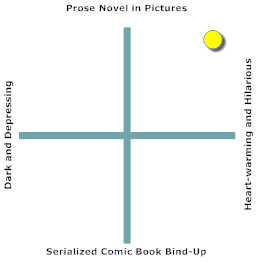
An excellent, heart-warming and hilarious novel told through sequential art.

So in my brain, I had a great blog post all planned out for today. It was going to be a nice and meaty post about different schools of writing process, and the dangerous temptation of superstitious totemic twaddle that so many of us fall prey to. But then I went through my mail from last week, and found a review copy of Jonathan Case’s debut graphic novel Dear Creature. And then my plans went the way of all those of mice and men. I cannot stress enough how excellent this book is, as a work of sequential art, as a story, and as an exercise in writing.

I didn’t even mean to start reading it: I intended to put it on my to-read shelves, and to get to it maybe sometime in the next couple of weeks. But somewhere in the twelve feet between opening the envelope on my kitchen table and putting it on a shelf in my library (probably because I “just took a peak” at the first couple of pages), Case’s story sucked me in like a whirlpool. Dear Creature is the literary, quirky, heart-warming, and deliciously pulpy love story (yeah, I know, right?) of an atomic sea mutant named Grue. Living in a sunken nuclear sub, and to the chagrin of a crustacean chorus, Grue is no longer content to devour lustful beach-going teenagers. With his eyes and heart opened by pages of Shakespeare’s plays found in soda bottles, the lonely sea monster naturally tries to seek out whoever has been sending out these messages.

It’s tempting when reviewing a graphic novel to start with the art. After all, the art is intrinsic to a graphic novel’s storytelling. But what really set Dear Creature apart for me was the writing. While many people who write sequential art are uncomfortable drawing distinctions between comic books and graphic novels, I’m afraid I’ve never agreed with Douglas Wolk’s claim that the sole difference is their binding. A true graphic novel – like Dear Creature, or Gene Luen Yang’s Level Up – is paced and constructed very differently from a bound-up collection of serialized 24 – 32 page comic books.

Most prose novels, whether we’re talking about Dickens, Calvino, or Ian Fleming, cannot be split up into neat episodes without losing some degree of their resonance or storytelling unity. But a graphic “novel” that began life as a series of smaller comic books, like Allan Moore’s Watchmen, Frank Miller’s The Dark Knight Returns, or Garth Ennis’ Preacher can never be more than the sum of its parts, however good those parts may be. That’s just the nature of the beast. But Dear Creature, while it is divided into chapters, coalesces by its very nature into a resonating, cathartic story that draws us in, makes us laugh, and satisfies us only when we have experienced its entirety. Case does not construct his individual chapters the way a comic book writer constructs particular issues: he constructs them the way a prose novelist constructs chapters, relying on the story’s over-arching flow, compelling characters, and emotional narrative to carry us along.

Case builds his characters through a flawless union of art and dialog. Grue, his lovelorn atomic sea monster, speaks in iambic pentameter entirely oblivious to its idiosyncrasy in 1962 California. With all of the book’s focus on Shakespeare, it’s tempting to try to find models in the Bard. But really, I trace Grue’s antecedents more to Cervantes than Shakespeare. Grue is like a modern day Don Quixote, in that for him the high drama of Shakespeare has applicability to every facet of his contemporary life. And if it doesn’t? Well, then by God it should! Case captures this touching quixotic earnestness in Grue’s every pose, centering our attention on his larger-than-life actions whether dramatic or comedic.

Grue is accompanied by a Greek crab chorus used to great comedic effect. If Aeschylus’ Oceanids in Prometheus Bound represent a “perfect audience’s” reactions to the Titan’s plight, then what do Case’s crabs represent? It’s not like they’re sympathetic to Grue’s concerns. Instead, they poke fun at the beleaguered monster and exhort him to return to feasting upon human flesh.

And Grue’s Dulcinea del Toboso? Like Aldonza Lorenzo, the woman who captures Grue’s deep and soulful heart with torn pages of Shakespeare sent into the briny deep is not your stereotypical love interest. First, she’s crazy, as in violently agoraphobic. And she is old (well, middle-aged) in the same way that Aldonza is plain. But just as Quixote looks past the simple truth in the interests of his higher truth, so too Grue simply does not notice. The love that forms between a man-eating atomic sea monster and a middle-aged agoraphobe is poignant, touching, and tragic.

Artistically, Dear Creature is equally clever. Case chose to draw it in a style that made me instantly think of Will Eisner’s The Spirit. Like Eisner, Case uses solid black shading to add depth to his panels, while relying on iconic lines to draw his heroes. This quasi-homage seemed most apparent and appropriate in the case of Henry Craw, a retiring policeman who particularly reminded me of an aging Denny Colt.

By combining excellent character development with superlative dialog, and a heartfelt emotional arc, Case has written one of the best novels I have read in years. And yes, that is novels as opposed to graphic novels. Yet since this book is structured so much like a prose novel, and with characters and writing that clearly trace their lineage back to classic literature, it did raise a question as I was reading it: does Dear Creature need to be sequential art to tell its story? Similar love stories, characters, quirks, and pulpiness have all been captured in prose by other authors before, and in particular this book made me think of A. Lee Martinez’ great books. But what did Case gain through choosing to tell this story visually? I think the answer speaks to Case’s prodigious and multifaceted skills and talents: by writing Dear Creature as a graphic novel, Case was able to get out of his own way. The use of sequential art in this book obviates the need for exposition. By relying on the art to show us what is happening, the dialog is able to stand on its own and remind us of Shakespeare, Cervantes, and classic drama undiluted by descriptive text. Which makes the story tighter, and in some ways purer, than it would otherwise have been.

I commend Jonathan Case for this excellent graphic novel. It is very rare to find a storyteller who is able to write something that is at once literary and meta-textual, while remaining touching and hilarious. To then combine that ear for dialog and prose with artistic talent is even rarer. If you enjoy sequential art, then hands down, you should pick up Dear Creature.

And I think that it should be on everybody’s short-list for the Eisner award.

REVIEW: Down the Mysterly River by Bill Willingham


Title: Down the Mysterly River
Author: Bill Willingham
Pub Date: September 13th, 2011
Chris’ Rating (5 possible): 1 point 1 point 1 point
An Attempt at Categorization If You Like… / You Might Like…

I’ve been a fan of Bill Willingham’s writing for years. His work on Vertigo’s Fables? Hands-down the best comic book writing out there. I’ve particularly appreciated the structure he brings to his sequential storytelling: sweeping, complex plots that more closely resemble epic fantasy than standard super-hero fare (most of which I can no longer stomach). Several months ago at BEA, I managed to snag a review copy of his new middle-grade fantasy novel Down the Mysterly River, which Tor Teen/Starscape just released a couple of weeks ago.

Down the Mysterly River follows the adventures of a young boy named Max who wakes up in the woods one day with no recollection of how he got there. Thankfully, Max is a Boy Scout and so is better prepared for such situations than I ever could be. As he tries to figure out where he is and how he got there, he makes friends with a talking badger, a tyrannical tom cat, and a friendly bear. All four of them are in the same situation, and together they must figure out what brought them to this place. But they must do so while fleeing from the Blue Cutters, a band of sword-swinging fanatics who want to re-create our heroes according to their own ideas of what makes people good. Obviously, Max and his friends are not particularly interested in being forcibly molded.

The book is generally structured as an adventure story, and blended with mystery. Our plucky band of heroes must sneak and fight their way free of the Blue Cutters while piecing together the mystery surrounding their appearance in this unfamiliar world. The book is written in omniscient third, but with a relatively narrow focus on Max. With his self-professed experience at detection, Max eagerly goes about solving the mystery and we are drawn into it in his wake. While Max may proceed with little fear, Willingham expertly uses ominous suggestions to raise tension for the reader. Within minutes of meeting Branderbrock the Badger, for example, we learn that he remembers his own death, suggesting that both he and Max are already dead.

I found the contrasts between positive and negative to be the book’s strongest aspects, and such contrasts show up repeatedly in Willingham’s character development. While our four heroes are drawn sympathetically, three out of the four have darker (or at least more negative) sides: McTavish the Monster (the tom cat) self-identifies as evil and selfish, but evidences unswerving loyalty when put to the test. In many ways, he reminds me of Doli from The Book of Three: on the surface, brash and self-centered, but heroic nonetheless. Walden the Bear is portrayed as dull-witted and lazy, but is giving and capable of great violence when roused. Max, with his capacity for introspection, teeters on the edge of making certain choices that may align him with the Blue Cutters’ morality. His struggles with his own conscience and justification lend the book its moral depth. Of the four heroes, Branderbrock is the only one who does not have a dual nature or conflicting desires. Together, our adventurers are offset by the Blue Cutters, who are depicted with haughty brutality. They are vicious and cruel, and their implacability in particular makes them frightening villains.

Willingham concretizes these contrasts in his battle scenes, where he does not shy away from violence. While I don’t think this weakens the book at all, I think it is particularly notable for its genre and intended audience. Most MG fiction – and even most YA – tends to steer clear of blood-in-the-mud battle scenes. And middle-grade heroes almost never kill human villains. Even in The Hunger Games, which is targeted towards a YA audience and is considered by many to be a particularly violent novel, Katniss Everdeen only directly kills one of the other twenty three tributes. But in Down the Mysterly River, intended for a younger audience, we not only watch our heroes become grievously wounded on several occasions, but we see the Blue Cutters torturing innocent animals, and watch Max actually kill one of the Blue Cutters.

This violence is depicted in a matter-of-fact fashion, and though I was surprised to see a MG novel with this degree of it, I found that it did not draw away from the story. In some ways, the violence lends a visual dynamism to the book: reading along, I imagined sequential panels visualizing the action as if I were reading a comic. This kind of stylized violence brings excitement to a graphic medium, but in prose I found that its implausibility diminished its realism. Yes, the book is violent. But it is no more violent Adams’ Watership Down, the story of Robin Hood, or Brian Jacques’ Redwall series.

Thematically, the violence was also treated seriously. Throughout, our heroes engage in violence defensively. They do not take the attack to the Blue Cutters: they are just trying to get away from people who are intent on torturing and killing them. And Willingham justifies our heroes’ violent response by showing us exactly how vile the Blue Cutters really are, and by making it clear that our heroes are significantly outnumbered. And, perhaps most significantly, he does not let our heroes off the hook: their actions have consequences, and Max is shown to struggle with his choices. That his actions to defend himself and his loved ones are justified in no way diminishes the poignancy of his guilty conscience. And, interestingly, the book seems to suggest that offensive action against the Blue Cutters is an adult right: one that twelve year-old Max is not ready to either understand or undertake.

The world-building is well-executed. Willingham’s cosmology – which lies at the heart of the mystery – is particularly interesting and appealing, though to explain why would unravel the mystery Willingham painstakingly sets up. Readers of Fables will no doubt recognize certain archetypes that show up in his world-building, but they are put to a very different use in Down the Mysterly River. The characterization and how it ties into the world-building is also particularly well done, with non-human heroes who we can understand and believe in despite their fantastic natures.

The writing itself is competent, but I found a number of areas where it could have been tightened. The first quarter of the book tends towards stilted descriptive sentences. At BEA, I asked Willingham about the difference between writing a prose novel and a comic script, and he pointed towards exposition. The book’s beginning clearly shows where Willingham struggled with this: his early descriptions tended to flow more like visual notation for an artist rather than descriptions of ongoing action. However, the text remains functional and his skilled characterization is able to overcome the exposition’s choppiness. And as the book’s plot accelerates, the flow improves and Willingham loses the stilted declarative style that predominated early on. By the book’s mid-point, sentences and paragraphs are flowing smoothly.

The other weakness that stood out to me in the writing was an occasional tendency to over-write. Honestly, I see this as less of a failure on the part of Willingham’s writing as on the part of his editor’s line-editing: good MG/YA editors should know to look out for this and trim it out of the book before it ever goes into production. Yes, this is a book for children. But kids are more perceptive than we stodgy grown-ups like to give them credit for. Even ten year-olds don’t need to have a rhetorical question defined and explained for them: if they don’t know the word, then they’ll pick it up in context. I found this tendency most jarring when it occurred at the end of certain chapters, throwing off the rhythm and dramatic resonance of the chapter’s conclusion. Next time, I would hope such extraneous and unnecessary sentences were just cut: part of what makes great MG fiction great is that it challenges the reader. And kids are especially sensitive to condescension in their reading.

Despite these weaknesses, I found Down the Mysterly River to be a fun adventure. The answers to Max’s mystery were robust, and the characterization and story arcs that Willingham takes us down are immensely satisfying.

For parents who may be concerned about the violence: it’s handled well, and if you have concerns about it, read the book yourself first, and then decide if your kid is ready for it. There’s no universal rule. I found that the violence was tasteful and well-executed. At nine or ten I know that I would’ve enjoyed the book. Whether the same holds true for your kid, well, that’s your call. Grown-up fans of Willingham’s comic book writing will probably enjoy it, provided that they remember that it is not a Fables book. Comic book retailers – who I’ve heard had trouble selling Willingham’s earlier prose novel in the Fables universe – may find that Down the Mysterly River is a great transition book for kids who read books like Owly and might now be ready for more grown-up fare.

I really enjoyed Willingham’s first foray into his own prose fiction, and I hope to see more books like this from him.

REVIEW: With Fate Conspire by Marie Brennan


Title: With Fate Conspire
Author: Marie Brennan
Pub Date: August 30th, 2011
Chris’ Rating (5 possible): 1 point 1 point 1 point
An Attempt at Categorization If You Like… / You Might Like…
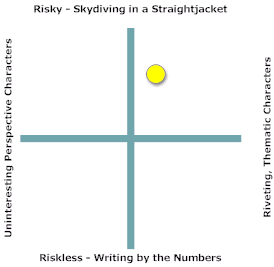
A risky undertaking that is more than half-successful.

A while back, I received a review copy of Marie Brennan’s With Fate Conspire, the fourth in her Onyx Court series. Now, let me start with a confession: before receiving my copy, I hadn’t read any of the earlier books. I know, I know – alternate/secret history set in various periods in London’s history? Liking historical fantasy as much as I do, one would think I had devoured this series from the first book up to now. But for whatever reason, I missed it until finding its fourth volume in the mailbox. Holding the book in my hand, I faced a choice: I could either catch up on the previous three books, or I could just dive into the fourth. Doing so would be a risk: would I miss vital backstory or world-building? I didn’t know. But I justified my decision with the fig leaf of “someone else might pick up the fourth book first, right?”

With Fate Conspire is set in an exceedingly well-researched late nineteenth century London. It features two primary viewpoint characters: the mortal Eliza O’Malley, a poor woman of Irish descent living in the London slums and Dead Rick, a faerie skriker (a Lancashire name for a lycanthropic faery who is an omen of death – more commonly known as a Black Dog) living in the Onyx Court’s Goblin Market. When we first meet Eliza, we quickly learn that she is desperately seeking a way to track down the faerie who kidnapped her lover seven years prior. When we first meet Dead Rick, we find him brutally forced to work as a slave, enforcer, and errand-boy for Nadrett, a criminal kingpin in the Goblin Market. Connecting both perspectives is the accelerating industrialization of London: the rise of iron-based industry and the development of the London Underground Railway are destroying the faerie city.

When we first meet both characters, they already have interesting pasts. Eliza’s lover was kidnapped by faeries and she foiled a faerie terrorist attack on the London underground. Dead Rick’s past is more mysterious, but it somehow put him at the mercy of Nadrett. At first, I assumed that these histories were the backstory that I had missed by not reading the earlier books. But then I realized that A Star Shall Fall is set more than a century before With Fate Conspire – which means that their backstories could not possibly have been in the pages I’d skipped.

When I picked up the fourth book in the series, I risked missing out on vital backstory. But writing the fourth book in the series, Brennan took a similar risk: she placed the moment of displacement – the point where Eliza and Dead Rick’s adventures start – off-screen. This is a particularly risky approach: by not allowing us to participate in her protagonists’ displacement, Brennan risks our investment in the characters and their world. I really enjoyed the structure and courage that this showed, but I found that the risk was only partially successful.

Dead Rick is modeled as a hero (see my post on A Theory of the Hero). We are shown his desperation to survive the Onyx Court’s imminent collapse, and his willingness to commit violence, but there remain lines he refuses to cross. He is a moral character, despite the self-loathing we see. He is an aspirational hero who wants to survive while still doing what he feels to be right. He may not always succeed, but he continues to aspire. He is used to show us the lawless underbelly of the Onyx Court, and the amoral brutality of some faeries. The challenges he face are existential: will Nadrett kill him? Will he survive the imminent destruction of the Onyx Court? Will he become like Nadrett to do so?

The portrayal of Dead Rick and faerie society were the high points of the book for me. First, I always enjoy well-drawn heroic characters. The challenges which Dead Rick faces are packed with drama. On an individual level, the unflinching depiction of Nadrett’s brutality and Dead Rick’s desperation make him particularly sympathetic: I cringed to see his experiences and wanted everything to work out for him. At the same time, his story becomes a microcosm of the Onyx Court’s story. Dead Rick’s experiences concretize the drama of the Onyx Court’s collapse by showing us the little guy’s perspective. Dead Rick is no chosen hero, capable of saving the Onyx Court from London’s industrialization. He can barely keep himself alive, let alone save the faerie city. But it is his courageous struggle against insurmountable challenges that makes his story a page turner. In Dead Rick’s case, Brennan was able to successfully skip his backstory: the sympathy he engenders, his emotional stakes, and his relationship to the Onyx Court’s broader struggle were enough to earn my investment.

By contrast, I found Eliza to be the far weaker character. If Dead Rick is defined by his rough moral code, then Eliza is defined by her obsession with tracking down Owen Darragh. This is not an existential challenge. The worst-case scenario for Eliza is that she never finds him. But because we did not get her backstory, we are not as invested in her quest as she is. Brennan tries to make Eliza sympathetic using tools parallel to those used for Dead Rick: Eliza is a poor costerwoman of Irish descent. Her experience of London is that of the down-trodden and the discriminated. While this works to make Eliza somewhat sympathetic, her story lacks the emotional tension of Dead Rick’s. The dilemmas she faces are not moral in nature: she rarely needs to choose between right and wrong, or the lesser of two evils. Short of killing innocents, she’s happy to cross almost any line in her quest. Her challenges are almost always tactical, and they fail to mirror or concretize those of broader mortal London.

In Eliza’s case, skipping of the backstory did the character a disservice. It made it impossible for me to really invest in Eliza’s travails. This problem is especially apparent when compared against Dead Rick’s storyline. Eliza’s difficulties and choices are inconsequential when set against Dead Rick’s primary problem (the catastrophic collapse of the Onyx Court).

That the faerie perspective is more compelling than the mortal one probably should not be a surprise. The Onyx Court is the primary constant throughout the (surprise surprise) Onyx Court series – which in and of itself is an interesting structural feature. Most contemporary fantasies that deal with the world of faerie tend to be either portal or intrusion stories where the focal lens is a human who finds themselves caught up in the magical world. In those stories where a human isn’t our lens, we often see through the eyes of a faery who – for all intents and purposes – tends to be indistinguishable from a super-powered mortal.

When writing a series, most authors take the safe approach of following one set of characters as they progress through events that can be encapsulated within a mortal lifetime. But Brennan takes a different path. Rather than give us characters to follow over the course of a single escalating adventure, she instead opens a window onto a particular time in the history of the eternal Onyx Court. The effect is like tuning into a long-running TV series mid-episode, mid-season. By nailing the faerie perspective – and lending it continuity throughout the series – Brennan is able to diminish the impact. Yet the relative weakness of her mortal character (Eliza) underlines the fact that the faeries – and how the Onyx Court deals with the challenges it faces – are the author’s primary concern. I am curious whether the mortal characters in the earlier books are as weak as Eliza.

Despite Eliza’s weakness, With Fate Conspire remains a very good book. Dead Rick’s story is – in my opinion – enough to carry it, and ultimately make it a satisfying experience. The world-building and research stand out for the level of detail and the skill with which they are woven into the story. The book’s pacing was fairly solid, providing moments of rising tension and breaths where I could assimilate the plentiful skulduggery and intrigue. Fans of “London Above / London Below” fiction along the lines of Kate Griffen’s Matthew Swift novels (see my earlier review), Neil Gaiman’s Neverwhere: A Novel, or China Miéville’s King Rat will likely enjoy With Fate Conspire, as will fans of painstakingly researched and imagined alternate/secret histories like Bruce Sterling and William Gibson’s The Difference Engine, Susanna Clarke’s Jonathan Strange & Mr Norrell: A Novel, or Jonathan Stroud’s Bartimaeus trilogy.

Perhaps the strongest recommendation I can offer is that after finishing With Fate Conspire, I went out and bought the preceding three volumes. Brennan took a significant risk structuring this book as she did, and while she may not have succeeded as well as I might have liked, neither did she fail. I applaud her courage, and her skill for getting it more than half right. I’m looking forward to the preceding three books.

A Theory of the Hero: Tragic and Anti-tragic Heroes (part 3 of 3)


NOTE: This is the third and final installment in a three-part series on heroic characters. This post will focus on how narrative timing and character choice determines the difference between tragic and anti-tragic heroes. The previous two posts respectively focused on agency, voice, and character sincerity and heroic story archetypes.

This past week I’ve been writing about heroic fiction, particularly focusing on heroic characters and their story archetypes. Every heroic story must take place within a moral universe (i.e. a universe where actions have implicit or explicit consequences). If the story’s setting were not moral, then it would be impossible to demonstrate the character’s heroic nature. But given that moral universe and the character’s heroic nature (which is intrinsically concerned with their value system), what makes some heroes “tragic” and others…not?

Can Tragedy Exist without Heroes?

No. Next question?

Okay, seriously: there are probably as many definitions of tragedy (in fiction) as there are critics. And I suspect that every one of them – from Aristotle to Hegel to Nietzsche – is probably right. But what most fail to point out is the simple fact that tragedy only happens to heroes. When we think of the characters who we would call “tragic”, all feature the same central concern with the hero’s value system. Whether it is Sidney Carton in Dickens’ A Tale of Two Cities, Moorcock’s Elric, or The Incredible Hulk‘s Bruce Banner: every tragic hero is centrally concerned with moral questions.

While every tragedy involves a heroic story, the converse does not apply. There are many heroic stories which both focus on heroic characters and adhere to the three primary heroic archetypes, but which we would nonetheless be hard pressed to call tragic. Consider Lewis’ The Lion, the Witch and the Wardrobe or Patricia C. Wrede’s Dealing with Dragons. Both stories deal with heroic characters, the former applying the aspirational archetype and the latter adhering more to the observational. Yet nevertheless, none of the heroes in either story can rightly be called tragic.

Choice: Making a Tragic Hero through the Exercise of Agency

Both Aristotle and Hegel (in particular) pointed out a key tenet of the tragic story: for tragedy to occur, the hero has to undergo some sort of reversal of fortune. That reversal may be externally mediated, the result of an opposing ethical force (a hero of different values, for example) or it may be an internal reversal (motivated by the hero’s evolving awareness or shifting passions). But in order to evoke catharsis, the hero has to reverse either some aspect of their nature or the trajectory of their experiences. That is exactly what heroic characters do when they transgress against their moral codes.

In heroic storytelling, the events of the plot, the story, and the character’s progression all come together in the hero’s choice of “right” or “wrong”. This choice may be shown baldly (e.g. Luke refusing the Emperor) or it may be concretized through dramatic action (e.g. Sidney Carton’s sacrifice). But if the hero makes the “right” choice (according to their own value system), the cathartic dénoument becomes a breath exhaled, the satisfaction of good triumphing over evil. If the hero makes the “wrong” choice, then we lament hypothetical paths not taken.

Because the hero is defined by his agency (see last Tuesday’s post), much of the tension in heroic stories stems from the question of how that agency gets exercised. Both aspirational and consequential archetypes are centrally concerned with the question of choice, though they derive their tension and their tragedy through entirely different methods.

The Tension of Expectations in Aspirational Storytelling

As they progress, aspirational stories derive their tension from uncertainty as to whether the hero will act in accordance with his moral code or transgress against it. In the moment of climax, when Katniss must choose between Peeta’s life and her own (in Suzanne Collins’ The Hunger Games) or when Valjean holds Javert’s life in his hands, the hero teeters on a knife’s edge. Make one choice, and they stay true to their own ideals. Make the other choice, and they throw those ideals to the wind. And while that moral choice drives tension in the reading experience, it does not determine tragedy.

Consider two very different aspirational heroes: Frodo Baggins and Sidney Carton. From the beginning of Frodo’s story in The Lord of the Rings, we face the question: will Frodo have the strength to destroy the One Ring? As the story progresses, we watch him struggle with the Ring’s influence and triumph (barely and not without hardship) over Sauron and the Ring’s evil. But it is at the last moment, when he is standing above the Crack of Doom – when he is actually in a position to fulfill his quest – that he faces the climactic choice. And he fails. Frodo allows the Ring to corrupt him, and decides not to destroy it. Of course, the world is saved anyway because Gollum (Frodo’s mirror-image) bites Frodo’s finger off and falls into the flame. But regardless of that eucatastrophic moment, at the culmination of Frodo’s aspirational story, he transgresses against his own value system.

Sidney Carton, by contrast, represents an inversion of Frodo Baggins’ story arc. Throughout A Tale of Two Cities, he fails to live up to his own value system. From his story’s beginning, we watch Carton’s self-loathing rise in parallel to his love for Lucie Manette. And it is only at the story’s end, when he chooses to sacrifice himself for Charles Darney, that Carton’s acts finally align with his moral code. At the climax of the story, he chooses to do what is “right” – unlike Frodo, who chose to do what is “wrong”.

Yet despite the opposite trajectories of their respective aspirational stories, both remain tragic heroes. The source of that tragedy rests on an underlying tension between natural human meta-ethics and the consequences represented in the story. As social creatures, we are preconditioned to believe that doing what is right benefits us. While every grown-up would readily admit that life is more complicated than that, deep within our souls there remains a conviction that if we play nice, eat our vegetables, and go to bed early, our lives will be better. Aspirational heroes turn tragic when their experiences invert that expectation.

Frodo Baggins does wrong. He fails, and knows it. The fact that his failure is justifiable in no way diminishes the fact that at the last moment, he choked. In our hearts, we expect that a hero who fails and acts evilly should get what’s coming to him. Which is not to be accorded the highest honors of the land, or the love and respect of all the peoples. Yet that is precisely what Frodo gets. He failed: it is only through Gollum’s avarice that the world was saved. If it was up to Frodo, Sauron would have won. Who, really, could ever trust him with something momentous after that? Though he is exactly its opposite, he receives all the accolades of the conquering hero. He does not get what was coming to him.

Sidney Carton, by contrast, rises to the occasion. When it comes down to it, he does his “far, far better thing”. But what does his nobility get him? We want Carton to live. We want him to get the girl, and to find happiness. Instead, he earns himself a short trip to the guillotine.

Carton and Frodo are both tragic heroes because the consequences of their choices stand in direct opposition to our expectations of justice. Carton earns a respect that he never gets to experience. Frodo earns opprobrium that he never has face. This produces a disconnect between our experience and our desires which rests at the heart of aspirational tragedy. We want heroes to get what they deserve. And it becomes tragic when they don’t. Which – not insignificantly – is often how real life works.

Facing the Music: Dealing with the Consequences of a Choice

Consequential tragedy is produced in an entirely different fashion. Aspirational stories start far in advance of the hero’s moral choice, which comes to represent the climax of the story. In consequential stories, the moral choice has either already happened (e.g. most Elric of Melniboné stories) or happens very early in the events of the story (e.g. Shakespeare’s Macbeth).

Macbeth knows that it is wrong to murder Duncan, but he does it anyway. His actions may be inconsistent with his values, yet his value system remains unchanged. By choosing to act against his own moral sense, Macbeth exercises his agency to tragic effect. Macbeth is a loyal soldier scarcely interested in power. The witches dangle the prospect of regency before him, and he makes a morally bankrupt choice. The remainder of the play then deals with the consequences of that fatal decision. In order to maintain his grip on power, Macbeth has to constantly escalate and revisit his choice: the murder of Banquo (and the attempt on Fleance), the slaughtering of MacDuff’s family, etc. Macbeth becomes a tragic hero because his capacity for good gets dragged deep into the mud following his regicide. He knows his acts are evil, and that evil tortures him, but the die is cast and he is locked into his inevitable doom. Of course, the murdering SOB “deserves it” – but he still retains all the nobility of spirit with which he began the play.

Moorcock’s Elric of Melniboné is in a similar boat. His Faustian bargains with Antioch and the demon-sword Stormbringer represent fundamental transgressions against his value system. The self-loathing that follows becomes the focus for Elric’s tragedy, and even though he wishes to be free of both, his entire saga depicts the gradual destruction of all that he loves at his own hands.

While consequential stories in particular lend themselves to tragic heroes, not all consequential heroes need be tragic. In particular, consequential heroes that are redemptive in nature avoid the trap of tragedy. Consider Jeffrey Ford’s hero Cley (from his amazing Well-Built City trilogy, starting in The Physiognomy). Initially, he is an evil (or at best, ignorant) man. But as the book and series progresses, he recognizes that he is not acting in accordance with his own implicit values, and sets out to seek redemption. His quest for redemption makes him a poignant and bittersweet hero, though one that never falls into the tragedy of his companion Misrix.

All this being said, I do not know if it would be possible to write a consequential story that is neither tragic nor redemptive. Where would the dramatic tension come from, if the character initially makes the “right” choice and no negative consequences follow? Seems like it would be a pretty dull story to me, though I suspect if someone were to pull it off they’d be sitting on an award-winner.

The Tragic versus the Anti-Tragic Hero

Have you ever wondered what the opposite of tragedy is? I sure have, and somehow “comedy” just does not cut it in my book. It has too many connotations of humor or slapstick. The Pevensies in The Lion, the Witch and the Wardrobe, Taran in the Chronicles of Prydain, and the Brothers Grossbart in The Sad Tale of the Brothers Grossbart are all heroic characters. They have agency, the narrative voice is compelling, and their moral values remain consistent throughout their stories. Yet none of them could rightly be considered tragic, nor could any of them be adequately described as comedic.
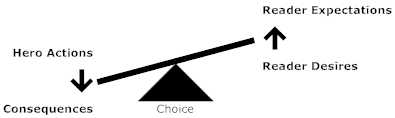
Which makes me long for something that is the opposite to the tragic hero, something I’ve taken to calling the anti-tragic hero for lack of a better term (yeah, I know…it’s a little ungainly: does anyone have any better suggestions?). Anti-tragic heroes can be found in any of the three heroic archetypes: aspirational (the Pevensies), observational (the Brothers Grossbart), or consequential (Cley). Some may be redemptive (Cley or Edmund Pevensie), but that is not at all necessary (e.g. the Brothers Grossbart or the remaining Pevensies).

The anti-tragic hero can be characterized as getting what we the reader believe they have earned through the exercise of their agency. Anti-tragic heroes generally behave according to the precepts of their value systems. The Pevensies’ values align well with standard Western values for good. The Grossbarts’ align well with standard Western values for bad. Cley – once he begins his redemptive quest – also aligns more with our concept of good. In each of these stories, the anti-tragic hero gets what the reader believes they deserve. The Pevensies, by their right and noble actions, become great kings and queens of Narnia. The Brothers Grossbart end up locked in a tomb – presumably for all time. Cley manages to make peace with his past sins and be reborn. Their fates align with our sense of justice, which may well be different from their own.

The Essence of Heroic Stories: Expectations, Values, and Choice

And this, I think, really distills the heart of what heroes and heroic fiction are all about. At the most basic level, heroic stories are all about values and expectations. When characters’ actions relate to their own value system, they become heroes. They may live up to their own expectations, aspire to the better parts of themselves, or struggle to live with their own choices. But they do so with the degree of drama and moral focus that defines them as heroes. Their actions elicit expectations on our part as readers: we want something good, bad, or ugly to happen to these heroic characters because we believe their actions have earned some measure of response. And the tension between the hero’s actions and their consequences within the story determines whether that hero becomes tragic or anti-tragic.

The Essence of Heroic Fiction

Works Mentioned / Used in this Post

Below is a list of the authors and titles that I found helpful in putting this together. It’s a list of pretty cool and interesting books, and I strongly recommend each and every single on of them for insight into the hero:

Non-fiction Fiction

A Theory of the Hero: Story Archetypes for Heroic Characters (part 2 of 3)


NOTE: This is the second in a three-part series on heroic characters. The previous installment discussed how agency, voice, and sincerity are used to determine heroic characters, while the third installment focuses on narrative timing and the tragic and anti-tragic hero.

This past Tuesday, I wrote about how narrative voice, and a character’s agency and sincerity determine whether they can be considered heroic. But in order for those three components to mean something, they must be embedded within a larger story and then expressed through the plot. Any heroic story – whether Tolkien, Howard, or Nabokov – is principally concerned with the hero’s value system. I see three primary archetypes for a heroic story, and makoto (a character’s sincerity to their own values) is central to each:

Heroic Story Archetype Description
1 Aspirational Will the hero live up to their own values? Or will they fail and transgress against them?
2 Observational How will the hero apply their values within a particular set of circumstances?
3 Consequential How will the hero face the consequences of their choices?

Different Strokes for Different Folks, and Different Stories for Different Heroes

The archetype that applies to a particular hero need not be the archetype that applies to the overall book/film. We talk about books having “a story” but really each hero gets their own story. Some books might have no heroes (Franz Kafka’s The Metamorphosis), others might have one (Nabokov’s Lolita), or many (I count nine in Les Miserables).

As a quick example to start off, let’s consider Star Wars (the original trilogy, naturally). Han Solo’s journey is entirely different from Luke Skywalker’s: though they share many experiences (though they go through the same plot), the choices, subtext, and meaning is different for each character. Darth Vader likewise has his own story. Luke’s is aspirational: will he stay on the Light Side or go to the Dark? Solo’s story – particularly in The Empire Strikes Back and Return of the Jedi – is observational: how will he apply his values under trying circumstances? And Vader’s story is consequential, focusing on themes of redemption and the consequences of choices he made before the events of the original trilogy. Each of these characters could be the “star” of the trilogy: that Luke’s arc gets the focus merely reflects the creator’s choice.

The hero’s story archetype determines the emotional arc of the story, the subtext that drives us to invest in the characters and keeps us tense. The hero’s value system and their behavior relative to that system determine the story archetype and set us up for the Aristotelian catharsis at the story’s climax.

Aspirational Stories: Portal/Quest Fantasies and Children’s Fiction

The Encyclopedia of Fantasy has a great entry on heroes and heroines which outlines a pretty extensive (though not exhaustive) typology of heroes. Looking at this list, however, it is clear that not every type of hero can support an aspirational archetype.

The classic model of an aspirational heroic story is the coming-of-age tale. Since so much of middle-grade and YA fiction is about helping characters negotiate and articulate their value systems, it should come as no surprise that children’s literature is rife with aspirational heroes. Taran the Assistant Pig-keeper in Alexander’s The Book of Three, Garion in Eddings’ Pawn of Prophecy, or Wart in White’s The Once and Future King are all great examples of aspirational heroes.

Hidden monarchs, ugly ducklings, changelings, and people who learn better are classic character models for aspirational stories. What is essential to this archetype is an evolution in the character’s choices. Unlike the observational archetype (see below), these characters’ are still struggling with their value systems. The “right” and “wrong” of their story is implied in the text: the reader understands what Taran must do, the reader knows what choices Garion must make, but the character does not. As the plot unfolds, the character gradually catches up to the reader and becomes able to articulate and act on their implicit value system.

Portal/quest fantasies are the most frequent structure for aspirational stories. The plot’s quest becomes the device by which the hero explores and articulates their choice. Frodo’s quest to destroy the Ring is inherently tied up in his value system. The crux of his story hinges on the question of whether he will allow himself to be corrupted by the Ring, or whether he will stay true to his values and destroy it. The climax of this archetype is the moment when the hero makes that final choice: when they decide whether they will do right or not. That climax is the moment of maximum tension within the story, and it defines the hero’s success or failure.

One of the most satisfying aspects of aspirational heroes is that they often make the “right” choice. Aragorn, Luke Skywalker, and most heroes in MG/YA fiction all ultimately make a choice that more-or-less aligns with most readers’ moral codes. But that success is not necessary. So long as the hero’s moral code remains unchanging, whether he succeeds or fails to live up to that code has no impact on the story’s resonance. Failure can be just as strong a resonator as success.

For example, Frodo Baggins is a failure. Yes, he remains a hero, but standing over the Crack of Doom, he allows the Ring to corrupt him, and he cannot bring himself to destroy it. Tolkien’s use of eucatastrophe (Gollum’s convenient attack on the invisible Frodo) is the device by which the author wrenches a positive ending out of his principal hero’s failure. This does not weaken the story – in fact, I think it enhances it by adding a tragic dimension to the character of Frodo Baggins. Everything does not work out, certainly not for Frodo. For the rest of his life, Frodo will have to bear the knowledge that at that last desperate moment, he blinked. If Frodo’s story is aspirational, then at the end of the day he fails in his aspiration. Yet his story still resonates.

Observational Archetypes: The Classic Heroic Story

When we use the words “heroic fantasy” most of us automatically think of muscle-bound heroes along the lines of Beowulf, Conan of Cimmeria, or Fafhrd and the Gray Mouser. We think of the stories written by Robert E. Howard, Michael Moorcock, Glen Cook, etc. Typically, these are immersive fantasies where the world of the story is assumed as a given. The heroes in question already fully live in their worlds, and their value systems are fully-formed and clearly articulated. However, what sets these stories apart from their aspirational counterparts is that they focus less intensely upon the hero’s moral code.

The climax of an aspirational heroic story hinges upon whether the hero will or will not live up to their values. But in an observational story, the hero will always live up to their values. These values are typically idiosyncratic when compared to those of other characters. Whether we’re dealing with loveable rogues like Han Solo, utter villains like the Brothers Grossbart, or introspective brooders like Elric of Melniboné, the hero’s value system always features some difference to those of the book’s other characters. Reading these characters’ stories, we are less concerned with will they or won’t they stick to their guns, and more concerned with how they will do so.

Observational heroes tend to be what The Encyclopedia of Fantasy calls Brave Little Tailors, Duos, or Temporal Adventuresses. Many fairy tale heroes, in particular the “Ivans” of Russian fairy tales or the “Jacks” of the British variety, fall into this camp. So would most of Robert E. Howard’s Conan stories, where his sword-swinging Cimmerian broods and simmers…but always acts according to his (admittedly sometimes rough) moral values.

The typical observational hero never ages: he or she is almost always portrayed in the prime of their youth, as the story’s momentum hinges upon their ability to act with physical or magical strength. Aspirational heroes and their stories tend to deal earnestly with stark moral black-and-whites. Observational heroes, however, tend to see more shades of grey. For Frodo Baggins or Taran the Assistant Pig-keeper, there is no middle ground: either they do right or they fail. For Conan, or Leiber’s Fafhrd and the Gray Mouser, their moral codes and the choices they face are more ambiguous, allowing for compromise.

This ambiguity creates a great degree of space for humor in observational stories. Whether it is Fafhrd and the Gray Mouser, Conan, or Han Solo, the ambiguity of the hero’s moral code and their situational application offers the opportunity to inject irony and sarcasm into the narrative. This kind of humor tends to be quite infectious, because it perhaps deals with moral choices more accessible to the average reader than those common in high fantasy. The choices our heroes face, while expressed in outlandish fashions, tend to have fewer world-changing or soul-destroying consequences than those found in aspirational stories.

Duos in particular are a common type of observational hero. While I have already mentioned Fafhrd and the Gray Mouser, I think a far better set of examples can be found in the mystery genre. Sherlock Holmes and Dr. Watson represent the classic ur-duo, and their stories clearly show the application of Holmes’ rational worldview. In Dashiell Hammett’s The Thin Man, Nick and Nora Charles have a clearly ideosyncratic, “us-against-the-world” value system which they apply consistently. As in so many mysteries, the morality of their philosophy is not the focus of the story: instead, the focus is on how that philosophy is actively applied within the plot.

Generally, heroic stories whose narrative focus is on the action of their plot tend to skew observationally. These are the stories that are more exciting than earnest. Bullington’s The Sad Tale of the Brothers Grossbart is a fun exploration of how a set of villainous moral codes can be applied across a variety of trying situations. Super-hero comic books in particular are another great example of this kind of storytelling: the hero’s moral code (remember Truth, Justice and the American Way?) is always a given, but decades of continuity explore how the hero applies that code to all manner of situations.

Consequential Archetypes: Living with Choices

The third and final story archetype for heroic characters returns to deal with the moral choices more earnestly than in most observational stories. Consequential stories focus on the hero’s actions after a moral choice has been made. By its very definition, this archetype tends towards the Aristotelian and the tragic. Typical heroes that fit this mold are the Knight of Doleful Countenance, or the sinner seeking redemption.

Often, the hero’s nobility is established off-screen before the events of the story. We know Macbeth is a noble hero because Duncan, his men at arms, and the sergeant tell us so before we ever meet the thane of Glamis. But Macbeth transgresses against his own moral code by killing his king, and the rest of the play focuses on him living with and facing up to the consequences of his evil act. Robert E. Howard’s Solomon Kane stories do something similar, where we first meet Solomon Kane as a puritanical zealot obsessed with meting out stern justice and stamping out whatever he considers evil, regardless of danger. Through the stories’ subtext, we gradually get the sense that Kane’s obsession is redemptive: that by stamping out evil, he may purge his own soul of whatever past sins may stain it. In Michael Moorcock’s Elric of Melniboné stories, the hero must live with the guilt of feeding souls to his demon-sword Stormbringer.

Consequential heroes and their stories may be redemptive or tragic. Darth Vader’s is a redemptive story, where he is able to return to the Light by betraying the Emperor. Macbeth or Othello, by contrast, are tragic: no amount of contrition on their part can ever expunge their guilt. Typical of consequential stories is a constant revisiting and escalation of the hero’s original choice: Macbeth is forced to one-up his betrayal of Duncan with the murder of his friend Banquo, followed by the slaughter of MacDuff’s family. Elric has to feed ever more souls to Stormbringer so that he can do what he feels is right.

By their very nature, consequential heroes and their stories are tragic: if aspirational stories end on “and they lived happily/sadly ever after” then consequential stories are what happens in the ever after.

Story versus Story and Mixing Archetypes

Like so many aspects of storytelling, the borders between these archetypes can be blurred. For example, Moorcock’s Elric of Melniboné combines aspects of the consequential archetype (the exploration of Elric’s guilt) with the observational (constantly re-visiting his moral choices in new circumstances). It is also possible, though very difficult, for a single hero to progress from an aspirational story, to an observational story, and then to a consequential story. I know of few examples of this kind of progression, but those that do come to mind are almost always some of my favorite stories. Lloyd Alexander’s Westmark trilogy shows us Theo’s aspirational story in its first book, and then follows the pattern of a consequential story in the second and third.

In Hugo’s Les Miserables, Valjean’s story opens as aspirational, proceeds to observational, and ends as consequential. In Hugo’s case, this masterful progression is strengthened by pitting Valjean’s moral code against opponents who are elsewhere along the archetypal progression. When Valjean’s story is in its aspirational phase, his antagonist Javert is in an observational mode. By the time Valjean has entered the observational phase of his evolution, Javert has “regressed” to the aspirational phase. When Valjean is in the consequential phase of his life, Marius Pontmercy is in the aspirational phase of his.

Hugo is arguably the master of this kind of complex hero construction: reading his works (in particular Les Miserables and The Hunchback of Notre-Dame) I suspect that every single hero archetype and every combination of their oppositions, tragic and anti-tragic, can be found. The next installment of this series (on Tuesday) will focus on this aspect of heroic storytelling. In particular, I will focus on how narrative timing affects tragedy in heroic fiction, and on the differences between tragic and anti-tragic heroes.

NEXT: Come back on Tuesday for the third and final installment which focuses on how narrative timing affects tragedy in heroic fiction, and for a discussion of tragic heroes and anti-tragic heroes.

A Theory of the Hero: Agency, Voice, and Sincerity (part 1 of 3)


For a while now I’ve been chewing on the concept of heroes/heroines, which at first glance looks simple. Say the word “hero” and everyone knows what we mean: we’re (stereotypically) talking about square-jawed men and kick-ass women who stab bad guys in the eyes with icicles, rescue intergalactic princesses, and Do The Right Thing. Heroes are “The Good Guys” that we root for in a story. But fiction – as life – tends to be more complex than that. For every Frodo Baggins we have an Elric of Melniboné. For every Peter Pevensie we have Steerpike. What then constitutes a hero? What makes one character or one story heroic and another not?

NOTE: This is the first in a three-part series of posts. This post is focused on what makes a given character heroic. On Saturday, I’ll post the next chapter, focusing on story archetypes for heroic characters, and the final post on Tuesday will focus on the difference between tragic and anti-tragic heroes.

Why do we need a Theory of the Hero?

If we want some sort of all-encompassing theory of the hero, we need to go beyond Campbell’s monomyth and Propp’s functional formalism. Regardless of how much I love both, a complete theory should be able to encompass both the classically-modeled Frodo Baggins and the monstrous Humbert Humbert.

In reading Ivan Morris’ excellent The Nobility of Failure: Tragic Heroes in the History of Japan over the weekend, something in my brain clicked. I think I might have figured out a secret ingredient that goes into the make-up of any hero, regardless of where they fall on a moral spectrum. Per Morris, heroes are defined at their core by the Japanese concept of makoto, which Morris translates as “sincerity” with connotations of self-contained philosophical sufficiency. In other words, a hero is a hero – regardless of their moral or immoral actions – if they act relative to a consistent moral code.

Hero vs Protagonist: Six of One, Half-Dozen of the Other

If you will forgive a brief moment of semantic pedantry, I think it is important to explain that I have never particularly liked the term “protagonist”. Since originating in Greek drama, I think the term has become incredibly muddled and imprecise. Etymologically, it means “chief actor” but a literal definition is too limiting to be functional. There are too many sweeping, epic novels like Hugo’s Les Miserables where identifying a particular chief actor becomes difficult (if not impossible).

Terms like protagonist and antagonist really describe the relationships between characters. The protagonist is opposed by the antagonist. This tells us nothing whatsoever about the characters in question, their value systems, moral codes, or courage. However, describing characters as either heroic or non-heroic does offer insights into their natures. Generally, for good drama in storytelling a hero needs to have an opposition: but a good hero can just as easily be opposed (antagonized) by another hero (the relationship between Hugo’s Jean Val Jean and Javert is a prime example of this type of opposition).

The Hero’s Function: Building Engagement through Agency and Voice

So what does a hero actually do in fiction? Besides saving the day, that is? As I see it, the hero/heroine is there to engage us on an emotional level. The hero draws us in and makes us care, and does so using the agency of their choices and the author’s narrative voice (which may be different from the character‘s voice).

The Hero’s Choices Make Us Respond

Can you imagine a hero with no agency? Would a character who just let stuff happen to them and passively reacted be at all engaging? Probably not. The hero/heroine’s choices determine how they change over the course of the story, giving us insight into their natures. Some heroes (Ayn Rand, I’m looking at you) are little more than two-dimensional symbols, a personification of some philosophical outlook with which we can either agree or disagree. Others are more complex, rounded (in Forster’s sense) characters for whom the nature of their choices actually matters. In each case, the hero’s choices cause some sort of a reaction in us. We may to some extent agree, sympathize, or understand the character’s dilemma and the outcome. Or we may view that choice as antithetical: we may disagree with it so violently that the strength of our dispute resonates just as strongly. Whether the hero strums our heartstrings up or down, the note still sounds. What matters is that the hero’s choices have an impact within the story, on the hero, and on us as readers.

It is this kind of approach that produces some of the most memorable heroes in fiction. Tolkien’s The Lord of the Rings is replete with heroes who have to make choices: first, who will take the burden of the Ring? Then, who will escort the Ring to Mount Doom? Will Frodo actually destroy the ring? Will Aragorn take the throne of Gondor?

These are difficult choices that Tolkien’s heroes must make. Every member of Tolkien’s Fellowship is a hero, and every one of these choices resonates with us to a greater or a lesser extent. For some (Samwise Gamgee in particular) their choices are shown in a generally positive light: they are the classic “good guys” who make the difficult choices that the author (and presumably most readers) view as morally right. Other heroes – in particular Boromir, Gollum, and even Frodo himself – all make at least one morally reprehensible choice, transgressing against their value systems. But it is the uncertainty of their choices and their struggle to make them – for better or worse – that make us engage with the book. Whose breath didn’t catch when Frodo’s simple nobility fails him at the last second? Who doesn’t feel a pang of Bilbo’s pity as the villainous Gollum’s ugly history is slowly exposed? And who isn’t relieved when Aragon finally accepts his responsibility for Gondor?

But just like Gollum, not all heroes need to be good guys. Remember that old saw about every villain being the hero of their own story? Consider Milton’s Paradise Lost, Nabokov’s Lolita or Jesse Bullington’s more-recent The Sad Tale of the Brothers Grossbart. These books’ heroes are morally reprehensible villains.

Milton’s Satan is…well, Satan. He’s The Devil. The embodiment of all evil, at least according to the sensibilities of Milton and his contemporaries. Nabokov’s Humbert Humbert is a pedophile, a monster as vile as could possibly be imagined. Yet he still has agency, and his choices – reprehensible as they may be – never fail to provoke a reaction on our parts. Bullington’s grave-robbing Grossbarts, though less compelling than the other two mentioned, generally pull off the same trick. And all three of these monstrous heroes do so using the second tool of hero-construction: the author’s narrative voice.

Narrative Voice as the Sneaky Tool of Understanding

What could make us care about such monsters? We may disagree, sometimes vehemently, with their choices. So why do we continue to follow the story? We care because the author’s narrative voice is beguilingly engaging. Milton’s primary (initial) character – Satan – needs no introduction. We know that he is a monster: The Devil. But Milton’s narrative style makes Satan’s charisma a palpable force, not unlike the serpent’s beguiling silver tongue in the Garden of Eden.

Both Nabokov and Bullington utilize framing devices that unequivocally establish that the heroes in question are evil. But we get drawn into their heads, drawn into their twisted worldviews, by the authors’ compelling rhetorical structure. By the time the monsters perpetrate their evil deeds, it is too late for us. However much their choices may disgust us, at some level the narrator’s slippery words have given us a window into their souls. Through that window, we can catch a glimmer of the monster/hero’s intrinsic nature.

The Hero’s Nature, Moving Targets, and Sincerity

And here we come back to the concept of makoto: if the hero (whether morally laudable or not) fails to evidence sincerity, if they are not true to their underlying nature, then no amount of agency or rhetorical trickery will resonate. At the heart of a hero’s underlying nature lies his moral value system. Whether we agree with this system or not, or to what degree their value system aligns with our culturally-acceptable moral codes, is unimportant. What matters is that the hero’s value system remains immutable throughout the story.

If the hero’s value system changes within a story, then suddenly the hero’s choices lose their meaning. Whether they articulate their system explicitly or not, their values represent an aspirational target for their behavior. Han Solo, Humbert Humbert, or John McClain always know what the “right” action is, according to their own moral codes. And while they may not always live up to their moral codes, those codes do not change. If they did, if the hero’s moral target moves, if their definition of “right” and “wrong” shifts, then suddenly all of their prior choices become meaningless within the confines of the story. It would be like retconning Uncle Ben out of Spider-Man’s origin story.

Neither Humbert Humbert’s or Frodo Baggins’ values change throughout their respective stories. At no point do their concepts of “right” and “wrong” shift. Instead, their actions either eventually align with those (stated or implied) values or transgress against them. The hero’s choices must be mobile – not the yardstick by which they are measured. Whether we agree with them or not, heroic characters maintain a firm and unchanging set of values: they must be “sincere” in their worldview. It is the choices they make relative to that philosophy that affects the drama and resonance of a story, and which makes them heroic.

NEXT: Come back on Saturday for the second installment on plot structures and story archetypes for heroic characters!

REVIEW: Blackdog by K. V. Johansen


Title: Blackdog
Author: K.V. Johansen
Pub Date: September 6th, 2011
Chris’ Rating (5 possible): 1 point 1 point 1 point
An Attempt at Categorization If You Like… / You Might Like…
An interesting epic fantasy that narrowly focuses on characters while playing with epic fantasy tropes.

It is tough to write an epic fantasy that adheres to the sub-genre’s conventions while still offering something new and innovative. Different authors use different techniques: Sanderson’s Mistborn subverts the idea that the hero always wins, Erikson’s Malazan Book of the Fallen series expands the scope of epic fantasy (see my earlier review), and N.K. Jemisin’s Inheritance trilogy undermines the trope of the perfect hero (see my earlier review). In her US adult debut Blackdog, K.V. Johansen builds a sense of narrow-focused hyper-locality embedded within a larger epic structure. By going small, Johansen is able to make her perspective characters, their struggles with madness and redemption, and the world they populate particularly compelling.

Blackdog opens from the perspective of Otakas, the protector of a remote mountain goddess named Attalissa. Otokas is an aging warrior, possessed by the mad spirit of the Blackdog. The Blackdog is crazy – utterly and implacably obsessed with protecting its goddess. It has gone centuries possessing one warrior after another, willing or not. From the opening pages we get the sense that Otokas and his predecessors walk a thin line between sanity and madness, constantly struggling against the Blackdog’s violent obsession.

Right away, we are given an interesting, compelling character whose perspective establishes the basics of Johansen’s world. In this world, gods are fundamentally tied to a particular place. Attalissa is not an all-powerful (or even moderately-powerful) goddess. While she may be the most powerful deity in her neighborhood, that neighborhood is still a backwater. Far away, there are empires and grand cities…but neither Otokas nor his goddess are interested in those places. They have one small corner of Johansen’s world, and the rest can go hang. Otokas’ mild irreverence and his dry, cynical sense of humor are put to good effect establishing this attitude. It immediately tells us that Blackdog is concerned with local matters, not the fate of the world. But while Attalissa and Otokas may be uninterested in the wider world, within the first chapter that world decides that it is interested in them. A warlord appears (literally) with an army on their doorstep, and Attalissa – an immortal goddess incarnated as a mortal child – and Otokas must flee to keep the goddess from being devoured. Otokas is able to get Attalissa out of her temple, but he is badly wounded. When he dies, the spirit of the Blackdog possesses Holla-Sayan, a foreign warrior traveling through Attalissa’s domain.

That first chapter is quite an action-packed opener, as within the first couple of pages we meet a compelling protagonist (Otokas), and right away find ourselves under siege. Despite the hard-hitting action, Johansen does an excellent job of keeping her world-building accessible, sliding it in between the arrows and sword fights. By adhering closely to her perspective character’s perception of the world, she gradually lays her world-building blocks. She manages this so subtly that the devices she utilizes are almost transparent: I had to look for them to find them hidden in the text. My first time through the book, I just got caught up in the adventure.

By the time we meet Holla-Sayan (and having read the back cover copy), I pretty much thought I knew what to expect from the plot: Holla-Sayan would be the hero, keep the goddess safe, wait for her to mature into her full power, try and organize some sort of resistance, come back and kick the warlord’s butt. And while in the loosest possible sense the book does follow this framework, the way in which Johansen executes it is particularly interesting.

This is not a standard “savior returns” fantasy: our “hero” is concerned first with keeping his own sanity, and only secondly with a warlord who did him personally little harm. Instead of focusing on the warrior/mentor/hero dynamic, Johansen builds a believable assemblage of secondary perspective characters who all act under their own agency. Since it will take years for the goddess to mature into her powers, she will need some sort of nascent resistance organization in place. But with Holla-Sayan too busy struggling with the Blackdog, this task is told from the perspective of one of Attalissa’s warrior priestesses. Holla-Sayan and the goddess actually spend most of the book completely ignorant of the goddesses’ supporters back home.

Each of the book’s six or seven perspective characters – including the warlord Tamghat and the goddess Attalissa – has a dark history that they are (in one way or another) trying to get through. Holla-Sayan is the only relative innocent among the lot of them, though his innocence is pointedly juxtaposed against the Blackdog’s animal savagery. While dealing with the superficial objective of defeating Tamghat or capturing Attalissa, each of the book’s key characters has to come to terms with themselves and their past choices. Johansen handles this emotionally fraught territory skillfully, offering a distinct flavor and different resolution to each of their stories. Where the resolutions do not satisfy, it is solely because some true conclusions are by their very natures unsatisfying: that is their point.

If there were a cheap “How to Write Epic Fantasy” book out there (and I’m sure there is somewhere) I suspect it would have at least one chapter on the value of epigraphs for world-building. Epic fantasy titles routinely get mocked for starting each chapter with a fragment of epic poetry, or a legend, or a piece of a history book, etc. from the book’s universe. As a reader, I’m always a little leery of epigraphs. Sometimes, I find them useful and insightful, but mostly I find they just take up space and add little to either the world-building or the story. I admit, after reading the first or second epigraph in a book, I’ll usually just skip the rest until after I’ve read through the text at least once. K.V. Johansen, however, eschewed epigraphs in Blackdog. Instead, she concluded certain chapters (particularly the early chapters) with a brief paragraph from an old-fashioned storyteller’s tale.

At first glance, one might be tempted to ask who cares? But by placing her epigraphs at the end of her chapters, Johansen is able to more effectively manage her pacing and the reader’s insight into the plot. The early chapters of Blackdog were particularly fast-paced and action-packed, and the epigraph at the end of the chapter gave much needed breathing room, an opportunity to pause and absorb the preceding events before diving into the next frenetic chapter.

Furthermore, the epigraphs adequately serve the function Diana Wynne-Jones lampooned with her “Legends” entry in the The Tough Guide to Fantasyland: they take us out of the perspective character’s head, and provide the reader with a brief glimpse into omniscient perspective. By carefully controlling what information is disclosed, we can put a number of facts together before our perspective characters do, which makes it that much more satisfying when our heroes catch up to us and figure it out. It’s a tried-and-true device frequently found in epic fantasy, and executing it deftly requires a careful balancing act: too much information, and the book yields no surprises. Too little, and the epigraphs offer no value. Johansen’s epigraphs – which only appear at the start of the book – manage this tightrope very effectively.

Johansen also uses creative dialogue markers to support her storytelling. Many of the perspective characters wrestle with madness and possession, which means that they have a lot of conversations with themselves. For those characters who are deeper in the throes of madness, or when the lines between their personalities grow more blurry, internal dialogue shifts from conventional form to more of a European fashion: Roman (straight, non-italicized) text, preceded by em-dashes, and lacking any “he said / she said” markers. This is particularly effective in the latter half of the book, where it amplifies the blurred and swirling wash of personalities within some characters’ heads. The overall effect is one that allows the reader to enjoy the whirlwind of madness and identity while still keeping characters and their diverging personalities straight.

Of the book’s perspective characters, only Attalissa did not appeal to me: this is the book’s primary weakness, and the reason why I’m giving it three stars. The goddess is one of the book’s most central characters, yet she has the least agency of them all. At the beginning of the book, when she is a little child, this is understandable and acceptable. But as she grows up, she continues to be passive and let events happen to her rather than take charge of them. This is understandable, given the character’s psychological make-up and history, yet nonetheless, it noticeably slows the pacing significantly in the chapters told from her perspective. It is not until the book’s climax that she becomes an active force, at which point her chapters accelerate to match the rest of the book.

Barring this one weakness, I quite enjoyed Blackdog. I felt that all of the characters were competently executed, even if Attalissa’s passivity throughout the book’s middle third bothered me. The world-building and the textual devices employed particularly stood out as interesting and of noticeable quality in the story. I would recommend Blackdog to people who have been exposed to epic fantasy before: this is not as accessible as (for example) David & Leigh Eddings’ work for new epic fantasy readers, but it is much more accessible than a lot of the hardcore epic fantasy out there. I believe fans of Brandon Sanderson or Brent Weeks in particular will enjoy this book.

The Evolution of Middle-Grade Fantasy and Television


NOTE: I drafted this on my computer while I had power at a local café, but I’m posting it from home on my cell phone. As a result, some of my formatting may have gotten messed up. If so, I apologize: I’ll fix it as soon as I have power and Internet at home.

When I was a kid, I watched a lot of cartoons. Thundercats, G.I. Joe, Transformers, Inspector Gadget…the list goes on. Thanks to Netflix, I’ve started re-watching many of these shows, but I find that it is hard to re-capture my childhood appreciation. Most did not age well (or maybe I haven’t), but it is somewhat saddening to see stories I loved as a kid come off as puerile now. Interestingly, the books I read as a child do not suffer from the same problem. Why are the shows I watched at eight or nine unwatchable now, but the books I read at the same age still enjoyable? Have I just become some sort of egg-headed curmudgeon (obviously I have, but is that the cause?), or is there something different about these stories that affects their longevity?

Since Hurricane Irene knocked out our power for the last couple of days, I’ve had nothing to do but think about this while twiddling my thumbs by candlelight. And here’s the conclusion I’ve come to: what sets timeless middle-grade fiction apart from the cartoons from the ’80s and early ’90s is the evolution of character and moral ambiguity.

The Quest Structure and Character Evolution in Middle Grade Fiction

Much of the middle-grade fantasy I read as a child (Lloyd Alexander’s The Chronicles of Prydain, Madeleine L’Engle’s Wrinkle in Time Quintet, or Susan Cooper’s The Dark Is Rising) relied on the standard portal/quest structure. The youthful hero/ine has to leave home, find something, and return.

A screenshot from Avatar: The Last Airbender showing Zuko.

Prince Zuko from Avatar the Last Airbender, via Wikipedia

Their physical quest mirrors an evolution of their characters. As they progress through the various stages of their adventure, the characters are naturally changed by their experiences. Edmund Pevensie, in C.S. Lewis’ The Lion, the Witch and the Wardrobe, starts as a resentful, selfish child. His exposure to the White Witch’s evil changes him, as do his attempts to earn his siblings’ (and Aslan’s) forgiveness. At the end of the book, bratty little Edmund Pevensie ultimately becomes “Edmund the Just.”

In Lloyd Alexander’s The Book of Three, Taran learns that adventure is not the rollicking good time he supposes, and that heroes must make difficult choices.

In Madeleine L’Engle’s A Wrinkle in Time, Meg develops self-confidence and self-value through realizing that although she lacks her siblings’ more obvious gifts, her capacity for love ensures a central place within her family.

While adult readers might deride the portal/quest fantasy structure as trite, its ability to harmonize the characters’ emotional journey with their physical adventure continues to make it resonate. The key to that resonance, particularly for young readers, is how compelling the characters are. If the characters are uninteresting, no kid will ever enjoy the book. If those characters do not change, then young readers will rapidly outgrow the story (if they ever get into it at all).

Character Evolution in Cartoons

This kind of character evolution is distinctly absent from cartoons of the ’80s. At the time, cartoons were often made to sell toys, and by their very nature were more open-ended: the writers had to keep the story going until the show got cancelled. This presents its own storytelling challenges, and as a consequence, each episode tended to be a self-contained story arc, while the series as a whole had only the loosest overall structure. Typically a shows’ latter seasons – when the creators saw their series nearing the end of its viability – would often feature multi-episode or season-spanning plots which the creators hoped would finish a story. Yet despite this “innovation” in storytelling, each episode still needed to be self-contained, and characters never evolved greatly from one episode to the next. The Donatello we meet in the first episode of Teenage Mutant Ninja Turtles is the same Donatello ten seasons later: his experiences over the ten years of show continuity have not introduced any changes into the character’s personality or values.

When we look at more modern cartoons, like Avatar The Last Airbender, we see an entirely different structure at work. First and foremost, the story is no longer open-ended. The show’s creators set out to tell a story in three parts. There was never an intention to keep the show going through ten years of storytelling. Avatar The Last Airbender is similar to much middle-grade fiction in that it retains a quest structure at its macro-level and focuses on an over-arching conflict between our heroes and a “Dark Lord” villain. However, as in all cartoons, each episode remains a self-contained adventure within the confines of the broader story.

I believe that this innovation is enormously significant in terms of televised animated storytelling. Thanks to its structure, Avatar The Last Airbender is able to introduce character arcs that parallel the story’s plot arc. Over the story’s three seasons, we can watch Aang mature and take on his responsibilities as the Avatar, Sokka grow into the capable warrior he dreams of being, and Katara master water-bending and come to terms with her feelings for Aang. Each of the principal characters gradually grows and changes over the course of the show’s three seasons, which ultimately makes the series’ conclusion all the more satisfying.

Villainy in Middle-Grade Fiction and Cartoons

Another key difference lies in how “classic” cartoons portray their villains. The portal/quest fantasy has often been mocked for its stereotypically irredeemable “Dark Lord” (for a hilarious send-up, I strongly recommend Diana Wynne Jones’ The Tough Guide to Fantasyland: The Essential Guide to Fantasy Travel). And both middle-grade novels and cartoons feature this trope.

The Dark Lord’s goals tend to be suitably grandiose: take over the world/universe/whatever. But while the Dark Lord is portrayed as irredeemable and morally abhorrent, our heroes rarely face him until the final battle. Instead, their direct opposition usually comes from the Dark Lord’s lackeys, who are more complex characters serving the Dark Lord for their own (less inscrutable) reasons. Their goals are more localized: gain temporal power, get the respect they think they deserve, etc.

Whether it is Alexander’s Queen Archen, Cooper’s Walker, or Lewis’ Edmund Pevensie, the Dark Lord’s helpers are shown to actively make choices that align themselves with evil. Unlike the Dark Lord, their evil is never a given: they choose it for themselves. But in “classic” cartoons, the Dark Lords’ lackeys are just as irredeemably evil as their master. Whether we are talking about the Thundercats’ Slythe, the Decepticon Starscream, or Cobra’s The Baroness, the front-line villains have no depth; their motivations are rarely explored.

Moral Ambiguity in Today’s Cartoons

Fast forward twenty years, and you find an entirely new generation of cartoons, like Avatar The Last Airbender and the Cartoon Network’s reboot of Thundercats. Today, the irredeemable evil of the villain and the unquenchable goodness of the “good guys” is far more flexible.

Consider the rebooted Thundercats: in the first episode, we learn that the Thundercats have been repressing the dogs and lizardmen for generations. While our hero, Lion-O might oppose this level of repression, “the good guys” are generally depicted as racists. Or consider Avatar The Last Airbender. In the first episode, we learn that the Fire Nation has waged a century-long war of subjugation against the other nations, slaughtering an entire race (the Airbenders) in an unprecedented genocide. Within the first season, though, we learn that both this genocide and the war-torn century are a result of the Avatar (theoretically our hero) running from his responsibilities.

None of the “classic” cartoons from the ’80s would ever have explored a theme as morally ambiguous as Aang’s rejection of responsibility. Instead, each of these shows had to end with a moralistic “lesson” portrayed through the dénoument: remember those “knowing is half the battle” sequences at the end of GI Joe episodes? Such an externally-imposed mandate makes morally ambiguous storytelling difficult, if not impossible.

But middle-grade fiction has always had this type of moral ambiguity. In The Lion, the Witch and the Wardrobe, Edmund Pevensie betrays his siblings to the White Witch in exchange for promises of power and Turkish Delight. More recently, Eoin Colfer’s Artemis Fowl is a thief and kidnapper who performs morally abhorrent acts with (it turns out) noble intentions. Michael Buckley’s Sisters Grimm wrestle with the right-and-wrong of trapping all magical Everafters in a small rural town, and their friend is the Big Bad Wolf – a villain struggling with his past crimes. Susan Cooper’s Walker shows us that the “good guys” might not always do good, and that they too can betray – or seemingly betray – their friends. None of this even touches upon Rowling’s Harry Potter books, with the moral ambiguity of Snape, Dumbledore, and Tom Riddle.

Avatar The Last Airbender probably offers us the most powerful example of how contemporary cartoons can treat villainy: when the series opens, Prince Zuko is the heroes’ primary opposition, and we watch him hunt the Avatar with intense zeal. However, by the end of the first season we understand that Zuko struggles through his relationship with his father (Fire Lord Ozai, the “Dark Lord” of the series) and with his own moral compass, personified by his Uncle Iroh. While Zuko represents the primary threat against the heroes, he is forced him into chasing the Avatar, and though we may not agree with his motives we at least understand them. His portrayal as an almost-sympathetic character makes his evolution that much more satisfying, as over the course of the three seasons we watch him gradually change from being the Dark Lord’s lackey to being one of the story’s principal heroes.

What are the Implications for Children’s Storytelling?

I think Avatar The Last Airbender, with its moral ambiguity and even-handed character arcs makes for innovative children’s storytelling, irrespective of medium. Avatar The Last Airbender’s treatment of Prince Zuko would be the equivalent of Queen Archen or the Horned King switching sides, and I have not seen much middle-grade fantasy take moral ambiguity to such lengths (though Lloyd Alexander’s Westmark trilogy – which may or may not be considered middle-grade – comes very close, and Joseph Delaney tries for it in The Last Apprentice: Revenge of the Witch). The creators of the Thundercats reboot openly discuss wanting to make a darker, more cinematic story than the original cartoon (although Cartoon Network’s Friday at 8:30pm timeslot for the show might suggest they are aiming for an older audience). Personally, I think all of this represents an opportunity for writers of middle-grade and cartoons.

The success of Avatar The Last Airbender proves that the middle-grade audience enjoys complex storytelling, with extended character arcs and moral ambiguity. While some might say that shows like that are “too much for kids,” I could not disagree more: by blending childish adventure with more serious storytelling, they are doing what children’s literature has always done: helping kids develop a vocabulary with which to internalize and articulate a morally complex world.

In a real sense, I think this represents the gradual accrual of wisdom. If – thanks to more morally ambiguous middle-grade fiction or morally-challenging cartoons – kids are able to recognize, understand, and internalize a more complex world, then I think this can only be good. Doesn’t it suggest that kids are growing wiser sooner? And from a more crassly commercial standpoint, it also opens up “children’s” stories for an audience entirely outside of its intended demographic.

Who says grown-ups can’t enjoy good kids’ stories, anyway?

Recommended Blog Posts Works Mentioned
If you enjoyed this blog post, here’s a list of others that are on related subjects which you might find interesting:

Since I talk about a lot of different authors and titles in this post, here’s a list for your enjoyment. I’ve included some titles that don’t get mentioned directly, but which you might find fun/interesting:

Books: